How to Write a Convincing Business Case for Stakeholders (With Free Template and Examples)


Sorry, there were no results found for “”
Sorry, there were no results found for “”
Sorry, there were no results found for “”
Do you feel you’ve found a solution to one of your company’s most pressing problems? Do you want to go straight to your seniors and tell them about your idea, basking in the glory of your eureka moment? 💡
Before you do that, take a deep breath and consider if your solution requires a significant financial commitment or a shift into critical business functions. If it does, you should learn how to write a business case to properly present your idea to the higher-ups.
Never done that before? No worries. In this article, we’ll explore:
A business case explains how the rewards of investing in a business idea or initiative outweigh the risks and costs.
It’s one of the many project management documents (like a project charter or a project plan) you may have to create when seeking the green light to proceed with a project. A well-crafted business case can be crucial for obtaining approval from your client, management, or other stakeholders in the early stages of your project’s lifecycle. 🟢
The key role of a business case is to justify an investment. It plays other important roles that make project management more efficient. Some of them include:
Preparing a business case can take a lot of time and effort, so it only makes sense when a project or an initiative requires a significant financial commitment. For all other approvals, you can use the project charter. Some scenarios in which a business case can make sense include:
While a business case may seem like a synonym for a business plan, based on its definition, content, and name, there are major differences between them. The most notable ones are:
A business case, on the other hand, includes only financial projections, risks, and costs of a project
While the exact structure of a business case will vary based on a specific situation, here are some of the essential components:
The executive summary provides a quick overview of the critical details covered in your business case.
Given that managers and executives are usually strapped for time, the executive summary will often be the only part of the document they actually read. That’s why it’s crucial to get this part of the document right and leave a powerful first impression.
The project definition sets the context for your business case by explaining the problem you aim to solve. It highlights an unfulfilled business requirement, outlines why it’s not being met, and finally presents your solution for addressing the mentioned shortcomings.
This is the crux of the matter—the financial appraisal part outlines the ROI your proposed initiative or project will likely generate for the business. It also covers the expected cost of executing your project or implementing your solution.
This part of the business case defines all the objectives and key results (OKRs) you want to achieve through the proposed project or solution. It also explains how those goals align with the company’s short-term and long-term goals. Lastly, it establishes success criteria for your project in the form of KPIs and key metrics.
The project scope sets limits and boundaries for your project by allocating resources and budgets and developing a schedule for completion.
A business case has to list all the risks associated with implementing the proposed solution and the mitigation strategies for dealing with them. It also weighs in on alternative approaches and their respective risks to explain why your initiative should be the preferred option.
Writing a business case is an elaborate task that requires extensive research and numerous analyses, from SWOT and cost-benefit analysis to stakeholder analysis. It’s no walk in the park, but it becomes much easier with an exceptional project management platform like ClickUp.
ClickUp equips project managers and business professionals with all the tools they need to craft a business case that will win the hearts and minds of their superiors—from ready-made templates to AI-powered document management features. Let’s find out how to write a business case in eight steps with the help of ClickUp.
Many business ventures fail because they create solutions to non-existing problems. To prevent this scenario, make sure you consider the following:
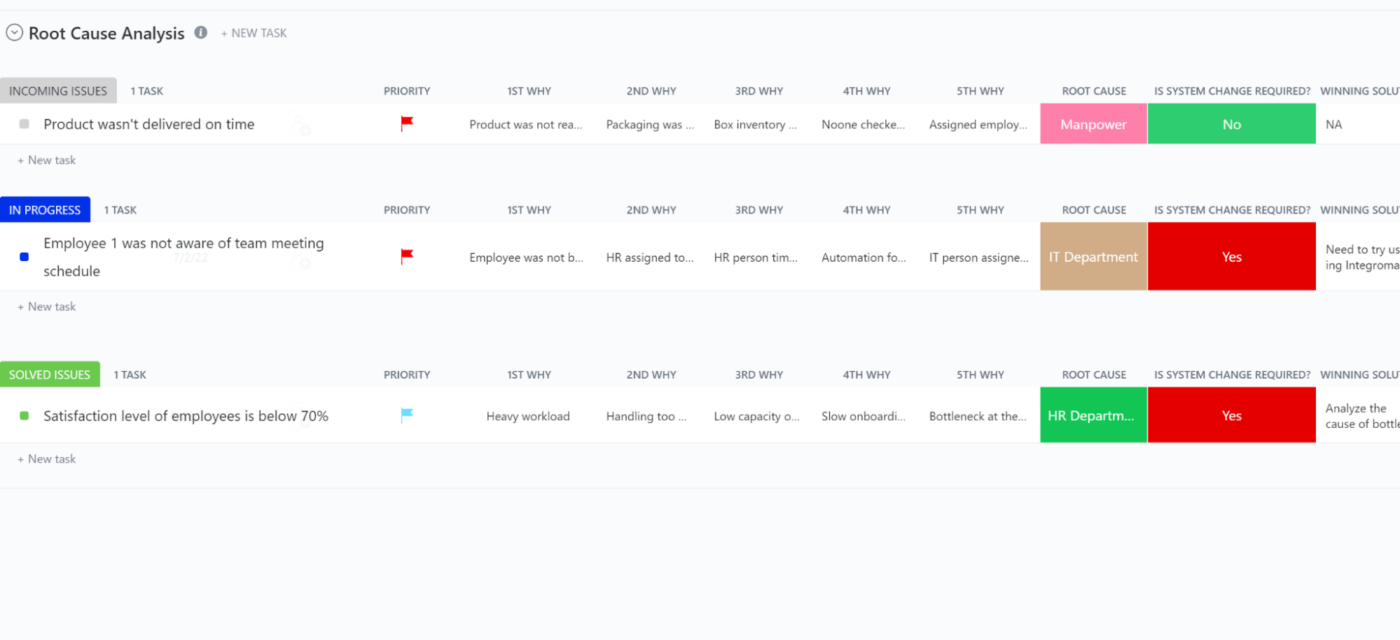
A structured way to identify your business problems is to use the ClickUp Root Cause Analysis Template. Classify everything going wrong with your business into multiple “Why” columns and then add their root causes in the relevant color-coded blocks. Once you analyze the root causes, you can tailor your solution to target and fix them.
After pinpointing the problem, the next step is identifying the stakeholders to whom you’ll pitch your business case. A stakeholder is anyone who has a say in approving your business case. Depending on the scope and complexity of your business case, one or all of the following stakeholders may play a role in its approval:
Discuss your initiative with the stakeholders to see whether they’re interested in it or not. It can also help you understand their perspective on the problem you’re aiming to solve. After all, you don’t want to put your efforts into a full business case only for the stakeholders to reject it. 🙅♂️
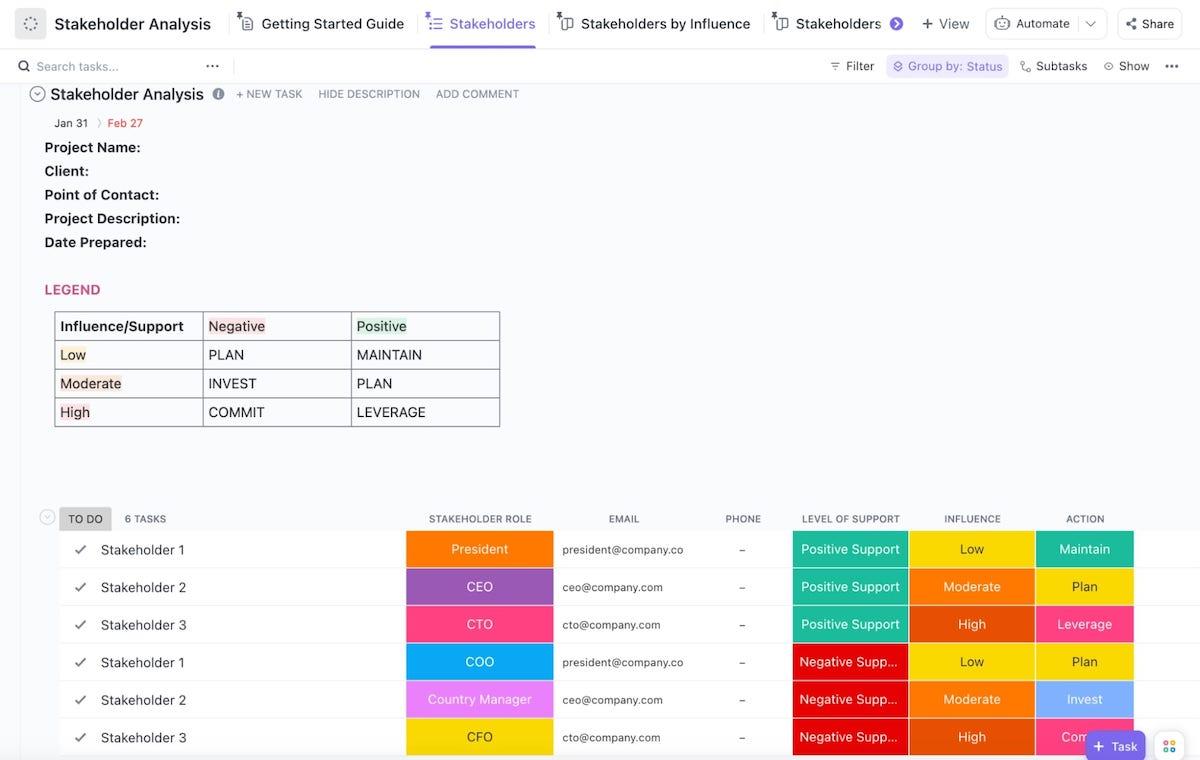
The easiest way to identify key stakeholders is to leverage the ClickUp Stakeholder Analysis Template. This framework can help you gauge the influence and support level of all stakeholders who will play a role in approving your business case. This information can also come in handy when you want to collect feedback from a stakeholder.
Once you’ve identified your problem and the involved stakeholders, it’s time to start drafting your business case.
The first part is the project definition section, which sets the background for presenting your case before stakeholders. It covers the problem your business case proposes to solve and explains why solving the problem is important. The section should cover the following:
The best tool for drafting this part of the document is ClickUp Docs—ClickUp’s built-in text editor and documentation management platform.
With ClickUp Docs’ collaborative editing possibilities, you and your stakeholders can work on the business case document in real time, ensuring its speedy and accurate completion. Stakeholders can also comment on areas for improvement. Finally, you can add a cover image to make your business case look more appealing or use slash commands to quickly add compelling blocks of formatted text.
After setting the background, the next step is the financial appraisal part. This section will be examined carefully during your pitch and serves to capture the stakeholders’ interest in your business case. For maximum accuracy, consult with a colleague from the finance department while drafting this part of the document.
Some of the information you may want to cover here includes:
Besides the financial aspects, this section also deals with risk analysis. Information on all potential risk factors identified through SWOT analysis, Monte Carlo analysis, and other risk identification strategies are outlined along with their respective mitigation strategies. It’ll be best to discuss the project risks with stakeholders identified in the first step—they can often share hidden insights and perspectives.
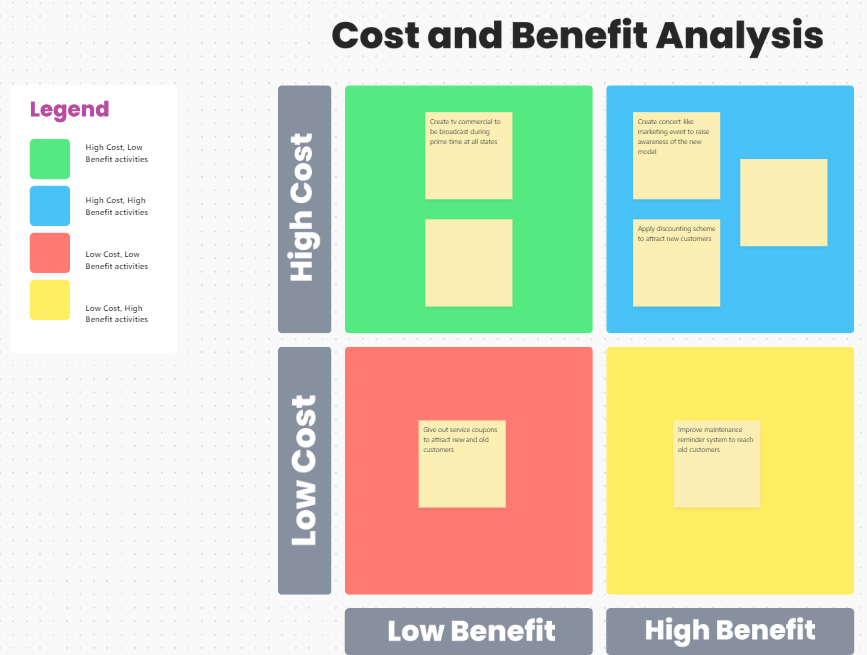
ClickUp provides a number of tools to help you conduct each of these analyses. For instance, you can use the ClickUp Cost Benefit Analysis Template to complete your cost-benefit analysis.
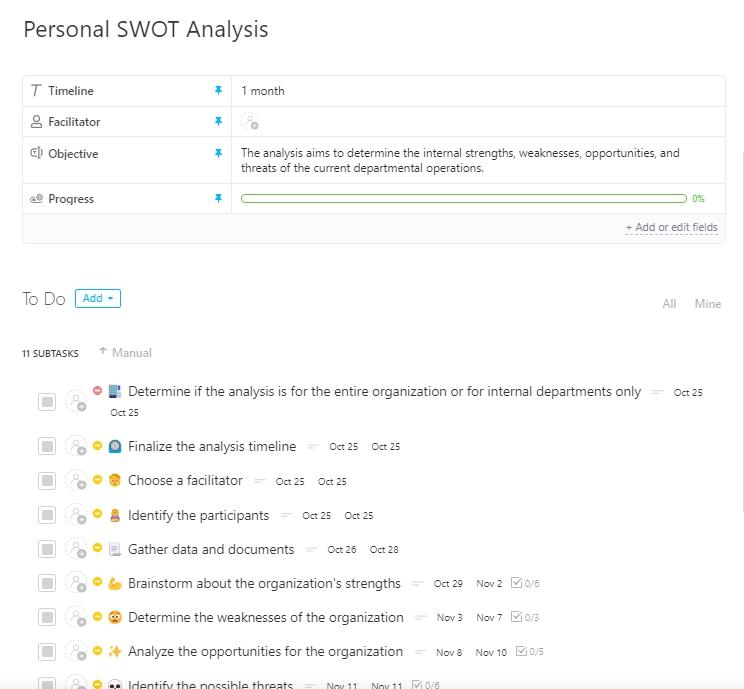
Similarly, the ClickUp SWOT Analysis Template can save you from jotting down rows of data to identify your initiative’s strengths, weaknesses, opportunities, and threats. It is a visually rich template that lets you easily identify high-impact activities and functions.
In this section, you should evaluate the alternatives to your proposed solution in the business case. Highlight the pros and cons of each option so the stakeholders can have a complete overview of every possible solution. Make sure to include your proposed solution in the comparison as well to explain why it’s better than all the alternatives.
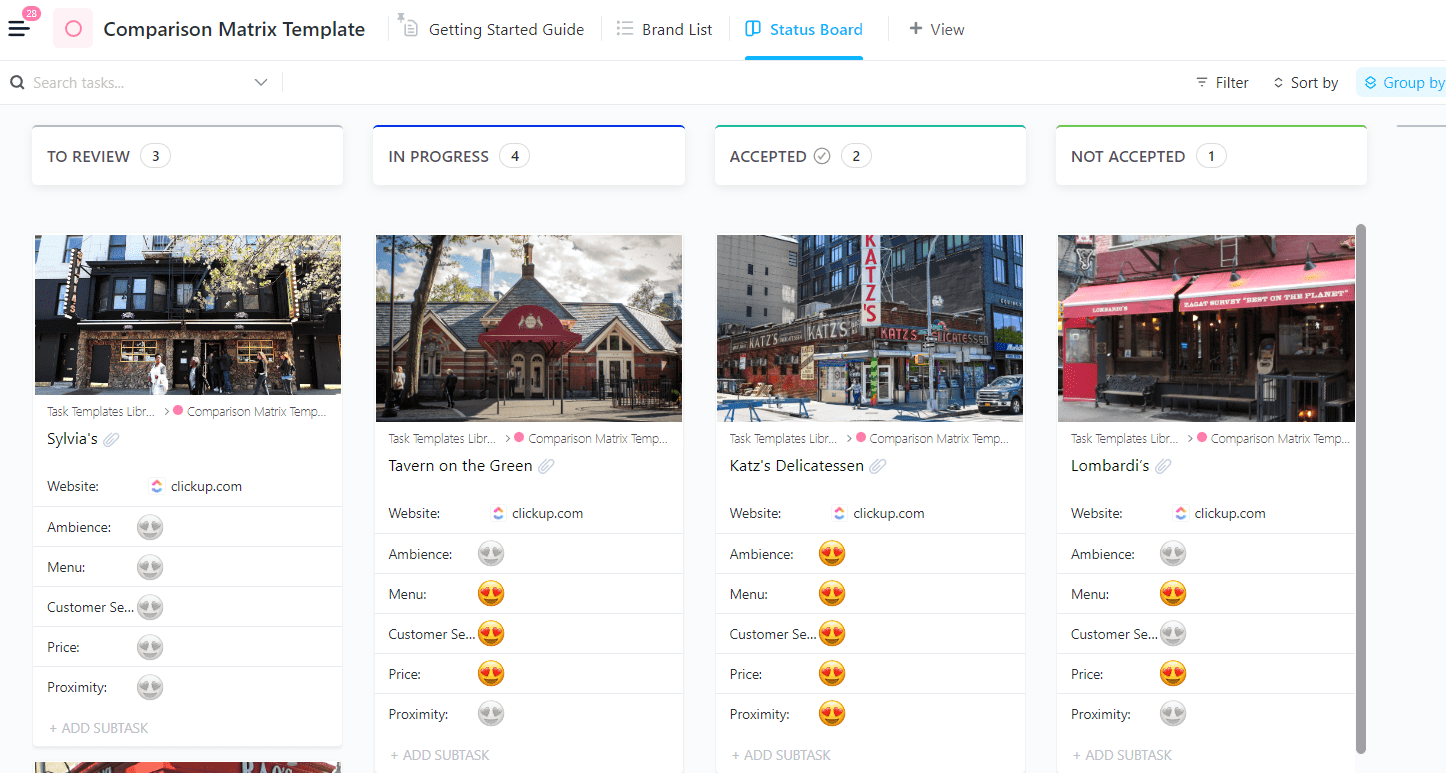
If you need help examining and comparing the alternatives, fall back on the ClickUp Comparison Matrix Template. Use it to record all the information about each possible alternative in different fields and then compare them on a Kanban board. Its visual format makes decision making easier, while its fully customizable fields allow you to record as many comparison parameters as you wish.
After you detail all the financial aspects of your project and compare it to alternatives, define a project scope in your business case. This section sets boundaries for the pending work and limitations on resources needed to complete it. Crucial information covered in it includes:
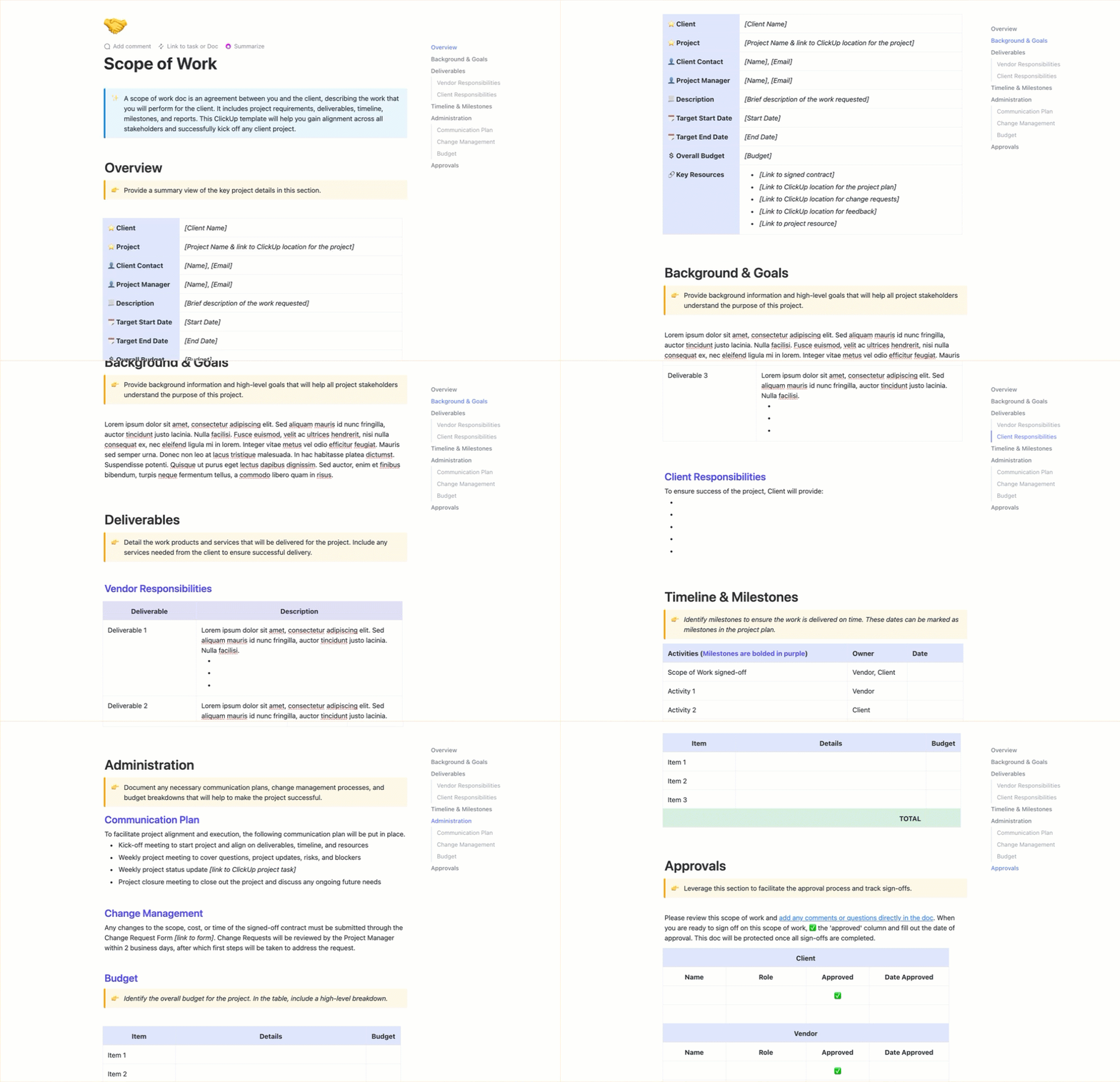
Once you define the project scope, outline the exact steps for implementing it. The easiest way to do this is to use the ClickUp Scope of Work Template. It allows you to record every aspect of the project scope in a well-organized manner to share with your stakeholders and get their opinions.
Once all major sections of your business case have been completed, you need to draft an executive summary to digest the crucial details from each section. This summary should be concise, ideally no longer than two pages. It will appear as the first item in your business case, providing stakeholders with a quick overview of your proposed project.
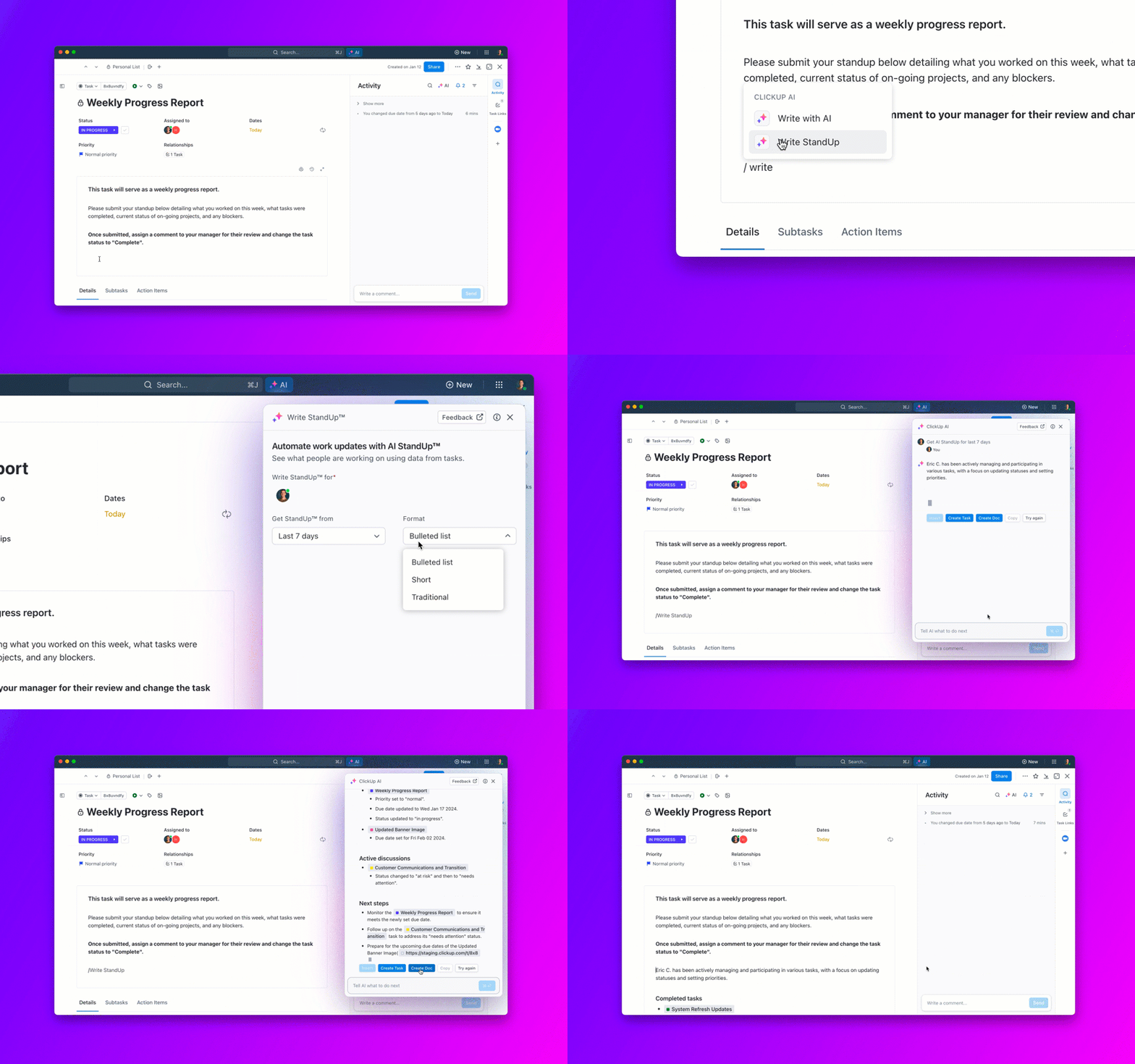
If you need help drafting your executive summary, team up with ClickUp Brain, a neural network and AI writing assistant built into ClickUp Docs. In mere seconds, it can generate a pitch-perfect summary of any business case document prepared until now.
Once you have your executive summary draft, use the ClickUp Executive Summary Template to format and organize it in a structured and presentable manner.
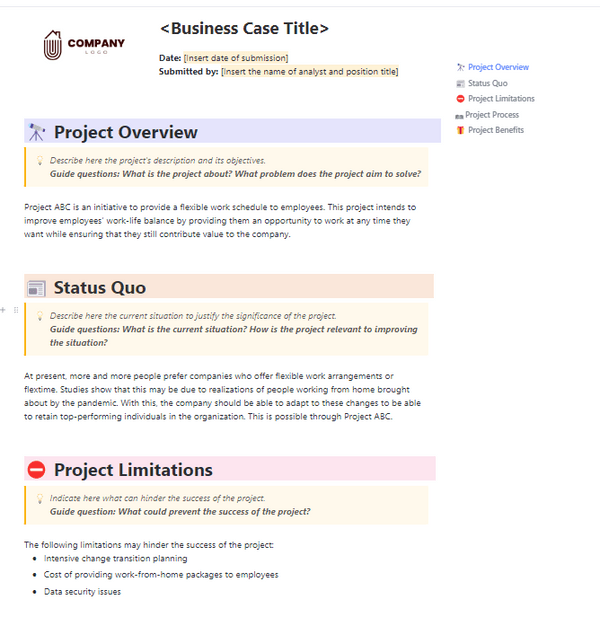
Now, it’s time to put together and structure all the sections drafted to this point to finalize your business case. That’s where the ClickUp Business Case Analysis Template can be a lifesaver.
The template includes dedicated sections to record each part of the business case. All sections are arranged in a structured manner to ensure that when you pitch your case, it makes a lasting impact on your stakeholders.
Now that you know how to write a business case, let’s check out some real-life examples of how business cases allow companies to approve major projects and make strategic decisions:
A lean startup operating in the healthcare space is facing workforce issues, which are preventing it from launching its product on time. The head of the product development team wants to hire three more engineers to speed up the product development process.
However, since it’s a lean startup with budget constraints, the team head needs approval from the startup founders before making the decision. So, the product team compiles a business case for hiring additional employees, and here are the main elements of their proposal:
A venture capital-funded fintech startup decides to launch a new product line of credit cards. It will allow the startup to onboard a slew of new customers but will also require significant financial investment for marketing and lending purposes. So the company prepares a business case for this new product line in an effort to obtain funding for it. Here’s what they detail in their business case:
A SaaS software vendor based out of Silicon Valley wants to reduce customer service spending without compromising service quality. The product manager of one of their leading products comes up with the idea of outsourcing customer service. So, they decide to prepare a business case before proposing the solution to the management. The business case outlines:
A construction company in Virginia is facing raw material supply issues. The cement supplier they work with repeatedly fails to meet the demand, so the project supervisor decides to add some redundancy by onboarding a new vendor.
This change can greatly influence the project, so the supervisor prepares a business case to propose the initiative to the management. The case addresses the following:
There are a number of mistakes project managers make when drafting a business case, which can jeopardize the approval of the entire project or initiative. Now that we’ve covered the complete process of writing a compelling business case, let’s look at the most common pitfalls and explore ways to avoid them.
The details of a business case require extensive research and knowledge of different business functions. No project manager can do it all alone without making mistakes or errors of judgment, so look for help from different departments in your company, whether it’s finance, marketing, or operations. 💁
Another crucial mistake when building a business case is presenting the document to stakeholders out of the blue. When you don’t involve relevant stakeholders at any stage in your business case development process, you increase the risk of it being rejected. That happens because:
To avoid this scenario, involve stakeholders at different stages of your business case drafting process and get your progress reviewed regularly.
The last thing you want when pitching your business case is a typo or a misrepresentation of facts. That can leave a bad impression on the stakeholders listening to your pitch. They may not take you seriously and ultimately reject your project proposal.
To ensure a bulletproof document, you should always review and proofread your entire business case before submitting it. Pay special attention to numbers and facts and double-check that they’re correct. Then, go ahead with your pitch.
A solid business case is the first step to getting project approval from your stakeholders. However, building it requires careful planning and the right tools to streamline the entire process. Fortunately, ClickUp equips you with everything you need at each step of building your business case—from ready-made templates and documentation tools to AI-powered writing assistance.
Sign up for ClickUp today and write a business case that will earn support and trust for your project or initiative.

Sudarshan Somanathan
Max 22min read
Sudarshan Somanathan
Max 25min read

PMO Team
Max 9min read

© 2026 ClickUp