The problem is that “AI” on a pricing page can mean four different jobs. Some tools draft your status updates. Some schedule your week. Some predict which project will slip. A newer group runs agents that take assigned work and act on it. A feature list rarely tells you which one your team needs.
This guide sorts 10 tools by the job their AI actually does, with one honest limit per tool. The short version: the AI is only as good as the project data it can see, so pick the tool where your work already lives.
TL;DR: In project management tools, “AI” usually means one of four jobs. Work out which job you need, then pick a tool where your project data already lives.
Drafts updates and reports: ClickUp Brain², Notion Agent
Schedules work onto the calendar: Motion, Microsoft Planner
Flags risk, overload, and budget overruns: Wrike, Smartsheet, Teamwork.com
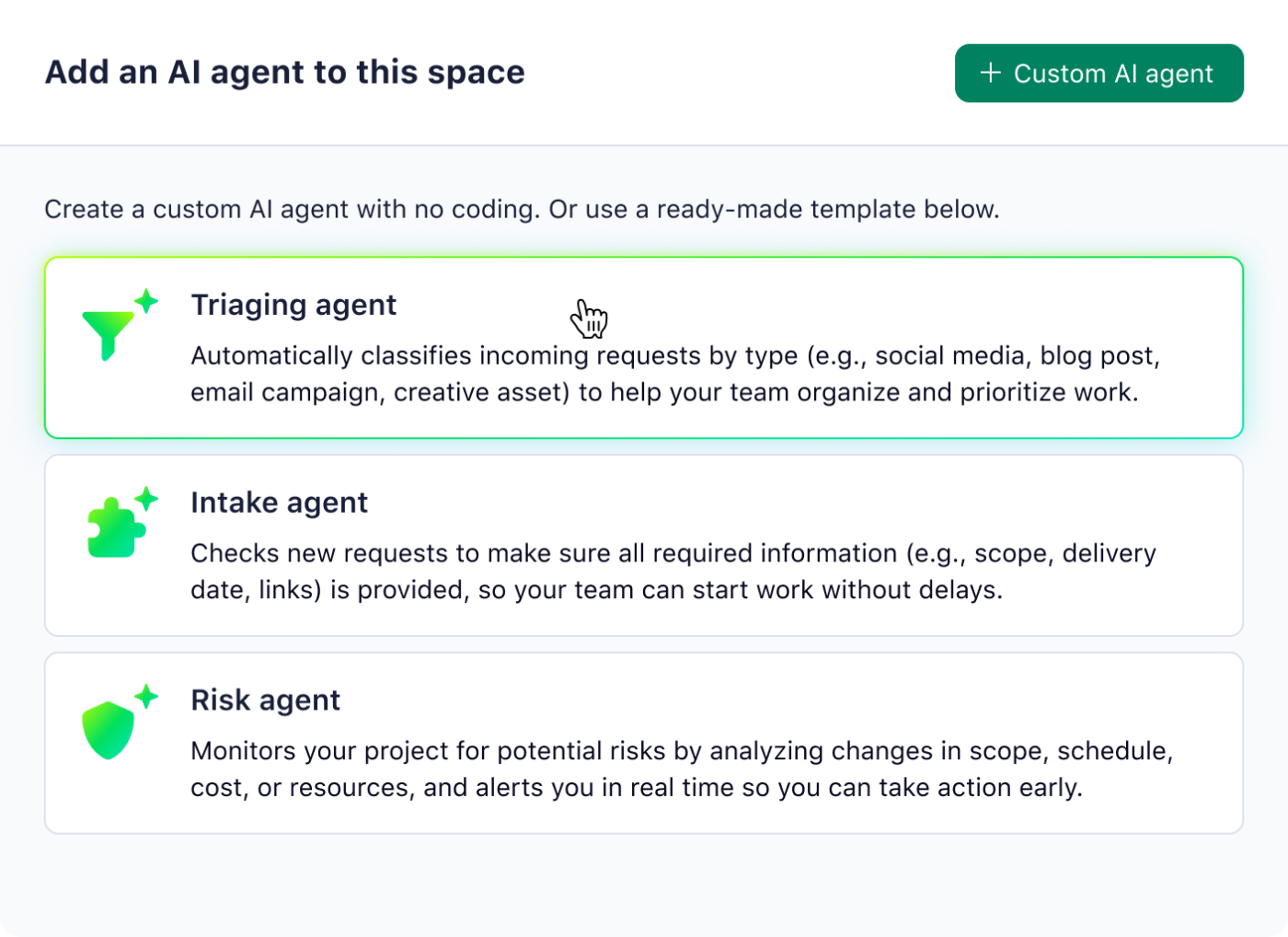
Takes assigned work and acts on it: ClickUp Super Agents, Asana AI Teammates, monday.com agents, Rovo Agents in Jira
Before you buy: Many tools put agents on higher plans or charge per credit or request. Estimate what a busy month costs, not a quiet one.
Summarize this article with AI ClickUp Brain not only saves you precious time by instantly summarizing articles, it also leverages AI to connect your tasks, docs, people, and more, streamlining your workflow like never before.
Summarize this article for me please
Which AI Project Management Tools Are Best at a Glance?
Tool
Best for
What the AI does
Starting price
G2 rating
Where it taps out
ClickUp
AI that works across tasks, docs, and chat in one workspace
Acts and drafts: Super Agents take assigned work; Brain² writes updates from live project data
Free Forever; paid plans available
4.6/5
Setup work for teams coming from single-purpose tools
Asana
Cross-functional teams that want ready-made AI Teammates
Acts: 30+ prebuilt AI Teammates, with Asana Dash sending work to the right one
Personal (free); Starter $13.49/user/month (billed monthly)
4.4/5
Small included allowance of AI requests
monday.com
No-code teams building AI into boards
Acts: AI columns and agents that work inside boards
Free; Basic $12/seat/month (billed monthly)
4.7/5
Agent runs use up credits fast
Wrike
Governed enterprise delivery with AI agents
Predicts and acts: Agents work within role permissions; AI insights show which work is slipping
Free; Team $10/user/month (billed yearly)
4.2/5
Agents need an annual Business plan
Smartsheet
Spreadsheet-native PMOs
Predicts: Writes formulas and analyzes sheet data
Pro $12/member/month (billed monthly)
4.4/5
Weaker on project knowledge kept in docs and chat
Jira
Software teams that want AI inside the issue tracker
Acts: Rovo Search, Chat, and Agents on paid plans
Free; Standard $9.70/user/month (for a 100-member team)
4.3/5
Heavy setup for teams outside engineering
Microsoft Planner
Microsoft 365 organizations already paying for Copilot
Schedules and acts: Project Manager agent builds plans and completes assigned tasks
Free with Microsoft 365; Planner Plan 1 $10/user/month
4.2/5
The agent needs a separate Copilot license
Notion
Docs-first teams that plan inside their wiki
Drafts: Notion Agent works from your pages and connected apps
Free; Plus $12/member/month (billed monthly)
4.6/5
No built-in workload or resource planning
Motion
Auto-scheduling individual workloads onto the calendar
Schedules: Puts tasks into open calendar time and moves them when plans change
Pro AI $29/seat/month (billed monthly)
4.1/5
Jobs that are mostly reacting to requests
Teamwork.com
Agencies tracking AI-assisted profitability
Predicts: AI utilization insights and profitability forecasts based on logged time and budgets
Free; Basics $13.99/user/month (billed monthly)
4.4/5
Built around billable client work
Pricing and features reflect what was available at the time of writing and can change. Always verify current details on each tool’s official website.
Summarize this article with AI ClickUp Brain not only saves you precious time by instantly summarizing articles, it also leverages AI to connect your tasks, docs, people, and more, streamlining your workflow like never before.
Summarize this article for me please
How we review software at ClickUp
Our editorial team follows a transparent, research-backed, and vendor-neutral process, so you can trust that our recommendations are based on real product value.
Summarize this article with AI ClickUp Brain not only saves you precious time by instantly summarizing articles, it also leverages AI to connect your tasks, docs, people, and more, streamlining your workflow like never before.
Summarize this article for me please
What Should You Look for in AI Project Management Software?
Look for AI that reads live project data and acts on it, then check what that AI costs at your usage. The same Capterra survey found the most valued AI benefits are task automation (48%), predictive analysis (37%), and risk management (28%). Use these questions to test any shortlist:
Which job does the AI do? Name it before the demo: drafting, scheduling, predicting, or acting on its own
What data can it see? Check whether it reads tasks only, or also docs, chat, calendars, and connected apps through enterprise search
Can you review what it did? Reject an agent you cannot edit, undo, or audit after it changes a task
How is usage metered? Find the credit, request, or action unit and estimate a busy month, not a quiet one
Which plan unlocks the agent? Many tools show AI on every tier but gate agents to upper plans or add-ons
Does it respect permissions? Confirm the AI only answers from items each person is allowed to open
Summarize this article with AI ClickUp Brain not only saves you precious time by instantly summarizing articles, it also leverages AI to connect your tasks, docs, people, and more, streamlining your workflow like never before.
Summarize this article for me please
Which Kind of AI Does Your Project Actually Need?
Start with the task that takes your team the most time each week. Each type of AI handles a different kind of work:
Draft: Your team spends hours writing status updates, briefs, or meeting recaps. Drafting AI, such as Notion Agent and ClickUp Brain², writes them from the tasks and docs already in your workspace
Schedule: Deadlines slip because work doesn’t fit the calendar. Scheduling AI, such as Motion and Planner’s Project Manager agent, puts tasks into open time slots and moves them when plans change. This is the job of project scheduling software
Predict: You find out about problems too late. Predictive AI in tools like Wrike, Teamwork.com, and Smartsheet flags projects running behind, people with too much work, and budgets about to run over
Act: Routine follow-ups take up your day. Agents such as ClickUp Super Agents, Asana AI Teammates, monday.com agents, and Rovo Agents take an assigned task, like sorting new requests or chasing updates, and complete it
Agents need the most checking before you buy. McKinsey’s State of AI 2025 survey found that 23% of organizations were scaling an agentic AI system, but no more than 10% were scaling agents in any single business function. So few teams have changed how their work runs around agents yet. Our explainer on ambient AI agents covers how always-on agents differ from chat assistants.
Agents also need clean task data. An agent reading tasks with owners, due dates, and linked docs can write a useful update. The same agent reading a board where half the tasks have no assignee writes an update that sounds right but isn’t.
Antonio Nieto-Rodriguez, former chair of the Project Management Institute, described the same effect in a 2025 interview:
In project management, we often assume that more technology means more control. In reality, AI exposes the underlying mess faster.
Antonio Nieto-Rodriguez, Former chair of the Project Management Institute
Summarize this article with AI ClickUp Brain not only saves you precious time by instantly summarizing articles, it also leverages AI to connect your tasks, docs, people, and more, streamlining your workflow like never before.
Summarize this article for me please
What Are the Best AI Project Management Tools?
This shortlist compares 10 tools by the job their AI does, the plan it requires, and the teams it fits. Each entry covers pricing, ratings, and the point where the tool stops fitting.
1. ClickUp (Best for AI that works across tasks, docs, and chat in one workspace)
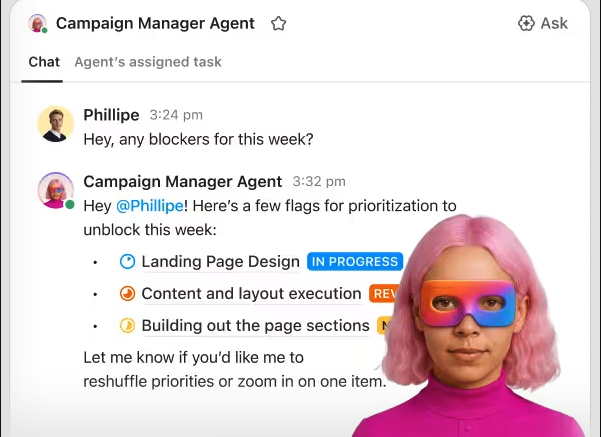
With ClickUp Super Agents, handle entire workflows, not just individual actions, so your projects keep moving even when no one’s watching.
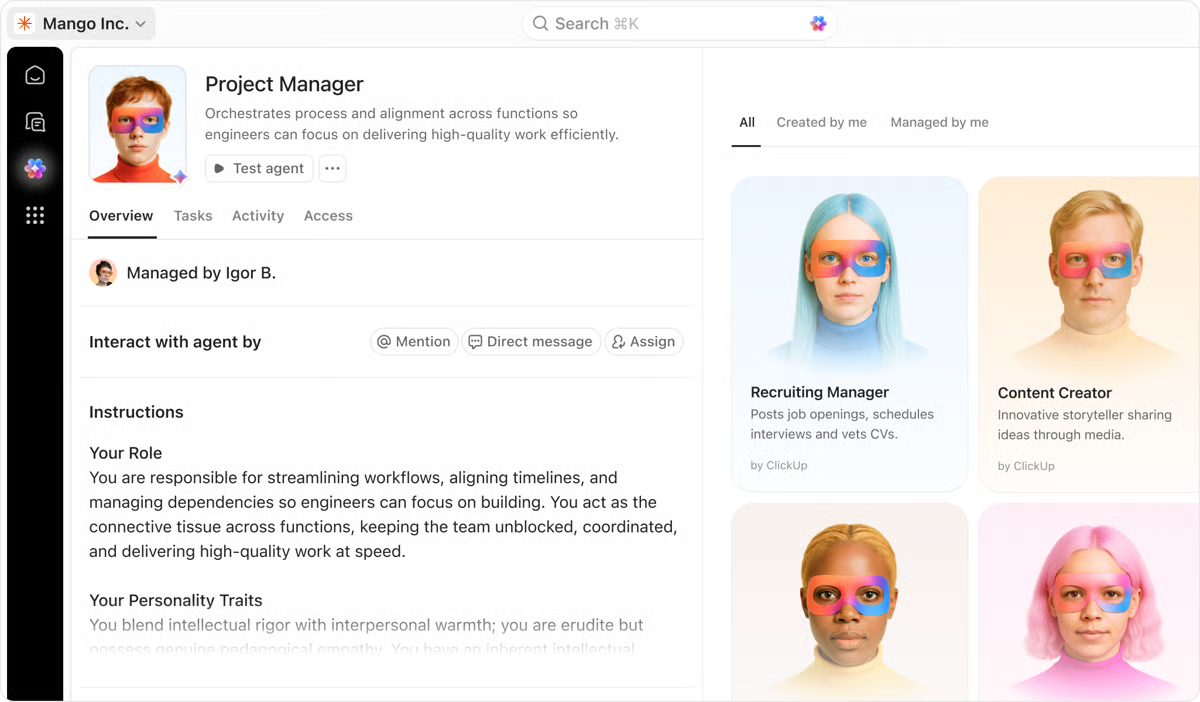
ClickUp’s AI handles the draft, predict, and act jobs inside the workspace where the project already runs. ClickUp Brain² uses the tasks, Docs, Chats, and connected-app data each person has permission to see. It also remembers your role, the people you work with, and your preferences from one conversation to the next. ClickUp Super Agents take assigned work like a teammate. Each agent has its own instructions, Skills, knowledge, tools, and model. An agent runs when someone @mentions it, assigns it a task, or messages it, and it can also run on a schedule or from an Automation.
For example, an agency owner can set up a Super Agent that checks for overdue tasks and tasks due that day every morning. It posts the three priorities before the first meeting. The briefing uses task owners and due dates across Spaces, so it reflects the current state of the work rather than someone’s memory of it.
The same workspace covers the rest of a project’s life. A single prompt can build a delivery plan in a new List with Gantt and Workload views, a scope Doc, and a kickoff deck. While the work runs, AI Fields keep each task’s summary and progress update current. AI Assign and AI Prioritize set owners and priorities from rules you write in plain language. At reporting time, Brain can find tasks stuck in progress, check team capacity, and write the project update or executive summary for a List and time period.
Standout features
MCP in both directions: Brain and Super Agents use tools from connected MCP servers, and external tools can work with your ClickUp data
AI Notetaker: Joins Zoom, Google Meet, and Microsoft Teams calls through your connected Google or Outlook Calendar, and SyncUps
Multi-model Brain²: Max is the default model, and you can switch to models like ChatGPT, Claude, or Gemini without losing Workspace context
Connected Search: Answers questions using files from apps like Google Drive, SharePoint, Jira, GitHub, and Slack, and respects each app’s permissions
Where it taps out: ClickUp’s flexibility means the AI inherits whatever structure you build. Teams coming from a single-purpose to-do app face real setup decisions about Spaces, statuses, and fields before agents produce useful output.
Best for: AI that works across tasks, docs, and chat in one workspace
Skip it if: Your team only needs a shared task list and will never connect docs, chat, or dashboards to it.
Asana’s agents arrive prebuilt: the pricing page lists 30+ AI Teammates, each with a defined skill, and Asana Dash routes work to the right one and surfaces what comes next.
Teams that want agents without designing them from scratch get a running start, because the Teammates already know Asana’s Work Graph of tasks, projects, and goals. Take a marketing operations lead who connects an intake form to a project. A Teammate turns each submission into a task with the right owner and fields.
AI Studio is the second layer. It is a no-code builder for smart workflows that embed AI steps into rules, and Starter includes 50,000 AI Studio credits per billing account per month. The structure fits companies where several departments share one Asana instance and need the same rule to behave the same way across teams.
Standout features
AI Teammates: 30+ ready-to-go agents that pick up assigned work with context from your projects
Asana Dash: Summarizes meetings, emails, and tasks and hands complex work to the right Teammate
AI Studio: No-code builder for AI-powered workflow rules, with credits included on paid plans
Automatic goal progress: Goals update from completed tasks, so AI summaries reflect real status
Pricing
Personal(free)
Starter: $13.49/user/month
Advanced: $30.49/user/month
Enterprise: Custom pricing
AI requests: $0.60 per request
Ratings
G2: 4.4/5 (14,000+ reviews)
Capterra: 4.5/5 (13,600+ reviews)
Where it taps out: AI Teammates and Dash share an included allowance of five requests per user per month, capped at 50 per account on Starter and Advanced. Teams that hand agents real volume move to prepaid packs or on-demand billing quickly.
Best for: Cross-functional teams that want ready-made AI Teammates
Skip it if: You want agents to handle most of the team’s routine work from day one without a separate AI budget line
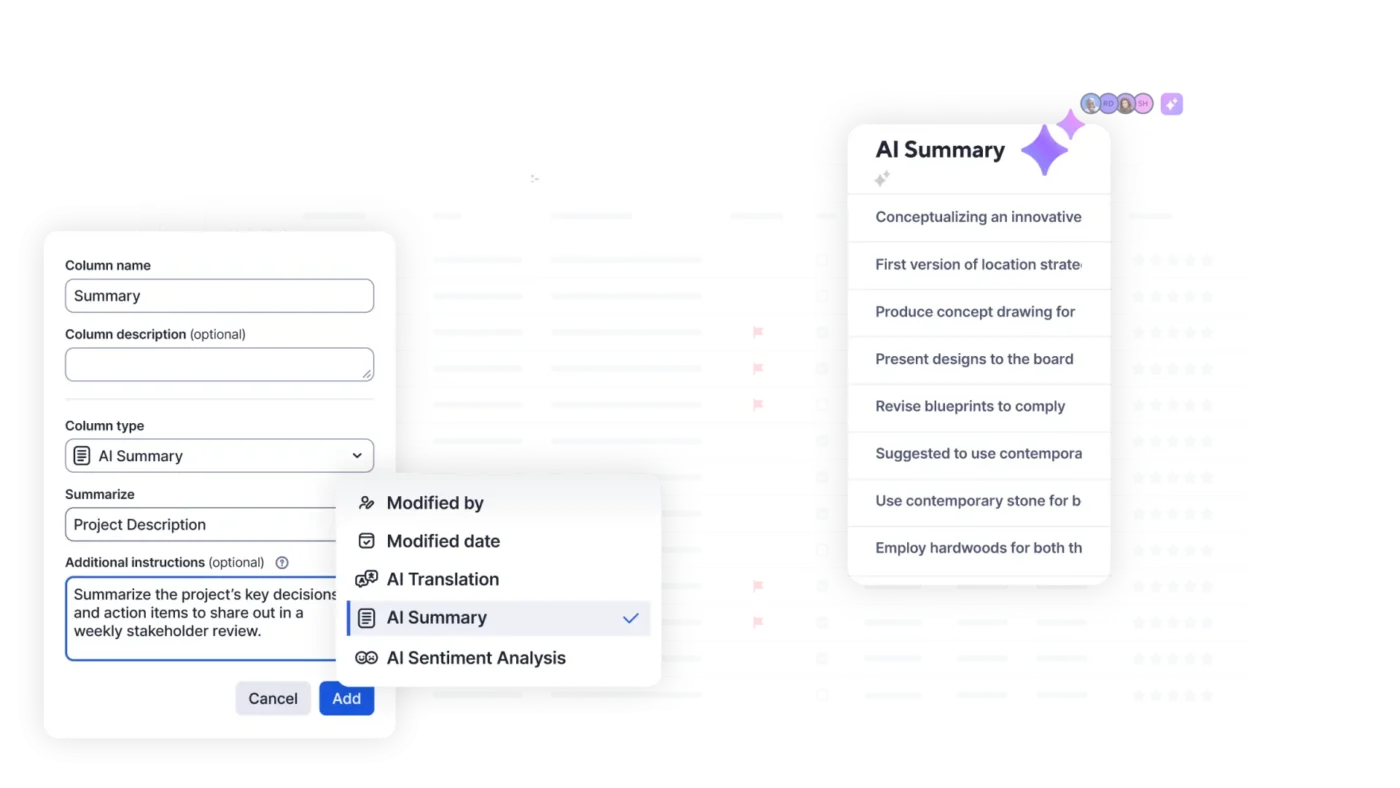
A 10-person operations team gets dozens of requests a day on one board. They add an AI column that reads each new request and tags its priority, the coordinator then sorts the board without opening every item.
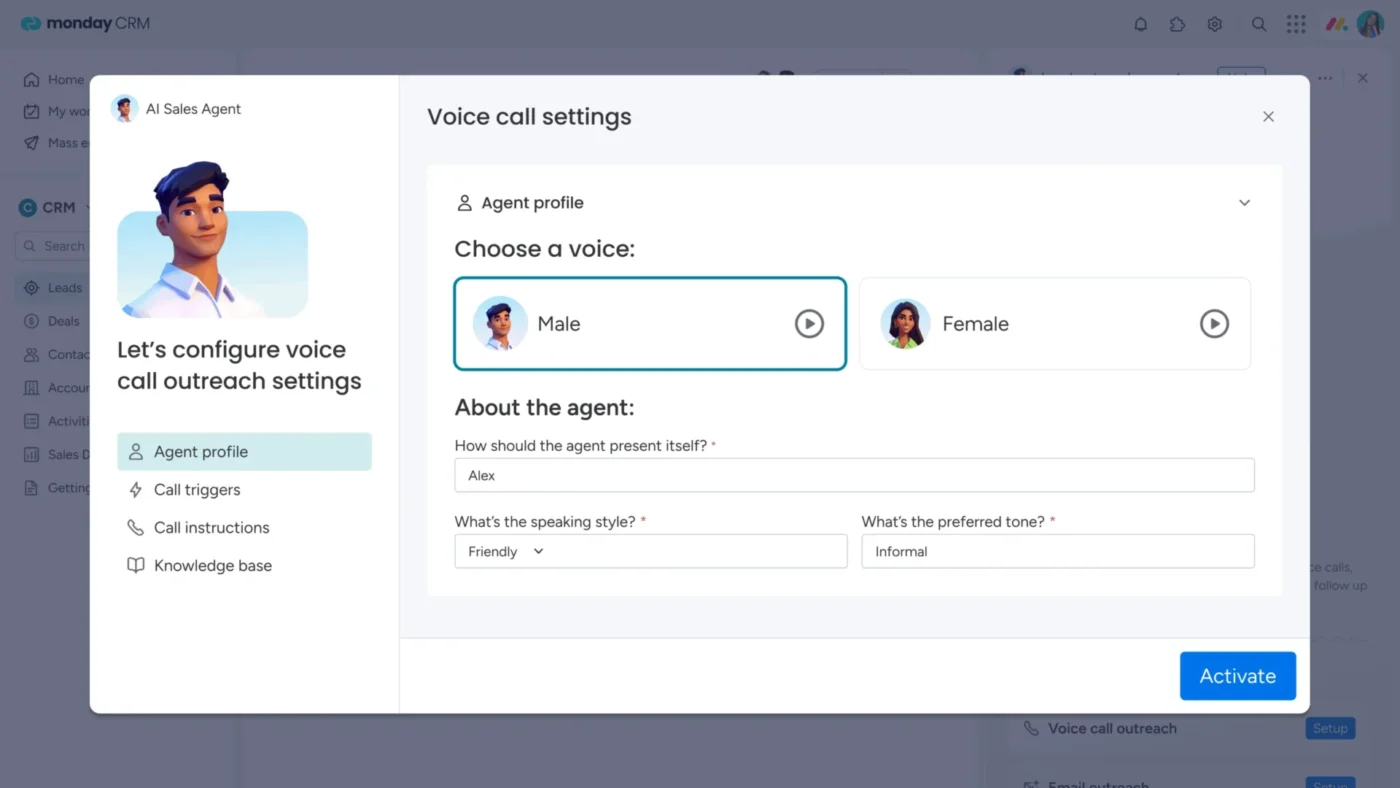
That’s how monday.com handles AI: it sits inside the board columns teams already use. AI columns summarize updates, categorize requests, or pull out details row by row. The AI agent workforce takes on specialized tasks across boards. Sidekick, the built-in assistant, answers questions and runs actions without leaving the board.
Because AI shows up as another column type, teams new to automation can add it without learning a separate tool. The Vibe app builder goes a step further and turns a plain description of a business need into a small custom app. Our monday.com review covers the rest of the platform.
Standout features
AI columns: Run summaries, categorization, and extraction across every row on a board
AI agent workforce: Agents that take on specialized tasks across boards using included credits
AI meeting notetaker: Turns calls into action items on the board
AI workflow builder: Chains agents, triggers, and actions into multi-step flows
Pricing
Free
Basic: $12/seat/month
Standard: $14/seat/month
Pro: $24/seat/month
Enterprise: Custom pricing
Included AI credits: 1,000 per month on Basic, 2,000 on Standard, 3,000 on Pro
Ratings
G2: 4.7/5 (17,200+ reviews)
Capterra: 4.6/5 (6,100+ reviews)
Where it taps out: Credits are consumed by task complexity, so information extraction and agent runs drain the monthly allowance faster than simple column fills. Several recent G2 reviewers say credits ran out quickly once their teams used AI daily.
Best for: No-code teams building AI into boards
Skip it if: Your team plans to run AI on every item across many boards and needs a predictable monthly AI cost.
I’ve built an agent that follows up on my tasks and tells me what’s next to do. My agent is linked to my WhatsApp, so anything I need is just a simple chat away. I can upload work documents, and the AI agent knows exactly which task they belong to and automatically checks the completion box. Also, the initial setup was extremely easy; all I did was tell the AI sidekick what I needed, and it got done in less than 10 minutes.
4. Wrike (Best for governed enterprise delivery with AI agents)
In a PMO running dozens of multi-phase programs, the first question after an agent acts is what it changed and who allowed it. Wrike is built around that question. Wrike says its agents work inside the same roles, permissions, and access controls as people, so their actions show up in the same auditable record as any team member’s.
Before a steering meeting, a program lead can ask Wrike Copilot for a project’s blockers instead of reading through every task. AI insights then show which work is drifting off schedule, so the lead walks in knowing which programs need a decision.
Wrike also runs its own MCP server, so outside assistants like Claude can act in Wrike and still leave a record. That suits enterprises that have standardized on one AI assistant but need to see everything it touched.
Standout features
AI agents: Run inside role-based permissions so actions stay auditable
Wrike Copilot: Answers questions and summarizes work inside projects
MCP Server: Connects outside AI assistants such as Claude directly to Wrike
AI Essentials: Comment summaries, board AI, and plain-language automation rules on Team
Pricing
Free
Team: $10/user/month (billed yearly)
Business: $25/user/month (billed yearly)
Pinnacle: Custom pricing
Apex: Custom pricing
Ratings
G2: 4.2/5 (4,500+ reviews)
Capterra: 4.4/5 (3,000+ reviews)
Where it taps out: Agent capacity lives on Business and above, and Wrike sells Business plans and higher as annual subscriptions only. Smaller teams testing agents for a month or two have no short commitment path.
Best for: Governed enterprise delivery with AI agents
Skip it if: You need to trial agents on a monthly plan before committing for a year.
Smartsheet uses AI to generate formulas and analyze project data in sheets. Every plan includes Smart Assist, Smart Columns, an AI dashboard builder, formula generation, and data analysis. A PMO that already runs projects as linked sheets can ask questions of that data instead of writing formulas by hand. Teams moving from Excel project management keep the mental model they know.
For example, a program manager tracking 40 rows of deliverables asks Smartsheet to write the formula that flags overdue items owned by one vendor, then builds a dashboard from the result.
You can also add connections to external AI tools, including Anthropic’s Claude, Microsoft Copilot, OpenAI’s ChatGPT, and Google Gemini Enterprise. That suits organizations that already standardized on one assistant and want it to read their project sheets. Workload tracking and baselines give the AI planned-versus-actual data to analyze rather than a single snapshot.
Standout features
Generate formulas: Describe the calculation and get a working formula for the sheet
AI dashboard builder: Builds a dashboard from existing sheet data on every plan
Smart Columns: Fill or classify column values with AI across rows
External AI connectors: Claude, Copilot, ChatGPT, and Gemini Enterprise read sheets (Business and up)
Pricing
Pro: $12/member/month
Business: $24/member/month
Enterprise: Custom pricing
Ratings
G2: 4.4/5 (22,700+ reviews)
Capterra: 4.5/5 (3,500+ reviews)
Where it taps out: Smartsheet’s AI is strongest on structured rows and weaker on unstructured project knowledge spread across documents and conversations. Teams whose decisions live in docs and chat get less from it; our Smartsheet vs. ClickUp comparison covers that trade-off.
Best for: Spreadsheet-native PMOs
Skip it if: Most of your project context lives in documents and chat threads, not in rows
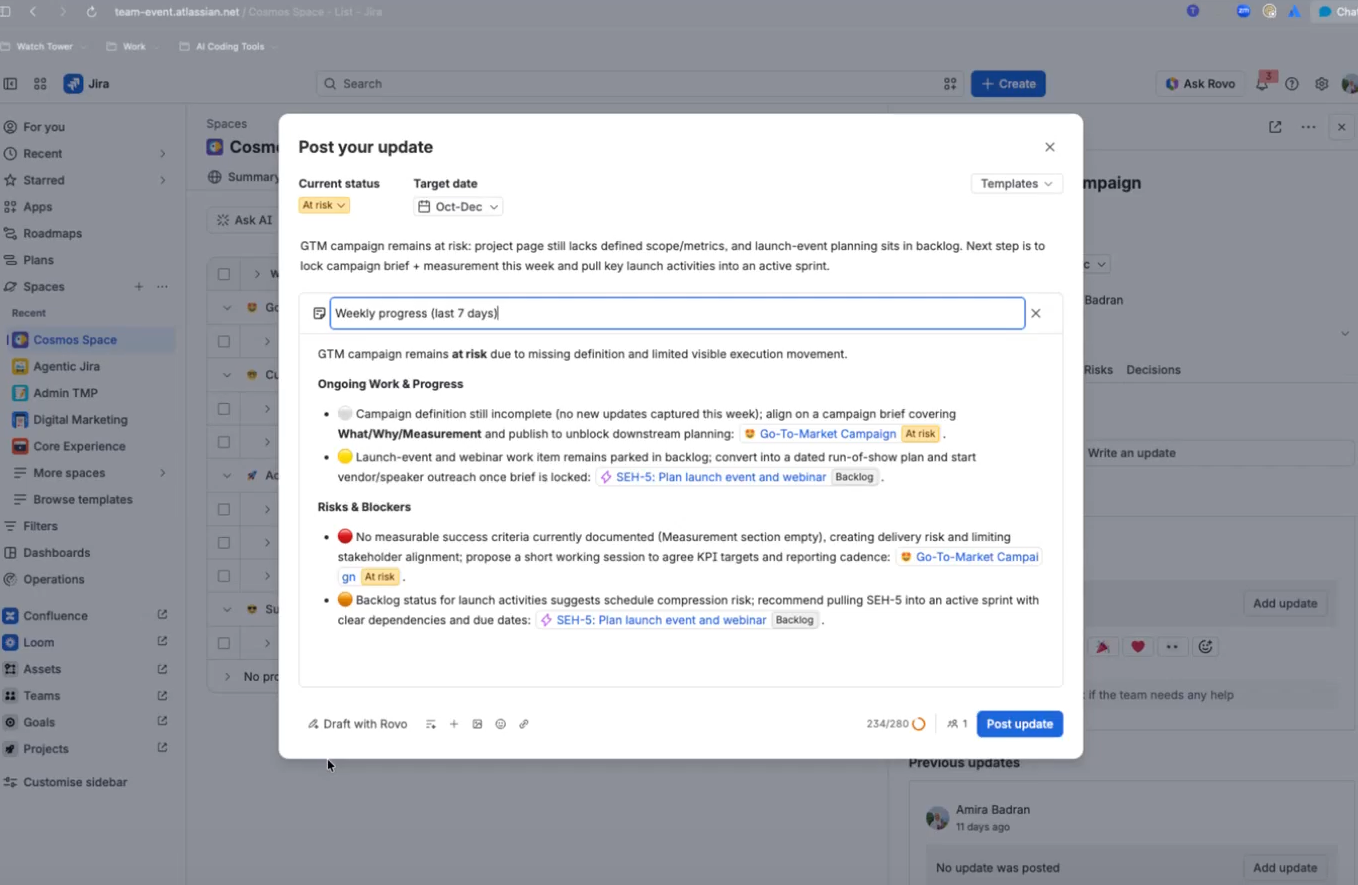
A product designer wants to know which tickets block next week’s release and what the team last decided about a feature. In Jira, that answer used to take a hand-built JQL filter and a search through Confluence. With Rovo, Atlassian’s AI, she asks in plain language and gets an answer drawn from the issues and pages the team already maintains.
Rovo works from Atlassian’s Teamwork Graph, which links Jira, Confluence, and connected apps. That means one answer can pull from a ticket and the spec page behind it. Because Rovo reads the same issues, sprints, and pages developers already keep current, nobody has to copy status into another tool for the AI to see it.
That makes Jira with Rovo a good fit for engineering teams whose project record already lives in the issue tracker. Teams comparing Jira with newer trackers can see our Linear vs. Jira breakdown, and our guide to creating a Gantt chart in Jira covers its timeline view.
Standout features
Rovo Search: Finds issues and pages across Jira, Confluence, and connected apps in plain language
Rovo Chat: Answers questions about project status using the Teamwork Graph
Rovo Agents: Agents that act within Jira on paid plans, metered by included credits
AI in automation: Describe a rule and generate the automation instead of configuring each step
Pricing
Free
Standard: $9.70/user/month (for a 100-member team)
Premium: $19.60/user/month (for a 100-member team)
Enterprise: Custom pricing
Ratings
G2: 4.3/5 (7,900+ reviews)
Capterra: 4.4/5 (15,500+ reviews)
Where it taps out: Jira’s schemes, fields, and workflows reward technical teams and slow down non-engineering teams. Marketing or operations teams sharing the instance often find the configuration heavier than their work requires.
Best for: Software teams that want AI inside the issue tracker
Skip it if: Most of the people on the project work outside engineering.
Jira SaaS feels innovative, especially in the way Rovo is tightly coupled with Jira. It makes it easier to find and understand project information using natural language processing.
7. Microsoft Planner (Best for Microsoft 365 organizations already paying for Copilot)
Planner’s AI is the Project Manager agent, which automates plan creation and task execution. You assign a task to the agent the way you would to a colleague. Microsoft’s documentation describes the agent chat (previously “Copilot in Planner”) as a natural-language way to update plans and get summaries.
An operations lead in a Microsoft 365 company can create a plan with the Project Manager agent, ask it to generate tasks for each goal, then assign research tasks to the agent while the team works the rest in Microsoft Teams. Users without a Copilot license can still collaborate on the plan but cannot assign tasks to the agent.
The appeal is reach: Planner is already inside Teams, Outlook, and SharePoint, and Planner and Project Plan 3 brings advanced dependencies and resource requests. Our guide to the Microsoft Planner Gantt chart covers the premium planning views.
Agent chat: Natural-language updates and summaries from plan content
Microsoft 365 reach: Plans live inside Teams, Outlook, and SharePoint where staff already work
Premium plans: Timeline, dependencies, and sprints from Planner Plan 1
Pricing
Free (Planner in Microsoft 365)
Planner Plan 1: $10/user/month
Planner and Project Plan 3: $30/user/month
Planner and Project Plan 5: $55/user/month
Ratings
G2: 4.2/5 (200+ reviews)
Capterra: 4.3/5 (200+ reviews)
Where it taps out: The agent requires a Microsoft 365 Copilot license on top of the Planner license, and premium features need Planner Plan 1 or higher. Teams end up managing a licensing stack before the AI does anything.
Best for: Microsoft 365 organizations already paying for Copilot
Skip it if: Your organization does not already license Microsoft 365 Copilot.
What real-life users are saying about Microsoft Planner
What i like most about Microsoft Planner is the simplicity of organizing tasks. I like the ability to be able to create tasks, set due dates, and see your progress.
8. Notion (Best for docs-first teams that plan inside their wiki)
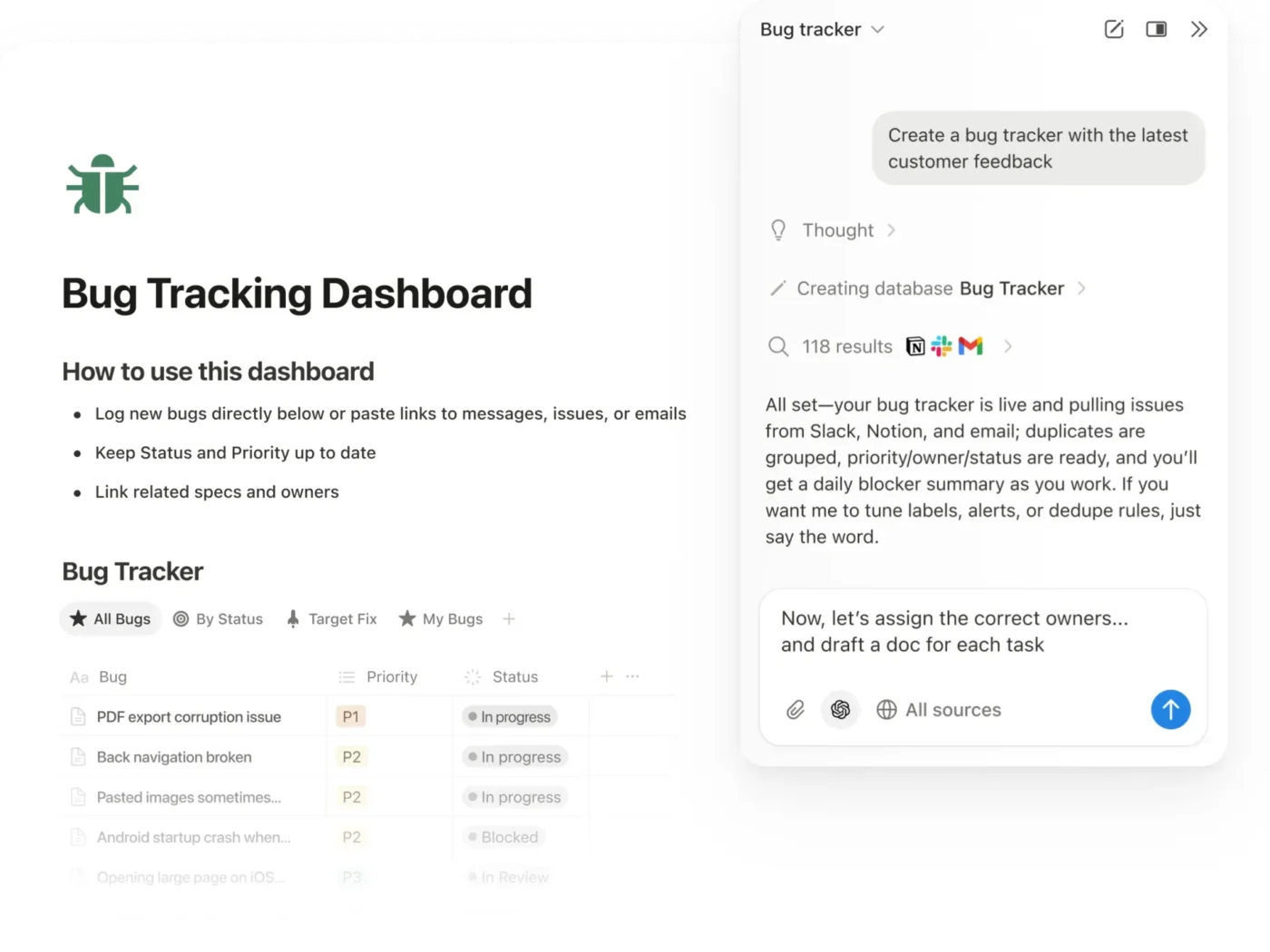
For docs-first teams, the project plan is a page. The brief, the decisions, and the task database all sit in the same wiki. Notion’s AI works from there. Notion Agent completes multi-step tasks using context from those pages, connected apps, and the web, so it drafts against the actual plan instead of a blank prompt.
A consultant can keep each client’s project in a Notion database with subtasks and dependencies. After a meeting, she asks the Agent to pull the key points from Slack and draft a report for the client. AI Meeting Notes captures the call itself without a bot joining, so the notes land next to the project they belong to.
Custom Agents take on repetitive work, like triaging requests or updating a database.
Standout features
Notion Agent: Completes multi-step tasks with context from pages, connected apps, and the web
AI Meeting Notes: Transcribes and summarizes meetings without a bot
Custom Agents: Autonomous agents for repetitive tasks, billed on Notion credits
Enterprise Search (beta): Answers questions across Slack, Microsoft Teams, GitHub, and more
Pricing
Free
Plus: $12/member/month
Business: $24/member/month
Enterprise: Custom pricing
Notion credits: $10 per 1,000 credits
Ratings
G2: 4.6/5 (12,500+ reviews)
Capterra: 4.7/5 (2,800+ reviews)
Where it taps out: Notion has no native workload or resource planning, so capacity questions such as who is overloaded next sprint need a separate tool or a hand-built database.
Best for: Docs-first teams that plan inside their wiki
Skip it if: You need to balance team capacity across several projects at once.
After meetings, instead of going through various notes, I can just tell it to check my Slack, extract the key points, and draft a detailed report. This saves me from doing it manually and helps me a lot.
Pro Tip: For teams weighing Notion as their main PM layer, our guides on Notion project management and how to use Notion AI show where the database model stretches and where it stops
9. Motion (Best for auto-scheduling individual workloads onto the calendar)
Motion does the scheduling job well. Its AI places tasks into open calendar slots based on deadlines and priority, then recalculates the plan when a meeting lands or a task slips, syncing with Google Calendar and Outlook. AI Chat answers questions such as which tasks are overdue across tasks, docs, and meeting notes.
The tool can build the day around existing meetings, protecting the time each task needs before its due date. When a task is not finished, Motion moves it forward instead of letting it disappear.
Motion has grown into AI Employees with specific skills, such as writing or client responses. Business AI adds team capacity planning, Gantt timelines, time tracking, and advanced dashboards, which moves Motion from a personal planner toward a small-team tool. If you are deciding between Motion and a plain calendar, our Motion vs. Google Calendar comparison helps.
Standout features
AI Task Planner: Schedules tasks into open time and reshuffles them when plans change
AI Chat: Answers questions across tasks, AI Docs, and notetaker summaries
AI Employees: Agents with set skills, such as writing or client responses
Team Capacity Planning: Shows team availability on Business AI
Pricing
Pro AI: $29/seat/month
Business AI: $49/seat/month
Ratings
G2: 4.1/5 (100+ reviews)
Capterra: 4.3/5 (80+ reviews)
Where it taps out: Motion assumes work fits into time blocks. Interrupt-driven roles, where most of the day is reacting to requests, see the schedule rebuilt so often that the plan stops being useful.
Best for: Auto-scheduling individual workloads onto the calendar
Skip it if: Most of your day is unplanned requests rather than tasks you can estimate.
Teamwork.com aims its AI at the numbers agencies live by: utilization, budgets, and margin. Its AI teammates include Scout, a personal assistant, and Flo, which automates project tracking and health, on every paid plan. Higher plans add AI utilization insights and profitability forecasting tied to logged time and budgets.
An agency operations lead can use the AI project wizard to spin up a project from a client brief, then check AI utilization insights to see who is over capacity before accepting a new retainer. Because time, budgets, and billing live in the same tool, the AI reads the financial picture rather than only the task board.
TeamworkAI is included in paid plans for an introductory period, with usage-based AI credits announced. Several agents, including Remi for resourcing and Kash for profitability, are marked “coming soon” on the pricing page.
Standout features
AI project wizard: Spins up full projects from a brief
Flo: AI project assistant that automates project tracking and health
AI utilization insights: Shows capacity and utilization patterns
AI profitability forecasting: Projects margin from time and budgets
Pricing
Free
Basics: $13.99/user/month
Accelerate: $29.99/user/month
Optimize: Custom pricing
Enterprise: Custom pricing
Ratings
G2: 4.4/5 (1,200+ reviews)
Capterra: 4.5/5 (900+ reviews)
Where it taps out: Teamwork.com’s data model centers on clients, billable hours, and budgets. Internal product or operations teams pay for financial structure they will not use, and the AI is tuned to those agency signals.
Best for: Agencies tracking AI-assisted profitability
Skip it if: Your team does not bill clients for its time.
What real-life users are saying about Teamwork.com
Summarize this article with AI ClickUp Brain not only saves you precious time by instantly summarizing articles, it also leverages AI to connect your tasks, docs, people, and more, streamlining your workflow like never before.
Summarize this article for me please
How Do You Choose the Right AI Project Management Tool?
Choose by the job you need the AI to do most, then by where your project data already lives. A tool’s AI cannot reason about work it cannot see, so the second question usually settles ties.
You want agents acting across tasks, docs, and chat: ClickUp
You want prebuilt agents for a cross-functional team: Asana
Your team builds its own workflows in boards without code: monday.com
You need governed, auditable AI across a large portfolio: Wrike
Your PMO runs on spreadsheets and formulas: Smartsheet
Your project is software delivery in an issue tracker: Jira with Rovo
You already license Microsoft 365 Copilot: Microsoft Planner
Your plans live in docs and a wiki: Notion
Your problem is fitting tasks into your calendar: Motion
You run an agency and care about margin: Teamwork.com
Before switching, run one real project through the trial instead of a demo board. Capterra’s research suggests checking whether the AI explains its suggestions, stays stable when owners change, and lets you review or reject actions.
Summarize this article with AI ClickUp Brain not only saves you precious time by instantly summarizing articles, it also leverages AI to connect your tasks, docs, people, and more, streamlining your workflow like never before.
Summarize this article for me please
Which AI Project Management Tool Should You Choose?
Whichever tool you pick, start small. Give the AI one recurring job, such as the weekly status update for one team. Once that output holds up for a few weeks without corrections, hand it the next job. Rolling out one workflow at a time shows you where the AI saves time before the whole team depends on it.
If you want agents, an assistant, and reports working from the same tasks, docs, and chat, ClickUp keeps all three in one workspace. Super Agents handle the follow-ups, Brain² drafts the updates, and Artifacts turn project data into decks and dashboards for stakeholders.
Summarize this article with AI ClickUp Brain not only saves you precious time by instantly summarizing articles, it also leverages AI to connect your tasks, docs, people, and more, streamlining your workflow like never before.
Summarize this article for me please
Frequently Asked Questions about AI Project Management Tools
Can you use AI for project management?
Yes. AI handles status summaries, task creation from briefs, scheduling, risk flags, and, with agents, routine follow-ups. It works best when tasks have owners, due dates, and linked documents, because the AI reads that structure to decide what to do.
Which AI tool is best for project managers?
The best AI tool for project managers is the one that matches their main job. ClickUp suits managers who want agents across tasks and docs, Motion suits calendar-heavy work, Wrike suits governed portfolios, and Jira with Rovo suits software delivery.
Will AI take over project management?
AI is absorbing the administrative work of project management, such as drafting reports and moving tasks. Stakeholder alignment, trade-offs, and judgment stay with people. Antonio Nieto-Rodriguez, former chair of PMI, argues the profession must adapt quickly as that administrative work disappears.
Can AI replace PMP-certified project managers?
No. A PMP credential covers judgment calls on scope, risk, and stakeholders that AI tools do not make on their own. What changes is the job mix, as agents absorb reporting and scheduling and certified PMs spend more time on decisions.
What challenges come with AI project management?
The main challenges are data quality, metered costs, and review. AI reading incomplete tasks produces confident but wrong output, credit-based pricing makes costs hard to predict, and agents need a clear way to audit and undo their actions.
What is the best AI agent for project management?
For most teams, the best AI agent for project management is one that runs inside the workspace where tasks already live. ClickUp Super Agents, Asana AI Teammates, monday.com agents, Rovo Agents in Jira, and the Planner Project Manager agent all take assigned work.
Are there free AI tools for project management?
Yes, with limits. ClickUp, Asana, monday.com, Wrike, Jira, Notion, and Teamwork.com all offer free plans, but most include only trial or basic AI. Agents and higher AI usage generally require a paid plan or add-on credits.
Everything you need to stay organized and get work done.