
Sorry, there were no results found for “”
Sorry, there were no results found for “”
Sorry, there were no results found for “”
The single biggest reason why people look for Zoom alternatives? That ever-so annoying 40-minute meeting cutoff in the free tier.
I should know because I’ve been in that awkward position more than once. Just to be clear, a new meeting tool will not solve the 40-minute problem.
Here’s the pricing breakdown: Google Meet’s free tier stops group calls at 60 minutes. Microsoft Teams free stops at 60 minutes. Whereby stops at 30 minutes with four people in the room. Webex stops at 40, matching Zoom exactly. The math keeps moving with a 10-minute margin.
But the important, underrated bit is this: Every free video tool charges you in a currency it doesn’t list on the pricing page.
What Zoom charges in minutes, Whereby charges by number of participants. Meet charges you in features (no recording until the $14 tier). And every single one of them charges in context: the decisions made during the call that evaporate the moment it ends.
So I tested seven alternatives against the constraint that actually matters for my work: time of course, plus what happens to my meeting notes, action items, follow-up tasks, after the meeting.
TL;DR: A 50-minute client review can fit inside Google Meet’s free group-call limit but exceed Zoom Basic’s. A 90-minute workshop needs a different plan. That difference matters more than which tool tops a generic ranking. Compare the calls your team actually runs: who joins, how long they last, what needs recording, and where decisions go afterward. Meet and Teams fit existing office subscriptions; Whereby focuses on guest access; Webex needs a closer look at security settings. Zoho adds another price comparison, while Jitsi gives technical teams control over hosting. ClickUp connects internal calls with project work. Start with those needs, then compare the full cost of switching.
| Tool | Best for | Standout feature | Starting price | G2 rating | Where it taps out |
| Google Meet | Teams already on Google Workspace | Zero-download browser joining with Calendar-native scheduling | Free; $7/user/mo | 4.6/5 (2,900+ reviews) | Recording locked behind $14 Standard tier; no native desktop app |
| Microsoft Teams | Organizations already on Microsoft 365 | 300 participants on every paid tier, even the $4 plan | Free; $4/user/mo | 4.4/5 (17,700+ reviews) | External guest experience is the weakest in the category |
| ClickUp | Teams whose real problem is meeting follow-through | AI Notetaker turns call decisions into assigned tasks inside the workspace | Free Forever; Custom pricing for enterprises | 4.7/5 (14,200+ reviews) | Built for internal working sessions, not webinars or large external events |
| Webex | Regulated industries that can’t compromise on encryption | End-to-end encryption on every tier including free | Free; $12/user/mo | 4.2/5 (18,900+ reviews) | Dated UI; integration catalog a fraction of Zoom’s |
| Whereby | Client-facing calls where guest friction costs you deals | Persistent room URLs with zero-download, zero-account guest joining | Free; $10.99/host/mo | 4.6/5 (1,100+ reviews) | Business tier requires a 3-host minimum ($42/mo real floor) |
| Zoho Meeting | Budget-constrained teams, especially Zoho customers | Full meetings from $6/host/mo with CRM integration | Free; $1/host/mo | 4.5/5 (1,100+ reviews) | Functional, not polished; integrations thin outside Zoho ecosystem |
| Jitsi Meet | Privacy-first teams that can self-host | Fully open source, no license fee, no data leaves your network | Free (self-hosted) | 4.3/5 (176 reviews) | Video quality degrades past ~35 participants; no AI features |
Our editorial team follows a transparent, research-backed, and vendor-neutral process, so you can trust that our recommendations are based on real product value.
Here’s a detailed rundown of how we review software at ClickUp.
After testing all seven tools against my workflows, these are the six questions that actually predicted whether a switch would work or not. We applied the same bar in our review of Kumospace alternatives.
That test is stricter than it sounds, and it disqualifies several tools that show up on competing lists.
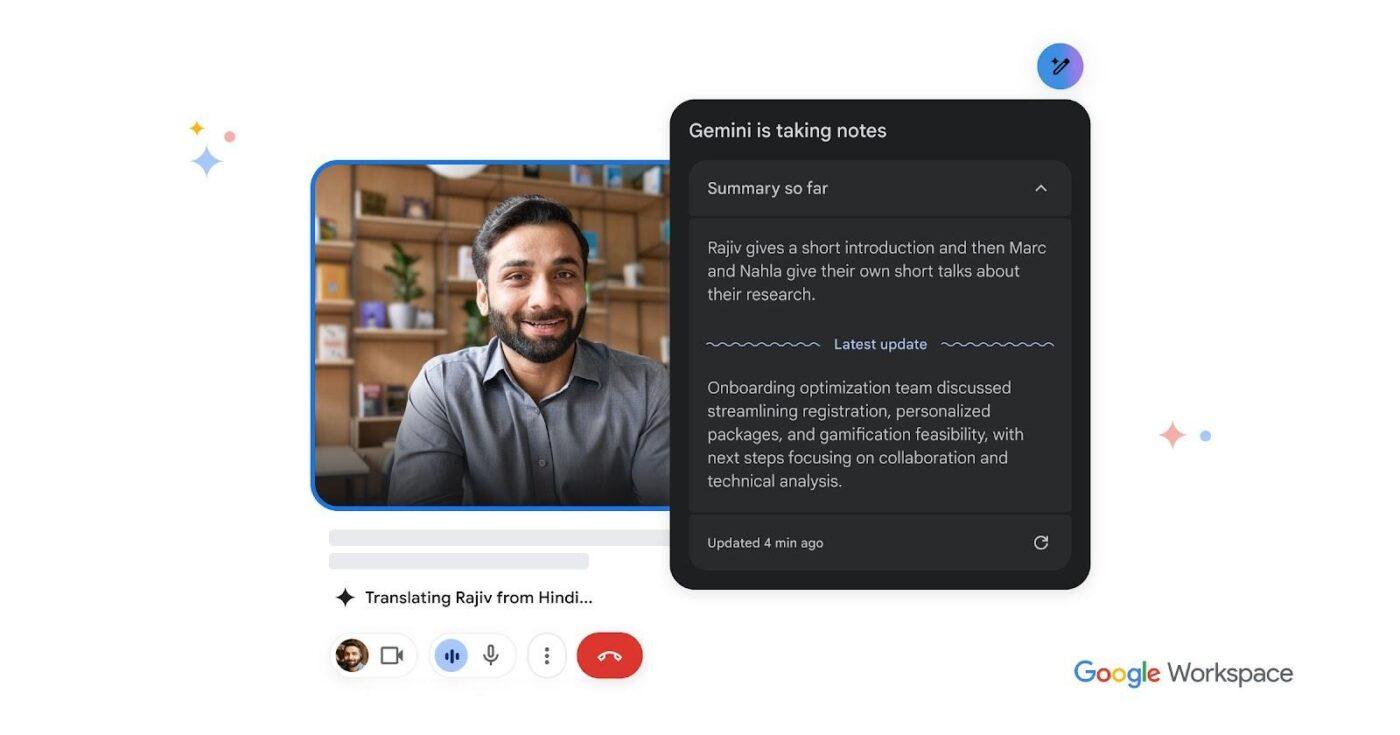
Google Meet is the default answer for any team whose email already ends in a Google-hosted domain. I often use it to communicate with freelancers, and the transition is frictionless since I have a Google Workspace account.
When I send a Meet link to a freelance writer or a guest contributor, they can simply join the meeting with a couple of clicks. And that low barrier to entry is the real product. For external-facing teams, that matters more than any feature table.
One thing worth understanding, Google Meet is priced as a feature of Google Workspace, and the meeting capabilities you get are a side effect of whichever Workspace tier finance already bought. Business Starter at $7/user/month gives you meetings but no recording. Recording arrives at Business Standard, $14/user/month. That Starter-to-Standard gap is the detail most comparisons skip, and it’s the one that bites. A team that upgrades from free Meet specifically to escape the 60-minute limit will discover it still can’t record a call.
The browser-only architecture also means I’ve dealt with screen-sharing freezes, high CPU spikes, and at least one full browser crash during a presentation. Google’s own support page tells you to close your other tabs, which is their way of saying the product competes with the rest of your computer for resources.
What happens after the meeting: Gemini can generate a summary and action items on Workspace Plus and higher, but they land in a Google Doc, not in your project management tool. If your workflow runs in ClickUp, Asana, or Jira, someone still has to copy those items over manually. Meet solves the call, but handoff is for you to deal with.
Where it taps out: The tile view caps at 16 participants (Zoom shows 49), which matters for all-hands. No native desktop app means performance depends entirely on your browser, and Google Meet had major outages in September and December 2025 that left users stranded mid-call. The free tier’s 60-minute cap is still a cap, and recording doesn’t unlock until the $14 Standard tier, not the $7 Starter most people see first.
Best for: Organizations with an existing Google Workspace contract, especially teams under 300 seats who need the simplest possible join experience for external guests.
Skip it if: You’re not on Workspace. Buying Workspace to get Meet means paying for Gmail, Drive, and Docs you may not need, and a standalone meeting tool will be cheaper.
A user review says:
Google Workspace works well for keeping technical discussions, documentation and project-related information closely tied to the development process. I am able to use Docs for writing technical notes, Sheets for managing and calculating data/metrics, Drive for storing and exchanging project information and Meet/Chat for in-time discussions regarding issues that arise during development. This eliminates the necessity of having different tools for communication and documenting in place and allows me to keep everything within the development process itself.
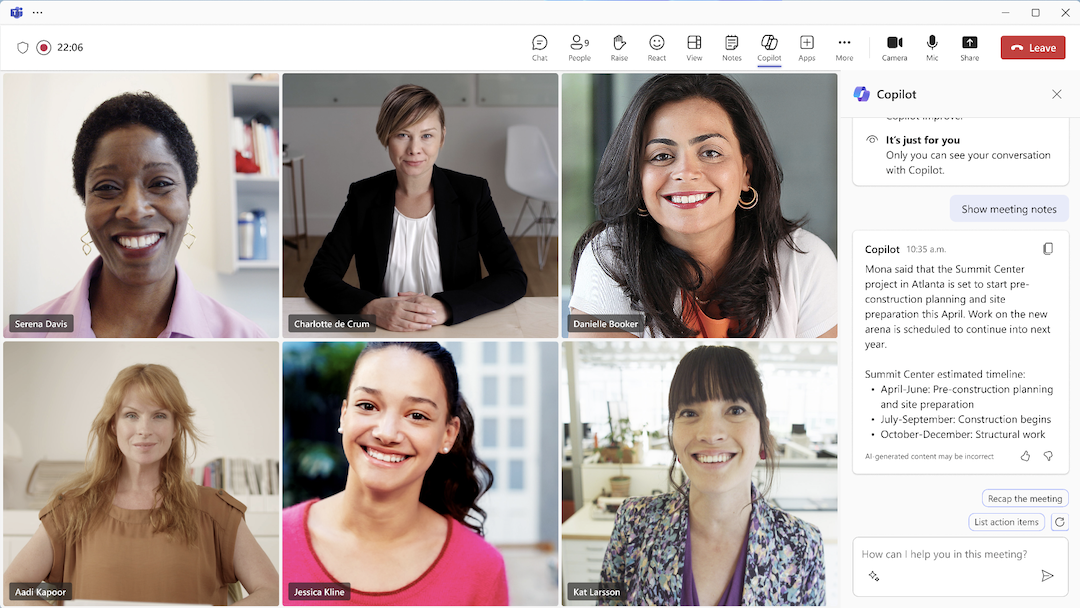
Teams has the lowest paid entry price on this list. Even the bottom-tier paid plan gives you the same meeting capacity as the premium tiers. The ceiling you’re paying for is everything around it: storage, desktop apps, compliance, and AI.
I tested it for a month of cross-functional editorial syncs, and the integration depth is real. Meeting recordings auto-save to SharePoint, chat persists alongside files for the same project, and the calendar is the Outlook calendar I already check every morning.
For internal teams standardized on Microsoft 365, the context stays in one place without any stitching.
Where it falls apart is outside the organization. External guests get tenant prompts, lobby settings, and a join experience that confuses people who don’t use Teams daily. Reddit users in 2026 describe persistent macOS notification failures and hours wasted trying to record calls that required a higher subscription tier than the marketing suggested.
Worth flagging for anyone budgeting from an old quote: Microsoft raised Business Basic from $6 to $7 and Business Standard from $12.50 to $14 in July 2026. And be careful reading the AI story into the base price. Microsoft 365 Copilot is a separate $21/user/month add-on, or $23.50 bundled into a new “Business Standard with Copilot” SKU. The sticker price and the price of the configuration you actually want are often not the same.
What happens after the meeting: Teams keeps recordings, transcripts, and chat in the same channel, and Copilot can generate summaries and action items. But Copilot is a $21/user/month add-on, and without it, someone still has to watch the recording or scroll the chat to extract what was decided.
Where it taps out: External guest experience is the weakest in the category. The client is heavy on system resources (G2’s most common complaint is slow loading and RAM consumption), macOS notification delivery is inconsistent, and the search function returns messy results when you’re trying to find an old file or chat thread. The gap between “Teams, the meeting tool” and “Teams, the configuration you actually want” is filled with add-ons: Copilot, Teams Premium, Phone, and Webinar hosting are all separate line items.
Best for: Organizations already holding Microsoft 365 licenses where meetings are primarily internal and IT support exists to manage the governance surface.
Skip it if: Most of your calls involve external guests, freelancers, or clients who don’t use Teams. Or if you want a lightweight meeting tool that a non-technical admin can run. Microsoft Teams rewards organizations with IT support and frustrates those without it.
A user review says:
Microsoft Teams is our team’s go-to for online meetings. The subscription is already included in our M365 service, so the cost is perfect for a small non-profit that works to keep their overhead as low as possible. It’s easy to use, so the learning curve is minimum. It allows us to work together to collaborate, meet together for team update meetings (which is vital for a fully remote with staff across the world), helps to streamline project management, and has great customization options such as filters and virtual backgrounds.
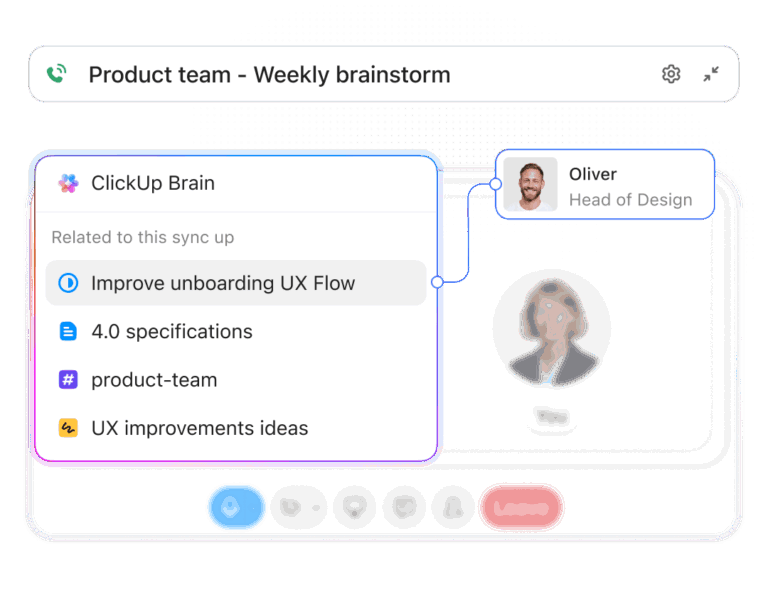
ClickUp is not a Zoom replacement, and I want to say that plainly before anything else. It belongs on this list because the tool addresses the problem none of the others solve: the meeting happens, decisions get made, but you can never find the notes or action items (in a helpful manner anyway).
When I moved those to SyncUps, the call started from the task we were discussing, screen sharing happened in context, and the decisions stopped evaporating. SyncUps can handle up to 200 participants with 24 speaking at once.
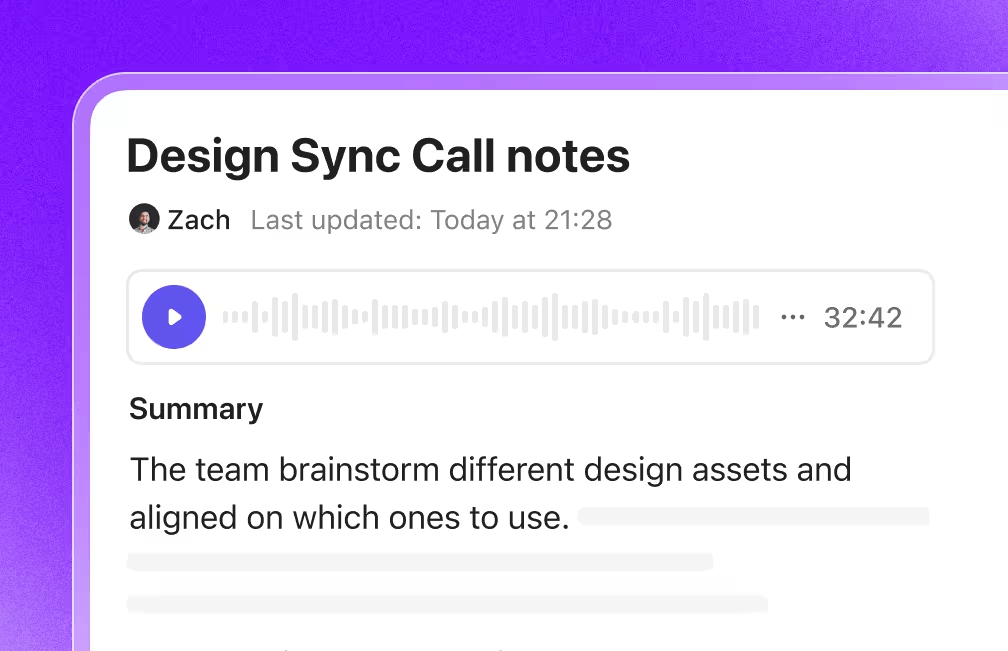
The AI layer is where the pricing splits. AI Notetaker joins your SyncUps or your existing Zoom, Teams, or Google Meet calls and produces a Doc with key takeaways and an action-item checklist that links directly to tasks. But Notetaker is not included in any base plan. It requires the higher-tier paid plans. If you want the calls without the AI notes, ClickUp costs nothing. If you want both, model the add-on before you commit.
What happens after the meeting: Brain² can pull up any past meeting note, decision, or action item from a natural-language question: “What did we agree on pricing last Thursday?” gets an answer drawn from your tasks, Docs, and meeting notes in one search. And once you have that answer, you can turn it into an Artifact: a slide deck, a dashboard, a project brief, or a status report built directly from the meeting content without copy-pasting into another tool.
Where it taps out: SyncUps are built for internal working sessions, not webinars, large external events, or anything needing registration pages. Longer calls may get audio recordings rather than video. And the feature requires you to be on paid plans.
Best for: Internal working sessions for teams that already manage projects in ClickUp, where the meeting is one step in a workflow, and the real failure mode is that decisions don’t turn into tracked work.
Skip it if: You run external webinars, large all-hands, or client-facing events with registration. ClickUp is not a webinar platform, and a 300-person all-hands company meeting belongs on Zoom, Meet, or Teams.
A user review says:
I love how ClickUp solves pretty much everything for me, from mundane tasks to recurring projects and reminders. I’m so in love with their AI notetaker and ClickUp Brain; they are such a blessing. The AI Agents are fantastic, acting like other apps but native to ClickUp, which is very useful. I created agents with specific tasks, follow-ups, and updates on my knowledge base, making everything so much easier. I use these AI agents to help with reporting, overseeing operations, projects, and movements, which is incredibly helpful. ClickUp University made the setup process miles easier. I am so happy that I can get reports with just a simple prompt instead of doing everything manually like before.
Also, check out how to replace daily standups on Zoom with SyncUps.

Webex is the option that wins regulated industries (think hospitals, law firms, and government contractors). Because end-to-end encryption is available on every plan, including the free one.
If your compliance team has a checkbox for E2E encryption, the evaluation tends to end at Webex regardless of what the rest of the market is doing. Cisco has been building network infrastructure for decades, and the security posture reflects that inheritance: FedRAMP High, HIPAA, SOC 2 Type II, ISO 27001, and data residency controls that most competitors can’t match in regulated verticals.
I tested it for a week, and the audio quality was genuinely impressive, especially the noise cancellation. The AI Assistant generates meeting summaries and action items on paid tiers. Where the experience breaks down is the interface. It feels enterprise-built in the way that means more settings, more menus, and a learning curve your team will complain about. G2 reviewers consistently flag “Not User-Friendly” and “Lack of Intuitiveness” as primary drawbacks. Webex is absent from G2’s “Easiest to Use” rankings entirely, while Zoom ranks 6th and Teams ranks 2nd.
The integration catalog is also noticeably thinner. Webex offers roughly 200 integrations, a fraction of Zoom’s marketplace. If your stack relies on a long tail of third-party tools, you’ll feel that gap fast.
What happens after the meeting: Webex AI Assistant generates summaries and action items on paid tiers, and recordings are stored with searchable transcripts. But there’s no native path from “action item in the summary” to “assigned task in a project tool.” The summary lives in Webex. Getting it into your actual workflow is still a manual step.
Where it taps out: The interface carries its enterprise baggage and often confuses new users. The free tier matches Zoom’s 40-minute cap rather than the 60 minutes Google and Microsoft offer. Webinars are a separate line item, starting at around $69/month, rather than something bundled into Meet. And enterprise pricing is quote-only through Cisco sales, with add-on costs for workforce optimization, calling integration, and contact center that can escalate fast once you’re past the sticker price.
Best for: Healthcare, legal, financial services, defense, and public-sector teams where encryption and compliance decide the purchase, especially organizations already running Cisco infrastructure.
Skip it if: Your stack depends on a long tail of third-party integrations, you want the cheapest path to longer meetings, or you need a tool that non-technical users can adopt without training. Webex is priced and built for organizations with compliance requirements to meet.
A user review says:
It has a beautiful UI and is very simple to use and learn, especially for newly added users. It supports a lot of integrations with 3rd-party companies, and the Slido integration is the one I use and love the most. It works pretty well, and the pricing is similar to all the competitors out there. At the moment, I haven’t used the AI tools provided by Cisco. For setup and day-to-day use, I’ve relied on help.webex.com many times, and I can say that a lot of posts there really helped me fix issues.
the messaging part, every chat, every message is like a new post where you can add comments below, and for me is just confusing because maybe i need to go back 10 days to find a reply to a “post” that has been answered yesterday.

Every room in Whereby is a persistent URL. I put mine in my email signature and send the same link to every freelance writer, guest contributor, and vendor I need to talk to. They click it, they land in the browser, and the call starts.
For consultants, recruiters, agencies, and anyone running back-to-back external calls, that removes a category of friction that the enterprise tools never quite eliminate.
Whereby is also the go-to embedded video product for telehealth and education platforms. The Embedded API lets you drop video directly into your own web app or client portal, which is a genuinely different use case from the rest of this list. The company is Norwegian, GDPR-native by default, with EU data residency, which matters if your clients care about where their call data lives.
The pricing model is unusual and worth understanding: Whereby charges per host, not per attendee. That means a 40-person company where three people run meetings pays for three seats, not 40.
What happens after the meeting: Whereby records calls on Pro and above, but there’s no AI summary, transcript, and action-item extraction. The recording is a video file you download or share. If you need decisions documented after the call, that’s on you or a separate tool.
Where it taps out: The free plan is the most restrictive on this list: 4 attendees, 30 minutes, one room. Trustpilot users report the 30-minute cap may apply as total usage, not per meeting, though Whereby’s page reads as per-meeting. There’s no SSO or enterprise admin console, and the integration ecosystem is narrow compared to Zoom or Teams. Brand recognition is lower in the US, which means some guests will hesitate when they see a Whereby link instead of a Zoom one.
Best for: Client-facing professionals, consultants, recruiters, and small teams who value guest simplicity over admin depth. Also product teams embedding video into their own applications.
Skip it if: You need company-wide rollout, SSO-driven provisioning, meetings above 200 attendees, or a tool your clients will recognize by name. Whereby is built around the room, not around the org chart.
A user review says:
I value Whereby’s zero-download browser-based guest access for our estate-planning clients, which removes tech hurdles and improves customer experience. The branded permanent rooms and waiting-room locks are great for security during sensitive consultations. I appreciate the smooth integration through Zapier webhooks that automatically push meeting events to Microsoft 365 and QuickBooks, making billing and scheduling seamless. Additionally, access to audit trails is vital for managing client PII and ensuring compliance with CCPA privacy guidelines.
Also Read: 10 Best Online Meeting Tools for Teams
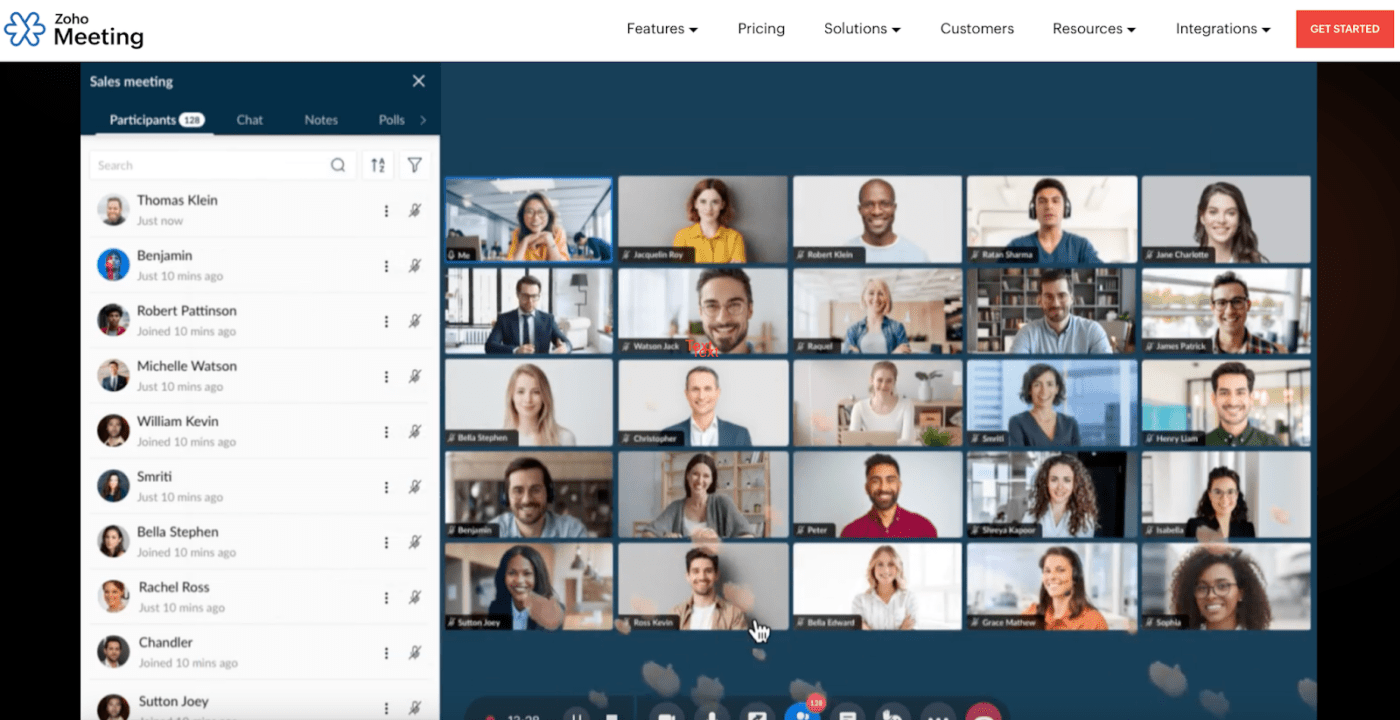
Zoho Meeting is the cheapest credible option on this list.
I tested it for a round of calls, and the experience is competent rather than remarkable. Meetings run browser-based with no download, last up to 24 hours on paid tiers, and record with 5GB of cloud storage per host. The Professional tier ($3/host/mo and up) adds breakout rooms, AI transcripts, recording keynotes, and end-to-end encryption. Transcription accuracy is solid, around 95% in PCMag’s testing, with each paragraph clickable to jump to that part of the video.
Where it gets genuinely interesting is for existing Zoho Suite customers. Meeting data flows into Zoho CRM, Zoho Projects, and Zoho Bookings, so a demo call can auto-populate the customer record without manual entry. The webinar edition (starting $8/organizer/mo) is dramatically cheaper than Zoom Webinars, which requires a separate paid add-on on top of a paid Zoom plan.
One caveat worth pricing in: because the tiers are banded by participant count rather than features alone, a single all-hands that exceeds your band forces an upgrade for every host, not just the one running the call. Teams that meet in small groups most weeks and occasionally gather everyone should model the spike rather than the average. Our comparison of meeting cadence for remote teams is a useful way to work out which pattern you actually have.
What happens after the meeting: Zoho’s Professional tier generates searchable transcripts and AI keynotes (meeting highlights). If you’re on Zoho CRM, the meeting record can land next to the customer profile automatically. But outside the Zoho ecosystem, transcripts stay in Zoho Meeting with no native path to your project management tool.
Where it taps out: The experience is functional rather than polished. Video quality can be inconsistent (users report occasional blurriness and choppy audio), virtual backgrounds are unstable, and recording processing times are slow. The UI feels dated compared to Zoom or Meet. Outside the Zoho ecosystem, the integrations thin out fast, and the participant ceiling is 250, so large all-hands are out of scope. Timezone handling for scheduling across regions is also a documented pain point that has led to missed meetings for users booking calls with international clients.
Best for: Small and mid-sized teams optimizing hard on cost, and existing Zoho CRM/Projects customers who want meeting data to land next to the customer record without extra steps.
Skip it if: You need more than 250 participants, a deep integration ecosystem outside Zoho, or the polish your clients will notice on an external call. If attendee experience is what you’re being judged on, Zoho isn’t the answer.
A user review says:
Easy to use and integrates well with the Zoho ecosystem. Scheduling video meetings is straightforward, and I like that I can assign another team member as the host and invite clients directly.

Jitsi Meet is the only option on this list where you can genuinely remove the vendor from the equation. It’s open source under Apache 2.0, has nearly 30,000 GitHub stars, and when self-hosted, there’s no usage cap, per-seat cost, or data leaving your network.
I tested it both ways. On the public instance at meet.jit.si, I created a room, sent the link, and my colleague joined from a browser in under a minute. The experience was clean for a quick two-person call. But meet.jit.si now requires a Google, GitHub, or Facebook account to create rooms (this changed in August 2023), and quality started degrading noticeably once I added a third and fourth participant.
Self-hosting is where the real proposition lives, and also where the real cost hides. A production deployment means a VPS with at least 4 vCPUs and 8GB RAM, TLS certificates, a TURN server for corporate NAT traversal, JWT authentication (the older secure-domain method is deprecated), and someone who can troubleshoot Prosody, Jicofo, and the Jitsi Videobridge when things break.
The Docker Compose setup takes about 30 minutes if you know what you’re doing. Production hardening takes considerably longer. Practical video quality holds for about 35 participants on dedicated hardware, and recording via Jibri is notoriously finicky, with multiple Capterra reviewers calling the deployment “a nightmare.”
What happens after the meeting: There’s no built-in AI notetaker or summary comparable to what Zoom, Meet, and Teams now ship. Closing that gap means bolting on a separate transcription service. For teams whose driving requirement is data sovereignty rather than convenience, that trade is usually acceptable.
Where it taps out: Free to license is not free to run. Self-hosting means owning TLS certificates, TURN servers, capacity planning, authentication, upgrades, security patches (including a November 2025 CVE for a DOM redirect vulnerability), and incident response. There’s no enterprise admin console, or AI features, or a clear support SLA. If you’re choosing Jitsi because it’s free and not because you need data sovereignty, every other tool on this list will be faster to adopt and easier to maintain.
Best for: Privacy-first teams, public-sector deployments, organizations in regulated industries that cannot send call data to a third-party server, and developers embedding video into their own product.
Skip it if: You have no engineering capacity to run infrastructure, you need meetings above 35 people with reliable video, or AI notes and summaries are part of what you’re buying. Jitsi’s trade-off is honest: maximum control in exchange for maximum responsibility.
A user review says:
I love Jitsi as a privacy-focused alternative to commercial video platforms. It solves key video conferencing pain points by eliminating account and app friction, addressing data privacy concerns, removing vendor lock-in and licensing costs, and simplifying developer video integration. What stands out is how seamlessly Jitsi balances frictionless access with uncompromising user privacy. Unlike other platforms that trap users behind mandatory account creation, proprietary app downloads, and restrictive freemium tiers, Jitsi delivers a top-tier video experience that respects user autonomy. The setup was incredibly easy and user-friendly, so much so that I would recommend it.
This list focused on full Zoom replacements, but three other tools keep coming up in the conversation and are worth knowing about.
Discord (free): Discord does something no business tool on this list does: it lets people stay in a voice channel for hours without anyone starting a meeting. It simply provides persistent voice channels you can drop into and leave. Video supports up to 25 participants at 720p on free, and all voice and video calls have been end-to-end encrypted since March 2026. For pair programming, creative co-working sessions, and internal teams that want an always-on office feel, it’s unmatched. The catch: no compliance certifications or enterprise admin layer exist. Plus, sending a Discord invite to a client sets a tone most businesses don’t want to set.
Loom (free tier, paid from $18/month): Loom isn’t a Zoom alternative in the traditional sense because it doesn’t host live calls. It replaces the meeting entirely. Record a screen-and-camera video, share the link, and the recipient watches on their own time. For weekly status updates, walkthroughs, and async feedback loops that don’t need to be synchronous, it removes the calendar problem Zoom can’t touch. If half your “meetings” are really one person presenting while everyone else listens, Loom is the honest answer. We cover more details in our guide to async video communication.
Jami (free, open source, peer-to-peer): Jami takes the privacy argument further than Jitsi. It’s fully peer-to-peer with no central server at all: calls route directly between devices, account creation is optional, and there’s nothing for a hosting provider to log or subpoena. The trade-off is polish and reliability: call quality is inconsistent, the user base is tiny, and there’s no web browser join. For the subset of users whose requirement is genuinely “no server touches my call data, period,” Jami is the only tool that delivers it.
Every tool on this list has a ceiling, and switching vendors doesn’t make ceilings disappear.
Across Zoom’s G2 reviews, the top complaint themes are meeting time limits, pricing frustration, and feature gaps on lower tiers. Google Meet’s reviews surface the same pattern. So does Teams. The dissatisfaction is structural to video conferencing, not specific to Zoom. Moving between them trades one set of constraints for another.
The question that actually predicts whether you’ll be happy with the switch is what you already pay for and where the answer needs to land.
And one option the switching guides never mention: choose none of them. If the only thing driving the evaluation is a free-tier timer, price the correct Zoom tier first and compare honestly. Staying is sometimes cheaper than migrating. Zoom Pro at $14.16/user/month removes the 40-minute cap, includes AI Companion at no extra cost, and everyone already knows how to use it.
Pro Tip: Before switching anything, export your Zoom cloud recordings and meeting history. Run the new tool alongside Zoom for two weeks against your 10 most common meeting types. Switching regret almost always comes from an edge case you didn’t test.
Zoom is still the strongest standalone video tool in 2026.
It’s the platform other people already have installed, the AI Companion comes free on paid plans, and it almost never drops a call.
What each tool here does is solve a problem Zoom wasn’t built to address. Meet and Teams eliminate the second bill. ClickUp eliminates the gap between the call and the work. Webex eliminates the compliance conversation. Whereby eliminates guest friction. Zoho eliminates the budget objection. Jitsi eliminates the vendor. My recommendation? Pick one concern that bugs you the most and go from there.
If follow-through is the problem (it was for me), then try ClickUp for free and see how the meeting-to-action item workflow fixes itself.
Yes. Zoom’s free Basic plan still caps group meetings at 40 minutes with up to 100 participants, as published on Zoom’s pricing page in September 2026. One-to-one meetings on Basic are also capped at 40 minutes. Removing the cap requires Workplace Pro at $14.16/user/month, which extends meetings to 30 hours.
The cheapest paid tier is Workplace Pro at $14.16/user/month on annual billing. Below that, Basic is free with the 40-minute group limit. Webinars, Phone, and Rooms are all separate add-ons that require a paid Workplace license underneath them.
Google Meet and Microsoft Teams both offer free tiers with 60-minute group meetings for up to 100 participants, the most generous free limits among major platforms. Zoho Meeting matches the same 60-minute, 100-participant pattern. Whereby’s free plan allows 30 minutes with 4 attendees. Jitsi Meet is open source and carries no license fee at any scale when self-hosted.
No single tool is better than Zoom for every team. Google Meet is better value for existing Workspace customers. Teams is better value for Microsoft 365 customers. Webex is better for regulated industries. Whereby is better for external client calls. ClickUp is better when the problem is meeting follow-through, not the call itself. Zoom remains the strongest standalone option when you need webinars and meetings from one vendor.
Zoom remains widely used, but its share of attention fell as Google and Microsoft bundled comparable video into subscriptions companies already bought. When Meet ships inside Workspace and Teams ships inside Microsoft 365, a standalone Zoom license becomes a second bill for a capability the business already owns. Zoom’s response has been AI Companion (free on paid plans) and the broader Workplace platform, but the bundling math is hard to beat. For more options, see our list of meeting apps.
Run your 10 most common meeting types through the alternative for two weeks. Include an internal standup, a client-facing call, a call with screen sharing, and a meeting that typically runs past 60 minutes. Check whether the new tool records, whether guests can join without friction, and whether action items land somewhere durable afterward. Export your Zoom cloud recordings before canceling, and keep both running during the overlap.

Manasi Nair
Max 29min read
Manasi Nair
Max 14min read
Manasi Nair
Max 9min read

© 2026 ClickUp




