Innovate, Adapt, Succeed: Implement the Right PMO Structures for Your Business


Sorry, there were no results found for “”
Sorry, there were no results found for “”
Sorry, there were no results found for “”
The architecture of your organization’s project management office (PMO) plays a role in the effectiveness of your project management endeavors. Aligning your PMO structure with the organization’s specific needs and resources helps deliver projects punctually and within budget.
Top-performing PMOs can drive remarkable gains in revenue and customer satisfaction. However, given the substantial variability among project management offices, merely establishing a PMO framework doesn’t guarantee success.
In this guide, you’ll learn all about different types of PMO structures and operating models. We’ll take a closer look at their various functions and strategic steps you can take to set up an efficient PMO without breaking a sweat!
A PMO, or Project Management Office, is a dedicated team or department within an organization responsible for establishing and upholding standardized project management practices. It provides the necessary structure and guidelines to effectively oversee and carry out projects under its authority.
The PMO oversees various aspects such as metrics, benchmarks, quality assurance, and documentation to ensure uniformity in managing and executing projects, programs, and portfolios. It can operate internally within the organization or externally through a separate entity or agency.
If you need a project management kickstart, you can leverage the ClickUp PMO Team Template! Designed specifically for PMO teams, this powerful tool assists in managing everything—from project plans and workloads to priorities and project progress. 🧾
The project management office spans various areas, including project planning, management, portfolio oversight, HR, and alignment with broader business objectives. Here are the specific functions of a PMO framework:
Organizations’ project management approaches vary based on their needs, project complexities, and maturity levels. That’s why PMO structures cater to diverse organizational cultures, project requirements, and strategic objectives.
Each PMO structure has specific advantages and limitations, offering organizations the flexibility to choose the most suitable approach according to their unique circumstances.
Here are the most common types of PMO structures:
The Directive PMO holds the highest authority among PMO structures, controlling multiple project aspects and frequently engaging directly with stakeholders and clients.
Directive PMOs typically recruit and delegate to project managers while providing guidance and supervision. They are crucial in project planning and overseeing an organization’s projects across their entire lifecycle, ensuring alignment with scope, budget, and timelines.
✅ Pros:
⛔️ Cons:
📌 Best for: Large organizations with complex projects needing strict oversight
Controlling PMOs strikes a harmony between standardization and adaptability. They have several key responsibilities, like enforcing agreed-upon project guidelines, tailoring and accommodating specific project requirements, and ensuring resource management.
✅ Pros:
⛔️ Cons:
📌 Best for: Organizations that need consistency but want to allow project managers some flexibility
Also Read: Adaptive Project Management
The Supportive PMO doesn’t have much say in directly managing the project. Instead, it acts like a consultant, offering support when team members need guidance.
Supportive PMO project managers aren’t required to follow strict methods, so they can pick the best approach for their projects, encouraging flexibility and new ideas.
When choosing a PMO for your project management style, the Supportive PMO is handy for handling immediate changes in real time rather than deciding on project priorities.
✅ Pros:
⛔️ Cons:
📌 Best for: Organizations with a mature project management culture that need guidance rather than control
Centralized PMO thrives in sizable enterprises that need consistent rules and standards. It excels in managing resources effectively.
In companies with extensive staff but limited management, a centralized PMO streamlines operations by minimizing the need for constant peer guidance. Instead, individuals and departments can rely on a centralized system, fostering efficient autonomy.
✅ Pros:
⛔️ Cons:
📌 Best for: Large enterprises that want strict governance and standardization
The decentralized PMO is common in agile project teams. It offers minimal central control, allowing teams the flexibility to adopt preferred tools and work methods.
Decentralized PMO offers guidance to high-value business units and helps when various units need to collaborate, even if they have different approaches, resources, or goals.
✅ Pros:
⛔️ Cons:
📌 Best for: Organizations with diverse business units requiring autonomy
Apart from the five main types of PMO structures mentioned above, here are a few others that can also be used in specific scenarios:
PMOs play a crucial role in the success of projects within organizations. Different PMO roles are tailored based on the organization’s size, the needs of stakeholders, and the business environment. Here are the primary PMO roles explained:
| Role | Key Responsibilities |
| PMO Director | Defines PMO strategy, aligns projects with business goals |
| PMO Manager | Implements governance, supports project managers |
| Project Manager | Manages project execution, budget, and stakeholders |
| Program Manager | Oversees related projects, manages interdependencies |
| Portfolio Manager | Manages the entire project portfolio, ensures strategic alignment |
| PMO Analyst | Tracks project performance, prepares reports and dashboards |
| Project Controller | Monitors budgets, schedules, and risks |
| Risk Manager | Identifies and mitigates project risks |
| Change Manager | Manages change adoption and stakeholder engagement |
| Agile Coach / Scrum Master | Supports Agile teams, facilitates Agile practices |
Harmonizing your company’s culture, requirements, and resources with your PMO strategy can enhance the likelihood of project success.
This alignment creates a clear structure that outlines the essential methods, tools, and resources needed for projects to succeed. Consequently, PMOs can make informed decisions, mitigate risks, and drive business growth. 🌱
There’s no universal solution to crafting a strategic plan for your PMO. Still, there are standard steps to take when formulating a PMO strategy. Plus, if you pair them up with ClickUp—an all-in-one project management solution—you’ll establish a perfect PMO structure in no time! 🙌
Here are the five crucial things you need to do:
The initial step toward a successful PMO structure is understanding your organization’s broader context.
Begin by defining your organization’s goals, values, and the challenges it addresses. Once these aspects are clear, assess your past performance, strengths, weaknesses, and areas for improvement. That way, you’ll know what to avoid and what to strive toward in the future.
Vision statement templates can prove helpful in this.
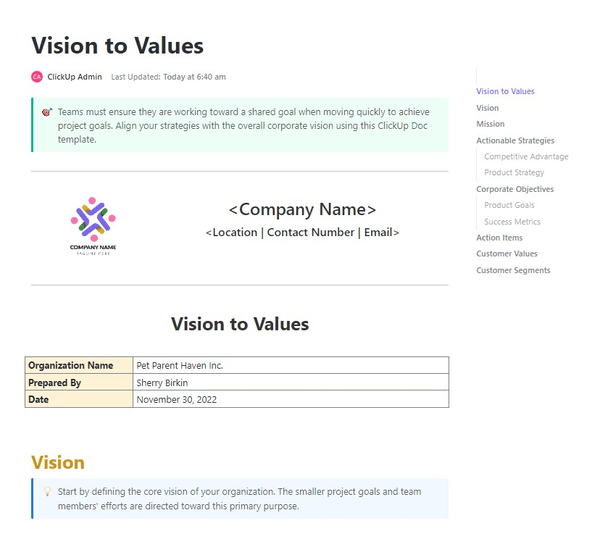
ClickUp’s Vision to Values template gives you the tools needed to set up an effective strategy for growth and success. This template will help you:
Like any significant project, establishing a PMO structure requires a clear vision of your objectives, anticipated bottlenecks, challenges, and strategies to overcome them.
To define precise goals, consider these questions:
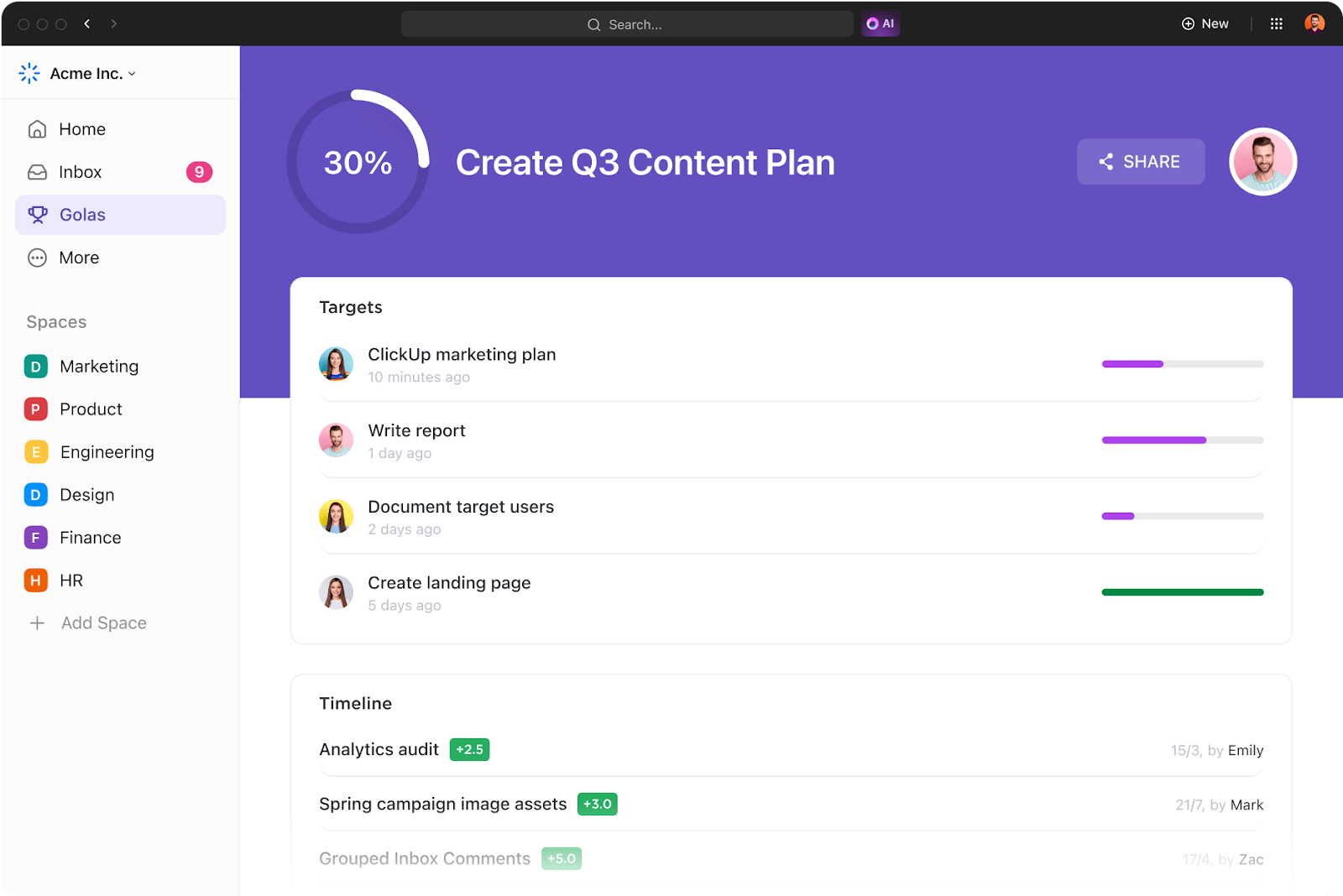
💡 Pro Tip: Once you’ve addressed these questions, streamline your objectives effortlessly using ClickUp Goals! Simply input key details like the goal, due date, and assignee, and you’re all set. 👌
Identify key stages in your project by marking them as Milestones and breaking down significant goals into manageable targets, so your team can work more productively.
You can even organize related goals into folders, providing a convenient, comprehensive view of the progress made toward your overarching objectives.
The effectiveness of your strategy significantly hinges on your organization’s assets and resources.
Effective allocation ensures that resources are utilized to their maximum potential across different projects. It prevents overloading or underutilizing resources, ensuring a balanced distribution for optimal productivity.
Optimize your resources to enhance project efficiency and minimize waste by:
Streamline your resource planning with the ClickUp Resource Planning Template. It presents a ready-to-use framework that helps in proactive planning using available resources, encompassing project budgets and team members’ schedules. It’s completely adaptable—customize it freely to suit your unique requirements. 🦄
Beyond the traditional task management through lists and boards, this template provides a Timeline view for linear schedule tracking, ideal for resource planning and roadmap visualization. It also offers a Gantt chart to visualize task dependencies, enabling a quick overview of roadblocks or bottlenecks to ensure continuous project progression.
Project failures often result from a lack of clear and efficient communication systems. When developing a strategic plan for your PMO, it’s crucial to identify stakeholders, outline their responsibilities, and establish communication channels for sharing the latest updates.
You should also define how project managers and teams will maintain ongoing communication and how team members will relay information about deadlines, obstacles, and emergencies. 🚑
💡 Pro Tip: ClickUp eliminates switching between project management dashboards and messaging apps, boosting communication efficiency!
Rely on ClickUp Docs for real-time collaboration on documents, with assigned comments turning into action items and text turning into actionable tasks.
You can also use ClickUp Chat for instant communication and task-related discussions in a unified thread or integrate ClickUp with your favorite third-party communication apps like Microsoft Teams.

Monitoring progress and KPIs serves as a compass, guiding the PMO toward facilitating informed, strategic actions throughout the implementation process. More specifically, it provides a clear picture of the PMO’s effectiveness in meeting defined goals, ensuring alignment with the organization’s strategic objectives.
Tracking project management KPIs and progress also enables data-driven decision-making by identifying areas for improvement and potential risks, allowing for timely adjustments to optimize processes. Progress tracking fosters accountability and transparency, showcasing the PMO’s value to stakeholders and ensuring continuous process improvement.
💡 Pro Tip: With ClickUp Dashboards, you’ll get a complete overview of your project in a single location! Think of it as your ultimate mission control center tailored for any project. It allows you to:
Organize, visualize, monitor, and evaluate your quarterly objectives by analyzing completed tasks, Burnup & Burndown charts, project time-tracking data, and workflow obstacles in one place!
Ditch the backlog of weekly reports flooding your manager’s inbox and streamline KPI tracking using the ClickUp KPI Template. This user-friendly template simplifies the monitoring and visualization of essential key performance indicators. It offers a holistic reporting layout, enabling you to:
Regular monitoring of metrics and KPIs facilitates continuous business process improvement. It allows you to identify areas needing improvement so that the PMO can adapt strategies and methodologies for better outcomes. 👍
Selecting the right Project Management Office (PMO) type for your organization is a strategic decision that depends on several factors, including organizational structure, project complexity, and business goals. Here are the key considerations to keep in mind:
The PMO must align with the company’s overall business strategy. Ask questions like:
Example: If the company prioritizes strategic alignment, an Enterprise PMO (EPMO) would be a strong choice.
A mature project management culture may need a Supportive PMO, whereas an immature one may need a Directive PMO. Question:
Example: If the organization lacks structured processes, a Controlling PMO can help enforce the PMO governance framework.
Some organizations require strict oversight, while others thrive with flexible frameworks. Ask:
Example:
The more complex the projects, the more structured the PMO should be. So, ask questions like:
Example:
The PMO structure should complement the organization’s operational setup. You can ask:
Example:
Industries with strict compliance standards may require stronger governance structures. These questions can help:
Example:
Some PMO types require significant investment, while others are lightweight and cost-effective. Here, ask questions such as:
Example:
The PMO should align with the methodologies used in the organization. Questions to ask are:
Example:
A Directive or Controlling PMO may be necessary if stakeholders expect strong control. Relevant queries include:
Example:
A PMO should meet current needs and adapt to future business growth. This entails asking:
Example:
Picking and building the right PMO structure can shape how projects unfold. Being familiar with the various PMO types and their effects allows organizations to choose wisely, ensuring consistent and considerable results.
Luckily, you can access all PMO essentials on a single platform with ClickUp, bringing you one step closer to success! With project management, team communication, and knowledge management all in one integrated, AI-powered platform, ClickUp is the only app you need for all things PMO.
Try ClickUp for free and easily create the PMO structure of your dreams! ✨

Sudarshan Somanathan
Max 22min read

Praburam Srinivasan
Max 23min read
Praburam Srinivasan
Max 21min read

© 2026 ClickUp