
Must-Have Onboarding Documents to Ensure Smooth Integration of New Hires


Sorry, there were no results found for “”
Sorry, there were no results found for “”
Sorry, there were no results found for “”
The onboarding process can make or break a new employee’s success in the role.
In its 2023 research, consulting firm Korn Ferry surveyed employees who quit their jobs within six to twelve months. As the reasons for their decision, the respondents mentioned factors like feeling disconnected from the company culture and a poor onboarding experience.
Onboarding documentation can help you be thorough and transparent with your new hires from day one. Besides the mandatory tax forms and employment contracts, there are many other helpful onboarding documents to consider. If prepared and organized meticulously, they can help employees navigate the new work environment effortlessly. 🧭
In this article, we’ll discuss the various types of documents you should include in your onboarding process, from legal and tax forms to organizational charts, process manuals, and non-disclosure agreements. We’ll also introduce a comprehensive productivity and project management platform that makes creating and organizing onboarding paperwork a walk in the park.
Similar to client onboarding, employee onboarding is the process of assimilating a new hire into an organization. It helps the employee prepare for the job and introduces them to the company culture.
A smooth employee onboarding process can drive motivation, productivity, and job satisfaction. On top of that, companies that have well-thought-out onboarding processes usually have lower turnover rates.
Documentation plays a crucial role in the onboarding process. It’s typically prepared by a human resources (HR) specialist, manager, or the business owner.
Besides being a legal requirement, onboarding documents can make the integration more efficient. They help the employee get to know the company and role in a quick and accessible way, supporting them during and after onboarding. 📃
The legal forms should be the first on your list of onboarding documents for new hires. Complete them within a few days of the employee’s start date to avoid legal troubles and fines.
The employee must complete a federal income tax form called W-4. By doing so, they specify their tax withholding status, influencing contributions such as Social Security and Medicare.
The W-4 form informs the Internal Revenue Service (IRS) on how much to deduct from the employee’s paycheck. It also lets you know how to allocate the taxed amount. 💵
Review the most recent W-4 form before each paycheck to ensure it aligns with the employee’s choices. You should also keep all employees’ tax documents on file for at least four years after the last tax sum is due or paid (whichever comes later).
Most states levy an income tax. The following nine also require your new employees to fill out a State Withholding Certificate:
The I-9 form confirms the new employee’s eligibility to work in the U.S., which depends on their citizenship, residency, visa, and immigration status.
The employee must complete the form and return it to you within three days of their start date.
Besides that, they must provide you with work eligibility documents, such as:
Review the form and documents to see if they meet all the requirements. You don’t need to submit them, but you must keep them on file in case an immigration officer requests them.
The following documents allow the new employees to familiarize themselves with the company’s policies, culture, people, events, and brand.
An employee handbook serves as an encyclopedia of essential company information. Be thorough and use clear language when creating it, but don’t overwhelm the employees with information.
Some of the most common elements of the employee handbook are:
Once the employee reads the handbook, they should sign the agreement form. ✍️
An organizational chart introduces the employee to the company’s structure. The chart should present the names of employees, their duties, and who they report to. It can facilitate internal and cross-functional communication. If the new employee has a question, they’ll know who to direct it to by looking at the chart. 👥
Every company has a unique, consistent way of representing itself. 🖼️
The brand guidelines document instructs the new employee on the appropriate application of logos, accepted fonts and color schemes, and the writing tone they should use for marketing materials or external communication.
From crucial meetings and deadlines to holidays and team-building events, the company calendar lets the new employee in on day-to-day activities. It allows them to plan ahead and sync their personal schedule with the company’s. 🗓️
Use the onboarding paperwork listed below to help the employee prepare for their new role.
At the final job interview, you may offer the position to the candidate, but you must follow it up in writing.
The employment offer letter outlines information about the new hire’s role, such as the job title, start date, expectations, compensation, and benefits. The employee should read it carefully and sign it to officially accept the terms.
Employee contracts are usually more in-depth. They may include information about the work schedule, duties, policies, confidentiality, and termination terms. They are similar to employee handbooks but are more concise and specific to the employee’s role.
Another crucial item on your employee onboarding checklist is process documentation.
Depending on the nature of the role, process manuals may look like general guidelines or detailed standard operating procedures (SOPs). The latter are step-by-step instructions on how to perform repetitive processes and solve problems.
The importance of such employee documents can’t be understated. With proper process documentation, both new and existing employees have a knowledge base to refer to if they have concerns. It can reduce the need for calls and meetings, making work more focused and efficient.
For new employees, consider crafting separate training plans. These documents should explain what the employee can expect in the first few months in their new role. They should also define how the duties may shift as the employee gains experience and the criteria for advancing into higher roles. While the new employee is in training, set them up with support from a peer or mentor. 👐
Prepare these documents to enable seamless compensation and foster transparency around the benefits.
If you’re going to pay the employee by depositing funds directly into their bank account, they need to fill out a direct deposit form. It lets you gather the information you need to process payments, such as the employee’s bank account details and preferences. 🏦
Make sure to collect this data well before the first paycheck so it can be processed on time.
While you should be clear about the benefits the company offers from the start, it’s best to create a document that can serve as a common reference point. In this document, include information such as:
Depending on your company’s policies, you may want to include these additional documents in the onboarding process.
The emergency contact form is indispensable to any company’s risk management strategy. It tells you who to reach out to in case of an incident. The form is especially important if the employee’s job involves potentially dangerous activities.
Ask the new employee to name at least two people in the form and include their phone numbers and email addresses.
If your company handles confidential information, you should prepare a non-disclosure agreement (NDA), whether you’re onboarding clients or employees.
By signing this document, the employee commits to safeguard the sensitive data they work with. If the NDA is breached, the company can take legal action. 🔏
A signed non-compete agreement prevents the employee from participating in activities that can impede the company’s competitive advantage for a certain period after their employment ends. Such activities may include working for a competitor or starting a competing business.
The non-compete agreement or a clause is crucial when the company has developed proprietary knowledge, relationships, or technology. It ensures that the employee can’t use their experience with the company to benefit a competitor.
If the job calls for drug testing or criminal background checks, include a detailed description of the requirements in your onboarding documentation. Once the employee submits records or test results, keep them on hand in case of future compliance reviews. Make sure the access to this sensitive data is restricted.
An employee consent document can have many applications. It ensures that the employee understands and agrees to a specific action, such as:
While your documentation should be comprehensive, it mustn’t overwhelm the new employee. That’s why it’s essential to create a plan to introduce the onboarding paperwork gradually while complying with regulations.
For example, Section Two of the I-9 form must be completed by the end of the third day of employment, so it should be one of your top priorities. On the other hand, the company calendar is neither a legal requirement nor crucial to the employee’s integration process, so you can get to it weeks after the start day.
When preparing, distributing, and organizing documentation, a proper productivity tool can be a lifesaver. It can be anything from a human resource management system (HRMS) and onboarding software to an all-in-one project management software like ClickUp. 🛠️
ClickUp is a powerful platform for handling HR matters and documentation. Discover some of the ways you can take advantage of its HR Suite below.
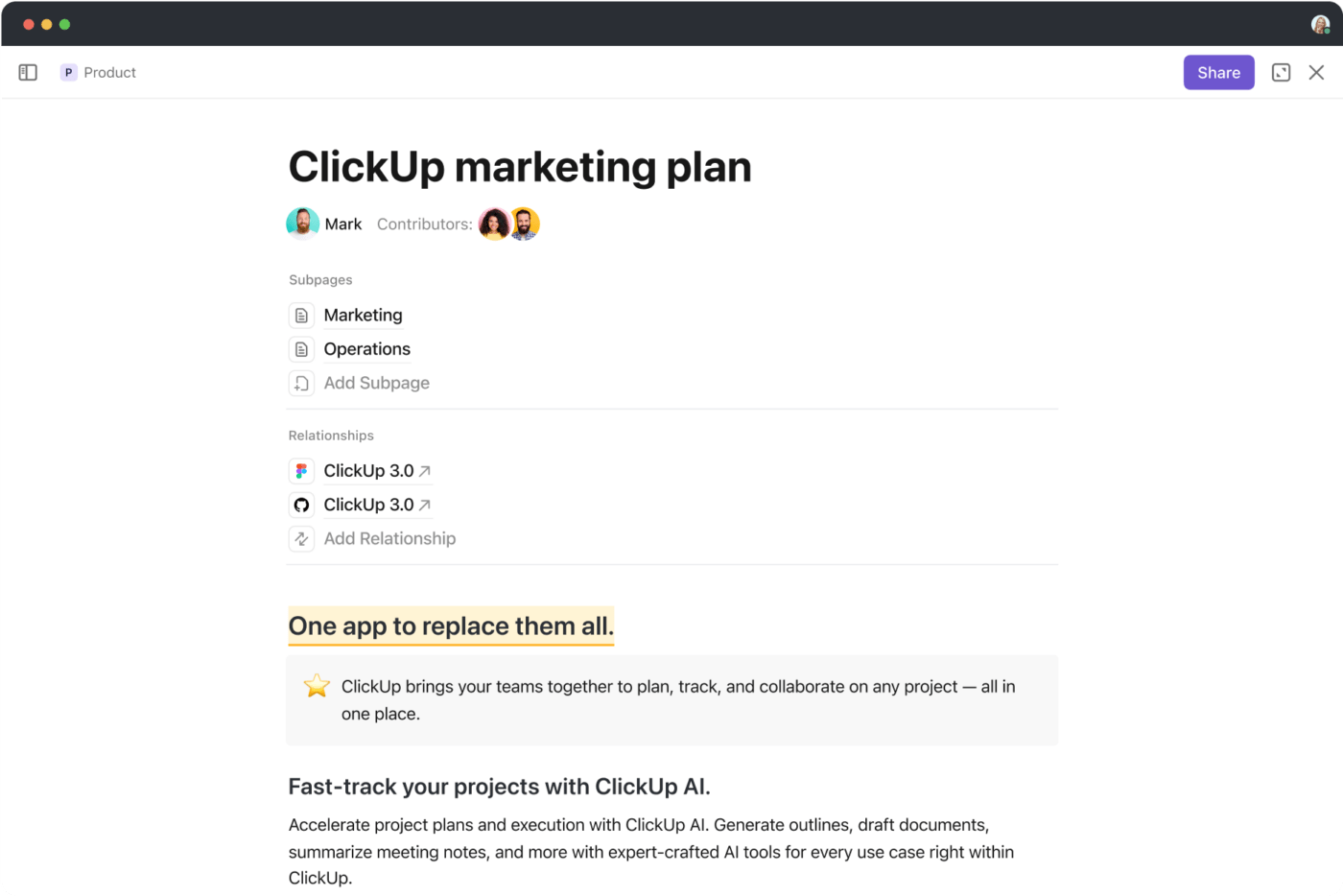
ClickUp Docs lets you create engaging manuals, wikis, and other documents for onboarding purposes. It functions as a standard text editor but has numerous formatting options. You can add the following elements to make your text more engaging:
Once your text is ready, send it to others for review. Create a shareable link, fine-tuning the permissions for different access levels. You and your teammates can edit the document collaboratively in real time.

Experiencing writer’s block? Leverage the power of ClickUp AI, a handy AI writing assistant. It can give you ideas, help you craft documents faster, and ensure they’re professional and organized.

Onboarding entails a ton of paperwork. You can make it more manageable with ClickUp’s Project Hierarchy, creating a structured and scalable database.
Add a company Workspace, divide it into dedicated Spaces for different departments or teams, and adjust the permissions for each.

Turn documents into Tasks and Subtasks. Organize them into Lists and Folders for different projects, job titles, geographic regions, and other relevant factors. You can assign and schedule tasks as well as add descriptions, statuses, priority tags, checklists, and comments.
With such a comprehensive but organized knowledge base, your new hires can access any information quickly. They won’t have any doubts about what they have to do, when to do it, and how to do it.
With ClickUp’s task management capabilities, you can plan and audit most HR processes. ClickUp can be your candidate and employee database, allowing you to fetch any information or document in a few clicks. 🖱️
When hiring, add candidates to your Space. Introduce Custom Fields to quickly view the status of their application, pay range, resume, legal documents, and other elements.
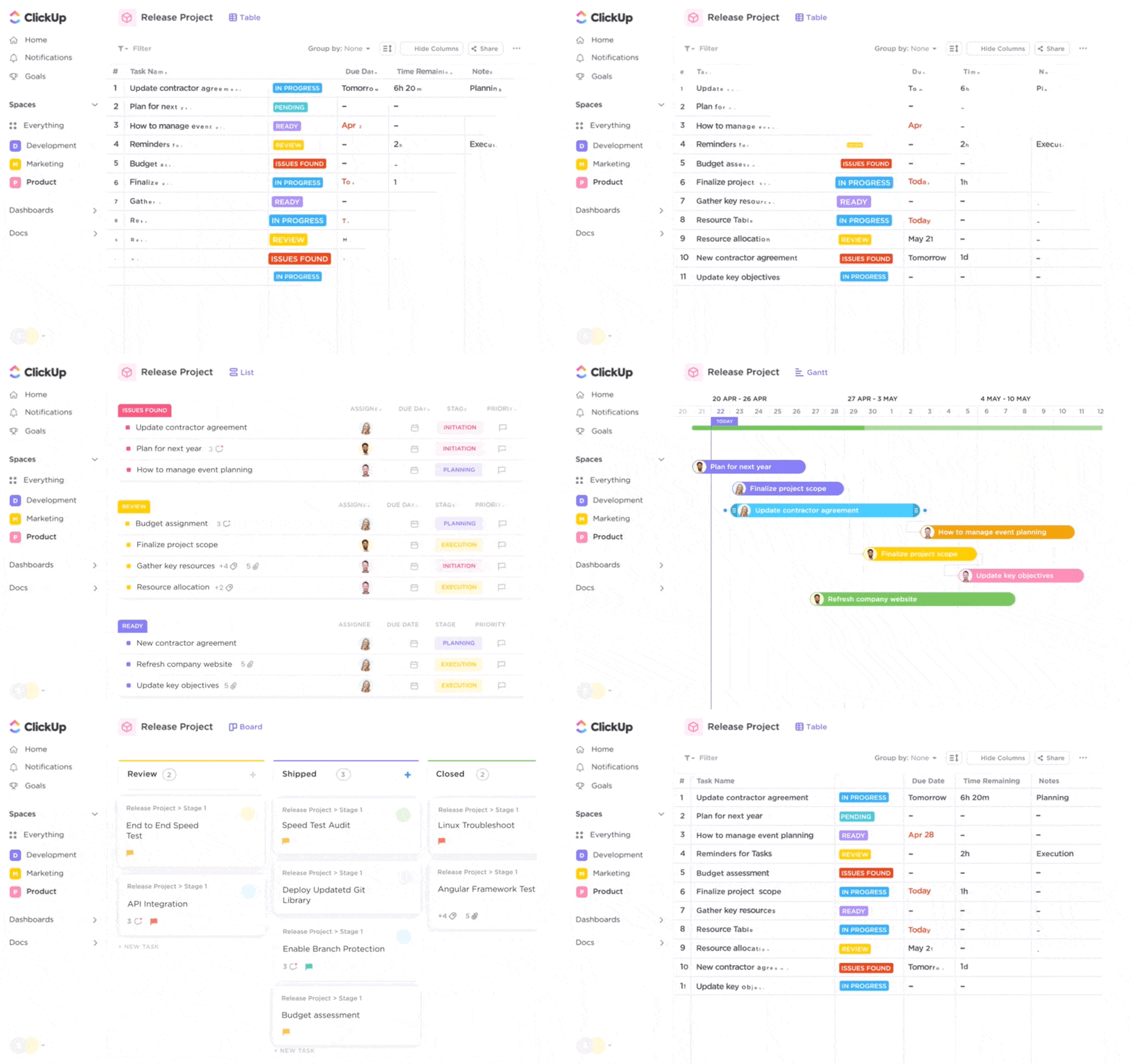
Leverage ClickUp’s 15+ views to manage different aspects of recruiting and onboarding. For example, you can:
Don’t know how to start organizing your Workspace? ClickUp has over 1,000 templates for a quick and painless setup.
The ClickUp Onboarding Checklist Template can be a simple reminder of crucial documentation you must collect and distribute. Other, more general templates include the ClickUp Employee Onboarding Template and the ClickUp New Hire Onboarding Template. Feel free to customize them to your company’s needs. 💖
Onboarding documents are a crucial part of employee orientation. When your documentation is sorted out, the rest of the hiring and onboarding process will fall into place. You’ll ensure compliance with the law and give new hires a single source of truth to turn to when they’re in doubt, preventing misunderstandings and fostering transparency.
With a comprehensive tool such as ClickUp, you can organize the documentation, plan and optimize the entire onboarding process, and give your new employees the best chance to succeed in their upcoming roles—sign up today. 🌟

Sudarshan Somanathan
Max 20min read
Sudarshan Somanathan
Max 12min read
Sudarshan Somanathan
Max 19min read

© 2026 ClickUp




