


Leading a successful event marketing campaign is on the wishlist of every hardcore marketing enthusiast.
But what truly makes such events “successful”?
Is it the buzz? Their number of attendees? Not completely!
While these metrics matter, eventually, it all comes down to how deep your event’s impact is. If you can turn a crowded exhibition hall into a list of potential customers, consider yourself an event marketing specialist.
Then again, to achieve such fantastic results, you must craft an event marketing strategy that engages and provides value to prospective attendees.
So, check out these 10 diverse event marketing examples we’ve compiled to sharpen your event management and hosting skills and add to the success to your next event.
10 Event Marketing Examples to Make Your Event Stand Out

 Summarize this article for me please
Understanding Event Marketing
Event marketing is a business’s way of connecting with people. Put simply, it’s a promotional strategy companies use to bridge the gap between them and their potential customers.
From planning to execution, event marketing campaigns involve creative brainstorming sessions at every point. They are led by a company’s marketing team to promote the business, its products, or its services through a virtual or in-person event. However, the bigger goal may vary from company to company.
While some host event marketing campaigns to provide learning opportunities to their target audience, others may do so to generate fresh leads or increase brand awareness. Yet, the fundamental objective is mostly the same—driving business growth.
Features of event marketing
If you’ve ever been involved in a well-planned event marketing campaign, you’ve likely noticed how it stands out from other corporate events. Here are some of its key features that explain why:
- Diverse formats: Event marketing campaigns can take any shape and form—virtual events, networking events, online events, in-person events, and many more. This diversity makes them fit to attain any marketing goal
- Targeted audience engagement: Want to garner leads or boost sales? Event marketing can help you achieve your specific goals. This targeted approach helps companies focus their marketing efforts, manage the event effectively, and reach their goal more efficiently
- Interactive experience: Event marketing campaigns—particularly the in-person ones—contain many interactive elements like live demos, speeches by industry leaders, and so on. This keeps the attendees engaged and constantly involved
- Multi-channel promotion: Event marketing campaigns often involve promotion across various marketing channels like social media platforms, email, websites, and so on. This helps in both driving attendance and spreading brand awareness
Benefits of event marketing
Now, let’s discuss a few advantages of hosting an event marketing campaign:
- Increases brand awareness: Amid fierce competition, it can be difficult for any business to create buzz. Event marketing campaigns ease that. They ensure your business surpasses existing customers and reaches out to its target audience more broadly
- Provides networking opportunities: Many business leaders and industry experts participate in such high-profile corporate events. So, attending these can prove beneficial for any brand or professional trying to strengthen their networking
- Enhances brand loyalty: Event marketing campaigns—whether virtual or in-person—encourage interaction. This creates a sense of community and kindles brand loyalty among the attendees
- Boosts business growth: Many businesses struggle to grow because they can’t generate leads or attract new customers. Event marketing addresses this challenge by hosting engaging events that draw in audiences, generate valuable leads, and, subsequently, drive business growth
Difference between event marketing and experiential marketing
In marketing connotations, the terms “event marketing” and “experiential marketing” are often used interchangeably. Now, although they do share a few similarities, these marketing initiatives are different from each other. Here’s how:
| Aspect | Event marketing | Experiential marketing |
| Focus | To promote a business or its products and services through in-person/virtual events | To enable a business to engage and create memorable experiences with its customers through hands-on, immersive activities |
| Primary goal | Brand promotion | Customer engagement |
| Audience engagement | Mostly passive | Highly interactive |
| Success metric | Post-event conversions, lead generation, etc. | Social media engagement, brand loyalty, etc. |
| Use cases | Product launches, trade shows, tech conferences, etc. | Pop-up experiences, immersive installations, brand activations, etc. |
Summarize this article for me please10 Solid Event Marketing Examples and Strategies You Should Try
Here are some incredible examples of event marketing that you can use to bolster your marketing efforts:
Experiential activations
Experiential activations feature installations your customers can visit and engage with. Since these activations aim to create memorable experiences for customers, they include interactive installations like gaming counters, murals, etc., that represent your brand.
Customers who visit these experiential installations tend to click pictures and share them on social media—which bolsters your social media marketing efforts and improves brand awareness.
Example: Audible Beach at San Diego Comic-Con (SDCC)
In 2022, Audible created massive sand sculptures of characters from its popular podcasts at the SDCC convention. The impact was equally phenomenal. Visitors took photos with the sculptures, sampled other Audible podcasts, and raved about the whole experience on social media.
Takeaway: Creating interactive and memorable experiences through experiential activations can significantly enhance your brand’s social media presence and overall brand awareness.
User conferences
User conferences are events companies organize to bring together their users, industry leaders, and influencers to educate, gather feedback, and create a community. They are mainly conducted in multiple stages, with sessions like presentations, workshops, breakout sessions, etc.
User conferences prove helpful in many ways. For instance, they are perfect for gathering real-time, honest feedback on your product. These conferences also set the stage for knowledge sharing and community building, which are essential to any business’s growth.
Example: Oracle Code One (JavaOne)
In 2022, tech giant Oracle hosted an environmentally conscious user conference—the Oracle Code One (JavaOne)—and invited programmers worldwide to participate. The program was a hit, with a theme-specific plant-conscious menu, lessons on carbon footprint reduction, and food donation opportunities.
Takeaway: Hosting user conferences encourages community building and provides valuable feedback crucial for business growth.
Virtual events
A virtual event is an online gathering conducted over digital platforms. It allows participants to attend the event without physically traveling to the location.
What is the biggest advantage of this event marketing type? You can host one for almost any purpose—conducting a workshop, providing virtual experiences, hosting online conferences—literally anything!
Example: Google I/O’s virtual event

In 2021, Google conducted a virtual event to provide the experience of its in-person annual developer conference—Google I/O—to everyone around the globe. With the help of a 360-degree camera, event organizers recorded a panoramic video of the speeches by the keynote speakers and published it on YouTube so everyone could be a part of it.
Takeaway: Virtual events offer flexibility and inclusivity, enabling global participation without the need for physical attendance.
Product launches
A product launch event is crucial for product-based businesses, where a company hosts a large-scale, often global, conference to introduce its new product in the market. The event typically begins with the CEO presenting the product’s features and discussing its need and impact.
High-level launches often include live demos and sessions with guest speakers, usually industry experts. In fact, some companies also use this moment to unveil their product’s brand ambassador to their audience.
Example: Apple’s Worldwide Developer Conference
Each year, Apple holds its Worldwide Developer Conference, wherein it launches its latest product and technology. Although the event occurs in person, Apple telecasts the launch to ensure its loyal fanbase, scattered across the globe, can witness the reveal. This helps the company create a solid sales momentum before the product hits the market.
Takeaway: A well-executed product launch can generate significant pre-release excitement and boost early sales momentum.
Networking events
As the name suggests, networking events host industry leaders, subject-matter experts, and other corporate professionals to provide networking opportunities to attendees. They are often formal and structured, starting with a meet-and-greet and ending with an official dinner.
You can host a networking event internally or externally. Let’s suppose you want to facilitate professional connections for your employees. In that case, you can host a networking event within your organization. Otherwise, networking events can be helpful if you wish to enable your target audience to interact and engage with industry experts.
Example: Lean Startup’s networking event
Lean Startup held a networking event at Mob Museum to provide global networking opportunities to its attendees. The event was crafted to ensure everyone found a like-minded person to interact with, making the experience immersive, interactive, and successful.
Takeaway: Facilitating networking opportunities through formal events can strengthen professional connections and industry relationships.
Fundraising galas
Fundraising galas are typical of Non-Profit Organizations (NPOs). However, any business can host such charitable events to create buzz about its brand.
Let’s say your company wants to amplify its philanthropic and community upliftment efforts. In that case, you can sponsor a fundraising gala for a charitable cause. Alternatively, if your company already has a philanthropic image, hosting such events can reinforce your brand identity and strengthen your connection with potential customers in your industry.
Attendees at such events typically consist of donors, philanthropists, community leaders, and even sometimes celebrities. So, besides raising awareness, such events pose a great networking opportunity.
Example: The Canadian Cancer Society’s Daffodil Ball

Every year, the Canadian Cancer Society hosts a unique fundraising event—the Daffodil Ball. Attendees are required to wear masks and interact with each other as soft jazz music plays in the background. With a high-profile guest list of business leaders, philanthropists, government officials, and celebrities, this NPO takes the boring out of charitable events by creating an ambiance of fun and entertainment.
Takeaway: Charitable events like fundraising galas can amplify your brand’s CSR efforts while providing valuable networking opportunities.
Hackathons
Hackathons are programming competitions that bring together programmers and developers from around the world to tackle a challenge. Participants compete over several days, and the top performer is awarded. These events can be held both in-person and virtually.
If you’re a tech or software company, hosting a hackathon can help promote your brand on social media. Besides, such events encourage the development of innovative ideas.
Read More: How to Organize a Hackathon
Example: Microsoft’s Building the Future hackathon
Pro developers and programmers participated in Microsoft’s esteemed Building the Future hackathon to innovate solutions for electric mobility. Although the entire event was conducted virtually, it still generated attention on a global level.
Takeaway: Hosting hackathons can generate excitement about your brand and improve innovation within the tech community.
Trade shows
Trade shows offer businesses an opportunity to showcase their products and services. As offsite events, they are typically held at external venues like convention centers and exhibition halls.
These events are generally hosted under a specific industry theme. So, they gather multiple brands in one place and provide a platform for companies to display their offerings to a broad audience and facilitate valuable networking opportunities.
Example: CNET’s COMPUTEX

At the COMPUTEX annual trade show, CNET provided tech companies like Intel with the opportunity to showcase their latest products and innovations. This demonstrates how participating in a trade show can help you display your offerings to potential customers, even if you do not directly belong to the industry.
Takeaway: Participating in trade shows allows you to showcase your products to a targeted audience, expanding your reach within the industry.
Internal company meetings
Do you want to familiarize your new recruits with the company’s mission and goals? Or perhaps check in with a team to gauge their overall progress? Host an internal company meeting!
These events are held within an organization to discuss strategies, objectives, and performance updates. However, in the bigger picture, they align your entire workforce with your brand values by reinforcing your culture and providing scope for regular communication and feedback.
Example: Plum Organics’ Coloring Book Meeting
In one of their recent internal team meetings, Plum Organics encouraged its employees to color with crayons while interacting with others. This activity inspired them to connect and realign themselves with the brand’s child-friendly branding.
Takeaway: Regular internal meetings reinforce company culture and ensure alignment with organizational goals.
Team building events
Team building events typically involve bringing together all the employees of your organization for holiday parties, fireside chats, and other similar activities that encourage interaction and connection building. Their main aim is to instill a sense of community and harmony within the employees.
Additionally, such events provide an excellent opportunity for employee training and skill development. As an organizer, you can get creative with your team-building events and host interactive training sessions, collaborative skill development workshops, etc., to facilitate both interaction and upskilling.
Example: Glassdoor’s Board Game Tournament
Glassdoor boasts a large global workforce. To encourage interaction among all its employees, the company hosted a Board Game Tournament as one of its team-building events. Everyone had the chance to interact with each other and form new bonds, even with those working in different locations.
Takeaway: Team-building activities strengthen employee bonds and enhance collaboration, contributing to a more cohesive work environment.
Summarize this article for me pleasePlanning and Executing Successful Event Marketing
The road to successful event marketing doesn’t stop at gaining inspiration. For best results, you need to plan and execute airtight event marketing strategies, and that’s where the role of analytics and CRM comes into play.
Role of analytics in assessing event marketing success
- Tracking key metrics: Analytics provide access to crucial datasets to let you monitor attendance, engagement, and participation rates. This helps you understand your event’s reach and its impact on your potential customers
- Measuring return on investment (ROI): Keeping a close check on your event marketing ROI makes sure you achieve your goals effectively. For that, you can consider analytics to assess leads generated, conversion rates, and the revenue impact of your events to measure the same
- Gaining audience insights: Analytics allows you to analyze attendee demographics and behavior to gain a deeper understanding of your audience. This enables you to tailor future event marketing strategies and meet their needs and preferences better
Role of CRM in event marketing
- Centralizing data management: CRM systems integrate and centralize attendee data, making it easier to track KPIs like interactions, preferences, and engagement history across multiple events
- Personalizing events: CRM allows you to customize events based on detailed attendee profiles and preferences. Leverage this data to tailor event experiences to meet individual needs and interests, creating a more engaging and relevant atmosphere for each participant
- Ensuring post-event follow-ups: CRM systems facilitate timely and personalized follow-ups with attendees. Automated reminders and customized messages help maintain engagement, strengthen relationships, and improve conversion rates by ensuring each attendee receives relevant information and continues to interact with your brand
Summarize this article for me pleaseUsing ClickUp for Event Planning and Execution
Inspiration, analytics, and CRM? Check! ✅
Now, all you need is a tool to craft an effective event marketing strategy and bring it to life.
Introducing ClickUp—a robust project management software with features and functionalities to facilitate event marketing. An all-in-one work management suite, ClickUp can fill the gap between your event marketing ideation and execution.
ClickUp for event planning

Every successful event starts with effective planning. With ClickUp Teams, plan and organize events that stay with the attendees long after they’re over. Here’s how:
- Use ClickUp Goals to plan and create bite-sized goals for the event
- Leverage ClickUp Docs to create and share event budgets and navigate the financial landscape of event planning smoothly
- Facing challenges with time management? Try the ClickUp Time Estimates to estimate the total time needed for event execution and complete every task without delay
- With ClickUp Tasks, create and assign to all your team members in a precise order of operations to ensure you never miss a beat
- Visualize your event plan with ClickUp Milestones to see how far you have come
ClickUp for event execution
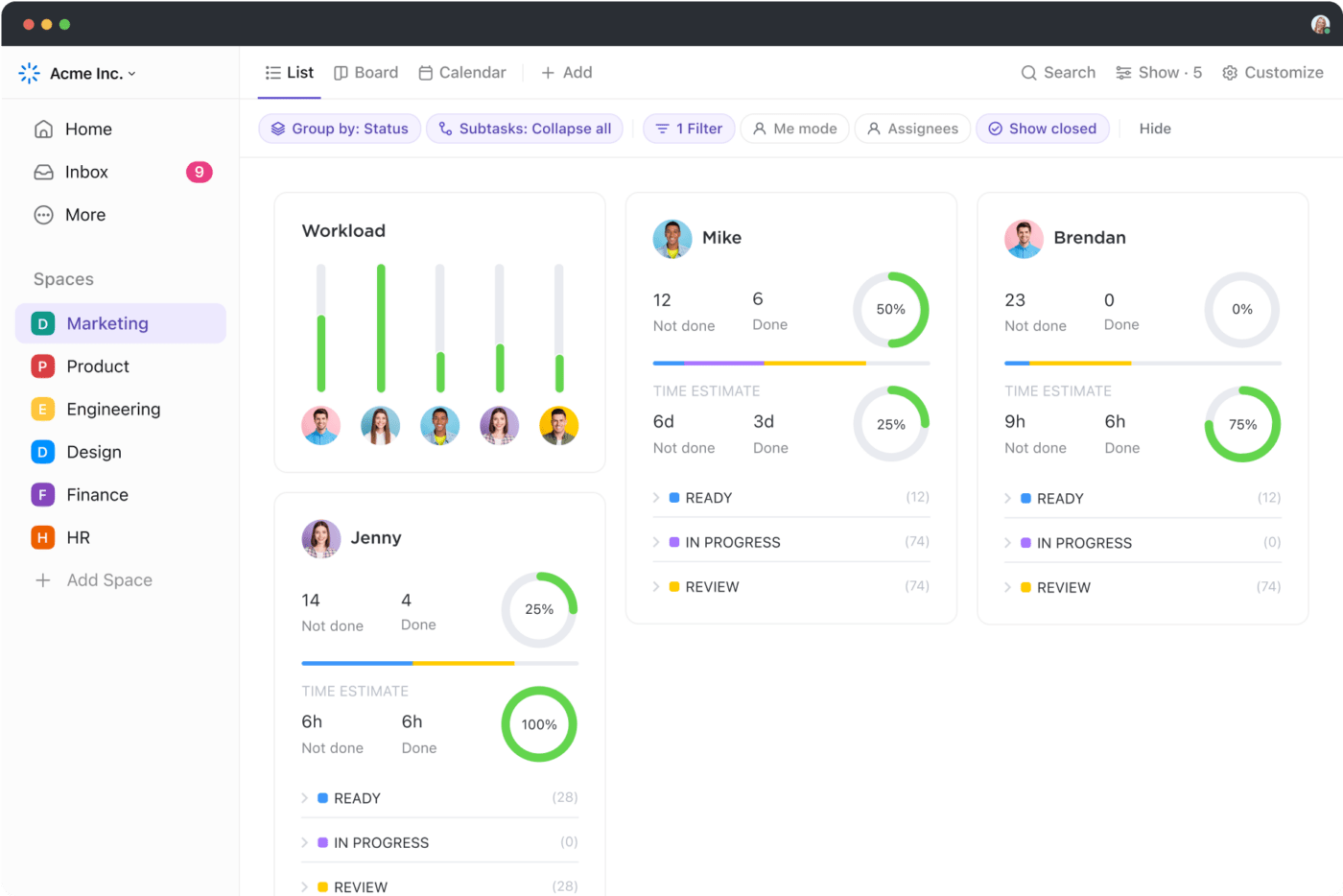
Done with planning your event? Now, let’s get down to business—here’s how you can put ClickUp Teams to use for executing your event strategies:
- ClickUp Chat View can help you collaborate with your team members about every activity in real-time
- Want to take a quick look at how things are going on ground zero? Use ClickUp Zoom Integration to schedule and run your team calls
- Manage your team members, their progress, workload, and everything else in between with ClickUp Dashboards
- Divide your project into smaller tasks with ClickUp Custom Task Statuses, Task Checklists, and ease event management
- With ClickUp Views, visualize your event workflow, manage its progress, and tweak workloads as needed
Besides these, ClickUp provides four ready-to-use, easily customizable templates to make the job easy. Let’s discuss them in detail:
1. ClickUp Event Planning Template
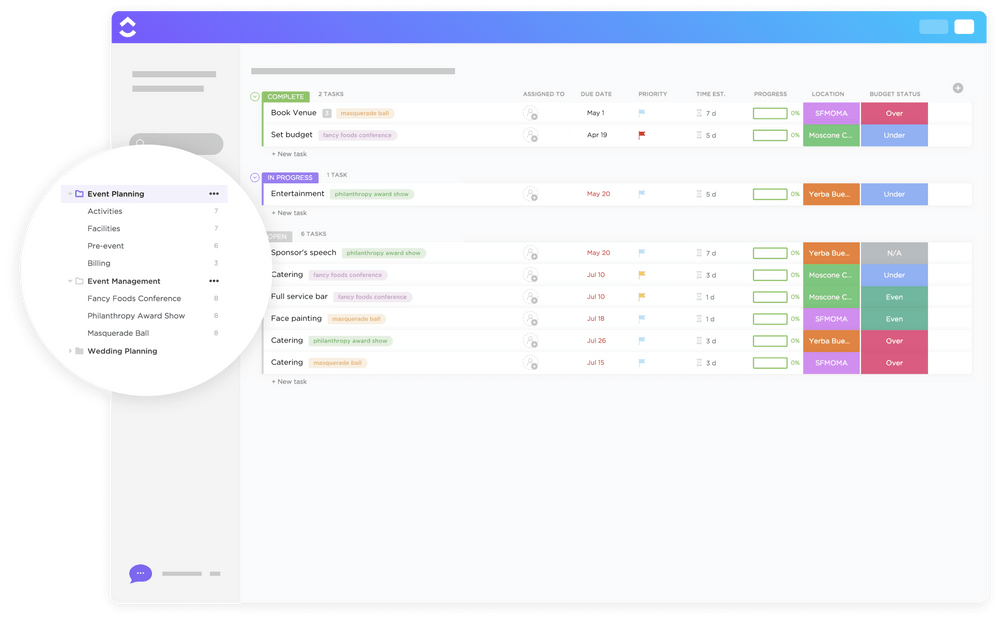
Event marketing starts with planning—and that’s exactly what the ClickUp Event Planning Template facilitates. This customizable template streamlines the entire event planning process for you. It provides a solid foundation that you can use to organize information and accelerate the efficiency of your execution.
The template helps you:
- Plan and visualize events with realistic timelines
- Align your team and resources around the larger goals
- Track progress and individual KPIs around the event planning and execution
2. ClickUp Event Marketing Template
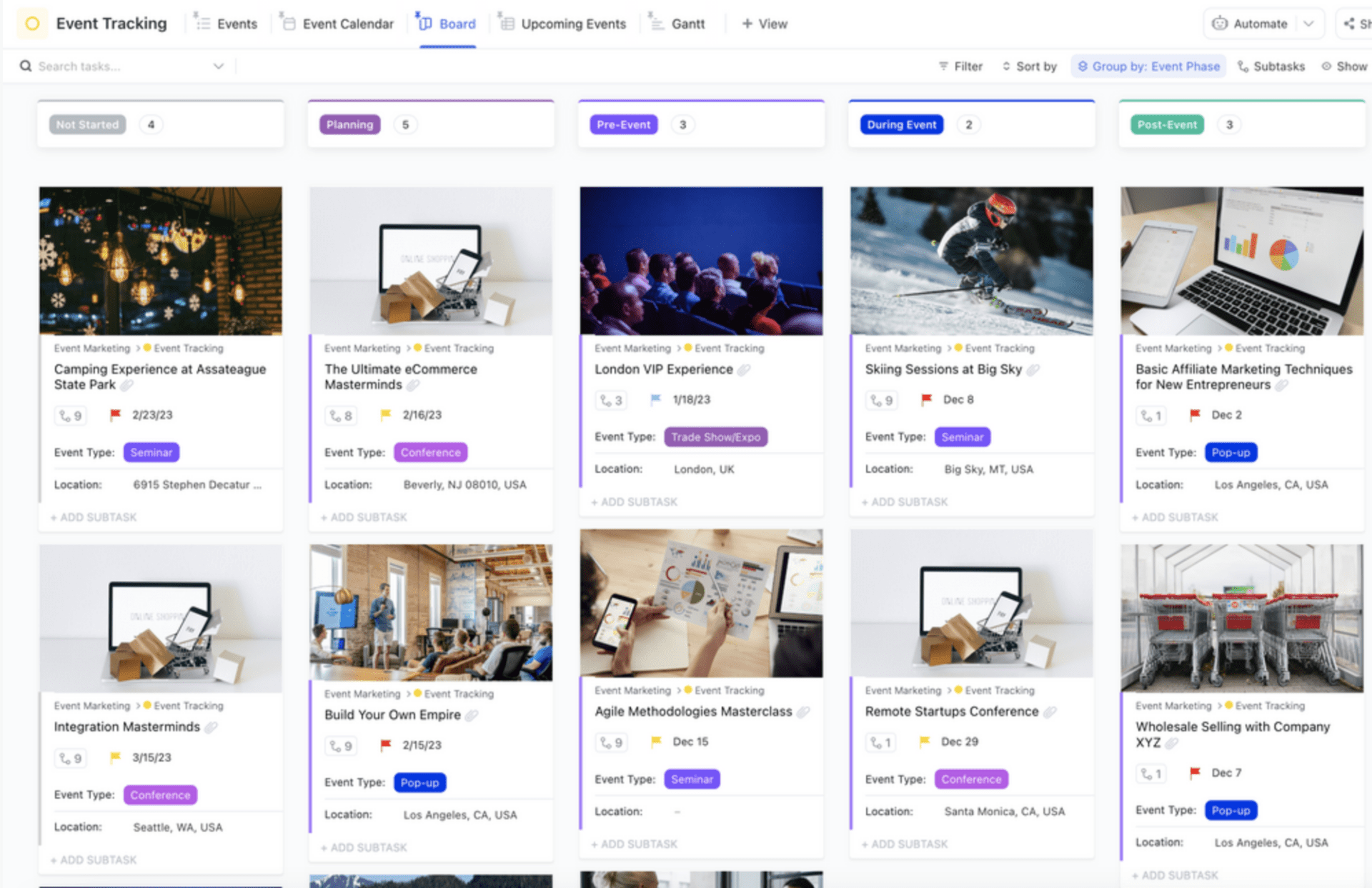
Event management is a broad activity made up of different marketing initiatives at every step. Guess what—the ClickUp Event Marketing Template lets you monitor the marketing side of your event management.
Its advanced features include:
- Team Docs View: Store documents for marketing event review
- Events View: Track upcoming events, tasks, and deadlines
- Meeting Minutes View: Record and store meeting notes and discussions
- Event Calendar View: Plan and track upcoming events with dates and times
3. ClickUp Large Event Planning Template
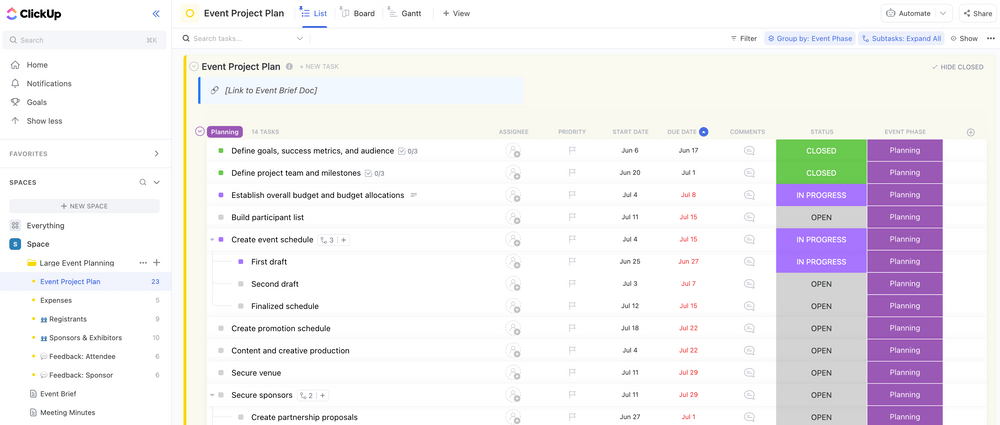
If the idea of planning a large event sounds daunting to you, check out the ClickUp Large Event Planning Template. With advanced features like custom fields and automations, it lets you host marketing events that are global in scale. This template can be your one-stop solution for managing everything—right from the event’s budget to attendees.
Additionally, it provides you with quick access to information with views like:
- Event Brief View: Maintain detailed records of event information and timelines
- Welcome View: Streamline event logistics and coordinate activities around guest arrival
- Attendee List View: Manage attendee information and ensure accuracy
- Meeting Minutes View: Document key decisions made during the event planning process
4. ClickUp Event Project Plan Template
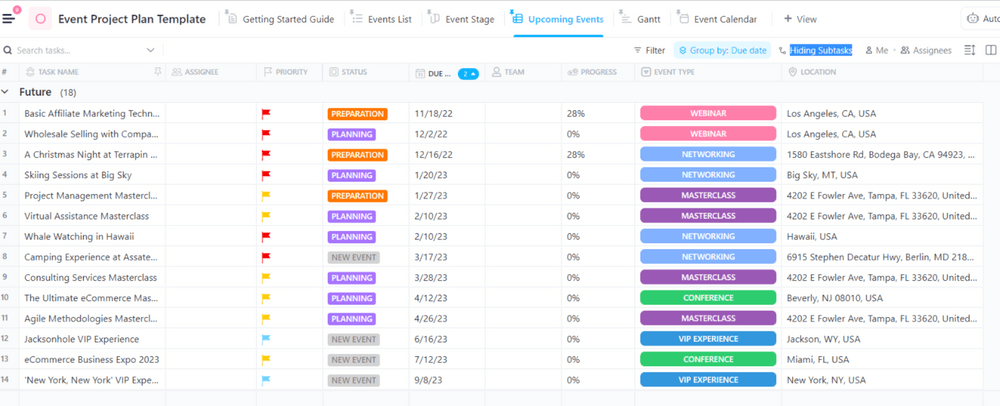
Exclusively made for busy event organizers, the ClickUp Event Project Plan Template makes managing multiple events a breeze. This template includes customizable event tracking, calendar, and briefing features that provide an eagle’s eye view of all your ongoing events in one place.
It helps you:
- Check if all your events are running smoothly
- Save time by following a templatized structure for all events
- Ensure consistency in branding across different events
Benefits of using ClickUp for event marketing
Here are some key benefits of using ClickUp for event marketing planning and execution:
- Centralizes information and communication to keep all team members aligned
- Facilitates real-time collaboration to improve communication and coordination
- Streamlines project management to enhance team efficiency and organization
- Automates repetitive tasks to save time and reduce manual effort
- Improves visibility of project timelines to ensure timely completion of tasks
Summarize this article for me pleaseMake Your Events More Effective with ClickUp!
Event marketing is among the few marketing tools that enable businesses to interact personally with their audience. It promotes brand loyalty on a deeper level by creating shared, memorable experiences with customers. It also strengthens corporate connections and boosts business growth.
However, with virtual formats gaining prominence, the landscape of event marketing is also changing. Trends like augmented reality, computer-based simulations, and virtual tours are set to lead the way. So, keep yourself informed and evolving.
As for the tool, ClickUp works for every event format. With a list of robust event marketing features, it’s your one-stop solution for event planning, management, and execution.
So, hurry up—get ClickUp today for free. Sign up here!


Everything you need to stay organized and get work done.

Recent Articles
Claude Skills for Writing: How to Build One That Actually Fires 
Claude Skills for Writing: How to Build One That Actually Fires
How Marketing Agencies Can Use Claude (Without Wasting It) 
How Marketing Agencies Can Use Claude (Without Wasting It)
Claude Code for Marketers: A No-Code Guide to Building Your Own Marketing Tools
Claude Code for Marketers: A No-Code Guide to Building Your Own Marketing Tools
