
Sorry, there were no results found for “”
Sorry, there were no results found for “”
Sorry, there were no results found for “”
We tested seven task management software across 16 workflows. Our top finding had nothing to do with features. Every free plan breaks somewhere. Asana limits you to two seats. Notion chokes as soon as a second person joins your workspace. monday.com turns its free plan into a brief trial.
ClickUp wins the most categories on raw tool choices and free space. But it takes a few days of patience to learn. Todoist, Jira, and Notion each own their lanes completely.
The right tool is the one whose limits don’t collide with how your team actually works. This guide shows you exactly where each one cracks.

If you’re hacking timeline views into Planner, Monday seems like the fix. But teams that scaled past 15 people on Monday hit the same wall. This migration checklist covers the move that actually lasts.👇🏼
After stress-testing seven task management tools across real-world workflows:
The truth: The ‘best’ tool depends on your team’s adoption appetite. A marketing team will reject Jira’s complexity, and engineers will dislike Trello. This guide will help you find your fit, not the consensus pick. Free-tier limits and pricing change fast, so check each vendor’s pricing page before you commit.
Did You Know? ClickUp’s ‘The Hidden Costs of Work Sprawl’ survey found that 61% of knowledge workers spend more time managing work than actually doing it.
You don’t need to read every section in order. Use the verdict, jump to your use case, and test the tool with real work before committing.
Skipping the trial run and picking on features alone is a top reason teams abandon a tool and start the search over.
How we review software at ClickUp
Our editorial team follows a transparent, research-backed, and vendor-neutral process, so you can trust that our recommendations are based on real product value.
Here’s a detailed rundown of how we review software at ClickUp.
Use this list as a shortcut. Each section compares the top tools for one real-world task management need.
You saw the quick verdicts above. Now here is the evidence. Every tool demos well. Active projects expose where each one cracks. We tore down these platforms across 16 distinct use cases to help you find your next fit.
Personal task management relies on one factor: friction. If logging a thought takes over three seconds, you will rely on memory and drop the ball. Simply put, a personal task manager must act as an extension of your brain.
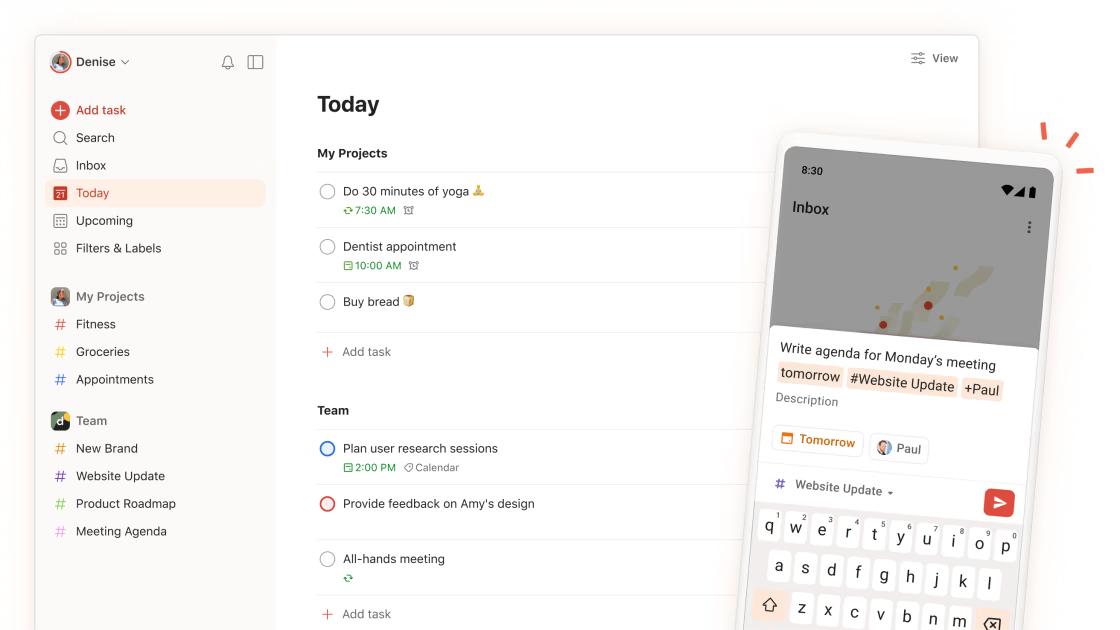
Best for: Individuals who must capture fleeting thoughts before they vanish.
Free plan limits: 5 active projects, 5 collaborators per project, 5 MB file uploads, 3 custom filters, no calendar layout.
Why it’s #1: Todoist’s natural language engine is unmatched. Typing ‘pay taxes next Friday at noon p1’ sets the date, time, and priority instantly. Global keyboard shortcuts and mobile widgets keep the process friction-free.
Honest take: It fails as a deep execution hub. You can’t draft long-form documents inside a task or map out project dependencies. It is a capture tool first, execution tool second.
A G2 reviewer uses Todoist as their personal task manager:
As an IT Project Manager in the Technology field I personally use Todoist as my own project management tool to manage some projects. Todoist provides an agile environment where I can plan technical work and development tasks (aligned to the approved schedule) and assign them activities, monitor progress through one central view, and create recurring reminder notifications for maintenance reviews and change committee documentation.
Best for: Solopreneurs, freelancers, and power users managing complex personal workflows.
Free plan limits: Unlimited tasks, 60 MB storage, trial of basic time tracking, 1 form.
Why it’s #2: Personal productivity requires more than a basic checklist. ClickUp offers native time-blocking, calendar syncing, and custom statuses. You can plan a deep-work week and track time against goals, instead of just crossing off isolated items.
Honest take: It has a steep learning curve. The interface trades a clean default for depth. So it looks busier than Todoist on a fresh workspace until you hide unused views. Quickly adding a thought on mobile takes more steps than Todoist’s instant input. The 60 MB storage cap also prevents you from using it as a file hub. It is overkill for grocery lists, but brilliant if your life requires a strict operational structure.
Best for: Researchers, writers, and knowledge workers whose tasks require deep context.
Free plan limits: Unlimited blocks for solo users, limited to 1,000 blocks for 2+ members, 10 guests, 5 MB file uploads; AI features are trial-only.
Why it’s #3: Notion lets you embed your to-do list directly inside meeting notes, travel itineraries, or research wikis. It avoids rigid list formats and bends to how your brain categorizes data.
Honest take: That flexibility is a trap. Because Notion does not enforce a strict task structure, custom databases easily become graveyards of forgotten pages. It also lacks aggressive, system-level alerts, making it a poor choice for strict deadlines.
Category winner: Todoist
Todoist wins because it clears everyday tasks out of your way fast. Choose ClickUp if your personal tasks resemble a solo business that needs a strict structure. Choose Notion only if your tasks are inseparable from writing and research.
A team of 2 to 10 usually runs on one or two core workflows. The winner is whatever everyone actually opens. Adoption and flexibility matter more than feature count here. Get it right, and the tool becomes your system of record. Get it wrong, and you’re back to a junk drawer of single-purpose apps.
Best for: Bootstrapped teams of 2–10 who need a central workspace without per-seat licenses.
Free plan limits: Unlimited users, unlimited tasks, 60 MB storage, 100 time-tracking uses.
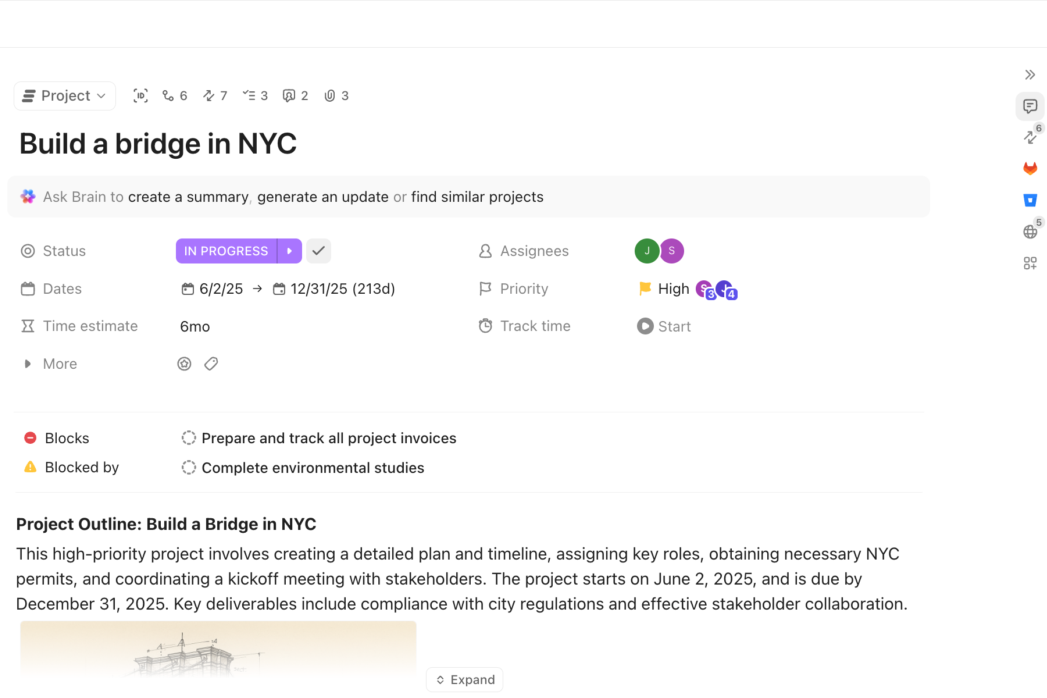
Why it’s #1: ClickUp is the only major tool that pairs unlimited free users with unlimited tasks. It includes List, Board, and Calendar views out of the box, plus native document creation. For a 5-person team, this covers task coordination, meeting notes, and project planning in one app. You avoid the immediate paywall that competitors enforce when you add a third team member.
Honest take: The interface requires setup. You must actively hide unused features and views to prevent clutter. Also, the 60 MB free storage is sized for task data. Creative teams handling large design files or video will lean on linked cloud storage.
A small-business G2 reviewer reviewed ClickUp:
The functionality is amazing, and the smooth blend of team communications and project management is what we have been looking for for quite some time now. Pricing is very fair, and the integrated AI functionality has proved to be very valuable. The interface is very nice, easy to use, and easy to master. It integrates well with Google Workspace and that has proven to be very valuable to my team. It does not glitch or slow down ever, and the support we received during the onboarding has been amazing.
Best for: Teams of 2–5 running linear workflows like content calendars or intake queues.
Free plan limits: 10 boards per workspace, 10 collaborators per workspace, 250 automation runs per month.
Why it’s #2: Trello requires no formal training. You create a board, define column stages, and drag cards across them. This low barrier ensures rapid team adoption. The free tier includes unlimited Power-Ups to connect cards to Slack, Google Drive, or GitHub.
Honest take: Trello is strictly a board-level tool. The free tier lacks native cross-board reporting, capacity planning, and timeline views. The 10-board limit is a hard cap. Once a small team manages multiple projects, they must upgrade to the Standard plan.
Best for: Very small teams that require strict task accountability and deadlines.
Free plan limits: 2 users for new accounts, unlimited tasks, list/board/calendar views, no automations.
Why it’s #3: Asana excels at enforcing process discipline. The interface clearly highlights who owns a task and when it is due. This structure leaves no room for ambiguity and simplifies tracking individual responsibilities across a project.
Honest take: The free tier has a strict 2-user limit. It makes Asana impractical for a standard small team looking for a free solution. A 3-person team must pay for the Starter plan. It also lacks native document support, forcing you to use Google Docs or Notion alongside it.
Almost made it: Teamwork
If you run a client services agency of 5–10 people, Teamwork’s free tier (5 users and 5 projects) includes basic time-tracking and client organization. It fits billable-hour workflows well. However, advanced features like billable rate management, project profitability dashboards, and invoicing require the (paid) Basics plan. This paywall drops it out of the top three for general small-team use.
Category winner: ClickUp
ClickUp wins because it removes the user and task limits that force early upgrades. It also provides enough views to manage different types of work. Pick Trello if your team struggles with complex software and needs a simple visual board. Asana excels at process discipline, but the 2-user cap means you must budget for paid seats from the start.
Sometimes you just need to see where everything stands without digging through nested lists or ticket descriptions. That’s what visual tools are for. The best ones lean on color-coded statuses, drag-and-drop, and clean Kanban boards so status is obvious at a glance.
Best for: Marketing, creative, and operations teams where visual presentation and stakeholder buy-in are critical.
Free plan limits: 2 users, 3 boards, 200+ templates.
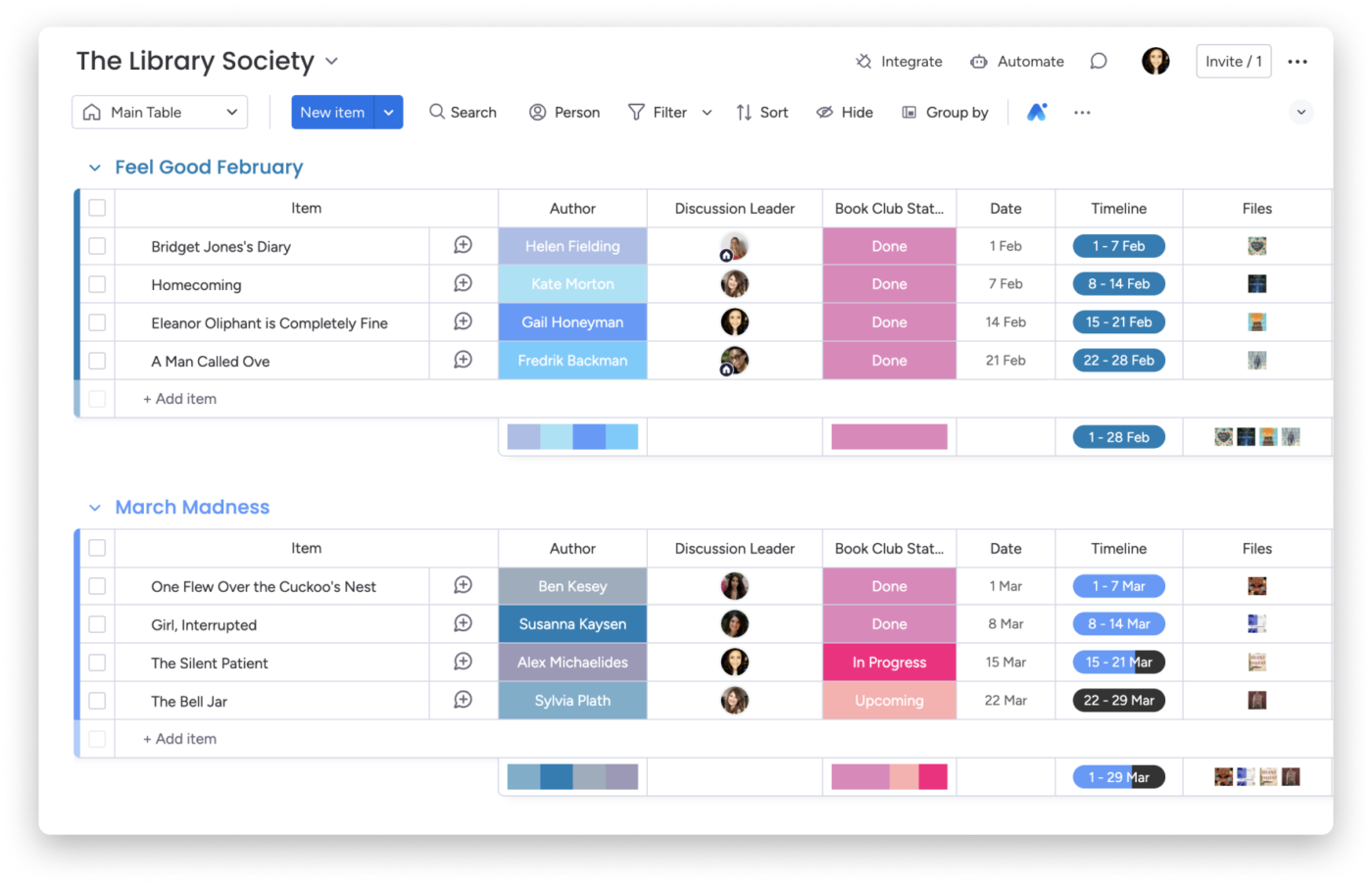
Why it’s #1: monday.com builds its entire product around the visual layer. Status columns use distinct color blocks by default. Project dependencies are clear. And the layout looks modern. It is the easiest tool to present during cross-functional meetings because the color-coded board logic is straightforward.
Honest take: The free tier operates as a limited trial. Capping the plan at 2 seats and 3 boards prevents actual team collaboration. At a 3-seat minimum on the $9 Basic plan, your true entry price is $27/month, a trade-off you accept for the visual polish.
Here’s what a G2 reviewer has to say about monday.com:
What I like most about monday CRM is its highly visual, customizable interface, which makes it easy to manage leads, sales pipelines, tasks, and team collaboration all in one place. The automation features help cut down on manual work, the dashboards give clear visibility into progress and performance, and the overall flexibility lets teams tailor the CRM to their specific business processes without a heavy technical dependency.
Best for: Teams that require strong visual Kanban boards alongside deep data and list views.
Free plan limits: Unlimited users, unlimited tasks, Board View, Calendar View, 60 MB storage.
Why it’s #2: ClickUp’s Board View manages Kanban workflows well. You can drag cards, group them by Custom Fields, and color-code them by status. It supports deep filtering, which allows you to simplify large projects by hiding specific data points. Unlike monday.com, ClickUp provides these visual List, Board, and Calendar views to unlimited users on its free plan.
Honest take: ClickUp trades monday.com’s out-of-the-box polish for configurability. The cleanest boards come after you set up your fields and statuses, not before. If you don’t standardize your custom fields and statuses, the visual views quickly become cluttered and confusing.
Best for: Small teams running straightforward, linear workflows like content pipelines or request queues.
Free plan limits: 10 boards per workspace, 10 collaborators per workspace, 250 automation runs per month.
Why it’s #3: Trello remains the standard for simple, card-based visual management. The interface focuses entirely on moving tasks from left to right across defined stages. It is completely intuitive, making it the fastest tool to deploy for teams that reject complex software.
Honest take: Visual management in Trello means Kanban cards exclusively. The free tier excludes Gantt charts, timelines, and advanced reporting dashboards. If your visual needs require tracking capacity, dependencies, or cross-project rollups, Trello will not support your workflow.
A G2 reviewer says:
I really love how customizable Trello is. It integrates well with other tools, like automation with Butler and syncing with Google Drive, which makes it fit into a broader tech stack. Trello’s visual board makes it easy to keep a scattered team aligned, helping remote members see who’s working on what, where bottlenecks are, and what’s next in the workflow. The initial setup was pretty straightforward, and it gave our small but growing team a simple way to stay organized as we scaled.
Almost made it: Smartsheet
Smartsheet’s grid-and-Gantt interface works well for teams transitioning from Excel spreadsheets. However, following its late-2024 private equity buyout, enterprise buyers must carefully negotiate long-term pricing contracts to avoid unexpected cost increases.
Category winner: monday.com
If your budget allows, monday.com wins on pure visual polish and ease of presentation. Choose ClickUp if you need visual boards but require a generous free tier with unlimited users. Choose Trello if your visual needs are strictly limited to simple Kanban workflows.
Engineering teams live and die by issue tracking, sprint planning, and backlog grooming. General task tools can fake some of this. But formal Agile usually demands a platform built for it.
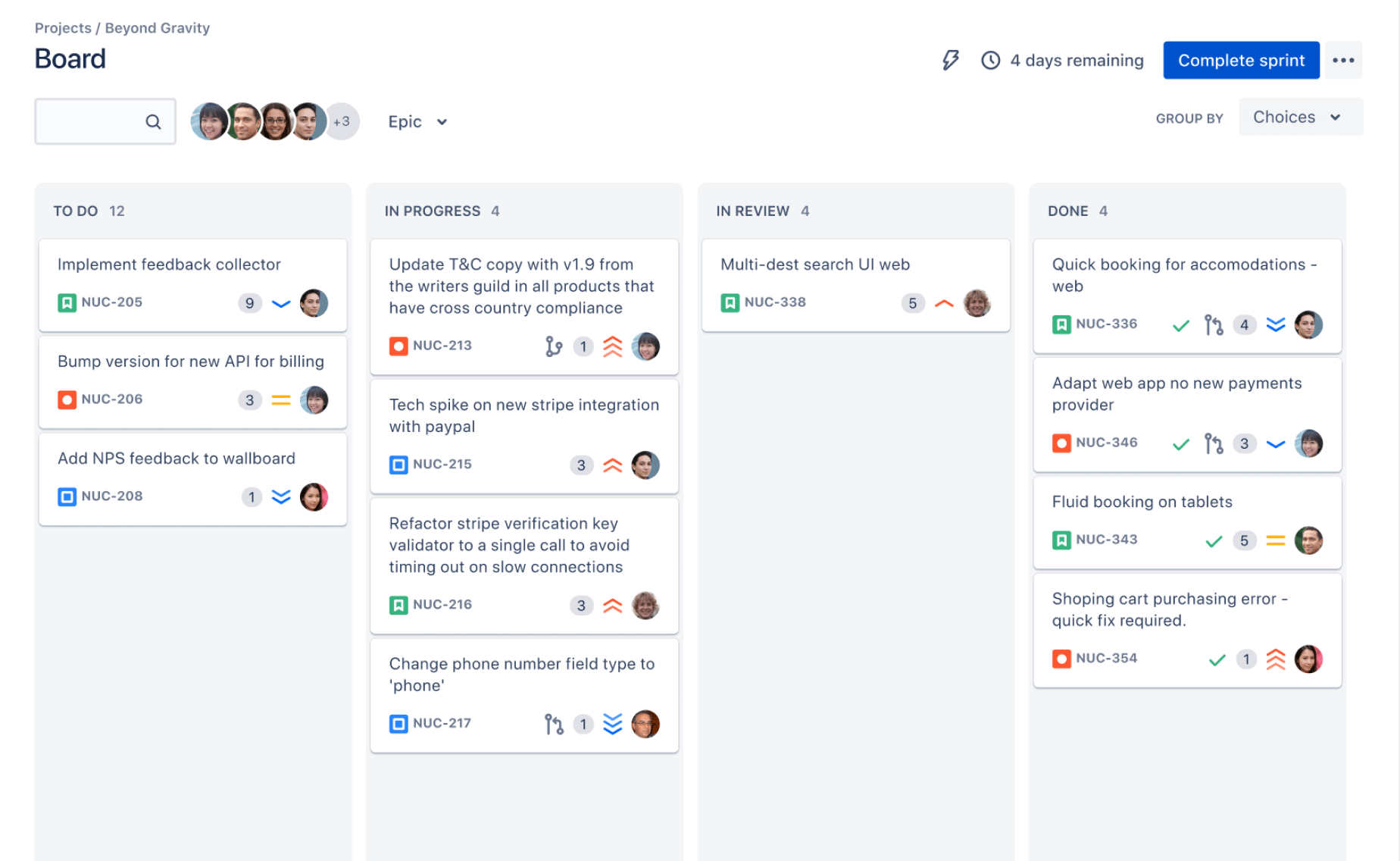
Best for: Engineering teams of any size running Scrum, Kanban, or scaled Agile frameworks.
Free plan limits: 10 users, unlimited projects, 2 GB storage, 100 automation runs per month.
Why it’s #1: Jira uses the core vocabulary of software development. Epics, user stories, sprints, story points, and burndown charts are native to the platform. It integrates directly with Bitbucket, GitHub, and CI/CD pipelines. Jira Query Language (JQL) allows for complex ticket filtering that no other tool on this list replicates.
Honest take: Jira is complex for non-engineers. The interface is dense and leans entirely on technical vocabulary, so marketing or ops teammates pulled into a board tend to stall out. The setup assumes you already think in epics and sprints. And the free tier’s 10-user cap means a growing eng org hits a wall right as cross-team collaboration starts to matter. It’s unmatched for developers and actively alienating to everyone else.
This is what a G2 reviewer thinks about Jira:
What I like most about Jira is its strong agile project management features and highly customizable workflows. It keeps sprint planning, bug tracking, and day-to-day task management well organized. The reporting dashboards, along with integrations with development tools, also make it easier for the team to track progress and collaborate more efficiently.
Best for: Engineering teams that collaborate closely with marketing, design, and product management.
Free plan limits: Unlimited users, Sprint Lists, Sprint Points, 60 MB storage.
Why it’s #2: ClickUp supports core Agile functions inside a general workspace. You can create Sprint Lists, estimate effort with story points, and run Kanban boards alongside marketing campaign trackers. It connects with GitHub and GitLab to bridge code deployment with cross-functional task tracking. The Business plan unlocks sprint automations, burndown cards, and velocity reporting.
Honest take: ClickUp is not a direct Jira replacement for enterprise software teams. The Sprint Points cap applies to both the Free Forever and Unlimited plans, so active engineering teams must upgrade to the Business plan for unrestricted use. Also, setting up velocity tracking requires manually configuring custom fields. And the native reporting lacks Jira’s depth. It can’t support advanced Scaled Agile Frameworks (SAFe) out of the box.
Best for: Product teams that follow general Agile principles without strict Scrum rituals.
Free plan limits: 2 users for new accounts, list/board/calendar views, no automations.
Why it’s #3: Asana’s structured interface works well for high-level product roadmaps and feature planning. The clear ownership model helps product managers assign deliverables and track quarterly progress.
Honest take: Asana is not a developer tool. It lacks native story points, sprint structures, and burndown charts. You must build these manually using custom fields. The same 2-user free cap applies here, so you’re on a paid plan from day one. It works best for high-level product management when paired with an execution tool like Jira or Linear.
Almost made it: Trello
Small development teams often use Trello boards for lightweight Kanban via the GitHub integration. This setup works for teams of 2 to 4 people shipping simple features. However, it fails once you require formal sprints or backlog grooming.
Category winner: Jira
Jira wins for software development because its Agile features are native rather than retrofitted. Choose ClickUp if your engineers must share a workspace with non-technical departments. Choose Asana only for high-level product management while keeping code execution in a dedicated developer tool.
Due dates alone don’t cut it once work moves in sequence. When one task slips, every task downstream has to move with it, automatically. That’s why this category lives or dies on Gantt charts, critical path highlighting, and drag-to-reschedule.
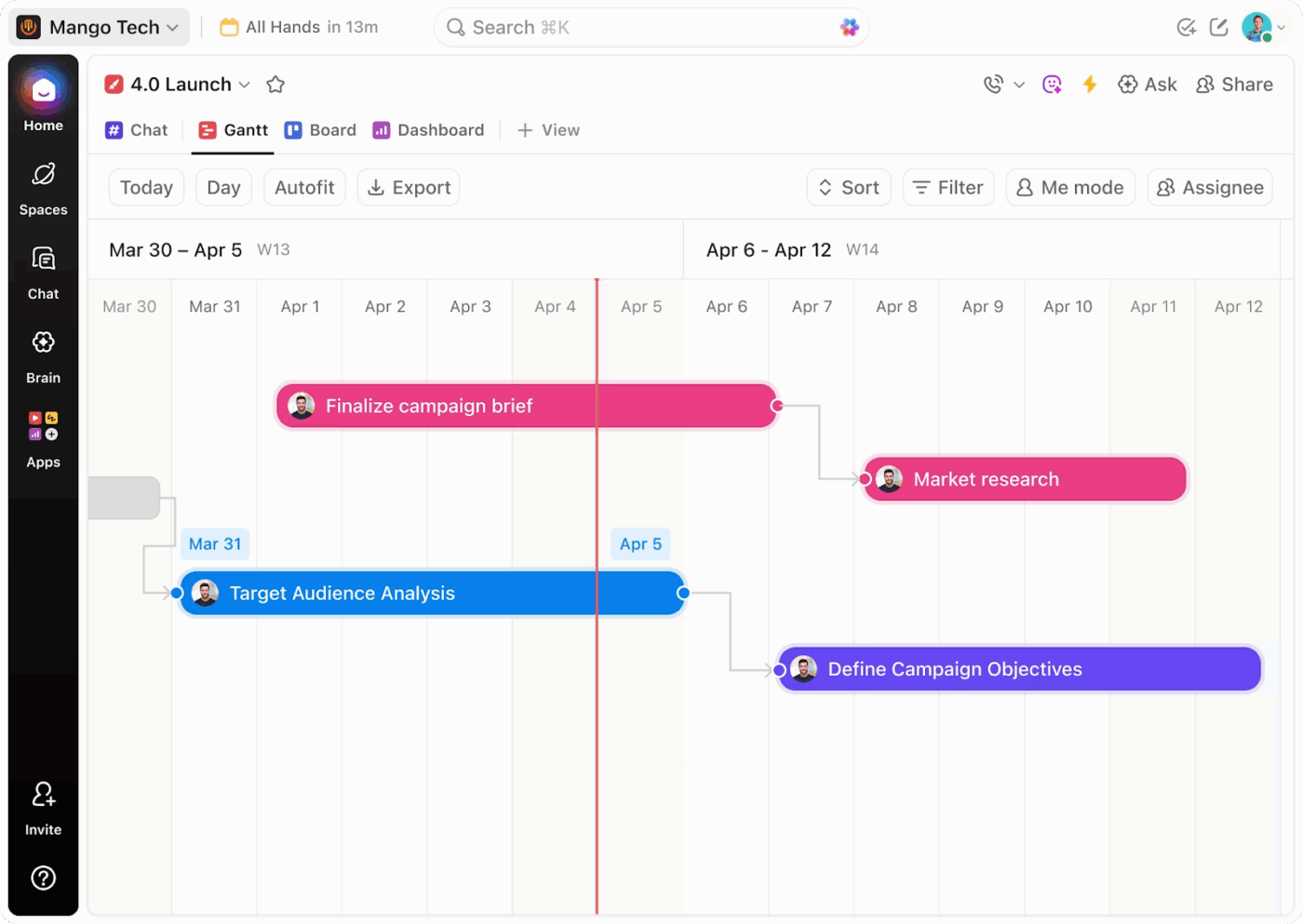
Best for: Operations teams and project managers running waterfall or hybrid methodologies.
Free plan limits: Unlimited users, 60 uses of Gantt View, and 60 uses of Timeline View.
Why it’s #1: No other major tool puts functional Gantt charts on a free plan; ClickUp does. You get start-to-finish dependencies, critical path calculation, and cascading schedule adjustments. If a task is delayed by three days, dragging it on the timeline automatically pushes back all downstream dependent work.
Honest take: The 60-use cap is a lifetime limit, which means the free tier serves as a temporary trial for continuous timeline management. Regular users must upgrade to a paid plan. However, because competitors block timeline views entirely on free tiers, ClickUp’s entry price provides deep feature access for a lower cost.
Best for: Teams running multiple simultaneous projects where executive presentation is critical.
Free plan limits: Timeline and Gantt views are completely locked.
Why it’s #2: The platform’s Timeline view provides a clean visual experience. Project dependencies render as clear, color-coded arrows, and the interface allows seamless zoom transitions between daily and quarterly views. This design makes it an effective Gantt alternative for stakeholder reporting.
Honest take: Accessing the Timeline view requires the Standard (paid) plan, which enforces a strict 3-seat minimum. A team of five pays $60 per month for the timeline features ClickUp includes on its lower tiers. And the 3-seat minimum means you can’t shrink your way out of it. The Gantt view simply isn’t available until you clear that floor.
Best for: Cross-functional operations teams that track projects against high-level company objectives.
Free plan limits: Timeline view is completely locked.
Why it’s #3: Asana’s Timeline view integrates directly with its Portfolios and Goals features. This connection helps leadership see exactly how a timeline delay on a single project impacts broader corporate goals across the organization.
Honest take: Asana locks its Timeline feature behind the paid Starter plan, with no free tier for schedule visualization. In addition, its Gantt layout lacks the flexibility of traditional, dedicated project management tools.
Almost made it: Wrike and Smartsheet
Both platforms offer enterprise-grade Gantt functionality but impose strict billing terms. Wrike’s Team plan caps at 15 users, forcing larger groups to upgrade to the Business tier. Smartsheet is ideal for spreadsheet-based operations. But corporate buyers should secure long-term price locks.
Category winner: ClickUp
ClickUp wins because it is the only platform providing actual Gantt functionality without an upfront paywall, which creates the lowest barrier to entry for timeline-driven work. Choose monday.com if visual presentation during meetings is your main goal and you have the budget. Choose Asana only if your organization relies strictly on their Portfolio and Goals tracking features.
For agencies and freelancers, tracking tasks means tracking revenue. If you use a separate app for your timer, you will forget to log hours. The best tools put the timer directly inside the task itself.
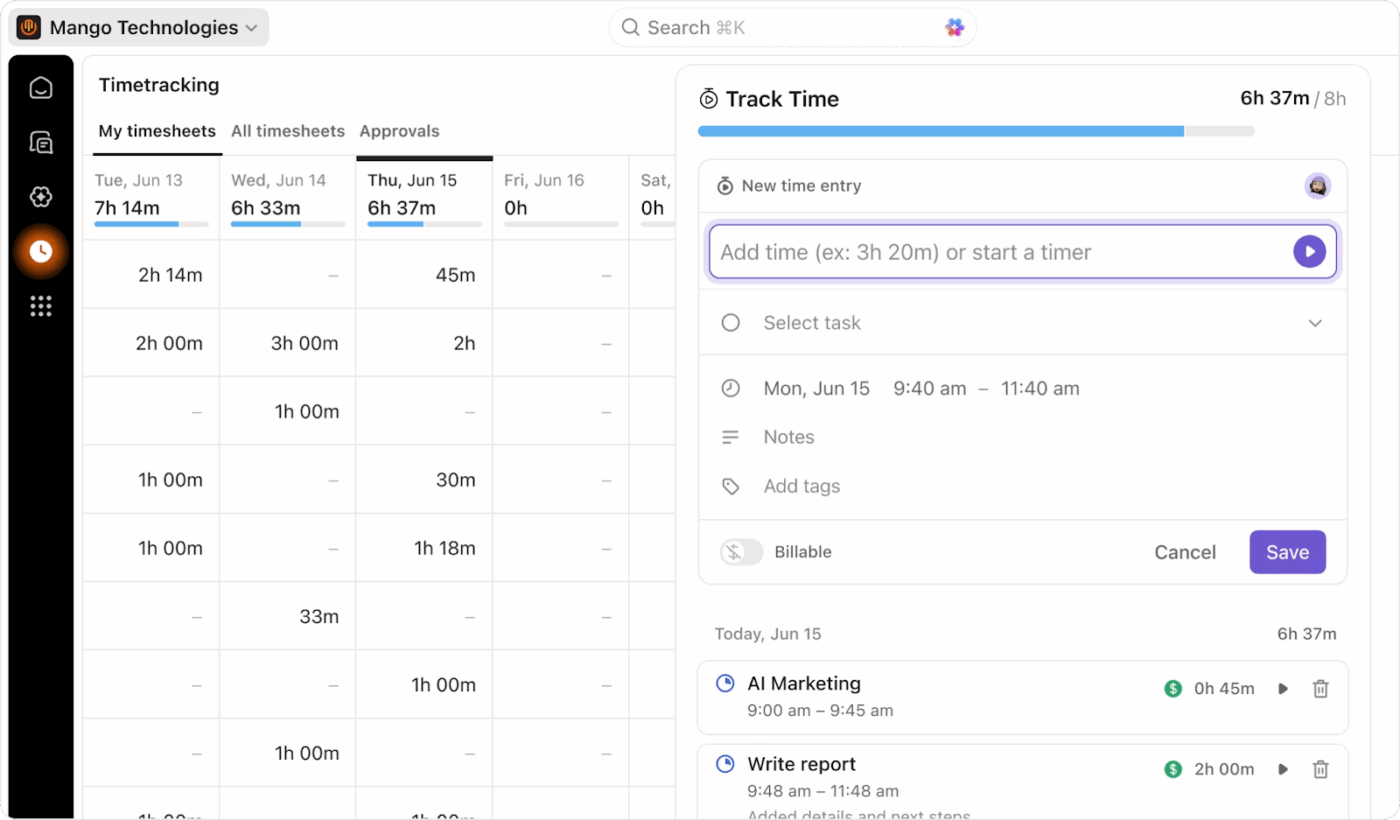
Best for: Agencies and freelancers who bill by the hour.
Free plan limits: Unlimited users, basic time tracking.
Why it’s #1: ClickUp puts a start and stop button inside every task. The Unlimited plan gives you unlimited time logs. The Business plan lets you add notes to your time, mark hours as billable, and compare estimates to actual work. No other tool moves as smoothly from free tracking to full agency tools.
Honest take: You will hit the free usage limit in a few weeks. The Unlimited plan removes that ceiling and covers most freelancers’ needs. To tag hours as billable and build invoicing workflows, you must pay for the Business plan. This is a big price jump for solo users. Also, ClickUp is not billing software. For heavy invoicing, you must connect it to tools like Harvest or QuickBooks.
Best for: Solo freelancers who already use timers like Toggl or Clockify.
Free plan limits: 5 active projects, no built-in time tracking.
Why it’s #2: Todoist does not have its own timer. Instead, it links directly with Toggl and Clockify. You can start a timer inside a Todoist task, and the data flows right into your billing app. This pairs Todoist’s fast task capture with dedicated money reports.
Honest take: This system breaks if you have a team. It only works well for solo users. If you need to see time sheets for multiple contractors, this setup will fail.
Best for: Software agencies that need to track time on specific technical issues.
Free plan limits: 10 users, basic time fields only.
Why it’s #3: Jira has simple time logs on its own, but you can buy a tool called Tempo from its app store. Tempo gives you deep charts, timesheet approvals, and billing links inside Jira. It is the best way to track developer hours.
Honest take: Tempo costs $100/year for teams of up to 10 users, which is affordable at a small scale. The cost problem starts when you outgrow Jira’s free tier. At 11+ users, the additional cost only makes sense if your team already uses Jira.
Almost made it: Teamwork
Teamwork is built for client work. It includes built-in timers, billable rates, and direct invoices in one place. It loses to ClickUp on general use, but wins if your business model relies entirely on billable hours.
Category winner: ClickUp
ClickUp wins because it puts the timer in the task. You don’t need extra apps or costly add-ons. Choose Todoist if you work alone and already pay for Toggl. Choose Jira only if you run a software agency and can pay extra for Tempo.
Automation kills the busywork. Hand those to the software, and the team moves faster. The test is whether a non-technical teammate can build a rule without filing a ticket to IT.
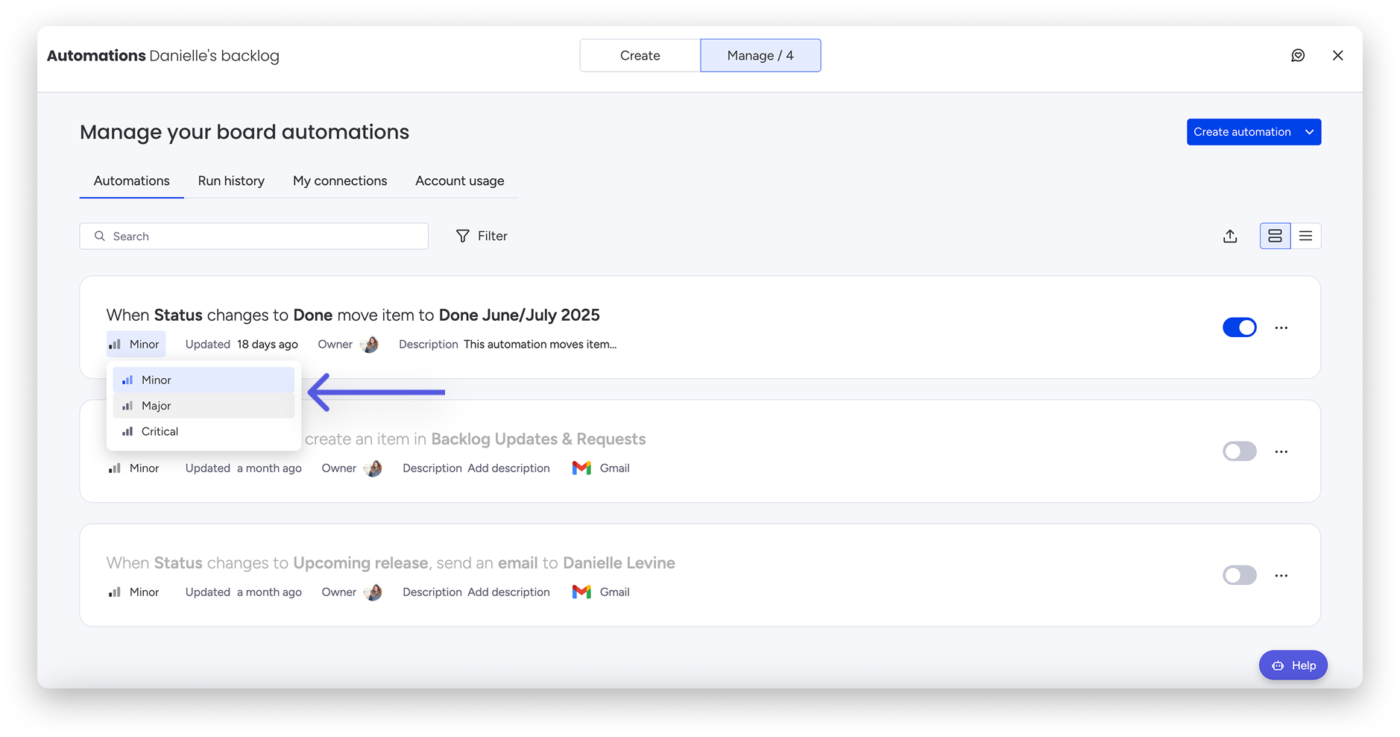
Best for: Operations, HR, and marketing teams that want to build workflows without code.
Free plan limits: No automations included.
Why it’s #1: monday.com makes automation easy. The tool uses plain-English phrases like ‘When status changes to Done, notify person.’ It comes with 250 ready-to-use templates that connect to Slack, Gmail, and Salesforce. A marketer can set up a clear handoff rule in under a minute.
Honest take: Watch the run limits. The Standard plan gives you 250 automation runs per month account-wide, not per user. An active team will use this up in a few days. You will then have to buy the more expensive Pro plan to keep your rules working.
Best for: Teams that need flexible, multi-step automations.
Free plan limits: 100 automation runs per month, capped at 5 total active automations.
Why it’s #2: ClickUp gives you more raw power than monday.com. You can build rules based on precise details, like date changes or subtask completions. ClickUp gives you 100 free runs per month so you can test your rules before paying. The Unlimited plan bumps this to 1,000 runs.
Honest take: ClickUp’s automation builder trades a few minutes of setup for deeper logic than monday.com’s recipes. The payoff is more precise rules. The cost is a slightly longer learning curve. Non-technical users may need to consult the help guides to correctly set up complex rules, though the AI assistant (ClickUp Brain) can help create automation using conversational language.
Best for: Large teams with fixed, unchanging processes.
Free plan limits: 2 users for new accounts, no custom automations.
Why it’s #3: Asana’s rule builder is highly reliable for standard work. It is great for routing tasks, moving items between sections, and updating fields based on set actions. It keeps your team following the exact same process.
Honest take: The rule builder feels like old corporate software. It lacks the friendly look of monday.com. As with every category, the free tier’s 2-user cap applies. It is a solid tool, but not the right choice for quick, creative testing.
Almost made it: Smartsheet
Smartsheet handles spreadsheet-style rules and approvals very well. It matches monday.com in depth, but the screen looks a generation older.
Category winner: monday.com (with a major caveat)
monday.com wins on pure user experience. The recipe model is perfect for non-technical teams. However, the run limits are account-wide, so active teams will outgrow Standard fast. If you have a tight budget, ClickUp is the better choice because it offers more runs for your money. Choose Asana only if you need strict corporate rules.
For research and strategy teams, the document is the deliverable. When the work is writing, notes can’t be bolted on as an afterthought. These teams need tasks that live inside the page.
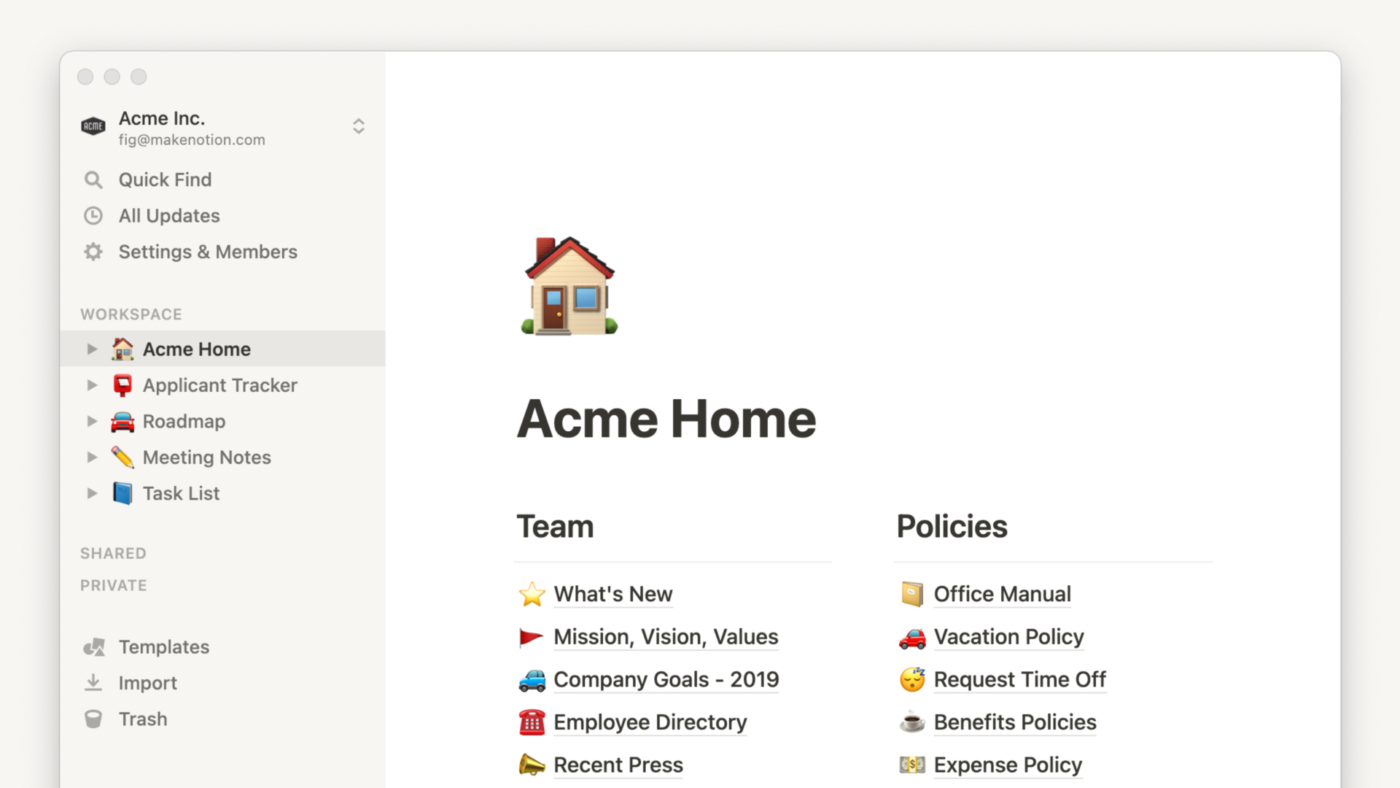
Best for: Writers, researchers, and teams that create text documents.
Free plan limits: Unlimited blocks for 1 user, block limit for 2+ users, 10 guests.
Why it’s #1: Notion flips standard tracking upside down. Tasks are just a part of the document. You can build lists that view as boards, calendars, or timelines right inside your meeting notes. This links your thoughts directly to your trackable work.
Honest take: The free plan only works well if you work alone. The moment you add a second person, you hit a strict 1,000-block storage cap. This turns the free plan into a very short trial for teams. It forces you to buy the paid Plus plan.
Hear about Notion from a G2 reviewer:
I have been using Notion at for organizing my work. It has been really helpful to track various tasks in my projects, along with time line and due dates. I heavily use the code blocks to store versions of code. It easily and swiftly handles thousands of lines of code. This I haven’t found in any app. The new feature that collects all tasks at one place has been amazing. It really helps.
Best for: Teams that need deep project tracking alongside long, nested wikis.
Free plan limits: Unlimited users, unlimited Docs, 60 MB storage.
Why it’s #2: ClickUp has a separate doc tool that matches top word processors. You can make sub-pages, write with others live, and place task lists inside the text. You get great writing tools without losing your heavy project dashboards and data reports.
Honest take: ClickUp keeps Docs and tasks in distinct zones. It’s a trade-off that favors heavy project tracking over inline note-taking. For dropping a quick checklist into the middle of a long note, Notion’s blended model feels faster.
Best for: Operations teams that need quick context without building a giant company wiki.
Free plan limits: 2 users for new accounts, basic text briefs.
Why it’s #3: Asana gives you ‘Project Briefs’ that sit right next to your task lists. This gives you a small space to list goals, attach files, and write quick text updates without leaving your main work board.
Honest take: The writing tool is bare. It lacks subpages, complex tables, and wiki layouts. If your team writes all day and links deep notes together, Asana will feel too small almost instantly.
Category winner: Notion (for solo users) or ClickUp (for teams)
Notion wins because it turns the text page into your main workspace. However, its block limit forces teams to pay fast. Choose ClickUp if you work in a team and want text separate from heavy task data. Choose Asana only for short project summaries.
Whatever software you use, leadership eventually needs numbers. Good tools turn that raw activity into live charts and cross-project roll-ups without requiring a CSV export. This separates a tool that scales from one that the team abandons.
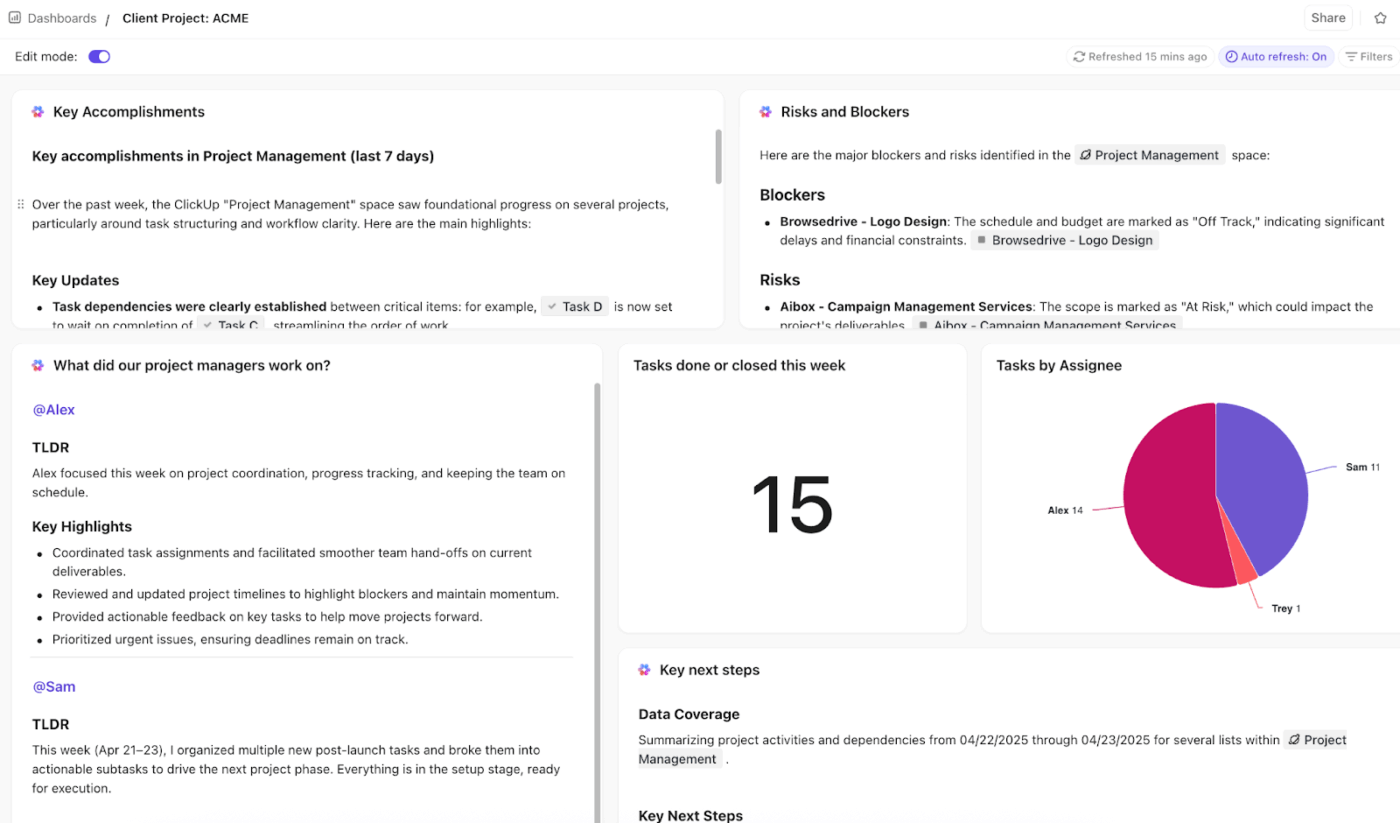
Best for: Project managers who need deep, widget-based reports.
Free plan limits: Unlimited users, 60 lifetime dashboard uses.
Why it’s #1: ClickUp gives you the best built-in charts without forcing you to pay right away. You can build dashboards with over 50 card types. These include sprint burndowns, time logs, math calculators, and bar graphs.
Honest take: The 60-use free limit is a lifetime cap, and every action counts toward it. Heavy users will exhaust it within days. The Unlimited plan only bumps this to 100 lifetime uses. For ongoing reporting, you need the Business plan. Also, because it has so many cards, building a clean screen takes time. You must first know your exact goals. It is not a one-click setup.
Best for: Operations teams that manage dozens of active projects for executives.
Free plan limits: 2 users for new accounts, very basic charts.
Why it’s #2: Asana’s Portfolio tool is strong for corporate tracking. It lets bosses see progress, risk, and status updates across many projects in one clean view. The data is neat, which makes it easy to spot late work across a whole department.
Honest take: Asana blocks reports on its free plan. To use reporting dashboards, you must buy the Starter plan. It is a strong tool for large companies, but it offers almost no value to free users as far as reporting is concerned.
Best for: Teams that show quick status updates to non-technical leaders.
Free plan limits: 2 users, 1 board per dashboard.
Why it’s #3: monday.com excels at look and feel. Its dashboard cards are colorful, clean, and easy to drag into place. If you need to show charts in a weekly board meeting, these look better out of the box than any other tool.
Honest take: This is the priciest route to reporting, and you’re paying mostly for polish. To open the full tool library, you must buy the Standard plan, which unlocks full dashboards. Even then, you can’t slice the data as deeply as ClickUp lets you.
Almost made it: Smartsheet and Wrike
Smartsheet links separate grids well, which helps finance and tech teams manage raw data. Wrike also offers great tracking charts for large teams. Both are strong corporate options if you have the budget, and check their billing rules.
Category winner: ClickUp
ClickUp wins because it offers the most chart options and makes them available on its cheapest tiers. Choose monday.com if visual looks are your top goal and cash is not an issue. Choose Asana only if you manage giant projects and can pay high rates.
Requests that come in over email or Slack get lost. And they always arrive missing half the details you need. Ops, HR, and marketing teams need one front door instead. The best tools hand you a form that turns each request into a trackable task on submit.
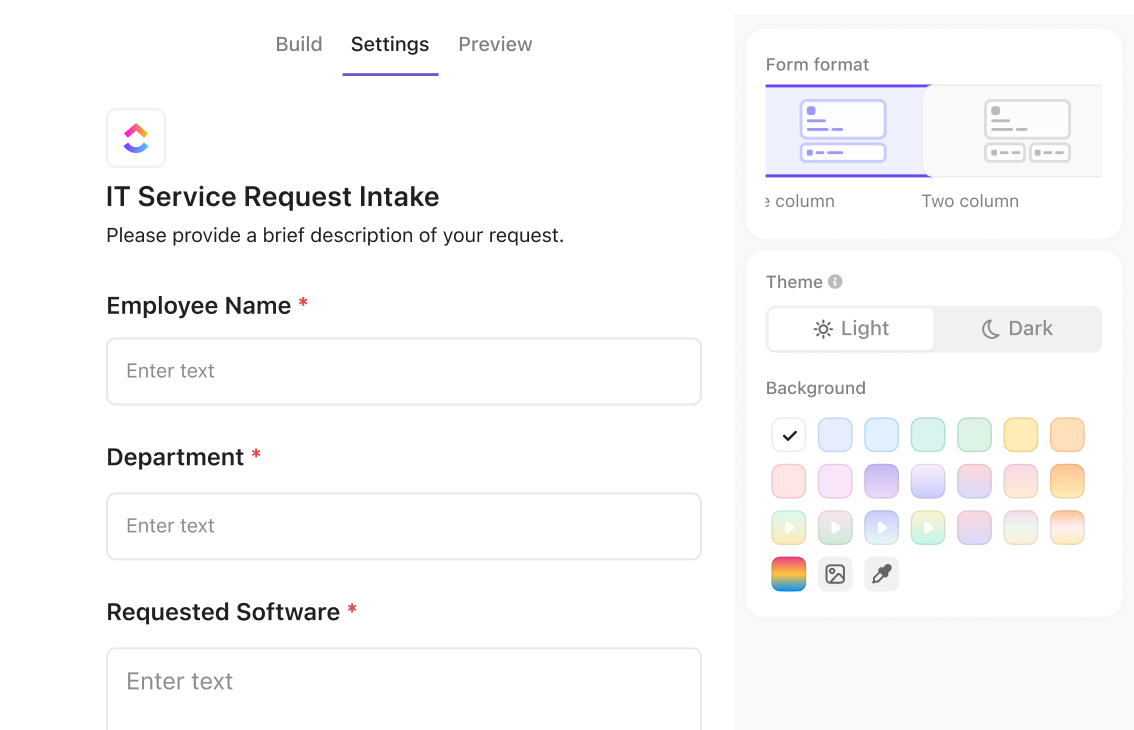
Best for: Operations teams that need to fix how people submit requests.
Free plan limits: Unlimited users, 1 active form.
Why it’s #1: Among the major tools, only ClickUp ships built-in forms on a free plan. Form entries turn into tasks instantly. The tool maps answers to custom fields, assigns owners, and sets statuses. Paid plans unlock conditional logic, which hides or shows fields based on past answers.
Honest take: The free tier limits you to one single form. You must choose a paid plan if you handle multiple request types, such as IT tickets and marketing briefs. Also, conditional rules are paywalled, which forces teams with complex workflows onto higher-priced plans.
Best for: Teams that run strict request processes for specific projects.
Free plan limits: 2 users for new accounts, forms are completely locked.
Why it’s #2: Asana’s form builder looks clean and is easy to use. Paid plans include conditional fields, custom branding, and direct task creation out of the box. It works well for standardizing how a project receives work. This ensures you get the exact data you need.
Honest take: Free tiers get no form access at all. You must buy the Starter plan to use basic forms. Branching logic (conditional fields) requires the Advanced plan. Also, Asana ties forms to specific projects instead of your whole account. If you need one main help desk form that routes work to different boards based on text choices, Asana makes it hard.
Best for: Service teams and agencies that collect data from outside clients or vendors.
Free plan limits: 2 users, basic forms are free.
Why it’s #3: monday.com builds its WorkForms tool for outside presentations. It lets you create highly branded forms that look clean when placed on a public website. Entries flow right onto your boards, turning client responses into instant tasks.
Honest take: While basic forms are free, advanced rules like conditional logic are locked behind the Enterprise tier. This makes it hard for mid-sized teams to build dynamic question paths without a massive budget jump.
Almost made it: Wrike
Wrike handles complex forms and creative briefs very well for large design teams. If you run a creative agency with a huge volume of incoming briefs, check out Wrike despite its rigid user-bundle pricing.
Category winner: ClickUp
ClickUp wins because it gives you a working form builder for free and deep task links on paid plans. Choose monday.com if your form faces the public and brand design is your top goal. Choose Asana if you have the budget and want neat forms tied directly to ongoing projects.
Agencies and consultants don’t just track tasks. They sell their time. General project tools take too much work to set up for billable rates, client views, and profit tracking. The best tools treat outside clients as a main part of the software.
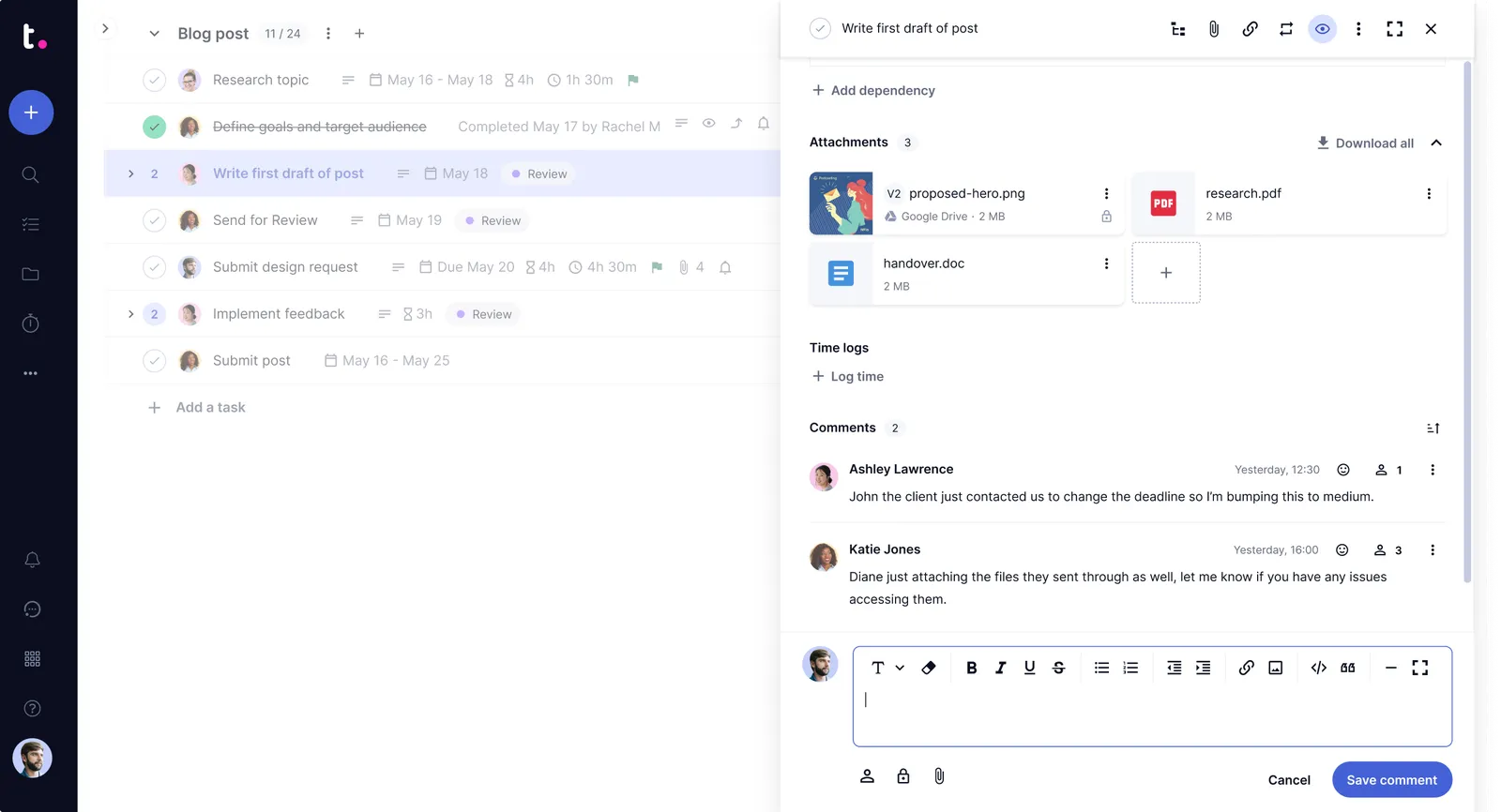
Best for: Client-services firms, dev shops, and marketing agencies that bill by the hour.
Free plan limits: 5 users, 2 projects, basic time logs, client groupings, 100 automations.
Why it’s #1: Teamwork is the only tool made just for billable client work. It treats ‘Clients’ as a main bucket for your work, not as a custom label hack. It features built-in timers with billable rates, profit dashboards, and direct invoices. You buy a full agency tool, not just a task board.
Honest take: It lacks the general flexibility of ClickUp and the bright look of monday.com. If your agency moves away from hourly fees toward flat-rate packages, Teamwork’s focus on time sheets can feel tight. The full client tools require the paid Deliver plan.
This is what a G2 reviewer has to say about Teamwork:
I can place repeating tasks into a template to facilitate the process and I can quickly add this task list to a project, which can be customized to each project. Teamwork seamlessly integrates with Google Drive and Slack which I used in my organization, helps me save time in communication and sharing files and assigning tasks.
Best for: Small agencies that want to build a custom client setup from scratch.
Free plan limits: Unlimited users, 100 time-tracking uses, 60 MB storage.
Why it’s #2: ClickUp lets you customize your client spaces deeply. You can give entire zones to specific clients, build charts to track team use, and use the built-in timer for hours. The Unlimited plan opens up guest settings so clients can see their work without seeing your internal notes.
Honest take: You must build the agency system yourself. Because ClickUp is a general tool, you have to add your own custom fields for billing and create reports by hand. Guest rules and rate tracking require paid plans, with full cash tools on the Business tier.
Best for: Large consulting firms that manage big projects and executive reports.
Free plan limits: 2 users for new accounts, no portfolio tracking.
Why it’s #3: Asana’s Portfolio tool is great for packing dozens of active client projects into one clean screen. The guest user setup is also neat. It lets you invite clients into specific projects safely without opening up the rest of your company’s workspace.
Honest take: Asana has no built-in timers or invoice tools. You must pay for extra apps to handle your billing. Also, Portfolios are locked behind the costly Advanced plan. It tracks tasks well, but manages a client’s business poorly.
Almost made it: Wrike
Wrike is a powerful choice for design agencies. Its built-in proofing tools, approval steps, and Adobe links make it a top choice for teams that ship creative files, if you can afford their rigid seat bundles.
Category winner: Teamwork
Teamwork wins for agencies because it handles the daily facts of billable-hour client work right out of the box. Choose ClickUp if you want a fully custom, general tool and do not mind building your own billing steps. Choose Asana only if you are a large firm that needs high-level charts and already uses separate billing software.
When your team is spread across time zones, you can’t unblock work with a quick meeting. The work has to carry its own context: thorough notes and clear comment threads. Done right, things keep moving even while half the team is asleep.
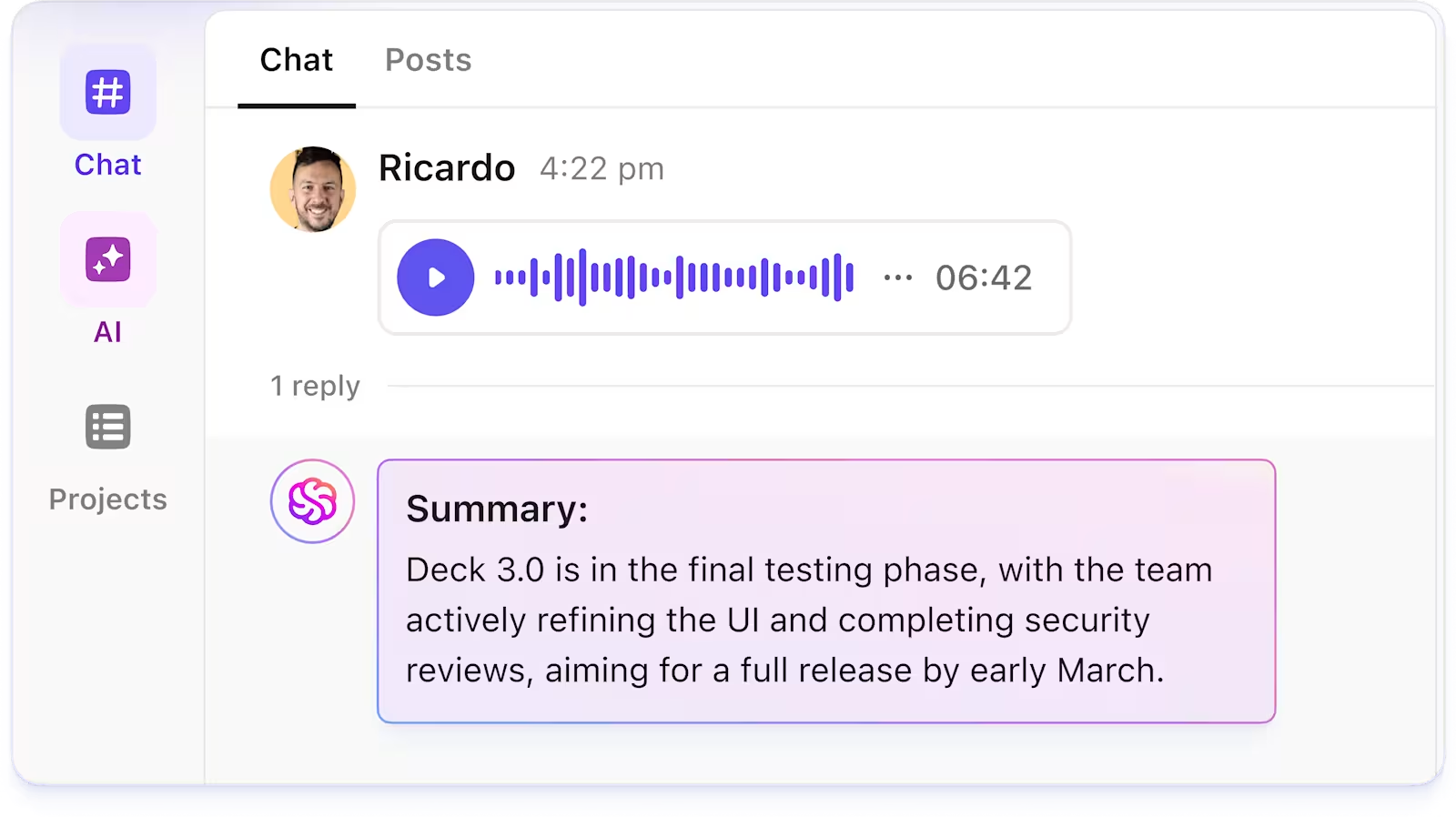
Best for: Remote teams that need clear task context and built-in video links.
Free plan limits: Unlimited users, threaded task comments, limited screen recording.
Why it’s #1: ClickUp cuts down on live meetings by putting tools right inside your tasks. The built-in ‘Clip’ tool lets you record your screen and drop the video straight into comments. This saves you from buying separate video apps. The Unlimited plan adds a native Chat board to keep team notes next to your work.
Honest take: Using a task tool for all chats takes a lot of team rules. Chat on the free plan is capped at 1,000 lifetime messages, so most teams will need the Unlimited plan for practical use. If your team keeps using Slack for project notes, ClickUp’s chat boxes will just become an ignored inbox.
Best for: Remote teams that choose long text notes over quick updates.
Free plan limits: Block limit for teams, 10 guests.
Why it’s #2: Notion works well for remote teams because it forces people to write things down. In a Notion culture, written briefs replace kickoff calls and shared pages replace daily meetings. Since tasks live inside these rich documents, anyone waking up in a new time zone has the full facts to start work fast.
Honest take: Notion lacks strong pop-up alerts and built-in chat. This makes it hard to handle urgent, time-sensitive roadblocks. Also, the team block limit on the free plan means groups must upgrade to the Plus plan right away to work together well.
Best for: Distributed operations teams requiring rigid accountability and clear task transitions.
Free plan limits: 2 users for new accounts.
Why it’s #3: Remote work breaks down when ownership is unclear. Asana enforces a strict ‘one assignee per task’ rule, ensuring there is never confusion about who is responsible for the next step. Its built-in ‘Project Updates’ feature also allows managers to broadcast structured status reports async, keeping stakeholders informed without requiring a sync call.
Honest take: Asana provides fewer native async tools than its competitors. There is no built-in screen recording, and the comment threading is less robust than ClickUp’s. Coupled with the strict 2-user free tier limit, it is a rigid, premium-priced solution for remote coordination.
Almost made it: Hive
Hive blends team text chat and task tracking into one app, using a chat screen that matches Slack. It is a solid pick for teams under 30 people who want to combine their software, though it lacks ClickUp’s deep task dashboards.
Category winner: ClickUp
ClickUp wins because it builds video recording, chat, and comment threads right into your tasks, which cuts down on live meetings. Choose Notion if your remote culture relies on long written docs. Choose Asana if single task ownership and clean handoffs matter most to your team.
Operations run on repeatable steps, fixed setups, and handoffs nobody has to think about. These teams need clear task ownership plus a high-altitude view for leadership. Here, strict and predictable beats flexible and free-form every time.
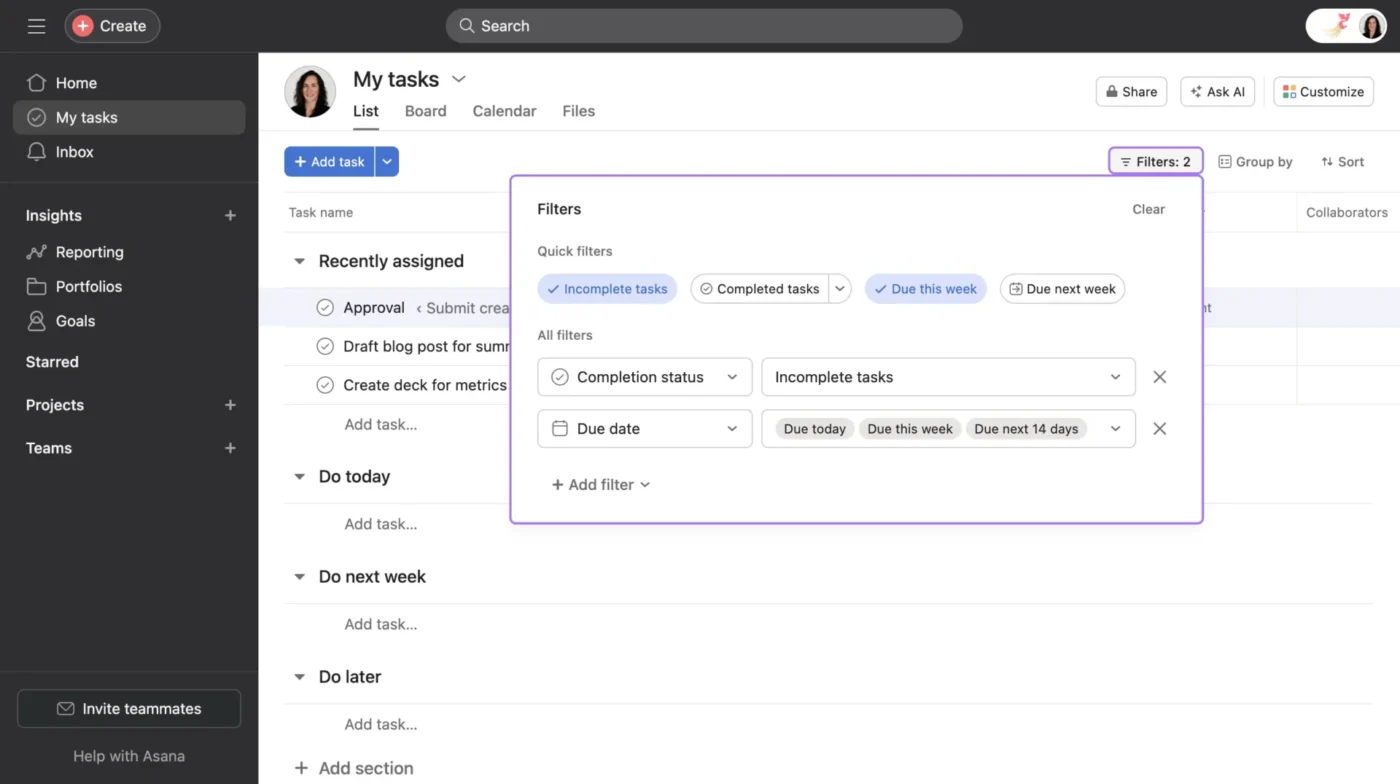
Best for: Operations teams that manage regular, process-heavy workflows.
Pricing limits: Custom rules and form triggers require a paid plan.
Why it’s #1: Asana allows only one owner per task. This rule keeps work from stalling due to mixed ownership. The app uses clear due dates and fixed handoffs. The built-in ‘Project Updates’ tool creates a steady path for weekly reports, which lets ops managers send status changes to bosses fast.
Honest take: The app’s tight layout can cause friction for fast-moving or creative teams. It lacks the deep data setup needed to build custom internal databases. You must change your daily work steps to match Asana’s exact layout to get the most value from it.
Here’s what a G2 reviewer likes about Asana:
What I like most about Asana is how it keeps everyone aligned and organized. It provides clear visibility into projects, makes task ownership simple to track, strengthens collaboration across teams, and reduces confusion around deadlines and priorities. The different project views and automations also help make workflows more efficient, smoother to run, and easier to manage overall.
Best for: Ops teams that manage complex tasks and need to track deep custom data.
Pricing limits: The Unlimited plan opens up 1,000 runs and custom fields. Full charts require the Business plan.
Why it’s #2: ClickUp gives huge workspace depth to ops managers. You can build custom intake forms, track time, and set up multi-step rules across many departments in one account. The highly custom dashboard layer lets teams track slow tasks and team loads in real time.
Honest take: The tool chooses maximum freedom over strict rules. If your team lacks good work habits, the software will not force them on you. Admins must actively lock down permissions, set required fields, and build workspace rules to prevent messy data tracking.
Best for: Operations teams that report directly to non-technical business bosses.
Pricing limits: Full automation rules require the Basic plan with a 3-seat minimum.
Why it’s #3: The app maps out operational facts very well. The chart layer turns complex task links and team limits into clean, simple graphs. Top bosses can see the status of a major company push instantly during a big team meeting.
Honest take: The platform relies heavily on its automation engine to keep tasks moving, and those rules eat through your monthly account limits fast. Operations teams with a huge volume of daily tasks often face forced, costly upgrades just to keep their workflows running.
Almost made it: Smartsheet and Zoho Projects
Smartsheet works well for ops teams that choose spreadsheet grids and need complex approval steps. Zoho Projects is a strong pick if your company already uses other Zoho tools, like their CRM or desk apps, for daily operations.
Category winner: Asana
Asana wins for structured operations because it forces the clear task ownership that ops teams need. Choose ClickUp if your work demands highly custom data tracking and more flexible setups. Choose monday.com if your top goal is showing clean data charts to executive leadership.
A good free plan should run your work, not nag you toward an upgrade. The tools below offer useful features. The difference between a real free tier and a glorified trial is whether you hit a wall on day one or day never.
Best for: Growing teams that need a shared workspace without paying seat fees.
Free plan limits: 60 MB storage, 100 time-tracking uses, 100 automation runs.
Why it’s #1: ClickUp gives you the most room to grow without paying. It includes unlimited users, unlimited tasks, built-in document tools, and multiple project views. A new company can run its entire business, from marketing timelines to product roadmaps, completely for free.
Honest take: The free tier’s 60 MB storage suits task data, not a media library. Teams uploading PDFs, design files, or videos will want to link out to cloud storage. Your team must rely on outside cloud links like Google Drive to keep the workspace usable over time.
Best for: Small groups that need to organize basic, step-by-step tasks fast.
Free plan limits: 10 boards, 10 total collaborators, 250 automation runs per month.
Why it’s #2: There is almost nothing to learn. The free plan allows unlimited Power-Up links. This lets teams connect their boards straight to tools like Slack or Google Drive without a paywall. It provides instant value for content pipelines and simple request queues.
Honest take: The 10-board limit stops you from separating your workflows as your business grows. Trying to manage separate departments or multiple clients inside this cap leads to messy, crowded boards. Also, you face a hard stop if you hit 11 total users.
Best for: Solo founders and small partnerships that want a highly polished screen.
Free plan limits: 2 users, basic list and board views, no timeline access.
Why it’s #3: The app feels smooth, fast, and responsive. It organizes your daily workload cleanly and makes clicking through deep project steps easy. It is a great space to track big goals alongside your daily to-do lists.
Honest take: The strict 2-user limit rules it out for standard teams looking for free software. It works only as a premium daily planner for individuals or two-person teams.
Category winner: ClickUp
ClickUp wins the free category because it gives you the highest user and tool limits for zero dollars. Choose Trello if you want a basic visual board to organize a small group right away. Choose Asana only if your team has exactly two people and you value a clean look over advanced features.
Enterprise task management focuses on security, scale, and compliance. Procurement teams judge these platforms based on single sign-on (SSO) tools, where data is stored, audit logs, and vendor stability.
Best for: Large companies that deploy software to thousands of non-technical users.
Pricing limits: Custom quoted by sales.
Why it’s #1: Asana gives large IT teams the deep control they need. It includes SAML SSO, user provisioning, and clear data storage options. Its main report engine gives executives a steady, uniform view of major corporate steps across marketing, HR, and operations.
Honest take: True compliance features are locked behind high tiers. While the basic Enterprise plan covers standard safety certificates like SOC 2, you must buy the more expensive Enterprise+ package if your company requires HIPAA data protection or strict leak prevention tools.
Best for: Huge engineering groups that use scaled agile frameworks.
Pricing limits: Premium costs $14.54 per user per month. Enterprise requires a custom quote.
Why it’s #2: Jira Premium brings you advanced roadmaps, project archiving, and a guaranteed 99.9% uptime backup rule. The Enterprise tier supports unlimited site setups and global data storage locations, which makes it the standard choice for heavy software development and code tracking.
Honest take: Atlassian holds a tight grip on enterprise developer tools. Since they ended their old Server products, teams have had to move to the cloud. Corporate buyers must prepare for regular price hikes of 5% to 15% during annual contract renewals.
Best for: Businesses trying to combine their software tools across tech and marketing teams.
Pricing limits: Custom pricing
Why it’s #3: ClickUp provides a single space that both developers and creative teams can alter for their own tasks. This cuts down on the total number of apps you have to buy. The tier includes legal service agreements, custom branding, and HIPAA tools right out of the box.
Honest take: The tool has a shorter track record with massive groups of over 5,000 users when compared to older rivals. Enterprise tech buyers often require long test periods to prove the system can handle the load before rolling it out to the whole company.
Almost made it: Wrike and Smartsheet
Wrike handles large design tasks well, but forces buyers into rigid contract blocks where you pay for empty seats. Smartsheet is great for regulated industries, but its private equity buyout means buyers must negotiate hard to lock in steady rates before pricing changes.
Category winner: It depends heavily on your team layout
Choose Asana Enterprise for large corporate rollouts outside of engineering teams. Choose Jira Premium or Enterprise for massive software development groups. Choose ClickUp Enterprise if you want to replace multiple separate tools with one shared platform. Use Wrike for complex design briefs, or Smartsheet for heavy spreadsheet tracking.
Task management tools look similar on pricing pages. But their free tiers break in very different places. This table compares each tool by its strongest fit, free-plan advantage, and main limitation. It will help you shortlist faster.
| Tool | Best for | Free-plan strength | Main free-plan limit |
|---|---|---|---|
| ClickUp | Growing teams and complex workflows | Unlimited users and unlimited tasks in one workspace | 60 MB storage; 100-use caps on time tracking and dashboards (lifetime, does not reset) |
| Todoist | Solo task capture | Fast natural language input | 5 active projects; no custom reminders |
| Trello | Simple visual workflows | Zero learning curve and unlimited Power-Ups | 10 boards and 10 collaborators per workspace |
| Asana | Structured operations | Polished UX with strict task ownership | Strict 2-user limit on new free accounts |
| Notion | Docs-first teams and researchers | Unlimited blocks and pages for solo users | 1,000-block limit the moment a second team member joins |
| Jira | Agile software engineering | Unlimited projects and 2 GB storage | 10-user cap; extremely dense for non-engineers |
| monday.com | Visual teams and presentations | Colorful, polished UI | 2 users and 3 boards (too thin for actual team use) |
The best task management software solves four problems. They capture speed, workflow flexibility, team adoption, and reporting visibility. Most ace one, fail the rest, and get abandoned by your team within months.
Here is the exact framework we used to evaluate them.
If logging a task takes more than five seconds, your team will skip it. They will drop notes in Slack or rely on memory. That is how shadow systems start. Todoist captures tasks instantly. Notion requires five clicks just to set a due date.
The test: Check for global keyboard shortcuts, mobile quick-add, and natural-language date parsing. If it takes four screens to log a 30-second task, walk away.
A tool should match how your team works. Tools that force a single view are great until your process changes. You need the ability to switch between lists, boards, and timelines using the exact same data. ClickUp and monday.com give you multiple native views. Trello forces you into boards.
The test: Can you look at your project as a Kanban board, then instantly view it as a calendar? If you have to leave the tool to view your work differently, the tool is fighting you.
When a tool becomes your source of truth, leadership expects visibility. Dashboards and roll-up reports separate tools that scale from tools that break at 50 users. ClickUp and Asana offer deep, native reporting. Todoist and Trello force you to pull data manually.
The test: Try to build a cross-project report filtered by owner and status. If that requires a CSV export to Google Sheets, the software is not enterprise-ready.
Great software companies operate in the open. Bad ones hide their pricing to negotiate higher rates, neglect their mobile apps, and sell you on bloated feature counts instead of daily usability.
The test: If the pricing page says ‘Contact Sales’, or asks for a credit card for a ‘free’ tier, walk away. A hidden product changelog is also a strong signal that the company ships slowly.
Today, every tool ships an AI badge. Most of it is novelty: a chatbot that drafts a task title you could have typed faster yourself. The 20% that actually earns its keep does the work you would otherwise skip: summarizing a 40-comment thread, writing the status update nobody wants to write, or turning a plain-English sentence into a working automation. The test is whether the AI saves you a task, not whether it has one.
The test: Ask the tool to summarize a long, messy task thread and draft the next status update. If the output is usable with light edits, the AI is real. If you spend more time fixing it than you saved, it is a demo feature. ClickUp Brain handles both natively, plus conversational automation building. Todoist and Trello have almost none, and that is fine for solo capture and simple Kanban.
This video shows you some of the common ways you can use AI to speed up your daily tasks.
If you need to make a fast choice without reading the detailed category breakdowns, use this matrix to find your tool in under a minute. Identify your team profile, match it to your daily workflow, and start there.
| Team profile | Primary workflow | Technical requirement | Recommended tool |
|---|---|---|---|
| Solo users | Quick daily task lists | Low (wants instant capture) | Todoist |
| 2–10 people | Mixed (tasks, docs, timelines) | Willing to learn a new system | ClickUp |
| 10+ engineers | Code, tickets, and sprints | High (lives in developer tools) | Jira |
| 10+ non-engineers | Structured deadlines and handoffs | Moderate (an hour to productivity) | Asana |
| 10+ creatives or ops | Visual boards and presentation | Moderate (an hour to productivity) | monday.com |
| Writers and researchers | Documents, wikis, and briefs | Low to Moderate | Notion |
| Teams of any size | Pure Kanban (dragging cards) | Very Low (‘just let me drag a card’) | Trello |
If you are still stuck after reviewing this matrix, your problem is no longer the software—it is that you haven’t started. Analysis paralysis will cost your team more time than a suboptimal tool ever will.
Pick the platform that matches your team size and technical comfort, then pressure-test it on a live project. You’ll learn more in 48 hours of real use than in another week of research.
We’ve watched teams struggle because of the same errors over and over again. Each one is fixable if you catch it before signing up.
Feature checklists make every tool look the same. ClickUp, Asana, and monday.com all demonstrably have Gantt charts, rules, and AI. Those lists tell you nothing about daily clicks and friction.
Do this instead: Pick the three tasks your team does every day. Test the tools by running those exact steps from start to finish. The tool that feels fastest wins.
A test project with ‘Task 1’ and ‘Task 2’ hides real problems. Real projects have messy notes, late steps, and shifting dates. Demo data is too clean to trust.
Do this instead: Import a real, active project on day one. Run it in the new tool alongside your old setup for two weeks to spot deal-breakers fast.
Changing apps kills team speed. Every tool move costs weeks of work and destroys team notes. After three tool changes, your team will stop trying.
Do this instead: Stick to a tool for at least one year. If you hit a wall before then, your process is broken, not the software. Fix your work habits first.
Spending a week building the perfect workspace causes two things: your team will get confused, and your needs will change within three months. Designing too early is the top reason setups fail.
Do this instead: Use the tool exactly as it comes for two weeks. Stick to basic templates and views. Only add complex rules after you feel the same pain point three times.
The best tool that half your team ignores is worse than an average tool that everyone opens daily. Adoption beats features, always.
Do this instead: Run a two-week pilot. If your team immediately rebels and reroutes work through another tool, you picked the wrong software.
There is no single winner for every team. The best task management software is the one whose limits do not block your actual workflow. Here is the honest take after testing these tools:
| Tool | Best for | The Honest Take |
|---|---|---|
| ClickUp | Overall for teams | Unlimited free users and the broadest feature set. The trade-off is the learning curve |
| Todoist | Solo users | Unbeatable capture speed and mobile UX |
| Jira | Engineering teams | Unmatched agile depth for software teams, but punishing for non-engineers |
| monday.com | Visual teams | Highly polished UX, but the free tier is too thin for real work |
| Notion | Docs-first teams | Tasks live inside your documents. Ideal for content and research teams |
| Asana | Structured ops teams | Deep reporting and portfolio rollups for teams with strong process discipline |
| Trello | Simple Kanban | Zero learning curve and ready in five minutes |
ClickUp took the top spot in 8 of the 16 categories we tested. Here are its four biggest advantages:
Get started with ClickUp for free.
For most teams that want a flexible workspace with room to grow, start with ClickUp Free. The migration cost into it is low, and the paid upgrade is reasonable. Plus, it easily scales from a personal task list to a 30-person cross-functional launch.
For solo users, start with Todoist. The natural-language capture experience is the fastest on the market. Engineering teams that run scaled Scrum can start with Jira. And, for writing and research-oriented teams, Notion fits well.
In case you’ve tried ClickUp before and bounced off due to complexity, start with Asana or monday.com.
Here’s something nobody else will tell you:
The software you pick is only 20% of the outcome. ClickUp will not make a chaotic team organized. Jira will not fix a broken sprint process. A team that assigns clear task owners and conducts strict weekly reviews will succeed with any of these apps. However, a team that lacks those habits will fail in all of them.
Pick the tool that fits your team, commit for 12 months, and put your energy into the work, not the workspace. (Run the two-week trial from Mistake #2 first.)
Yes. ClickUp, Trello, Asana, Todoist, and Notion have permanent free tiers that do not require a credit card. If a tool asks for a card to sign up for ‘free,’ it is a trial.
Task management focuses on individual to-dos like assignments and due dates. Project management adds big-picture tools like Gantt charts, resource allocation, and portfolio rollups. The line is blurred today. ClickUp, Asana, and monday.com handle both seamlessly.
Yes. Every free tier in this guide is licensed for commercial use. However, free tiers lack SSO, audit logs, and HIPAA compliance. If you work in a regulated industry, plan to pay.
Todoist. The natural-language input makes capturing tasks near-instant. If you anticipate hiring or collaborating within a year, start with ClickUp instead to avoid a painful migration later.
In 2026, credible entry-level plans range from $4 to $11 per user per month. Mid-tier plans with automations and dashboards cost $10 to $25. Enterprise tiers with strict security features start at $19 and easily hit $60.
Most tools lock premium features, but keep your data accessible if you downgrade. If you cancel entirely, vendors permanently delete your data within 90 days. Always export your workspace as a CSV or JSON file before canceling.
Most tools offer CSV/JSON export and native importers; ClickUp, Asana, and Trello all import directly from each other. Always export your source workspace before you start, and migrate one active project first to catch field-mapping gaps. Budget two weeks of parallel running.

Manasi Nair
Max 26min read

Arya P Dinesh
Max 18min read
Arya P Dinesh
Max 20min read

© 2026 ClickUp




