



Sorry, there were no results found for “”
Sorry, there were no results found for “”
Sorry, there were no results found for “”
We live in an age of constant distraction, where multitasking feels like the only way to keep up. You’re replying to emails during Zoom calls, scrolling social media while eating, and brainstorming ideas while folding laundry.
But is it really moving the needle on the goals you care about? Perhaps not.
A possible solution? Single-tasking—a focused, intentional approach to work.
Research shows that tackling one task at a time boosts efficiency, improves work quality, and reduces mental fatigue. It’s not about doing less; it’s about working smarter. Let’s break down how single-tasking can help you get more done—without the burnout.
Single-tasking means giving full attention to one task at a time—eliminating distractions and immersing yourself fully in the work. Instead of juggling multiple things and spreading your focus thin, single-tasking allows you to work more efficiently by focusing on a single activity.
For years, multitasking was seen as the ultimate productivity hack. But research proves otherwise. Multitasking costs up to 40% of a person’s productivity due to cognitive load.
As a result, single-tasking is making a comeback. More people realize that focusing on less leads to achieving more—with better results, lower stress, and a stronger sense of accomplishment.
By embracing single-tasking, you can sharpen your concentration, produce higher-quality work, and finally work in a way that aligns with how your brain functions best.
🧠 Did you know? Multitasking requires you to spend more time on finishing tasks and can decrease creativity.
Multitasking has long been praised as the ultimate productivity method, the default almost, but science tells a different story. While it may seem like you’re getting more done, multitasking can lead to mistakes, stress, and lower efficiency. Let’s break down the myths, the reality, and when multitasking might work.
| Myth | Reality |
| Multitasking makes you more efficient | Studies show multitasking decreases individual performance by 15%. Your brain needs time to refocus every time you switch, creating mental drag |
| The brain can handle more than one task at a time | The brain doesn’t truly multitask—it just switches rapidly between tasks. This constant shifting depletes mental energy and increases cognitive load, leading to mistakes and fatigue. Research suggests that the human brain lacks the cognitive and neural building to performance two or more tasks simultaneously |
| Some people are ‘good’ at multitasking | Research from Stanford University found that people who frequently multitask perform worse in memory, attention, and task-switching than those who focus on one thing at a time. Even self-proclaimed “good multitaskers” struggle when tested. |
Your brain thrives on focus. While multitasking might feel productive, it burns more energy, slows you down, and increases errors. Let’s break down why single-tasking is the smarter way to work.
Your brain isn’t built to juggle multiple tasks—it’s wired to focus. When you multitask, your brain rapidly switches between tasks, draining mental energy and reducing efficiency.
Single-tasking, on the other hand, activates the prefrontal cortex—the part of the brain responsible for deep thinking, decision-making, and problem-solving. This allows you to process information more effectively, work faster, and produce higher-quality results.
Attention is a finite resource. When you split it across multiple important tasks, each gets less cognitive power, reducing overall performance. Single-tasking, on the other hand, channels your full attention into one task, boosting accuracy and efficiency.
Studies show that sustained focus strengthens working memory and enhances cognitive control, leading to better task outcomes.
Want to boost creativity? Single-tasking is the key. When you fully focus, your brain can enter a flow state—a mental zone where ideas come naturally and problem-solving feels effortless. Research suggests that people in a flow state are up to 500% more productive. 👀
Beyond creativity, single-tasking prevents cognitive overload, which can impair memory and decision-making. By spending time on just one task, you give your brain the space it needs to think deeply, innovate, and perform at its peak.
📌 Example: Cal Newport, author of Deep Work: Rules for Focused Success in a Distracted World, attributes his high-quality academic research and best-selling books to single-tasking. His success proves that focused work leads to greater achievements.
Single-tasking can transform the way you work. Here’s why it’s worth adopting:
⚡ Enhances productivity: Doing less actually helps you accomplish more. Single-tasking eliminates the mental lag caused by switching between tasks, allowing you to complete work faster and with fewer mistakes.
🧘 Improves mental well-being: Juggling multiple tasks overwhelms the brain, increasing stress levels. Single-tasking promotes a calmer, more focused work environment, keeping you in control.
💡Boosts creativity and problem-solving: Creativity thrives when the mind is fully immersed in a single task. Deep focus allows for better problem-solving and more innovative thinking.
✅ Builds a sense of accomplishment: Completing tasks one at a time provides a sense of progress, reinforcing good work habits. Instead of feeling scattered, you’ll end your day knowing exactly what you’ve achieved.
⏳ Saves time in the long run: Multitasking often leads to errors that require rework. Single-tasking gets it right the first time, saving you time and frustration
While single-tasking is generally the better approach, some situations allow for limited multitasking:
These tasks are low-stakes and don’t require cognitive effort. However, for complex or high-priority tasks, single-tasking is the way to go.
While multitasking might seem like a time-saver, it often backfires. Here’s why:
When you split your attention, the quality of your work suffers. A study by the University of London found that multitasking during cognitive tasks lowers IQ scores, similar to the effects of sleep deprivation.
Constant task-switching increases cortisol (the stress hormone), leading to mental fatigue. A study by the University of California, Irvine found that workers interrupted frequently experienced significantly higher stress levels.
Multitasking prevents the brain from encoding information properly. Chronic multitaskers struggle with filtering out irrelevant information, making it harder to retain key details.
✨ Fun fact: Multitasking can lower your IQ by up to 15 points—the same impact as staying up all night!
Shifting from multitasking to single-tasking requires intentional effort, but the benefits—higher productivity, better focus, and reduced stress—are well worth it. Here’s how you can integrate single-tasking into your daily routine.
Productivity starts with clarity. When you have a long list of tasks, it’s easy to feel overwhelmed and jump between them without making real progress. That’s where prioritization comes in—helping you focus on what truly matters.
A well-structured to-do list is the backbone of effective single-tasking. But a simple list isn’t enough. You need a system that organizes tasks, highlights priorities, and keeps you on track.
ClickUp, the everything app for work, does exactly that! It offers powerful task management features designed for deep focus and efficiency.
With ClickUp Tasks you can:

Distractions kill focus. You can minimize interruptions with these techniques:
🔕 Turn off notifications: Use ‘Do Not Disturb’ mode on your phone and desktop. Limit cell phone calls to designated times for better concentration
🛑 Create a dedicated workspace: A quiet, clutter-free space helps signal your brain that it’s time to focus
🎧 Use noise-canceling headphones: Block out background noise with instrumental music or white noise
📮ClickUp Insight: 60% of workers respond to instant messages within 10 minutes, but each interruption costs up to 23 minutes of focus time, creating a productivity paradox.
By centralizing all your conversations, tasks, and chat threads within your workspace, ClickUp allows you to ditch the platform hopping and get those quick answers you need. No context is ever lost!
Time blocking helps you focus on one task at a time. The Pomodoro Technique—working in 25-minute intervals followed by short breaks—increases productivity.
🕒 How to implement it: Choose a task and set a 25-minute timerWork with full concentration until the timer goes offTake a 5-minute break, then start another 25-minute sessionAfter four sessions, take a longer break (15–30 minutes).
ClickUp transforms time blocking into an effortless system with powerful scheduling and time management features:
With ClickUp Time Management you can:

📖 Read More: Task Management Skills
Breaks are essential for sustained focus. Here are a few ways to take breaks strategically:
✅ Step away from screens: Go for a short walk, stretch, or grab a healthy snack
✅ Practice the 20-20-20 rule: Every 20 minutes, look at something 20 feet away for 20 seconds to reduce eye strain
✅ Avoid “fake” breaks: Scrolling social media isn’t a real break—it over stimulates your brain instead of recharging it
Deep work—the ability to focus without distraction—is a skill that can be trained. Mindfulness and meditation improve concentration by strengthening attention control. Studies show that even 10 minutes of daily meditation can improve focus and reduce stress.
‘Chunking’ is a cognitive technique where you break down information or tasks into smaller, manageable parts. This helps:
📌 Reduce cognitive load and make complex tasks easier to handle
📌 Boost memory retention—your brain remembers grouped information better
📌 Improve efficiency by keeping your attention on one section of a task at a time
Use ClickUp AI to break down large Tasks into subtasks, so you can tackle them one at a time and get work done.
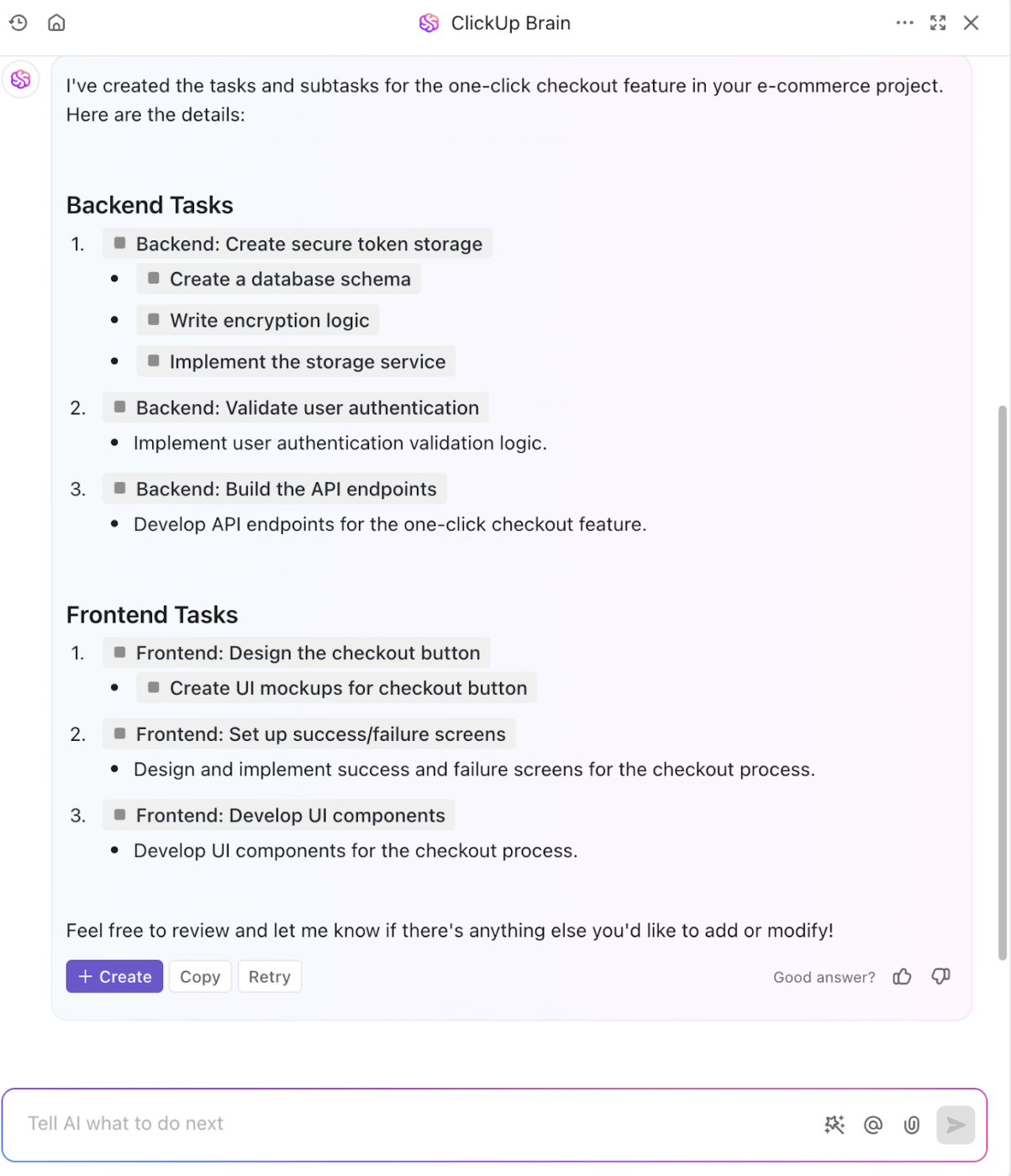
Single-tasking is a lifestyle shift that can transform the way you work and live. Focus on one thing at a time, and watch your efficiency soar.
ClickUp also offers a time-blocking template to help you plan and track tasks seamlessly. The ClickUp Daily Time Blocking Template simplifies task scheduling, prioritization, and focus management.
This pre-built template allows you to visualize your entire day in structured time blocks, helping you stay productive without feeling burnt out.
📖 Read More: Free Task Management Templates
If you are overwhelmed with multiple tasks and need some assistance to plan your day, try using AI tools for daily tasks. They can help you generate to-do lists and block time for deep work. This reduces the mental load of figuring out what to do next.
Another perk of using AI for planning is that it can adapt to your work style. For example, if you’re most productive in the morning, AI can schedule your most important tasks during that time. It can also handle repetitive planning work like sorting emails or scheduling meetings.
You can use ClickUp Brain, ClickUp’s powerful AI assistant, to get instant task updates and summaries. This way, you don’t risk productivity loss by switching platforms while searching for additional context or information at work.

Breaking free from multitasking isn’t easy in a world full of distractions. However, mastering focused work is the key to higher productivity, lower stress, and sharper decisions. Here’s how to overcome the biggest barriers to single-tasking and make it a habit.
📖 Read More: Top Task Automation Software
💡 Pro Tip: Try “Task batching“—group similar tasks together and tackle them in focused sessions. ClickUp’s Task Priorities make it easy to batch and rank your most important work.
By tackling distractions, setting clear priorities, and fostering a focused environment, single-tasking becomes a habit that drives better work, less stress, and greater efficiency.
🧠 Did you know? The Pomodoro Technique was invented by Francesco Cirillo in the 1980s, inspired by a tomato-shaped kitchen timer!
In a world that glorifies multitasking, single-tasking is the real productivity hack. By focusing on one task at a time, you can work smarter, reduce stress, and produce higher-quality results.
The shift isn’t always easy, but with the right strategies and tools, it’s completely doable.
ClickUp makes single-tasking effortless with features like Focus Mode, Priority Labels, and Time Blocking—helping you eliminate distractions, structure your workflow, and enhance your overall well-being by reducing stress and improving focus.
Ready to stop juggling and start achieving? Sign up for free on ClickUp today and experience the power of single-tasking!
© 2026 ClickUp



