
Sorry, there were no results found for “”
Sorry, there were no results found for “”
Sorry, there were no results found for “”
Businesses need quality content. But creating a winning content strategy requires more than posting content. You need a flexible system that also keeps you accountable.
That’s precisely what a content calendar delivers.
With the right content calendar tool, planning your next month or quarter becomes easy. A solid content calendar software helps you stay agile, delivering engaging content while responding to trends with speed.
In this article, we’ll explore the best content calendar software available and help you choose the right fit for your workflow.
| Tool | Best For | Key Features | Pricing* | Ratings |
| ClickUp | Visual planning and execution of content campaigns for teams of all sizes | Drag-and-drop Calendar View, AI scheduling, AI content assistant, workflow automation | Free plan available; Custom pricing available for enterprises | G2: 4.7/5 Capterra: 4.6/5 |
| CoSchedule | Social publishing, campaigns, and content management for mid- to large-sized teams | Unified calendar, ReQueue automation, AI Social Assistant, AI Marketing Assistant, social inbox | Free; Paid plans start from $29/month per user | G2: 4.4/5 Capterra: 4.4/5 |
| Planable | Fast, collaborative content reviews and approvals for large teams and agencies | Real-time previews, multi-step approvals, version history, comments | Free; Paid plans start from $39/month per workspace | G2: 4.6/5 Capterra: 4.5/5 |
| Buffer | Simplifying multi-channel publishing for small teams | Post repurposing with AI, multi-platform scheduling, content boards, engagement inbox, browser extension | Free; Paid plans start from $5/month per user | G2: 4.3/5 Capterra: 4.5/5 |
| ContentStudio | Multi-channel content management at scale for mid-sized to large agencies | Unified calendar, blog + social publishing, content discovery, AI assistance, analytics, custom roles | No free plan; Paid plans start from $29/month per user | G2: 4.6/5 Capterra: 4.7/5 |
| Loomly | Structured team collaboration and approval workflows for large teams | Role-based access, content previews, approval stages, post ideas and templates, analytics | Free plan available; Custom pricing | G2: 4.6/5 Capterra: 4.6/5 |
| Sendible | Large agencies anaging multiple brands and client approvals | Brand-specific workspaces, white-label dashboards, AI assistant, bulk scheduling, monitoring tools | No free plan available; Paid plans start from $29/month per user | G2: 4.5/5 Capterra: 4.6/5 |
| StoryChief | Unified multichannel publishing and collaboration for enterprise teams | Multi-platform scheduling, SEO + AI, team workflows, content audits | Free; Paid plans start from $59/month per user | G2: 4.6/5 Capterra: 4.7/5 |
| Kapost | Aligning content ops with the customer journey for large businesses | Journey mapping, workflow builder, asset gallery, performance dashboards | Custom pricing | G2: 4.0/5 |
| Google Sheets | Flexible and budget-friendly content calendars for freelancers and small teams | Real-time collaboration, custom formatting, template support, timeline add-ons | Free | G2: 4.6/5 Capterra: 4.7/5 |
| Trello | Visual planning and content task management for small teams or solopreneurs | Kanban boards, Calendar Power-Up, Butler automation, AI assistance, checklist collaboration | Free; Paid plans start from $6/month per user | G2: 4.4/5 Capterra: 4.5/5 |
Use our free Content Calendar Planner to schedule content, assign ownership, manage deadlines, and keep every campaign moving.
The right content calendar software acts as your command center for content planning, team collaboration, and publishing workflows, allowing you to publish posts directly across multiple social media platforms.
Here’s what to look for in an ideal content calendar software:
👀 Fun Fact: NASA’s moon landing was a content calendar masterclass. In the months leading up to Apollo 11, NASA collaborated with broadcasters and journalists on a series of well-timed educational pieces and behind-the-scenes content.
It’s time to retire your spreadsheets. Managing your social media content calendar will become much easier with these tools:
Our editorial team follows a transparent, research-backed, and vendor-neutral process, so you can trust that our recommendations are based on real product value, including the user interface.
Here’s a detailed rundown of how we review software at ClickUp.
With the involvement of writers, designers, platforms, and timelines, the complexity of content pipelines becomes overwhelming. Too much on your plate, and you risk missing deadlines, publishing low-quality content, or losing client trust.
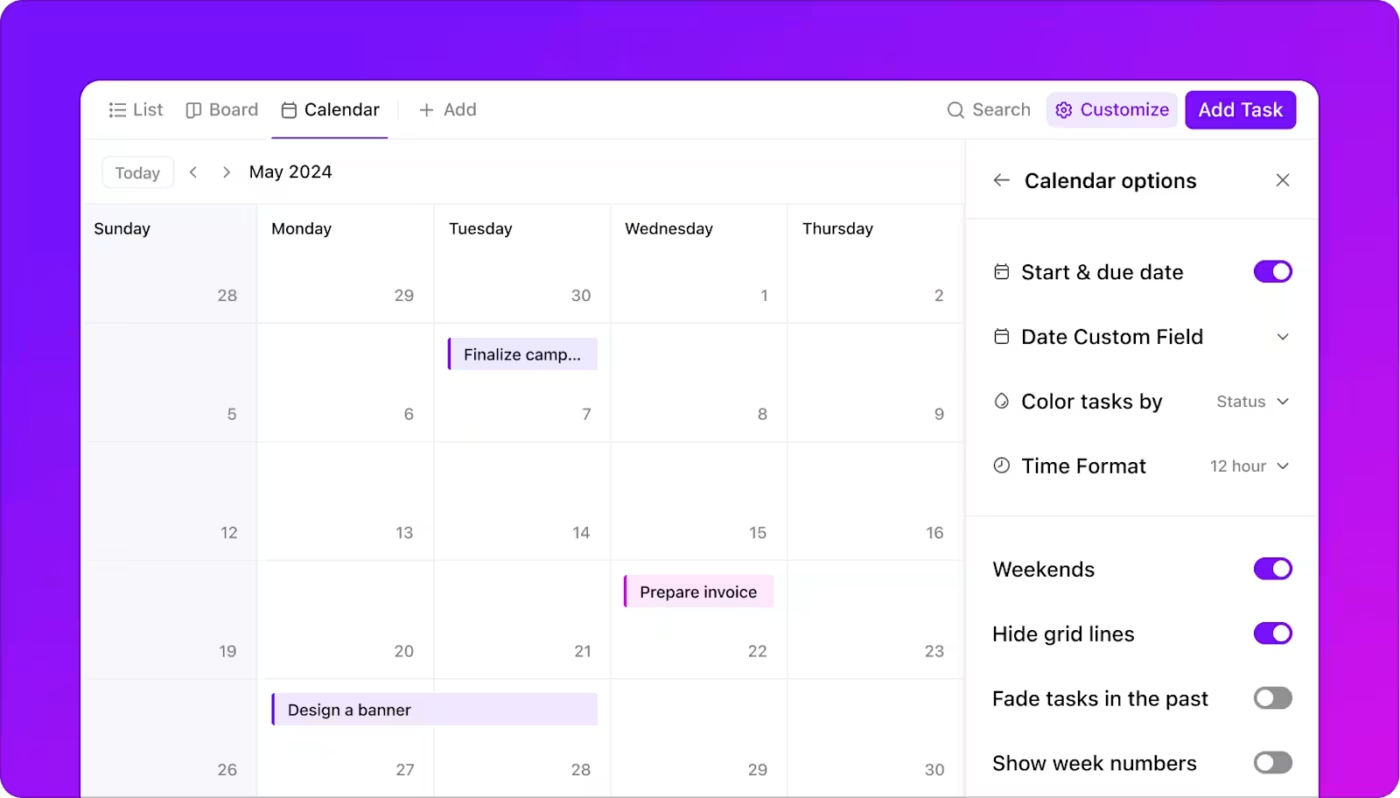
ClickUp tackles this with two key tools built for content teams: ClickUp Calendar and the ClickUp Calendar View.
ClickUp Calendar is an AI-powered scheduling assistant that helps you automatically block focus time, reschedule tasks, and stay aligned with your daily goals.
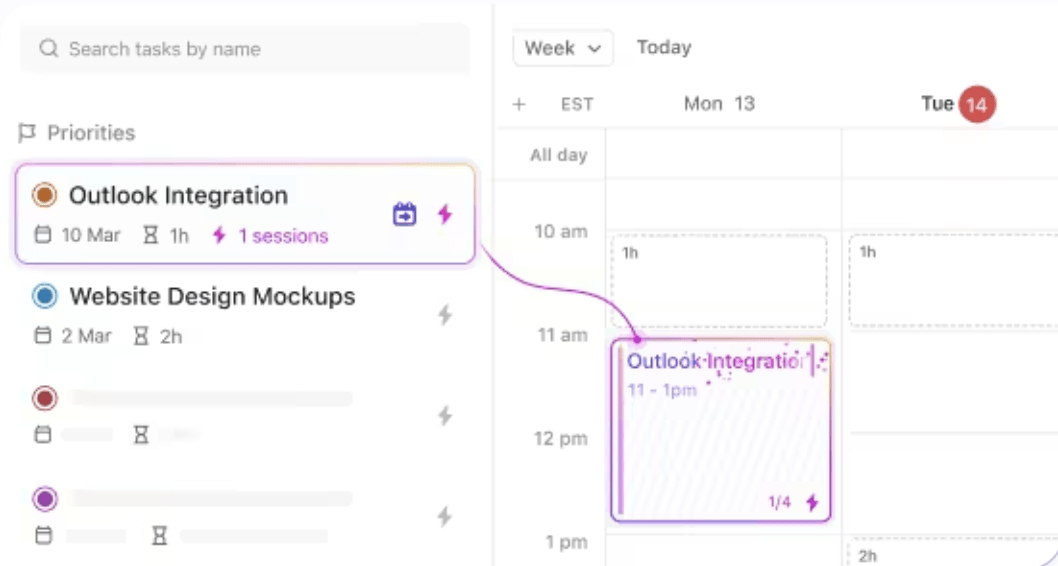
It integrates with Google Calendar, Outlook, and your task list to suggest the best times to work on campaigns, create content, or attend meetings.
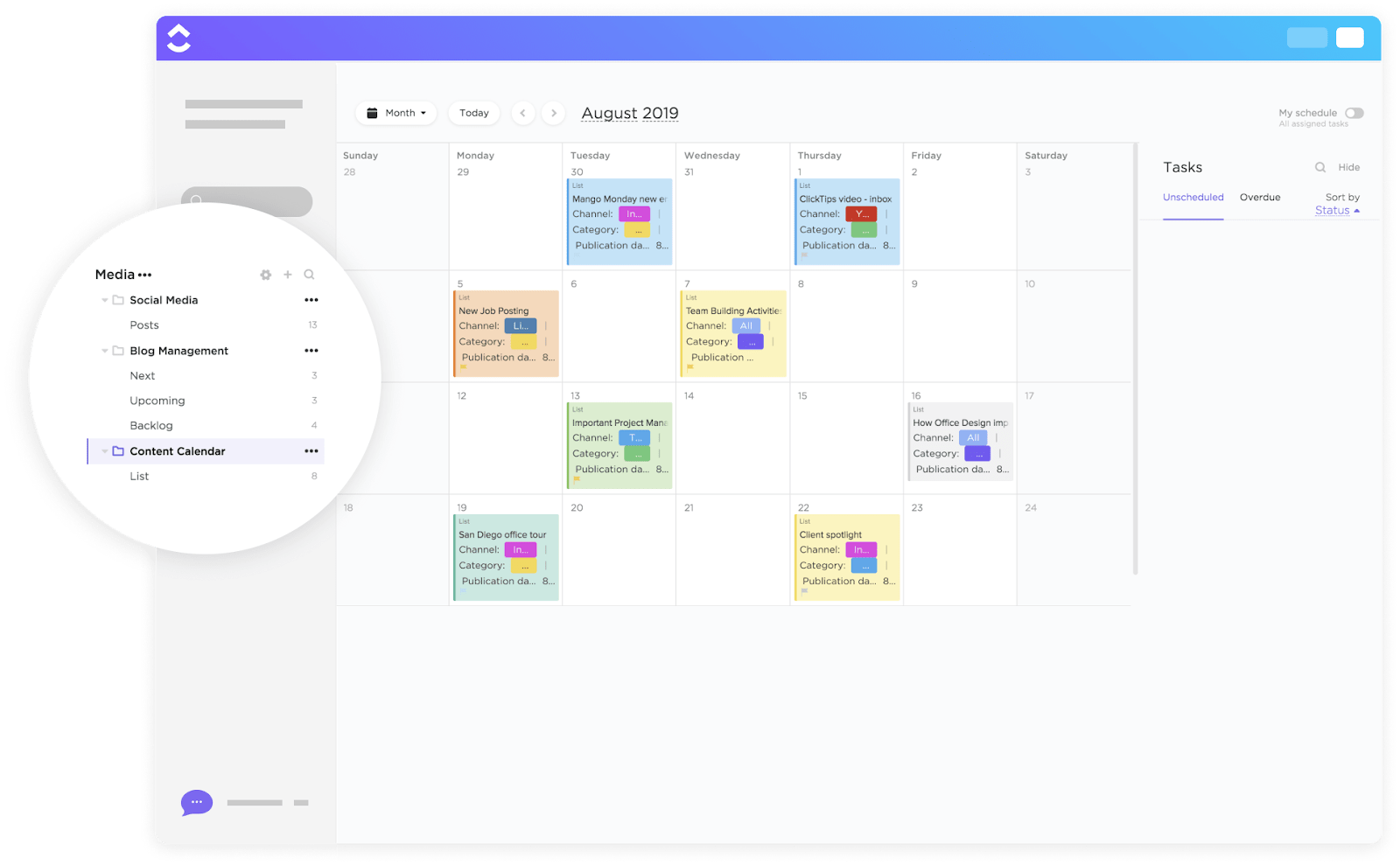
On the other hand, Calendar View gives content and social teams a visual, drag-and-drop interface to map tasks by day, week, or month. You can reschedule social media campaigns with a click, track task owners, and spot overlapping work in seconds.
If you’re using ClickUp for multiple clients, chances are you’re handling more than one calendar. Here’s a guide on how to manage it all efficiently on ClickUp Calendars:
When Instagram Reels and blog post deadlines collide, marketing teams using ClickUp can easily shift priorities directly in the interactive calendar.
ClickUp also supports custom workflows that let you build a clear content pipeline: from draft to review to publish.
This is what Derek Clements, Marketing Manager at BankGloucester said about ClickUp.
I use the base features ClickUp like spaces/folders/lists and the Calendar view the most as they are most versatile. However, if you find yourself needing a specific format or visualization, ClickUp has tons of more indepth stuff like time tracking, task automation, dashboards and more.
Overloaded with tasks? You can apply social media calendar templates and automate recurring tasks to free up time. Plus, ClickUp’s AI Writer for Work can help generate campaign ideas and create social media copy, captions, and briefs directly inside tasks.
ClickUp Brain also suggests task updates based on meeting transcripts, auto-generates templates for recurring content types, and answers questions about your calendar or campaign assets.
For example, you can ask, “Which posts are still awaiting approval?” and get a real-time response.
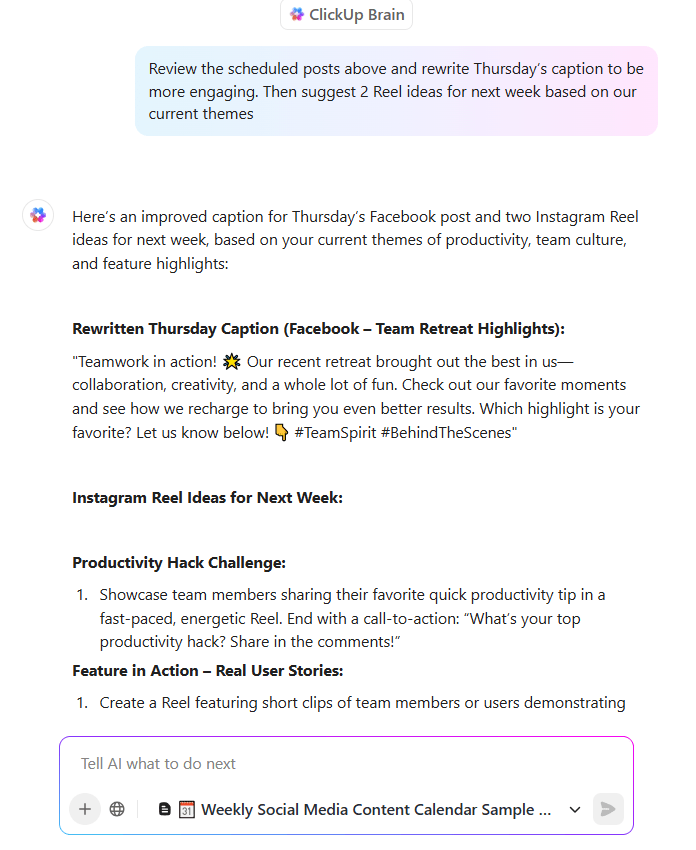
Looking to automate your tasks even further? ClickUp AI Agents act on your behalf to keep your content calendar running without manual effort.
From generating images for posts to updating task statuses and sharing progress summaries in real time, these agents reduce busywork so your team can focus on content creation
To make things even easier, ClickUp offers a ready-to-use Content Calendar Template explicitly built for marketing and social teams. Unlike a basic spreadsheet, this template combines an interactive calendar, customizable workflows, and task tracking.
This template is ideal for teams who want to stay ahead of deadlines, maintain a consistent posting schedule, and keep everyone aligned on content goals throughout the year.
This G2 review noted:
New calendar & Gantt upgrades make planning less painful. The March 2025 refresh merged tasks, docs, chats, and meetings into a single calendar view and added AI-powered time blocking; Gantt charts load noticeably faster and keep the zoom level persistent.
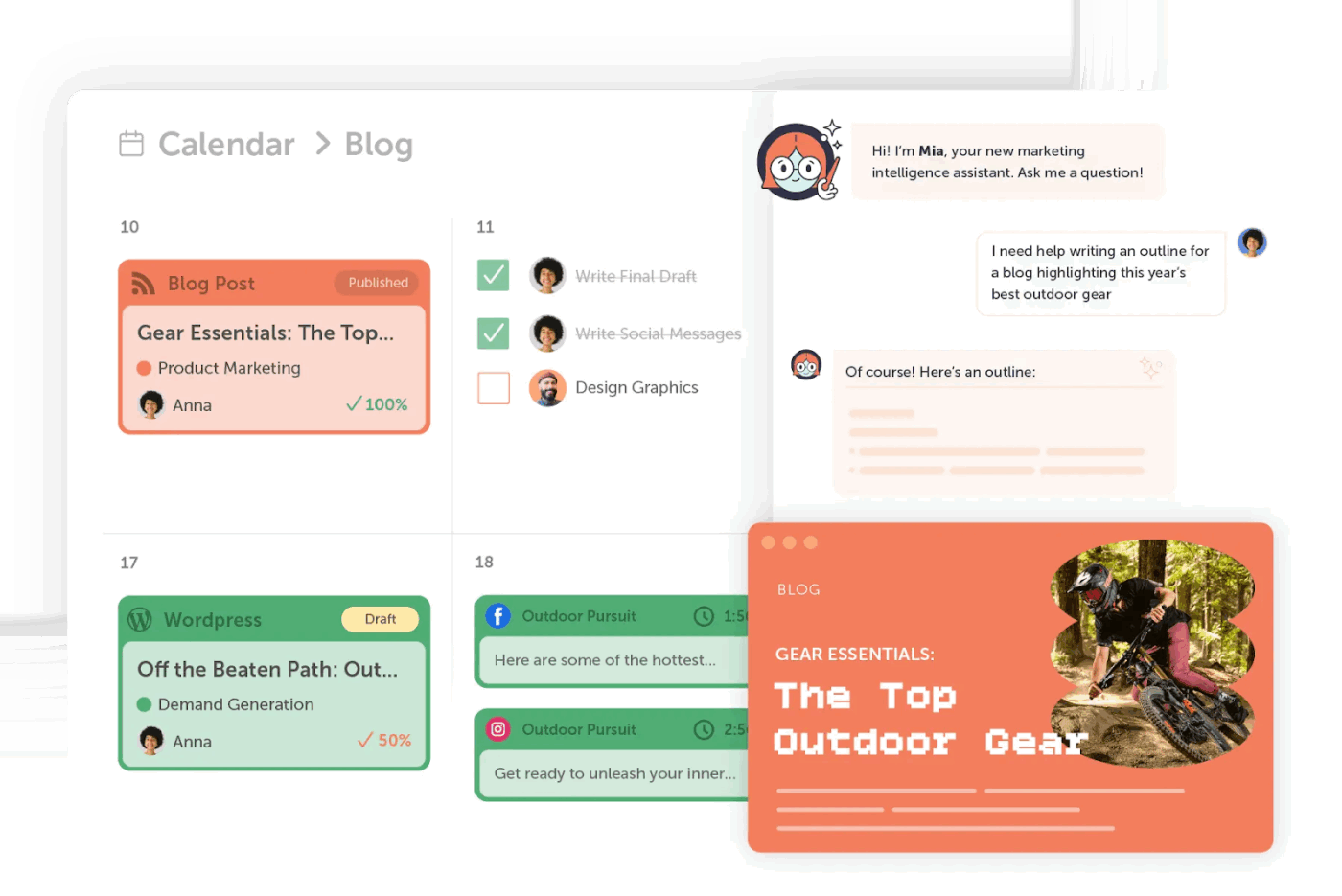
Consistency is often where social strategies fail because teams lack a system to organize and repeat what works.
Tools like CoSchedule solve this dilemma by giving you a unified calendar built for repeatable success. This content and social calendar lets you manage posts, blogs, email promotions, and events in one place.
The tool offers native support for marketing workflows with built-in social publishing, WordPress integration, and campaign performance analytics purpose-built for content-heavy teams.
With features like drag-and-drop scheduling, ReQueue automation, social media templates, and built-in AI tools, you can ensure that your best content is never wasted.
This Capterra review highlighted:
One Place for 20+ social accounts and 6 blogs. Time to post and schedule was dramatically reduced and the analytical reporting is Great!
📖 Also Read: Top Content Collaboration Platforms
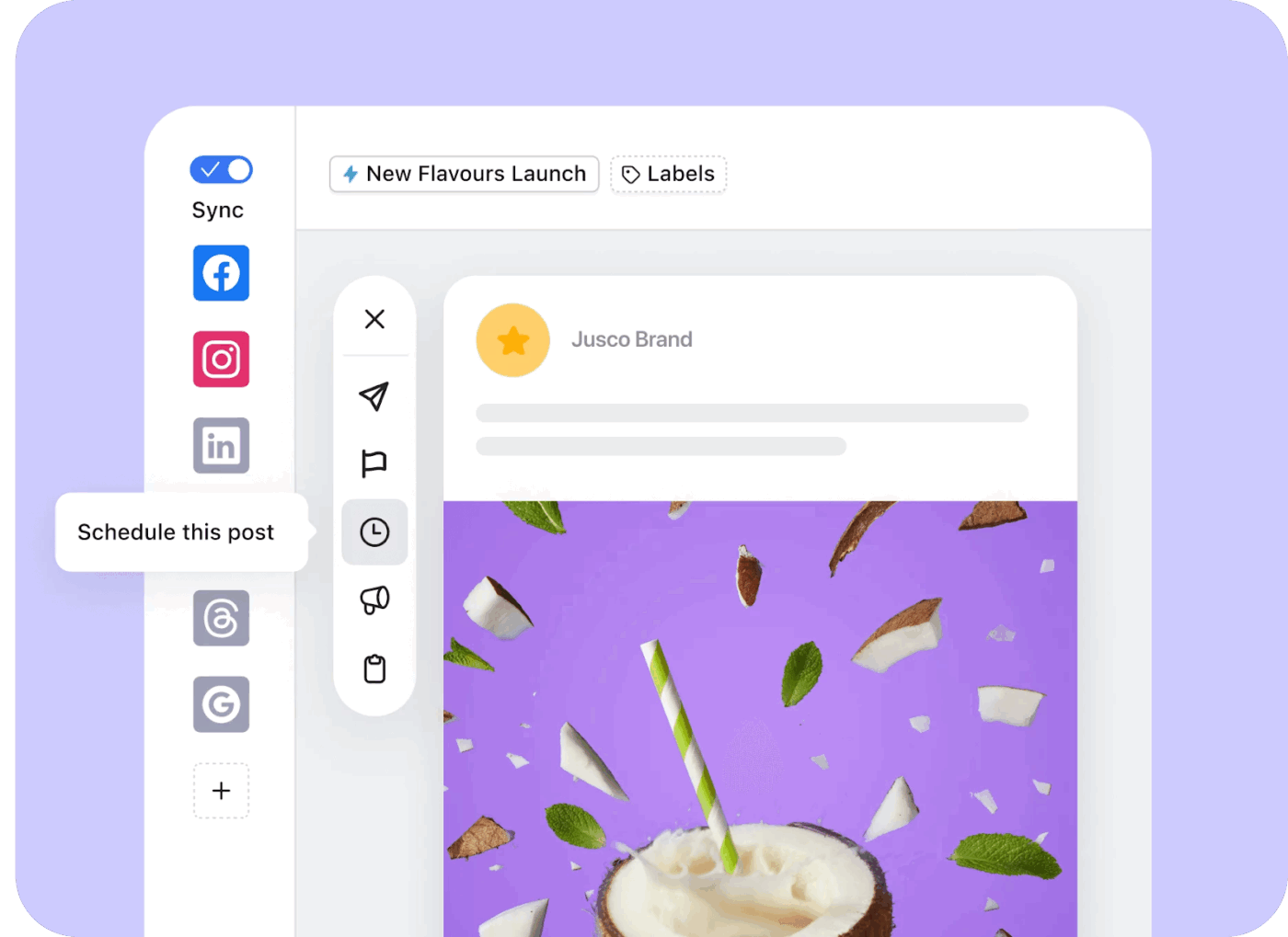
For many teams, the biggest delay in social content is approvals. Waiting on feedback, chasing clients for sign-off, or struggling with unclear comments can derail even the best-planned social media calendar.
Planable solves this by offering a real-time, collaborative space where you can create, review, and approve social media posts just like they’d appear on the final platform.
Built for social media managers and agencies, Planable offers side-by-side views for feed and calendar planning, content previews that mirror real posts, and simple approval flows.
Plus, you can tag teammates, leave comments directly on content, and use version history to track changes.
This G2 review featured:
I like the easiness of collaboration, client approval, the app, keeping comments organized under each post, and much more!
📖 Also Read: Free Content Strategy Templates for Marketing
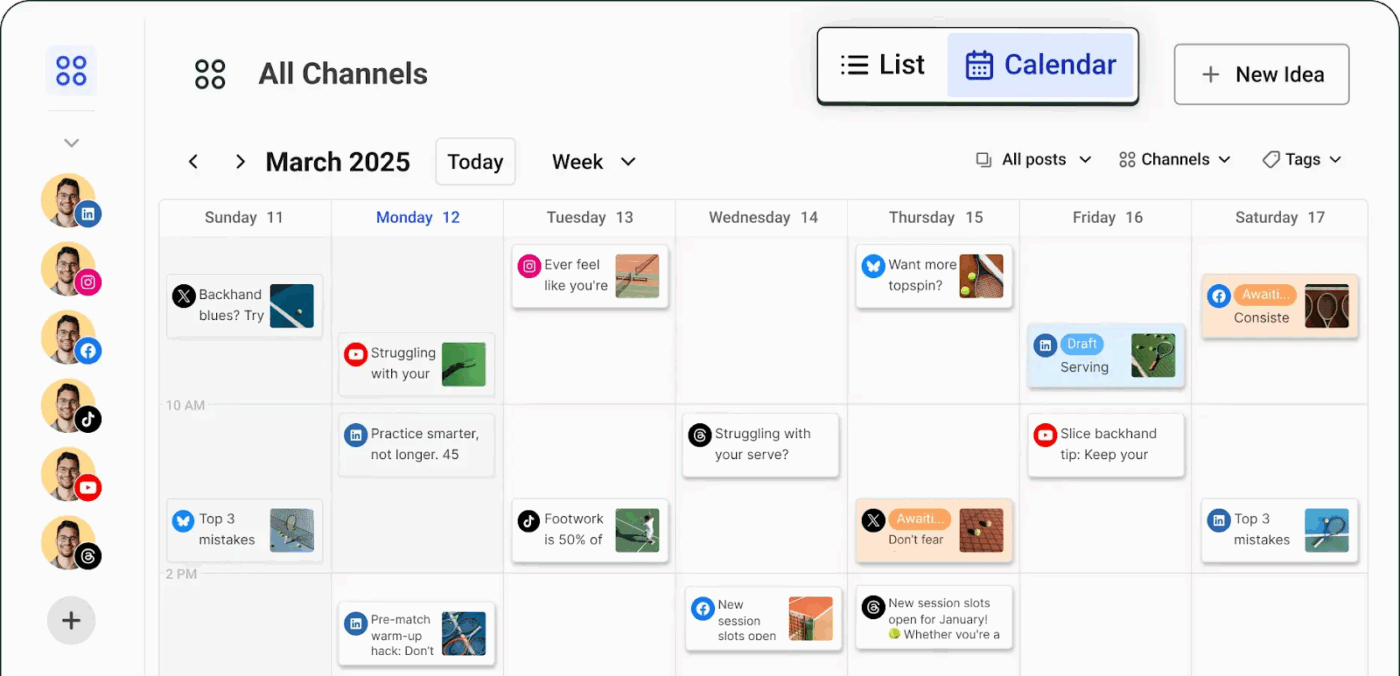
You’ve just finished editing a Reel, writing a caption, adding hashtags, and posting it on Instagram. Now, you need to reformat the same content for TikTok, adjust the tone for LinkedIn, and queue it for X.
This juggling act happens daily for solo creators and small teams, and it’s exhausting.
Buffer is designed to reduce that strain. It gives you one place to write, schedule, and tailor content for 10+ platforms, so you never have to start from scratch.
The tool’s AI Assistant helps repurpose your content instantly, while the new calendar view offers complete visibility into your week or month. Plus, with its browser extension, you can queue content to your calendar from anywhere.
This Capterra review shared:
The platform offers a seamless and efficient way to schedule and post content across various social media channels, including Twitter, Facebook, LinkedIn, and Instagram.
💡 Pro Tip: Want to stand out in a sea of professionals? A Guide to Building Your Personal Brand on LinkedIn walks you through crafting a profile that truly gets noticed.
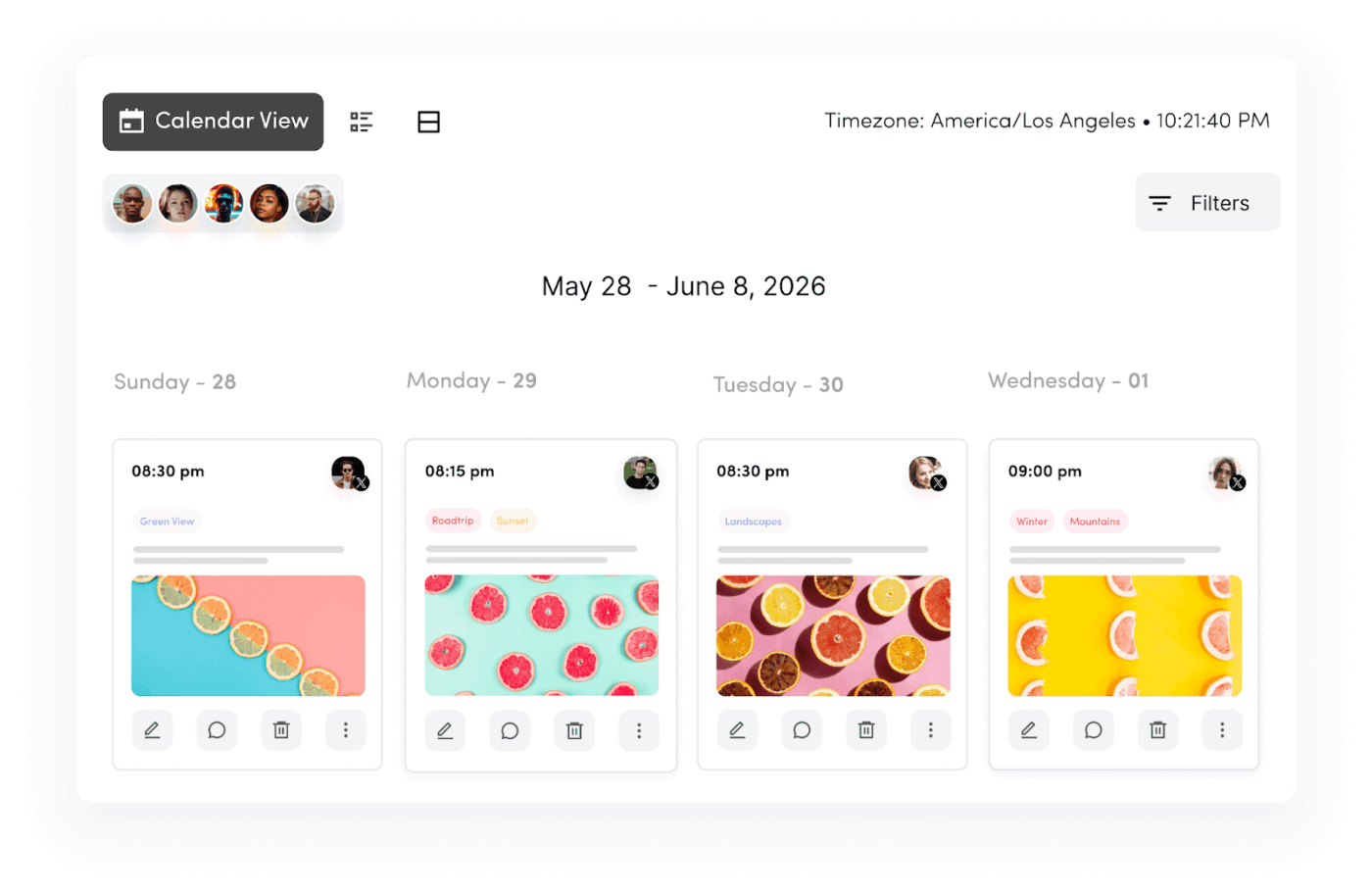
If your team handles both blog content and social posts, chances are you’re duplicating efforts. This means drafting captions separately, switching scheduling tools, and chasing approvals across email threads.
ContentStudio solves this by centralizing content creation, curation, and publishing in one place, whether you’re planning an email campaign and a blog series or repurposing Reels into LinkedIn posts
With the ability to store, organize, and share all your media assets in one place, and simple approval workflows that let you get quick feedback and approvals, this tool cuts down a lot of time and effort involved in day-to-day social media management.
If you’re short of inspiration, the AI Assistant can quickly generate text, images, and captions for your posts.
This G2 review noted:
I’m especially impressed by the ability to thoroughly plan posts, analyze content performance, and automate tasks that used to take up so much time.
📮 ClickUp Insight: 18% of our survey respondents want to use AI to organize their lives through calendars, tasks, and reminders. Another 15% want AI to handle routine tasks and administrative work.
To do this, an AI needs to be able to understand the priority levels for each task in a workflow, run the necessary steps to create tasks or adjust tasks, and set up automated workflows.
Most tools have one or two of these steps worked out. However, ClickUp has helped users consolidate up to 5+ apps using our platform! Experience AI-powered scheduling, where tasks and meetings can be easily allocated to open slots in your calendar based on priority levels. You can also set up custom automation rules via ClickUp Brain to handle routine tasks. Say goodbye to busy work!
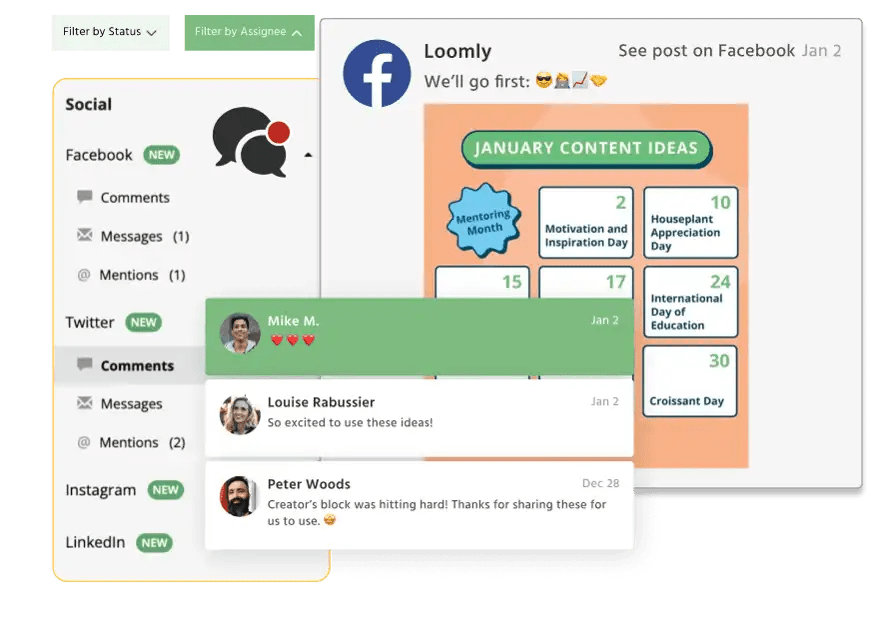
Your team just wrapped a new campaign draft, which your manager must approve by Friday.
The next step involves a flurry of Slack messages, email threads, and missed updates.
Loomly offers a cleaner way to move content from idea to approval. Instead of chasing feedback, every team member gets a defined role like contributor, reviewer, or approver, with automated steps to follow. That way, posts are approved on time, with fewer surprises and no last-minute scrambling.
The platform also eases the daily task of thinking up new post ideas with its post and hashtag suggestions. You can create, import, and edit visuals to suit every social network and even create post templates for recurring post types.
This G2 review captured:
It’s really simple to use and has a calendar view so I can see all my posts scheduled for the week. It’s super reliable and sends reminders if I’ve forgotten to change a post from draft to scheduled.
👀 Fun Fact: In the 1930s, radio dramas were created specifically to entertain homemakers, with shows sponsored and even produced by soap brands like Procter & Gamble. These shows followed weekly programming calendars, making them early forms of serialized brand content.
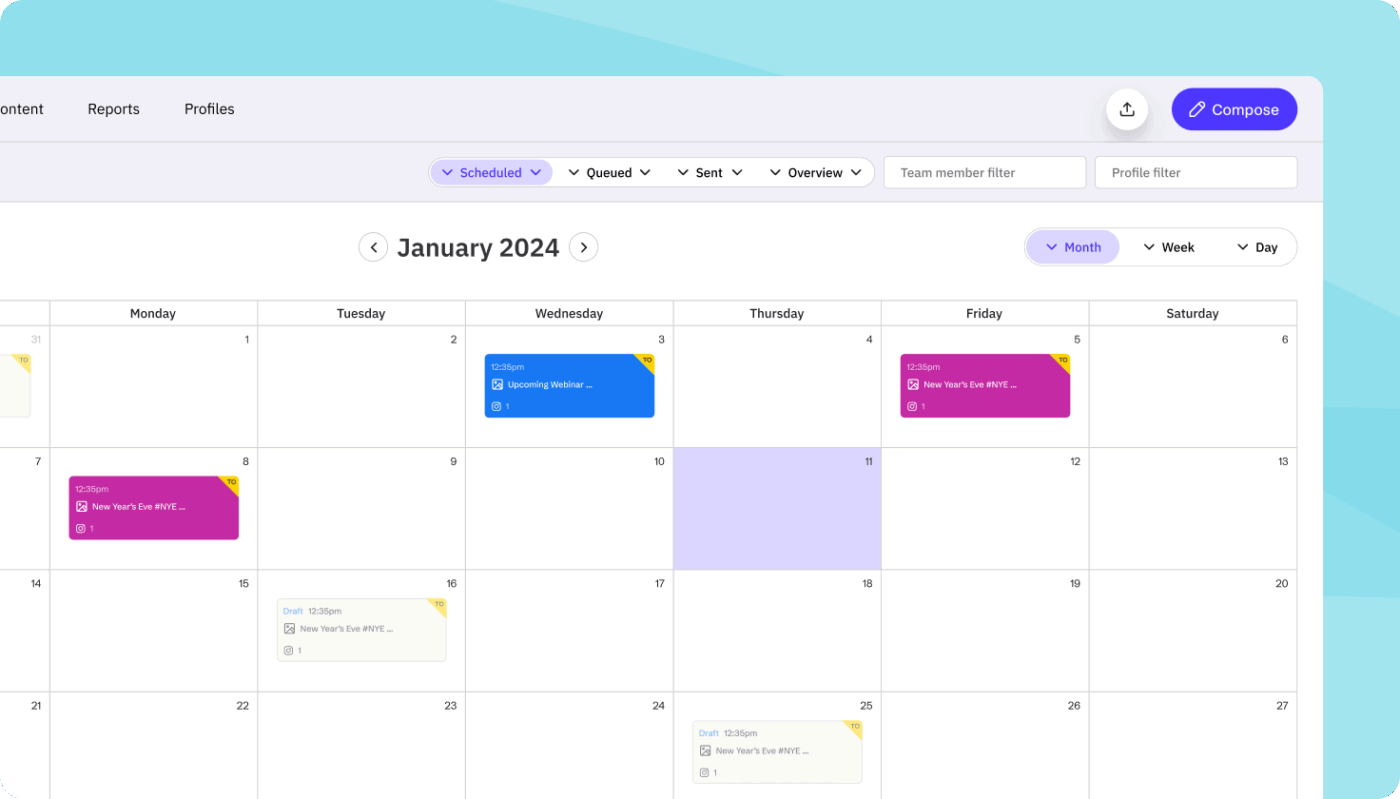
Client approvals are one of the most significant slowdowns in agency workflows. It takes brands an average of 10 days to approve a single piece of content, time that could be better spent creating, scheduling, or optimizing campaigns.
Sendible cuts through this bottleneck with brand-specific workspaces, built-in approval workflows, and white-label dashboards that make content reviews faster and more professional.
Whether you’re working with one client or 30, Sendible helps you deliver content on time without the back-and-forth.
The platform also simplifies post planning and scheduling with bulk imports, a built-in content library, and even repeated scheduling of evergreen content. With AI Assist, you can cut the time needed to write and optimize captions as well.
This G2 review featured:
I’m no expert in social media posting but Sendible makes the whole process easy and stress free, I can post across multiple platforms with ease and see what is due to go out and what as already been sent very simply.
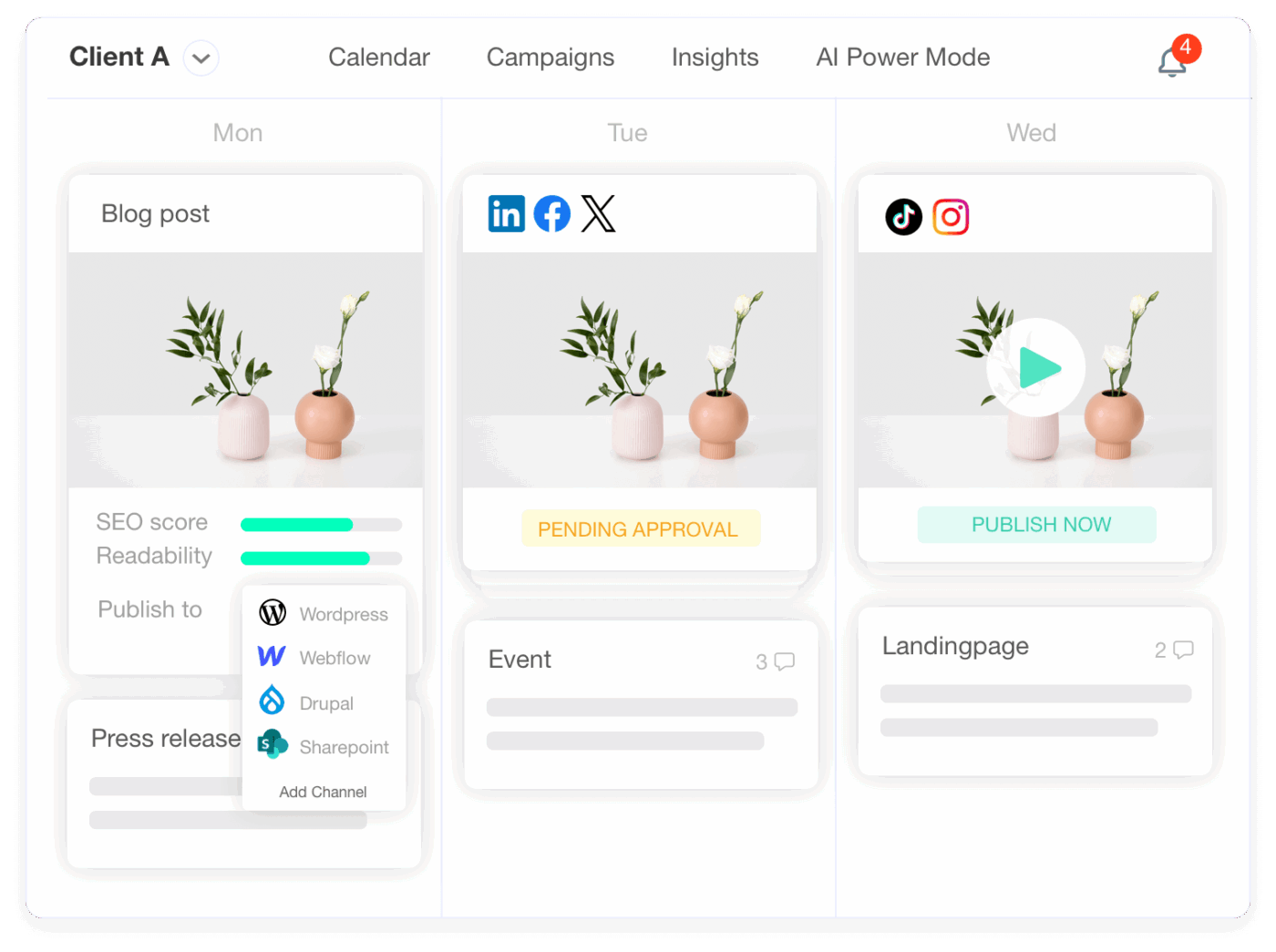
Most content teams waste hours switching between external tools. StoryChief eliminates that friction by centralizing your entire content operation through an intuitive content calendar.
Instead of switching back and forth between Google Docs, CMS logins, and endless email approvals, your team can co-create and publish from one place, with multichannel scheduling built in.
With built-in SEO optimization, AI assistance for drafting and tagging posts, and integrations with CRMs and tools like OneDrive, StoryChief makes the modern social media marketer’s life much easier.
This Capterra review stated:
The visual nature of the tool has meant that a client can now “see” what we’re trying to achieve with a written piece of content. It’s also helped us to think about our content holistically, not only publishing a piece, but how we plan to distribute it.
👀 Fun Fact: In 1900, the Michelin brothers published a free guide for drivers that included maps, hotel tips, and restaurant recommendations. The logic? If people drove more, they’d need more tires. Content marketing genius long before it had a name.
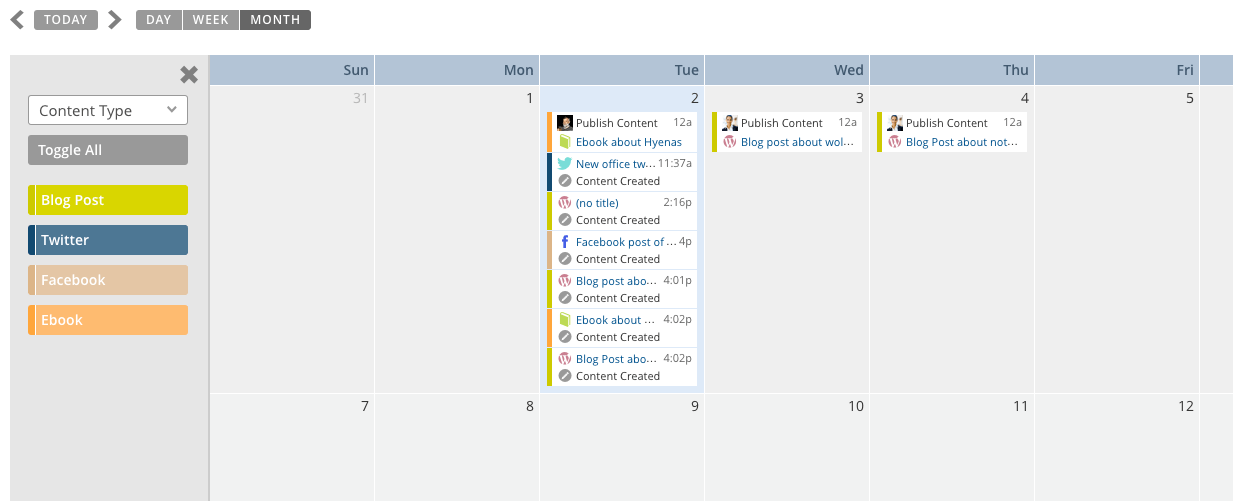
Only 13% of marketing leaders report content strategy as their top challenge, but that low number masks a much bigger issue. The real struggle lies in execution.
Kapost helps B2B marketers unify their content operations across teams and platforms with a strategy-first approach. It helps plan initiatives across multiple social media accounts through a social media planner and maps content to customer journey stages.
You can also track production and approval workflows and measure performance in one place while ensuring brand guidelines are being met.
With Kapost, you can build galleries of approved content, publish to multiple platforms, and connect with tools like Salesforce, HubSpot, and Marketo for better cross-functional visibility.
This G2 review noted:
The ease of setting up specific workflows for every stage of content creation, including being able to seamlessly assign stakeholders for review. Also, can build a great editorial calendar.
💡 Pro Tip: Want to future-proof your brand strategy? Read How to Use Trendspotting (with Examples) to learn how top brands identify and act on trends, before everyone else.
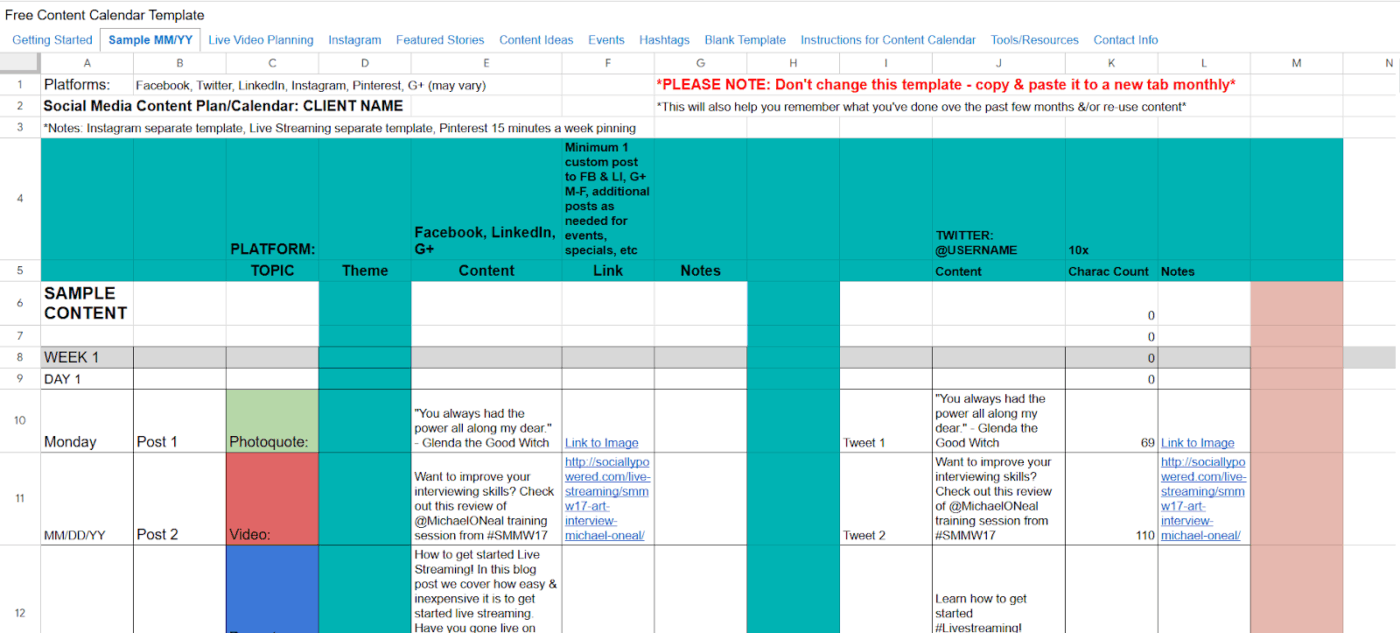
Content planning doesn’t always need complex tools or steep learning curves. For teams that value simplicity, collaboration, and complete control over formatting, Google Sheets remains one of the most underrated calendar tools out there.
This popularly used document tool can double as a content calendar software, and is surprisingly powerful for building editorial calendars that adapt to your needs, especially when paired with timeline views or templates.
And if you’re already tracking tasks, metrics, or budgets in Sheets, your calendar can sit right alongside everything else.
This G2 review noted:
Easy to use and real-time work together with all my employees, we use google sheet the most, and it is just like excel for free.
📖 Also Read: Best Google Sheets Alternatives & Competitors
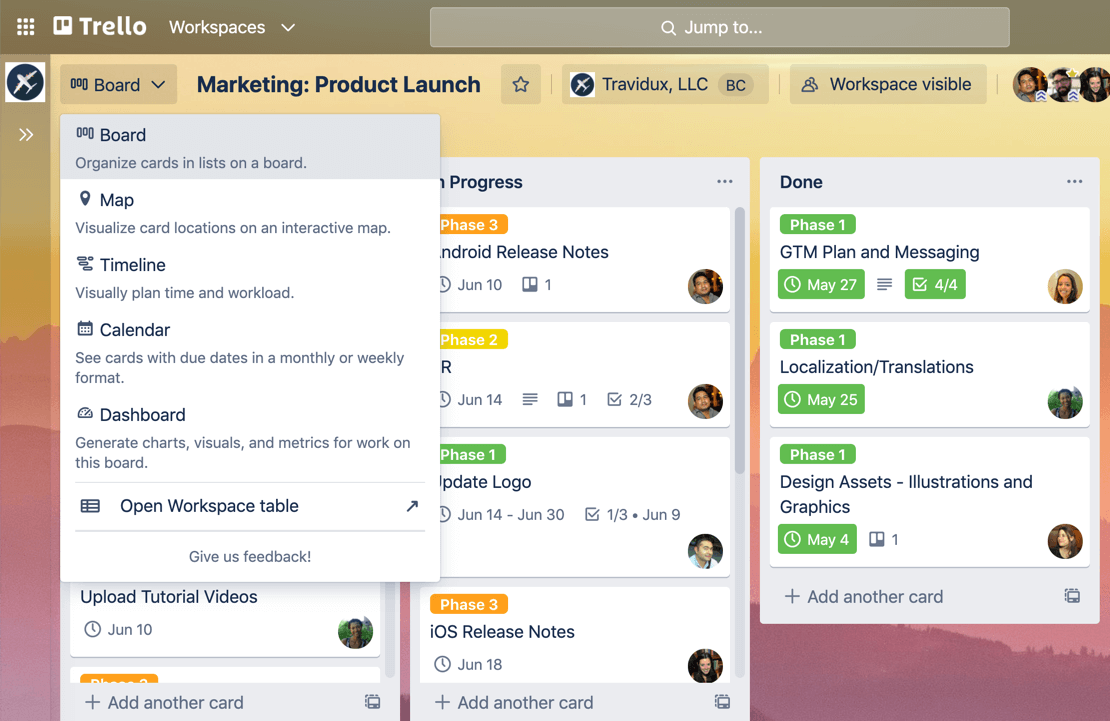
For many content teams, structure is what turns ideas into output. But not every team needs a heavyweight tool to organize that structure.
Trello offers a highly visual, drag-and-drop approach to content calendar management using Boards, Lists, and Cards.
You can create a card for each content task, assign due dates, labels, and assignees and checklists, and move them across custom stages like “Ideas,” “Drafting,” “Design,” and “Published.” The Calendar Power-Up provides a comprehensive overview of all scheduled tasks.
Trello’s Butler automation also helps eliminate repetitive actions like moving cards after due dates or alerting teammates on status changes. Higher-tier plans also give you AI assistance to generate and proofread copy and brainstorm content ideas.
This G2 review featured:
I particularly enjoy Trello’s user-friendliness—its drag-and-drop functionality is intuitive and makes managing tasks straightforward and visual.
📖 Also Read: A Guide to Building Your Personal Brand on LinkedIn
Here are three more content calendar tools that offer strong planning, publishing, and collaboration features:
💡 Pro Tip: Managing multiple client campaigns without chaos? Try ClickUp for marketing campaign management to maintain control.
Consistency in content marketing is more important than occasional brilliance. Without a clear plan, even your most creative ideas fizzle.
Content calendar software does more than just show you what’s scheduled. It brings structure to your creative process, aligns your team, and makes deadlines feel a lot less stressful.
While many tools on this list do a fantastic job with specific tasks—like scheduling or approvals—ClickUp brings it all together. It gives you a single place to manage content, collaborate with teammates, track deadlines, and even generate content ideas with AI.
Ready to leave scattered spreadsheets and last-minute scrambles behind? Sign up for ClickUp now!

Arya P Dinesh
Max 27min read

Manasi Nair
Max 27min read
Manasi Nair
Max 32min read

© 2026 ClickUp