






Still downloading templates?
There’s an easier way. Try a free AI Agent in ClickUp that actually does the work for you—set up in minutes, save hours every week.
Sorry, there were no results found for “”
Sorry, there were no results found for “”
Sorry, there were no results found for “”
E-commerce moves by the hour. One minute you’re planning a drop; the next you’re chasing a TikTok spark and nudging budgets. “Launch and leave”? Gone.
The fix isn’t more meetings—it’s more thoughtful execution. Use AI marketing tools to forecast, launch, and tune campaigns while your team does the work only humans can do. And speed turns into scale when briefs, assets, and reporting live in one place (hello, ClickUp 👋).
What you’ll get in this blog: Key principles, step-by-step workflows, and the tools to make it real. ✨
AI campaign execution isn’t ‘ask a bot for copy.’ It’s your entire loop—plan → launch → optimize—running with help. Forecasts guide the plan, workflows assign themselves, and budgets shift before you even log in. You steer; the system handles the busywork.
Here’s what that looks like in action:
📌 Example: An e-commerce skincare brand could use predictive analytics to spot rising demand for a serum, shift budget toward high-performing Meta Ads using integrated attribution data, and generate fresh ad creatives—all while ClickUp keeps every task, asset, and update centralized in one place.
With AI in the driver’s seat and a platform like ClickUp acting as your command center, campaign execution stops being reactive and starts becoming proactive, scalable, and delightfully predictable.
📮 ClickUp Insight: 24% of workers say repetitive tasks prevent them from doing more meaningful work, and another 24% feel their skills are underutilized. That’s nearly half the workforce feeling creatively blocked and undervalued. 💔
ClickUp helps shift the focus back to high-impact work with easy-to-set-up AI agents, automating recurring tasks based on triggers. For example, when a task is marked as complete, ClickUp’s AI Agent can automatically assign the next step, send reminders, or update project statuses, freeing you from manual follow-ups.
💫 Real Results: STANLEY Security reduced time spent building reports by 50% or more with ClickUp’s customizable reporting tools—freeing their teams to focus less on formatting and more on forecasting.
📖 Read more: Want to dive deeper into how leading teams already make this shift? Check out how the ClickUp marketing team uses ClickUp.
E-commerce never takes a breath. Trends shift overnight, ad costs climb without warning, and shoppers expect a smooth, personalized experience every time they land on your site. Try keeping up manually, and it’s like showing up to a smartphone fight with a flip phone.
Speed. Personalization. Survival. 🎯
From guesswork to growth: Here’s why AI rewrites the rules for e-commerce campaigns:
Mini story: Your growth team kicks off a holiday push. Day two, CPA spikes on Google. Spend shifts to Meta and fresh copy rolls out before fatigue hits. You get a clean summary—not a fire drill.
At the same time, ClickUp keeps tasks, assets, and timelines aligned across marketing, product, and ops—so execution runs smoothly and nothing slips through the cracks.
The result? Campaigns that are faster, sharper, and built to scale.
🎥 Want to see AI marketing in action?
Before diving deeper, check out this quick explainer that explains how businesses use AI to plan, execute, and optimize their campaigns.
📌 Watch: How to use AI for marketing
💡 You’ll learn:
AI is now woven into every campaign milestone from creative briefs to budget shifts. Here’s what that looks like in practice.
Why it matters:
One of the most complex parts of running e-commerce campaigns is deciding how much budget to allocate across channels. Manually checking dashboards, comparing CAC/ROAS, and redistributing spend is slow and often reactive. AI solves this by real-time monitoring campaign performance and automatically reallocating spend to the best-performing channels, audiences, or creatives.
How it works:
📌 Example:
Many brands lean on platform-native automations to keep budgets fluid. For instance, Meta Advantage + campaign budget automatically redistributes spend across ad sets to improve overall results. At the same time, Google Performance Max dynamically allocates budget across Google channels based on predicted return (including marginal ROI considerations).
In ClickUp: Centralize your campaign budget tracking and approvals in one place, and use integrations to pull performance data for real-time decision-making.
💡 Pro Tip: Set up an Autopilot AI Agent in ClickUp to monitor campaign budgets and automatically assign tasks or send alerts if spend exceeds thresholds or performance dips.
Why it matters:
Guessing what customers will want next month is risky business. Over-ordering inventory ties up cash, while underestimating demand leads to stockouts and missed sales. Predictive analytics changes the game by analyzing purchase history, seasonality, and customer behavior to forecast demand, customer lifetime value, and churn risk.
How it works:
📌 Example:
A UK DTC skincare brand, Balance Me, used Klaviyo’s data-driven replenishment timing to nudge reorders and saw an 83% increase in repeat purchases—proof that predictive/lifecycle signals can lift retention around key promos.
In ClickUp: Bring predictive insights from your analytics tools into a ClickUp Docs. Then use ClickUp Brain to summarize those signals into campaign priorities instantly—so your team sees the “what to do next” without combing through raw data.
Why it matters:
Shoppers today expect more than discounts—they expect brands to know them. That means emails that recall past purchases, product suggestions that feel handpicked, and ads that speak directly to their interests. AI makes it possible to deliver that level of personalization not just to one customer, but to thousands—at scale.
How it works:
📌 Example:
Sephora has publicly shared how it uses AI-driven personalization across the journey—balancing automation with brand voice to tailor recommendations and messaging; this was outlined by Sephora’s Sr. Director, CRM & Personalization in 2025. Earlier AI/AR initiatives like Virtual Artist (with AI color match) show the same personalization ethos in practice.
In ClickUp: Map out customer journeys—like welcome sequences, abandoned cart reminders, or loyalty offers—alongside the rules that decide who gets them. Store these plans in Docs for cross-team visibility, use Whiteboards to visualize the flow, and let ClickUp Brain summarize them so marketing, product, and ops stay aligned.
💡 Pro Tip: Use ClickUp’s AI-powered templates to save your best-performing customer journey flows and reuse them for future campaigns.
Why it matters:
Creative bottlenecks are one of the most significant pain points in campaign execution. Teams often need multiple ad versions for testing. Producing them manually can take weeks of copywriting and design. AI-powered content creation delivers them instantly. Generative AI instantly removes this friction by producing creative assets, allowing for more experimentation and faster iteration.
How it works:
📌 Example:
Advertisers using Amazon Ads’ AI image generation to place products in lifestyle scenes have recorded up to 40% higher CTR versus plain product images; small brand Formosa Covers reported +22% clicks, +21% orders, and +35% ROAS after adopting the tool for Sponsored Brands.
In ClickUp: Keep everything creative in one place—prompts, copy drafts, and asset links all live inside campaign tasks. Use ClickUp Automations to move assets through stages like draft → review → approved, so designers, writers, and marketers always know what’s ready to launch and what still needs work.
Why it matters:
Campaign execution requires tight coordination between marketing, creative, product, and operations teams. Without automation, projects get stuck waiting on approvals, missed handoffs, or repetitive manual updates. AI-driven workflows ensure campaigns move smoothly from idea to launch.
How it works:
📌 Example:
📮 ClickUp Insight: 21% of people say more than 80% of their workday is spent on repetitive tasks. And another 20% say repetitive tasks consume at least 40% of their day.
That’s nearly half of the workweek (41%) devoted to tasks that don’t require much strategic thinking or creativity (like follow-up emails 👀).
ClickUp AI Agents help eliminate this grind. Think task creation, reminders, updates, meeting notes, drafting emails, and even creating end-to-end workflows! All that (and more) can be automated in a jiffy with ClickUp, your everything app for work.
💫 Real Results: Lulu Press saves 1 hour per day, per employee using ClickUp Automations—leading to a 12% increase in work efficiency.
In ClickUp: Autopilot AI Agents automate task assignments, status changes, reminders, and escalations—so your campaign never stalls waiting for a manual update.
👉 Together, these use cases show how AI isn’t just powering pieces of your e-commerce campaigns—it’s orchestrating the entire process. And when you bring everything into a single hub like ClickUp, you don’t just get marketing automation—you get clarity, accountability, and scale.
✨ Feel-Good Reminder:
Even if your first AI-powered campaign feels like feeding prompts into a magic eight-ball, you’re ahead of the 85% of brand and agency marketers who still manage media planning in spreadsheets. Centralize, experiment, and iterate—ClickUp makes it less scary.
The challenge with running e-commerce campaigns isn’t just execution; it’s that execution is spread across too many tools and too many people. With AI, you have one connected, intelligent system that supports every stage of the campaign lifecycle and drives sustainable business growth.
Here’s how to execute an e-commerce campaign with AI from start to finish:
The problem: Campaign planning is chaotic. Launch notes live in email, priorities pop up in Slack, and creative teams wait on a brief that never arrives. By the time everything is stitched together, momentum is lost.
The ClickUp AI solution:
1. Start with clarity:
Set your campaign’s purpose using ClickUp Goals. This gives your team a clear target and keeps everyone aligned.
2. Turn Ideas into action:
Describe your campaign vision to ClickUp Brain, and it instantly drafts a campaign brief in ClickUp Docs—no blank page, no wasted time.
3. Let ClickUp build the plan:
When your brief is ready, ClickUp Docs automatically creates all necessary ClickUp Tasks and Milestones.
Each task is assigned to the right person, with deadlines set—so nothing slips through the cracks.
4. Fill in the gaps, effortlessly:
Are there missing assets, offers, or legal details? ClickUp Forms collects everything you need from stakeholders in one place and links it to your campaign.
5. Capture every meeting, action, and next step:
During campaign meetings, ClickUp AI Notetaker records the conversation and creates a transcript.
✨ Why it’s smart
ClickUp AI doesn’t just organize your campaign—it runs it for you, from goal-setting to execution, so you can focus on results.
👉 Try this prompt in ClickUp Brain:
Create a campaign brief for the “SleepEase Weighted Blanket” launch, formatted for ClickUp Docs. Use clear section headings, dividers, and short paragraphs (no tables or bullet points). The brief should cover product overview (features and target audience), campaign goals and KPIs, messaging and differentiators, marketing channels and creative requirements, timeline and milestones, budget outline, Brain action items, and team action steps. Keep the content concise, actionable, and fully editable in ClickUp Docs.
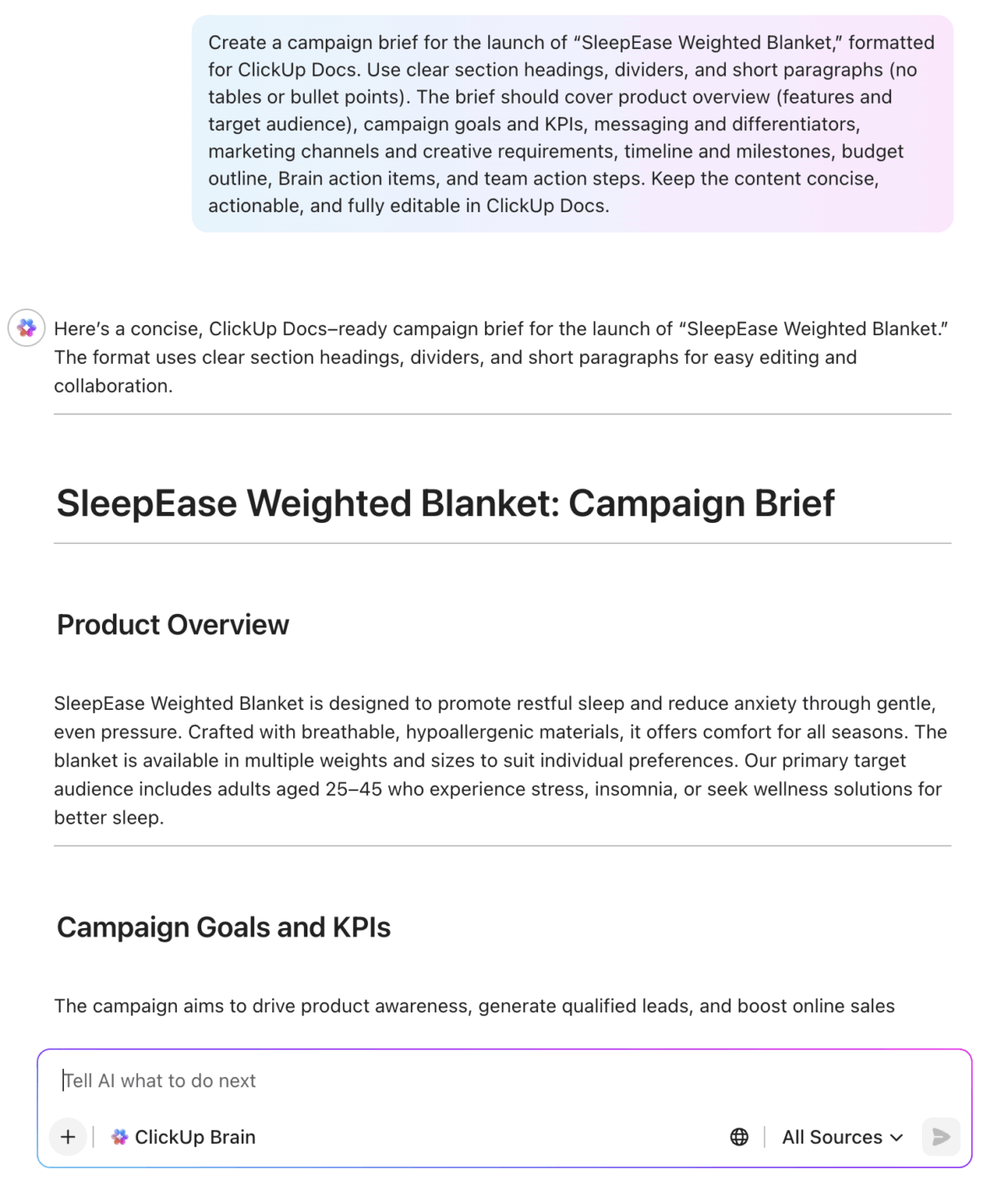
Now that you have seen the prompt and the ClickUp Brain output, you will find the ClickUp Doc with the updated content.
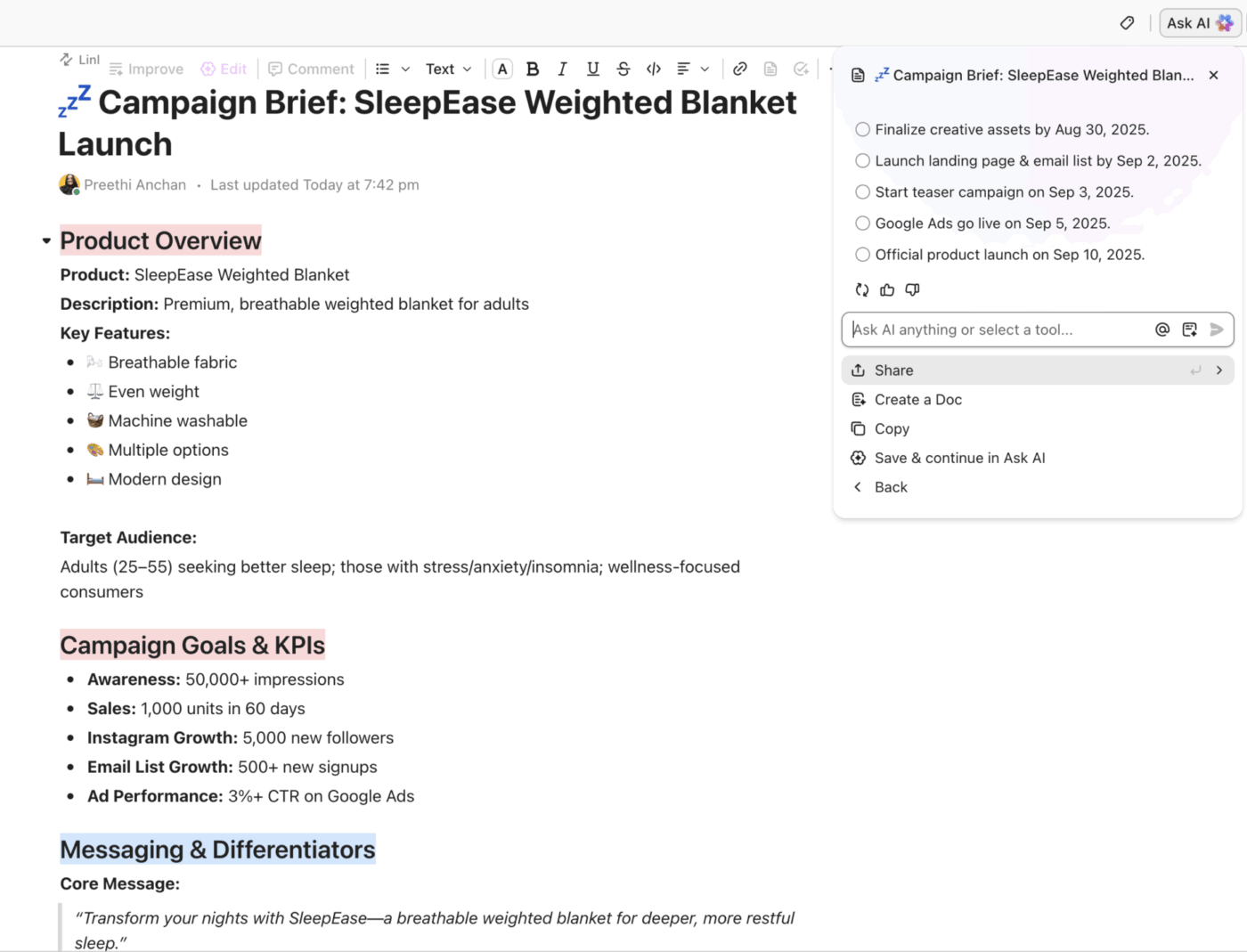
📌 Example: A DTC skincare brand uploads a messy PDF of product details + Slack approvals. ClickUp Brain outputs:
💡 Why it’s convincing: Instead of losing a week to alignment, the team starts on day one with a ready-to-execute roadmap.
💡 Pro Tip: AI won’t judge your 47 open campaign drafts—but your CMO might. Use ClickUp Docs + ClickUp Brain to turn half-baked notes into polished briefs before anyone else sees the chaos.
The problem: Creative ideation drags. Copywriters hit writer’s block, designers lack reference points, and campaign ideas often drift off-brand. By the time teams align, deadlines are already looming.
The ClickUp AI solution:
1. Ideation that’s always on-brand
With ClickUp Brain, every creative idea is informed by your past campaigns, documents, and assets—ensuring your team’s output is original and on-brand.
2. AI-powered suggestions, tailored to you
ClickUp AI analyzes your campaign history and uses advanced multimodal models to suggest ad copy, design prompts, and A/B test ideas—all tuned to your unique brand voice.
3. Instantly generate creative variants
Need options? ClickUp generates multiple headlines, carousel captions, product descriptions, and emails in bulk—right inside the ClickUp Tasks or ClickUp Docs, with no copy-pasting between tools.
4. Fine-tune with model switching
Choose the best AI for the job—OpenAI, Claude, Gemini, and more—all accessible within ClickUp Brain. Instantly switch models to optimize for persuasion, emotion, or technical accuracy, always using the full context of your work.
5. Visual collaboration with ClickUp Whiteboards
Brainstorm as a team in real time. Map out customer journeys, campaign flows, or creative concepts visually. When inspiration strikes, convert sticky notes into actionable tasks with a click.
6. Accelerate production with AI-generated visuals
Whether you need image prompts or carousel concepts, ClickUp AI (or your designers) can create them directly from campaign briefs—speeding up creative production and eliminating the need to start from scratch.
✨ Why it’s smart
ClickUp AI transforms creative ideation from scattered and manual to focused, fast, and consistently on-brand—so your team can always deliver standout campaigns.
👉 Try this prompt in ClickUp Brain:
Generate three ad headline variations and carousel caption ideas for the launch of our ‘EcoFlex Denim.’ Include one lifestyle-driven, one value-driven, and one urgency-driven angle. Reference our Spring 2024 campaign stored in Docs. Provide Instagram carousel concepts for each.
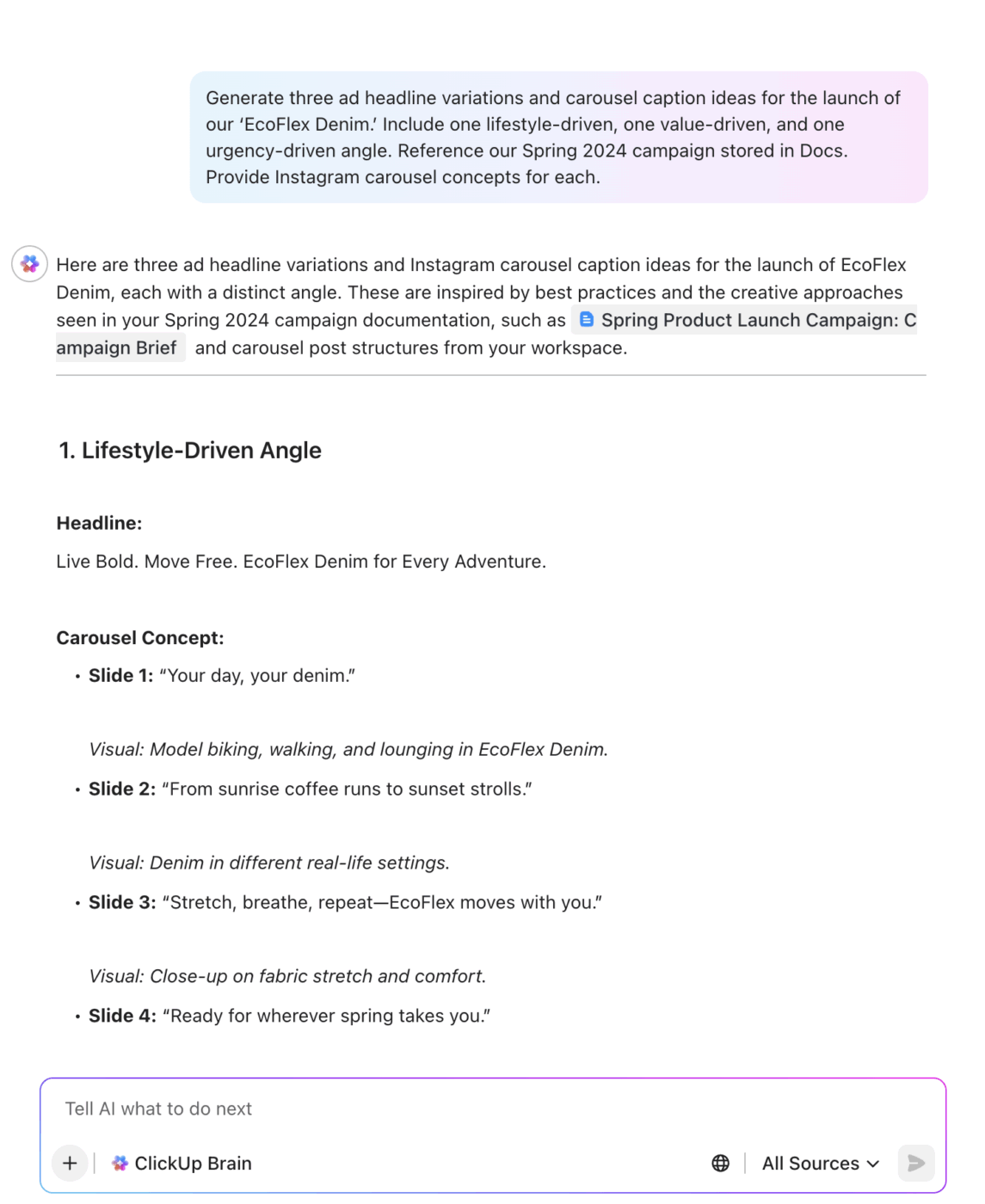
📌 Example: A fashion retailer launching a denim line uploads last season’s campaign brief into ClickUp Docs. ClickUp Brain instantly generates:
From there, designers use ClickUp Brain to produce Instagram carousel mockups aligned to these angles. The concepts flow into Tasks with due dates and owners auto-assigned—ready for feedback and launch prep.
💡 Why it’s convincing: Instead of waiting weeks for brainstorm meetings, rewrites, and design drafts, the team has polished, test-ready creative ideas in hours—every concept consistent with brand tone and past campaigns.
💡 Pro Tip: Don’t let your campaign moodboards live on 14 open Chrome tabs. Let ClickUp Brain auto-summarize your ideas and dump everything into a ClickUp Whiteboard, where you can start organizing the information and collaborating.
The problem: Campaigns often stall in the “handoff” stage. Creative might be approved, but assignments, dependencies, and reminders get buried in email threads or Slack pings. By the time tasks are actually assigned, deadlines are already slipping. This manual follow-up kills campaign momentum.
The ClickUp AI solution:
ClickUp Autopilot AI Agents keep campaigns moving without human micromanagement. They don’t just automate task workflows; they understand campaign context and act as proactive coordinators.
1. Trigger-based execution
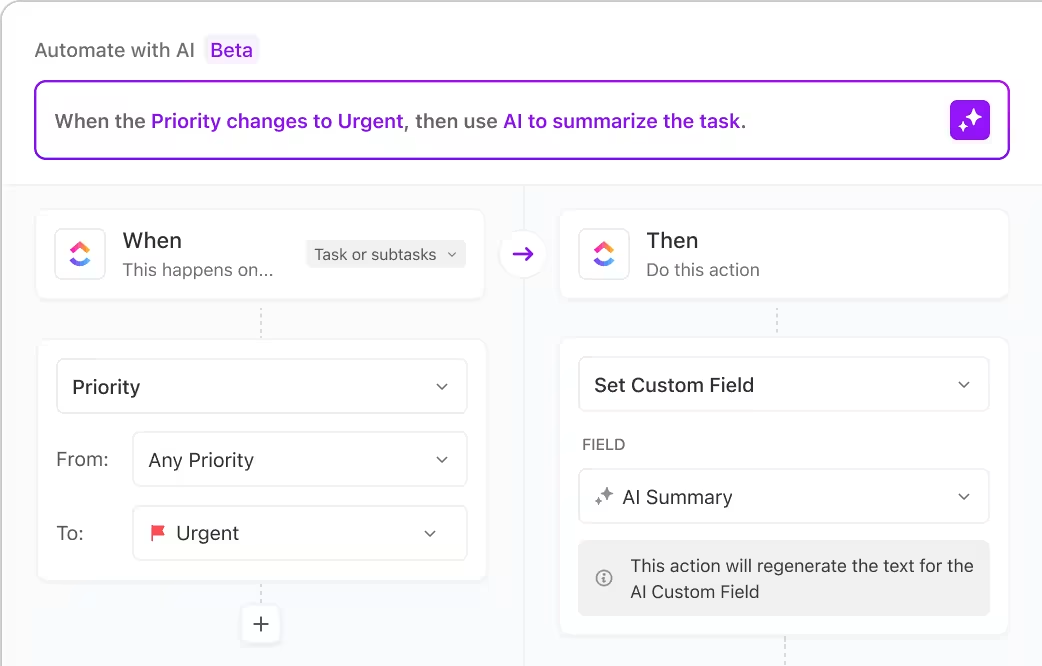
Set rules like “If campaign brief = approved, then assign tasks, notify stakeholders, and update the campaign calendar.”
2. Contextual reasoning
AI Agents can read campaign briefs, check dependencies, and escalate blockers before they become issues.
3. Smart routing
If the budget is over $20K, an agent automatically tags Finance for review; if assets are overdue, the ClickUp AI Agent pings the owner and updates the campaign timeline.
4. Always-on workflow
Campaigns move from approval to launch without waiting for a project manager to push things forward manually.
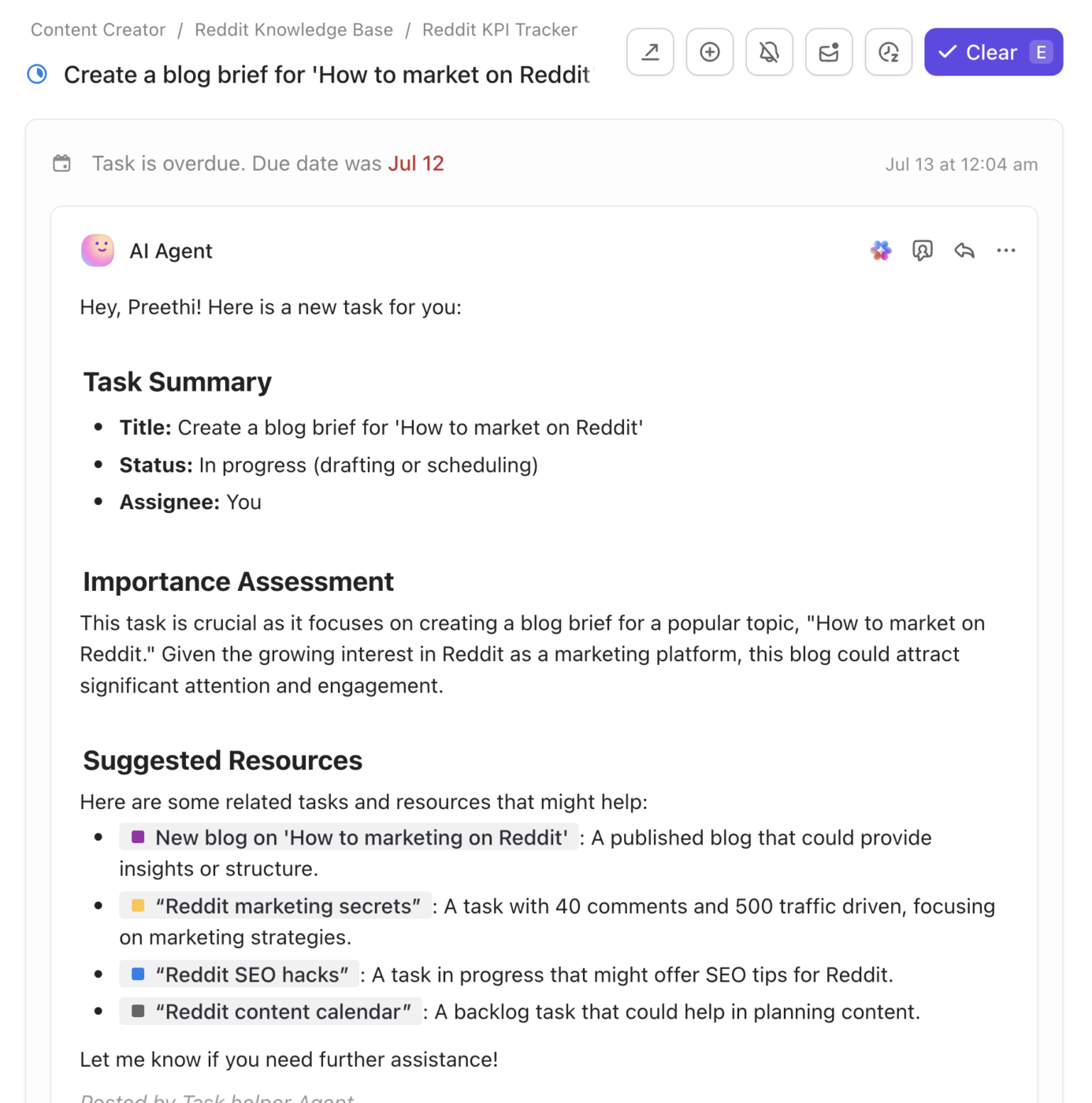
✨ Why it’s smart
📌 Example: For a Valentine’s Day promo campaign:
Agent rule: Doc status = Approved → create tasks, assign owners, set due dates, notify stakeholders.
💡 Why it’s convincing: Instead of PMs chasing updates, campaigns move forward automatically. Teams stay focused on strategy and creativity, while Autopilot handles the handoffs and nudges that usually cause delays.
The problem: During campaign execution, teams waste hours hunting for last year’s performance data or tracking the latest creative update. Review cycles are outdated, and decisions are delayed by the time they piece everything together.
The ClickUp AI solution:
ClickUp Brain + Enterprise AI Search eliminates the back-and-forth. Instead of digging through dashboards or pinging analysts, teams get instant, contextual answers from across their entire Workspace.
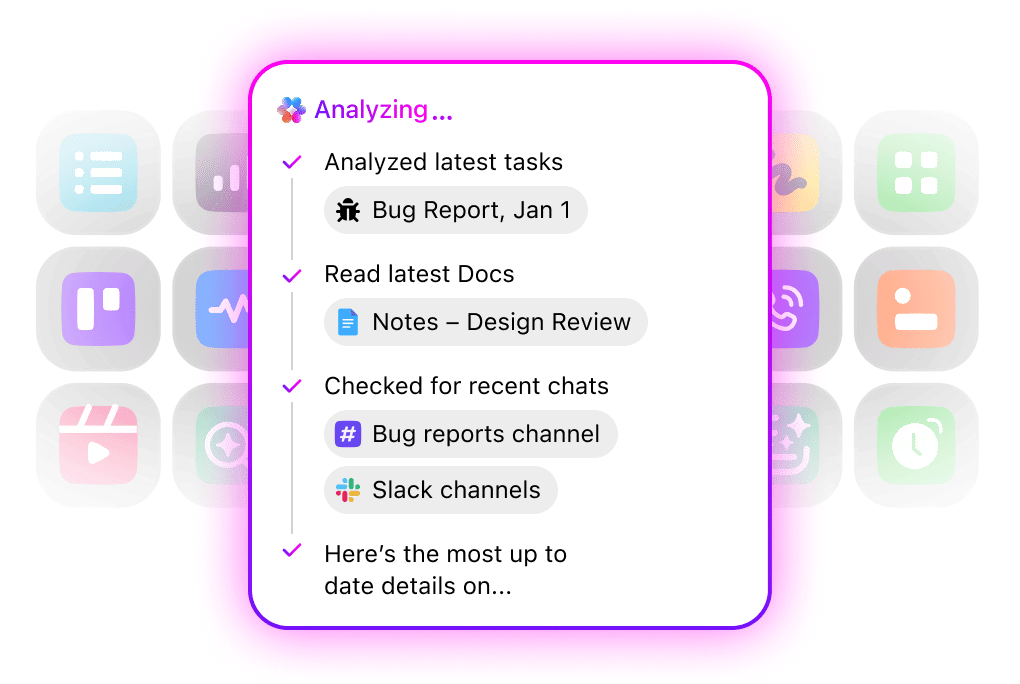
Here’s how it works in ClickUp:
1. Enterprise AI Search
Ask questions in natural language across tasks, docs, messages, and connected tools like Slack, Gmail, and Sheets. With full context from your workspace, you get precise answers instantly—no dashboards or data digging required.
2. Real-time campaign visibility
Need updates on the fly? Ask “What’s the Spring campaign landing page status?” or “Show me 2023 Q4 attribution data for Facebook ads.” ClickUp delivers accurate answers in seconds, giving you live campaign intelligence when needed.
3. Built-in proofing and approvals
Review creative assets without leaving your workspace. Comment directly on images, videos, or docs, and push them through automated approval workflows—so feedback loops that once took days now happen in minutes.
4. Continuous optimization
Forget bottlenecks buried in inboxes. With AI surfacing insights instantly, teams can make more informed calls, fine-tune campaigns in real time, and scale faster than ever before.
✨ Why it’s smart
ClickUp Brain transforms marketing operations from reactive and fragmented to proactive, fast, and insight-driven—helping your team launch stronger campaigns with confidence.
📌 Example: An e-commerce growth lead prepping for a board meeting asks ClickUp Brain
Enterprise AI Search pulls:
💡 Why it’s convincing: Leaders don’t need analysts or multiple dashboards—they have instant customer insights in seconds.
🧐 Did You Know? Some marketers use AI to build “anti-personas”—profiles of people least likely to buy—helping teams avoid wasted ad spend.
The problem: Launches can be messy. Calendars don’t sync, asset versions clash, and performance feedback lags by days.
The ClickUp AI solution:
1. Plan every launch in one place
Use ClickUp Calendar to see emails, ads, SMS, and social media side by side, so timelines align and nothing is missed.
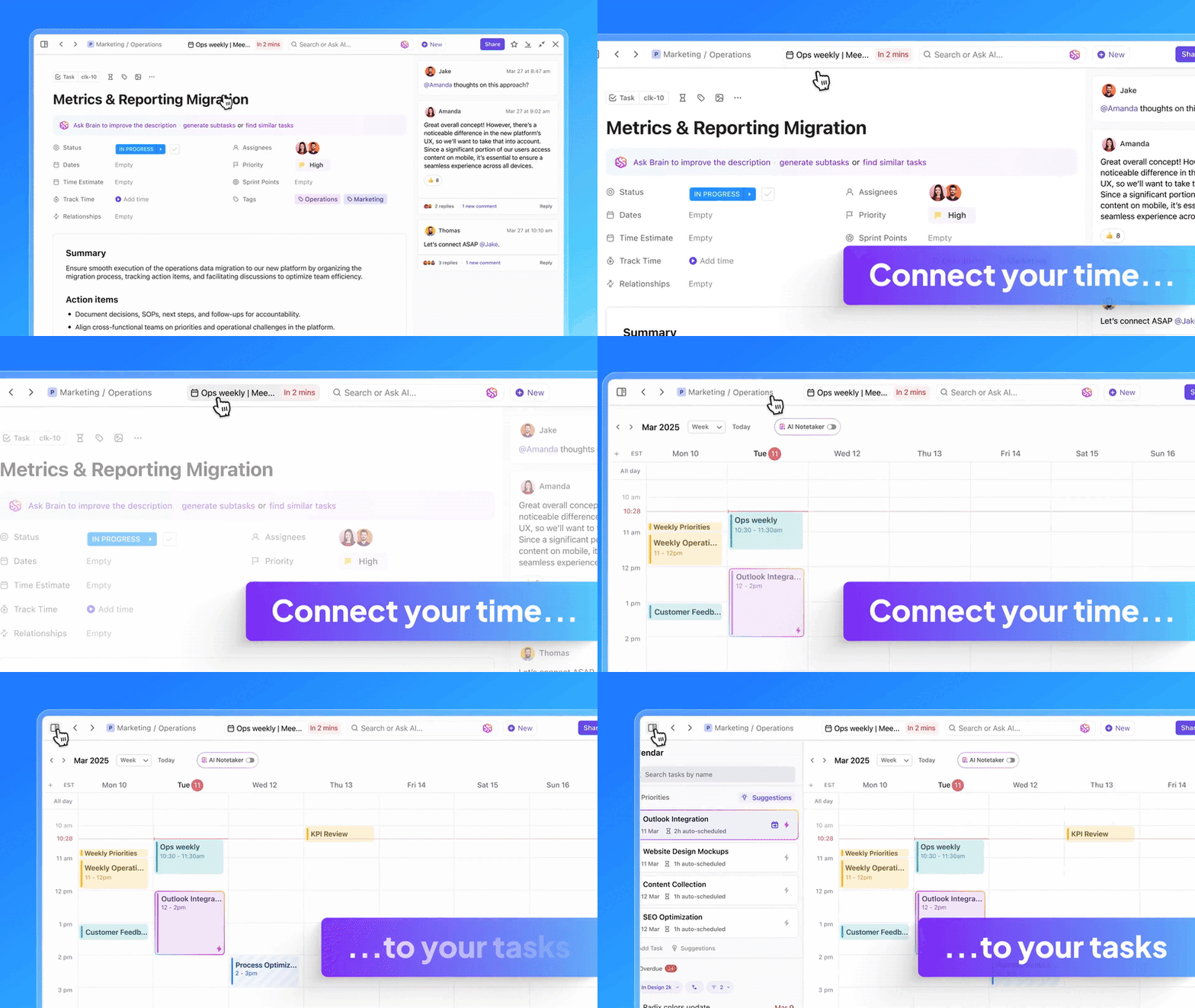
2. Automate the busywork
Set smart rules with ClickUp like “if asset uploaded → status = Ready for QA” to keep campaigns moving without manual check-ins.
3. Spot issues instantly with AI
Dashboard AI Cards highlight changes like “CTR down 12% vs. last week” and suggest fixes—such as running a headline test—before performance dips further.
4. Report in seconds, not hours
AI auto-generates weekly or monthly performance summaries for leadership, turning raw data into polished insights with a single click.
5. Track effort, prove ROI
Built-in time tracking connects hours to campaign tasks, helping agencies justify billables and teams understand effort vs. impact.
6. Slice data your way
Custom Fields and advanced views let you segment campaigns by channel, budget, or owner—making pivots simple and precise.
✨ Why it’s smart
ClickUp AI transforms campaign management from a manual, reactive process into a connected, proactive system—so teams can launch faster, optimize continuously, and confidently report.
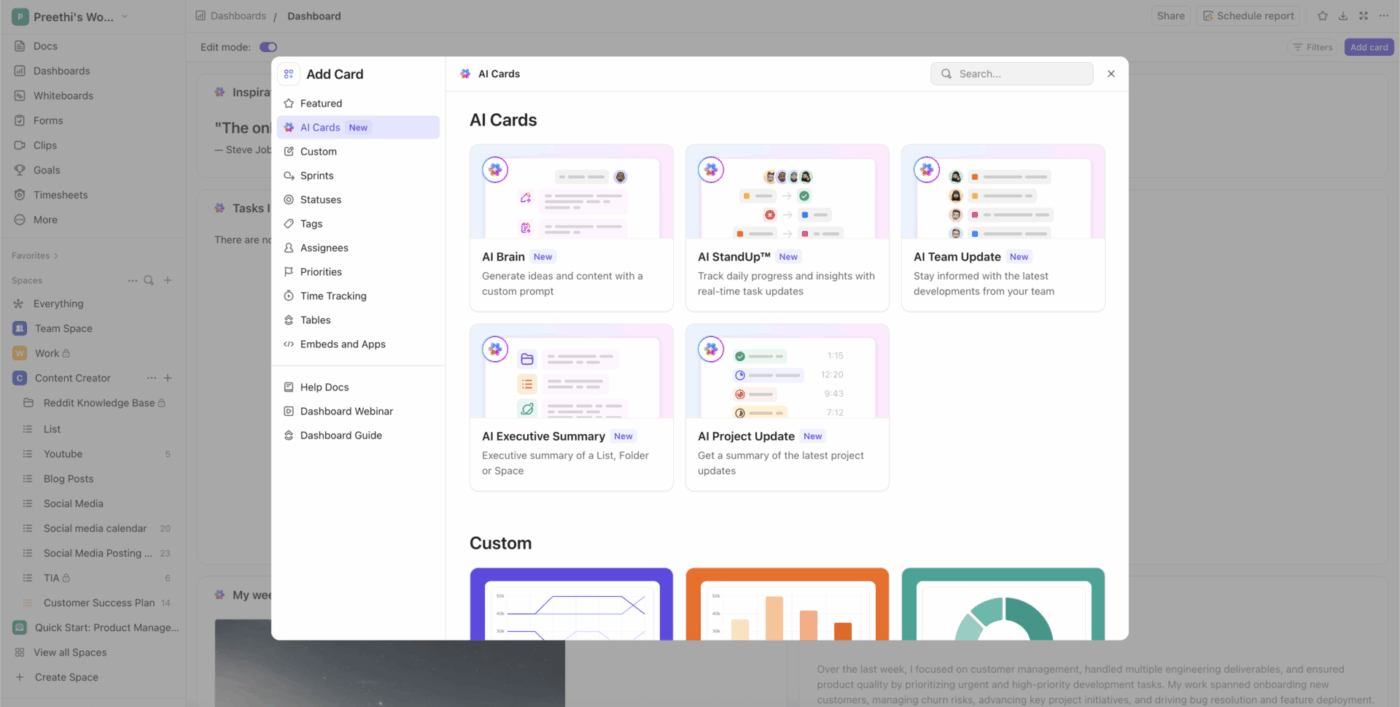
📌 Example: A health supplement brand launches across Meta, Google, and Klaviyo. Instead of toggling tools
What happens when you click “Review budget”:
💡 Why it’s convincing: Teams see what underperformed, what’s outperforming, and the exact dollar move in one place—no tab hopping, guesswork, and accidental auto-spend.
💡 Pro Tip: Stay on top of campaign progress from anywhere with the ClickUp mobile app—review, comment, and approve on the go.
The problem: Every campaign feels like starting over—learnings get lost and templates stay buried.
The ClickUp AI solution:
1. Save campaigns as repeatable templates (with best practices baked in)
With ClickUp Templates, you can capture workflows—briefs, ClickUp Tasks, ClickUp Automations, ClickUp Dashboards, and reports—and reuse them for future campaigns. Each template comes with your proven processes and optimization guardrails built in, so every launch starts on solid ground.
2. Organize by campaign type
Tag your templates for Holiday Promos, Product Launches, or Retargeting Flows. For example, the ClickUp Promotional Calendar Template helps manage seasonal campaigns in one workspace, giving your team a plug-and-play starting point.
3. Refine with AI prompts and AI Agents
Over time, ClickUp Brain prompts and Autopilot Agents learn from your workflows, so campaign setup and execution get faster and more efficient with each iteration.
✨ Why it’s smart
ClickUp turns successful campaigns into playbooks—so your team can launch faster, more confidently, and with consistency across every channel.
📌 Example: After running three seasonal promos, a fashion brand saves its best-performing Holiday Playbook as a ClickUp Template. The following year, they spin it up in a single click—updated with new ClickUp Brain prompts and automation rules.
💡 Why it’s convincing: Each campaign strengthens the next, transforming execution from a one-off effort into a scalable growth engine.
👉 With AI-powered playbooks in place, teams move beyond “just executing” to compounding growth every campaign cycle.
✨ Feel-Good Reminder:
AI isn’t here to replace your creative spark but to stop you from crying over last-minute pivots. With ClickUp AI Agents auto-shifting tasks and deadlines, you can stay in the zone while the boring stuff updates itself.
👉 The result? Campaigns that finally work as hard as you do.
Google Ads AI vs. Other e-commerce AI platforms
Not all AI platforms are created equal. Here’s how Google Ads AI stacks up against other leading tools:
| Feature | Google Ads AI | adcreative.ai | Klaviyo Predictive AI | Triple Whale/Northbeam |
| Automated Bidding | ✅ | ❌ | ❌ | ❌ |
| Creative Generation | Limited (text only) | ✅ (visuals & copy) | ❌ | ❌ |
| Predictive Analytics | Basic | ❌ | ✅ | ✅ |
| Attribution | Basic | ❌ | ❌ | ✅ (multi-touch) |
| Integration with ClickUp | Via Zapier/Make | ✅ | ✅ | ✅ |
Takeaway: Use Google Ads AI for bidding; pair with creative, attribution, and orchestration tools—run the workflow in ClickUp.
🧐 Did You Know? AI agents are already handling the majority of customer inquiries. The 2025 Rep AI Ecommerce Shopper Behavior Report found that 93% of customer questions are resolved by conversational AI—no human needed.
AI only matters if it pays for itself. Your leadership doesn’t care about “automation” or “generative copy”—they want proof that campaigns launch faster, perform better, and scale without ballooning headcount.
How to prove ROI (the CFO way):
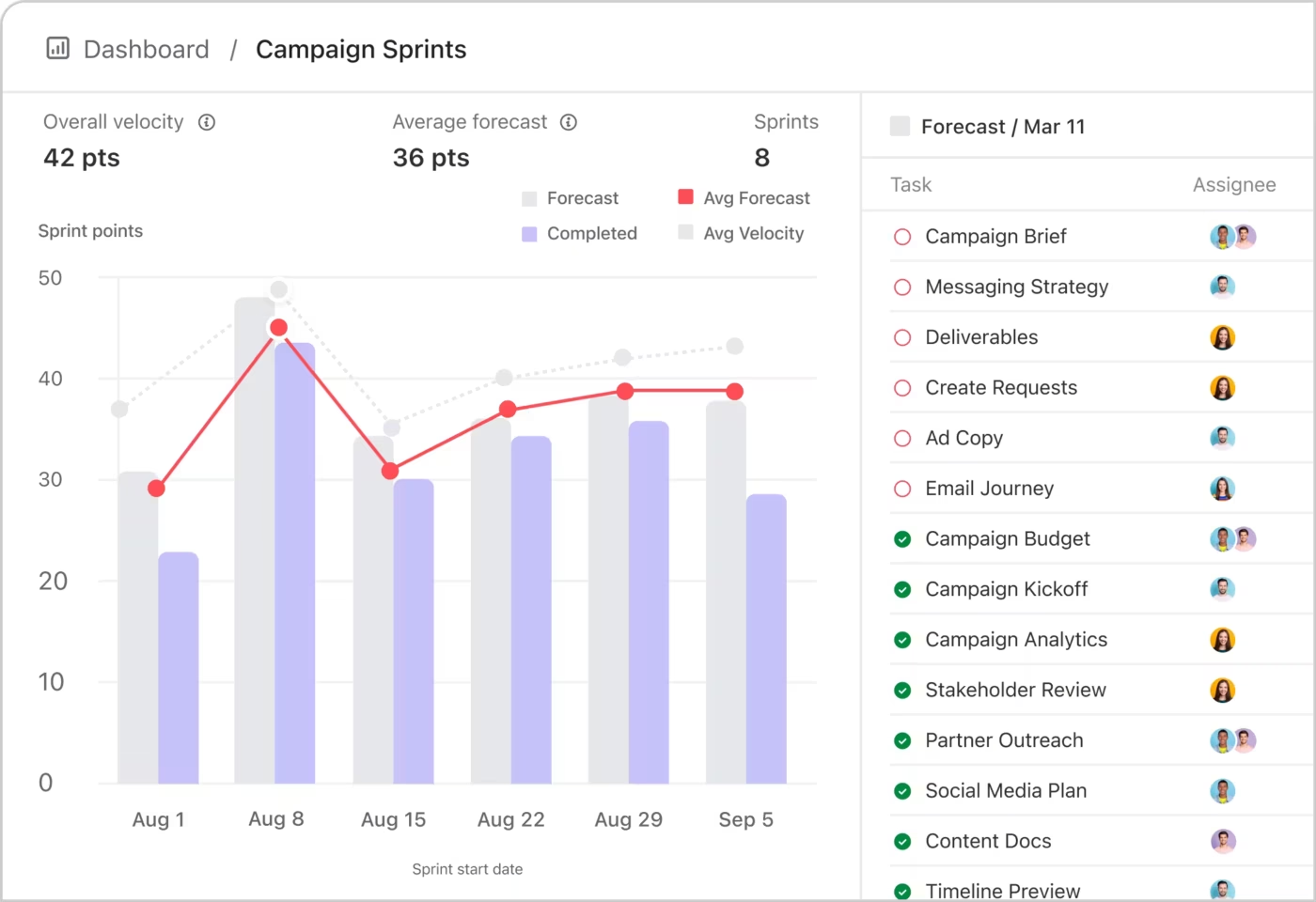
In ClickUp: ClickUp Dashboards + AI Cards surface live ROI snapshots (CTR, ROAS, conversions). Automated reports roll up weekly wins and budget tips so that you can show impact in minutes—not weeks.
💡 Pro Tip: Save your ROI dashboard as a ClickUp Template so every future campaign comes with built-in reporting.
🎉 Fun Fact: Using AI-driven consumer trend analysis, Coca-Cola launched its first AI-generated flavor (“Coca-Cola Y3000”). 🥤
🧐 Did You Know? L’Oréal’s CREAITECH platform lets creative teams use generative AI to place a single product shot into any environment—like a Japanese garden or Parisian street. No more expensive international photoshoots!
AI is no longer just ‘support tech’ for e-commerce—e-commerce brands now see it as the operating system of campaign execution. From creative generation to attribution modeling, every funnel part can now be automated or optimized with AI. But the real power comes when these tools work together, not in isolation. Below are the top AI tools to consider, with ClickUp Brain as the central hub to connect your campaign from planning to execution.
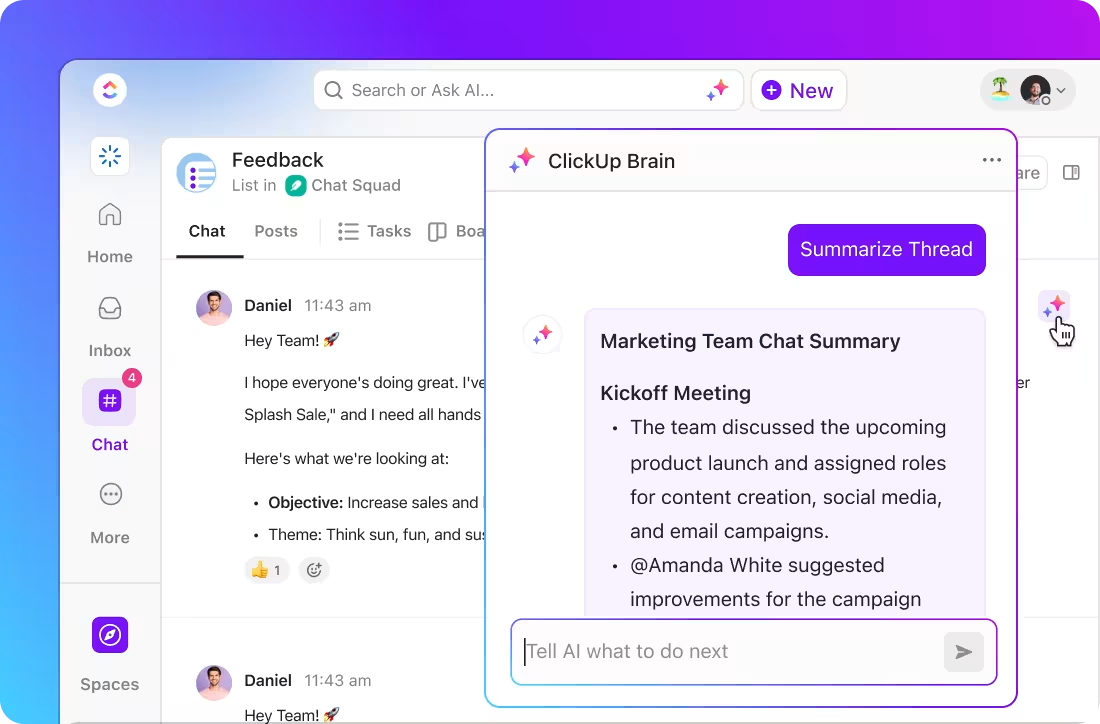
Every successful campaign begins with planning, and many teams lose speed. ClickUp Brain turns the planning process into a living, automated system instead of a static spreadsheet.
What it does:
Centralize campaign planning & creative workflows → Build campaign briefs, timelines, and creative asset requests in one Workspace. Everyone sees the same source of truth, whether they’re in product, marketing, or operations
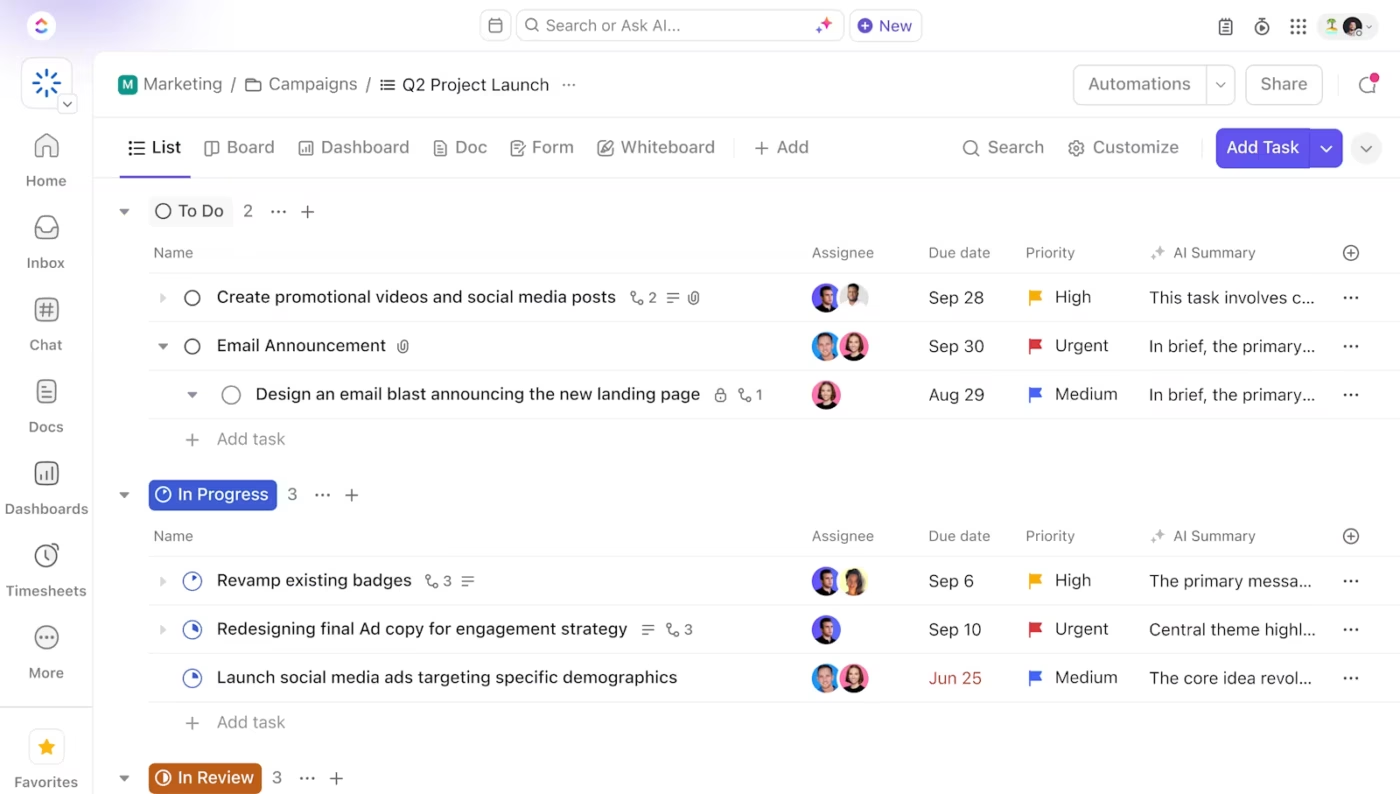
💡 Pro Tip: Use ClickUp’s compliance and brand guardrail features to set up AI-powered approval gates—ensuring no campaign launches without the proper disclaimers, brand voice, or legal checks.
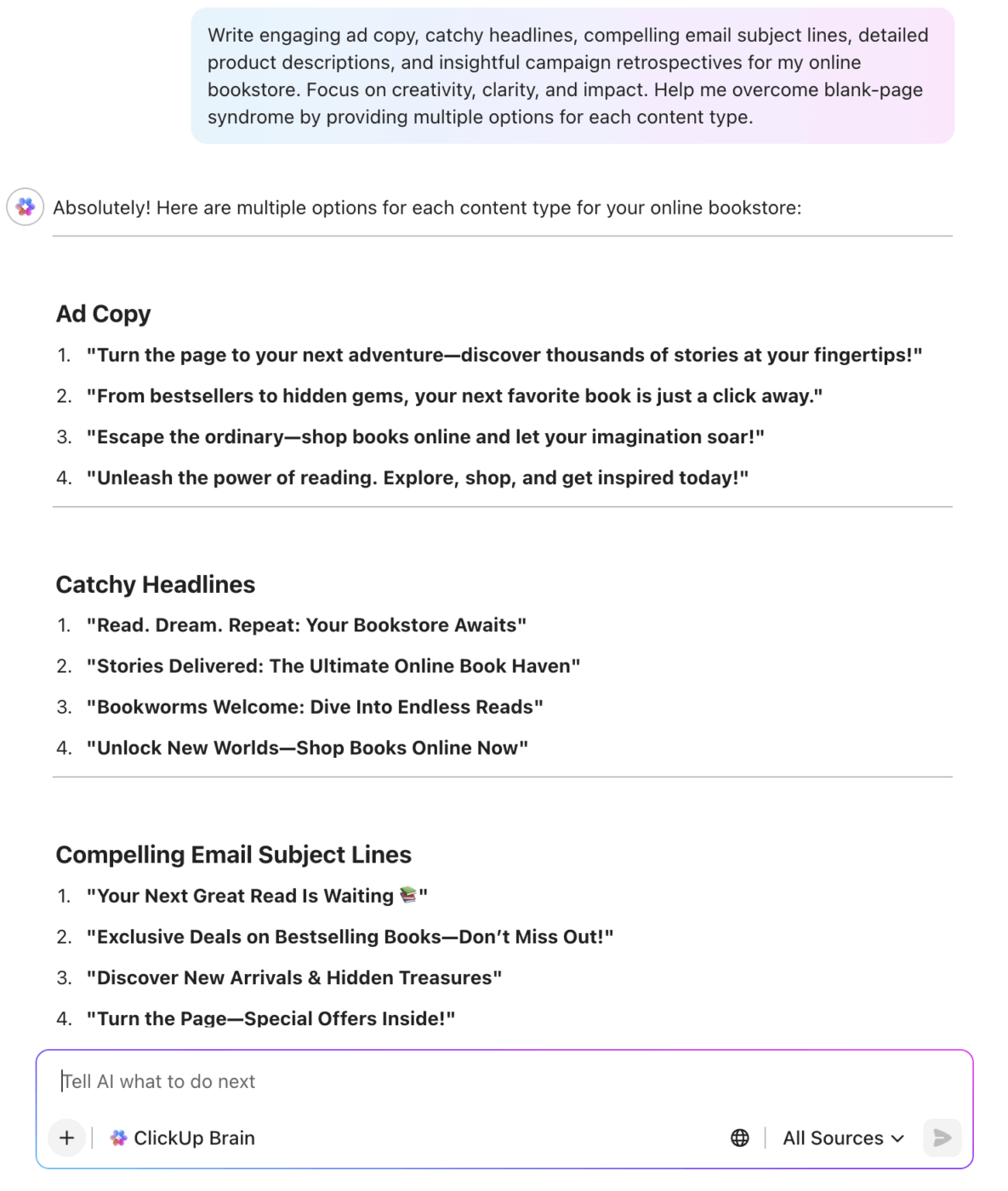
AI-powered copy & content generation → ClickUp Brain writes ad copy, headlines, email subject lines, product descriptions, and campaign retrospectives. No more blank-page syndrome
Save this 9-point AI Preflight Checklist as a reusable ClickUp template. Every campaign launches with guardrails (brand, budget, compliance) already built in—no steps missed, no surprises.
✨ AI preflight essentials
🧹 Data hygiene – Are product feeds, UTMs, and consent flags accurate and up to date?
🎯 Objective clarity – Does every channel have one clear KPI?
🛡️ Guardrails – Are brand voice, disclaimers, and localization rules locked in?
🧪 Experiment design – Is each test built around a single hypothesis with rules + success criteria
💸 Budget rails – Have you set automated min/max spend thresholds?
👩✈️ Human-in-the-loop – Which steps need manual review or sign-off before launch?
📊 Measurement Plan – Are you tracking blended ROAS, incrementality, or both? How will you report results?
🎨 Creative refresh cadence – When/how will AI flag fatigue or performance dips?
🔄 Rollback plan – If things go sideways, can you instantly revert to a steady-state setup?
ClickUp AI Agents → Automate using campaign management tools. Example: an AI Agent can track creative approvals, ping stakeholders if reviews are late, and adjust deadlines based on dependencies
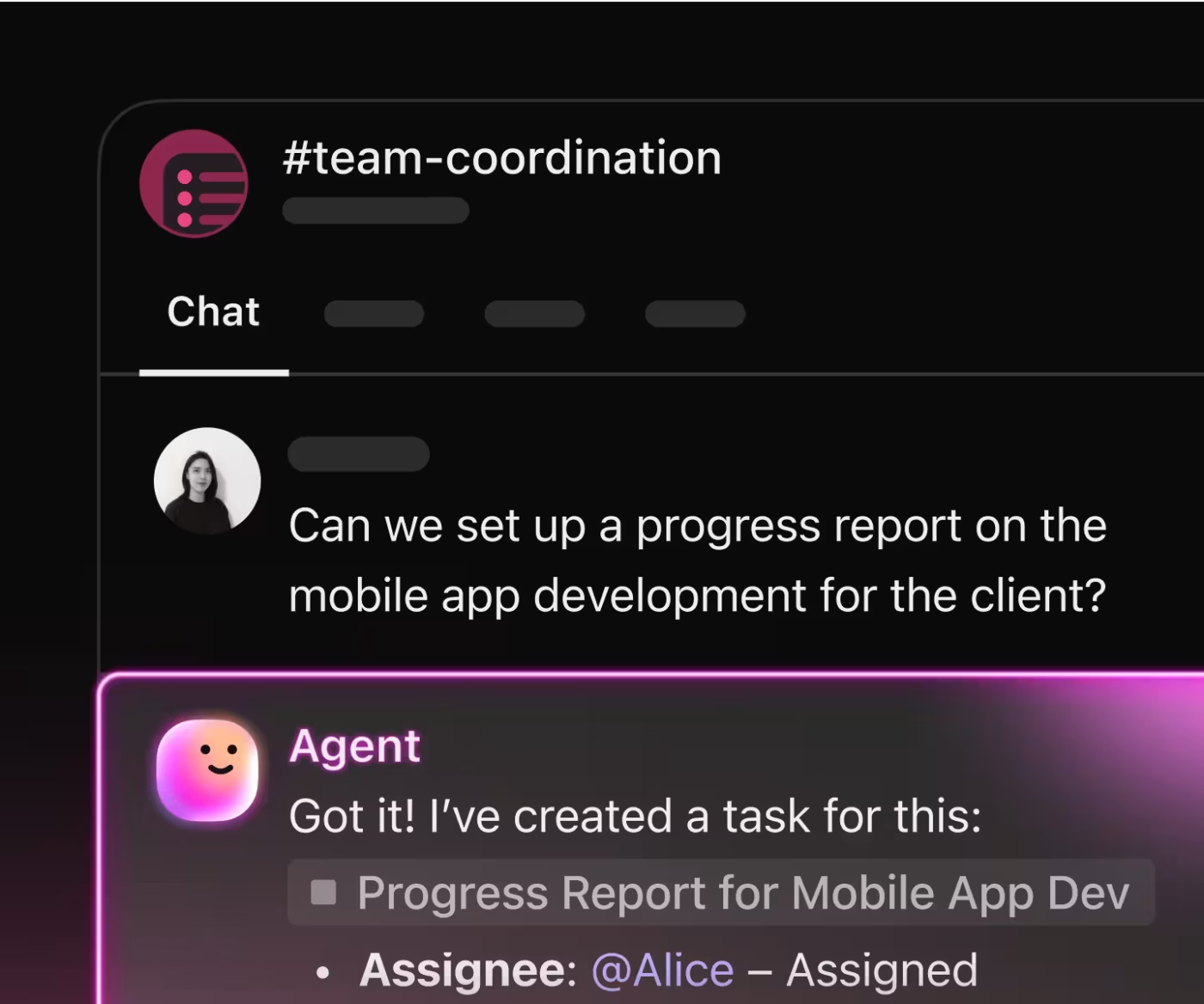
👉 With ClickUp, campaigns don’t just “get managed”—they evolve dynamically with ClickUp AI Agents monitoring performance and ensuring nothing slips.
🧐 Did You Know? Visual search is booming: eMarketer reports a 70% global increase in visual searches from 2023 to 2024. AI is making “see it, shop it” a reality for e-commerce.
Campaigns die without fresh creatives. That’s where visual AI tools step in.
Why ClickUp matters here: Store Canva and AdCreative.ai outputs directly in ClickUp Docs linked to campaign tasks. ClickUp Brain can track asset readiness (draft, review, live) so no creative falls through the cracks.
💡 Pro Tip: Kickstart your planning with ready-made marketing campaign templates inside ClickUp, then use ClickUp Brain to fill in copy, captions, and reports.
Customer retention is as critical as acquisition, and Klaviyo’s AI models make retention predictive instead of reactive.
What it does:
ClickUp tie-in: Plan, manage, and track all these Klaviyo flows inside ClickUp. It can even auto-generate email drafts based on campaign briefs, while an AI Agent updates campaign timelines once flows are approved.
🎉 Fun Fact: CarMax used generative AI to summarize thousands of customer reviews in hours—a task that would have taken human writers years
Attribution is the hardest part of e-commerce marketing. Without it, you’re flying blind.
ClickUp tie-in: Instead of bouncing between dashboards, ClickUp Brain can pull attribution summaries directly into your Workspace. Ask the AI, “How did TikTok affect last month’s ROAS?” and see data visualized in your campaign doc.
🧐 Did You Know? Amazon boosted ad click-through rates by up to 40% using AI-generated images in tests.
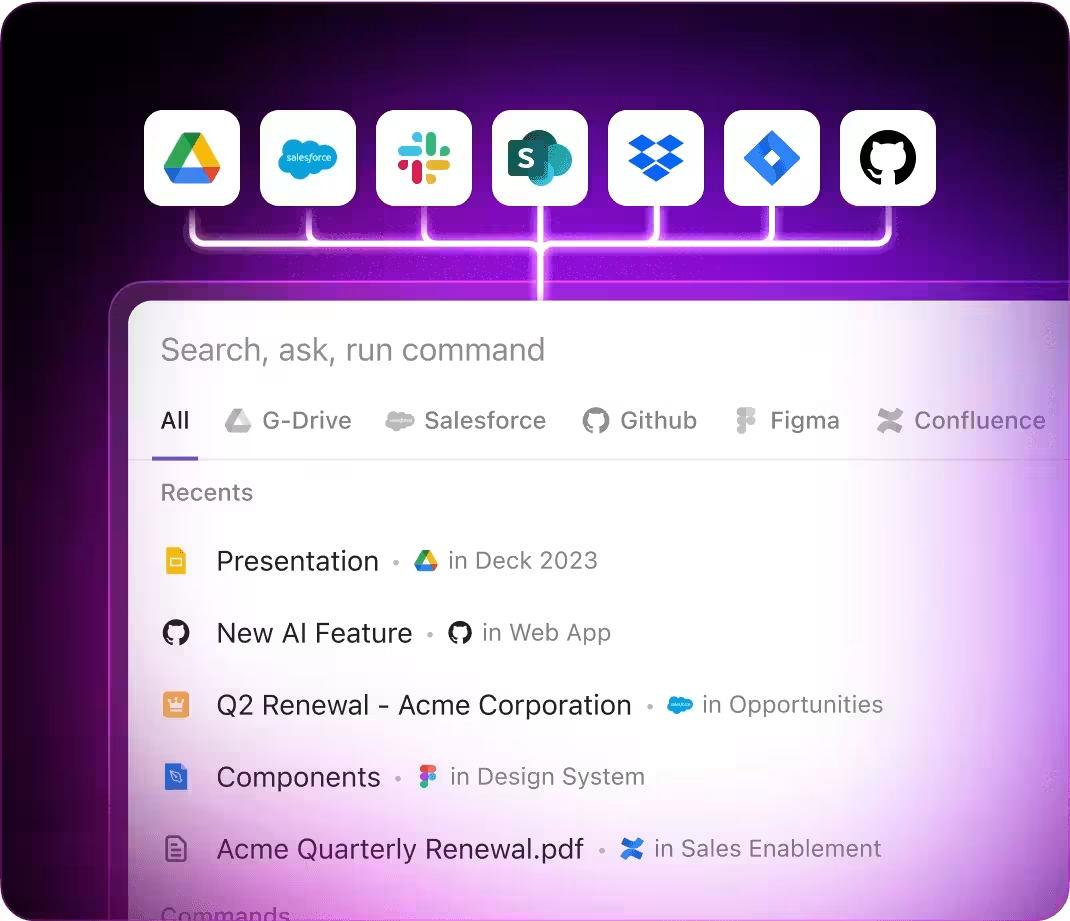
On their own, AI marketing tools are powerful. Together, they create AI sprawl—a mess of disconnected dashboards, reports, and notifications that leave teams scrambling to piece things together. Instead of accelerating growth, the stack slows execution.
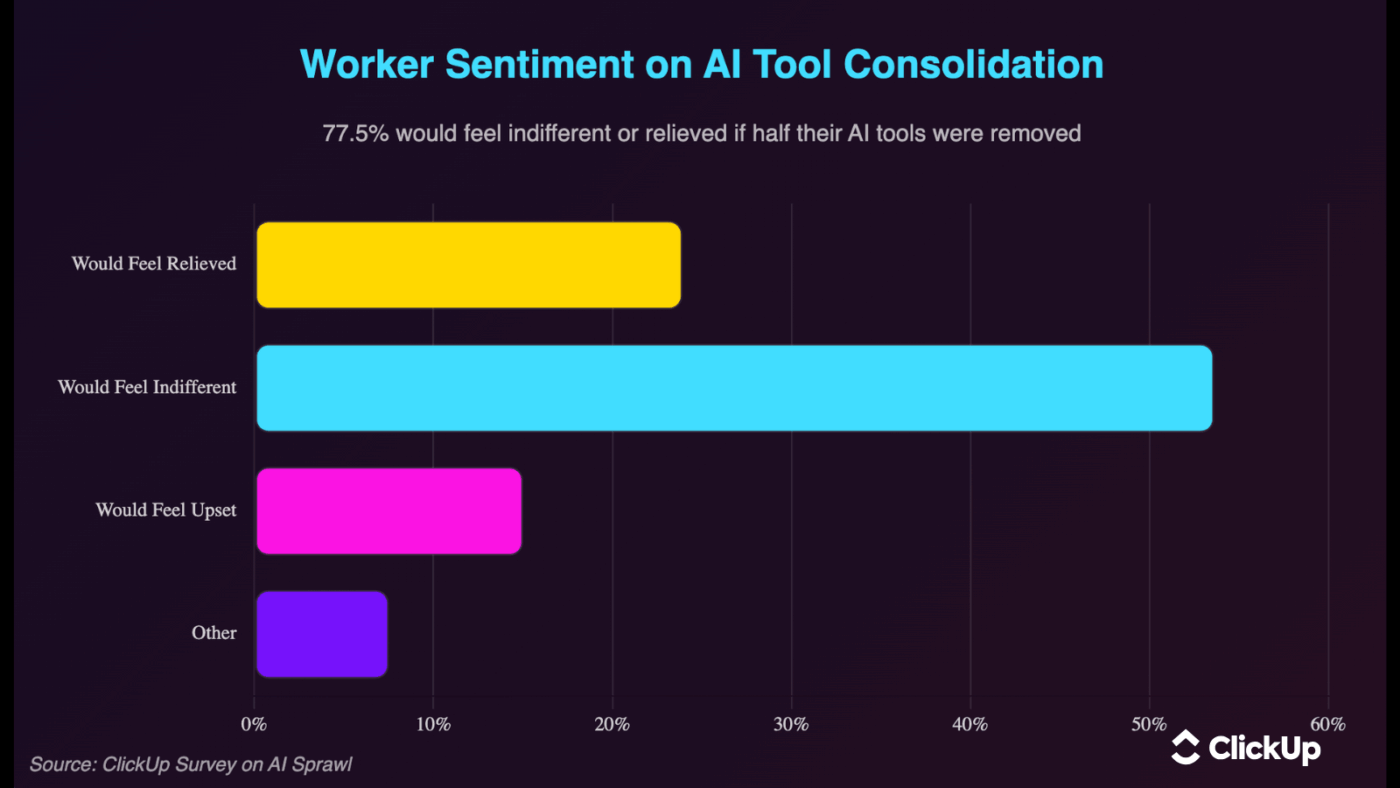
No surprise then that 77.5% of workers said they’d be indifferent—or even relieved—if half their AI tools disappeared.
That’s where ClickUp Brain steps in as the command center:
👉 Instead of chasing approvals, reconciling conflicting metrics, and context-switching across tools, teams stay aligned in one hub, with AI ensuring no detail is missed.
📖 Read more: For a comprehensive roundup, check out these AI tools for e-commerce that can power every stage of your campaign.
Why this matters
Small teams don’t have endless cash or hours. AI isn’t about shiny tools—it’s about cutting bottlenecks so founders aren’t stuck as creative, media buyer, and analyst all at once.
How to start lean
Your starter AI stack
1-week AI sprint
Key metrics
Bottom line
For small brands, AI should feel like an extra teammate—not another tool to babysit.
AI is powerful in e-commerce campaign execution, but it’s not magic. Teams often stumble because they treat AI as a “set it and forget it” tool instead of a guided partner. Here are the most common pitfalls—and how to avoid them with the right strategies and AI support.
Fragmentation, not innovation, is often the real cost of AI overprocurement. Multiple-point solutions—each promising value—create inefficiency, confusion, and wasted investment.
Insights from ClickUp’s resources highlight how serious this issue is:
Imagine a team juggling five AI apps—one for ad copy, one for analytics, and another for project tracking. Instead of speeding things up, switching between tools slows them down and leaves critical data scattered.
The fix with AI:
👉 Instead of letting AI sprawl slow you down or expose you to risk, you streamline execution—navigating from chaos to clarity with one trusted hub.
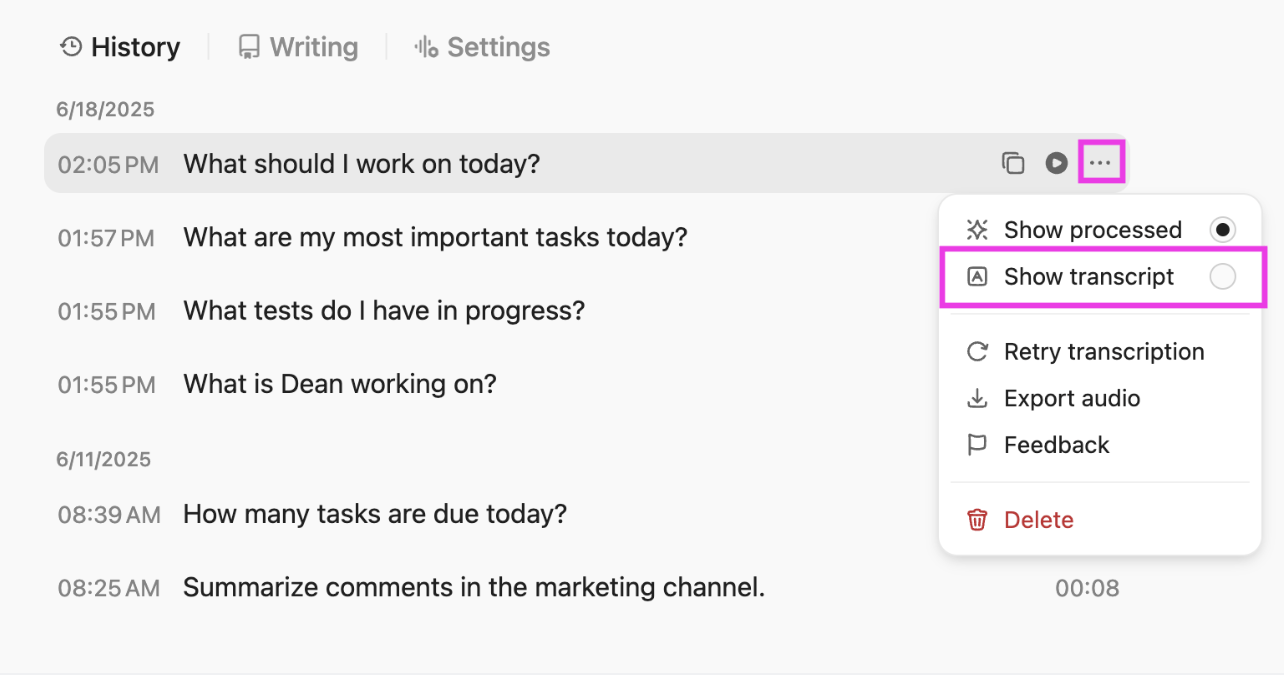
💡 Pro Tip: Your messy voice notes can become campaign gold. ClickUp Brain Max uses the talk-to-text feature and auto-structures your voice input into tasks or briefs in ClickUp—like having an intern who loves deciphering your tangents.
Many brands assume AI ad platforms will self-optimize, but skewed input data can lead to runaway spending—often on underperforming channels.
Suppose a DTC apparel startup leaves Meta Ads unchecked. Within weeks, 70% of its budget goes to retargeting existing buyers—driving repeat purchases but barely growing new revenue.
The fix with AI:
👉 Instead of finding overspending after the fact, you prevent it in real time.
🎉 Loyalty is built before checkout
Loyalty cues—like trust signals and easy navigation—predict repeat purchases more than the first transaction.
Map loyalty touchpoints in ClickUp Docs and let ClickUp Brain Max generate trust-building copy before campaigns go live.
Even with AI generating copy or creatives, campaigns slip when workflows aren’t synced.
Imagine a beauty brand planning a “Holiday Glow” campaign. If feedback delays push launch four days past Cyber Monday, the momentum—and sales—vanish.
The fix with AI:
👉 You move from firefighting to proactive, AI-managed execution.
AI models often make decisions that are hard to interpret. Without transparency, teams can’t explain to leadership why a campaign succeeded or failed. Natural language processing (NLP) can help surface explanations from campaign data in plain English.
Suppose a cosmetics brand sees a sudden ROAS spike from AI-driven ads. Confidence crumbles when results dip if the team can’t explain which audience or channel drove it.
The fix with AI:
👉 Transparency builds trust and makes AI results defensible in the boardroom.
🧐 Did You Know? Nike’s AI-powered search lets shoppers use natural language queries like “Find me lightweight trail shoes for narrow feet,” making products easier to discover and boosting SEO.
Rolling out AI isn’t just a tech project—it’s a cultural shift. If analysts or copywriters feel replaced rather than empowered, adoption suffers.
Imagine a retailer introducing AI ad copy overnight. Creative teams feel sidelined, stop engaging, and quality drops.
The fix with AI:
👉 AI adoption succeeds when people see it as an ally, not a threat.
🧐 Did You Know? According to Cisco, 89% of consumers say the best support experience blends AI efficiency with human empathy. Automation should be fast and scalable—but always make it easy to reach a real person.
Ads lose steam when the same creative runs too long.
Suppose a furniture brand runs the same carousel ad for 90 days. CTRs nosedive and ROAS drops 45%.
The fix with AI:
👉 Instead of reacting after results tank, AI triggers refresh cycles right on time.
🎉 Fun Fact: Nutella used AI to design 7 million unique jar labels for its “Nutella Unica” campaign. Every single jar sold out within a month—proof that personalization at scale can create collector-level excitement.
Insights get trapped when marketing, ops, and product rely on different tools.
For example: a sneaker brand ran a TikTok-heavy campaign that spiked demand for one SKU, but ops didn’t see it in time—leading to stockouts and late shipping.
The fix with AI:
👉 AI breaks silos and prevents expensive blind spots.
AI personalization can feel intrusive if it’s poorly tuned.
For example: A homeware brand recommended the same couch a customer had already purchased. Instead of delight, the result was unsubscribes.
The fix with AI:
👉 Personalization becomes thoughtful, not robotic.
🎉 Fun Fact: Even AIs know Heinz is king of ketchup. When asked to visualize “ketchup,” DALL-E 2 consistently generated images that looked like a Heinz bottle—no brand hints needed! 🍅
Some teams “dabble” in AI—using it for copywriting but still tracking campaigns in spreadsheets—leading to confusion and duplication.
Suppose a beauty brand uses AI to send identical promotional emails to all customers, ignoring purchase history. The result? Customers feel spammed, and engagement drops.
The fix with AI:
👉 The brands winning with AI are embedding it into every execution stage.
🎉 Fun Fact: Brands that excel at AI-driven personalization generate 40% more revenue than those that don’t. Personalization isn’t just a buzzword—it’s a profit engine.c
From loyalty programs to creative production, generative AI in e-commerce drives real, measurable wins. But this isn’t just a big-brand advantage—teams using ClickUp already see it in action.
📉 STANLEY Security saved 8+ hours/week on updates and cut report time by 50%
📊 CEMEX accelerated product launches by 15%
💸 RevPartners slashed SaaS costs by 50% with ClickUp as their all-in-one workspace
So what are the world’s leading e-commerce brands doing with AI e-commerce tools? Let’s take a look.
Results: 📈 +5% retention lift · 🎁 2× loyalty redemptions · 🛒 2× abandoned-order conversions
AI-powered segmentation helped Panera identify at-risk customers and deliver personalized offers during a major menu transition—protecting loyalty while increasing conversions.
🎉 Fun Fact: Using AI-driven segmentation, Netflix discovered that horror fans love rom-coms. This surprising crossover allowed them to craft more resonant, better-targeted promotions.
Results: 💰 +7% revenue per visitor · 📊 ~10% conversion lift
By dynamically curating homepage experiences for each shopper, Saks used AI to turn browsing intent into measurable revenue.
🎉 Predictive AI spots micro-trends early
Retailers using AI to detect “micro-trend” signals in searches and social chatter can boost trending product sales by 30–40%.
Set up an AI agent to scrape trend signals and assign tasks instantly—so you capitalize before competitors.
Results: ⚡ 90% faster + cheaper image production · 🖼️ 70% of editorial images AI-generated in a quarter
Zalando built an AI-powered creative pipeline that drastically cut production cycles, helping them launch refreshed campaigns faster.
Results: 📈 +35% conversion · 💰 +40% revenue per visit · 🚪 –28% exits
With Black Friday traffic spikes, TFG deployed conversational AI to guide shoppers, recover carts, and reduce exits in real time.
Results: 🤝 Unified creative ops + 📊 analytics across multiple DTC brands after acquiring Avalanche AI
When Wholesome Goods acquired Avalanche AI, it faced the challenge of managing various DTC brands efficiently. The company scaled without duplicating effort by centralizing creative ops and analytics into one AI-driven system.
Results: 🛍️ A bespoke AI concierge site blending philosophy with commerce
Luxury fashion house Brunello Cucinelli blended AI with its heritage-driven storytelling. Its AI concierge behaves less like a chatbot and more like a digital docent—anchoring every recommendation in craftsmanship, provenance, and philosophy.
Results: ⚡ 40% faster reporting · ⏰ 5+ hours saved weekly
Results: ⚡ 40% faster reporting · ⏰ 5+ hours saved weekly
Dashboards and ClickUp Brain cut reporting time and eliminated back-and-forth, giving teams time for creative work.
Results: ⏳ 8+ hours/week saved · ⚡ 50% faster report creation
ClickUp AI Notetaker and Dashboards eliminated status meetings and manual updates, boosting productivity.
Results: 🚀 15% faster launches · ⏱️ 24hr communication lag reduced to seconds
With tasks, chat, and automations all in one place, cross-functional delays vanished—and campaign velocity increased.
Results: 💸 50% reduction in SaaS spend
By consolidating multiple tools into ClickUp, RevPartners dramatically cut costs while improving alignment and execution.
Results: 🤝 20% increase in communication efficiency
Streamlined planning, faster content feedback loops, and real-time updates helped Pigment’s teams stay in sync—without extra effort.
Results: 📈 30% faster development · 💪 20% reduction in overwork
Workload View and automated planning tools helped the team scale output without burning out.
🧩 Takeaway
AI is changing how campaigns are executed—but it doesn’t require a massive tech stack or big budget to see results.
With ClickUp, you get the structure, automation, and intelligence to run high-performance campaigns at scale—just like the brands above.
💡 Pro Tip: Smaller teams can start with cost-effective AI solutions like generative ad tools or predictive CLV models before scaling into multi-agent orchestration. This avoids overspending on platforms you can’t fully operationalize yet.
AI in e-commerce is shifting from tactical helpers (“write me an ad”) to strategic orchestrators that can run campaigns end-to-end. The future isn’t about more tools but profitability, retention, and trust.
AI Agents will act like a cross-functional team, replacing scattered automations.
📌 Example: A Planning Agent drafts briefs from last year’s data, a Creative Agent generates ad variants, a Media Agent shifts budget by margin and stock, and a Compliance Agent blocks launches missing disclaimers.
Why it matters: Campaigns adapt in real time, cut handoffs, and reduce fire drills.
With third-party cookies fading, personalization will come from first-party data like purchase history and loyalty profiles.
📌 Example: A skincare brand triggers a refill reminder email based on churn signals, not third-party tracking.
Why it matters: Consent-based personalization builds trust and long-term loyalty.
AI will optimize media spend by contribution margin and lifetime value, not just ROAS.
📌 Example: A footwear brand reduces ads for a viral sneaker with high return rates and invests more in core products with more substantial margins.
Why it matters: Marketing spend becomes a disciplined profit lever, not a vanity metric.
Generative AI will create copy, visuals, and video at scale—but governance ensures control.
📌 Example: All assets are checked against brand tone, compliance rules, and inclusivity standards before approval.
Why it matters: Brands scale creative safely without risking lawsuits or inconsistent voice.
AI assistants will replace static bots with real-time, guided shopping experiences.
📌 Example: A shopper asks for a size out of stock; the assistant suggests an alternative, applies a loyalty discount, and saves the cart.
Why it matters: Conversational AI removes friction, lifting conversions and cart survival rates.
Last-click attribution is outdated; AI will unify incrementality tests and media-mix modeling.
📌 Example: A Measurement Agent shows which creative lifted revenue and recommends budget reallocations mid-quarter.
Why it matters: Marketing becomes measurable in CFO terms, turning “awareness” into defensible growth.
Most brands are stuck testing AI in silos—creative here, bidding there, analytics elsewhere. The winners will treat AI as infrastructure, not apps: insights flowing into execution, built-in compliance, and every campaign more effective than the last.
ClickUp connects these dots—tying planning, creative, media, and measurement into one loop—so AI stops being a side project and becomes how your business runs.
For any e-commerce business, leveraging AI technology in ad placements across social media platforms helps optimize every marketing campaign. By using real-time data to handle customer inquiries, prevent lost sales, and reduce customer churn, teams can boost customer satisfaction, improve overall marketing efforts, and drive strategies that truly increase customer engagement.
AI in e-commerce marketing has moved past experiments. The real question isn’t “Can AI write ads?”—it’s “Can AI run campaigns that scale profitably and consistently?”
That’s the difference between dabbling with disconnected tools and building a repeatable engine. ClickUp makes that possible. Combining briefs, assets, automations, dashboards, and AI agents in one platform turns scattered tests into a unified system. Creative gets generated in context, approvals move automatically, and optimization ties directly to metrics like retention, revenue, and brand trust.
Turn launch chaos into a playbook. Run your next campaign in ClickUp—briefs, budgets, and updates in one place. Try it free. ✨
Summarize this article with AI ClickUp Brain not only saves you precious time by instantly summarizing articles, it also leverages AI to connect your tasks, docs, people, and more, streamlining your workflow like never before.Frequently Asked Questions
Start by clarifying your campaign goal—awareness, conversions, retention, or profitability. Then match the right type of AI capability to that stage. For example:
Generative AI tools (e.g., AdCreative.ai, Canva AI) for creating ad copy, images, and variations at scale
Predictive models (e.g., Klaviyo Predictive AI, Northbeam) for churn, CLV, or demand forecasting
Attribution/optimization engines (e.g., Triple Whale, Fospha) to track efficiency and reallocate spend
Execution layers (e.g., ClickUp Brain + Agents) to connect outputs, assign tasks, and automate workflows
Always test tools against small datasets before scaling, and keep a human in the loop for brand alignment and compliance
Define your target audience and conversion goals
Use generative AI to produce multiple ad copies and creative variants
Use predictive modeling and predictive analytics to forecast click-through rates and conversion likelihood
Connect ad performance data to your campaign dashboard
With ClickUp, set an AI Agent to reallocate budget if a campaign’s ROAS dips below target, while ClickUp Brain generates weekly summaries for your team
This turns Facebook Ads into a self-optimizing system instead of a set-and-forget campaign.
For DTC, where margins are slim and customer intimacy is everything, AI delivers three big wins:
Personalization at scale (dynamic emails, product recs)
Profit-driven targeting (reducing returns, optimizing for CLV instead of clicks)
Faster creative cycles (daily ad variant testing instead of monthly)
DTC teams using ClickUp Brain can centralize content, auto-generate A/B tests, and automate reporting, freeing them to focus on brand storytelling while AI handles execution.
Yes—AI can segment existing customers based on purchase behavior, frequency, and lifetime value. Then, it can generate personalized offers (like upsells, bundles, or loyalty discounts) that feel relevant without over-discounting.
Example: An AI system notices that a repeat shoe buyer typically orders every 90 days. It triggers a personalized reminder email with a new seasonal style at day 75.
In ClickUp, you can document these trigger rules, let an AI Agent track purchase patterns, and automatically assign your retention marketer a task to launch campaigns right on schedule.
AI isn’t a magic lever—it still needs complex numbers. The best way to measure ROI is to blend traditional marketing metrics with AI-specific ones:
Incremental lift: Does AI boost conversions vs. a holdout group?
Blended ROAS/CAC: Are AI-optimized campaigns driving more efficient spend across channels?
Payback period: How quickly does the AI investment recover its cost?
Process savings: Time-to-launch (TTL) and reporting hours saved are part of ROI, too.
The smartest teams combine financial returns with operational efficiency to see the full impact of AI.
AI is powerful but not plug-and-play. Common hurdles include:
Data readiness: Poor tagging, inconsistent UTMs, or small datasets reduce AI accuracy
Over-automation: Too many automated rules can lead to conflicting signals or wasted spend
Compliance risks: Personalization must respect GDPR/CCPA and consent requirements
Cost creep: Subscriptions and API calls add up if you don’t track usage carefully
Tackling these challenges requires balancing automation with oversight—small guardrails prevent big mistakes

© 2026 ClickUp

There’s an easier way. Try a free AI Agent in ClickUp that actually does the work for you—set up in minutes, save hours every week.