







Still downloading templates?
There’s an easier way. Try a free AI Agent in ClickUp that actually does the work for you—set up in minutes, save hours every week.
Sorry, there were no results found for “”
Sorry, there were no results found for “”
Sorry, there were no results found for “”
Just like your body relies on its various organs to function optimally, a project relies on roles like project managers, project sponsors, and stakeholders to achieve its objectives. 🏁
Clearly defined project roles promote accountability. Each team member knows their responsibilities, which empowers them to take ownership of their tasks.
When roles are ambiguous, chaos ensues. Multiple team members may inadvertently attempt to carry out the same tasks simultaneously, and holding anyone responsible for project deliverables would be a challenge.
Whether you’re building a project management team from scratch or expanding an existing one, we’ll outline 20 key project roles essential for successful project execution.
Keep in mind that different projects and organizations will feature different project roles. For instance, if you’re adopting Scrum roles, you might not have a traditional project manager as their responsibilities would be split among several team members. On the other hand, the variety of project management roles also depends on the size and industry of your organization.
In this section, we’ll walk you through 20 typical project team roles and break down the responsibilities of each. Let’s dive in!
Good project managers are the architects of project success as they oversee every stage of its lifecycle, from inception to completion. They plan, organize, and communicate project activities to relevant stakeholders, ensuring smooth execution and timely delivery.
A project manager is responsible for:
Depending on the project size, project team members are professionals assigned to various roles under the guidance of the project manager.
They collaborate to ensure the project is carried out successfully by:
Project stakeholders are a diverse group of individuals, including both internal team members and external partners, whose interests are affected by the project outcome to varying extents.
From investors and suppliers to customers and employees, stakeholders have key responsibilities vital to the success of a project. Some of these include:
As a critical stakeholder, the project sponsor typically provides the necessary support and resources to ensure timely and within-budget project execution.
The responsibilities of project sponsors include:
Typically, the project owner is an executive who bears the ultimate responsibility for a project’s success or failure.
Unlike project managers, who are accountable for overseeing and coordinating a project’s activities, project owners focus on aligning the project’s business outcomes with the organization’s goals.
For instance, if there’s a shift in consumer preference that could impact how a project lines up with market trends, it would be the responsibility of the project owner to identify and communicate this development.
The project owner collaborates with the project manager to oversee initiatives such as adjusting marketing communication strategies to mitigate potential threats. Additionally, they work with the project sponsor to secure the resources needed to implement these initiatives.
Some of the responsibilities of project owners include:
Unlike the project sponsor, who focuses on an individual project, the executive sponsor is typically an organization’s senior manager or a high-ranking executive overseeing multiple projects. Their primary responsibilities include:
Project leaders are entrusted with leading and inspiring the project team. By fostering a productive environment and developing communication strategies, they ensure every team member is engaged and committed to achieving the project’s objectives.
They are responsible for:
The project scope can change due to evolving requirements, stakeholder feedback, or external factors. The business analyst is responsible for looking into these changes, evaluating their impact on project success, and determining their feasibility before implementation.
Their key responsibilities in an organization include:
Comprising executives from various cross-functional teams, the steering committee serves as an advisory board overseeing the project’s lifecycle. As key stakeholders, they aim to shape the project for success by providing strategic guidance and direction.
Some of their primary responsibilities include:
Rather than dealing with the big picture like project managers, project coordinators focus primarily on administrative tasks, such as monitoring the project’s day-to-day activities.
Project coordinators typically require less hands-on experience in project planning and execution and would generally take fewer project management courses than project managers.
Some of their primary responsibilities include:
Subject matter experts possess specialized knowledge or skills relevant to the project. They offer insights and guidance to meet the project’s technical requirements.
They are responsible for:
Resource managers meticulously plan and allocate the project’s resources within budget constraints.
They are responsible for:
Unlike project managers who focus on one project, project directors manage several projects in an organization simultaneously and make critical decisions to propel them forward.
Some of their primary responsibilities include:
Project management consultants are invaluable external assets, offering specialized support to organizations for a designated period. They advise on the best ways to optimize processes and devise strategies to ensure successful project execution.
Their key responsibilities include:
Risk managers proactively identify and mitigate potential threats before they can impact a project’s progress.
They are responsible for:
The project management office ensures consistency in project management practices. It does so by developing and refining project management methodologies and training the project managers and other team members. The PMO plays a pivotal role in enterprise project management by overseeing resource allocation across different projects.
The PMO director is an executive who assumes a key managerial role in the organization by optimizing the operations and performance of the PMO. Their primary responsibilities include:
A functional manager is at the helm of a specific unit or department, taking charge of all operations within it. They’re all about managing day-to-day activities, providing resources, and optimizing processes within their functional area.
They are responsible for:
Project quality managers maintain rigorous quality control and assurance standards across projects in an organization.
They are responsible for the following:
Procurement managers are intermediaries that connect the project team with the company’s suppliers or vendors.
They contribute to the project team by:
The change control board comprises professionals who manage unexpected challenges and opportunities during a project’s lifecycle.
They are responsible for:
Now that we’ve identified the key project roles, the next step is ensuring their successful implementation in your organization. This is where project management software comes to the rescue.
ClickUp is one of the top project management software solutions available today. It has a comprehensive suite of features to streamline project management and implementation of project roles.
Some of the benefits of using a project management software like ClickUp include:
With ClickUp’s extensive features, you can seamlessly implement and manage project roles using the four steps below:
The first step in implementing project roles is clearly defining each individual’s responsibilities based on the project’s scope and objectives. This clarity fosters accountability as every project team member will be aware of their areas of ownership.
To make this step easier, consider using a ready-made roles and responsibilities template. While there are many options out there, we highly recommend the ClickUp Project Management Roles and Responsibilities Template.

This customizable document allows you to clearly outline elements like objectives and goals, project roles, and responsibilities using four main subsections:
Once you’ve tailored the template to suit your project’s needs, you can grant access to all relevant stakeholders and generate a shareable link to the document. You can send this link via ClickUp’s native real-time communication platform—ClickUp Chat.

The second crucial step in project role implementation is assigning roles and tasks to appropriate team members. To kickstart this process, create a new Workspace on ClickUp and onboard all relevant stakeholders.
You can then assign user roles to each stakeholder, granting them specific rights and permissions based on their responsibilities. Some of the available roles on ClickUp include:

Ineffective communication is a significant challenge in project management. Consider a scenario where a functional manager needs resources from the resource manager for their functional area. Without clarity on who to approach (and established role relationships), unnecessary delays would arise, disrupting project implementation.
To mitigate such issues, companies often use organizational chart templates to ensure everyone knows who to contact in specific situations. ClickUp streamlines this process with the ClickUp Organizational Chart Template.
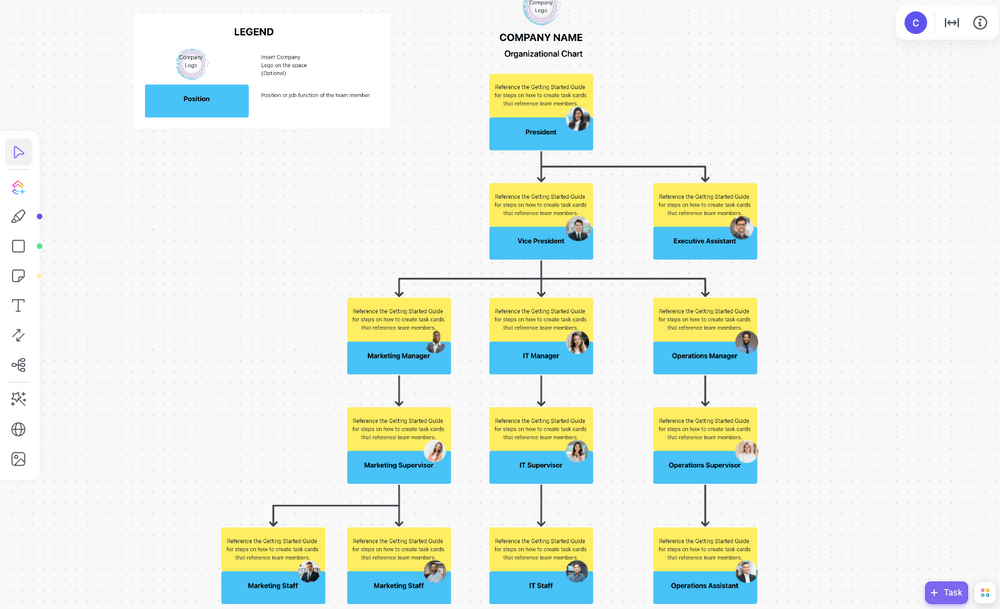
To get started, simply add the template to your Workspace and gather information on all roles and responsibilities within the organization.
If you’ve already created and customized the ClickUp Project Management Roles and Responsibilities Template, the information-gathering process would be much easier since the document already contains all the data you need.
Next up, you’ll need to customize the organizational chart template. This template provides a ClickUp Whiteboard where you can insert shapes like rectangles. The shapes include project team members’ names, job titles, contact information, and specific responsibilities.
Use connecting lines to link the shapes and illustrate reporting relationships between these roles. As time progresses and changes occur, you can update the chart by adding or deleting shapes to reflect changes in positions or personnel.
Successful implementation of project roles requires diligent tracking of responsibilities and tasks. Typically, the project manager spearheads this effort by utilizing various tools and techniques.
A great way to achieve this is by leveraging ClickUp’s 15+ views. For instance, the Gantt Chart view lets project managers outline the project’s timeline and the activities necessary for implementation. This graphical representation makes tracking each stakeholder’s progress with their respective tasks easier.
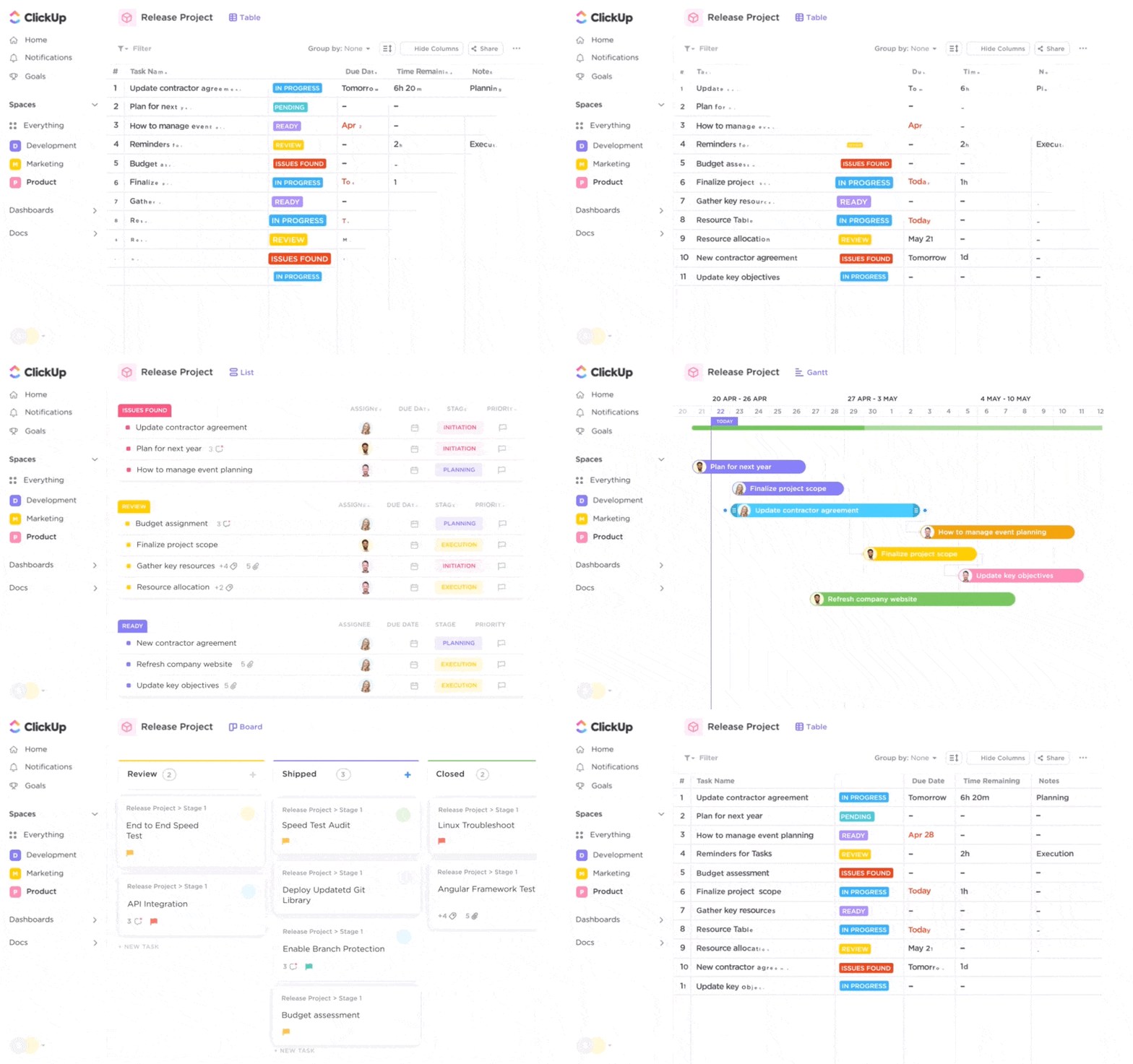
Some of the other ClickUp views include:
Project success relies on the coordinated efforts of individuals assuming different roles and responsibilities. Well-defined roles mitigate the risk of confusion, clarify communication channels, and foster accountability.
ClickUp is a great tool for streamlining this process using customizable organizational charts, role specification templates, Gantt Charts, and more. Sign up today to optimize your role management workflows and ensure seamless project execution! ⭐

© 2026 ClickUp

There’s an easier way. Try a free AI Agent in ClickUp that actually does the work for you—set up in minutes, save hours every week.