


As a project manager, you’re probably already familiar with how challenging some problems can be, such as managing overdue tasks without feeling overwhelmed and putting undue pressure on your team.
When you’re doing a hundred things at once to ensure on-time delivery, you need practical strategies to manage your workload.
Lean project management is all about working smarter rather than harder. It’s focused on being more efficient and reducing wasteful processes. Unlike traditional project management, which has fixed phases, this approach emphasizes flexibility and adaptation, giving you more control over project outcomes.
Besides Agile, Lean is one of the most popular project management methodologies in practice today. How are they different? Is one arguably better than the other?
Let’s quickly explore the differences between Lean and Agile project management before we go deeper into the former and its implementation.
How to Implement Lean Project Management
- Understanding Lean Project Management
- The Five Key Principles and Stages of Lean Project Management
- Lean vs. Agile vs. Scaled Agile vs. Lean Six Sigma
- Implementing Lean in the Real World
- The Role and Responsibilities of Lean Project Managers
- Establish Your Lean Team with ClickUp
- Frequently Asked Questions [FAQs]
Lean vs. Agile project management
Both Lean and Agile project management methodologies apply mostly to software development, manufacturing, production, and IT.
Lean project management mandates efficiently getting the most out of what you have. It constantly examines the way things are done to find and get rid of unnecessary steps, making sure the final product is of value to the customer.
Agile, however, understands that project plans are not set in stone. Agile project managers know plans can derail, and they are adept at handling changing project demands. They deliver projects in small, iterative chunks, constantly testing and tweaking their approach based on customer feedback to make the project a success.

 Summarize this article for me please
Understanding Lean Project Management
Lean project management isn’t just about saving money and resources. It uses the perfect amount of tools and manpower to deliver exactly what your client needs right when they need it. It’s all about using the right number of people and tools to get the job done.
By getting rid of wasteful processes [such as waiting periods or unnecessary features], Lean helps you:
- Slash costs and project timelines
- Boost customer satisfaction through better service
- Tap into your team’s potential with increased productivity and efficiency
- Gain crystal-clear project visibility at the team level
- Deliver higher quality work with more value for the customer
- Master the art of prioritizing tasks effectively
Now, let’s unpack the core principles that make Lean project management so effective.
Pillars of Lean
No matter where you use Lean, the core principle stays the same: deliver maximum value by eliminating wasteful processes.
But what is waste?
Lean uses three key Japanese terms, Muda, Mura, and Muri, developed by the Toyota Production System [TPS], to identify waste. Let’s break them down.
- Muda [無駄] is any activity that sucks up resources but adds nothing to the customer. Holding onto unfinished work, producing too much, or creating defects are all prime examples. Imagine you’re making a sandwich for a friend. Chopping all the vegetables and only using half would be Muda
- Mura [むら] refers to unevenness in your workflow, like unbalanced workloads. Think about waiting in line at the store—one minute it’s fast, the next it’s slow. Mura creates delays and frustration for everyone involved
- Muri [無理] is overloading your team or equipment to meet unrealistic targets. It’s like pushing a machine past its capacity. Muri can result in burnout and mistakes
Suppose your team has seven programmers working on features but only three testers to review their work [Mura]. This creates a bottleneck where features pile up waiting to be tested [Muri], overloading your testers [Muri]. Rushed testing due to this overload can lead to bugs slipping through [Muda], ultimately delivering faulty software to the customer [more Muda]. By tackling all three Ms, you can simplify your workflow and achieve peak efficiency.
How the Project Management Institute [PMI] encourages the adoption of Lean for efficient workflows
The Project Management Institute [PMI] is the world’s leading professional association for project management. Founded in 1969, it serves over 3 million professionals in nearly every country.
PMI recognizes that Lean is an effective tool for increasing project efficiency and delivering value. Here’s how PMI promotes a lean culture:
- Lean principles integrated: PMI has incorporated key Lean principles, like eliminating waste and maximizing learning, into their project management frameworks and best practices. Think of it as pre-installed efficiency for your projects
- Lean for all projects: PMI advocates applying lean thinking across the project spectrum. Building a skyscraper? Developing a cutting-edge app? Lean can help you deliver maximum value, no matter the project
- PMI lean resources: PMI offers learning resources, webinars, and training programs specifically on implementing Lean principles in project management. This will equip you and your team with the knowledge and skills to adopt a lean mindset and truly optimize your processes
- Lean certification: PMI offers specialized certifications like the PMI Agile Certified Practitioner [PMI-ACP] that recognize expertise in Agile and Lean methodologies for project delivery
PMI considers Lean project management tools to be a key element in boosting project performance and providing maximum customer value. Their training and certification programs give project professionals the tools they need to use Lean project management principles and achieve successful project results.
Lean methodology and the Toyota way
You already know that the Lean methodology wasn’t formulated as a theory in a lab. It was a practical solution to the real-world needs and problems faced by the Toyota Production System [TPS].
After World War II, Japan’s resources were limited. Toyota had to be efficient with limited materials and workforce. They began to rethink traditional manufacturing processes.
Taiichi Ohno, an industrial engineer at Toyota, developed the core principles of Lean. His focus was mainly on delivering value to the customer and knocking out anything that didn’t contribute, that is, waste.
But not all waste is created equal. There are different ways to categorize Muda in lean project management.
- Type 1 Muda are activities that are still necessary for the project’s completion. Examples include safety inspections or regulatory compliance procedures. While they don’t directly add value to the product, they can’t be canceled entirely
- Type 2 Muda are activities that should be canceled because they add nothing of value. Examples include unnecessary meetings, unclear communication leading to rework, or waiting due to poor planning
Another core principle that supplements this approach is Kaizen, the Japanese philosophy of continuous improvement. It advocates for constantly analyzing processes, identifying areas for waste reduction, and always trying to be more efficient.
In 1990, James Womack’s ‘The Machine That Changed the World’ popularized the term and helped spread Toyota’s Lean and Kaizen principles beyond the automotive manufacturing industry.
Summarize this article for me pleaseThe Five Key Principles and Stages of Lean Project Management
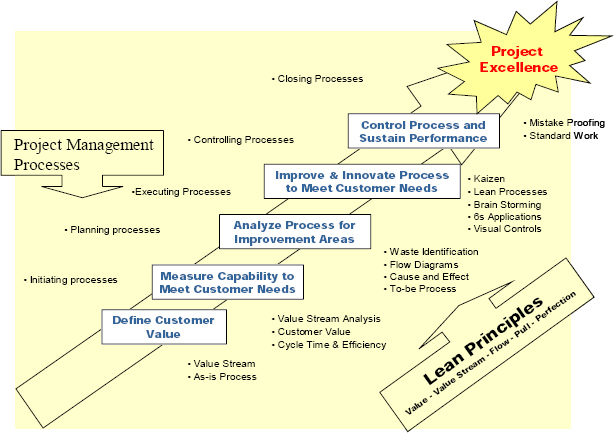
Lean project management isn’t a quick fix; it’s a journey that unfolds in five stages, which are also known as the five core principles of the Lean methodology.
1. Define value
Before you build anything, understand what ‘value’ means to your customer.
Suppose you’re a software development team building a new fitness app. Is ‘value’ a fancy calorie tracker or a simple, user-friendly app that helps people stay motivated? Talk to potential users, gather feedback, and define what features truly matter to their fitness goals.
2. Map the value stream
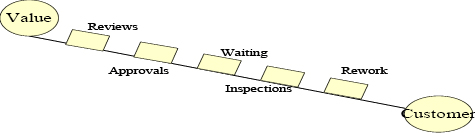
Value Stream Mapping: Analyze every step involved in delivering that value. Identify and get rid of any waste [Muda].
Let’s say your app development project process involves multiple rounds of design revisions and lengthy code reviews. This can lead to bottlenecks and delays. Map the entire process, identify steps that don’t directly contribute to a better app [like too many design reworks], and simplify the workflow.
3. Create flow
Think of your project as an assembly line. Arrange the value-adding activities in a smooth, continuous flow.
For instance, break down your app development into smaller, manageable tasks. Use Kanban boards to visualize the workflow, prioritize tasks, and identify any roadblocks that might slow down progress.
4. Establish pull
Respond to actual customer demand, not trends or predictions. Produce only what’s needed when it’s needed.
For example, take things one step at a time. Instead of trying to do everything at once, release a minimum viable product [MVP] first and gather feedback. Use the feedback to figure out which feature of the app you need to work on next. This way, you’ll make sure you’re building features that people actually want and avoid wasting time on [potentially unnecessary] bells and whistles.
5. Seek perfection
Continuous improvement is the heart of lean, and efficiency is its brain. Always look for ways to simplify project processes.
For instance, hold regular team discussions to determine what’s working well in the app and what needs improvement. Encourage team members to suggest new ideas to improve the app, no matter how small. Keep tweaking your workflow to improve speed, efficiency, and accuracy for the future.
Summarize this article for me pleaseLean vs. Agile vs. Scaled Agile vs. Lean Six Sigma
While Lean, Agile, and Scaled Agile focus on improvement, they differ in their targets. Lean tackles waste across any process; Agile thrives on adapting to changing project needs; and Scaled Agile coordinates Agile practices for large projects. Lean Six Sigma blends Lean’s waste-minimization focus with Six Sigma’s statistical analysis to optimize existing processes.
Let’s take a closer look at these differences.
| Feature | Lean | Agile | Scaled Agile | Lean Six Sigma |
| Focus | Eliminating waste, maximizing value delivery | Adaptability, responding to change | Aligning large teams and projects | Reducing defects, improving process efficiency |
| Project phases | Not strictly defined, continuous improvement | Iterative sprints with flexible planning | Frameworks for scaling agile across large enterprises | A data-driven approach to process improvement |
| Project management | Simplified workflows, minimizing waste | Collaborative, customer-centric approach | Frameworks for coordinating large teams | Data-driven, statistically-focused |
| Change management | Encourages continuous improvement | Embraces change and iteration | Frameworks for managing complex change across large teams | Data-driven approach to process improvement |
| Suitable for | Well-defined projects with clear value proposition | Projects with changing requirements or uncertain outcomes | Large, complex projects with multiple teams | Projects with defects or aiming for high process efficiency |
| Examples | Manufacturing, software development | Software development, marketing campaigns | Enterprise software development, large-scale product launches | Manufacturing, customer service processes |
Let’s break each of these models down and learn how to apply them.
1. Lean project management
Lean focuses on avoiding waste [Muda] and maximizing value delivery to the customer.
- Example: A hospital implements lean to simplify patient intake processes, reducing wait times and improving patient satisfaction
- Why choose Lean: Great for projects with a clear value proposition and minimal requirement changes. Lean is good at making workflows better and getting the most out of well-defined projects
2. Agile project management
Agile is about adaptability and responding to changing customer needs through short, flexible development cycles [sprints].
- Example: A software development team uses Agile to develop a new mobile app. They gather user feedback after each sprint and adapt features based on that feedback
- Why choose agile: Excellent for projects with evolving requirements or uncertain outcomes. Agile allows you to adjust your course based on new information, making it perfect for projects in changing environments
3. Scaled agile project management
Making sure big teams and projects in a company work together while sticking to Agile principles
- Example: A large bank implements a scaled agile framework [like SAFe] to manage the development of a new online banking platform across multiple teams
- Why choose scaled agile: When you’ve got big projects with lots of teams and moving parts, you need a way to manage it all. Traditional Agile methods might not cut it, so you’ve to adapt and scale up to keep everything running smoothly
4. Lean Six Sigma
A data-driven approach that combines Lean principles of waste reduction with Six Sigma’s focus on defect reduction and process improvement. It uses the DMAIC [Define-Measure-Analyze-Improve-Control] cycle for continuous improvement.
- Example: A manufacturing company uses Lean Six Sigma to identify and eliminate defects in their production line, reducing waste and improving product quality
- Why choose Lean Six Sigma: It’s ideal for existing processes that need to be optimized for better quality. The data-driven approach makes it easy to find problems and track progress
Which one should you choose?
You need a project management model that meets your needs. Here’s how you can define your needs:
- Project scope and requirements: For well-defined projects with minimal changes, Lean might be the best way forward. For projects with changing requirements, Agile is a better fit
- Project size and complexity: For large, complex projects with multiple teams, Scaled Agile provides a framework for coordination
- Process improvement focus: If reducing mistakes and improving efficiency are your main goals, Lean Six Sigma is a strong choice
Sometimes, a hybrid approach combining elements from different project management processes can be the most effective strategy for your project management plan.
Summarize this article for me pleaseImplementing Lean in the Real World
Simply choosing any project management method won’t guarantee success—be it Agile or Lean. To effectively manage projects using these approaches, you need a project management software that offers specific functionalities:
- Task and project management: You should be able to break complex projects down into manageable, well-defined, measurable, and trackable steps. The software should handle creating, assigning, and tracking tasks for your projects
- Workflow automation: Automate repetitive tasks to simplify your workflow and free up your team’s time
- Remote collaboration: Promote effortless communication and collaboration within your team, even if everyone isn’t in the same location
- Integration flexibility: Integrate with other tools your team uses to avoid information silos and keep everything centralized
Project management methodologies aren’t one-size-fits-all. Teams might use Agile, Scrum, Kanban, Lean, Six Sigma, or even a hybrid approach, depending on the project.
Let’s explore some Lean tools and methodologies:
- Kanban: A visual workflow management system that uses boards and cards to depict the current status of tasks—this allows teams to see their workflow clearly, identify areas where tasks get stuck, and improve their overall efficiency
- PDCA [Plan-Do-Check-Act]: A recurring approach used for problem-solving and continuous improvement, PDCA involves four steps—plan [define the problem and develop a strategy for improvement], do [implement the strategy], check [assess the results of the strategy], and act [take action based on the assessment]
- Value stream mapping: A technique used to document, analyze, and improve the flow of materials and information within a process—VSM helps identify areas of waste and opportunities for improvement
- Workflow optimization: The process of identifying and taking care of bottlenecks in a workflow to improve productivity—tools such as Kanban boards, PDCA cycles, and value stream mapping can be used for workflow optimization
How are these methodologies specifically useful for software development? You can apply the Lean approach to software development in various ways:
- Agile software development: A flexible approach to software development that focuses on teamwork, adaptability, and continuous improvement
- DevOps: A set of practices that merges software development [Dev] and IT operations [Ops] to improve the speed and quality of software delivery
- Scrum: An agile framework that uses short sprints [development cycles] and regular reviews to deliver software in a flexible way
Lean supports continuous improvement efforts by increasing efficiency and productivity, reducing waste and costs, improving customer satisfaction, and engaging employees productively.
In 2009, researchers studied a small software development team at BBC Worldwide in London to see how well Lean methods worked. They examined the team’s work, task boards, and meetings, interviewed the team members, and crunched numbers.
After a year of implementing Lean, things were much better: Software releases were 37% faster and more consistent [47% improvement], and customers found 24% fewer bugs.
Faster releases, focusing on what customers valued most, also meant less risk from technology changes or market shifts.
Although this study was done years ago, it shows that Lean is a project management model worth trying out, especially given the tremendous time and cost savings it can unlock.
How do you get started with Lean? There are several platforms or combinations of tools that you can use.
But which one’s the best?
While there’s no single answer because each team has a unique set of workflows and requirements, adaptability is key. Luckily, you’ve got ClickUp, a project management platform that can help you switch methodologies based on project and team needs. This lets your team focus on what matters: delivering successful projects.
Here’s how ClickUp can simplify Lean project management for you:
1. Using visualization tools
ClickUp equips you with powerful tools to seamlessly integrate Lean and Agile principles into your project management workflow.
Kanban
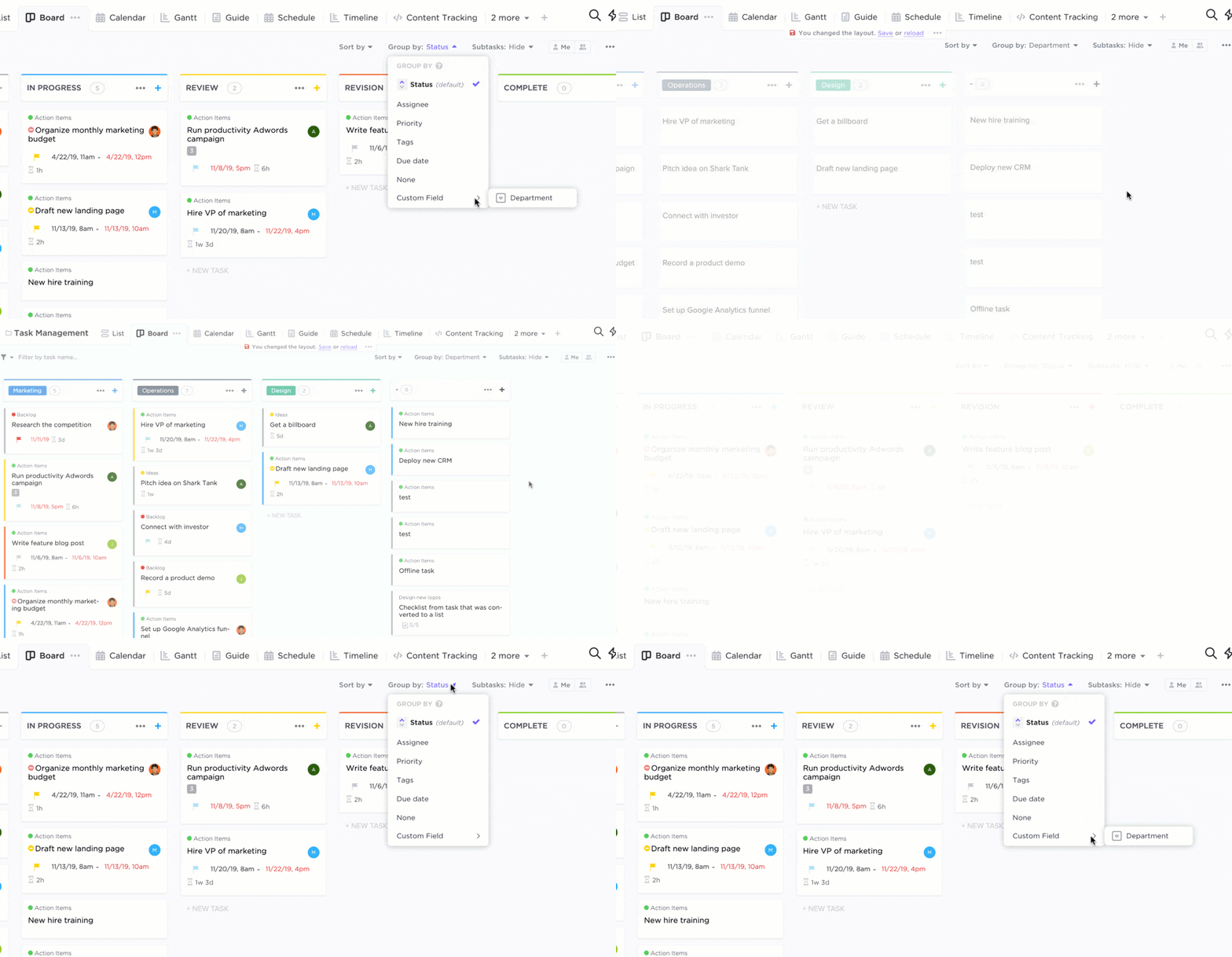
Create visual ClickUp Kanban Boards with the boards representing project stages [like ‘To Do,’ ‘In Progress,’ ‘In Review,’ ‘Done’]. Break down large tasks into smaller, more manageable subtasks within each section. This keeps your workflow organized and ensures everyone on the team understands their roles and responsibilities.
Drag and drop tasks between Boards to visualize workflow progress and prioritize tasks. Use color coding to highlight urgent tasks or tasks requiring specific skill sets.
Set WIP limits for each stage to prevent bottlenecks and ensure smooth flow. WIP limits the number of tasks that can be done at a particular stage at any given time. This helps prevent teams from taking on too much work at once, ensuring tasks get done through the workflow without getting stuck.
PDCA [Plan–Do–Check–Act]
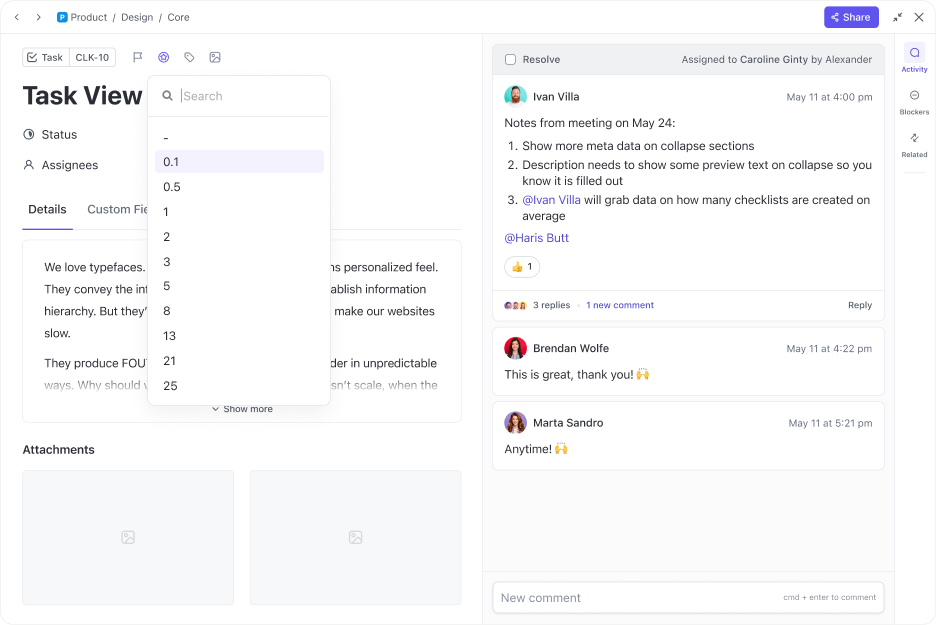
Use ClickUp Tasks and ClickUp Custom Fields to merge PDCA into your Lean project management workflow. Here’s how:
- Plan: Define your project goals and break them down into actionable tasks within ClickUp Tasks. Assign tasks to specific team members, set due dates, and establish clear expectations by adding clear dependencies
- Do: Assign tasks to team members, set realistic deadlines, and track progress in real time using ClickUp’s intuitive interface. Use features like task dependencies to ensure tasks are completed in the correct order and avoid roadblocks
- Check: During this phase, ClickUp’s data collection capabilities become instrumental. Create custom fields specific to your project to gather valuable data on performance. This data could include cycle times, defect rates, or customer satisfaction metrics
- Act: Data is only useful if it’s analyzed and acted upon. ClickUp facilitates collaboration and knowledge sharing. Use ClickUp Assign Comments or ClickUp Docs to record key findings, identify areas for improvement, and brainstorm solutions as a team. Documenting learning ensures continuous improvement is embedded within your project management lifecycle
Value-stream mapping
Value Stream Mapping [VSM] is a useful tool for identifying waste and optimizing processes. However, creating a clear and actionable VSM can be a challenge.
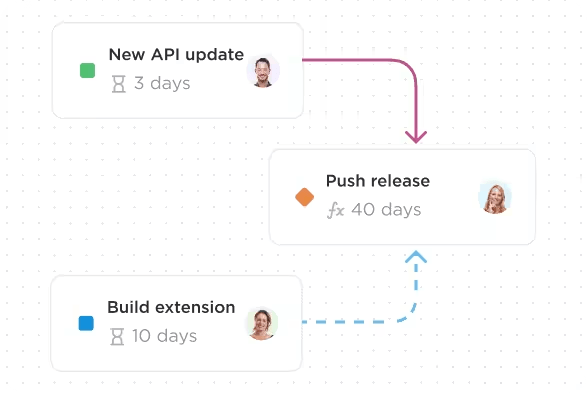
Brainstorm and visually map out the entire project value stream, identifying all steps involved in delivering value to the customer.
ClickUp’s Mind Maps are perfect for capturing all the ideas and steps involved in your value stream. Start by creating a central node representing the final value delivered to the customer.
Then, branch out to map out all the upstream processes, sub-processes, and activities that contribute to delivering that value.
Use sub-nodes to represent decisions, approvals, handoffs, or any other steps that contribute to the overall flow of work. Color coding can help differentiate between different types of activities or departments involved.
Create a dedicated ClickUp Whiteboard to collaboratively map out the current state and desired future state of your value stream. We have a great template for this, so you don’t have to start from scratch.
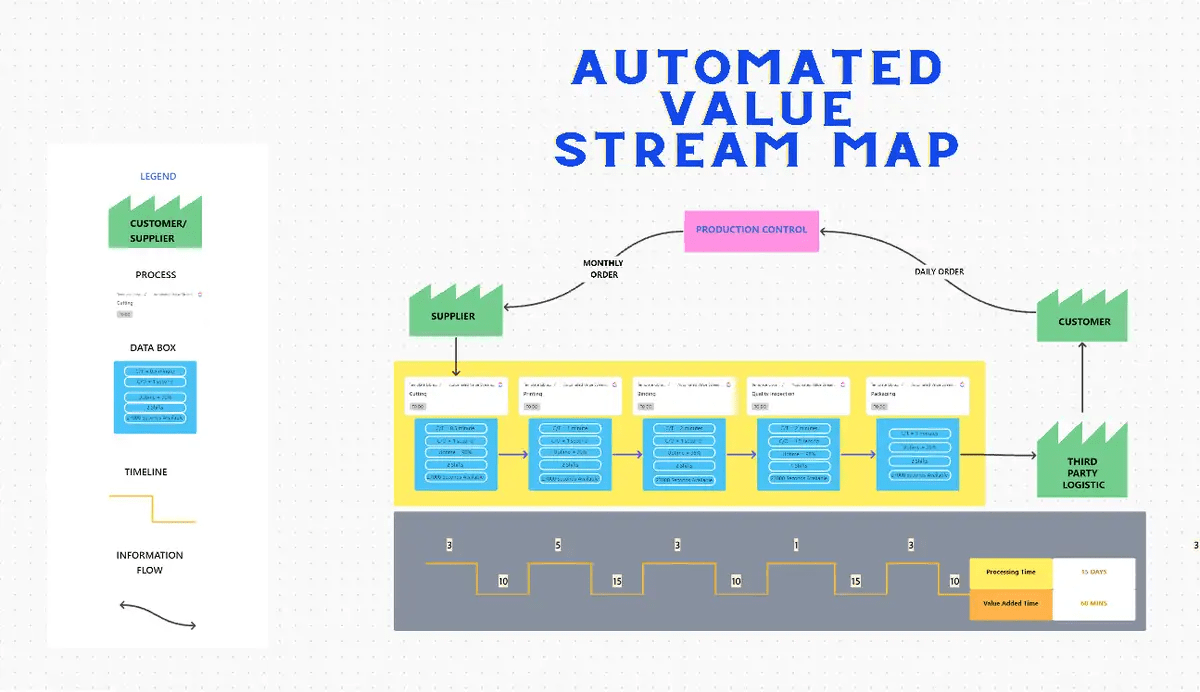
ClickUp’s Automated Value Stream Map Whiteboard Template is your one-stop shop for simplifying your value stream analysis:
- Customizable statuses: Track the progress of each step in your value stream with custom statuses. This gives you a clear picture of where things stand and where bottlenecks might be lurking
- Data-rich with custom fields: Go beyond basic VSMs. Use nine custom fields specifically designed for value stream mapping. Capture vital information such as cycle times, processing times, and value-added time for each step. These data points become building blocks for a data-driven approach to process improvement
- Dual views for deeper insights: The Whiteboard view provides a visual canvas to map out your entire value stream, allowing you to see the big picture and identify potential areas for improvement. Switch to the Processes view for a detailed breakdown of each step, complete with custom fields to capture granular data
- Project management powerhouse: Use comment reactions to provide feedback, encourage collaborative editing for real-time updates, and implement automations to facilitate tasks related to your VSM analysis
- AI-powered enhancements: Take advantage of ClickUp Brain’s AI features that help with data analysis within your VSM, further simplifying your workflow and providing even deeper insights
Workflow optimization
Combine ClickUp Automations with ClickUp Dashboards to automate tasks and generate in-depth reports of any task, milestone, or goal to achieve, ultimately optimizing your workflow.
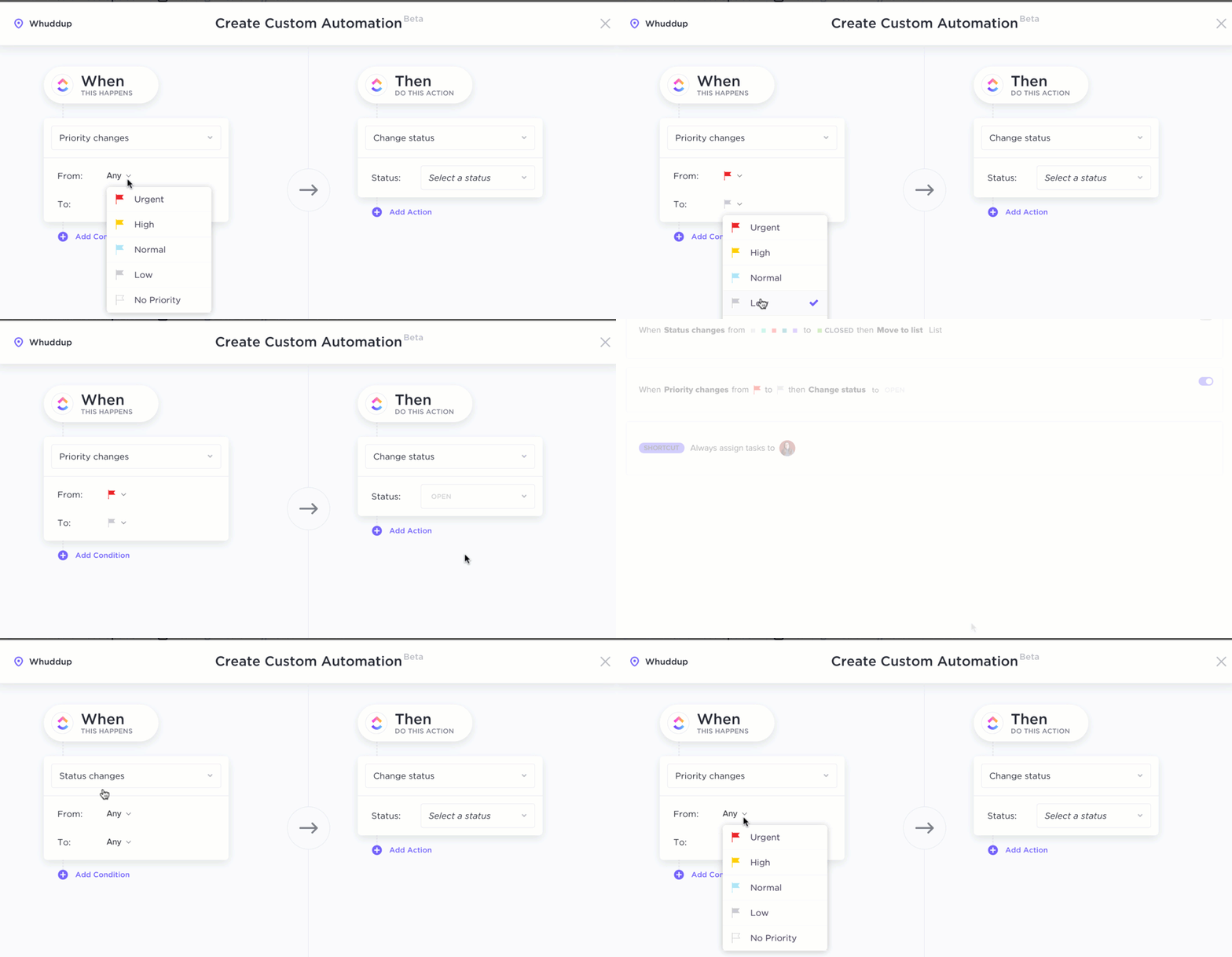
ClickUp’s Automations lets you set up custom rules to automate repetitive tasks across your projects. Here are some examples:
- Move tasks automatically: When a task is marked complete in one List, automatically move it to the next List on your Kanban board. This keeps your workflow flowing smoothly and ensures everyone on the team knows what needs to be worked on next
- Assign reviewers: Automatically assign tasks for review to specific team members or groups once a task reaches a designated stage in your workflow. This simplifies the review process and avoids bottlenecks
- Set due dates based on dependencies: Automatically set due dates for dependent tasks based on the completion date of a parent task. This ensures a realistic project timeline and avoids delays
- Auto-assign based on skills: When a new task is created with specific skill requirements, automatically assign it to the team member with the most relevant expertise
- Create recurring tasks: Automate the creation of recurring tasks, like weekly team meetings or monthly reports.
- Get a headstart with pre-built automation sequences: ClickUp offers a library of 100+ pre-built automations that address common workflow scenarios. These templates can be easily customized or used as inspiration for creating your own automations
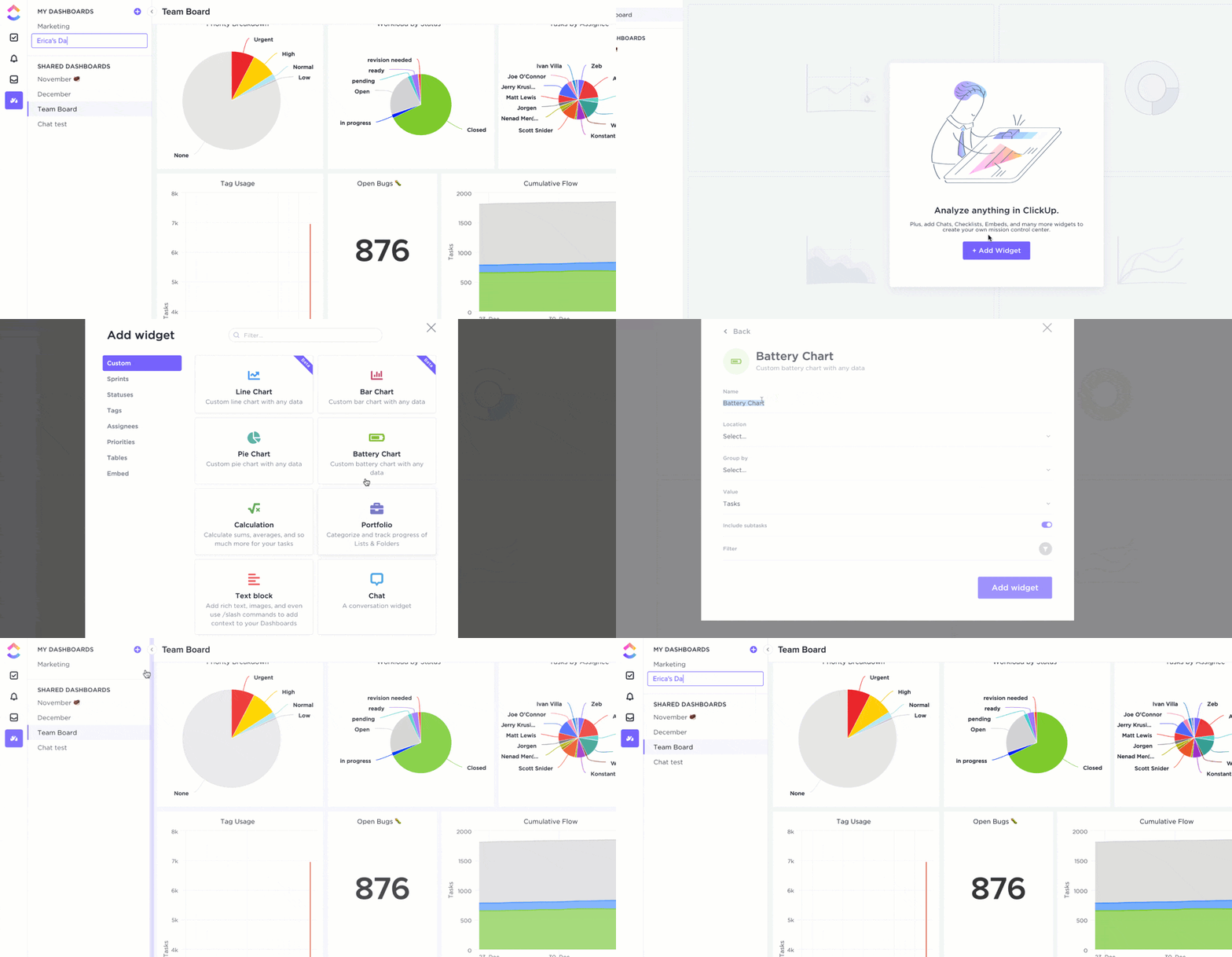
ClickUp Dashboards act as your customizable command centers to provide a real-time view of your project management. With drag-and-drop functionality, you can build dashboards specific to your needs, displaying key metrics and insights to help you identify areas for improvement.
You can create dashboards for the following purposes:
- Kanban board analysis: Track the number of tasks in each stage of your Kanban board over time. Identify bottlenecks by visualizing where tasks are getting stuck and taking longer than expected
- Workload management: Monitor team member workload by visualizing the number of tasks assigned to each individual. This helps ensure fair distribution of work and prevent burnout
- Task completion rates: Analyze the percentage of tasks completed on time or overdue. This helps identify areas where deadlines are consistently missed and allows for adjustments to project timelines or resource allocation
- Cycle time tracking: Measure the average time it takes for tasks to move from one stage to another in your workflow. This helps identify inefficiencies and opportunities for streamlining processes
- Burn down charts: Visualize the remaining workload for a project over time. Track progress toward project goals and identify potential roadblocks that could prevent on-time completion
2. Using Lean project management solutions for software development
ClickUp’s many project management solutions let you establish flexible methods for managing software development at your organization.
Agile software development
Let’s first look into ClickUp Agile Project Management Software, especially pre-made for Agile teams that want to use Agile-first tools alongside others.
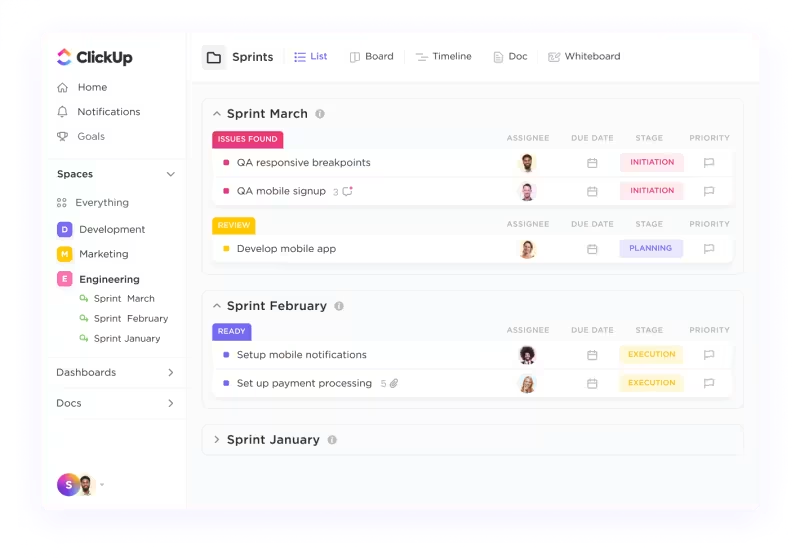
Here’s how you can put ClickUp to use for agile methodologies:
- Use ClickUp Brain’s AI tools: Create technical documentation in docs and let AI write, rephrase, edit, summarize, and proofread it. Generate templates to do any task and set up automations within them so work gets assigned seamlessly
- Manage and assess backlogs: Use custom fields and formulas to measure impacts and tradeoffs for issues, product ideas, and new features so that can make smarter prioritizations
- Visualize your workflows: Use flexible views such as ClickUp Gantt Chart view, Board view, or Timeline view and assign due dates, set priority levels, track with custom statuses
- Automate reporting: Set up ClickUp Goals and KPIs to track progress across projects
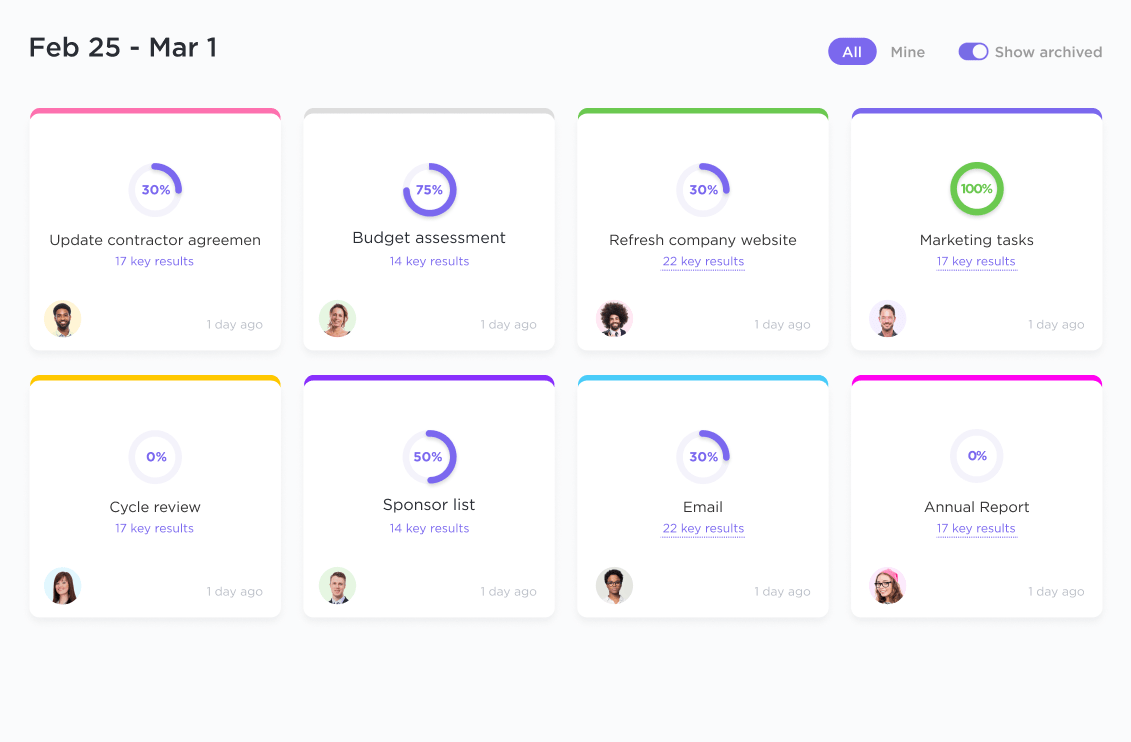
Automatic reporting lets software teams keep stakeholders up to date without any manual intervention. Monitor your progress using numeric, financial, binary [true/false], and task-based targets. Combine tasks from various teams to create goals, such as sprint targets or weekly sales objectives
- Use templates: Use 1000+ pre-built templates for Agile, Lean, DevOps, Scrum, sprints, product development, or any use case you can think of
For instance, the ClickUp Agile Project Management Template is designed to help you implement Agile practices effectively.
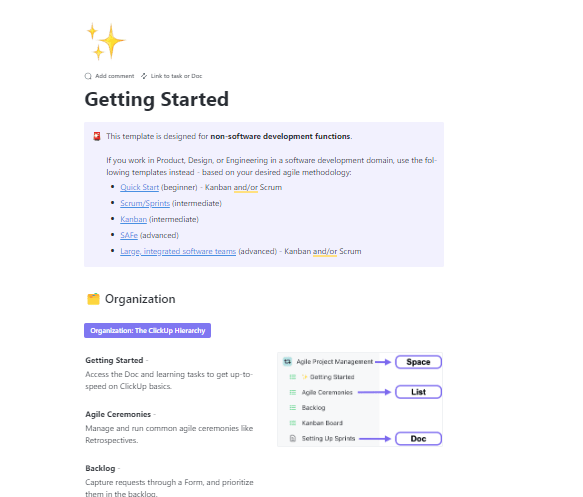
Use this template to:
- Streamline incoming requests using a ClickUp Form. Capture all relevant details and funnel them into your backlog
- Choose between a Kanban Board or Sprints to manage and execute work. Visualize progress and keep tasks moving forward
- Conduct regular Agile meetings to review sprint performance and continuously improve your processes
DevOps
ClickUp Integrations connects all your external tools in one place to create the perfect agile project management hub.
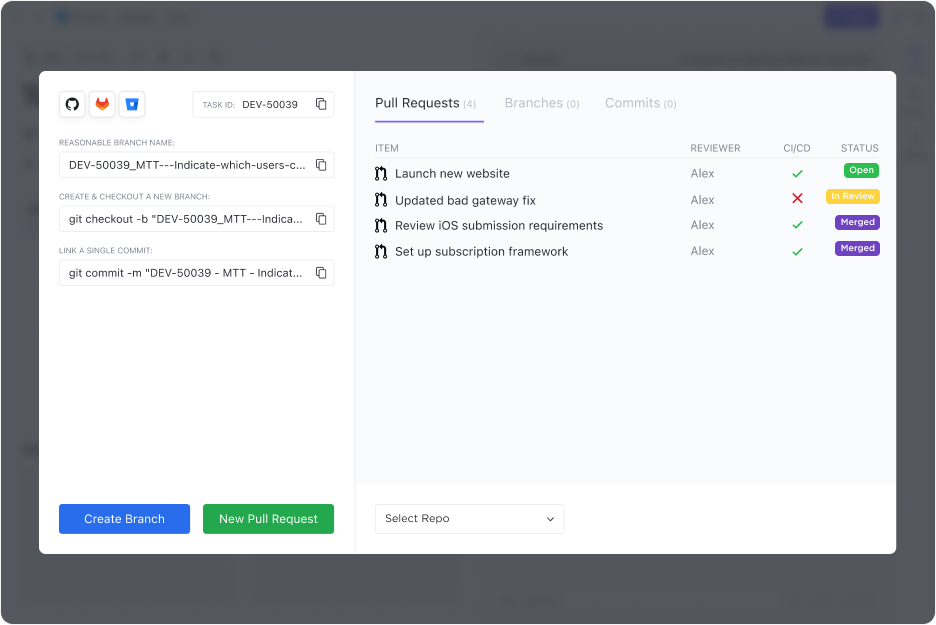
For instance, the ClickUp-GitHub integration helps you:
- See all GitHub activity related to any task directly within ClickUp
- Link pull requests, commits, and branches to your GitHub tasks
- Update task statuses in GitHub; meanwhile, ClickUp updates the same on your workflow
Scrum
You can also set up ClickUp Sprints in Board View and apply the scrum methodology for whichever project requires it.
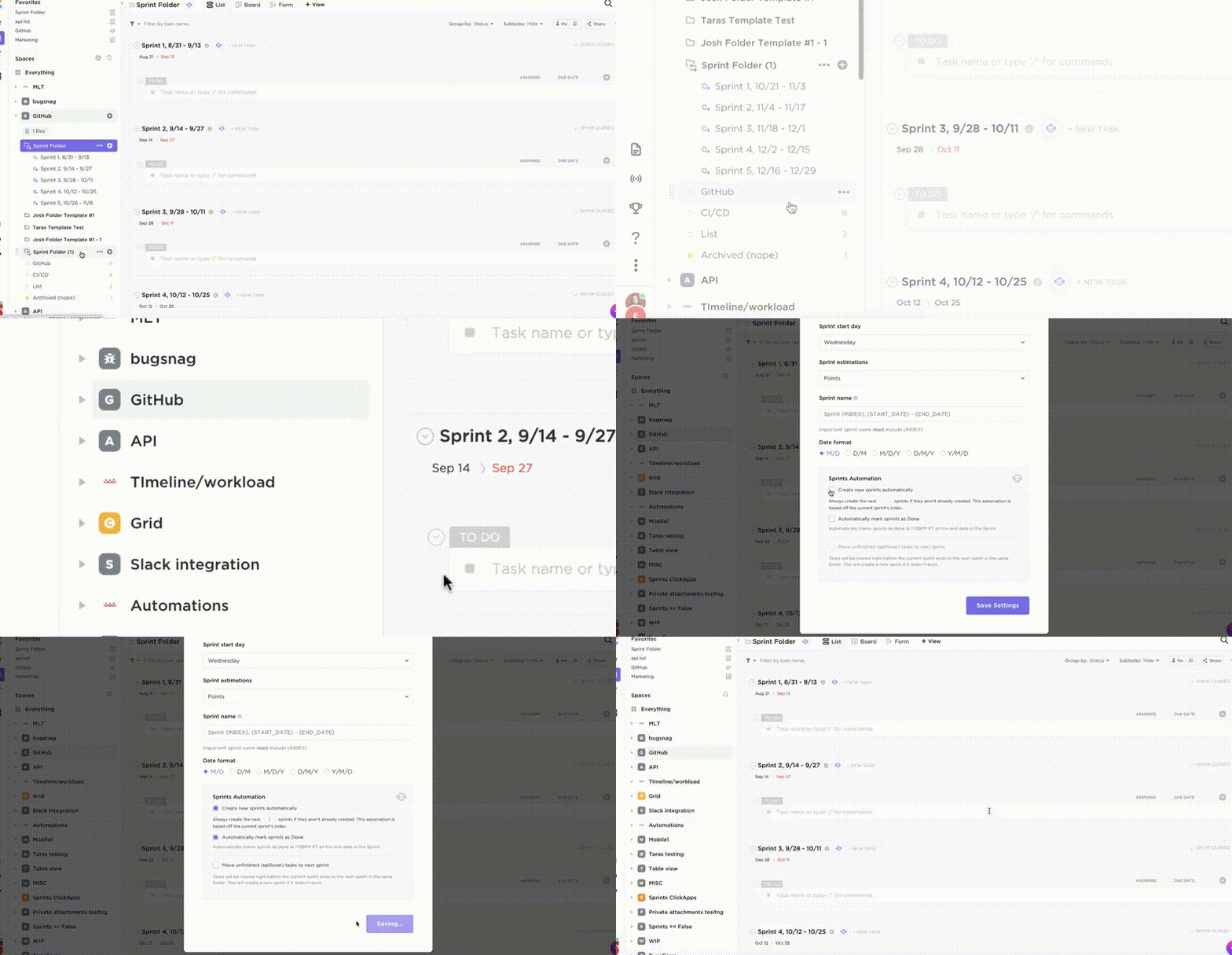
Here’s a breakdown of how to effectively implement ClickUp Sprints within your Scrum workflow in ClickUp:
- Create a new list for your sprint backlog: This List will hold all potential user stories and tasks for the upcoming Sprint
- Use multiple lists for the sprint stages: Create separate Lists within your Board View to represent different stages of your workflow, such as ‘To Do,’ ‘In Progress,’ ‘In Review,’ and ‘Done’
- Move tasks within lists: As your team works on user stories, drag and drop tasks between Lists to reflect their progress through the workflow stages. Break down user stories into smaller, actionable tasks within each List. Assign tasks to team members, set due dates, and use comments and attachments for collaboration
- Review progress: Use the Board view to visualize progress. Identify any roadblocks in task completion
- Adapt and adjust: ClickUp allows for real-time adjustments throughout the Sprint. If needed, tasks can be re-prioritized or moved between Lists to reflect changes in the project landscape
The ClickUp Lean Business Plan Template simplifies incorporating this methodology within your organization.
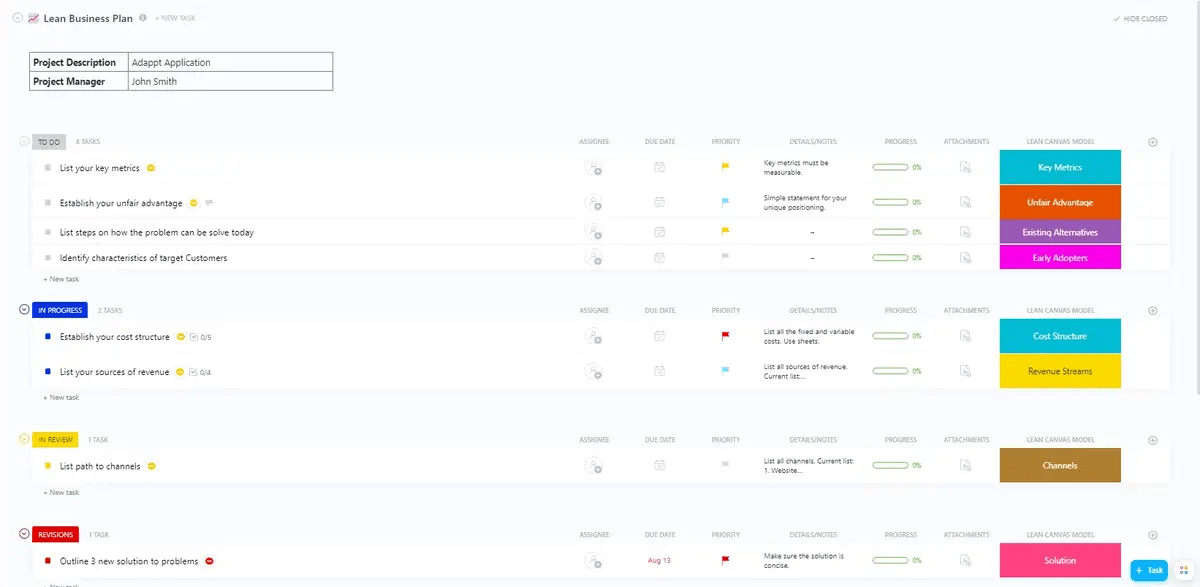
This comprehensive template equips you with the tools to transform your business ideas into a reality—efficiently and affordably:
- ClickUp Custom Statuses: Track the progress of each step in your business plan with custom statuses like Needs Research, In Development, and Ready for Implementation. This keeps you organized and ensures you’re making steady headway
- ClickUp Custom Fields for deeper insights: Go beyond basic planning with ClickUp’s custom fields. Create fields to capture specific details relevant to your business model, such as target market demographics, competitor analysis, or key financial projections. These details enrich your plan and provide a clearer picture of your business’s potential
- ClickUp Views for Simplified Planning: ClickUp offers multiple views to tailor your planning experience. Navigate between project names, summary breakdowns, and a dedicated Lean Canvas Model view. This flexibility allows you to approach your business plan in a way that works best for you
Case study
Let’s examine how ClickUp helped Lids, a sports apparel company serving North America, Europe, and Australia.
Lids, a retailer with over 1200 stores, faced challenges managing rapid expansion due to disorganized workflows. They relied on various scattered tools like spreadsheets and email, leading to communication gaps and inefficiencies.
They onboarded ClickUp to centralize communication and tasks. Now, different departments collaborate seamlessly within ClickUp. This reduced email traffic and shortened meetings by 66%, freeing up valuable time.
ClickUp also improved Lids’ inventory management. Previously, they manually tracked inventory costs, making budgeting difficult. ClickUp allows them to track unit costs and build more accurate budgets for new stores. Overall, ClickUp has increased productivity and saved Lids over 100 hours across teams.
Summarize this article for me pleaseThe Role and Responsibilities of Lean Project Managers
As a lean project manager, you must prioritize delivering maximum value to the customer while eliminating waste throughout the project.
Key responsibilities and expectations
- Customer-centric approach: Identify and meet customer requirements efficiently, avoiding waste of time, resources, and effort
- Waste elimination: Continuously identify and remove non-value-adding activities like unnecessary transportation, inventory buildup, excessive motion, waiting periods, over-processing, and overproduction
- Workflow optimization: Ensure tasks flow smoothly from one stage to the next by removing obstacles and bottlenecks. Implement pull systems driven by customer demand instead of pushing work through the pipeline
- Realistic goal setting: Set challenging yet achievable goals and manage stakeholder expectations through Lean tools like statistical process control. This allows for early issue identification and quick resolution, minimizing rework
- Big picture perspective: Guide the team to build solutions that align with the broader business strategy, ensuring the project contributes to the overall goals
The team in the Lean Project Management Framework and its importance
Lean project teams are structured specifically to achieve maximum efficiency and value delivery. Here’s a breakdown of the key roles and how they contribute to the overall success:
- Team lead: They’re the quarterback of the operation, leading the team toward project goals. They possess strong lean expertise to manage the project timeline and resources and ensure successful outcomes
- Project sponsor: A sponsor is a champion within leadership who advocates for the project’s success. They remove roadblocks, secure resources, and have a solid understanding of lean principles to support the team’s efforts
- Team members: They form the backbone of the team, actively participating in improvement initiatives. They’re equipped with lean awareness and actively apply lean tools and processes within their area of expertise
- Process owner: This is a leader who oversees the specific process being addressed in the project. They’re responsible for implementing and maintaining the improved process after successful completion
- Subject matter expert [SME]: An SME is a skilled professional who brings specialized skills and knowledge to the table. SMEs can come from various functions like IT, HR, Finance, etc., depending on the project’s focus, ensuring a well-rounded perspective
- Finance partner [SME]: They provide financial expertise, analyzing the project’s return on investment [ROI] and verifying potential cost savings from the team’s proposed solutions
By pairing the right tool with the Lean philosophy, teams can boost project results and overall business performance.
Summarize this article for me pleaseEstablish Your Lean Team with ClickUp
Companies such as Amazon, Nike, and Caterpillar Inc. have successfully integrated Lean principles into their project management practices, and you can too!
However, implementing Lean requires a change in mindset and company culture, which can be challenging. When dealing with large, complex projects, Lean’s focus on simplicity may be less applicable. But with the right tool, making this transition becomes easier.
What should you not compromise with? A US survey found that 36% of project management software users considered functionality the most important factor in choosing their software.
ClickUp’s flexibility provides the muscle you need for all the heavy lifting involved in complex projects. Prioritize tasks based on what matters most, visualize workflows for maximum efficiency, collaborate seamlessly via built-in communication tools, and track progress with laser focus. The road to project success is clear with ClickUp—are you ready to take the wheel?
Sign up for ClickUp today!
Summarize this article for me pleaseFrequently Asked Questions [FAQs]
1. What are the five rules of Lean management?
The five rules of Lean management are:
- Define value: Identify what truly matters to the customer
- Map the value stream: Visualize all the steps in the process
- Create flow: Eliminate bottlenecks and keep work moving smoothly
- Establish pull: Produce based on actual customer demand, not forecasts
- Pursue perfection: Continuously strive to improve and eliminate waste
2. Is Lean part of SAFe?
Yes, Lean is one of the core pillars of SAFe [scaled agile framework] alongside agile and systems thinking. SAFe integrates these principles to help large organizations scale Agile practices.
3. What is the Lean 5 methodology?
The ‘Lean 5’ likely refers to the 5S methodology, a core foundation of lean practices. It focuses on creating a clean, organized, and efficient work environment through five steps: Sort, Set in Order, Shine, Standardize, and Sustain.


Everything you need to stay organized and get work done.

Recent Articles

Enterprise Project Management: How to Run Every Project as One Portfolio 
Enterprise Project Management: How to Run Every Project as One Portfolio
How to Build a Task Dashboard Your Team Actually Trusts
How to Build a Task Dashboard Your Team Actually Trusts
