
How to Enable Gamification in Project Management to Improve Team Engagement


Sorry, there were no results found for “”
Sorry, there were no results found for “”
Sorry, there were no results found for “”
A few years ago, the world’s largest personal care company launched a gamified mobile app to train and engage its beauty advisors—who spoke more than six languages and were spread across over 18 countries.
We’re talking about L’Oréal. The app was packed with features, such as a newsroom, streak notifications, scorecards, and peer-vs-peer quizzes. Moreover, advisors could log in anytime, complete a quick micro-module, and upskill on the go.
These game elements turned training into a friendly competition and kept engagement levels sky-high. The results? L’Oréal exceeded its training and ROI targets within the first ten months.
Gamification is at the core of revolutions.
Project managers are now conscious of the need to integrate game mechanics into daily workflows, making even the most mundane tasks feel a little less… well, mundane.
So, how does gamification in project management actually work? Let’s understand the basics and see how project managers turn work into a game worth playing.
We can all agree that nobody wakes up excited to update a spreadsheet or track project milestones. This is why gamification in the workplace is important. But what exactly is gamification, and how does it benefit the workplace?
🙃 The technical definition: Gamification adds game mechanics to non-game environments—think workplace software and project management processes—to boost engagement and participation.
🙂 The gamified definition: Imagine your workday wasn’t just about meeting deadlines and winning. Here’s what it would look like:
Now your project or workday is no longer tedious. These gamification techniques tap into something primal—the thrill of competition, the satisfaction of progress, and the joy of collecting digital “trophies.”
Which definition did you like better? Which was easier to understand? If it was the gamified one, you already see the power of the gamification strategy. Now, let’s explore how project managers are benefitting from implementing gamification in their teams.
We’ve established that gamification techniques can make completing tasks feel less like a chore and more like leveling up through a game-based approach.
But to truly understand the impact of gamified project management, let’s visualize how it creates a ripple effect across teams.

As you can see, each step is interconnected:
💡 Pro Tip: Use customizable communication plan templates to ensure consistency, streamline messaging, and effortlessly align all stakeholders.
Let’s look at how gamification elements can turn project management into an engaging experience (with examples from leading companies!):
Teams stay motivated by awarding gamification elements like badges for completing tasks or achieving milestones.
Southwest Airlines demonstrated this using Kick Tails, a peer-recognition system in which employees reward each other with lottery entries for outstanding work.
🧠 Did You Know: According to the Gamification at Work Survey, 89% of employees said they’d be more productive if their work felt more like a game. We’re all just waiting for our jobs to come with XP points and level-ups.
Leaderboards showcase top performers, pushing team members to stay engaged.
Ansay & Associates took this concept further with the “Wheel of Wow,” where top performers spin for rewards.
🔗 Also Read: Project Management Memes & Funny Videos
Unexpected rewards increase motivation.
Uber introduced a lottery system in which platinum drivers earned tickets for each trip, which entered them into a $5,000 prize draw. Applying this to project teams can make completing tasks more exciting.
Tracking progress in real time makes project milestones feel more tangible. For example, a progress bar gradually fills up as the milestones are completed, encouraging employees to go all the way to the finish line.
💡 Pro Tip: Teams can use Kanban boards and visual trackers to stay on top of their goals.
Rewards should be desirable—think extra PTO, team lunches, or gift cards. Letting employees pick their gamification rewards ensures the system boosts employee engagement instead of feeling like a gimmick.
🔗 Also Read: Best Free To-Do List Templates
Integrating gamification techniques into your organization starts with choosing a platform that seamlessly integrates with existing workflows. The platform should be easy to use and feel as natural as scrolling through your favorite app.
ClickUp does exactly that.
ClickUp is a visual project management software packed with game mechanics, transforming tasks into exciting quests and simplifying communication. As the everything app for work, it brings your tasks, projects, docs, knowledge, and even chat together into one platform—powered by AI!
Let’s see how ClickUp can also be used as employee engagement software, and aligns with gamification strategies to enhance project success.
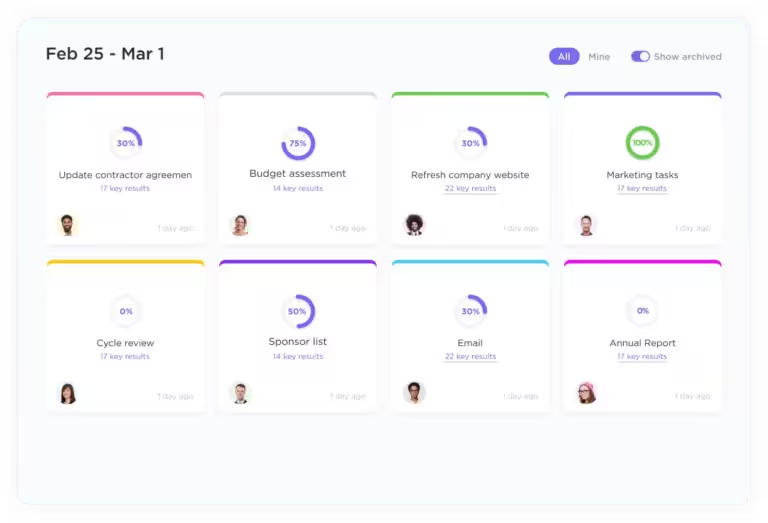
Objectives and project goals are the backbone of any organization, and a gamification model doesn’t change that—it optimizes it. With ClickUp Goals, teams can set clear objectives, track progress in real time, and celebrate when key milestones are hit.
Seeing progress bars fill up in ClickUp as tasks are completed provides instant gratification, similar to gaining XP in a game. This visibility keeps teams engaged and driven to reach the next milestone.
By setting up team or individual goals with deadlines, ClickUp encourages a friendly, competitive spirit—pushing productivity while making work more engaging.

💡 Pro Tip: Organize goals into folders by quarter, department, or team for structured tracking. Customize the goal tracking app to fit your team performance metrics, whether task-based or numerical.
ClickUp Whiteboards are ideal for team brainstorming and collaboration sessions.

ClickUp Whiteboard’s interactive visuals make it easy to map out strategies, design workflows, and even create fun challenges like team trivia or planning games.
💡 Pro Tip: Regular team-building activities strengthen communication, boost morale, and improve collaboration. Check out these fun communication games at work for your team.
Since we are discussing visual engagement, ClickUp Views enable 15+ customizable views to visualize project tracking, tasks, and workflows in a way that works best for your team.
📌 Example: Let’s say you’re managing a software development project. Your team has developers, designers, and project managers with different needs.

Imagine seeing your team’s productivity at a glance—no spreadsheets, endless updates, just real-time data in one place. That’s ClickUp Dashboards.

To start with, set up graphs, charts, and status indicators to highlight team performance and progress tracking.
Dashboards display goal progress, completed tasks, and sprint velocity in real time. Watching this progress keeps teams engaged and motivated.
Custom cards show individual and team performance, fostering a sense of competition. Recognizing top performers creates a “high-score” mentality, encouraging continuous improvement.
You can also use Dashboards to track daily task completion, maintaining momentum like a game’s streak system. Keeping a streak alive boosts accountability and productivity.
ClickUp Dashboards are a real game changer for us because we now have a true real-time view into what’s happening. We can easily see what work we’ve completed and what’s in progress.
Rewards drive motivation, but without timely recognition, they lose impact. ClickUp Automations solve this by triggering instant updates when goals are achieved.
For instance, you can automate employee shout-outs in Slack or email whenever project milestones are met.
There are some more use cases and productivity improvement techniques that you can discover in this video:
With ClickUp Docs, teams can organize information, create detailed guides, and collaborate in real time. But here’s the kicker—ClickUp’s Assign Comments turns real-time feedback on these docs into actionable tasks instantly.

📌 Example: A manager leaves a comment on a document → it becomes a task assigned to the relevant team member.
📮 ClickUp Insight: 92% of knowledge workers struggle to keep track of important decisions buried in chats, emails, and spreadsheets. Our research has found that key insights can be easily missed without a centralized system.
To spend less time searching and more time getting things done, switch to ClickUp, where everything—tasks, projects, conversations, and even AI-powered insights—lives in one place.
Once you’ve collected insights from ClickUp Dashboards and Goals, why not turn it into a leaderboard? Recognizing top performers and fostering healthy competition can drive even better team engagement.
Look at how all these features by ClickUp came together to improve operations over at the CN headquarters.
⚠ Challenge: Cartoon Network’s social media team had too many project management tools on their plate, leading to duplicate work, misalignment, and unnecessary complexity. Moving a single post meant updating two separate systems, wasting time and causing constant headaches.
✅ Solution with ClickUp: Cartoon Network needed a centralized system for everything from strategy to execution—and ClickUp delivered.
✨ Impact: ClickUp helped Cartoon Network cut content production time by 50% while doubling the number of social channels managed with the same team size. With real-time collaboration, flexible views, and automated reporting, the social media team works smarter, faster, and more efficiently.
Gamification in project management is simply the future of our workplaces. However, we need to make sure it’s sustainable by preparing for these potential challenges beforehand:
A little healthy competition can boost team performance, but too much can turn the workplace into a cutthroat battlefield. The key is to balance competition with collaboration so that achievements don’t come at the expense of teamwork.
✅ Solution: Design game mechanics that reward collaboration, such as team-based challenges or group milestones. Highlighting shared responsibility ensures a supportive work environment rather than an overly competitive one.
If gamification strategies favor certain individuals, they can demotivate the rest of the team. Rewards should reflect effort, collaboration, and quality of work, not just speed or output.
✅ Solution: Establish clear guidelines on how progress tracking and rewards work. Using ClickUp Dashboards ensures real-time visibility, so everyone knows where they stand and how to improve.
🔗 Also Read: Project Management Dashboard Examples & Templates
Not everyone is driven by badges and leaderboards—some prefer recognition, learning opportunities, or creative freedom. A one-size-fits-all gamification strategy won’t work.
✅ Solution: Offer a variety of incentives—from public shout-outs to skill-building opportunities. ClickUp’s custom goals allow teams to track progress in different ways, making sure motivation isn’t tied only to competition.
If employees chase rewards without focusing on actual growth, gamification loses its impact. Over-reliance on external incentives can reduce intrinsic motivation over time.
✅ Solution: Align rewards with learning by recognizing skill development alongside task completion. Instead of frequent, low-value incentives, offer meaningful rewards like career development opportunities or meaningful responsibilities.
The global gamification market is on a speed run, projected to grow from $15.43 billion in 2024 to $48.72 billion by 2029.
But let’s be real—these numbers don’t even scratch the surface of the productivity boost and profits that gamification brings.
The simple truth? Gamification = fun work = more productivity 💯
With gamification tools like ClickUp, you get customizable goals, leaderboards, dashboards, and real-time automation to track progress, boost motivation, and simplify project workflows—all in one place.
Create a free account on ClickUp and level up your project management ‘game’.

Sudarshan Somanathan
Max 23min read
Sudarshan Somanathan
Max 22min read
Sudarshan Somanathan
Max 22min read

© 2026 ClickUp





