
Sorry, there were no results found for “”
Sorry, there were no results found for “”
Sorry, there were no results found for “”
The hard part of creative approval is getting the right people on the right version, resolving conflicting feedback, and knowing when the asset is cleared to move. Commenting tools solved the markup problem years ago. Coordination is what still breaks.
And that gets messy fast. A video editor needs frame-level notes. A packaging team needs color and barcode checks. A social team needs approval tied to the publishing calendar, while an enterprise marketing team may care more about intake, routing, and reporting.
That’s why creative approval software is a broad category. Some tools are dedicated proofing systems. Others sit inside project management, social publishing, video production, or digital asset management.
For this list, we compared ten tools based on how they handle real review work: asset types, versioning, stakeholder routing, proofing depth, approval controls, integrations, and what happens once someone signs off. The goal is to help you pick the tool that matches where your current approval process breaks.
| Tool | Best for | Standout feature | Starting price* | Where it taps out |
|---|---|---|---|---|
| Ziflow | High-volume proofing across every asset type | Multi-stage reviews, version comparison, combined proofs, comment filtering, and approval history | Free; paid from $199/mo | Strong on proofing, but not built to manage the wider creative project |
| Filestage | Keeping internal and client review rounds separate | Reviewer groups, Batch Review, Review Agents, auto-compare text, and voice-summary feedback | Free; paid from $199/mo | Reviewer-group limits can push complex approval chains into higher tiers |
| Frame.io | Video review inside Adobe workflows | Frame-accurate comments, Premiere and After Effects integration, Camera to Cloud, transcripts, and version stacking | Free; paid from $15/user/mo | Less suitable for teams centered on DaVinci Resolve or Final Cut Pro |
| ClickUp | Connecting approvals to the work around them | Proofing, Assigned Comments, Custom Statuses, Automations, Brain, Super Agents, and AI Notetaker | Free; paid from $7/user/mo | Lacks specialist inspection for native design files, live sites, packaging, and prepress work |
| PageProof | Compliance-heavy and controlled review | Smart Check, ColorSep, Smart Compare, controlled reviewer roles, invisible comments, and prototype proofing | Paid from $249/mo | Can get harder to manage when many proofs span clients and campaigns |
| Approval Studio | Print and packaging artwork | Four compare modes, color separation, barcode scanning, Adobe extension, and detailed project history | Paid from $60/mo | Project management stays lightweight outside the approval process |
| Planable | Social media content approval | Channel previews, approval flows, four content views, bulk approval, publishing calendar, and AI copy tools | Free trial; paid from $33/workspace/mo | Social network API limits can still require manual publishing steps |
| Air | Approvals that end in an organized asset library | Asset-level approval metadata, Libraries, conversational search, expiration controls, and AI Canvas | Paid from $900/mo | Approval routing is lighter than dedicated proofing platforms |
| Adobe Workfront | Enterprise marketing operations | Request queues, routing rules, automated approval workflows, proof reporting, Adobe integrations, and AI assistant | Custom pricing | Powerful but carries substantial workflow design and admin overhead |
| Wrike | Approvals embedded in project workflows | Proofing, Comparison Mode, guest reviews, custom approval flows, Blueprints, request forms, and Adobe extension | Free; paid from $10/user/mo | Proofing support varies depending on where attached files come from |
Our editorial team follows a transparent, research-backed, and vendor-neutral process, so you can trust that our recommendations are based on real product value.
Here’s a detailed rundown of how we review software at ClickUp.
Six things matter most: file formats, guest access, version comparison, workflow stages, the audit trail, and how it links to where work is tracked. Together they decide whether a tool holds up once files, stakeholders, and deadlines pile up.
Then weigh all six against your team’s shape. A five-person in-house team with one stakeholder needs nothing like the engine a global brand needs to route creative through agencies, legal, compliance, and regional teams. Start with the complexity you have today, then buy for the workflow you expect to keep.
If you want a quick visual on how AI is changing creative review and handoff, this walkthrough covers the workflow side of the same problem:
The ten strongest options are Ziflow, Filestage, Frame.io, ClickUp, PageProof, Approval Studio, Planable, Air, Adobe Workfront, and Wrike. Each wins a different job, from notes pinned to a video frame to ink checks before print to sign-off that sits in the campaign plan. The entries below cover standout features, pricing, real user reviews, and where each tool taps out.
Ziflow is an online proofing system built around the review process. Upload an image, PDF, video, audio file, or live webpage, and reviewers can open it in the browser, leave comments on the asset, and mark the exact area that needs work. Video and audio feedback can be pinned to a timestamp, while comments tie to the proof version where they were made.
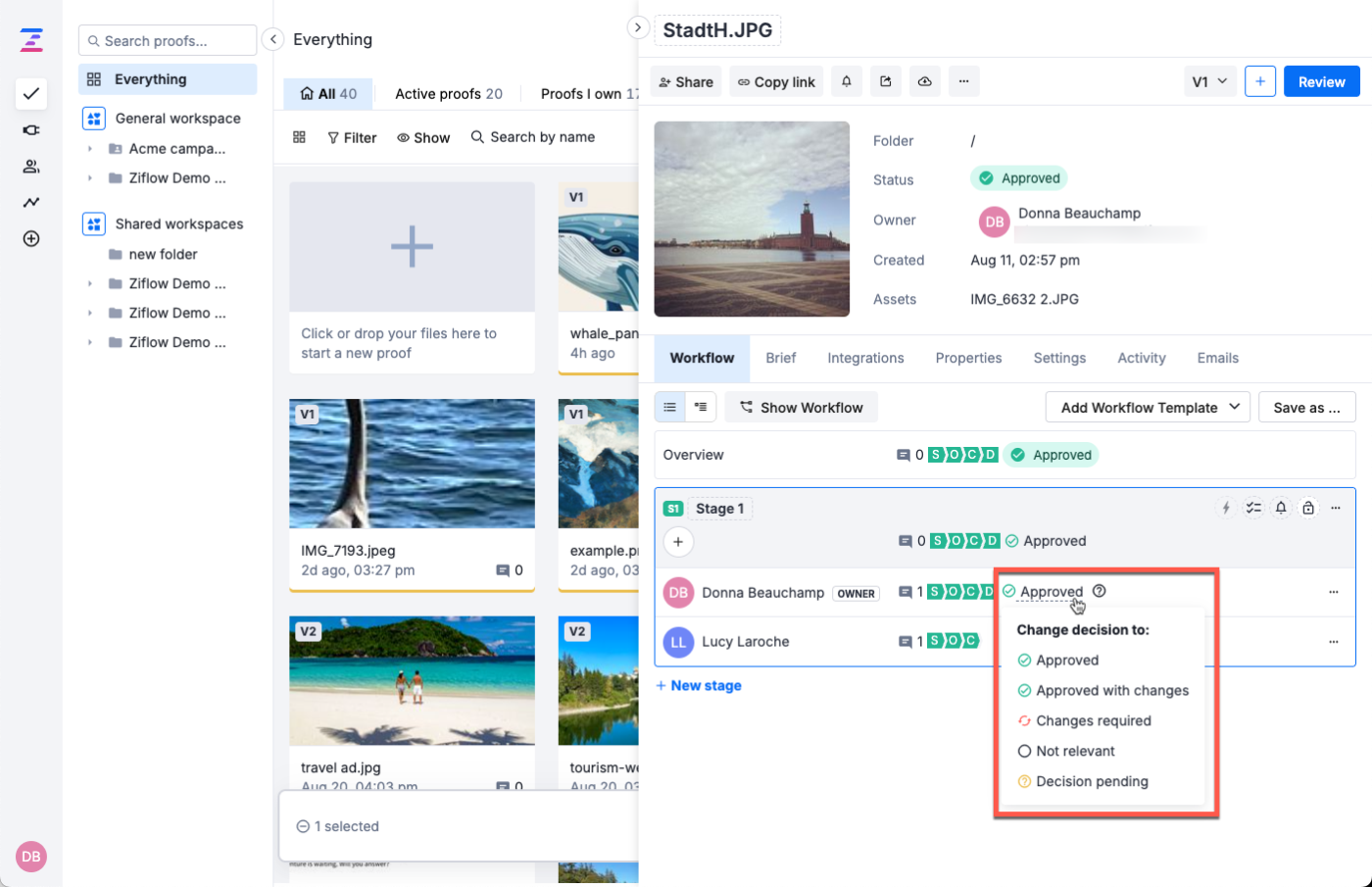
Review stages control who sees the work and when. A proof can go to the creative team first, move to the client after internal approval, then pass to legal or compliance before it’s cleared. Each stage can have its own reviewers, deadlines, and decision rules, and Ziflow keeps the approval history with the asset.
For teams handling a high volume of proofs, that history keeps each round easy to follow. Reviewers can see what still needs their attention, and project managers can track whether an asset is in review, approved, or back with the creative team.
A G2 user mentioned:
I like that Ziflow organizes different versions of the same video in the same proof, which is especially useful. The automated delivery, or workflows, are a huge time saver for me. I don’t have to send any emails or continuously monitor my inbox. Once something is approved, it is automatically delivered to the next group of reviewers.
Where it taps out: Ziflow stays focused on proofing. It can route reviews, collect feedback, and record approvals, but it isn’t where teams plan campaigns, assign production work, or manage the wider creative project. Expect to connect it to the work management system your team already uses.
Best for: Agencies, in-house creative teams, and regulated brands that need a defensible sign-off record across several formats and stakeholder groups.
Skip it if: Your review volume is a handful of assets a month. The same goes if your proofs are almost all live web pages, where version comparison helps the least.
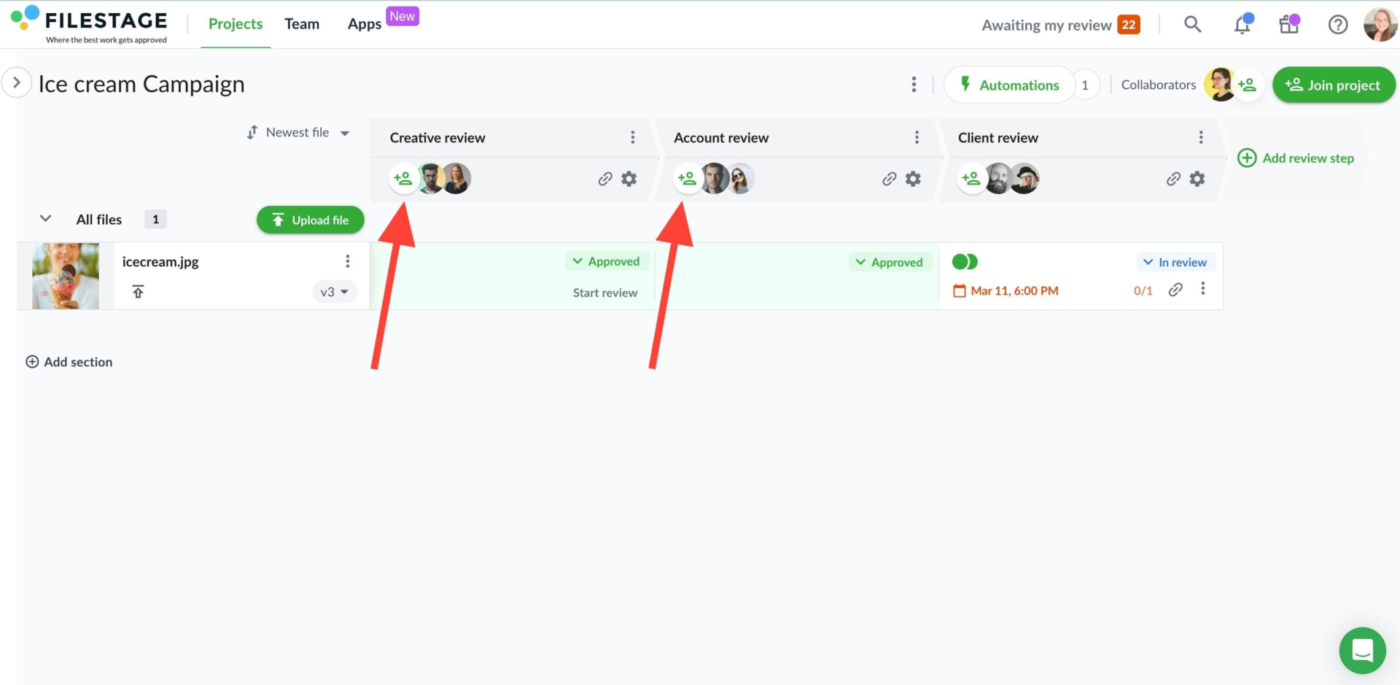
Filestage separates reviews by audience. A project is a set of columns called “reviewer groups,” and each one holds a different crowd: Creative in the first, Client in the second, Legal in the third. A file starts on the left and moves right as each group signs off. Reviewers only ever see the column they were invited to, so the client opens a clean round with none of the internal back-and-forth in it.
In a column, a reviewer clicks the exact spot they mean and types there. Annotations, text highlights, and attached reference files all hang off that comment, and anything left on video or audio picks up a timestamp. Each reviewer closes with Approve or Request changes, and the dashboard colors in who has decided and who hasn’t.
Automations start the next reviewer group when the prior one approves. Comment copying is manual and selective, in the hands of a human team member.
A G2 user said:
Filestage has significantly streamlined our review and approval processes with international clients. As a lead agency, we work daily with numerous clients from various industries, different points of contact, file formats, and languages. Especially in this complex environment, Filestage ensures centralized and transparent coordination.
It’s particularly helpful that everyone involved can leave their feedback directly on the respective asset. Comments, discussions, approvals, and version statuses are all consolidated in one place and easy for everyone to track. This reduces misunderstandings and makes coordination significantly more efficient.
Where it taps out: Count your audiences before you pick a plan. Free and Starter plans allow two reviewer groups, while Business allows three. That means a chain of Creative, Account, Client, Brand, and Legal needs the Enterprise plan.
Best for: Agencies and marketing teams that want clean boundaries between internal, client, and stakeholder rounds.
Skip it if: Your approval process depends on several stakeholder groups debating the same feedback in one shared thread.
Also Read: Client Collaboration Software
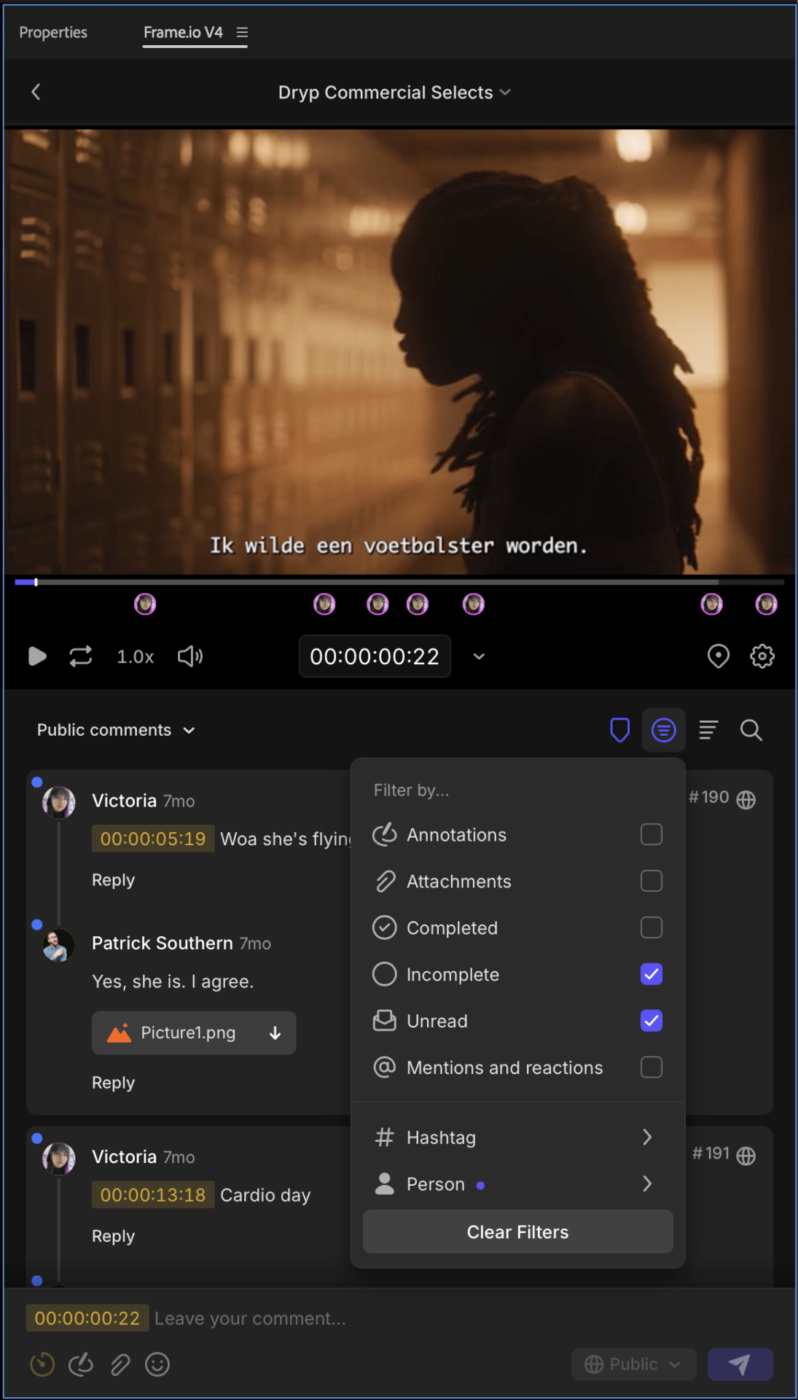
Frame.io is Adobe’s cloud-based video review and collaboration platform that brings the review queue into the edit bay. From Premiere Pro 25.6 onward, the V4 panel is built into the app rather than installed as an extension. An editor browses Frame.io workspaces and projects, imports original media or proxies, keeps the Frame.io folder structure as Premiere bins, and uploads the active sequence for review without opening a browser.
Comments come back to that same timeline. Click a comment card, and the playhead jumps to the frame it belongs to. Switch on Comment Markers, and every note sits on the timeline as a marker. Change the cut, and the panel offers to upload it as a new version, stacked under the last one.
After Effects gets its own V4 panel, which renders compositions straight from the Render Queue and jumps the playhead to a comment. On the reviewing side, clients open a share link with no account and no paid seat, leave frame-accurate or range-based comments, and draw on the frame.
A G2 user described:
As a graphic and interior designer, I regularly handle creative files, revisions, client feedback, and project presentations, and Frame.io has made collaboration much smoother for me. The best thing is how easy it is to manage feedback and revisions in one place without dealing with long email conversations. It helps me stay organized while working on design projects, especially when sharing visuals, edits, or presentation drafts with clients and team members.
Where it taps out: Frame.io caps paid members hard: five on Pro, 15 on Team, and everything above that is a sales conversation. It also doesn’t offer a native V4 integration for DaVinci Resolve. Final Cut Pro also lost some V4 features. Teams that edit outside Adobe should test their current workflow before moving to V4.
Best for: Video and post teams who cut in Premiere Pro or After Effects and want client notes on the timeline.
Skip it if: Your editors live in DaVinci Resolve or Final Cut Pro, and a native panel is central to how they take feedback.
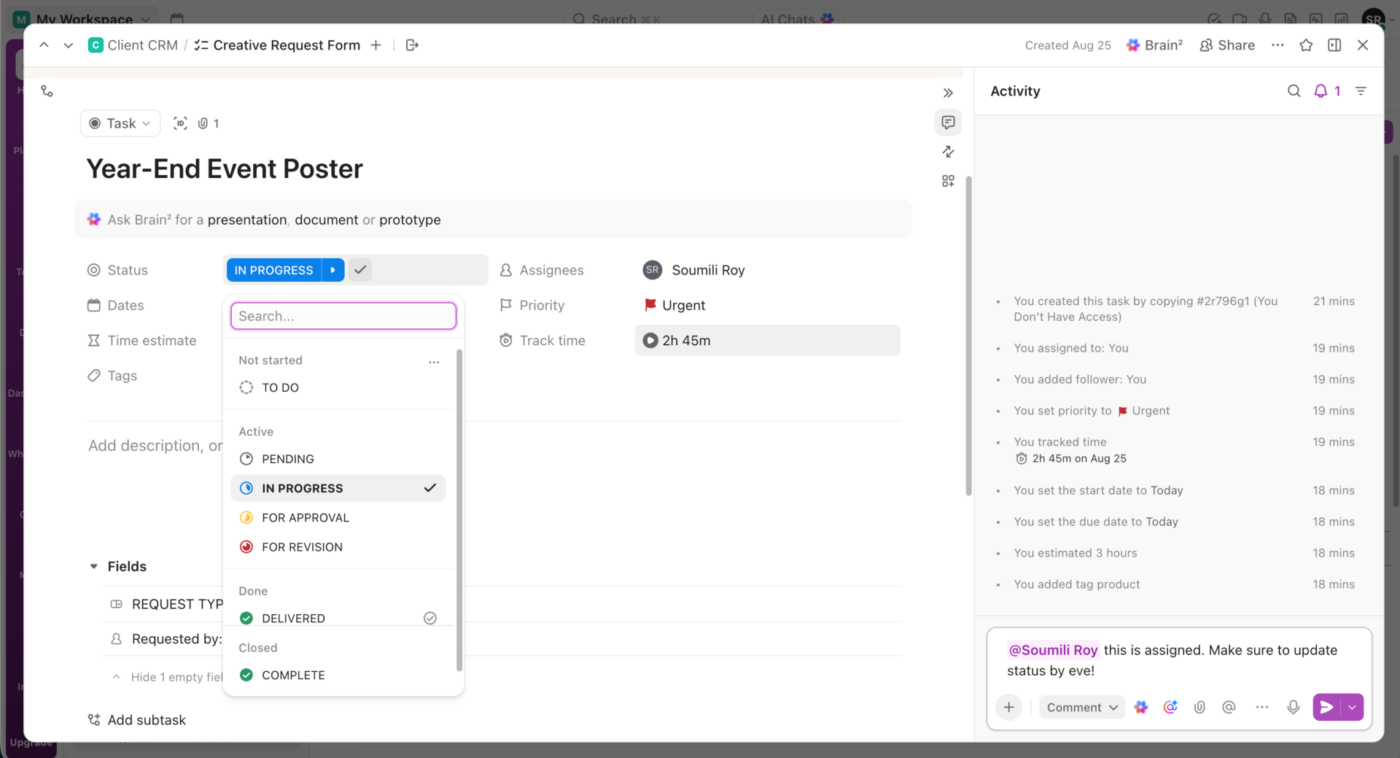
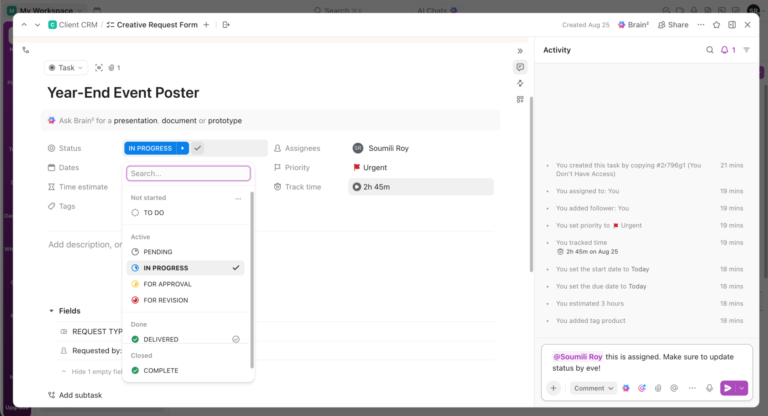
ClickUp keeps the review inside the task that owns the work. For starters, ClickUp Proofing runs on images, videos, and PDFs attached to that task, so the file sits next to the brief, deadline, status, and every comment the campaign has already gathered. Nobody has to reconcile a proofing tool against a project tracker afterward.
Reviewing works the way it does anywhere else. Click the exact spot on an image or PDF and type; on video, the comment picks up a timestamp and appears in the playback bar. What happens next is the difference. Assign that comment to a person, and it becomes an open item on the task, remaining open until the owner marks it as resolved.
The pipeline around those comments is yours to build. ClickUp Custom Statuses walk a design task through Draft, Internal Review, Client Review, and Approved. While that happens, ClickUp Custom Fields specify the campaign, channel, and approval owner. Dependencies further align the work waiting behind the sign-off, and ClickUp Automations move the next step along when the status flips.
The AI layer then reads it all. ClickUp Brain summarizes a long review thread, tells you what was decided, and turns the leftovers into tasks and subtasks.
A G2 user described:
I use ClickUp for managing our ads-making workflow and appreciate how it keeps the entire ad production workflow in one space. I like the way it organizes tasks, with clear options for pre-production, production, and approval stages, making things more straightforward. The features like task management, search, assignee options, and the ability to transition tasks smoothly from pre-production to production add a lot of value to my workflow. It enables our process where the copywriter writes the task, sends it for approval, and once approved by the senior writer, it is then assigned to us designers. We create the ad, attach the file, and send it for further approval, ensuring the entire team stays in sync and our marketing tasks are efficiently coordinated.
Where it taps out: ClickUp Proofing covers images, video, and PDFs, but it doesn’t offer the specialist inspection tools found in dedicated proofing software. Teams working with native design files, live websites, packaging artwork, or detailed prepress checks may still need a more specialized review tool.
Best for: Marketing and creative teams that want feedback, revisions, ownership, and project status tied to the same work item.
Skip it if: Your approval process depends on specialist proofing for native design files, live webpages, packaging, or prepress artwork.
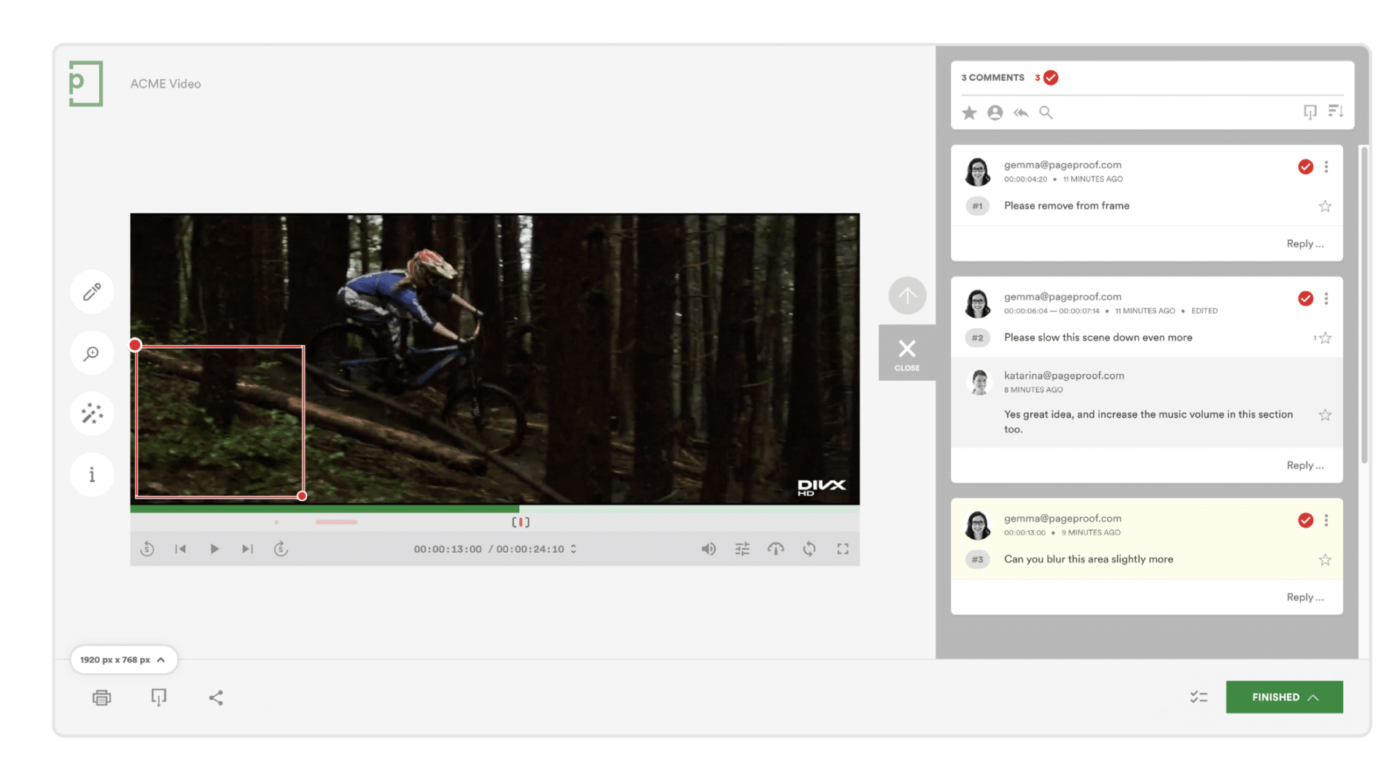
PageProof gives creative teams the inspection kit a print shop expects. Smart Check reads a proof on upload and reports its dimensions, fonts, color profile, and linked files. You can scan a barcode or QR code, test a color’s contrast against WCAG AA or AAA, run a spell check, or verify every hyperlink. ColorSep goes further for print work, previewing the individual CMYK and spot plates and reporting ink coverage as you hover.
Authority is just as precise. A workflow carries four kinds of participants. Reviewers comment freely without holding anything up. Mandatory reviewers hold the proof until they decide. Gatekeepers send it onward or back to the owner. Approvers close it out. With several people in one role, you set the bar: all of them, just one, or a specific number. An approver can lock the proof while signing off, which takes the red pen away from everyone else during that final pass.
Feedback can stay compartmentalized as well. With invisible reviewer comments switched on, an outside reviewer sees only their own notes and replies, while your team reads the whole discussion.
A G2 user added:
What I like most about PageProof is that it makes feedback very easy and clear. Everything is in one place, so there’s no confusion with emails or different versions. It saves time and helps teams work better together.
Where it taps out: PageProof can get harder to navigate when an agency is juggling lots of proofs across clients and campaigns. Collections and folders help organize the dashboard, but visibility and permissions still work largely at the individual proof level.
Best for: Packaging, regulated marketing, and print-heavy creative teams that need detailed artwork inspection alongside structured approvals.
Skip it if: Your review process is mostly lightweight digital feedback and you don’t need print checks, controlled reviewer visibility, or production-level inspection tools.
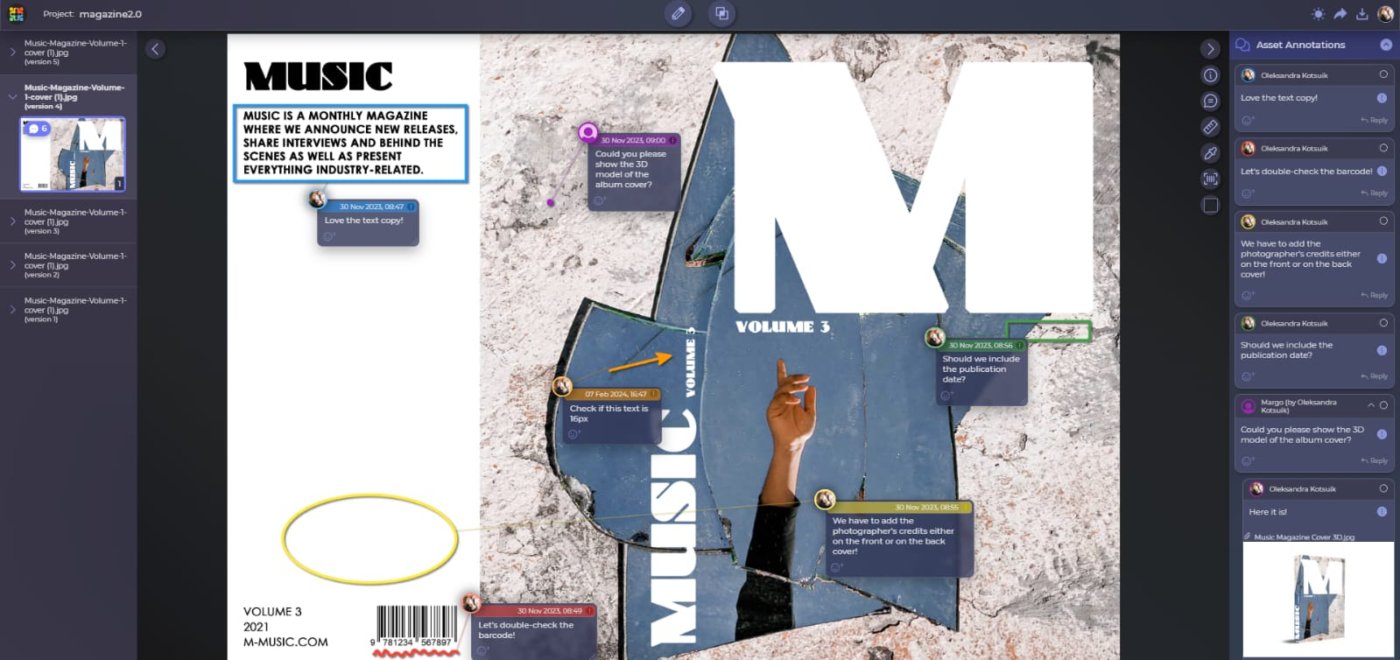
Approval Studio is an artwork review platform built around catching what changed between versions. Its compare tool runs four separate modes: Side-by-Side, Fader, Difference, and Toggle. Side-by-Side puts two versions next to each other, zooming and rotating them together. Fader is a slider you drag to switch between versions. Difference shows only what changed, and Toggle flips between the two versions, making a change announce itself.
Packaging and print teams get the most from this. Approving a revision there means checking that the one change you asked for landed, and that three others didn’t sneak in. The tool opens dozens of file types in the browser, including AI, PDF, TIFF, PNG, and Office files, as well as MP4 videos with comments pinned to a point in the clip.
The record stays with the artwork. Project History logs every action, who took it, and when, down to each annotation and version. A PDF report pulls one asset or a whole project into a single file, with annotated thumbnails, open tasks, and every approval or change request. Projects then move across a Kanban board you build yourself, up to ten columns wide.
A G2 user said:
The fact that it does not require my clients to create login details or download apps. You can also click the preview button to see the file and the annotation features exactly as the clients will see it.
Where it taps out: Approval Studio keeps project management fairly lightweight. You can assign review tasks, track due dates and statuses, and monitor progress from the dashboard, but it isn’t built to manage the broader creative operation around those approvals. Teams that need resource planning, campaign dependencies, or detailed production tracking will still need a separate work management tool.
Best for: Packaging, label, print, and artwork production teams that need to inspect small visual changes before files go to press.
Skip it if: Your approval process centers on video work or complex stakeholder routing more than close artwork inspection.

Planable is a social media management and collaboration platform built around approving content before it goes live. Posts appear in layouts that mirror the destination channel. That means a reviewer can judge an Instagram carousel, LinkedIn post, TikTok reel, or YouTube video in roughly the same context in which the audience will see it.
Workspaces keep each client or brand separate, with their own connected pages, calendar, campaigns, and approval flow. Teams can also keep work-in-progress posts and internal comments hidden until the content is ready for the client. For agencies managing several accounts, this gives each client a contained review space without mixing their calendars or conversations.
Once content is approved, it can move straight onto the publishing calendar for Facebook, Instagram, LinkedIn, X, TikTok, YouTube, Pinterest, Threads, and Google Business Profile. That’s where it pulls ahead: Planable covers the path from draft to approval to scheduled post, rather than ending the workflow once someone gives the creative a green light.
A G2 user mentioned:
What I like best about Planable is how much it simplifies collaboration and client approvals. Its interface is intuitive, visually clear, and easy for both our internal team and our clients to use, even without extensive onboarding.
The platform integrates well into our social media workflow, allowing us to organize content, leave comments, request changes, and approve posts in one place. Its performance has been reliable, and it helps us avoid long email chains, duplicated files, and confusion about the latest version of a post.
Where it taps out: Publishing still depends on what each social network exposes through its API. That means some native features can’t make the trip through Planable. For example, Instagram Stories can’t include polls, questions, links, or other interactive elements via direct publishing. Teams using advanced native post formats may still need a final manual step inside the social app.
Best for: Social teams and agencies that want client approval tied directly to the publishing calendar.
Skip it if: Your creative approval work is mainly packaging, long-form video, or production artwork more than channel-ready marketing content.

Air is a creative asset management platform that keeps approval tied to the asset library. Files can carry approval status, usage rights, expiration dates, assignees, ratings, and campaign details through Custom Fields. So a team can filter for assets waiting on approval, find everything cleared for a campaign, or pull up licensed images that are about to expire.
Boards and Libraries give that information structure. Teams can use Boards for active campaigns and Libraries for larger collections by brand, market, or business unit. Versions stay grouped with the asset as it moves through review, while comments and timestamped video feedback stay attached to the work itself.
And once an asset is approved, that status becomes part of how the library works. Teams can combine approval state with fields like channel, campaign, or usage rights to create a cleaner pool of creative that’s actually ready to use. That’s where Air stands apart from proofing-first tools: review feeds directly into how the asset library is organized.
A G2 user described:
What I like best about Air is that is VISUAL. Everything is laid out very in a very clean design that helps me find the content I need very quickly. I also love how easy it is to share links to specific assets, we are a mostly remote team lately, so if I have something I need to share for approval I can upload a draft of a video without worrying that another team member may find it and think it’s a final version, because only certain members have access to the “Drafts” folder.
Where it taps out: Air’s approval flow is lighter than dedicated proofing tools. Teams needing sequential approvals, mandatory approvers, complex rules, or legal-grade routing may find less depth than in Ziflow, PageProof, or Workfront.
Best for: Brand and content teams that want approved creative to become part of a searchable, governed asset library.
Skip it if: Your main need is complex approval routing over organizing, governing, and reusing assets once they clear.
Also Read: Brand Asset Management Software
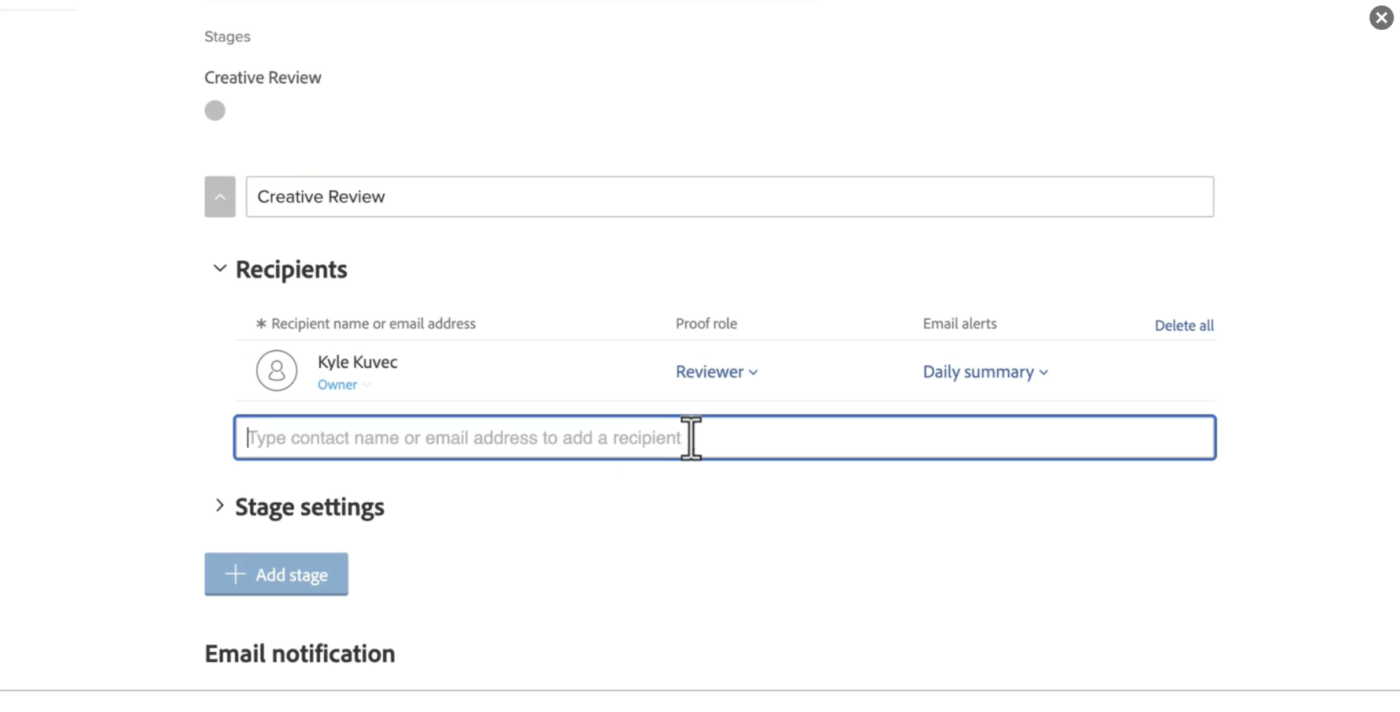
Adobe Workfront integrates creative approval into the surrounding workflow: intake, projects, people, files, and reporting. A campaign request comes in through a Request Queue. A Queue Topic sorts it, and a Custom Form asks what the team needs to know. Routing Rules then send it to a person, job role, team, or project. Big marketing groups get one front door for work that otherwise turns up in email, chat, and spreadsheets.
Projects, tasks, issues, templates, files, and proofs can each have their own approval process. A routine work item may need only a decision. A creative file opens in the proofing viewer for markup, comments, and versions. Unified Approvals returns Approve, Approve with changes, or Needs work.
Automated Workflows handle the formal chains. You build proof stages that run in sequence or side-by-side. Name the reviewers, approvers, and lead decision-maker on each one. Set a deadline for each stage, and add dependencies that hold a stage until the one before it has cleared.
The work also reaches into the Adobe apps. The Workfront plugin runs in Photoshop, InDesign, Illustrator, Premiere Pro, and After Effects. A designer can see their assignments, tag teammates in comments, log time, and mark work as done without leaving the app.
A G2 user mentioned:
The best part is definitely the visibility it provides across different workstreams. I love that I can jump into a project and immediately see the full audit trail—who approved what and when. It’s also great for resource management; it gives a clear picture of my team’s bandwidth so we don’t over-commit. Having a single place for proofing and feedback instead of digging through endless email chains is a massive lifesaver for my daily productivity
Where it taps out: Workfront’s flexibility comes with a real admin burden. Request Queues, routing rules, Custom Forms, approval processes, permissions, and reporting all need to be designed and maintained around the organization’s workflow.
Best for: Large marketing organizations that need creative approvals governed by the same system that controls intake, resources, projects, and reporting.
Skip it if: You want a proofing tool you can roll out quickly without assigning people to build and maintain the workflow underneath it.
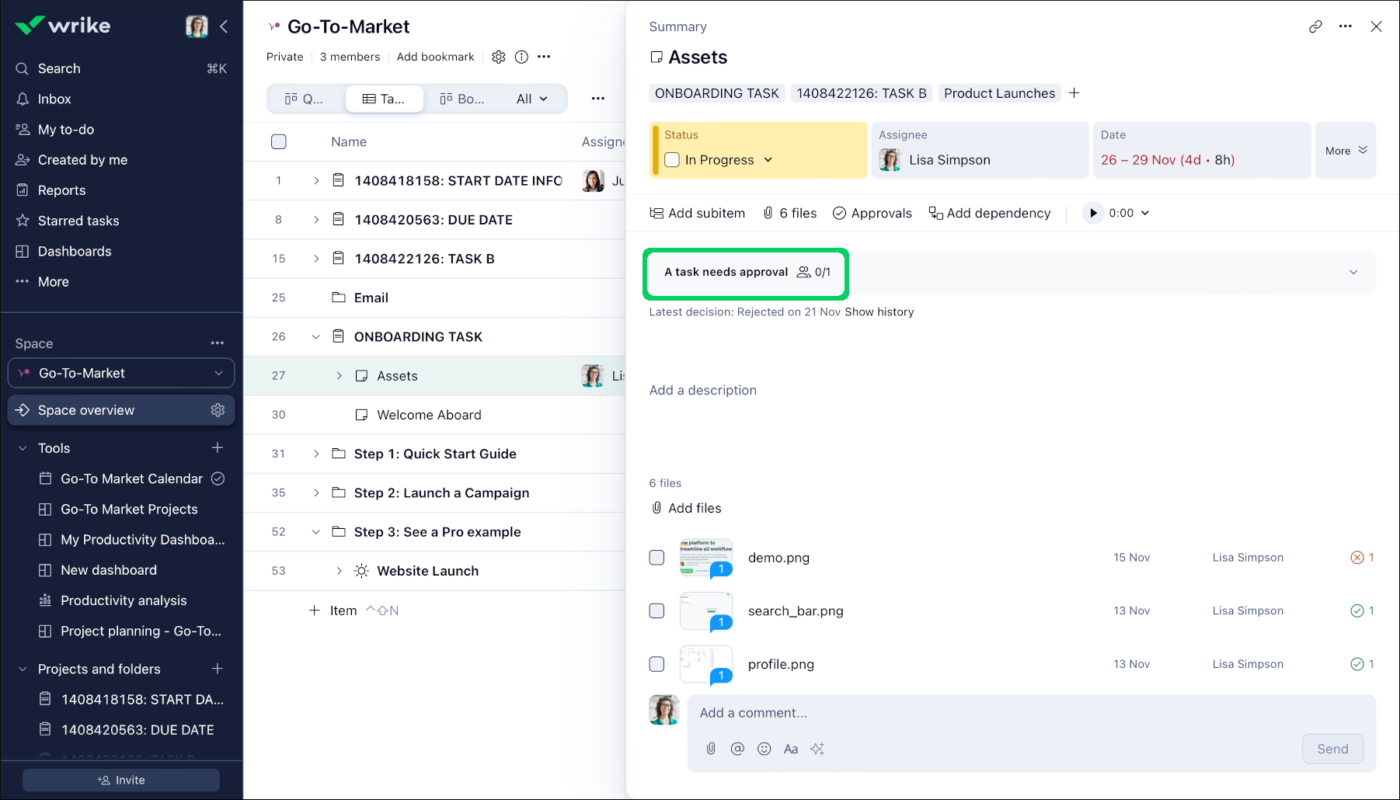
Wrike is enterprise work management with the review folded in. A campaign runs through the creative, brand, legal, and regional teams, as well as outside stakeholders. Operations leads watch capacity, ownership, and delivery dates across the whole portfolio. Approval becomes one status on that map, and the map is the point.
Proofing further covers images, PDFs, Office files, video, and website links. Reviewers mark up the file in place. Comparison Mode opens two versions side-by-side, or layers them in Overlay for images, PSD, TIFF, SVG, HEIC, and PDF. Guest reviewers receive an email link, see the files assigned to them, and answer “Approve” or “Changes required” without ever joining your workspace.
Approvals also live on the work itself. Tasks, folders, and projects each take an approval with named approvers and a due date. Attach one to a custom workflow, and a status change opens the approval; then the decision moves the item to the next status on its own.
Designers can stay in Adobe as well. The Wrike extension runs in Photoshop, Illustrator, InDesign, and Premiere Pro. From there, they upload a preview, push a new version, open Proofing, add reviewers, and set a review due date.
A G2 user said:
I love using Wrike as a project management tool for my in-house creative marketing team. It has been a lifesaver for organizing tons of requests into clear tickets with timelines, briefs, and assigned resources. I also enjoy using the approval tool for reviewing assets. The timeline feature is my favorite. It’s so easy to create timelines using predecessors and blueprint templates.
Where it taps out: Wrike Proofing is picky about where a file comes from. Local uploads, Bynder, MediaValet, and SharePoint work for images and PDFs, while Dropbox and Box attachments often won’t open in the proofing viewer.
Best for: Enterprise marketing and creative teams that want approvals connected to project planning, resources, and delivery.
Skip it if: You want a dedicated proofing tool without enterprise work management wrapped around it.
Start with what happens to the asset before and after someone clicks Approve. Two tools can both offer comments, version history, and sign-off while solving very different problems.
Here’s what to look at:
A good shortlist starts with one question: where does your approval process break today? When reviewers can’t inspect the asset closely enough, buy proofing depth. When feedback gets lost between teams, buy routing and ownership. When approved work is hard to find again, buy asset management. And when the review works fine while the campaign around it stalls, buy a work platform that carries the approval into the next step.
Approval software can make each review round cleaner. It puts comments on the asset, keeps versions together, and shows who has approved what. But the number of rounds still depends heavily on who gets a say, what they’re being asked to judge, and whether conflicting feedback is resolved before it reaches the creative team.
That distinction matters because faster markup doesn’t fix a slow decision process. Adobe’s 2026 State of Marketing in an AI-Driven World surveyed 150 marketing leaders and practitioners across five countries. It found that 84% of organizations had missed at least one marketing opportunity in the previous quarter because their workflows couldn’t respond in time. Another 29% had missed six or more.
Adobe points directly to cross-team handoffs and approval delays as places where momentum breaks down. And when organizations try to scale AI, 51% name inconsistent workflows as a barrier, ahead of centralized coordination and training. The problem isn’t simply how fast someone can annotate a PDF. It’s how work moves between people once those comments exist.
That shows up in creative review as well. Version comparison, timestamped comments, and side-by-side proofs make feedback more precise. They don’t decide which stakeholder has the final call when legal, brand, and creative disagree.
Rachel Krause, Director of Live Training at Nielsen Norman Group, describes what happens when the review itself has no clear focus:
When stakeholders and team members don’t know where to focus, they’ll give any and all feedback and will force you to work hard to reset the conversation back to your original goals for the critique.
The fix starts before anyone opens the proof. Tell reviewers what kind of feedback you need: brand voice, factual accuracy, visual execution, legal compliance, or something else. Nielsen Norman Group’s critique guidance similarly recommends tying feedback back to a shared goal, persona, scenario, or use case.
Then make the decision path explicit. Name the final approver, keep the reviewer list as small as the work allows, and resolve conflicting comments before sending them back for revision. Track the number of rounds per asset after adopting a new tool, too. If that number stays flat, the bottleneck probably sits in the approval process itself. A clear design brief upstream can do more for that problem than another markup feature downstream.
Pick a proofing tool when errors slip through review: missed changes, wrong versions, unrecorded sign-offs. Pick a work platform when approved files sit idle because nobody owns the next step. The sections below give the diagnostic approach for each.
A barcode ships wrong, a version goes to print with last round’s headline still in it, or legal approves a regulatory claim with nobody recording the justification. Ziflow, PageProof, and Approval Studio are built for this. Auto Compare catches the pixels that moved, ColorSep opens the individual plates, and a barcode scanner reads the code before the file reaches a press. No work platform has an equivalent.
The proof itself was fine. It sat in someone’s inbox for days because nobody owned the next step, and the campaign slipped by a week. ClickUp, Wrike, and Adobe Workfront put the review inside the work, with an owner, due date, status, and dependent tasks that unblock it the moment it clears.
Many proofing tools integrate with work platforms. Ziflow, for example, connects directly to ClickUp, Asana, and monday.com. But you’re paying for two subscriptions and maintaining a sync. That trade pays off when your inspection needs are genuinely specialist: packaging, prepress, or regulated claims. For a marketing team routing images, video, and PDFs, one system wins, and it should be the one holding the brief and the deadline.
Most approval delays have nothing to do with the proofing experience. The markup was clear, the client replied, the changes were obvious. The file then sat in somebody’s inbox for four days because no one owned the next step, and a launch date moved. No amount of additional markup capability was going to prevent that.
ClickUp closes that gap by keeping the review inside the task that owns the work. The proof sits next to the brief, deadline, and campaign it belongs to. A comment on the file becomes an assigned item with a name and a due date, and it stays open until that person resolves it. On top, ClickUp AI reads the whole thread and tells you what was decided.
Nobody chases anybody, because the approval and the work occupy the same place.
Get started with ClickUp for free.
Partly. Creative approval software can automatically route a file to legal or compliance, assign mandatory approvers, enforce review stages, set deadlines, block the next step until sign-off, and keep a record of the decision. What it can’t do is replace the judgment itself. A tool may flag missing disclaimers, prohibited terms, barcode issues, or brand-rule violations, but a lawyer or compliance owner still needs to decide whether the asset is safe to publish. Tools such as PageProof, Ziflow, Filestage, and Adobe Workfront are stronger here because they support structured review stages and formal approval roles.
At a minimum, the audit trail should show who reviewed the asset, which version they saw, what comments or changes they made, their final decision, and when that decision happened. For regulated or client work, look for a history that can also show approval stages, version numbers, reopened reviews, and any changes made after sign-off. The useful test is simple: six months later, could you prove exactly which file was approved and by whom? If the answer is no, the activity log isn’t doing enough.
Not always. Creative approval software manages the active review process. A digital asset management system manages the library after the work is finished. You may need both when approved assets have to stay searchable by campaign, market, usage rights, expiration date, or licensing terms. Air is a good example of a platform that brings those two jobs closer together. But if your approved files already move cleanly into an existing DAM, adding another asset library may just duplicate work.
A simple proofing tool can often be introduced within days if the workflow is just upload, review, revise, and approve. Enterprise systems take longer because the software has to match your intake forms, approval stages, permissions, integrations, reporting, and team structure. The bigger variable is process design. If nobody agrees on who approves what, which decisions block progress, or when legal enters the review, software setup will take longer because you’re defining the workflow at the same time you’re configuring the tool.
It can be, but don’t assume every platform offers the same controls. For unreleased campaigns, product launches, regulated content, or client assets, verify encryption, role-based permissions, SSO, two-factor authentication, guest access controls, retention settings, and audit logs. Larger organizations may also need certifications such as SOC 2 or ISO 27001, along with data-residency options or contractual security requirements. And pay close attention to guest links. A review link that’s easy for a client to open should still let you control who can view, download, or share the asset.
Yes. Several tools in this list offer a free plan or a free way to test the workflow.
Ziflow and Filestage have free tiers for smaller review setups. Frame.io offers a free plan for small video teams, while ClickUp and Wrike include free work management plans with more limited approval or proofing capacity. Planable also lets teams test its social approval workflow before moving to a paid workspace. Free plans are usually enough to test one real approval process. The limits tend to appear around users, reviewer groups, projects, storage, proofing volume, or advanced workflow stages. So compare the free tier against your actual approval chain.
For many marketing and creative teams, yes. ClickUp Proofing lets reviewers annotate images, videos, and PDFs directly on task attachments, assign comments, and keep feedback tied to the work that owns the deadline and status. That can remove the need for a second proofing subscription when your review process is fairly straightforward. But it isn’t a full replacement for specialist systems such as Ziflow or PageProof when you need formal approve/reject controls on the proof itself, multi-stage reviewer roles, native version comparison, packaging checks, or deeper prepress tools.
Frame.io has the deepest Premiere Pro integration. Adobe Workfront connects across Photoshop, InDesign, Illustrator, Premiere Pro, After Effects, and XD. PageProof also integrates closely with Adobe apps, especially InDesign. Pick based on whether your team is mainly editing video, running enterprise workflows, or reviewing artwork.

Manasi Nair
Max 15min read
Manasi Nair
Max 19min read
Manasi Nair
Max 26min read

© 2026 ClickUp




