
Sorry, there were no results found for “”
Sorry, there were no results found for “”
Sorry, there were no results found for “”
If you’re one of many people searching for agile tools, chances are you already have Jira, Azure DevOps, or Linear. The tracker is settled, but everything happening around it isn’t: sprint planning on a Miro board, retros in a Confluence page, and a roadmap in a slide deck someone updates the night before the review.
So the real question isn’t which tracker to buy. It’s whether the second tool is worth adding, and if yes, then which one. Miro and Parabol are strong at running a ceremony and weak at owning a backlog. Jira and Azure DevOps are the reverse. Linear and Shortcut come closest to doing both, but they hit real limits at enterprise scale.
If you have fewer than 25 engineers and no tracker yet, start with Linear and skip the rest of this list. If you’re already in Jira and your retro decisions keep evaporating, a ceremony tool like Parabol will help more than a tracker migration will. In fact, 69% of teams finish less than 60% of their retro action items before the next retro.
And if you’re the team paying for a tracker, a whiteboard, and a docs tool to run one sprint, ClickUp is the option on this list that runs planning, retros, and the backlog in the same place, so a sticky note becomes an assigned task without anyone retyping it. It’s more setup than a single-purpose tracker needs, and teams coming from Linear will feel that in the first week.
I rated all ten tools in this list on how much manual work you need to put in between a decision someone makes in a meeting and a ticket another person can pick up.
| Tool | Best for | Standout feature | Pricing* | Where it taps out |
|---|---|---|---|---|
| Jira | Scrum and Kanban teams scaling past 50 people | Its Marketplace offers thousands of add-ons that extend the tracker into time tracking, test management, or design handoff without leaving the board | Free; paid from $7.91/user/mo | Configuration debt from statuses, screens, and custom fields slows down small teams that lack a dedicated admin |
| Linear | Product engineering teams that prioritize speed over configuration | Its Cycles auto-roll unfinished work into the next iteration, killing the Friday afternoon card-dragging ritual | Free; paid from $10/user/mo | No custom states per team or formal portfolio roll-ups; complex multi-team orgs hit walls quickly |
| ClickUp | Cross-functional teams keeping ceremonies and backlog on the same data | Its Whiteboards convert sticky notes into sprint-ready tasks in one click; planning decisions land directly in the backlog | Free Forever; paid from $7/user/mo | Front-loaded setup investment before the consolidation payoff kicks in, which costs a team arriving from a single-purpose tracker its first week |
| Shortcut | Small engineering teams that want planning layers without admin overhead | Its three native layers (Stories, Epics, Objectives) connect individual work to strategic goals without building custom fields | Free; paid from $8.50/user/mo | Manual sprint carryover, which means unfinished stories sit until someone drags them into the next Iteration |
| Azure DevOps | Teams already inside the Microsoft and GitHub ecosystem | Its Pipelines trace a user story from backlog through branch, PR, build, and deployment in a single service | Free (first 5 users); paid from $6/user/mo | Stakeholder access excludes boards, backlogs, and sprint planning, forcing non-engineering planners onto a full license |
| monday dev | Dev teams reporting sprint progress to non-technical stakeholders | Its color-coded dashboards render sprint progress; a non-technical stakeholder can read delivery status without a walkthrough | Paid from $9/seat/mo | Sprint management and GitHub integration require stepping above the entry tier, gating the agile features that differentiate it |
| Asana | Agile marketing and cross-functional operations teams | Its Workflow Bundles package automations, custom fields, and templates into one step that applies a full sprint setup to any new project | Free; paid from $10.99/user/mo | No native story points or velocity charts; points-based sprint reporting requires custom fields and third-party add-ons |
| Miro | Facilitators running sprint planning, story mapping, and workshops | Its two-way tracker sync turns canvas sticky notes into tracked issues in Jira, Linear, ClickUp, or Azure DevOps | Free; paid from $8/user/mo | Two-way tracker sync requires the Business plan, and below that every planning decision is manually recreated in the tracker |
| Parabol | Distributed teams running retros and estimation poker | Its anonymous retro mode hides responses until the facilitator reveals them; quieter team members surface problems they wouldn’t say out loud | Free; paid from $8/user/mo | No backlog, it always adds a login alongside whatever tracker the team already uses |
| Zoho Sprints | Small teams on a tight budget needing real Scrum reporting | Its built-in retro meetings attach directly to a closed sprint’s record, keeping ceremony notes and delivery data in one place | Free; paid from $1/user/mo | Native integrations outside the Zoho ecosystem are limited; GitHub- and Slack-focused teams find fewer connectors |
Our editorial team follows a transparent, research-backed, and vendor-neutral process, so you can trust that our recommendations are based on real product value.
Here’s a detailed rundown of how we review software at ClickUp.
Agile tools are the software a team uses to plan, track, and review work in short, repeating cycles.
When we say ‘agile tools’, it can mean the set of practices that predates any software: user stories, story points, burndown charts, planning poker, and retrospectives. The Agile Manifesto was signed in 2001 and names no products.
The second meaning of agile tools is the actual software that hosts those practices. The distinction matters because the practices generate the data, and the software decides whether that data survives the week. If you are running sprints as part of project management, then you need both.
Agile is also no longer a software-only practice though. This walkthrough shows how marketing, operations, and other non-engineering teams run sprints without pretending to be a dev team:
If you’re on the hunt for agile software tools, then start by scoring every tool against these six criteria: sprint modeling, estimation-to-reporting flow, ceremony write-back, sprint automation, developer surface area, and compatible AI capabilities. Together, they separate tools you keep from the ones you abandon by sprint three.
Eight backlog-owning trackers and two ceremony tools, each evaluated on sprint modeling, estimation flow, ceremony write-back, automation, developer reach, and AI.
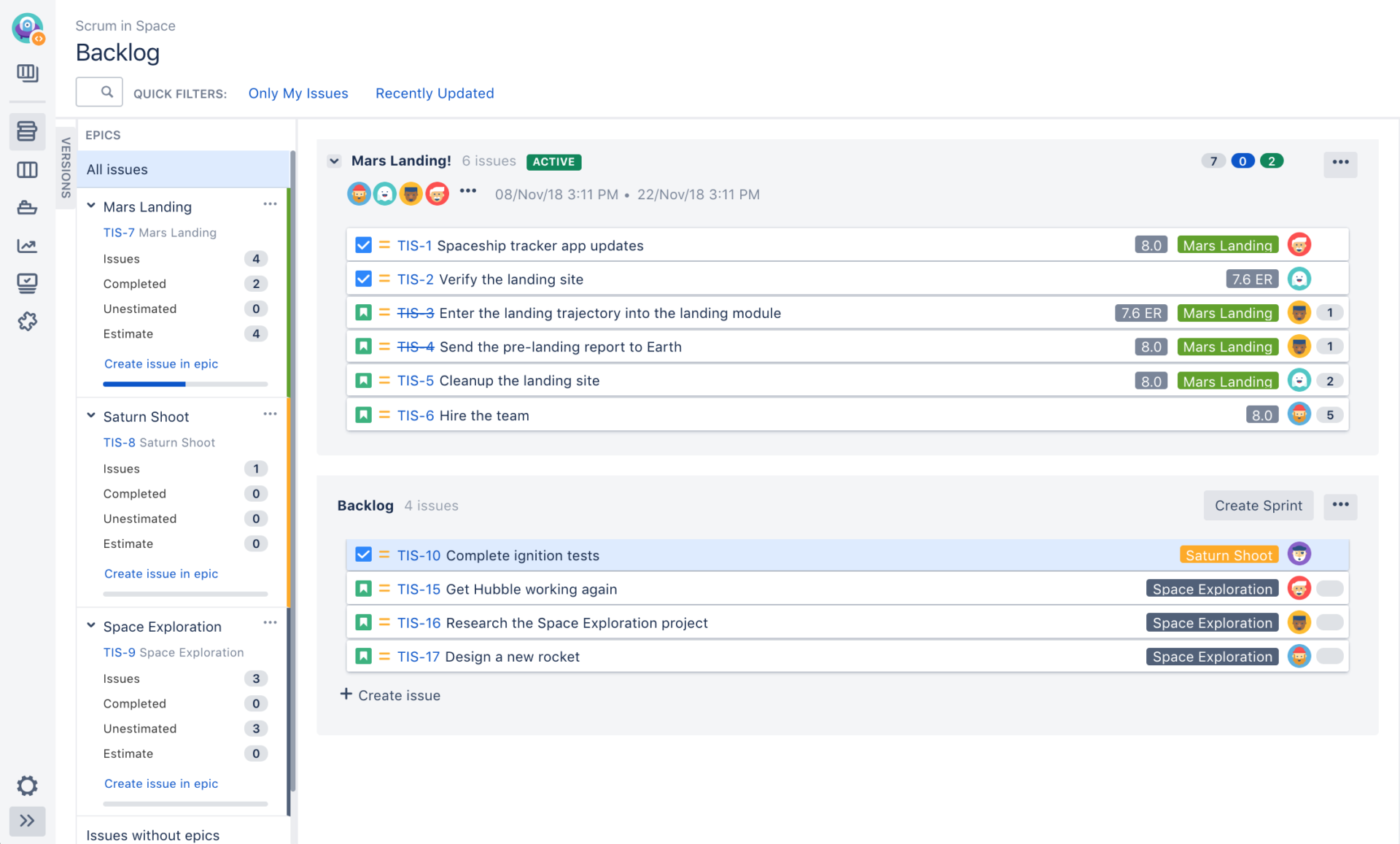
The backlog view in Jira is where most teams spend their time. You drag stories into a sprint, assign points, and commit. The board reflects those commitments in real time: swimlanes split by assignee or priority, WIP limits flag overloaded columns, and the burndown chart updates as issues move through states. When a sprint closes, unfinished work stays visible in the backlog rather than disappearing into a filtered view.
Once a few sprints close, the data starts earning its keep. The velocity chart shows whether the team is finishing more or less each cycle, and cumulative flow pinpoints the column where work stalls. When multiple teams feed into the same release, Advanced Roadmaps maps their dependencies so a slip on one board shows up on every connected plan.
Rovo, Atlassian’s AI layer, drafts work items from plain-language prompts and builds automation rules by describing what you want in a sentence. Ask it to summarize a project’s status, and it pulls from issues, comments, and linked Confluence pages.
Where it falls short: Teams without someone who owns workflow hygiene accumulate statuses, screens, and custom fields that nobody prunes. The configuration that makes Jira powerful at 50 people becomes overhead that slows down a team of five.
Skip it if: You have a small team and no one who wants to maintain the setup. That overhead compounds every quarter.
One G2 reviewer put it this way:
Jira’s greatest strength is its unmatched customizability for Agile workflows. Whether you follow Scrum, Kanban, or a hybrid approach, Jira can be tailored to fit your exact process. The ability to create complex workflows, automate repetitive tasks (via automation rules), and configure distinct issue types allows teams to work exactly how they want.
Linear loads in under 200 milliseconds, and nearly every action maps to a keyboard shortcut. Create an issue, assign it, set a cycle, and start building. The interface stays out of the way.
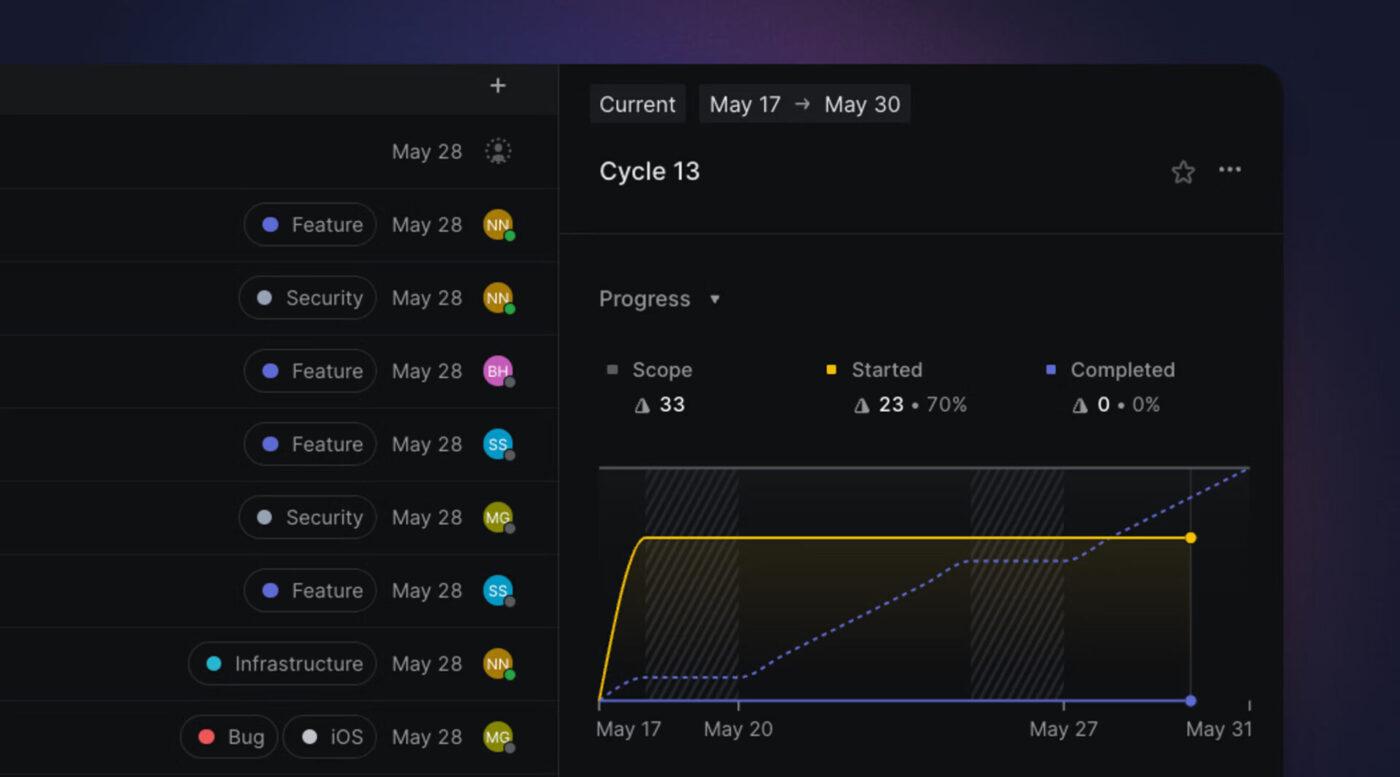
Where Linear solved the biggest sprint-hygiene problem is Cycles. Set a start day, a duration, and an optional cooldown. When the cycle ends, unfinished work automatically rolls into the next one. That single default kills the Friday afternoon ritual of dragging cards from one sprint to the next.
Projects and Initiatives sit above Cycles for work that spans several weeks. Triage funnels incoming bugs and requests into a holding queue before they touch the backlog, so your active cycle stays clean until you explicitly pull something in. The Linear Agent can triage, assign, and update issues on its own. Code Intelligence and Triage Intelligence go further: they read your codebase and route issues to the right team.
Where it falls short: Linear picks one workflow model and sticks to it. Teams that need custom states per team, heavy custom fields, or formal portfolio roll-ups will hit walls quickly. The tool resists bending into a shape it wasn’t designed for.
Skip it if: Your process genuinely requires per-team workflow customization. The speed comes from the opinionated model, and you can’t have one without the other.
See how this G2 reviewer uses Linear:
I use Linear for software development, tracking tickets through all of their states and assignees, and maintaining agile cycles on a sprint board. I find it very helpful for planning software features and projects as tickets are easily visualized in their clean UI. I like the simplicity and responsiveness of the desktop application, and it’s simpler to use and understand than many comparable tools I’ve used. It’s also integrated with GitHub to track the state of tickets through development, and with Notion to help maintain any documentation on specific features.
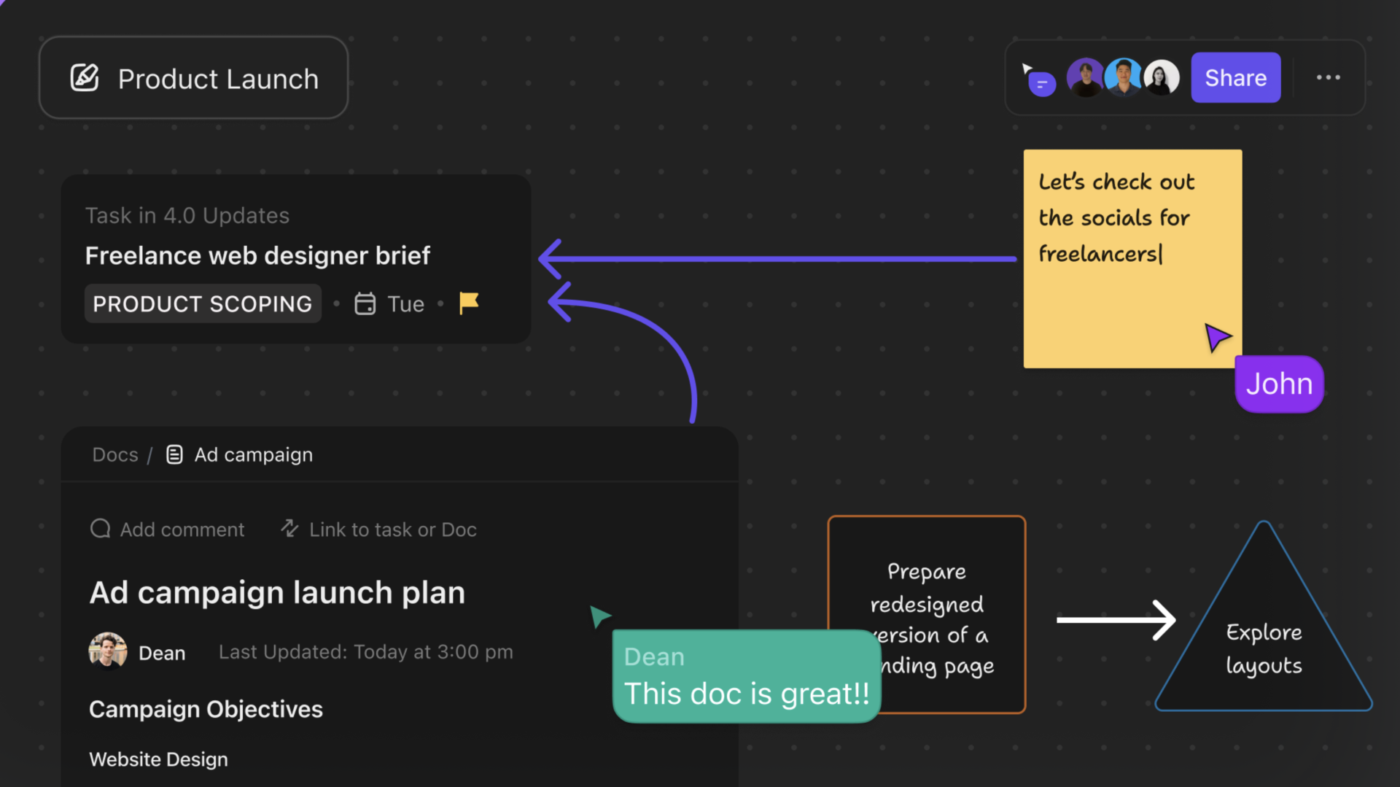
Most agile teams keep their backlog in one tool and their ceremonies in another. ClickUp puts ceremonies, backlog, and reporting on the same underlying data. Start a planning session in a ClickUp Whiteboard. Drop sticky notes, debate scope, convert each one into a task with one click. Those tasks land directly in the sprint backlog: assigned, estimated, and already visible on the ClickUp Dashboard your lead checks every morning.
ClickUp Brain drafts user stories from a prompt during that same session. With its help, the team refines language instead of writing from scratch. ClickUp Sprints handle dates, carryover, and velocity from that shared task data. Burndown and burnup charts read from the same items the team committed during planning. The report reflects what the team actually agreed to.
ClickUp Docs sit alongside the work: a product spec and the sprint it feeds live in the same workspace, keeping context one click from execution. When a retro surfaces three things to fix, Brain condenses the thread into action items, and Super Agents can pick them up, respond to @mentions, and act on triggers autonomously.
Where it falls short: A team arriving from a single-purpose tracker will spend the first week learning where things live. The workspace has a lot of surface area, and the setup investment is front-loaded before the consolidation payoff kicks in.
Skip it if: You want a minimal issue tracker and nothing else. ClickUp is built for teams replacing several tools with one, not teams that prefer one tool per job.
Here’s what this G2 reviewer likes best about ClickUp:
Being able to organize the backlog in a clear hierarchy and switch from the list to the Gantt chart instantly, the relational fields save my life by linking epics with user stories across different spaces without duplicating information. It’s super agile for seeing progress.
Agile templates that carry the setup for you: Browse ClickUp’s agile template library for sprint planning, retrospective, and backlog management templates. Each one pre-loads views, statuses, and custom fields matched to the ceremony it supports. Skip the blank-canvas phase and run your first sprint on a working structure.
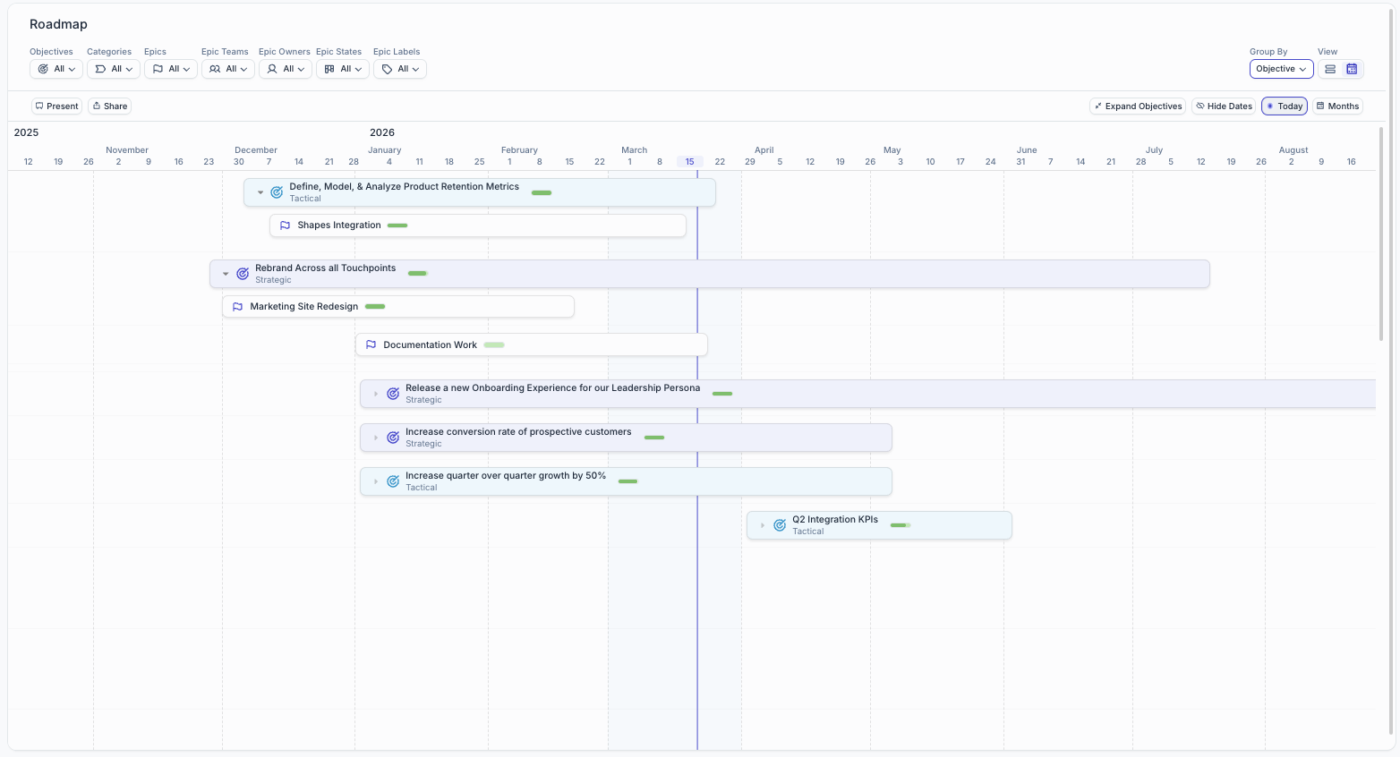
Shortcut sits between Linear’s single-model opinion and Jira’s deep configuration. You get three planning layers out of the box: Stories for individual work, Epics to group related stories, and Objectives to tie epics to a strategic goal. No need to build a custom hierarchy or configure fields before the first sprint starts.
Iterations handle time-boxed sprints. Create one, drag stories in, and the board scopes to that iteration. Docs live inside the same tool, so a PRD and the stories it spawned sit side by side. When you need context on why a decision was made, the reasoning is one click from the work it created.
The free plan is unusually complete for the category. Ten users get Kanban boards, Iterations, Roadmaps, Docs, and integrations with GitHub, Slack, and Figma at no cost. Paid tiers add velocity, cycle time, lead time, and cumulative flow reports.
Where it falls short: Sprint carryover is manual. When an Iteration closes, unfinished stories stay where they are until someone drags them into the next one. Reporting also stops at basic Epic and Iteration views unless you unlock the fuller analytics suite.
Skip it if: Your iteration pace is fast enough that dragging leftover stories every two weeks becomes a real time sink. At low volume it’s fine. At scale it’s a chore nobody owns.
This is what a G2 reviewer thinks about Shortcut:
What I like best about Shortcut is its clean, intuitive interface combined with strong agile-friendly features. It makes managing software projects simple and efficient, with Kanban boards, sprint planning that help teams stay aligned without unnecessary complexity. Integrations with tools like Slack and GitHub further streamline workflows.
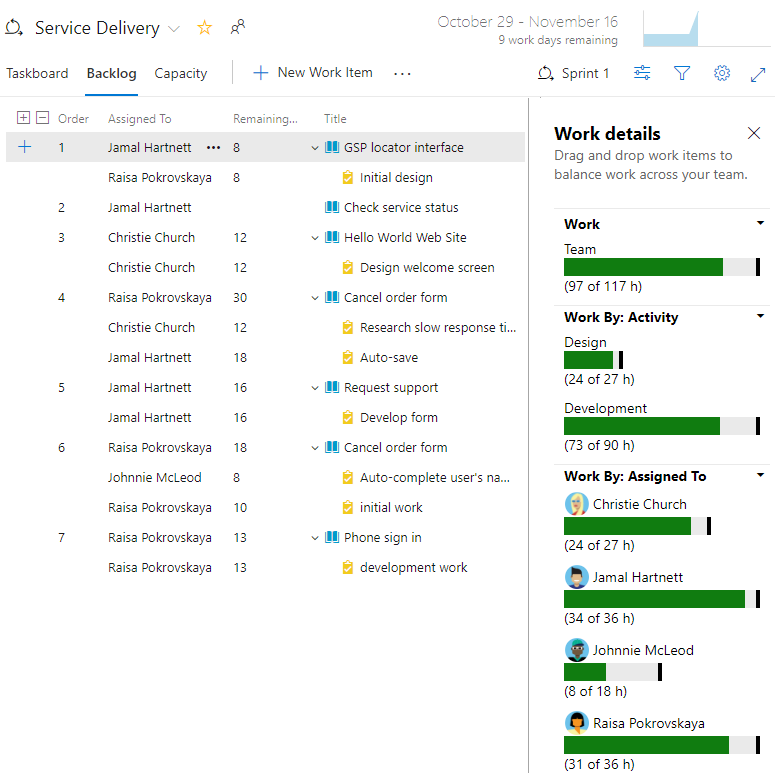
Azure DevOps bundles agile planning with source control, CI/CD pipelines, test plans, and package management in a single service. You trace a user story from the backlog through a branch, a pull request, a build, and a deployment in a single service.
Azure Boards supports Scrum, Kanban, and CMMI process templates. Pick one when you create a project, and the board comes pre-wired with matching work item types, states, and backlog levels. Sprint planning includes capacity tracking: set each person’s available hours and activity type. The board flags an overloaded sprint before it starts. Delivery Plans layer multiple team backlogs onto a single timeline, helping cross-team dependencies surface visually.
Pipelines run builds and deployments alongside the planning work. Push a commit linked to a work item and the board updates. GitHub Copilot Code Review plugs into pull requests for AI-assisted review. Artifacts handles NuGet, Maven, npm, and Python packages with 2 GiB of storage included.
Where it falls short: The Stakeholder access level excludes Kanban boards, backlogs, sprint planning, and portfolio management. Non-engineering colleagues who need to move cards or manage a backlog need full access. The platform also loses value quickly when your code lives outside the Microsoft and GitHub ecosystem.
Skip it if: Your agile team includes non-engineering planners who need to manage work directly. The access split between viewers and planners creates friction for cross-functional adoption.
Here’s what this G2 reviewer has to say for Azure DevOps:
Azure DevOps Server provides a comprehensive suite of tools for seamless collaboration, from version controling to CI/CD. I use it almost daily as my current project uses this tool to manage the project. I personally liked how robust it’s integration is, with Azure services. It also has a diverse repository options fostering efficient and agile development processes.
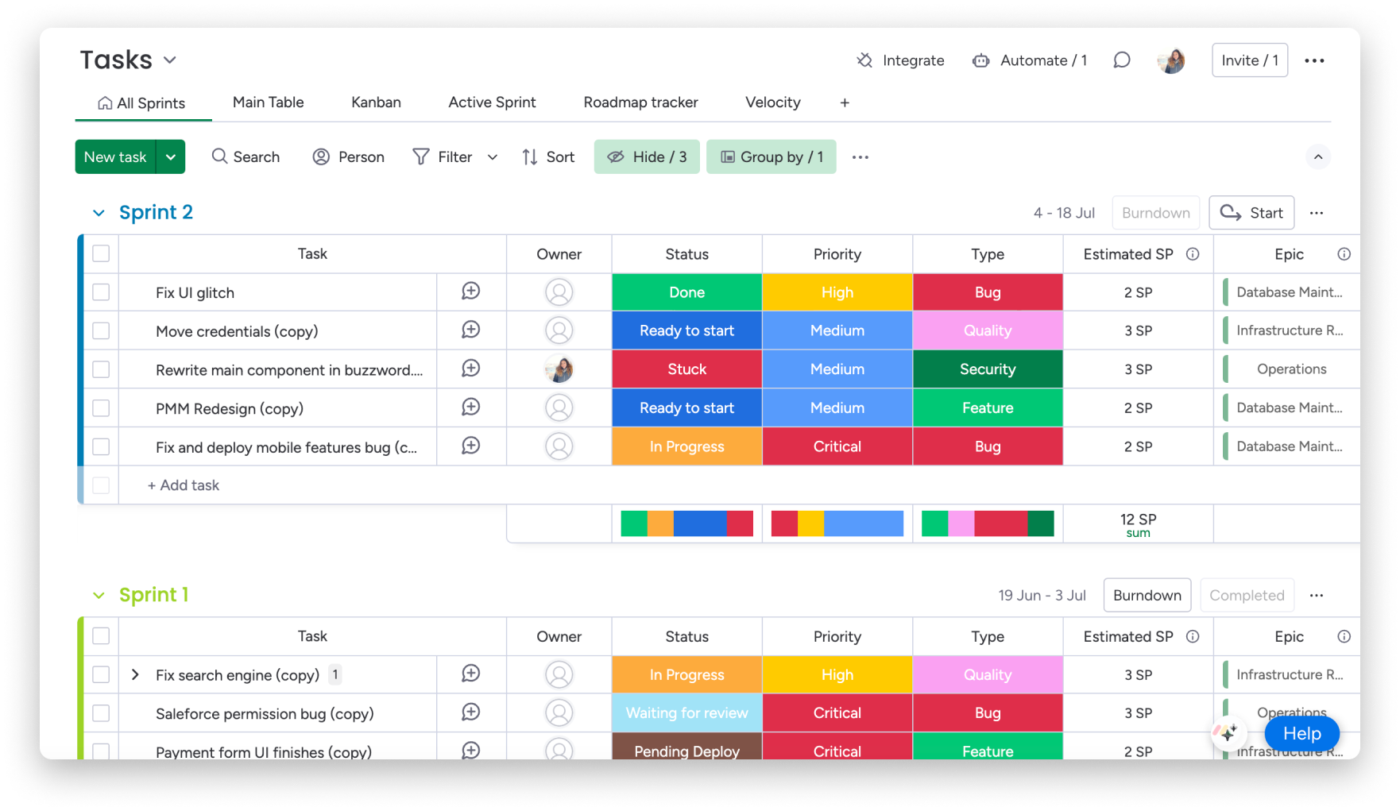
Explaining sprint progress eats more time than the sprint work itself. monday dev solves that translation problem. Sprint progress renders in color-coded boards, timeline views, and dashboards that a marketing lead or a founder can read cold.
Sprint management runs from a backlog through sprint boards with story points and burndown tracking. Pick a story, assign it, tag it to a sprint, and the board updates in real time. Roadmap planning connects those sprints to a longer timeline. The business side can see where a feature lands relative to a quarter. A two-way GitHub sync keeps code and board in lockstep: merge a PR and the story’s status moves on its own.
AI writes sprint summaries after each cycle closes. A standup report assembles itself from what actually shipped and what got stuck. Next, the daily standup view collects each person’s update in one place. Capacity planning shows who is overloaded before the sprint commits, and an engineering performance dashboard tracks cycle time and throughput across teams.
Where it falls short: Sprint management, GitHub integration, and roadmap planning are not available on the entry tier. The agile features that make monday dev distinct from monday work management require stepping up, and agile reporting with cross-team roadmaps sits a level above that.
Skip it if: You’re a small team trying to stay lean on cost. The agile features that justify picking monday dev over monday work management require the Standard or Pro tier, so you commit to a higher seat price before your first sprint starts.
A G2 reviewer on what keeps them on monday dev:
What I like best about monday dev is how it brings product, development, and project management activities into a single, collaborative workspace. Instead of tracking work across multiple tools, teams can manage roadmaps, sprint planning, bug tracking, feature requests, and task execution in one platform, which improves visibility and reduces communication gaps.
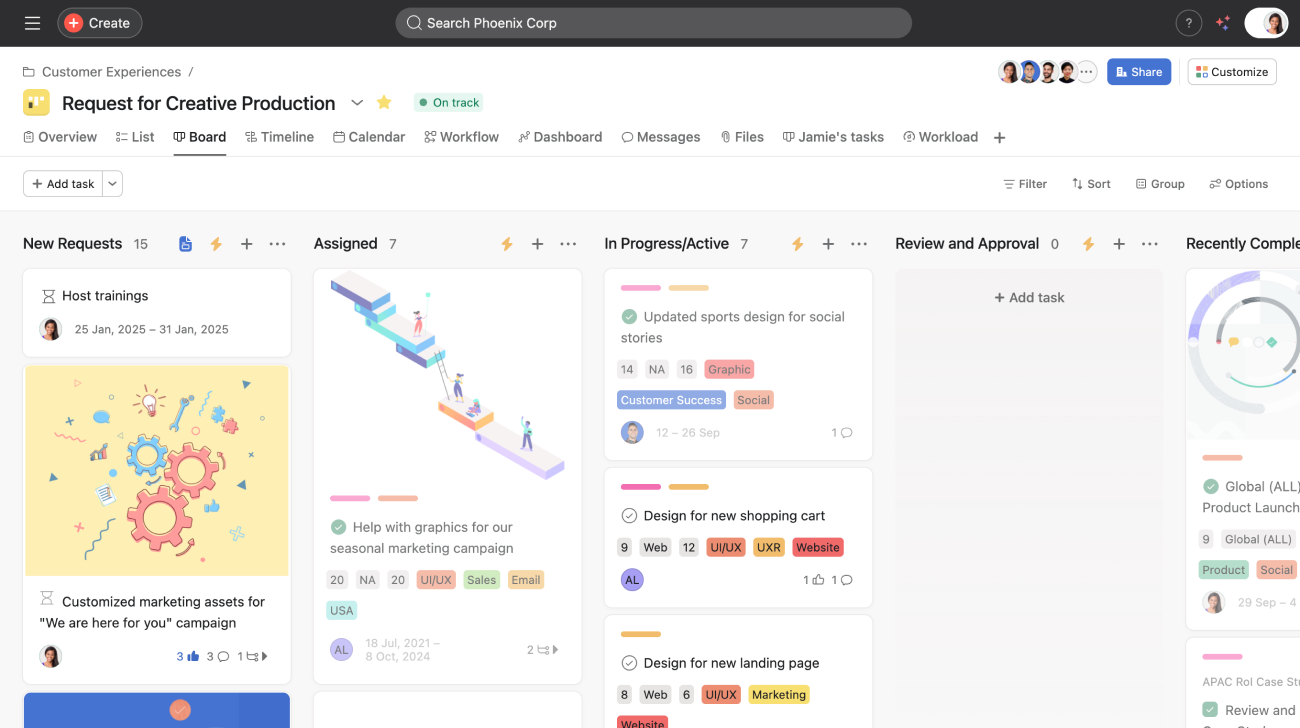
Agile marketing and operations teams can switch to Asana. It has no native sprint object. Teams model iterations using projects, sections, and custom fields. That approximation works well for a marketing sprint where the cadence matters more than story points and burndown charts.
Create a project, add sections for each sprint phase (To Do, In Progress, Done), and switch between Board, List, Timeline, and Calendar views on the same data. A marketing manager sees the Kanban board. Meanwhile, a VP sees the Timeline with milestones. Nobody duplicates anything. Forms automatically turn intake requests into backlog items. This means a stakeholder-submitted marketing brief lands as a task in the right section.
Rules handle the repetitive work. A status change triggers an assignee swap, a tag update, or a Slack notification. String a few rules together and sprint admin runs itself. Two-way Jira Cloud sync connects marketing iterations in Asana with engineering delivery in Jira—dependencies between the two teams surface automatically in both tools. Asana AI generates smart status summaries and flags projects at risk of slipping before someone has to ask.
Where it falls short: There are no native story points or velocity charts. Estimation lives in custom number fields you build and maintain yourself, and burndown reporting requires a third-party integration or a manual dashboard build. The gap shows up when a team wants points-based sprint reporting.
Skip it if: You are an engineering team running Scrum. Modeling sprints, points, and velocity from generic fields takes more effort than using a tool that has them natively.
This G2 reviewer describes Asana as an agile tool:
It’s a very agile system for workflow and task management. It sets clear timelines, reminders, dependencies, and updates as the workstreams evolve. It gives a clear overview of the project and level of completeness. Its reminders are a plus when dealing with multiple competing tasks and expectations. It also has a great notification feature that keeps teams updated throughout the process.
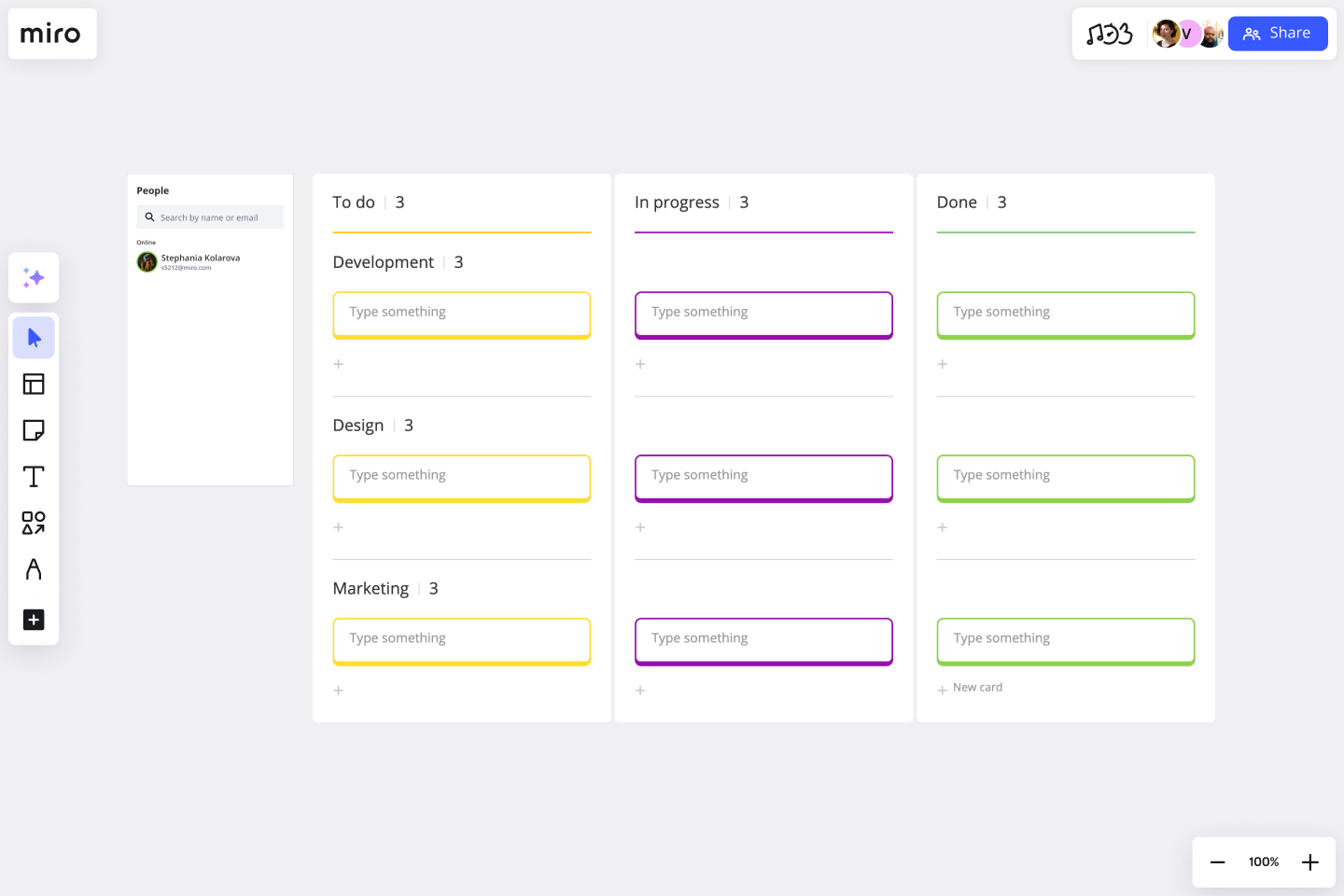
Open a Miro board, pick a story-map template from the library of thousands, and invite the team. Everyone drops sticky notes at the same time. Dot voting ranks the ideas without a round-robin discussion. A timer keeps the session from running over.
Private mode hides responses until the facilitator reveals them. Which means the loudest person in the room doesn’t anchor every answer. You run a full planning ceremony, from brainstorm to ranked priorities, all on the same canvas.
Its canvas handles the structured work. Docs, Tables, Timeline, and Kanban formats sit alongside drawings. A story map can live next to a data table of acceptance criteria. Two-way sync with Jira, Asana, Linear, ClickUp, and Azure DevOps turns sticky notes into tracked issues in your backlog tool. AI workflows generate diagrams, summaries, and prototypes from canvas content, and an MCP server connects Miro to AI coding tools like Cursor and GitHub Copilot.
Where it falls short: Two-way tracker sync is not available on every tier. Without it, sticky notes stay on the canvas. You have to manually recreate every decision made during planning in the tracker, which is exactly the ceremony gap this guide describes.
Skip it if: You need a tracker. Miro complements one; it doesn’t replace it. A team that uses Miro alone will have well-run ceremonies with no backlog underneath them.
Hear about Miro from an Agile Coach:
As an Agile Coach, what I like most about Miro is the flexibility. I can create different experiences for each workshop, from retrospectives to strategic planning, using voting, timer, templates, and automations to facilitate collaboration and decision-making.
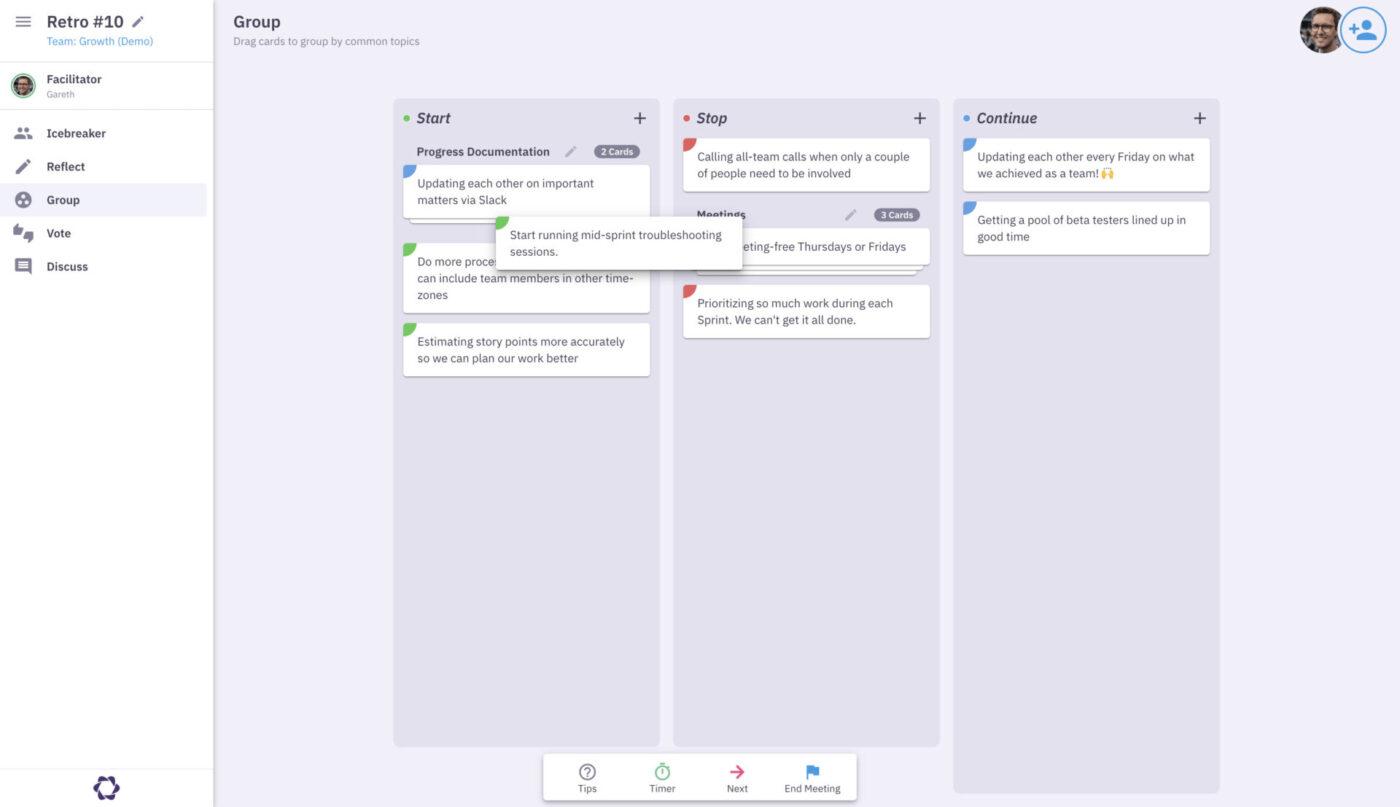
Retros go quiet when people edit themselves in front of the room. Parabol fixes that by making anonymity the default. Start a retro, and every team member submits reflections privately. The facilitator groups similar feedback into themes, or lets AI cluster it automatically, then reveals the cards for discussion. Problems people would not say out loud surface because nobody knows who wrote what.
The same facilitated, time-boxed structure runs across multiple meeting templates: Start/Stop/Continue, Sailboat, standup check-ins, and sprint poker. In a poker session, each team member picks a card from the estimation scale, and all cards flip at the same time. No anchoring, no deference to the loudest voice. Estimates and action items sync back to Jira, GitHub, Slack, and Mattermost, so decisions land in the tracker without a copy-paste step.
AI discussion prompts suggest better questions when a facilitator runs dry. AI grouping clusters retro cards by theme before the team starts discussing. The codebase is fully open source, and the product carries SOC 2 Type II certification. Security-conscious teams can inspect the code themselves and point to an independent audit.
Where it falls short: Parabol has no backlog. It runs ceremonies and sends the output elsewhere. That means it always sits alongside a tracker, never replaces one. Teams that want every part of agile in a single tool will find Parabol adds a login rather than consolidating.
Skip it if: Your tracker already runs decent retro boards and you don’t want another tool in the stack.
A G2 reviewer shared their thoughts about Parabol:
Parabol has been one of the best retrospectives tool I’ve ever used. Especially as a product with a free tier option, the benefits are unmatched!
The format of Parabol makes it the ideal tool for teams that are spread across multiple time zones.
It has been a great way to get all team members engaged in our Scrum ceremonies such as Backlog Refinement, Stand-up, Retrospectives, and more.
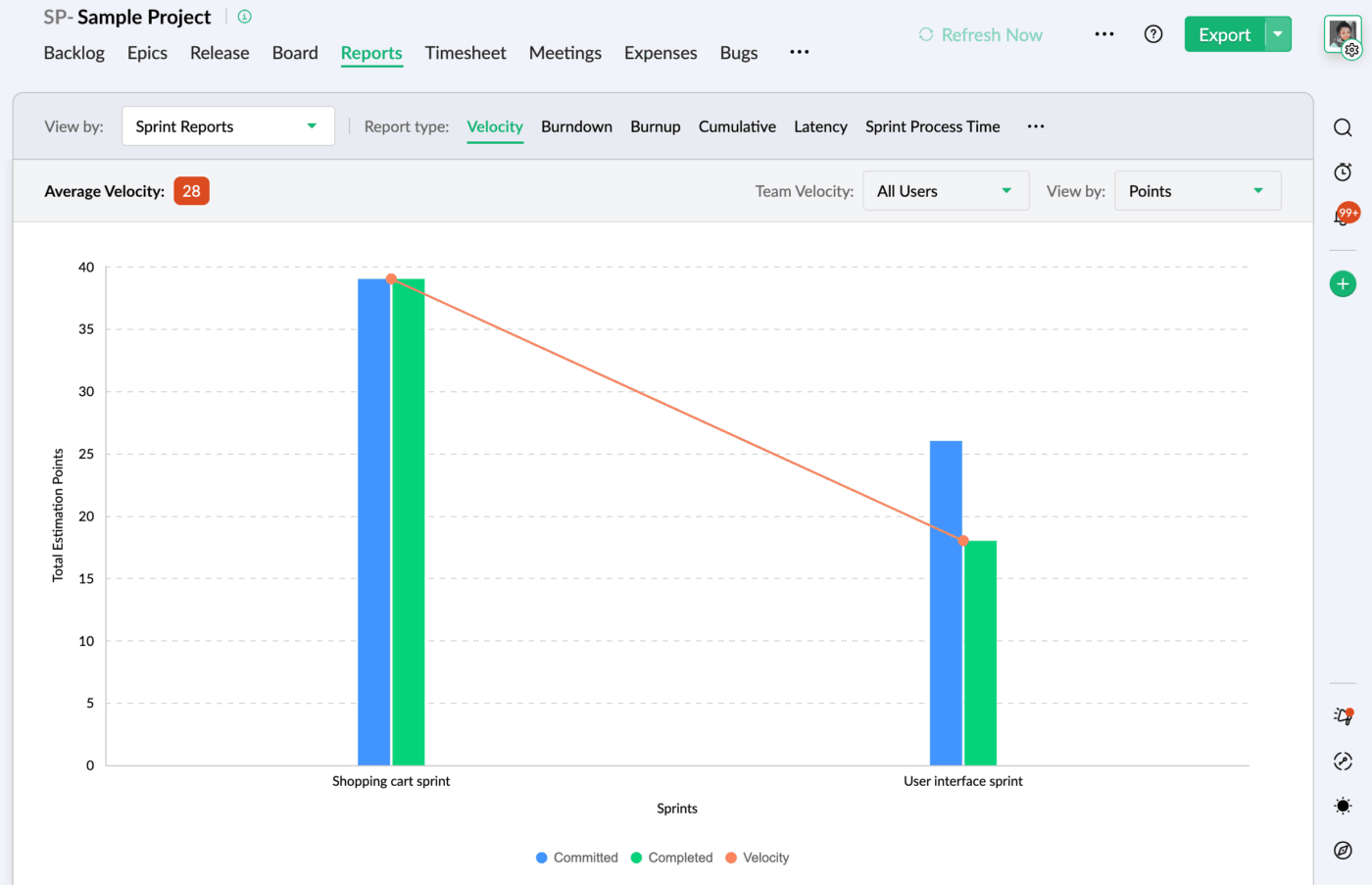
Zoho Sprints is a dedicated agile Scrum tool with native sprint mechanics. Create a project, set up a sprint, and drag items from the backlog into it. The board tracks each item through your workflow states. When the sprint closes, velocity shows how much the team finished relative to previous cycles, and the burndown shows where work stalled midweek.
Retro meetings are built in. Start one directly from a closed sprint, capture what went well, what didn’t, and what to change, and the notes stay attached to that sprint’s record. Estimation runs through a collaborative Planner where team members assign points at the same time. This way, hidden complexity gets caught before the sprint commits.
Data import from Jira, Azure DevOps, and Trello gives migration a path. Alongside Zoho’s own Zia assistant, the platform connects external AI models including OpenAI, Anthropic, and Google. You pick the provider your team already trusts for summarization, drafting, and analysis.
Where it falls short: Only one sprint can run at a time on the entry level. Overlapping iterations or multi-team coordination require moving up. Native integrations outside the Zoho ecosystem are limited. Which means teams that run on GitHub, Slack, or Figma AI will find fewer connectors.
Skip it if: Your tools sit outside Zoho and you rely on deep integrations with the broader dev and design ecosystem. The connector library prioritizes Zoho-native teams.
This G2 reviewer reviewed Zoho Sprints:
The clean and intuitive UI/UX makes it easy to manage agile workflows. I also appreciate how well agile principles are implemented in the platform. The customization options are quite flexible, and the global view provides a helpful overview of multiple projects. The pricing is also competitive.
Only four of the ten write retro actions back natively: ClickUp, Zoho Sprints, Parabol, and Miro on its Business plan. Everything else routes through extensions or copy-paste. The table below shows which tools write ceremony decisions back to a backlog and which make you copy them by hand.
| Tool | Retro actions become work items? | Planning decisions write back? | Estimation feeds velocity? |
|---|---|---|---|
| Jira | Via Confluence or third-party retrospective tool | Native (backlog to sprint) | Native story points and velocity charts |
| Linear | Via third-party retro tool | Native (Cycles with auto-rollover) | Native through Insights (Business plan) |
| Shortcut | Via third-party retro tool | Native (Iterations) | Velocity and cycle-time reports (Team plan) |
| Azure DevOps | Via Retrospectives extension | Native (sprint planning in Boards) | Native capacity and velocity tracking |
| ClickUp | Whiteboard sticky to task in one click | Whiteboard to sprint backlog, native | Sprint Points and burndown (Business plan) |
| monday dev | Via third-party retro tool | Native (sprint boards) | Sprint velocity via dashboards |
| Asana | Via third-party retro tool | Modeled with sections and custom fields | No native story points or velocity |
| Zoho Sprints | Native retro meetings | Native (sprint planning) | Native velocity, burndown, burnup |
| Miro | Two-way sync to tracker (Business plan) | Two-way sync to tracker (Business plan) | No native estimation reporting |
| Parabol | Syncs action items to Jira/GitHub | Syncs poker estimates to Jira/GitHub | No native velocity (relies on tracker) |
Agile tooling usually fails at the seam between the ceremony and the backlog, not inside either one. Teams buy one tracker, then run planning on a whiteboard, estimation in a poker app, and retros in a doc. None of those write back. Within a few sprints, the tracker holds a version of the work that nobody has corrected.
Easy Agile’s State of Team Alignment report breaks down the carryover stat from the top of this article, and the detail is worse than the headline. Over a third of teams roll 26 to 50% of their planned work into the next cycle, sprint after sprint. And of the retro actions teams commit to, most never ship: the ceremony works; the follow-through doesn’t.
You can see the gap priced into the plans. Miro’s two-way sync with trackers is a Business plan feature. Below that, the board where your team actually planned the sprint is a picture. Shortcut’s rule that moves unfinished stories into the next Iteration is a paid automation. The ceremony layer is cheap to start and expensive to connect.
This is also why velocity charts are less trusted than they should be. A burndown is only as honest as the last time someone reconciled it with what the team agreed in a room, and the Easy Agile data above suggests most teams stopped reconciling weeks ago.
The practical fix is to pick your seam deliberately. Either buy the plan that syncs the ceremony back to the backlog, or run the ceremony inside the tracker you already own and accept a less elegant canvas—both work. Paying for a canvas that stays disconnected from the tracker adds cost without closing the gap.
83% of agile practitioners already use AI tools, but 55% spend 10% or less of their work time with them. Adoption outpaced integration. Teams installed the tools and then struggled to find where they fit inside a planning session, a refinement, or a retro.
The benefits that practitioners report cluster tightly: increased productivity (73.7%), reduced cognitive load (71.6%), and greater focus (71.6%). The strongest use cases stay bounded and low-risk: preparing retro templates, simplifying requirements for different audiences, clustering qualitative feedback, and generating first drafts of user stories. No respondent reported AI making a strategic product decision.
That pattern points to where AI actually earns its place: saving 30 minutes of sprint documentation so the team can spend that time on the conversations that shape the sprint. Every tool in this guide ships some form of AI. The ones that embed it into the ceremony workflow (Parabol’s AI grouping, Linear’s Triage Intelligence, ClickUp Brain’s story generation, Miro’s AI workflows) deliver more value than a sidebar assistant with no sprint context.
Choose based on where your process currently leaks, not on which tool has the longest feature list. Five common situations cover most teams.
Whatever you pick, run one real sprint in it before committing. Import an actual backlog, not a sample project. The friction shows up in the second sprint, not the demo.
Each tool above solves a different piece of the sprint puzzle. Jira and Azure DevOps win on depth; Linear and Shortcut on low setup cost; monday dev and Asana on business legibility; Miro and Parabol on the ceremony layer; and Zoho Sprints on budget. None of them fixes an unclear backlog or an ownerless process.
The one question worth answering before you buy: where does your sprint data stop being true?
Fix that seam, and the tool choice mostly follows. If you answer that ceremonies and backlog have drifted apart, keeping them on the same data is the shortest route back. You can try ClickUp for free and run a sprint end to end before deciding. Teams already using agile Scrum practices can map their existing ceremonies across in an afternoon.
Most agile tools run $6 to $20 per user per month on their entry paid tier, with capable free plans available. Jira Standard is $7.91/user/mo, ClickUp Unlimited is $7/user/mo, Azure DevOps Basic is $6/user/mo after five free seats, and Miro Business (needed for two-way tracker sync) is $20/member/mo. Watch for features gated above the entry tier, especially story-point velocity and ceremony-to-backlog sync.
Zoho Sprints is the strongest genuinely free agile tool for small teams. Its free tier includes velocity, burndown, burnup, and cumulative-flow reports for three users, while most rivals put them behind a paywall. ClickUp’s Free Forever plan adds unlimited tasks and members; Jira is free for 10 users; and Parabol runs retros and sprint poker free for two teams and 10 meetings a month. Pick Zoho for reporting, ClickUp for breadth, and Parabol for ceremonies.
Agile retrospective tools are apps that run structured retro meetings: collecting feedback, grouping themes, and turning takeaways into action items. Parabol is the dedicated pick, with anonymous retros, grouping, and summaries free for up to 10 meetings a month. Miro handles retros on an open canvas with voting and a timer, while ClickUp keeps retro notes on the same data as the backlog so actions become tasks.
Agile tools support any iterative framework, including Scrum, Kanban, and hybrids, while Scrum tools model that framework’s specific mechanics: fixed-length sprints, story points, velocity, and burndown. Jira, Zoho Sprints, and Azure DevOps are Scrum tools in this sense; Trello and Miro are agile tools without native sprint objects.
Linear, ClickUp, and Azure DevOps are the closest Jira alternatives for agile teams. Linear suits product-engineering teams that want speed over configuration, ClickUp fits cross-functional teams that need ceremonies and backlog on one data set, and Azure DevOps is the natural pick for teams already on the Microsoft and GitHub stack. Zoho Sprints is the budget option with native Scrum reporting. Choose by where your process leaks, not feature count.

Arya P Dinesh
Max 21min read
Arya P Dinesh
Max 15min read

Manasi Nair
Max 15min read

© 2026 ClickUp




