






Still downloading templates?
There’s an easier way. Try a free AI Agent in ClickUp that actually does the work for you—set up in minutes, save hours every week.
Sorry, there were no results found for “”
Sorry, there were no results found for “”
Sorry, there were no results found for “”

Juggling files, video calls, and team chats across time zones?
Remote work only works when your tools do.
That’s why platforms like TeamViewer have become go-to solutions — but are they still the best option out there?
In this blog, we’ll compare the key features, limitations, pricing, and reviews of 10 competitive remote desktop tools to help you find the best alternative to TeamViewer.
No matter your team size or budget, we’re here to help you find the right solution so your team can communicate between multiple monitors and stay on track.
TeamViewer is a remote access software that enables people to use remote devices to connect to another server or device. This allows teams to quickly and easily access files, apps, and data from any device—without the need for a VPN.
Along with remote access to files, TeamViewer is used for remote support for IT teams. Support teams use TeamViewer to remotely take control of devices to troubleshoot, solve problems, and roll out apps and program updates.
Together, these features make TeamViewer an attractive option for remote-first companies with team members distributed across the country or the world. The software makes connectivity, teamwork, and keeping remote teams engaged easier. ✨
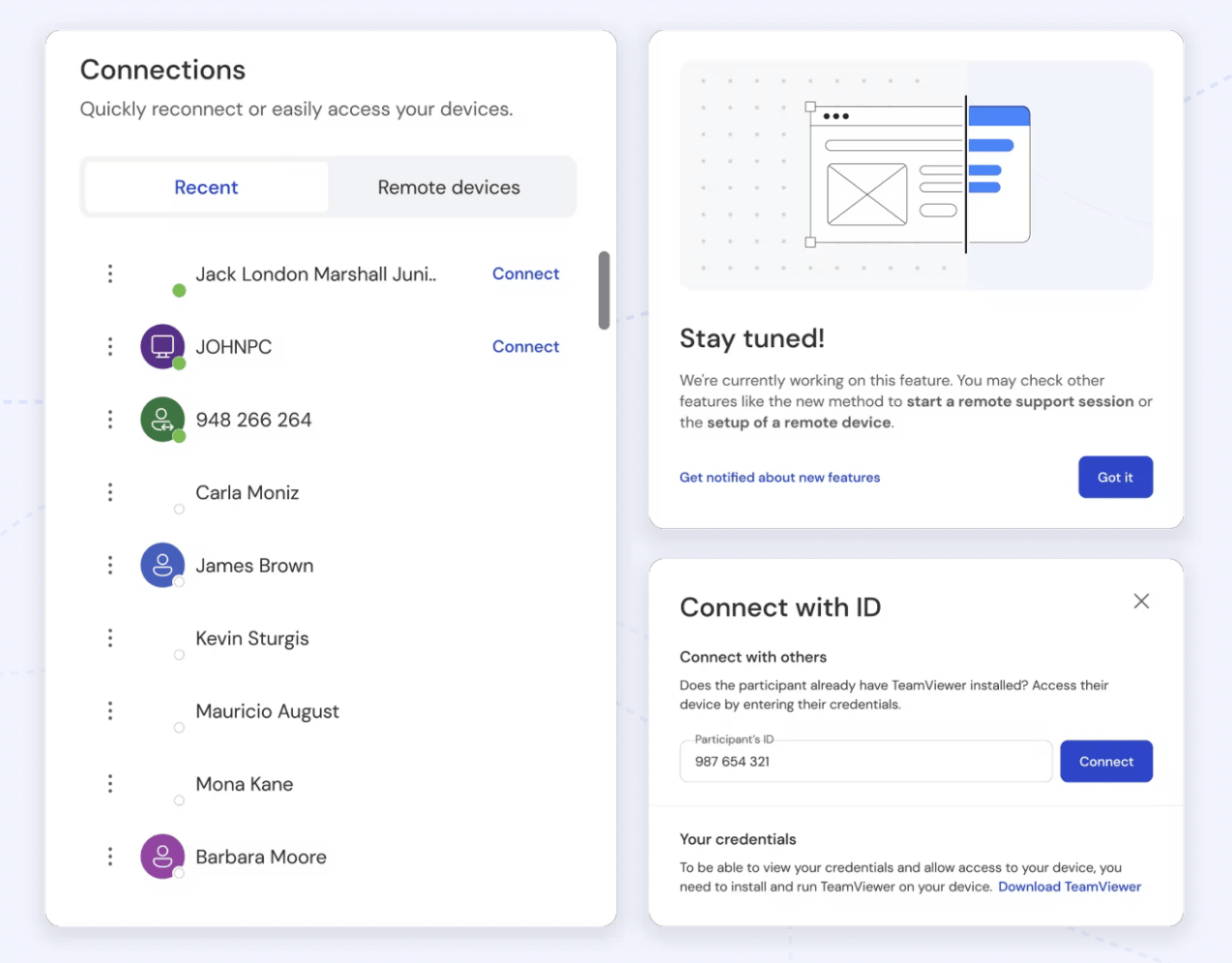
While it is a widely recognized remote access tool—both for personal use and enterprise users— you may still be seeking a free alternative to TeamViewer that better suits their specific needs. Several factors drive the demand for top TeamViewer alternatives, ranging from security concerns to usability and cost.
One major consideration is password protection and secure connections. Users increasingly demand strong security protocols, including encrypted connections and two-factor authentication, to ensure that remote connections are safe and private. For organizations that require session recording or need to ensure secure connections for compliance reasons, TeamViewer may not offer the most efficient or cost-effective solution.
Some users find TeamViewer’s interface complex or its setup overwhelming. A user-friendly interface and easy configuration are essential for those looking for a cloud-based solution or a tool with cross-platform compatibility, including Windows computers, Android and iOS devices, and Chrome OS devices. A better alternative may also support cross-platform desktop sharing and unattended support, making it more practical for varied workflows.
For businesses or individuals managing local printers, accessing file access, or operating within a local network, TeamViewer alternatives may provide more seamless integration. Others are looking for advanced features such as whiteboard functionality, remote meetings, video calls, or even tools like ConnectWise Control or Dameware Remote, which offer key features targeted at specific use cases.
Finally, many users are simply in search of a free version or a free TeamViewer alternative that allows for unlimited devices without sacrificing performance. This is especially true for budget-conscious users who are frustrated by poor customer service or limited capabilities in the free version of TeamViewer.
➡️ Read More: Best Screen Share Software for Remote Meetings
Here’s a comparison table for the 10 best TeamViewer alternatives.
| Tool name | Key features | Best for | Pricing |
| ClickUp | Work management, Custom fields, Automations, Docs & chat, Asset tracking, Time tracking | Teams needing project/IT asset management, not direct remote control | Free; Paid plans from $7/user/month |
| AnyDesk | Remote desktop, File transfer, Privacy mode, Branding, Cross-platform, Encryption | Small businesses, freelancers, IT support | Free; Paid plans from $22.90/month (Solo) |
| Remmina | Multi-protocol (RDP, VNC, SSH), Open source, Linux native, Hotkeys | Linux admins, developers, open-source users | Free |
| Chrome Remote Desktop | Browser-based, Cross-platform, Easy setup, File transfer, Screen sharing | Individuals, families, small teams | Free |
| NoMachine | High-performance, File transfer, Printing, VPN, Multi-OS, Graphics/audio streaming | Power users, IT admins, graphics-intensive work | Free (personal); Paid plans for enterprise |
| Zoho Assist | Remote support, Unattended access, Mobile support, White-labeling, Security | IT help desks, MSPs, support teams | Paid plans from $12/user/month |
| RemotePC | Unattended/on-demand access, Session recording, Multi-platform, Web access | Home offices, businesses, hybrid teams | Paid plans from $22.12/year (Consumer) |
| LogMeIn Pro | Remote desktop, File transfer, Multi-monitor, Security, Bundled antivirus | Professionals, small businesses | Paid plans from $30/month |
| GoToMyPC | Web-based access, File transfer, Remote printing, Security, Multi-device | Individuals, freelancers, small businesses | Paid plans from $28/month/computer |
| Splashtop | Remote access, File transfer, Multi-monitor, USB redirection, Session recording | IT, education, creative pros, MSPs | Paid plans from $5/month (Solo) |
Our editorial team follows a transparent, research-backed, and vendor-neutral process, so you can trust that our recommendations are based on real product value.
Here’s a detailed rundown of how we review software at ClickUp.
While you can use TeamViewer to deliver remote support, we will focus on alternatives that better suport the teamwork and remote access aspects. With this in mind, here are the best alternatives to TeamViewer to help you work more effectively from any location.
OK, we know ClickUp may not be the first tool you consider when looking for a TeamViewer alternative. But while this remote collaboration tool doesn’t enable remote desktop access, it does facilitate productivity and teamwork in other exciting (and incredibly efficient) ways.
It’s not a remote desktop tool in the traditional sense, so you won’t be using it to directly control someone’s computer screen or jump in to fix their software in real-time. Think of it more as a super-powered command center for all your work, including things that relate to remote devices.
ClickUp for Remote Work lets you totally organize and manage all the tasks and information around your IT assets and remote setup.
You can actually set up a section, maybe a “Space” or “Folder,” just for your IT assets. Imagine having a task for “Sarah’s Laptop” or “Production Server 01.” Then, you can add all sorts of details to these tasks using Custom Fields. Things like serial numbers, software licenses, last update dates, or even a handy note with the AnyDesk ID for that machine.

You can also use ClickUp’s Custom Statuses to keep tabs on the status of your devices, like marking them “Online,” “Offline,” or “Needs Update.” And if something needs doing, you can literally create an automation to, say, automatically assign an “Install Latest OS Patch” task to your IT tech whenever a device’s status changes. Pretty neat for keeping things humming along!
While ClickUp won’t give you live diagnostic data or let you remotely power on a machine (that’s still a job for your dedicated remote access software), it’s fantastic for managing the process. You can use Tasks in ClickUp track support requests, schedule maintenance, keep an inventory of all your remote gear, and even build custom ClickUp Dashboards to see the overall health of your IT assets at a glance.
Team size: All kinds of teams as well as individual users
Who is ClickUp a good fit for?
What I love most about ClickUp is how it’s genuinely transformed the way we work as a team. Before we started using automations, we were stuck doing a lot of repetitive admin, things like manually applying templates to each subtask or constantly checking and updating task statuses. It was frustrating, time-consuming, and honestly, it pulled our focus away from the work that actually matters.
When I set up our first ClickUp automation, it was like a lightbulb moment. Now, with something as simple as adding a tag, the entire subtask template applies automatically. We no longer waste time digging through subtasks or worrying that someone forgot a crucial step.
Learning how to use the templates and getting everything initially set up was a challenge.
Yes. It is fantastic for keeping a detailed inventory of your devices, effortlessly logging issues as they pop up, easily pulling up all the associated details, and even capturing the time spent on remote support or maintenance. If you’re looking to boost accountability, streamline your IT workflows, and gain clear oversight into your distributed assets, ClickUp is a powerful companion.
AnyDesk is a remote desktop software app that allows teams to stay connected to programs and transfer files, no matter where they are. With this remote collaboration tool, you can access any team member’s remote device via password, enable security features like privacy mode, and manage mobile devices at scale.
Team size: Individuals, freelancers, small to medium-sized teams, and large enterprises
Who is AnyDesk a good fit for?
The best part about AnyDesk is its ease of installation/ implementation and ease of use. It takes so little space and UI is certainly beginner friendly. Additionally, It supports cross platform communication between different Os. It also provides level of securities while accessing other systems remotely. Definitely one of the best platforms for remote access.
Sometimes the connection drops for no clear reason, and it can be a bit frustrating. Also, the interface feels a little dated, but it gets the job done.
AnyDesk is ideal for users and organizations prioritizing high-speed, secure, and cross-platform remote access, especially those in IT support or remote work environments. Its performance on lower bandwidths and straightforward interface make it a strong contender.
Remmina is a free, open-source remote access software for screen sharing and file sharing. It connects to your desktop from another device. This streamlined software tool for Linux desktop users is built with developers and IT professionals in mind.
Who is Remmina a good fit for?
Remmina app is good. it comes bundled with Ubuntu and other distros as well and is very simple to configure. You can even use RDP files to access the remote machine.
As part of my job requirements/perks, I have an IPSec tunnel between my work PC and home PC. I use Remmina/xrdp to connect between the two computers (work to home and home to work), and that has been great as well. Yesterday Remmina updated, and then neither PC would connect. Connections via Windows 10 from/to Linux work perfectly, but Linux to Linux was a no go.
Remmina is an excellent choice for Linux users, system administrators, and developers who need a versatile, free, and robust remote desktop client capable of connecting to diverse remote systems using various protocols. It is a powerful tool for specific niches, but it is not suitable for organizations seeking commercial-grade features like centralized deployment, managed user access, or dedicated 24/7 technical support.
📮ClickUp Insight: The average professional spends 30+ minutes a day searching for work-related information—that’s over 120 hours a year lost to digging through emails, Slack threads, and scattered files.
An intelligent AI assistant embedded in your workspace can change that. Enter ClickUp Brain. It delivers instant insights and answers by surfacing the right documents, conversations, and task details in seconds—so you can stop searching and start working.
💫 Real Results: Teams like QubicaAMF reclaimed 5+ hours weekly using ClickUp—that’s over 250 hours annually per person—by eliminating outdated knowledge management processes. Imagine what your team could create with an extra week of productivity every quarter!
Chrome Remote Desktop is a great alternative for fast remote desktop access and screen sharing between multiple monitors. Use the tool to connect with others as a project management software tool, to give remote control support, or to access your remote computer while you’re working away.
Team size: Individuals, families, and very small teams, particularly for ad-hoc support
Who is Chrome Remote Desktop a good fit for?
Chrome Remote Desktop is SUPER easy to set up, for you and for your end users, especially if Chrome is already widely integrated within your organization. It’s got a good range of features for general remote access, and is easy to set up for single-time use, or for continued access to a remote machine.
It is an easy browser to handle, but still with basic functions, the support for IT has grown considerably, but nevertheless leaves to be desired in the issue of line management that is still considered simple-minded.
Chrome Remote Desktop shines with its simplicity and accessibility within the Chrome ecosystem. However, it is not an ideal option for businesses or IT departments requiring advanced features like centralized user management, robust reporting, advanced security controls, or dedicated enterprise-level support.
🧠 Did You Know? Chrome Remote Desktop was first released in 2011 as a browser extension, enabling access to any computer via Chrome—even Chromebooks!
NoMachine is a remote desktop tool that helps people connect to their desktop from any location. The software makes it easy to work while away on business travel or working from a coworking space. Access files and programs and edit or print them wherever you are.
Team size: NoMachine offers solutions scaling from free personal use to enterprise-grade server and cloud products managing several users and machines
Who is NoMachine a good fit for?
This tool solves most of our problems related to remote system access or accessing any device connected on our server. It has user-friendly interface which helps us to configure and establish connection very smoothly. Moreover it’s 128 bit encryption provided required security while remote accessing our system.
I don’t like the limited customer support; you can hardly get any responses through emails or phone calls, and the first time configuration can be confusing at the beginning.
NoMachine is an excellent choice for users needing direct access to their physical or virtual desktops with a near-local experience. While its free personal version is robust, commercial deployments require careful evaluation of its diverse product lines and a more involved setup compared to simpler, out-of-the-box solutions.
Zoho Assist is a remote IT support software tool that enables your team members to take control of remote devices to troubleshoot problems, roll out fixes, and support others. This is primarily for IT teams that offer support to others, but the software also allows you to access your own device remotely. ⚒️
Team size: Organizations managing numerous remote devices and support sessions effectively
Who is Zoho Assist a good fit for?
Zoho provides centralized control over multitude of devices across different departments. And with ease of invite/customer connection, it allows for a quick support sessions on demand. The deployment can be an breeze, with options to deploy through the domain, policy, or pre-shared link distribution. As unattended access allows for a remote access to any of the remote devices at any time. We use it daily, to support the customers with their tech issues, or to allow the employees to connect to their workstations when working from home.
End user interaction. It is too difficult to achieve a connection with the limited knowledge of the client. IE: too many clicks needed to connect. Connection sometimes doesn’t go through due to video issues. Cost is getting prohibitive. Other solutions (Anydesk) are more economical and officeing the same tools with an easier connection process.
Its native strength within the Zoho suite makes it an exceptionally compelling choice for organizations already utilizing or planning to adopt other Zoho products.
➡️ Read More: How to Build a Strong Remote Company Culture That Lasts
RemotePC is a remote desktop access tool designed for consumers and professional teams that want to access their main device or desktop 24/7 from any location. This TeamViewer alternative allows you to remotely access files, print, and collaborate with multiple users.
Team size: Home offices and large teams alike
Who is RemotePC a good fit for?
RemotePC impressed me from the start with its effortless setup and intuitive interface, installing the software and configuring my machines took only minutes. The UI is good; every feature is properly labeled, so I never have to hunt around to figure out how to do something.
I rely on it near-daily to connect to my work PC from home and to access my home PC from a central location, keeping my files and environments neatly separated. Performance has been consistently solid. When I encountered an account issue that needed escalation, the customer support team was prompt, knowledgeable, and patient, guiding me through the resolution without any hassle.
Adding additional user accounts worked, but was confusing to start with. Also, we’ve had some problems with the key password, but it is important for security.
RemotePC’s competitive pricing, comprehensive features, and emphasis on security make it an excellent alternative for organizations seeking a reliable and feature-rich remote desktop solution.
🌻 Fun Fact: In 2022, 50% of workers used remote desktop at least weekly; 91% of organizations showed interest in 2022.
LogMeIn Pro is an alternative to TeamViewer that offers individuals and teams a way to stay connected to their files and each other from any device. Use the software to access files, applications, and bookmarks across a range of different devices and operating systems.
Team size: While LogMeIn Pro offers features that are useful for IT teams, its core Pro offering is optimized for personal and small team remote access
Who is LogMeIn Pro a good fit for?
It helps me keep my 3 locations organized and secure, i appreciate the one space and privacy for my staff when needed as opposed to using thier own phone numbers
The cost is definitely a drawback. Mac to PC can sometimes be a bit frustrating too.
LogMeIn Pro suits those who prioritize unattended access, integrated security (antivirus, password manager), and are willing to invest in a well-established, dependable tool. However, its higher cost might be a significant consideration for budget-conscious users or very large enterprises.
GoToMyPC is a remote desktop software that enables users to connect to files, applications, and data while they’re on the move. Features like remote printing and drag-and-drop file transfer help teams stay productive even if they can’t reach their main work device.
Team size: Individuals, freelancers, and small businesses looking to manager a smaller number of systems
Who is GoToMyPC a good fit for?
GoToMyPC provides easy remote access from anywhere. I use it regularly from home and court and am able to quickly and easily get information from our system. It allows me to leave files back in the office and just bring essentials to court when necessary. I use it to work remotely from home as well.
On rare occassions the program will lock up at the host site and even though it is an option we have never succesfully been able to reboot the computer remotely to reload GOTOMYPC. That is a minor issue so barely worth mentioning since it happens so infrequently .
GoToMyPC’s intuitive web-based interface and robust performance make it a good choice for users who want to connect to their computers without technical fuss. While its cost is at the higher end of the spectrum, the consistent performance, bundled features like antivirus, and ease of use justify the investment for those seeking a premium, hassle-free remote access experience.
➡️ Read More: Best Remote Work Tools for Team Collaboration
Splashtop is a remote access and remote support software tool that keeps team members connected to their files and each other. This TeamViewer alternative enables users to access their devices from anywhere, alongside features like remote printing, file transfer, and session recording.
Team size: Flexible across the spectrum, supporting individual professionals, educational institutions, small and medium businesses, and large enterprises with distinct product tiers for each
Who is Splashtop a good fit for?
As an IT technician supporting multiple client environments, Splashtop has become an essential part of my toolkit. Whether I’m providing helpdesk support, accessing servers, or troubleshooting desktops, it delivers reliable, high-speed remote access every time.
Clunky to install, maintain, Interface needs an update. Different product line makes it unnecessarily confusing. SOS , Business, etc.
Splashtop’s distinct strength lies in delivering a near-local desktop experience, even for demanding applications, making it an outstanding alternative for those prioritizing graphical fidelity and smooth remote interaction.
Choosing the right remote access tool depends heavily on your specific requirements.
We’ve examined10 distinct alternatives to TeamViewer, each offering particular strengths and ideal use cases. The optimal choice will align with your individual or organizational needs, budget, and the nature of your remote work or support tasks.
Here’s a concise overview of each tool’s primary focus:
Ultimately, selecting the right alternative involves evaluating your priorities, such as cost-efficiency, required features, security standards, ease of deployment, or integration with existing systems. Each listed option presents a viable choice in the remote access market.
TeamViewer remains one of the world’s most popular remote desktop services, but this shortlist of alternatives proves that there may be a better remote access solution for your individual needs.
However, if you’re ready to revolutionize your approach to remote work, try ClickUp for free. Our all-in-one app is designed to enable users to create a digital workspace where teams can work together in real time or asynchronously on documents, tasks, projects, and more.
Teams often switch due to rising costs, licensing restrictions, security concerns, or complexity. Others need better cross-platform support, simpler setup, or tools that fit specific use cases like IT support, Linux environments, or budget-limited teams.
Most modern alternatives, including AnyDesk, Chrome Remote Desktop, and Zoho Assist, support secure remote connections without requiring a VPN by using encrypted cloud-based connections.
Not directly. ClickUp doesn’t provide remote desktop control, but it complements remote access tools by managing IT assets, tracking support tasks, documenting issues, and coordinating remote work workflows in one place.
Yes, many alternatives offer strong security features such as end-to-end encryption, two-factor authentication, access controls, and session logging. Security levels vary, so enterprise teams should review compliance and audit capabilities carefully.
Start by defining your primary need: remote support, personal access, Linux compatibility, performance, or cost. Then compare tools based on security, scalability, ease of use, and whether they support your devices and workflows.

© 2026 ClickUp

There’s an easier way. Try a free AI Agent in ClickUp that actually does the work for you—set up in minutes, save hours every week.