Sorry, there were no results found for “”
Sorry, there were no results found for “”
Sorry, there were no results found for “”
Google Sheets is hands down the fastest way to track daily tasks without signing up for anything. Open it, add your columns, and start working.
And those free templates make it look easy. So you download one only to realize that they skipped the parts that make a tracker usable: status dropdowns, conditional formatting for overdue tasks, and formulas that count what’s done. You’ve probably added those yourself more than once.
Not happening on our watch, though!
We’re bringing you 10 free daily task tracker and to-do list templates for Google Sheets, and 8 ClickUp templates. You’ll also get a setup walkthrough covering checkboxes, overdue-task highlighting, and completion formulas.
| Template | Best for | Key fields | Link |
| Task Tracker Template by ClickUp | Shared daily task lists with named owners | Task Name, Priority, Assignee, Status, Start/Due Date, Notes | Download template |
| Daily and Monthly Task Tracker by Template.net | Daily + monthly view with status charts | Date, Task, Priority, Status, monthly donut charts | Download template |
| Daily Task Tracker by Template.net | Time-tracked daily work | Task Description, Time Started/Ended, Duration, Completed | Download template |
| Task Tracker by Template.net | Multi-status workflows with progress charts | Task, Status, Priority, Notes, progress charts | Download template |
| Task Status Tracker by Template.net | At-a-glance visual reporting | Task, Status, custom fields, charts/graphs | Download template |
| Google Sheets To-Do List by Zapier | Personal weekly checklist, zero setup | Task, Day, Notes, color-coded status | Download template |
| Task Progress Tracker by Unito | Multi-tool progress reporting | Task sync, burndown charts, workload per member | Download template |
| Weekly Schedule Template by SpreadsheetPoint | Weekly time blocking + daily to-dos | Time slots, daily checklists, goals, reflections | Download template |
| Task Tracker Template by ProjectManager | Team tracking with auto-generated charts | Task, Assignee, Priority, Status, Due Date, summary charts | Download template |
| Gantt Chart Template by ClickUp | Project milestones and timeline tracking | Phase, Dates, RAG Status, Milestones, Variance | Download template |
| Template | Best for | Key features | Link |
| Simple Task Management | Simple starting point for organized tracking | List, Board, Doc views, Custom Fields, priority flags | Get free template |
| Daily Task Management | Time-blocked daily planning | Calendar view, Gantt charts, goal milestones | Get free template |
| Daily Task List | Routine building + task tracking | Automations, custom workflows, notifications | Get free template |
| Project Task List | Single project with multiple contributors | 5 views including Embed, custom statuses | Get free template |
| Task Management | Multi-project team coordination | Team view, workload balancing, 6 views, 3-list structure | Get free template |
| Work To Do | Weekly planning with dependencies | Weekly Calendar, subtasks, Gantt, duration tracking | Get free template |
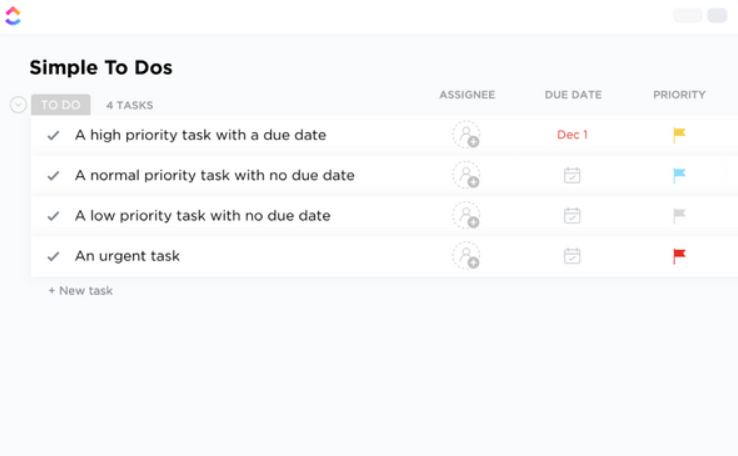
| Simple To-Dos | No-frills prioritized checklist | Prioritized Tasks view, tags, automations, status board | Get free template |
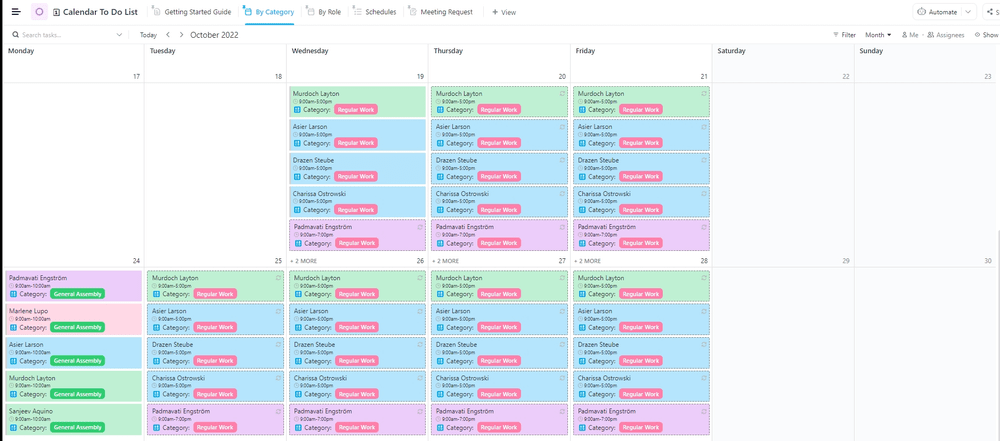
| Calendar To Do List | Calendar-first task organization | 5 custom views, meeting prep tracking, role filtering, time tracking | Get free template |
Each template below covers a different ground. We’ve added ‘Best for’ and ‘Skip it if’ to every review so you can find the right fit fast.
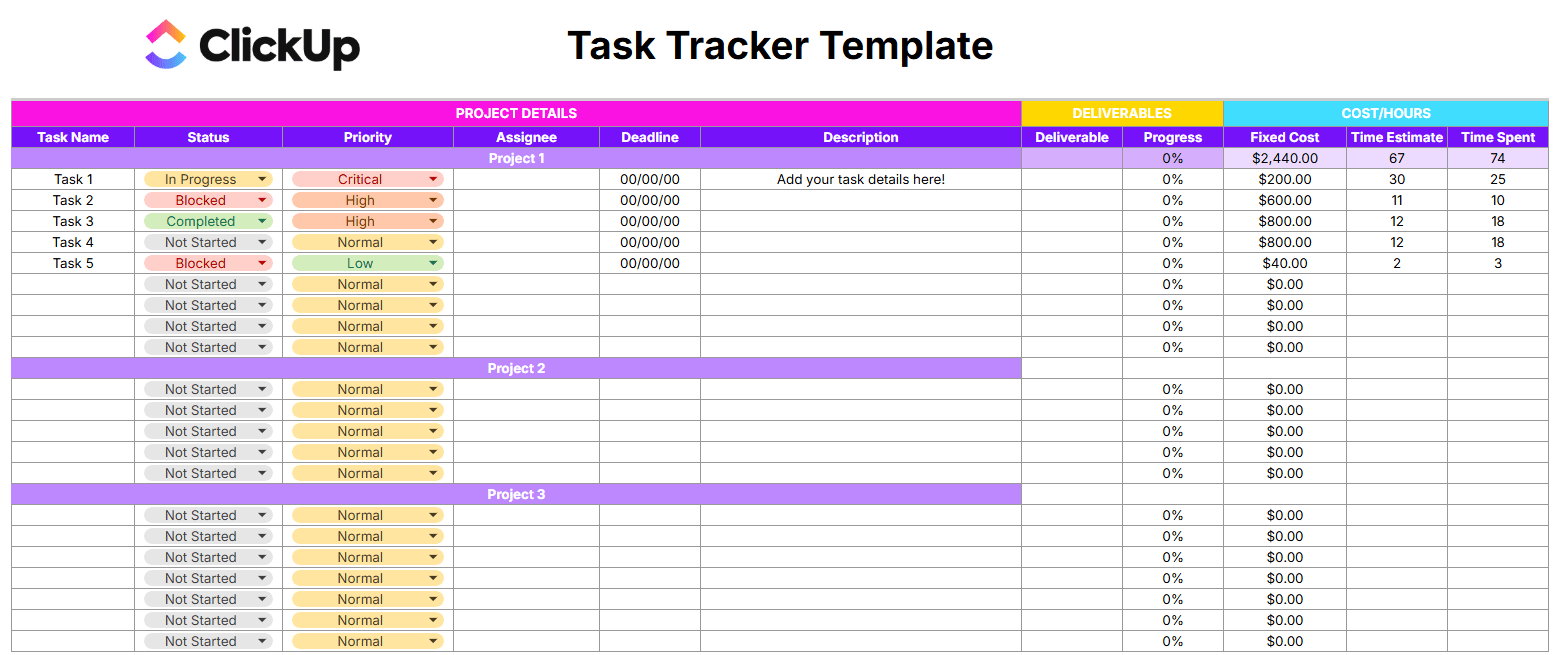
Use the Google Sheet Task Tracker Template by ClickUp when you need a shared Google Sheets tracker with named owners and clear deadlines. It covers task names, priorities, assignees, statuses, start and due dates, and notes in a single sheet.
Use case: You’re a project lead running a product launch with deliverables split across design, copy, and dev. Each person gets their own rows, each task gets a priority and a due date, and status dropdowns (To Do, In Progress, Done) let you filter the sheet in a Monday standup to see what’s blocked. The Notes column is where you drop links to specs or flag dependencies without cluttering up the task name.
Best for: Teams splitting daily work across multiple owners who need one shared view of status and deadlines
Skip it if: You only track personal to-dos with no assignees. A simpler checklist saves you columns you’ll never fill

Most trackers show you today. The Google Sheet Daily and Monthly Task Tracker Template by Template.net shows you today and the full month, with donut charts tracking status by month so you can spot patterns (like tasks piling up every third week) without building a dashboard.
Use case: You’re a freelancer juggling 15-20 client deliverables across a month. The daily view handles what’s in front of you. The monthly view catches the deadlines you set three weeks ago and forgot about. The per-month donut charts tell you at a glance whether January was a 70% completion month or a 40% disaster.
Best for: Freelancers or solo operators managing recurring deliverables who need both a daily checklist and a monthly status snapshot
Skip it if: You work in a team with shared ownership. There’s no Assignee column, so you can’t track who’s responsible for what

Tracking hours, not just tasks? The Google Sheet Daily Task Tracker Template by Template.net is built around time. That means logging when you started, when you stopped, how long it took, and whether you actually finished.
Use case: You’re a content marketer logging how long each task takes so you can quote clients accurately next quarter. Monday’s row says you spent 2 hours on keyword research and 1.5 on a blog draft, but the draft isn’t done. By Friday, you’ve got a week of time data showing that drafts consistently eat 3 hours, not the 1.5 you’ve been estimating. That’s the kind of pattern a simple to-do list never surfaces.
Best for: Freelancers, consultants, or anyone who bills by the hour and needs a time log alongside their task list
Skip it if: You don’t care how long things take. If completion matters more than duration, template #2 or #4 covers that without the extra columns

If your workflow lives and dies by task status, the Google Sheet Task Tracker Template gives you more status granularity than most free sheets. Beyond the standard To Do / In Progress / Done, you can add On Hold, Pending Review, Blocked, or whatever your process actually needs.
Use case: You manage QA for a small dev team. Every bug report gets a row with its own status: Open, Investigating, Fix In Progress, Ready for Retest, Closed. Your Monday review is a filtered view showing everything that’s not Closed. The built-in charts give you a visual breakdown without switching to a dashboard, so you can paste a screenshot into Slack and skip the standup when things are on track.
Best for: Teams running multi-stage workflows where three statuses aren’t enough, like QA pipelines, editorial calendars, or approval chains
Skip it if: Your work is straightforward from start-to-finish. If you only need To Do and Done, this template adds complexity you’ll ignore. Template #1 keeps it simpler
Bonus: Check out these task list templates in Word as well!

Some people don’t want to read rows. They want to open a sheet and know where things stand in two seconds. The Google Sheet Status Tracker Template is built for that: it’s a visual-first tracker where charts and graphs do the talking.
Use case: You’re a team lead who reports progress to a manager every Friday. Instead of scanning 40 rows and counting statuses manually, you open the sheet and the charts already show 28 complete, 8 in progress, 4 not started. You screenshot the graphs, drop them into your weekly update, and you’re done in under a minute. The layout is also clean enough to screen-share in a meeting without anyone squinting at cells.
Best for: Team leads or managers who need to report progress visually to stakeholders without building charts from scratch
Skip it if: You’re the only person looking at this sheet. Charts are overhead when you just need a checklist. Template #6 is leaner for personal tracking

Google Sheets To-Do List Template by Zapier is a blank weekly checklist you fill in Monday morning and work through by Friday. That’s it.
Use case: You’re a writer with a predictable weekly rhythm: three articles, two rounds of edits, one client call. You type Monday’s tasks in column A, Tuesday’s in column B, and strike them through as they’re done. The “For Later” section at the bottom catches tasks that don’t have a deadline yet but need to live somewhere. It’s the digital version of a sticky note on your monitor, except it doesn’t fall off.
Best for: Individuals who want a personal weekly checklist without any setup or learning curve
Skip it if: You need to assign tasks to other people or track status beyond done/not done. There are no Assignee or Status columns. Template #1 or #4 handles shared work better

Every other template on this list tracks tasks in one tool.
The Google Sheets Task Progress Tracker Template by Unito pulls tasks from multiple tools into one Google Sheet and turns them into progress reports with bar, pie, and burndown charts.
Use case: You’re a project manager with tasks split across Asana, Trello, and a Google Sheet that someone started six months ago. Instead of opening three tabs every morning, you sync everything into the Data Dump tab and the template generates a progress report: open vs. completed vs. overdue, workload per team member, and a burndown chart showing whether you’ll hit the sprint deadline or miss it by a week. That report goes straight to your stakeholder update.
Best for: Project leads managing work across multiple tools who need a single reporting layer without migrating everything into one platform
Skip it if: All your tasks already live in Google Sheets. The sync setup adds overhead you don’t need. Templates #1 through #5 cover single-sheet tracking without any integrations
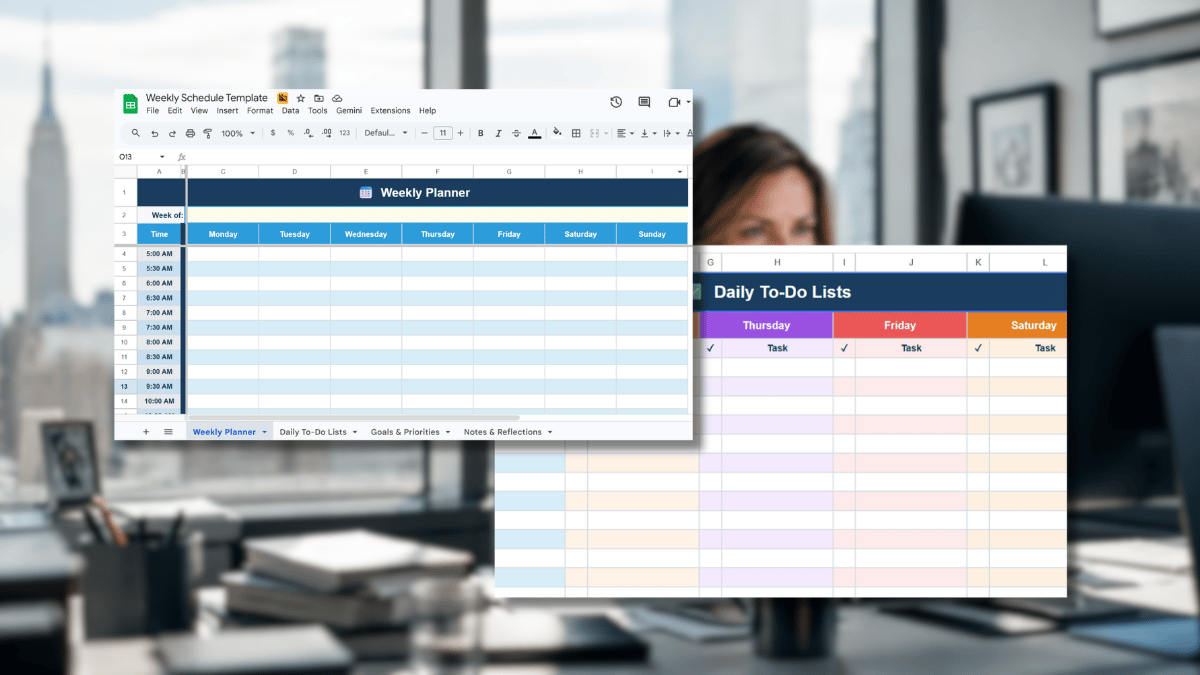
A daily tracker tells you what to do today. The Weekly Schedule Template by SpreadsheetPoint tells you where your entire week goes. It ships with four tabs: a time-blocked planner in 30-minute increments (5 AM to 10 PM), daily to-do lists with checkboxes, a goals and priorities sheet, and a notes/reflections tab for end-of-week review.
Use case: You’re a marketing manager who blocks Monday and Wednesday mornings for deep work, has recurring standups Tuesday and Thursday at 10 AM, and needs Friday afternoons clear for weekly reporting. You map all of that in the planner tab, then use the daily to-do tab to list the actual tasks that fill each block. By Friday, the goals tab shows which of your three weekly priorities you actually shipped and the reflections tab captures what slipped and why, so next week’s plan starts sharper.
Best for: Individuals who plan by time blocks and want their schedule, tasks, and goals in one file
Skip it if: You manage a team and need assignee columns or shared status tracking. This is a solo planning tool. Templates #1 or #9 handle team work
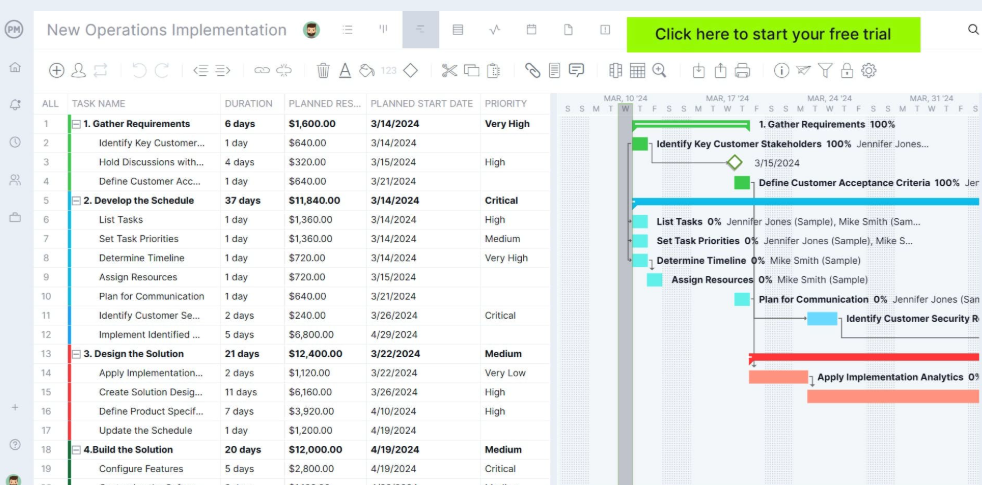
Templates #1 through #6 work fine for one person or a small list. Once you’re managing a team and need charts that update themselves, the Task Tracker Template by ProjectManager adds the reporting layer most free Sheets templates skip. It comes with an Assigned To column, Priority and Status dropdowns, due dates, and two summary sections that auto-generate charts: one for task priority distribution and one for task status breakdown.
Use case: You’re an agency project coordinator with 30 tasks spread across 4 team members for a client website launch. Each person’s tasks are assigned in the “Assigned To” column with High/Medium/Low priority. As the week progresses, the team updates statuses from Not Started to In Progress to Completed. On Friday, you open the Task Status Summary section: a pie chart shows 18 completed, 9 in progress, 3 not started. You screenshot that chart, paste it into the client’s weekly status email, and you’ve got a professional update without touching a slide deck.
Best for: Team leads and project coordinators who need a shared task tracker with built-in visual reporting for stakeholders
Skip it if: You need per-person filtered views or auto-calculated project completion percentages. Template #1 covers basic shared tracking, and a dedicated tool handles complex multi-project reporting better
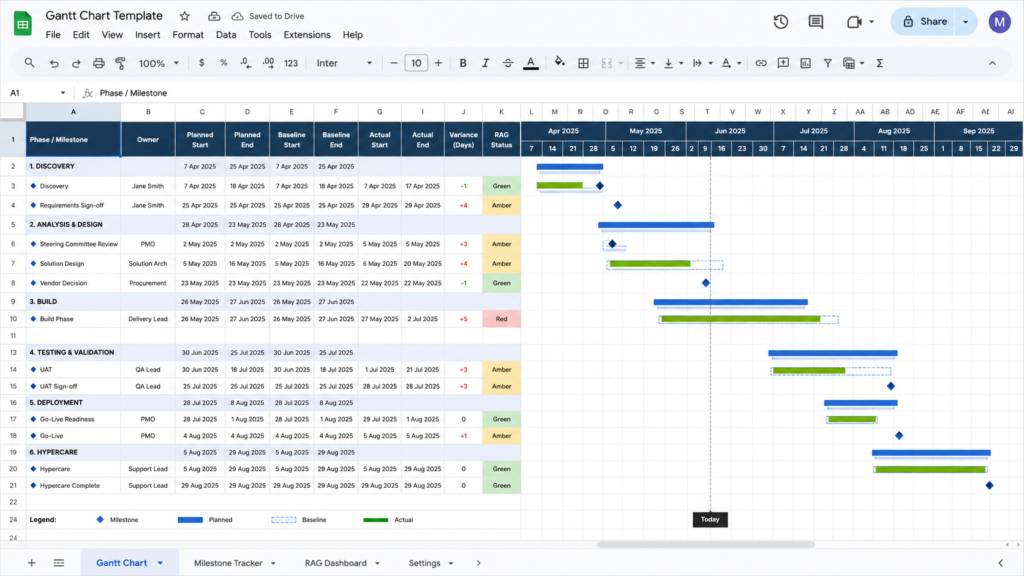
Deadlines and status columns show you what’s late. A Gantt chart shows you why it’s late, by mapping tasks across a timeline so overlaps, gaps, and dependencies become visible. The Gantt Chart Template by ClickUp is a free, ungated Google Sheets file with conditional formatting timeline bars, milestone markers, RAG status indicators (Green/Amber/Red), and baseline vs. actual date tracking with automatic variance highlighting.
Use case: You’re running a 12-week product launch across design, development, and marketing. Each phase gets a row with planned start and end dates, and the conditional formatting draws the timeline bars automatically. When the design phase slips by 5 days, you enter the actual end date and the Variance column turns red with “+5.” In your steering committee meeting, you screen-share the one-page Gantt and the RAG column instantly shows which phases are at risk without anyone opening a task management tool.
Best for: Project managers and team leads who need a visual timeline for stakeholder reporting without switching to dedicated PM software
Skip it if: Your project has more than 30-40 tasks with complex dependencies. The conditional formatting can get unwieldy at that scale. That’s when a dedicated tool like ClickUp’s native Gantt view earns its keep
A template gets you the columns. This section gets you the parts that actually make the tracker work: checkboxes, a formula that counts completed tasks, a completion rate that updates itself, and conditional formatting that turns overdue rows red without you scanning dates manually.
Start with any of the templates above, or open a blank Google Sheet. Either way, set up these six columns:
A: Task | B: Due Date | C: Done | D: Owner | E: Priority | F: Notes
Select C2:C100. Go to Insert → Checkbox. Each cell gets a TRUE/FALSE toggle. When someone finishes a task, they check the box. That’s the input every formula below depends on.
In a summary cell (e.g., H2), enter:
=COUNTIF(C2:C100,TRUE)
This counts every checked box. Place it next to a label like “Tasks completed” so the number means something at a glance.
In H3:
=IFERROR(COUNTIFS(C2:C100,TRUE,A2:A100,"<>")/COUNTIF(A2:A100,"<>"),0)
This divides completed tasks by total tasks (ignoring blank rows) and returns a percentage. Format the cell as a percentage: Format → Number → Percent. If you have 14 tasks and 9 are checked, it reads 64%.
Select A2:F100. Go to Format → Conditional formatting → Custom formula is and enter:
=AND($A2<>"",$B2<TODAY(),$C2=FALSE)
Set the formatting to a red fill. Now any row with a task name, a due date in the past, and an unchecked box turns red automatically. Completed tasks stay clean. Blank rows stay clean. Only the stuff you’re behind on gets flagged.
| Formula | What it does | Where to put it |
=COUNTIF(C2:C100,TRUE) | Counts completed tasks | Any summary cell |
=IFERROR(COUNTIFS(C2:C100,TRUE,A2:A100,"<>")/COUNTIF(A2:A100,"<>"),0) | Completion rate as a percentage | Any summary cell, formatted as % |
=AND($A2<>"",$B2<TODAY(),$C2=FALSE) | Flags overdue, incomplete tasks with red fill | Conditional formatting rule on A2:F100 |
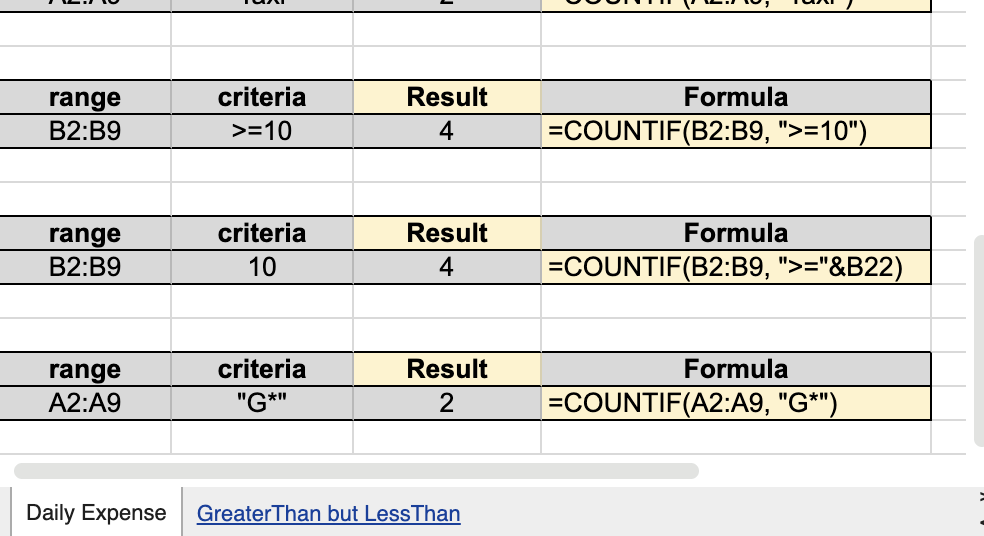
Google documents COUNTIF, COUNTIFS, and custom conditional formatting formulas if you want to dig deeper.
Google Sheets handles daily task tracking well up to a point.
Following are the real trade-offs, not dealbreakers, so you know when a spreadsheet is still the right call and when it’s time to look at a dedicated tool.
The templates above work well for individuals, small teams, and single projects. When you need assigned notifications, dependency tracking, workload balancing, or field-level permissions, that’s the signal to move to a dedicated tool.
If your tracking needs have outgrown what a spreadsheet can handle, these ClickUp templates add what Sheets can’t: assigned notifications, dependency logic, multiple views (List, Board, Calendar, Gantt), automations, and built-in time tracking. They’re free to use with a ClickUp account
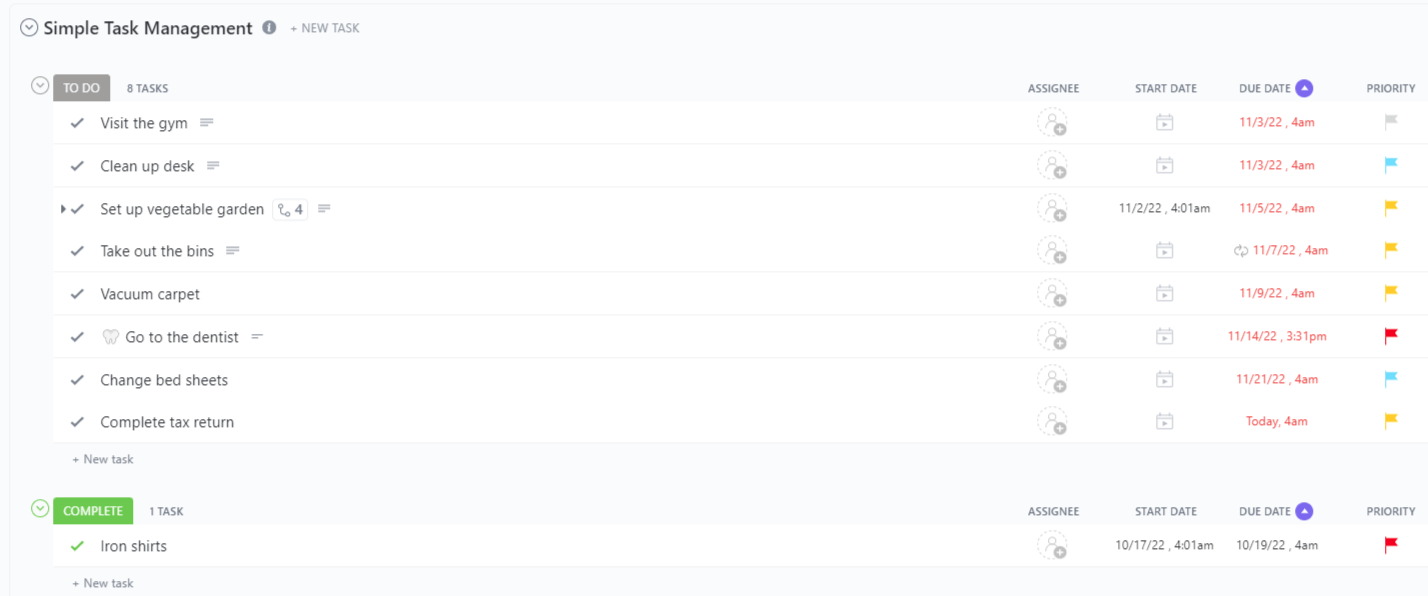
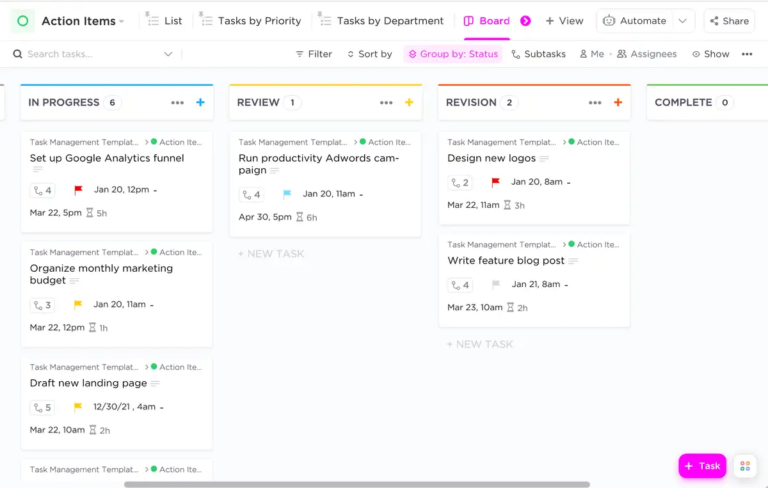
If a spreadsheet tracker was a step up from sticky notes, this is a step up from spreadsheets. The Simple Task Management Template gives you List, Board, and Doc views out of the box, so the same set of tasks can look like a checklist, a kanban board, or a documentation page depending on what you need that minute.
Use case: You’re a startup founder tracking everything from product bugs to investor follow-ups to office supply orders. Instead of three separate sheets, you create one list. Switch to Board view during your morning standup to see what’s in progress, flip to List view to sort by due date before your afternoon, and open Doc view when you need to write context around a task for a new hire. One template, three ways to look at the same work.
Best for: Individuals or small teams who want a simple starting point for organized task tracking with more flexibility than a spreadsheet
Skip it if: You need time tracking, Gantt charts, or workload views. This one’s intentionally simple. ClickUp Template #5 adds the heavier project management features.
The Daily Task Management Template is a planner that maps your day across tasks, meetings, events, and errands, with a Calendar view that turns your task list into a time-blocked schedule.
Use case: You’re a customer success manager with 6 client check-ins, 2 internal meetings, and a product demo prep squeezed into one day. You open Calendar view and see exactly where each block sits. Between meetings, you’ve scheduled 45 minutes for follow-up emails, flagged as High priority. By 4 PM, the Gantt view shows you’ve completed 8 of 11 items, and the 3 remaining are low-priority tasks you can push to tomorrow without anything breaking.
Best for: Individuals who plan their day by time blocks and need a daily planner that doubles as a task tracker
Skip it if: You manage a team and need assignee columns, workload balancing, or multi-project views. ClickUp Template #5 handles team-level coordination
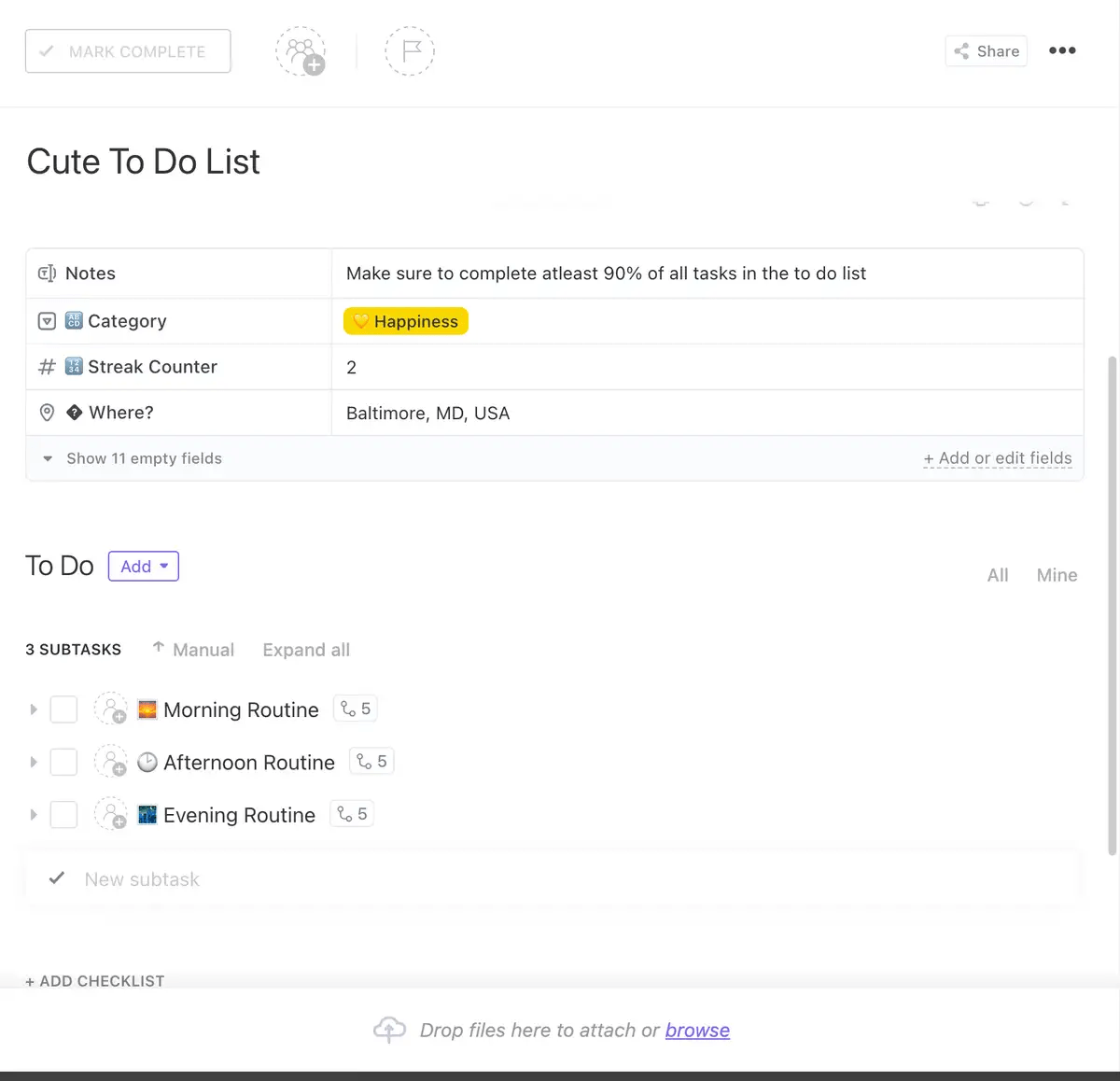
Planners help you schedule. Habit trackers help you stay consistent. The Daily Task List Template tries to do both: it’s a routine builder with task tracking baked in. Custom statuses, fields, and views (including Gantt, List, and Calendar) come pre-configured, plus automations that send notifications when deadlines approach.
Use case: You’re building a morning routine alongside your work tasks. Your list has “Review overnight support tickets” at 8 AM, “Write weekly report draft” at 10 AM, and “30-minute walk” at 12:30 PM. The automations ping you 15 minutes before each deadline. By Friday, you’ve got a week of completed/missed data that shows you consistently skip the walk on meeting-heavy days. That pattern only becomes visible when you track routines and work tasks in the same place.
Best for: Individuals building daily routines who want automated reminders and habit visibility alongside their work tasks
Skip it if: You don’t care about routine tracking and just need a task list. ClickUp Template #1 is simpler and faster to set up
Single-project tracking needs more structure than a daily to-do list but less overhead than full project management software. The Project Task List Template hits that middle ground with five views (Doc, Board, List, Calendar, and Embed) and custom statuses you define to match your project’s actual workflow.
Use case: You’re running a 6-week product documentation overhaul. Writers, designers, and a reviewer each own different tasks. You set statuses to Draft, Design Review, Final Edit, Published. The Board view gives you a kanban of what’s in each stage. When the reviewer needs context, she opens the Embed view where you’ve dropped a Loom walkthrough of the new docs structure. No one leaves ClickUp to find the video, and no one asks “where’s the brief?” because it’s embedded in the task list itself.
Best for: Teams running a defined single project with multiple contributors, custom stages, and a need to keep reference materials attached to the task list
Skip it if: You’re juggling multiple concurrent projects. ClickUp Template #5 handles multi-project coordination with workload visibility
This is the heavyweight of the list. The Task Management Template is built for teams managing multiple projects simultaneously. Six views, pre-built Custom Fields, and a Intro to Team view that shows each person’s workload so you can assign tasks based on who actually has capacity, not just who you thought of first.
Use case: You’re a marketing ops lead running a product launch, a webinar series, and a blog redesign at the same time with a 7-person team. Tasks live in three lists (Ideas, Backlogs, Action Items), each with owners, priorities, and due dates. On Monday, you open Team view and immediately see that your designer has 14 tasks due this week while your copywriter has 3. You drag two design tasks to the copywriter (who also handles basic graphics) and rebalance the week before anyone gets buried. The six views let you flip between kanban for sprint planning, list for status updates, and calendar for deadline visibility without maintaining separate trackers.
Best for: Team leads and project managers running two or more active projects who need workload visibility and multi-view flexibility
Skip it if: You’re tracking personal tasks or a single small project. ClickUp Templates #1 or #3 do that without the extra structure you won’t use
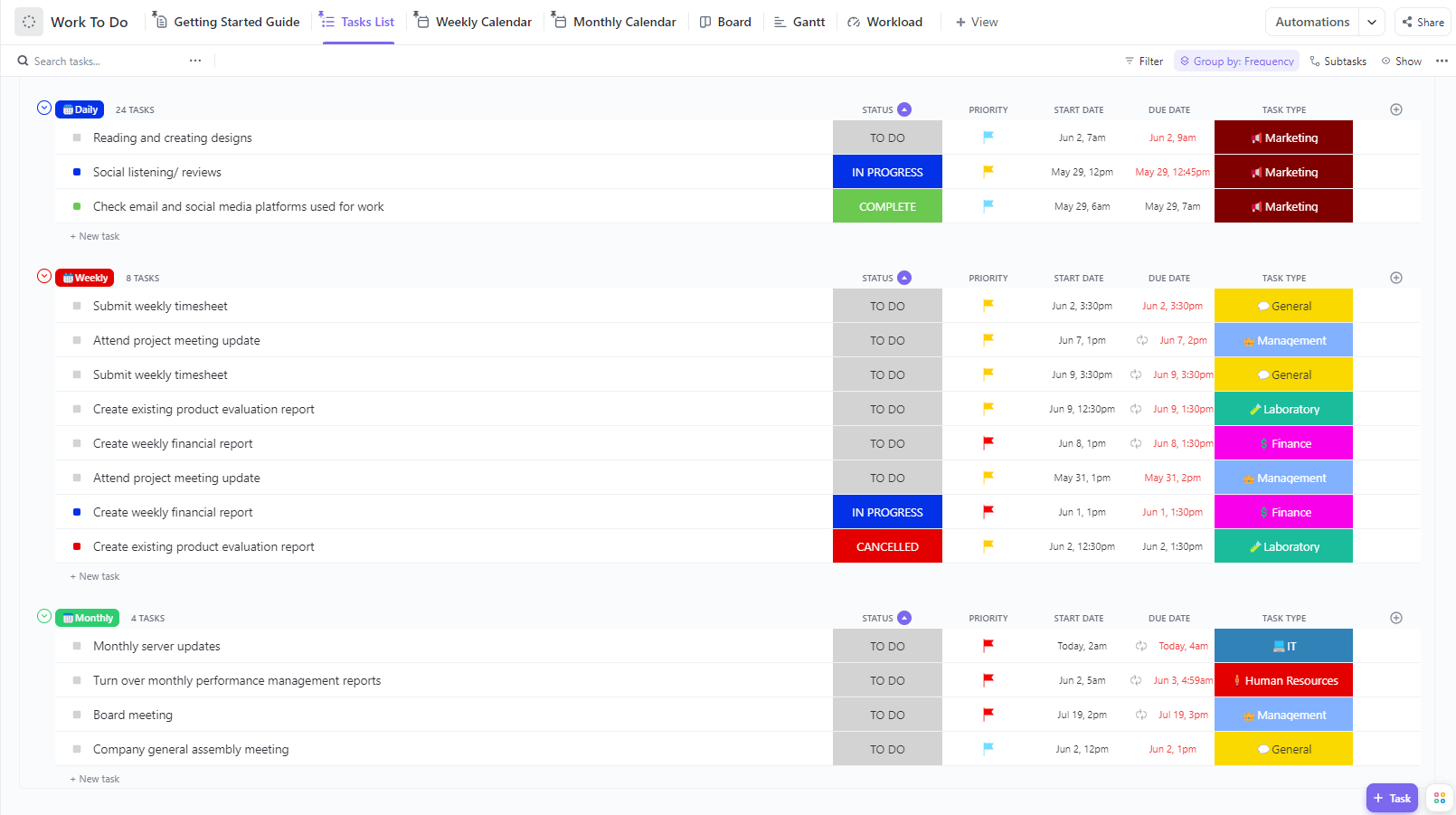
The Work To Do Template is organized around a Weekly Calendar view that lays out your tasks across the work week, so Monday’s priorities and Friday’s deadlines are visible in the same glance.
Use case: You’re a product manager who batches different types of work by day: Mondays for sprint planning, Tuesdays and Wednesdays for feature specs, Thursdays for stakeholder reviews, Fridays for backlog grooming. You plot each task on the Weekly Calendar and attach subtasks where needed (the spec has three sub-deliverables: draft, peer review, final version). The Gantt view shows you that Thursday’s review depends on Wednesday’s spec being done. If Wednesday slips, you see the downstream impact immediately instead of realizing it Thursday morning.
Best for: Individuals and small teams who plan by the week and want to see how tasks connect across days
Skip it if: You need team workload balancing or multi-project management. ClickUp Template #5 handles cross-team coordination better
Sometimes you need a simple list you can trust. The Simple To-Dos Template is the closest ClickUp gets to a pen-and-paper checklist: tasks, priorities, assignees, due dates, and a Prioritized Tasks view that sorts everything by urgency automatically.
Use case: You’re an office manager juggling 40 small tasks that don’t belong to any project: renew the software license by Thursday, order new monitors, schedule the team offsite, follow up on the catering quote. None of these need a Gantt chart. You dump them all into the template, flag the license renewal as Urgent, and the Prioritized Tasks view pushes it to the top. Tags let you filter by category (IT, Facilities, Events) when you need to batch similar tasks. Automations handle status changes so when you mark something Done, it moves out of your active view without you dragging it anywhere.
Best for: Individuals or teams who need a clean, no-frills task list with automatic prioritization and don’t want project management overhead
Skip it if: Your work involves dependencies, deadlines that affect other tasks, or multiple projects. ClickUp Template #4 or #5 adds the structure this one intentionally leaves out
Every template so far organizes tasks by status or priority. The Calendar To Do List Template organizes them by time: weekly, bi-weekly, or monthly calendar views that show when things are due, not just what’s due. Five custom views (By Role, Meeting Request, By Category, Schedules, and Getting Started Guide) let you slice the same calendar from different angles.
Use case: You’re an executive assistant managing a VP’s week. Monday has 3 prep tasks before a board meeting. Wednesday has a client dinner that needs a restaurant booking and travel confirmation. Friday has a quarterly report deadline with two review tasks that need to finish by Thursday. The Schedules view shows you the whole week as a calendar. The Meeting Request view pulls out just the meetings and their pre-work. The By Role view separates what you own from what the VP owns. One template, three filtered views of the same deadlines.
Best for: Anyone managing a busy calendar who needs to connect tasks to specific dates and meetings, not just track them in a list
Skip it if: Your tasks don’t have specific dates or time-based dependencies. ClickUp Template #7 handles dateless to-do lists better
That’s not all. Apart from these templates, ClickUp’s Task Templates feature also lets you create your own. This way, you can create templates for repetitive tasks and workflows and improve productivity. Plus, they’re simple, customizable, and require no training.
A task tracker only needs to answer three questions every time you open it: what’s due, what’s done, and who owns it. Everything else is optional depending on how complex your work is.
Start with these five columns:
Add these when you need them (not before):
The templates above are pre-built with different combinations of these fields. Match the template to the complexity of your tracking, not the other way around.
Undoubtedly, Google Sheets templates for daily task tracking are helpful for managing tasks and to-do lists.
However, Google Sheets are not perfect. If you regularly need to handle multiple tasks and collaborate with different teams, tracking everything using Google Sheets templates will be challenging. That’s where task management software like ClickUp comes in.
ClickUp’s template gallery offers multiple spreadsheet templates ideal for managing personal to-dos and professional projects. These free templates offer many customization options and additional features, including notifications and workflow automation.
In addition, ClickUp adds a ton of convenience with its task management and AI capabilities.
So, why struggle with Google Sheets? Sign up for ClickUp and download these templates today.
Yes, two options. Google Tasks is a standalone to-do app with dated reminders and repeating tasks. Google Sheets lets you build a custom tracker with your own columns and formulas. Choose Tasks when a personal list with reminders is enough. Choose Sheets when you need owners, priority sorting, or progress calculations.
Google Docs works for a checklist inside a document, like meeting action items or a packing list. Google Sheets works when tasks need separate columns for dates, owners, status, or formulas. If you’re sorting, filtering, or calculating anything, Sheets is the right tool. If you’re just checking things off inside a document you’re already writing, Docs is fine.
Move completed tasks to an Archive tab instead of deleting them. Keep a “Later” section for work without a deadline so it doesn’t crowd your active list. Review the Later section weekly rather than copying every unfinished item into each new day. Filter views also help: create a filter that hides rows where Status = Done, so your daily view only shows open work.
Yes. Share one Google Sheets file and give Editor access to the people who update it. Add an Owner column and agree on status labels before the team starts. The most common mistake is sending separate copies for daily updates, because those copies become different versions of the tracker within hours. One shared file, not multiple copies. Google’s sharing guidance covers permission setup.
Not by default. A due date in a column won’t notify anyone. You can build automated reminders using Apps Script installable triggers that check for upcoming deadlines and send emails, but someone has to write, test, and maintain the script. For built-in task reminders without code, Google Tasks or a dedicated task manager like ClickUp handles this out of the box.
You’re probably viewing the owner’s original file, not your own copy. Go to File → Make a copy and edit the new file in your Drive. If you can make a copy but certain cells won’t let you type, the sheet has protected ranges. Check with the file owner or look for an unlocked version. Google’s protected ranges guidance explains how to check and adjust permissions.

Praburam Srinivasan
Max 27min read

PMO Team
Max 9min read
Praburam Srinivasan
Max 16min read

© 2026 ClickUp