
Sorry, there were no results found for “”
Sorry, there were no results found for “”
Sorry, there were no results found for “”
The average knowledge worker toggles between apps 1,200 times a day, spending roughly four hours every week just reorienting. You cannot solve this by adding another app to the pile. Instead, find one centralized, all-purpose organization app that simplifies your workflow.
Organization apps help you capture, structure, and track everything you’re responsible for in one system, whether that’s work-related projects, personal tasks, or both. The best ones, though, go beyond simple to-do lists by adding scheduling, prioritization, and cross-tool visibility so nothing gets lost between intention and execution.
A one-line verdict: The best organization apps in 2026 are Todoist (minimalist tasks), ClickUp (all-in-one for teams), TickTick (solo planning), and Notion (content systems).
| Tool | Best for | Standout feature | Pricing* | Where it’s not ideal |
|---|---|---|---|---|
| Todoist | Minimalist task management for individuals and small teams | Quick Add parses natural language into a scheduled, recurring task, and the mobile widget captures from any app with one tap | Beginner: Free; Pro: $5/user/mo; Business: $8/user/mo | Dependencies ride on labels and filters rather than a dedicated tool, and built-in reports stay basic |
| TickTick | One app for tasks, calendar, and habits as a solo user | A persistent notification widget lets you add a task or start a Pomodoro timer without hassle, alongside six calendar views, habit tracking, an Eisenhower Matrix, and voice capture from the home screen | Free; Premium: $49.99/billed annually | No built-in messages or discussion threads, so teams take conversations to a separate chat tool |
| Google Keep | Quick note capture for Google Workspace users | A home-screen widget for one-tap capture (text, voice, or photo) with zero setup, free cross-device sync, and a single export into Google Docs when a note outgrows it | Free with a Google account | Lacks generative AI, folder hierarchy, and automation, so not ideal for workflow management |
| Microsoft To Do | Recurring office tasks for Microsoft 365 users | My Day surfaces a fresh daily plan with personalized suggestions, and Copilot in Outlook turns flagged emails into tracked tasks instantly | Free with a Microsoft 365 account | No boards, timelines, or advanced reporting, so teams running complex projects may need more structure than it offers |
| ClickUp | Teams of all sizes that want to replace several apps with one workspace | Tasks, docs, calendar, chat, and AI (Brain) in one place, where Brain keeps everything queryable and builds automations from plain-language instructions | Free forever; Custom plans available for enterprises | The depth that makes it powerful adds configuration, so users who only need a simple single-purpose organizer face a steeper start |
| Notion | Marketing teams building a content calendar and wiki | Every database page opens into a full document, so the brief, draft, research, and tracking share one card, with Notion AI drafting and summarizing inside it | Free; Plus: $10/mo; Business: $20/mo; Enterprise: custom | Hands you a blank page instead of a preset system, and on mobile, it’s better for reading and light edits than fast capture |
| Evernote | Researchers organizing notes, clips, and tasks into one searchable hub | Searches inside PDFs, handwritten pages, and images, plus semantic AI search finds notes by meaning rather than exact keywords | Starter: $8.25/user/mo; Advanced: $20.83/user/mo; Enterprise: custom | Can feel slow or heavy on mobile, especially on older phones, and the depth that serves power users means lighter tools beat it for quick, simple notes |
| Sunsama | People who plan a daily schedule around tasks from multiple tools | A morning planning ritual pulls work from Asana, Jira, Trello, Notion, email, and Slack into one realistic daily schedule with time estimates | Free trial; Pro: $17/user/mo; Enterprise: custom | The Android app is a companion for quick check-ins, not the full planning experience, so mobile-first Android users miss core functionality |
Our editorial team follows a transparent, research-backed, and vendor-neutral process, so you can trust that our recommendations are based on real product value.
Here’s a detailed rundown of how we review software at ClickUp.
The four things that determine whether an organization app sticks or gets abandoned within a month are: ease of adoption, cross-platform reliability, the size of the team that will use it, the flexibility-vs-simplicity tradeoff, and notification follow-through.
A Futurum Group survey of 830 IT decision-makers found that 41% of organizations now plan to consolidate apps actively. The ‘best-of-breed’ approach (a separate specialist tool for every job) dropped to 20.7%, its lowest point, in 2026. The market is moving toward fewer, better-connected tools.
Eight tools made this list: Todoist, TickTick, Google Keep, Microsoft To Do, ClickUp, Notion, Evernote, and Sunsama. Each one solves organization problems for a different person and workflow, and falls short in a few areas.
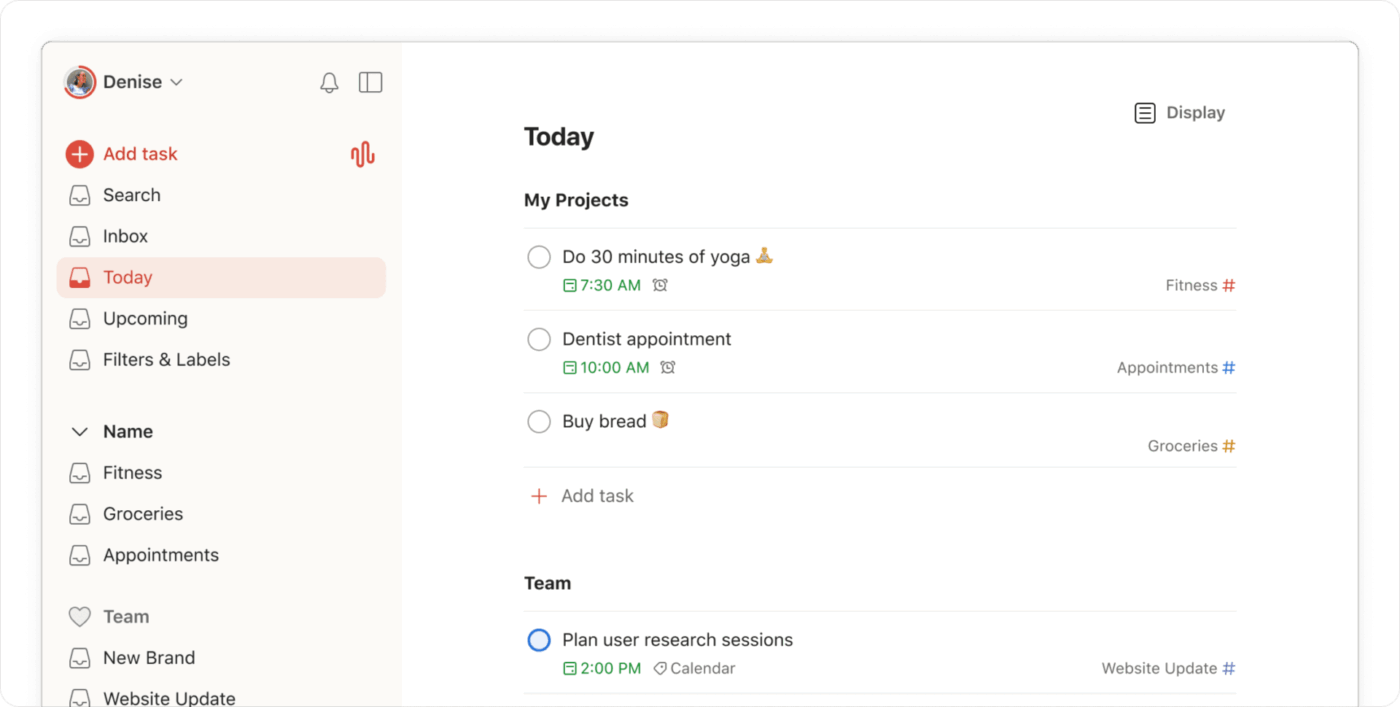
Todoist is a widely popular organization app, especially for solo users. Quick Add turns a typed to-do into a scheduled task. For example, if you enter ‘call the vendor every Monday at 10 am’ in the app. It fills the due date and adds a weekly repeat reminder next to it. The task also gets segregated into Today, Upcoming, or a filter you build, showing only priority to-do lists
When your small team needs a shared workspace, it opens up beside your personal projects instead of merging with them. You and your teammates can open public or private projects, share them via links, and set who sees what using roles and permissions.
The mobile widget and share-sheet capture mean you can add something from any app in a second. It syncs across phone, watch, browser, and desktop without a hiccup.
In practice: a freelancer keeps each client in their own project, tags anything waiting on a reply with a @follow-up label, then builds a filter that shows only overdue items carrying that label. Monday morning becomes a single screen instead of four. Setup takes 10 minutes, and because Quick Add parses dates as you type, adding the next task never interrupts whatever you were already doing.
When Todoist is not an ideal choice: Todoist maps task dependencies through labels and filters. It’s different from a dedicated dependency tool, and its built-in reports stay close to the basics. If your team plans around detailed dependencies and relies on deep reporting, you’ll bump up against those limits in daily work.
Skip Todoist if: Your projects hinge on mapping dependencies and pulling detailed progress reports.
Hear about Todoist from this G2 reviewer:
It’s an extremely easy to use app, so it doesn’t take as much time to create lists and tasks as it does with some of the other more complicated to do list apps. We used it to help us manage and share tasks at work when we were a small team and it was super effective. We would receive notifications when we were assigned something and could comment back and forth on that particular task, making it an effective way of communicating as well.
Also Read: Best Todoist Alternatives & Competitors
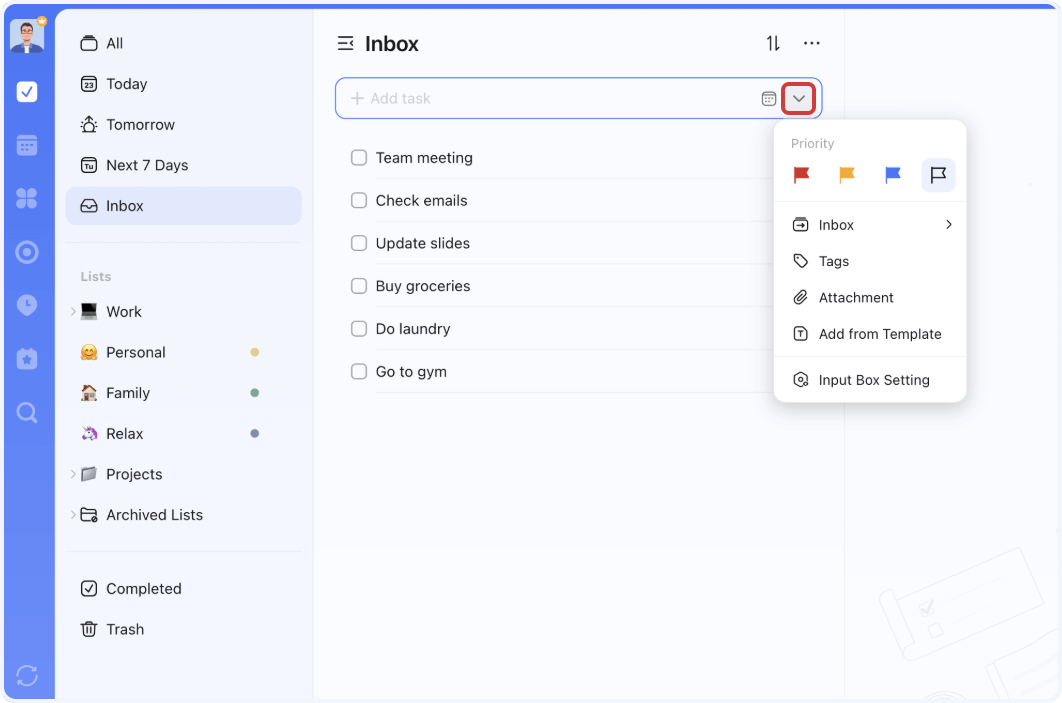
TickTick pulls a task in three ways: you type it in plain language, speak it when typing is awkward, or right-click text in your browser to turn it into a task. Once tasks are in, sort them using lists, tags, and smart filters, much like a dedicated, organized daily planner.
The Eisenhower Matrix in TickTick splits the load into urgent and important, so parallel deadlines don’t crowd out the work that counts. You can read the same tasks as a list, a Kanban board, or a timeline, and jump to the calendar to check whether tasks are stacking up too close together.
On mobile, the persistent notification widget lets you add a task or start a Pomodoro timer without hassle. Voice capture works from the home screen, and the calendar view is swipe-navigable. Plus, the habit check-ins push a single-tap notification at your chosen time.
A concrete setup: a grad student keeps coursework in one list, thesis chapters in another, and gym check-ins under habits. During submission week, the Eisenhower Matrix pushes revisions above inbox cleanup, and the Pomodoro timer starts from the same notification bar. One app covers what usually takes a planner, a habit tracker, and a separate timer app.
When TickTick is not an ideal choice: TickTick lets you share a list and assign a task, but it gives your team no place to talk. There are no built-in messages or discussion threads, so a colleague who has a question about a task has to take it to email or another chat app.
Skip TickTick if: Your team needs to discuss work where the tasks live, not in a separate chat tool.
See why this G2 reviewer has been using TickTick for years:
I’ve been using this tool for years for everything – organizing tasks and projects in business, as well as for goals and a more organized personal life. I must say that among most of the tools I tried, this one turned out to be the most versatile, stable, convenient and multifunctional. It has everything for people with any level of organization and workload. From a simple to-do list to managing large and complex projects. I really like the ability to create lists, organize tasks using tags and priorities, integration with calendars, reminders and other useful things. I especially want to point out two things – help with healthy habits.
Watch how to build a searchable note organization system using templates, tagging methods, and structural tricks inside ClickUp:
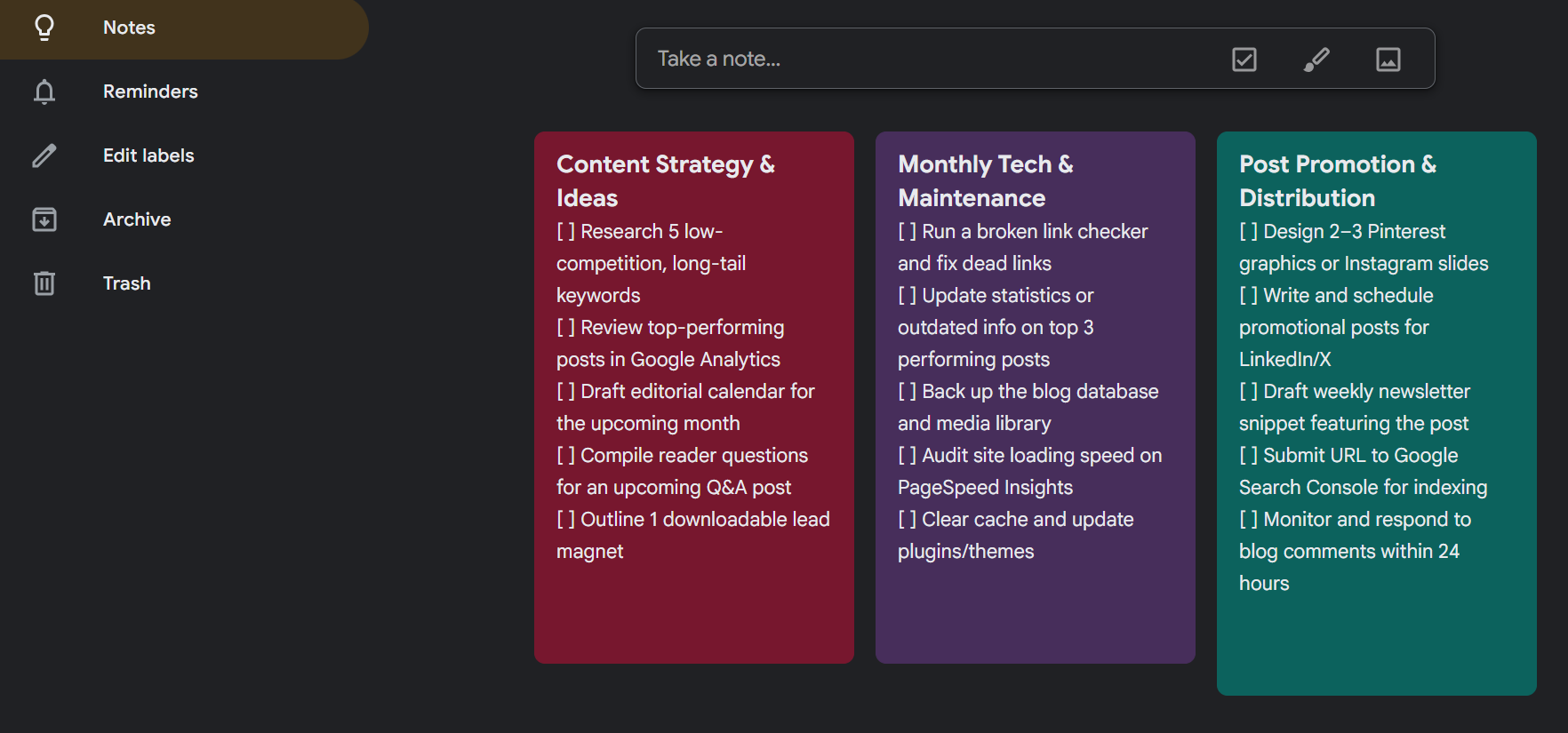
Google Keep strips note-taking down to its simplest form. There are no folders to build or a formatting menu to learn, so the first note takes only seconds. For someone already working in Gmail and Docs, that means grabbing a thought without stepping away from the task in front of them.
You can use it to log grocery lists, quick captures, and ‘remember this’ moments. It’s fast on Android and perfectly usable on the iPhone. The widget sits on your home screen for easy access. There’s no sync delay to worry about, because the note you thumb-type at the store shows up in your browser tab at home within seconds.
When a note has outgrown what Keep can hold, a single export carries it into Google Docs, where it becomes a fuller document.
Where it earns its place: you are on a call, and someone names a competitor worth researching. Two taps on the widget saves it, with no app switch and no folder decision. A labeled search pulls it back later. Keep works best as the front door to a bigger system, capturing everything during the day so you can move the notes that matter into Docs or a task tool when you triage.
When Google Keep is not an ideal choice: The intelligence underneath is light by design. Keep suggests and sorts a little on its own, but it won’t draft or rewrite anything, so anyone counting on a generative assistant should look elsewhere.
Skip Google Keep if: You want a fully automated note-taking app.
This is what a Capterra reviewer thinks about Google Keep:
Google Keep is very easy to use and it has a simple user interface. Organizing notes is very easy with the labeling system and colors. Another feature I use is the collaboration, I can share my notes with others, they can fill checklists or edit notes.
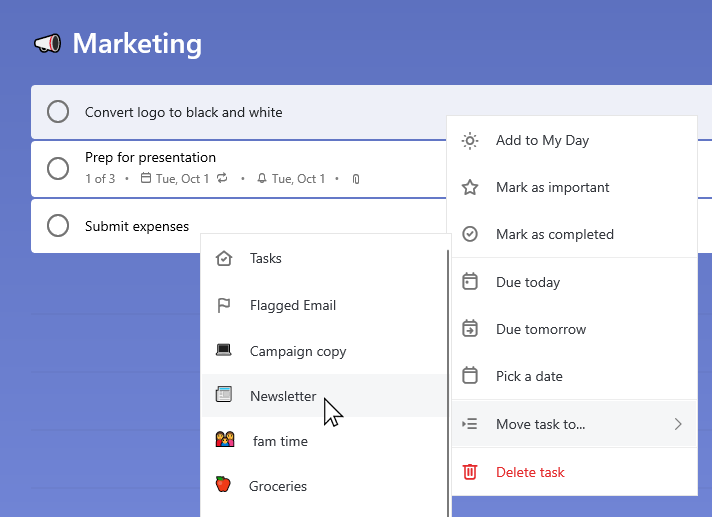
Microsoft To Do fits the office worker who already lives in the Microsoft 365 suite. It comes with the license many teams pay for, so an administrative assistant can open it next to Outlook without adding another subscription.
Lists, steps, due dates, and reminders work cleanly on the phone with no learning curve. The My Day widget surfaces your daily picks on the home screen, and flagged Outlook emails appear as tasks without switching apps.
For a Microsoft-centric office, the pull is having tasks, email, and Teams chat sitting in one connected place.
A real example: an office manager runs the monthly close from one list. Each recurring task carries steps for the vendor invoices, and a flagged email from finance becomes a task automatically, so nothing lives only in Outlook. My Day rebuilds every morning, which forces a deliberate call on the day instead of a rolling backlog you stop reading. Because tasks sync with Microsoft Planner and Teams, a delegated item appears for your colleague without a separate assignment message.
For anyone whose day already runs through MS Outlook, that is the biggest advantage: no new login, no new subscription, no sixth place to check.
When Microsoft To Do is not an ideal choice: Microsoft To Do is built for straightforward task lists. A team managing larger projects will find no advanced boards or timelines to visualize work. Customization remains limited, so there are only a few ways to shape a workflow beyond lists, steps, and due dates.
Skip Microsoft To Do if: A team running complex projects needs reporting, time tracking, or board and timeline views to manage the work.
Why this G2 reviewer uses Microsoft To Do:
This tool is very straightforward and easy to use. The reminders help us stay on top of our tasks. It also allows integration with Microsoft Outlook and Teams, making it convenient to manage everything in one place. We can sync tasks with our team members and assign them collaboratively, which really helps boost our productivity.
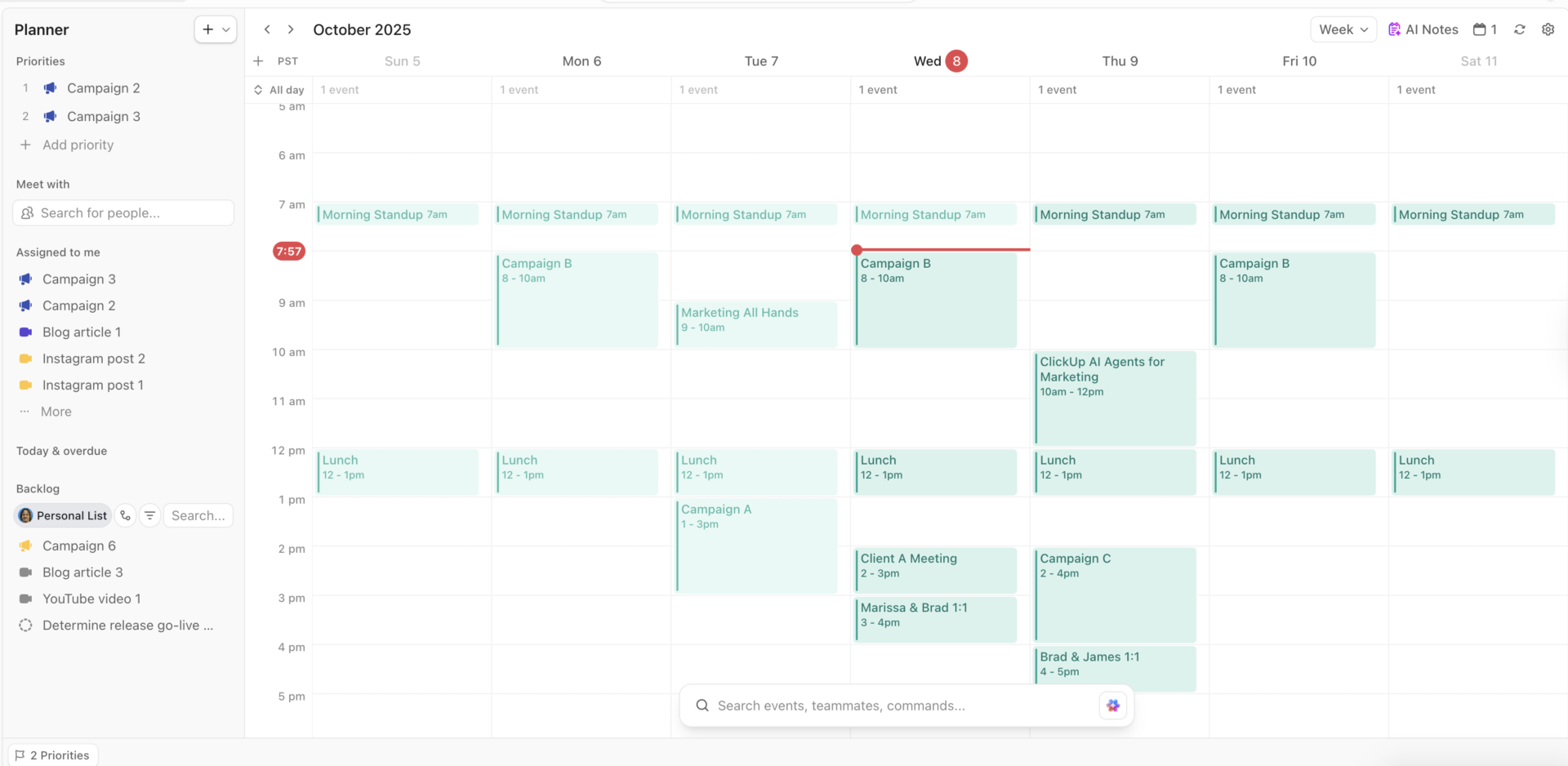
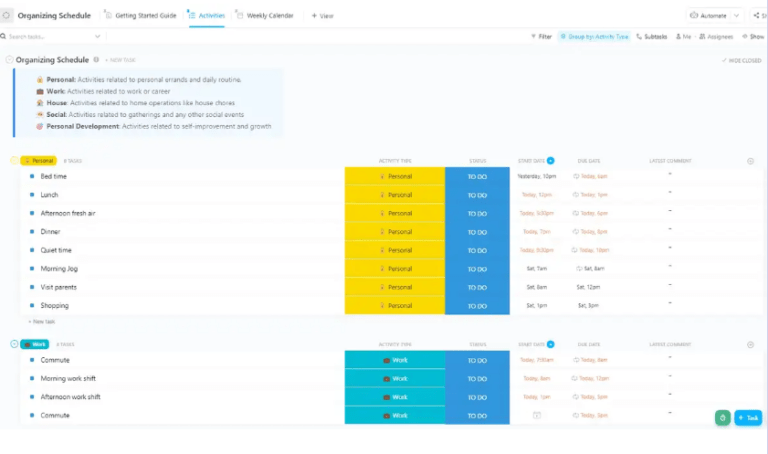
ClickUp is a work management platform that brings everything into one place. Work remains separate from personal life, and within a project, things go through stages. Set it up once, and then the system will keep it sorted for you.
For example, a new task is added to its List and automatically inherits the appropriate status options. ClickUp Views let you see the same List as a Board, Calendar, Table, Gantt, or Timeline without moving anything. Each view has its own filters, grouping, and sorting, so you can build a ‘This Week’ Calendar View and a ‘By Status’ Board View, all pointing at the same data.
The reason this works is that ClickUp connects what you need to do with when you’ll do it. Your tasks carry deadlines, and your external planners sync in. The ClickUp Planner stitches both together and blocks time against what’s available. Drag a task to Thursday to reschedule it, create new tasks directly on a date, and see the workload by day or week.
On mobile, you get home-screen widgets on iOS and Android, a Home view that surfaces what’s due, a Personal List that syncs with the browser, and mobile time tracking. Plus the ability to create Tasks, update statuses etc. ClickUp Brain can draft, summarize, and turn a spoken thought into a structured task from your phone. This makes capture-on-the-go useful.
When ClickUp is not an ideal choice: The depth that makes it powerful also makes it heavy. If you want to drag five tasks around and call it a day, the hierarchy, views, and custom fields will feel like over-engineering.
Skip ClickUp if: You want a simple, single-purpose organizer with zero configuration.
What aspect of ClickUp is helpful for this G2 reviewer:
The most helpful aspect of ClickUp is its flexibility. It can be customized to fit different workflows, teams, and projects through custom fields, statuses, automations, dashboards, and multiple task views such as List, Board, Calendar, and Gantt. This makes it easy to organize work, track progress, and stay on top of deadlines.
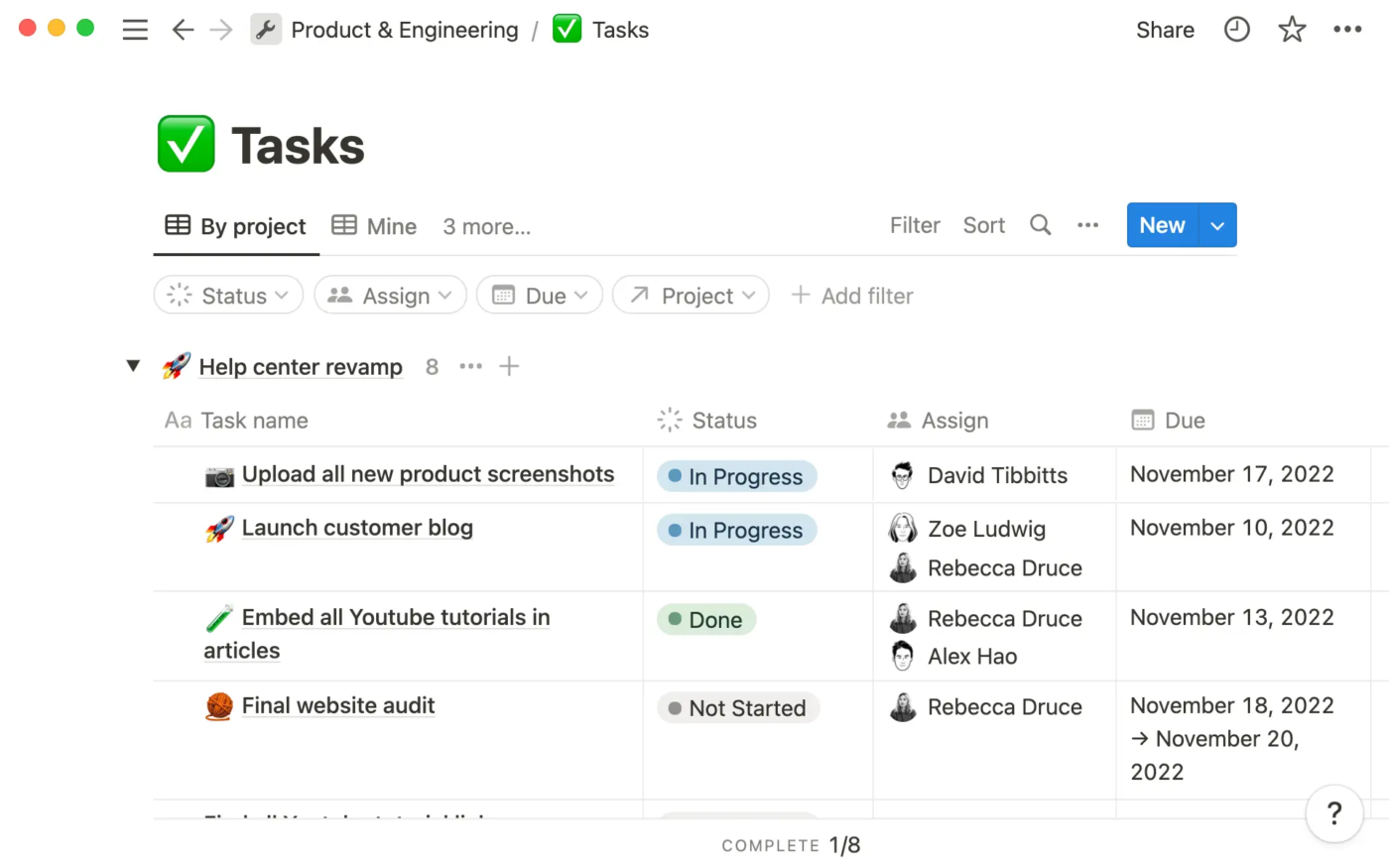
Notion is a blank canvas that becomes whatever you design: a task database, a habit tracker, a personal wiki, a reading list. For people who enjoy building their own system, this database software stands out.
What sets the workflow apart is that each database page opens into a full document. The creative brief, the draft, the research, and the feedback all sit inside the same card the team is tracking. Marketers stop digging through email threads and scattered drives for the latest version because the work and the tracking live in one place.
Notion AI runs inside that page. It drafts a post from a few rough bullets, summarizes a long document into a single paragraph, or pulls action items from meeting notes. You can move from idea to draft without opening a second tool.
A content team’s setup shows the payoff: one database holds every article, with properties for status, owner, target keyword, and publish date. The calendar view becomes the editorial calendar, the board view becomes the pipeline, and opening any card reveals the brief, the draft, and the reviewer’s comments on the same page. Nothing sits in a separate drive folder, so nobody asks where the latest version went.
When Notion is not an ideal choice: Notion is better for reading and light edits than fast capture on a phone. Building a new view from a small screen can feel complex.
Skip Notion if: You need fast mobile capture as your primary workflow, not a desktop-first system you check on your phone occasionally.
See how this G2 reviewer uses Notion to organize their university work:
What I like best about Notion is how it lets me combine all my university work in one place instead of switching between different apps. I can write lecture notes, organize assignments, and also include coding snippets with proper formatting, which is really helpful since my courses involve both programming and written content. It also makes it easy to structure everything by course and topic, so my notes don’t feel scattered and are easier to revise later. Overall, it helps me stay organized and keeps both my technical and written work connected in a simple, customizable way.
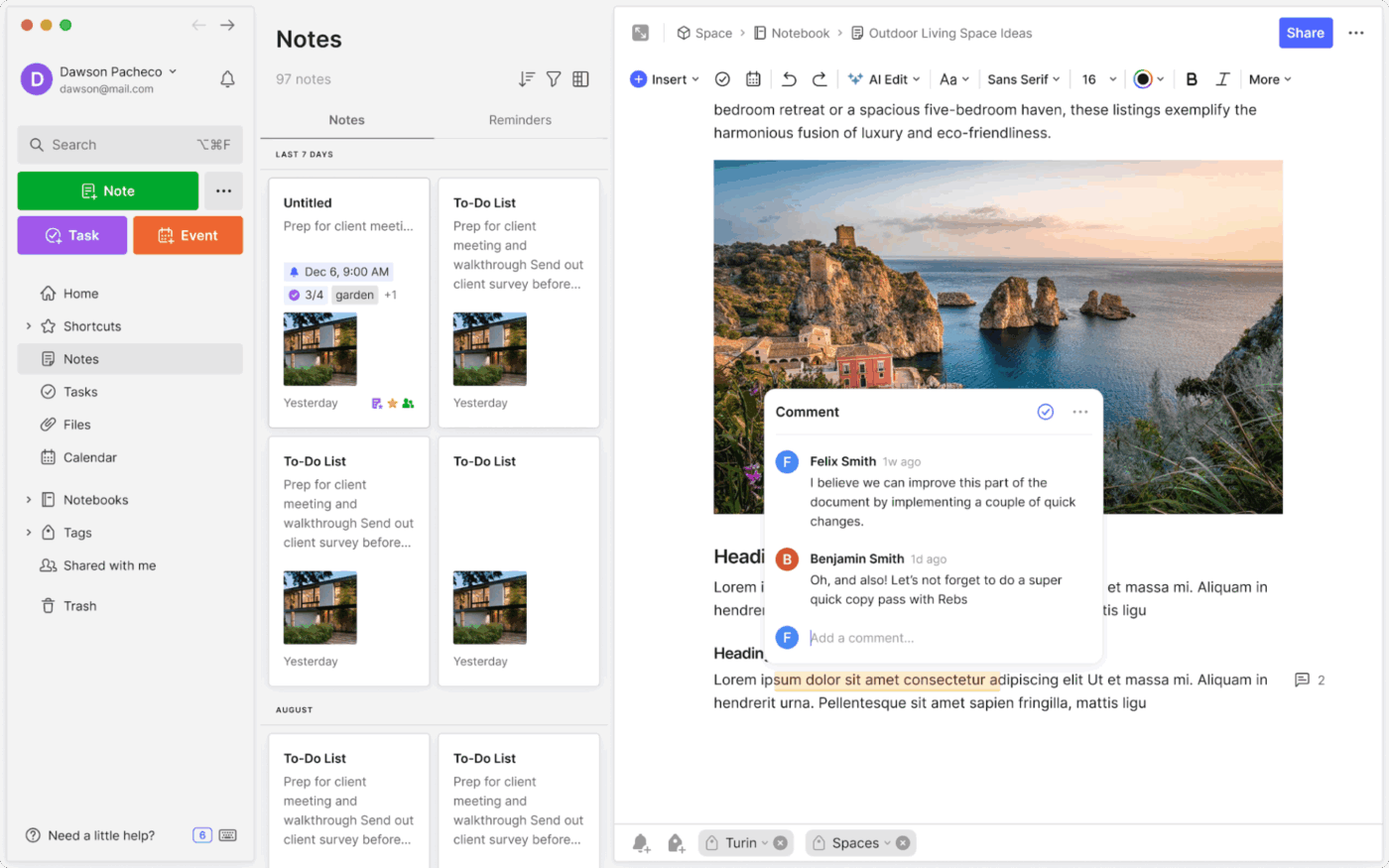
Evernote, a Notion alternative, is built for the person who saves first and sorts later. A researcher clips an article, a writer dumps interview notes, a scanned receipt gets filed, all without stopping to decide whether it matters yet. The pile grows fast, and in most apps, that’s where it turns into a graveyard.
What keeps it from becoming one is recall. Evernote searches the contents of what you saved, not just the titles, so text inside a PDF, a handwritten page, or an image still turn up months later.
Recent AI, built with OpenAI, pushes recall a step further. Describe what you’re after in plain words, and semantic search finds the closest notes. You can also hand a recorded interview to AI Meeting Notes and get back a searchable transcript.
A researcher’s workflow makes the case for Evernote: clip twenty sources during a literature review, photograph two pages of handwritten conference notes, and drop in a recorded interview. Three months later, searching for a phrase you half-remember surfaces the PDF paragraph, the handwriting, and the transcript together. That recall is the product. Evernote rewards saving without sorting, which is the exact habit most note apps punish.
When Evernote is not an ideal choice: Evernote can feel slow or heavy on mobile, especially on older phones. The mobile app is powerful once loaded, but launch time and sync speed lag behind lighter tools like Keep or Todoist.
Skip Evernote if: You want a lightweight, instant-open mobile app. Evernote’s mobile value is in its search depth, not its speed.
Hear about Evernote from this G2 reviewer:
I have been using Evernote since it was first released. Evernote has grown the list of features since the start, some like reminders I never use, but it does show the developer’s attention to detail. I use the system for writing and not taking. I do like the new AI features so I can record a meeting and have it translate to text.
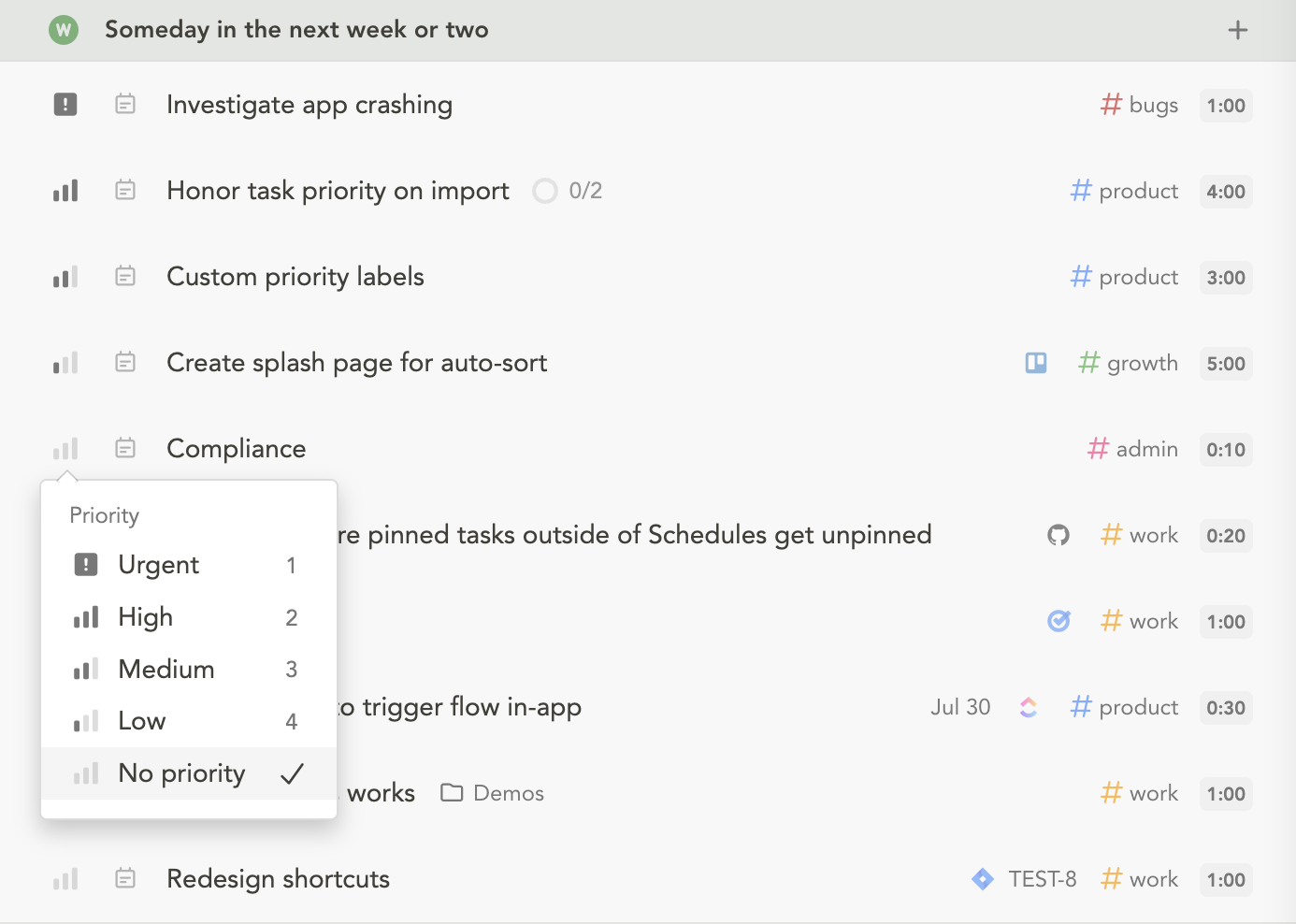
Sunsama is the outlier in the list. It takes a few minutes each morning to plan the day on purpose. You pick what matters today, estimate how long it takes, and stop when the day is realistically full.
The plan only works because the tasks come from everywhere at once. Sunsama pulls work from Asana, Jira, Trello, Notion, and other sources, plus emails and Slack or Teams messages, into a single list for the day. The schedule reflects what a day can actually hold, not your wish list.
Throughout the day, the digital planner focuses on protecting that plan. New work can slot in as it arrives, distracting apps can be muted, and reminders nudge a break before energy runs out.
What the ritual looks like: at 9 a.m., you pull today’s Jira tickets, two Slack requests, and three emails into one list, estimate each, and watch the total run past eight hours. Something moves to tomorrow before the day starts rather than after it fails. Sunsama does not replace Asana or Jira. It sits on top of them and forces the daily question: what can you actually finish today?
When Sunsama is not an ideal choice: Sunsama is built around its desktop and web app, where the planning ritual, timeboxing, and integrations all come together. The Android app is meant as a companion for quick check-ins, not a full replacement, so it leaves out some of that functionality.
Skip Sunsama if: You work primarily from an Android phone and need the full planning experience on mobile rather than a companion app.
See what Sunsama does for this Capterra reviewer:
It gives me a realistic picture of how I’m spending my time, which helps keep me aligned with my goals and intentions.
Picking the right organization app comes down to your workflow type, how it eliminates tool sprawl, and why it keeps you from quitting. This table maps all three.
| Organization app | Workflow type | Tool sprawl impact | Prevents you from quitting if… |
| Todoist / MS To Do | Simple tasks & deadlines | Single-purpose (keeps it simple) | You usually quit due to heavy setup friction |
| Google Keep / Evernote | Rapid notes & quick ideas | Single-purpose (low footprint) | You need zero-click mobile capture speed |
| TickTick | All-in-one solo planning | Replaces task app + calendar | You want consolidated tools without bulk |
| ClickUp | Team projects & workspaces | Replaces 2–3 separate workspace tools | You outgrow simple tools quickly |
| Notion | Content systems & databases | Replaces notes, docs, and databases | You need a system that adapts as you grow |
| Sunsama | Daily unified agenda | Integrates (doesn’t replace) Slack/Jira/Email | You get overwhelmed by multi-channel clutter |
Match the productivity app to the reason your last app didn’t stick, and you’ll pick better than any feature comparison chart can tell you.
If your needs are a quick grocery list or a single daily to-do, any of the lightweight apps here will do the job. Pick the one whose capture speed fits your reflexes. But if your organization problem is that tasks, notes, calendar, and team communication live in five different apps, a single-purpose tool adds a sixth place to check.
ClickUp eliminates that gap. Your tasks carry deadlines, docs live next to the work they support, the calendar shows what’s due beside what’s scheduled, and Brain keeps the whole system queryable without manual upkeep. One workspace replaces the sprawl.
Get started with ClickUp for free and see how many apps you can stop opening.
For most people, an all-in-one like ClickUp or TickTick is the best app to organize their whole life, because it keeps tasks, notes, calendar, and reminders in one place instead of scattered across single-purpose apps. TickTick suits solo users on a budget; ClickUp fits anyone consolidating several tools.
TickTick and Notion are the strongest student picks. TickTick bundles tasks, a calendar, habits, and a Pomodoro timer in one app; Notion’s free plan handles class notes, reading lists, and schedules in flexible databases. For fast, free capture of assignment reminders, Google Keep is hard to beat. Students already inside Google Workspace or Microsoft 365 get Keep or Microsoft To Do at no cost.
If Notion feels like too much setup, Todoist (tasks), Google Keep (notes), and TickTick (all-in-one) organize you out of the box with no template-building required. ClickUp’s Free Forever plan is the closest structured workspace alternative, with unlimited tasks, docs, and a calendar. The tradeoff: you get less customization than Notion, but you start organized on day one instead of building the system yourself.
Yes, organization apps can make you more productive when they replace tools rather than pile on top of them. A joint Qatalog and Cornell study found context switching hampers productivity for 45% of workers. So a new app you add alongside five others can cost more attention than it saves. The productivity gain comes from consolidation: fewer places to check means fewer chances to lose the thread.
The best work app depends on your existing stack. Microsoft To Do is the free default for Outlook and Teams users; ClickUp consolidates projects, docs, and tasks for people, replacing several tools; and Sunsama is best for a deliberate daily planning ritual with timeboxing. Match the tool to whether your bottleneck is capturing, consolidating, or choosing what to do today.
Apps win on capture speed, reminders, and sync; paper wins on focus and zero notifications. If you constantly capture on the go, a mobile app with a home-screen widget beats paper because ideas get saved before they evaporate. If your goal is deliberate daily planning without distraction, a paper planner or a ritual-based app like Sunsama can serve you better. Many people pair a fast capture app with a short paper or digital daily plan.
A to-do list app (like Todoist or Microsoft To Do) manages tasks: creation, deadlines, and completion. An organization app is broader, combining tasks, notes, calendars, file management, and project tracking in a single system. TickTick, Notion, and ClickUp are organization apps because they replace multiple single-purpose tools. The distinction matters when choosing: if you only need task capture, a to-do app is simpler. If tasks, notes, and planning are scattered across three apps, an organization app consolidates them.
TickTick is a common pick for people with ADHD because it combines tasks, reminders, habits, and a built-in Pomodoro timer, reducing the need to check multiple apps. Todoist’s instant natural-language capture helps externalize thoughts before they slip away. Avoid tools that require upfront configuration (like Notion) since setup friction is where many ADHD users typically abandon apps.
Yes. TickTick and ClickUp both support separate workspaces or projects for personal and professional tasks within the same app. TickTick’s free tier handles this cleanly for individuals; ClickUp’s Spaces let teams keep work projects visible only to colleagues, while a Personal List stays private. The key is an app that separates contexts without requiring two logins.

Manasi Nair
Max 26min read

Arya P Dinesh
Max 18min read
Arya P Dinesh
Max 20min read

© 2026 ClickUp




