

Sorry, there were no results found for “”
Sorry, there were no results found for “”
Sorry, there were no results found for “”
Search “due date tracking software” and the results can’t decide who you are. Half assume you’re an accountant, where a missed filing means penalties and an angry client. The other half assume you’re a team lead, where one slipped task drags an entire launch with it. Same phrase, two completely different tools.
That split is the whole game. Compliance dates are fixed, recurring, and tied to documents. Project dates move the moment priorities do. Only 36% of organizations finish projects on time, and choosing the wrong kind of tool is one reason why.
So the rule underneath all our nine picks below is simple: don’t buy for the deadline you track most often. Buy for the one that costs the most when it slips.
| Tool | Best for | Standout feature | Starting price* | Where it taps out |
|---|---|---|---|---|
| Financial Cents | Small accounting and bookkeeping firms | Recurring projects, client requests, reminders, capacity dashboard, and 400+ firm-built workflow templates | Paid from $19/mo for one user | Less useful for broad cross-department project work |
| TaxDome | All-in-one tax practice management | Pipelines, client portal, documents, signatures, billing, reminders, and deadline dashboards | Paid from $800/year per seat | Needs real setup across pipelines, templates, automations, and client workflows |
| Canopy | Accounting firms that want room to scale | Task plans, relative due dates, recurring work, client files, billing, capacity planning, and tax tools | Paid from $74/user/mo | Recurring workflow automation and capacity planning start on Plus |
| Jetpack Workflow | Simple, recurring accounting deadlines | Recurring jobs, workflow templates, checklists, progress reports, and cascading service updates | Paid from $40/user/mo | No client portal, document management, e-signatures, or billing |
| File In Time | Desktop tax-calendar tracking | Built-in federal and state tax due dates, workload views, staff assignment, and rollover tasks | $199/user one-time purchase | Desktop-first and narrow; no cloud, mobile, portal, or wider practice workflow |
| ClickUp | Due dates across teams and projects | Start and due dates, Calendar, Gantt, Workload, reminders, templates, date remapping, and Dashboards | Free; paid from $7/user/mo | Needs setup around dates, recurring tasks, and team deadline views |
| Motion | Automatically scheduling work before deadlines | AI auto-scheduling that places tasks around meetings and warns when time runs out | Paid from $19/seat/mo for business users | Not built for compliance calendars or large project portfolio management |
| Asana | Portfolio-wide due date visibility | Timeline, dependencies, Portfolios, Workload, rules, and cross-project deadline tracking | Free; paid from $10.99/user/mo | Portfolio and workload tools sit on higher plans |
| Todoist | Personal and lightweight due date tracking | Natural-language due dates, recurring tasks, reminders, Upcoming view, and custom filters | Free; paid from $5/mo | No dependencies, workload planning, true start dates, or portfolio controls |
Our editorial team follows a transparent, research-backed, and vendor-neutral process, so you can trust that our recommendations are based on real product value.
Here’s a detailed rundown of how we review software at ClickUp.
Due date tracking software monitors deadlines and sends escalating reminders as they approach; compliance-focused tools also tie each date to client documents and an audit trail. The best due date tracking software covers eight essentials: recurring-deadline support, automated reminders and escalations, client and document collection, calendar sync, dependencies, an audit trail, integrations, and mobile access.
Which ones matter most depends on what your deadlines are like. Are they recurring or one-off? Penalty-bearing or movable? Tied to documents or tied to tasks? Good due date management comes down to that fit, not the length of the feature list.
Once you know which pattern describes your work, most tools rule themselves in or out. Here’s the rubric you can apply:
Before comparing the tools, here’s a quick look at how AI-assisted scheduling can balance calendars, workloads, and deadlines in practice.
The first five tools serve the dominant searcher—accountants and bookkeepers tracking compliance deadlines. The last four serve teams and individuals tracking project and personal due dates.
Financial Cents is practice management software for accounting firms that run the same deadline work across dozens of clients. It fits solo bookkeepers and small firms that have outgrown spreadsheets but don’t need a full tax prep suite.
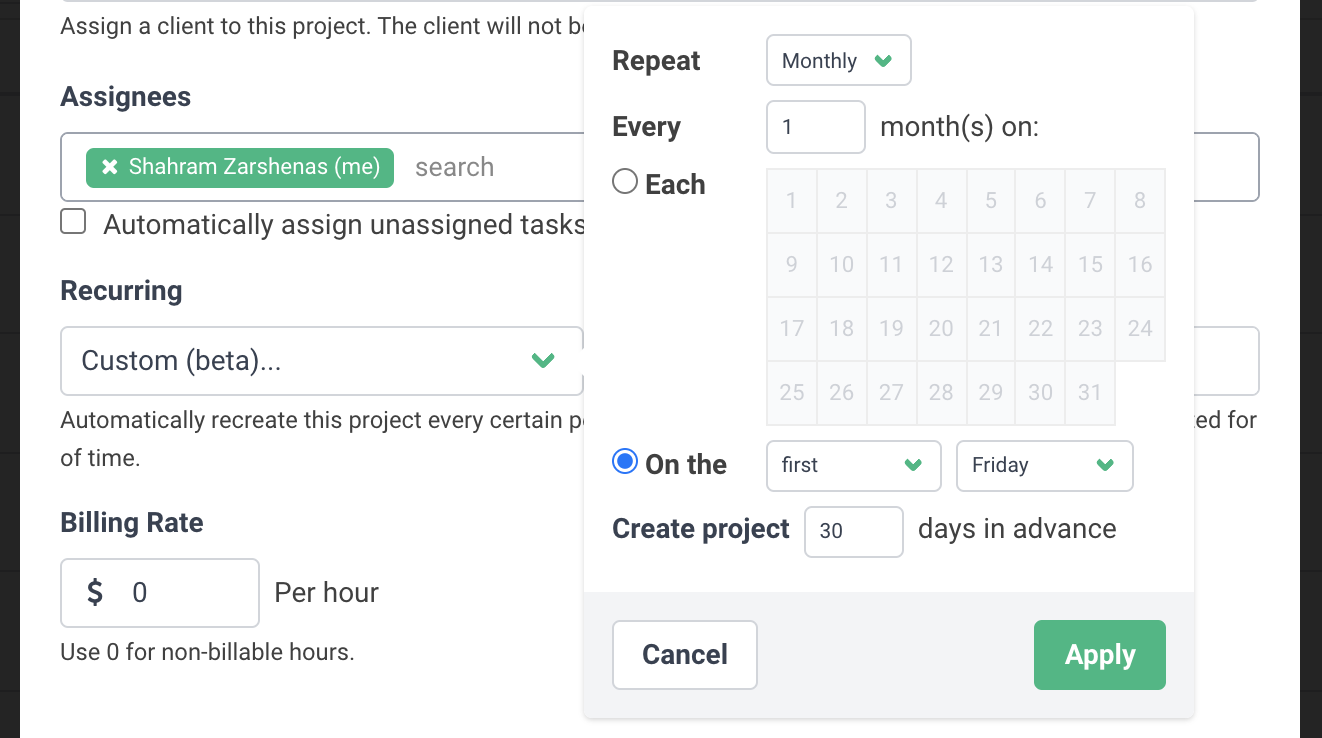
Recurring projects handle the predictable side of the calendar. You set up a monthly close, payroll cycle, or tax job once, and Financial Cents rebuilds it on schedule each time without making you redo the setup.
Client requests handle the rest. Firms can request documents directly within the project and choose when the request goes out. From there, email or text reminders keep nudging the client until they reply via a passwordless portal.
A Capterra user shared:
Financial Cents has transformed the way I manage client tasks. The intuitive dashboard allows me to easily assign, track, and prioritize tasks for each client. The ability to set due dates and receive reminders ensures that nothing falls through the cracks. This has streamlined my workflow, making it easier to stay on top of all client engagements.
Where it taps out: Financial Cents is built around firm work, so it is less useful for teams running projects across many departments. The per-user cost can also climb fast as you add staff.
Best for: Solo practitioners and small accounting firms whose due dates depend on recurring client work and documents arriving on time
Skip it if: You need a broad project management platform or a full tax suite with built-in preparation tools
TaxDome is an end-to-end practice management platform for tax, bookkeeping, and accounting firms. It suits established practices that want due dates, client communication, documents, billing, and signatures in one system.
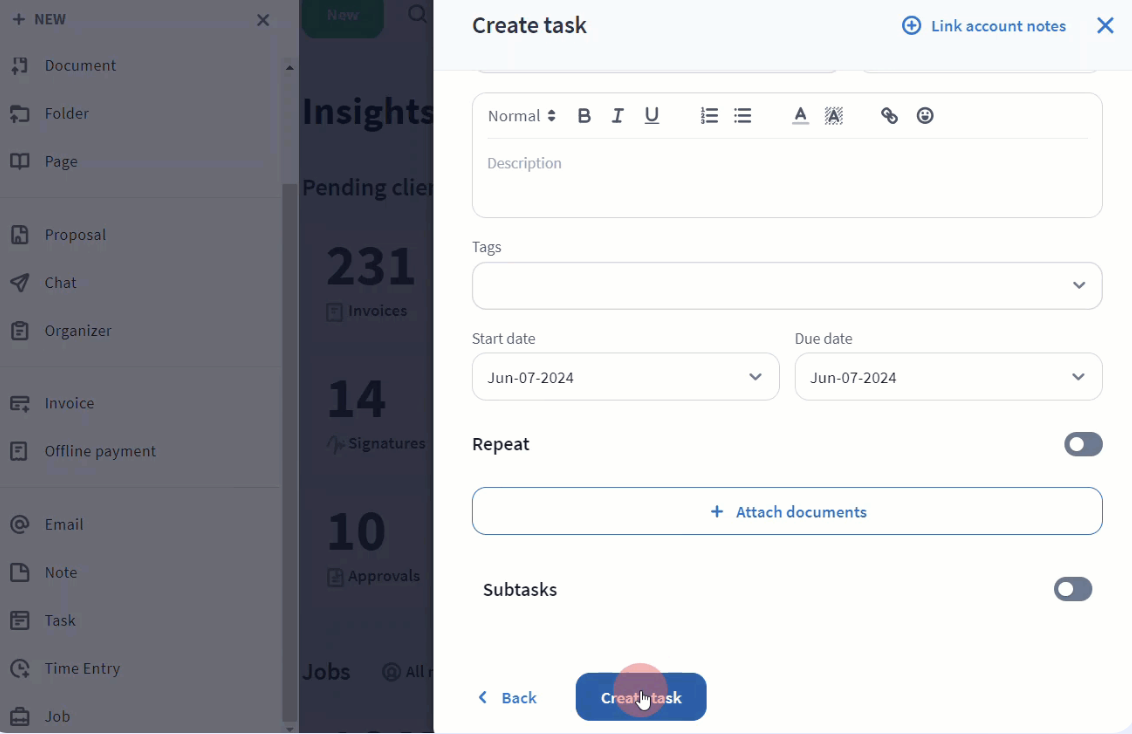
Its pipelines give each job a clear path from intake to filing. A client’s return moves through set stages, and the team can see what’s due, who owns it, and what’s holding it up. TaxDome can also push a job to the next stage when a linked event happens.
The rest of the platform keeps the client-side deadline tied to the work. Clients can upload documents, respond to requests, exchange messages, sign returns, and pay invoices through the secure portal or mobile app. Meanwhile, the firm tracks the entire job from a single record.
With a one-year commitment:
A G2 user mentioned:
TaxDome helps us stay on top of projects and due dates. We no longer have to worry so much about things falling through the cracks. With, pipelines, and tasks, each team member knows what they are supposed to be working on.
Where it taps out: TaxDome takes real setup work. Pipelines, templates, tags, automations, and client-facing processes all need mapping before the platform feels smooth. Its annual per-seat pricing can also become a substantial upfront commitment as the firm grows.
Best for: Multi-person tax firms that want deadlines, documents, signatures, billing, and client communication under one roof
Skip it if: You want a lightweight deadline tracker, a quick setup, or flexible month-to-month pricing
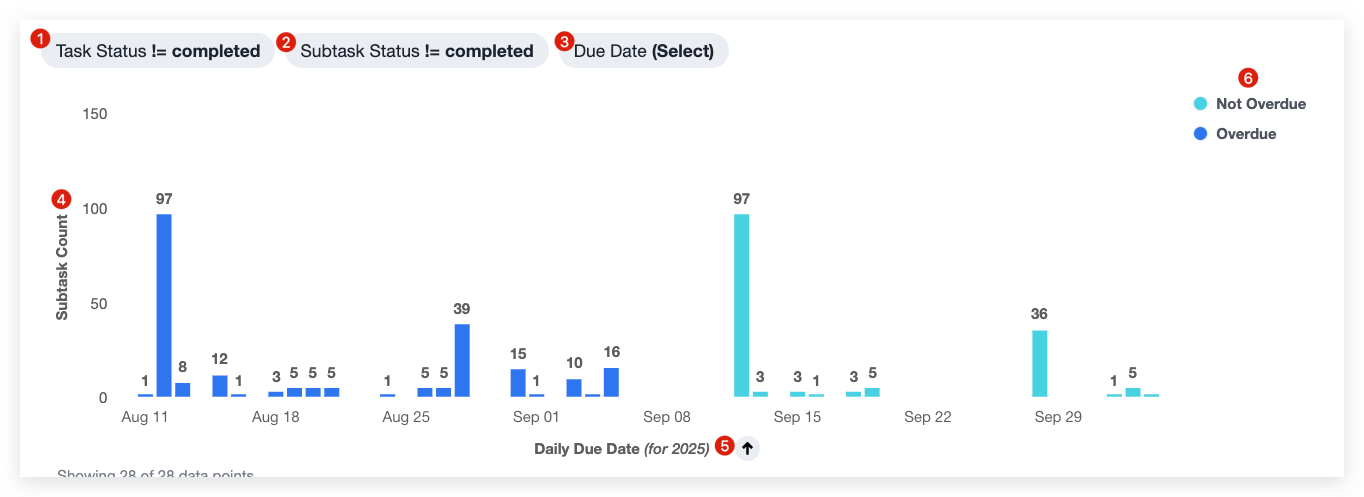
Canopy started as tax resolution software and grew into a full practice management suite, and that lineage still shows. Client records, files, deadlines, billing, and messages all sit in a single workspace, but the tax firm’s DNA runs deeper than that of most rivals. It’s suitable for growing CPAs and tax firms who are beyond basic deadline tracking, but are not yet ready for the enterprise overhead.
For due date tracking, Canopy assigns each job a task plan. Each plan has owners, statuses, subtasks, client requests, and fixed or relative due dates. Relative dates are a big help for tax work. A review deadline can shift on its own, based on when prep wraps up.
Recurring tasks rebuild monthly, quarterly, or yearly work on the right schedule. The firm-wide dashboard then shows what’s open, overdue, or waiting on the client.
Note: Automated recurring workflows and capacity planning begin on the Plus plan.
A G2 user shared:
Complete practice management system that helped us eliminate a multitude of apps and enabled me to sleep at night, knowing that in all phases of our practice – accurate client data, workflow, scheduling, billing, due date monitoring – Canopy handles it all.
Where it taps out: Canopy’s current bundled plans are less flexible than its old module-by-module pricing. Firms that need recurring workflow automation must start with Plus, and specialist tax tools add another layer of cost.
Best for: Growing accounting and tax firms that want deadline tracking connected to client files, billing, capacity, and tax work
Skip it if: You only need a low-cost due date tracker or still prefer to buy practice management features one module at a time
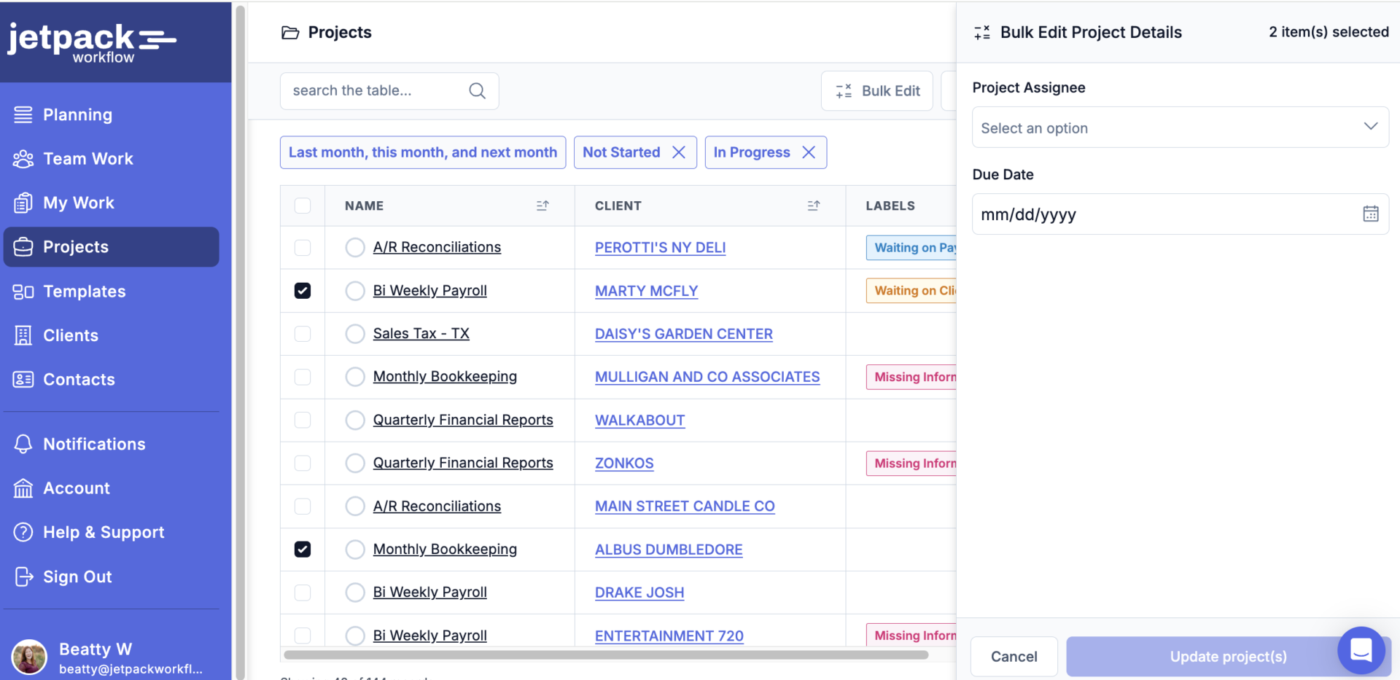
Ask a small firm why a deadline slipped, and the answer is rarely the tooling. It is the recurring work: the monthly books, the quarterly payroll, the annual returns that quietly drop off the radar. Jetpack Workflow is built for that gap and nothing else. It tracks recurring jobs for CPA, bookkeeping, and tax shops, and it deliberately skips portals, billing, and document storage to stay fast.
Jetpack’s dashboard lists every active client job on a single scrollable screen. Teams can sort it by client, assignee, status, and due date. That answers the question that matters on a busy morning: what’s due, and who owns it?
Custom recurrence rules rebuild work daily, weekly, monthly, or on a schedule you set. Payroll runs and bookkeeping cycles then come back on their own, with no manual setup.
A G2 user mentioned:
Jetpack Workflow gives you a place to put all tasks that we have due monthly, quarterly, bi-annually, and annually, prioritize those tasks, assign them, and show the workflow of who, how, and when items need to be finished and reviewed.
Where it taps out: Jetpack Workflow is strongest at internal job and due date tracking. But it doesn’t offer the client portal, structured document management, e-signatures, or broader communication tools you get in full practice management suites.
Best for: Small accounting firms that want recurring jobs, checklists, and due dates without a long implementation process
Skip it if: You want client communication, document management, billing, and deadline tracking inside one platform
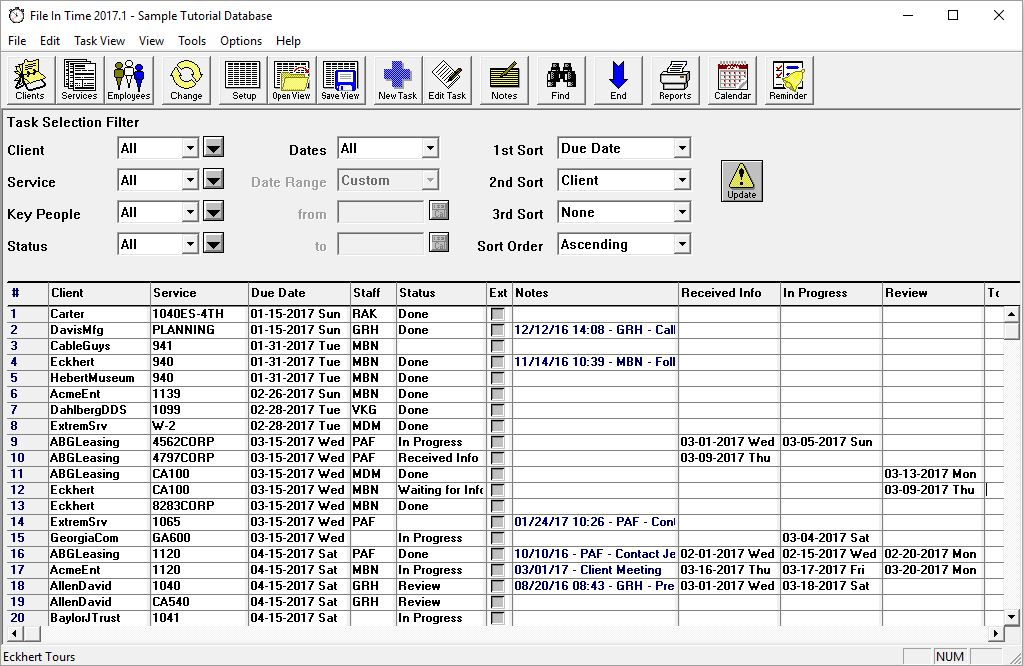
File In Time is a Windows-based due date tracker for tax and accounting firms. It gives you a dedicated filing calendar instead of a full practice management suite. It fits smaller firms that still work mainly from the desktop and prioritize accurate tax data over client portals, billing, or collaboration tools.
The software ships with built-in due dates for nearly 200 federal and state income tax returns. Assign the right services to a client, and File In Time creates the filing tasks for you. You never type a deadline by hand.
It can also track custom work, from recurring bookkeeping jobs to one-off projects and internal reminders.
Note: File In Time has too few public reviews to source a representative user quote, so we’re relying on our personal testing.
Where it taps out: File In Time is a narrow, desktop-first tracker. It does not replace a client portal, document system, secure messaging tool, or full practice management platform.
Best for: Small tax and accounting firms that want built-in filing dates and straightforward desktop deadline tracking
Skip it if: You need cloud access, mobile work, client collaboration, or one platform for the wider firm workflow
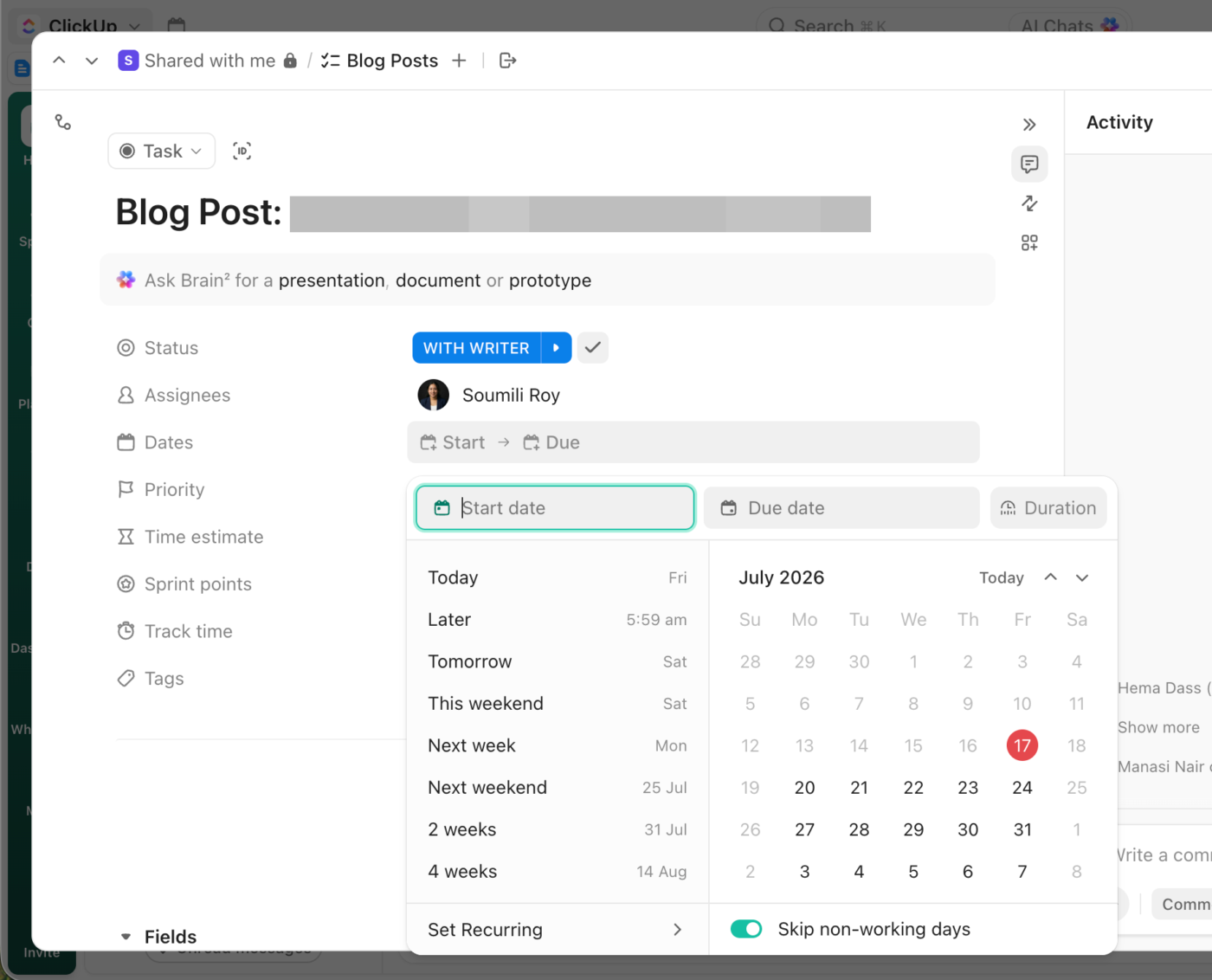
ClickUp is a converged AI workspace, and it shines when due dates span multiple kinds of work. Teams can assign tasks with both start and due dates, add exact times, and manage those dates in List, Board, Calendar, Gantt, Workload, or Table view.
Due dates also change color as work moves from upcoming to due today, overdue, or done on time. That makes late work easy to spot without opening each task. On top of that, ClickUp’s AI-powered Calendar can auto-schedule tasks around your meetings, and rebuild the plan when a meeting appears or a task runs late.
Its date-remapping tools are a real help for repeat projects. Save a launch, audit, campaign, or client workflow as a template, then remap every task’s dates around the new deadline when you reuse it. ClickUp can also push subtask dates forward when a parent deadline shifts. It keeps the gaps between steps intact, so no one reschedules them manually.
A G2 user said:
Honestly, what I love most about ClickUp is how it just gets out of my way and lets me run my life the way I want to. Like, I can have my whole week laid out in a list view, then flip to a calendar and suddenly everything makes visual sense same tasks, totally different perspective. That flexibility is kind of addictive.
And the customization! I’ve set up my personal space exactly how my brain works priorities, due dates, little color tags and now opening it in the morning feels less like a chore and more like having a game plan. It actually makes me want to stay on top of things, which honestly says a lot.
Where it taps out: ClickUp gives teams many ways to structure dates, views, reminders, and reports, and that range does take some setup. A team still has to decide which work gets a start date, how recurring tasks regenerate, and which deadline views people are expected to check.
Best for: Cross-functional teams that need one due date system across projects, campaigns, client work, operations, and recurring processes
Skip it if: You need a preloaded tax calendar or a narrow personal reminder app with almost no configuration
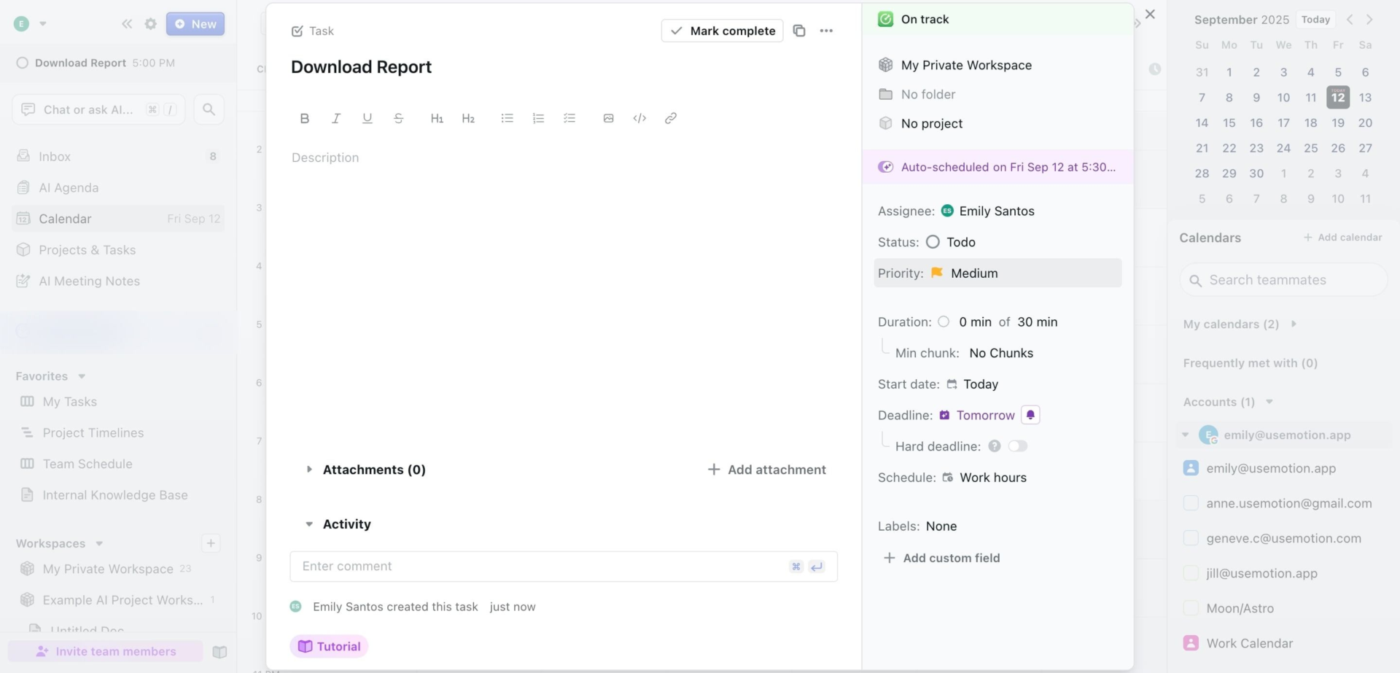
Motion is built for those who know what’s due but struggle to make room for the work. Add a task with its duration, priority, start date, and deadline, and Motion will slot it in an open block on your calendar. It suits solopreneurs and small teams whose deadlines slip because meetings and urgent requests keep taking over the day.
The schedule does not stay fixed, either. When a meeting appears or a task runs late, Motion moves the remaining work into the next available slots.
It also treats hard and soft deadlines differently. Hard-deadline work gets stronger protection, while flexible tasks can move when the calendar becomes crowded.
A G2 user commented:
Motion has elevated my productivity to the max. I am am able to enter task for different projects and have an organized and timely calendar to follow. I use motion every single day and it has been instrumental to improving my work flow.
Where it taps out: Motion works best when a deadline can be translated into blocks of working time. It doesn’t include statutory filing calendars, compliance workflows, or the detailed portfolio structure found in a larger project management platform.
Best for: Individuals and small teams that need tasks automatically placed around meetings before the due date arrives
Skip it if: You need industry-specific compliance dates or a deep system for managing large, interconnected projects
Also Read: Deadline Management for Writers
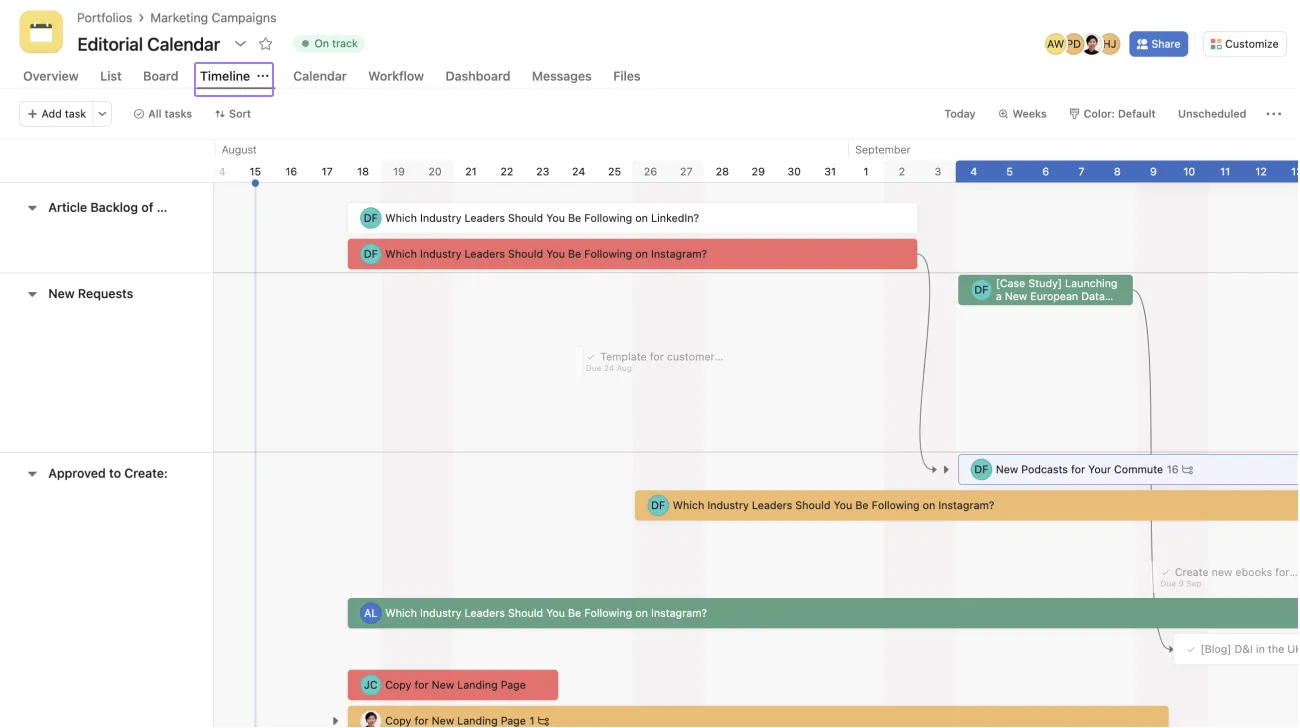
Asana works well when deadlines sit across several teams and projects, and leaders need one place to see how those dates connect. It suits larger departments and PMOs who have moved past individual task lists but still want a system that’s easier than a heavy enterprise tool.
Timeline view in Asana turns project due dates into a visual schedule, with date ranges and dependencies laid out on one screen. When one task blocks another, teams can fix the sequence right on the timeline.
Asana can also automatically shift dependent dates when an earlier deadline changes. That keeps the rest of the plan aligned, instead of leaving every later date to fix by hand.
A G2 user mentioned:
The ability to set flexibly recurring tasks, to set reminders for further out future dates, to keep track of delegated tasks, to add subtasks to note when action has been taken, even if the original item isn’t yet done. I like being able to add tasks by email (though I wish there was a way to set a deadline via email). Access via browser or mobile device. Comparative easy for learning basic functionality for new users. Views for more visual people vs. more list or data-oriented users.
Where it taps out: Asana’s strongest cross-project tools sit on the Advanced plan. Smaller teams may end up paying for portfolio and workload features before they need the rest of that tier. Complex setups can also get harder to maintain as rules, custom fields, and projects multiply.
Best for: Larger teams and PMOs that need to compare due dates, workload, and project health across departments
Skip it if: You only need a simple deadline list or want portfolio-level reporting at an entry-level price
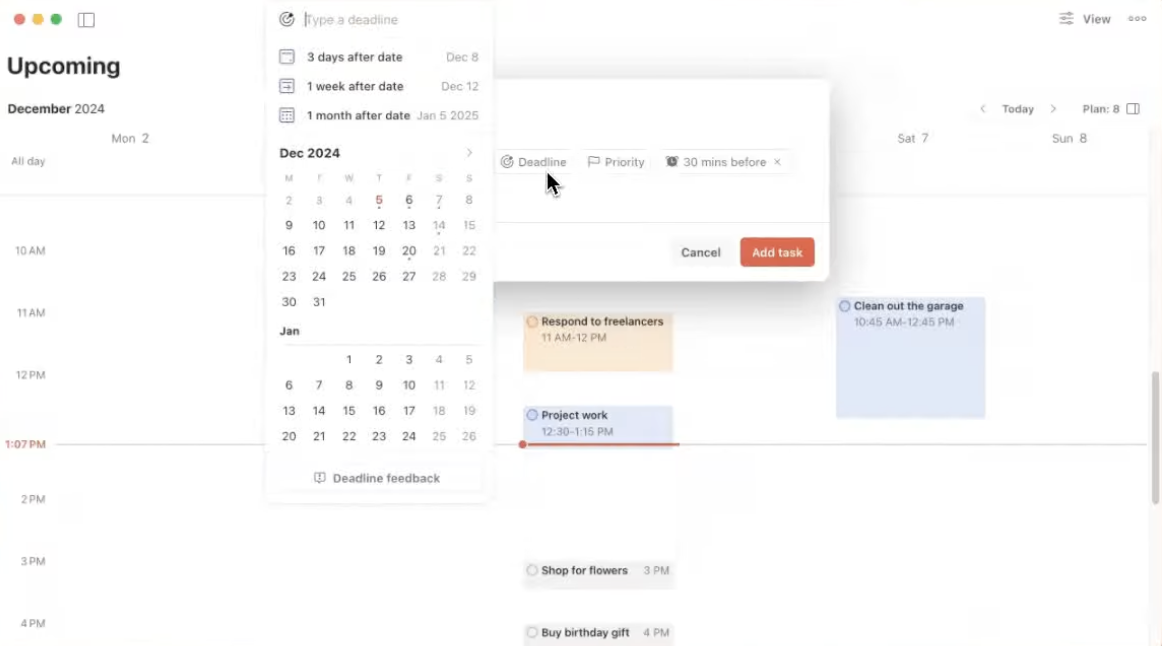
Todoist is for individuals and freelancers who want to record a deadline before it slips their mind. Its natural-language input makes that fast. Type “send invoice every last Friday at 3 pm,” and Todoist turns the phrase into a recurring task with the right schedule.
It also handles the difference between when you plan to work and when the work must be finished. You can schedule a task for Monday, add a firm deadline for Friday, and keep both dates visible. That small distinction makes Todoist more useful for real deadline planning than a basic to-do list.
A G2 user wrote:
Best-in-Class Natural Language Input: You can type a messy sentence like “Review the budget every second Friday at 10am #Work p1” and the app instantly parses the date, time, project, and priority. This removes the friction of clicking through menus just to get a thought out of your head.
Where it taps out: Todoist keeps personal deadlines clear, but it lacks task dependencies, workload planning, and detailed portfolio controls. It also does not support true start dates that hide work until it becomes active.
Best for: Individuals and freelancers who want a fast way to capture, repeat, filter, and review personal deadlines
Skip it if: You need dependency-based scheduling, compliance workflows, or detailed coordination across a large team
Choose based on what sets your deadlines: a fixed filing calendar or shifting project priorities. Compliance-driven firms should match a practice management tool to their size and document workload; project teams should pick for how their dates connect across people, tasks, and dependencies.
You’re in the accounting camp. Match the tool to the size and shape of your firm:
You’re in the generalist team camp, where the split is just as clean:
Stay on a spreadsheet if you’re one person tracking fewer than a dozen or so recurring deadlines, ideally with a daily task tracker in Google Sheets. But move the moment reminders and ownership start slipping
One rule cuts through all of it: don’t buy for the deadline you track most often, buy for the one that costs the most when it slips. A compliance firm that treats statutory dates like flexible project tasks will eventually miss a filing. A cross-functional team that forces shifting work into a fixed tax calendar will fight the tool every week. Match the software to the deadline that hurts, and the rest follows.
Deadline escalation is the practice of scheduling reminders that intensify as the due date approaches, matched to the cost of a deadline slip. A single alert rarely works, especially when the deadline depends on clients, reviewers, or other teams.
Use the deadline’s cost and complexity to set the cadence:
| Deadline type | First reminder | Escalation | Final alert |
|---|---|---|---|
| Statutory filing | 30 days before | 14 and 7 days before | Daily during the final 3 days |
| Client document request | 14 days before | 7 and 3 days before | Alert the account owner |
| Project milestone | 7 days before | When the task becomes at risk | Notify the owner and blocker |
| Personal task | 1–3 days before | Morning of the due date | Send an overdue reminder |
Keep the escalation tied to action. A useful alert should say what’s late, who owns it, what’s blocking it, and what happens next. Otherwise, it becomes another notification people learn to ignore.
And don’t use the same cadence for every deadline. A tax filing that carries a penalty needs more lead time than an internal draft that can move by a day.
In a randomized trial with 5,709 clients of the Santa Clara County Public Defender’s Office, automated court-date texts reduced warrants for missed appearances by about 20%. The warrant rate fell from 12.1% among people who received no reminders to 9.7% among those who did. Incarceration linked to missed dates also dropped from 6.2% to 4.8%.
Lesson: Reminders work best when they arrive before the cost of inaction becomes irreversible. For a filing, that may mean prompting the client while there is still time to collect a missing document. For a project, it means flagging the blocker before the final due date is already at risk.
It always takes longer than you expect, even when you take into account Hofstadter’s Law.
Wrote cognitive scientist Douglas Hofstadter in Gödel, Escher, Bach. Deadlines are stubborn that way.
Due date software can tell you when work is late, but it can’t make an impossible plan doable. So before you set the date, pressure-test three things:
This matters because a reminder only helps when the work can still get done. If a tax filing is stuck waiting on client documents, or a milestone hangs on three unfinished tasks, one more alert won’t fix the real problem.
Use the software to catch feasibility early. Compare workload against available hours, add start dates, map dependencies, and check blocked work before the due date slides into the danger zone.
Two crowds, two toolkits. If your deadlines are statutory filings tied to clients and documents, a practice management tool is the honest answer, and the reviews above point to the right one by firm size. If your deadlines are project milestones tied to people and tasks, the right type of project management software will serve you far better than any tax suite.
For that second crowd, ClickUp tracks due dates, reminders, recurring tasks, and dependencies on every plan, so you can see every deadline and what it’s waiting on in one place.
Start tracking deadlines in ClickUp for free.
There’s no single best; it depends on which deadline costs the most when it slips. For statutory tax and client-compliance deadlines, practice management tools like Financial Cents, TaxDome, and Canopy lead because they tie due dates to clients and documents. For project and team deadlines, ClickUp, Asana, and Motion are stronger because they handle dependencies, workload, and scheduling.
Most firms use practice management software that clones a recurring deadline set across every client, instead of a manual spreadsheet. Tools like Financial Cents, TaxDome, Canopy, and Jetpack Workflow regenerate quarterly and annual filings automatically, request documents from clients, and keep an audit trail. Manual spreadsheets break down past roughly a dozen recurring deadlines or more than one person.
Yes. ClickUp’s Free Forever plan includes start and due dates, reminders, recurring tasks, and unlimited members. Todoist and Asana also offer free plans, though Todoist reserves custom reminders for paid users, while Asana’s Personal plan is limited to two users. Among the three, ClickUp offers the broadest free feature set for teams tracking deadlines across shared projects.
For US federal returns, the IRS failure-to-file penalty is 5% of unpaid tax per month, up to 25%, plus a separate failure-to-pay penalty and interest. That downside is why accountants treat statutory dates differently from movable project work and use software with a recurring filing calendar and an audit trail.
Yes, and for one person tracking a handful of recurring deadlines, it’s fine. The limit shows up around a dozen recurring deadlines across more than one person. Plus, spreadsheets don’t send reminders or assign ownership, so a missed date only surfaces when someone happens to look. That’s the point of switching to dedicated software.
They work for a handful of personal dates but break down fast for real deadline management: no recurring job templates, no dependencies, no escalating reminders, no ownership or audit trail. Most dedicated tools sync two-way with Google Calendar and Outlook instead of replacing them, layering reminders, recurrence, and reporting on top.
A task manager organizes what needs doing; due date tracking software emphasizes when things are due, through reminders, recurring dates, escalations, and (for compliance) document collection tied to each deadline. Many work platforms like ClickUp and Asana do both, but a dedicated deadline tool prioritizes never letting a date pass unnoticed.

Arya P Dinesh
Max 18min read
Arya P Dinesh
Max 20min read

Praburam Srinivasan
Max 45min read

© 2026 ClickUp




