

Sorry, there were no results found for “”
Sorry, there were no results found for “”
Sorry, there were no results found for “”
Half of all knowledge workers say they procrastinate most when the first step of a task is not obvious, according to ClickUp’s procrastination survey. Most people do not need more motivation. They need a list that turns vague work into a clear next action.
A task setup does that through five habits: capture, organize, prioritize, execute, and review. Get that loop right, and the tool matters less.
This guide shows how to run that loop across work deliverables, side projects, household logistics, and personal goals, even on a bad week. We’ll cover why most lists collapse by week two, how to choose today’s work, and how to set the system up in your current tool, with a ClickUp walkthrough if you want one workspace for tasks, notes, calendar planning, and AI reviews.
Most personal task lists fail because they collect obligations without turning them into decisions. That works on a light day. It breaks when real life adds volume, ambiguity, and competing deadlines.
A busy week is not just more tasks. It is overdue replies, shifting deadlines, errands, admin work, and one large project that keeps sliding to tomorrow. A flat list puts “reply to Sam,” “finish taxes,” and “think about career change” beside each other as if they require the same kind of attention.
They do not.
That is where most lists collapse: they collect the workload but never shape it into a plan.
These are the four gaps that usually cause the breakdown:
Tasks get scattered across Slack threads, email, conversations, and memory. Nothing is reliable, so your brain keeps scanning for what it might have forgotten.
Capture means getting a task out of your head and into one trusted place as soon as it appears. Research by E. J. Masicampo and Roy Baumeister found that unfinished goals triggered intrusive thoughts, but making a specific plan reduced that mental noise. A trusted task inbox does something similar: it gives each task a place to return to, so your brain can stop rehearsing it, over and over.
“Plan campaign strategy for Q2” sitting next to “Print boarding pass” makes both feel equally heavy. A project takes more than one action. If you treat a project like a task, it stays on the list without moving.
For example:
The task should tell you where to start. The project only tells you what you eventually want done.
When everything looks equal, urgency wins. Research on the mere urgency effect shows that people often choose time-sensitive tasks over more important tasks, even when the important task has a better payoff. The Eisenhower Matrix works because it separates urgency from importance before the day starts.
Tasks end up in a notes app, a project tool, email, sticky notes, and your head.
The cost is daily: you cannot see your full workload, so you cannot trust your own list. The same pattern shows up at work when information is split across too many tools.
Microsoft’s Work Trend Index found that 62% of workers spend too much time searching for information. Your task list should reduce the number of places you check each day.
A prettier list will not solve this. You need a repeatable process for capturing tasks, sorting them, choosing what matters, doing the work, and reviewing what changed.
Build a personal task system by choosing one trusted tool, capturing everything there, sorting tasks into a few broad categories, and reviewing the list daily and weekly. The goal is to reduce decision fatigue, not create a perfect productivity dashboard.
Here is how to set up a task list that supports those five habits.
The specific app matters less than checking the same place every day. Dedicated task managers like ClickUp, Todoist, Things 3, and Microsoft To Do work better than plain notes once you need due dates, reminders, recurring tasks, and multiple views.
If setup takes more time than doing the task, the system has become the task. Start simple, then add structure only when the list starts breaking.
Group tasks into 3 to 5 areas of responsibility: Work, Personal, Health, Side Project, and Household.
Here are a few simple setups:
Five buckets stay sortable. Twenty tags become their own organizing project. Categories let you focus on one area without losing sight of the rest.
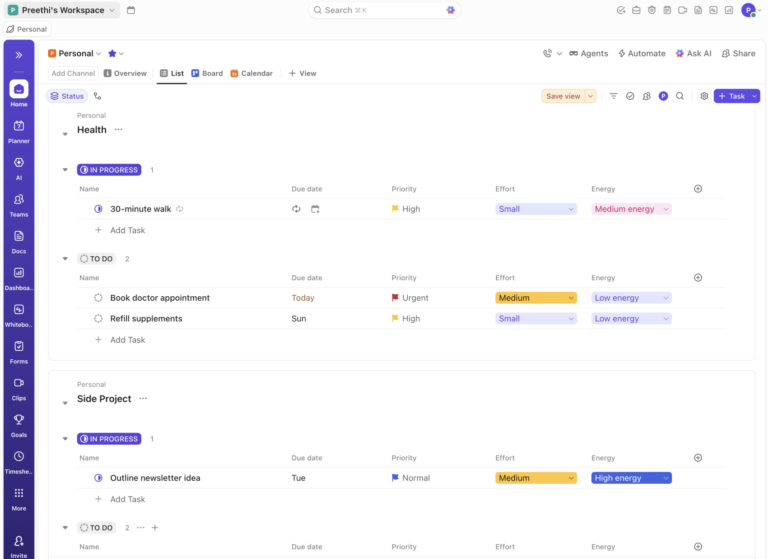
A simple list, like the To Do List Template in ClickUp, is enough to start. For personal use, rename the default categories to match your real areas, delete the team fields you will not use, and turn on Priority so urgent tasks do not sit beside nice-to-have tasks with the same weight.
Keep the setup shallow in week one. Configuration can feel like progress. The list only starts helping once you use it.
The instant a task enters your mind, it goes into the inbox of your chosen tool. Do not categorize it in the moment.
This is the core idea behind David Allen’s Getting Things Done. Capture every unfinished task, promise, idea, or follow-up before you decide what it means. Define the next action later.
Remembering work and doing work are separate jobs. Your task system should handle the remembering part.
Once a day, turn vague entries into concrete next actions. 50% of people who procrastinate say the reason is ambiguity about what to do first.
Quick test: if the task still makes you ask, “Where do I start?” it is not clear enough yet.
Clarifying the task is the fastest fix because it tells you exactly what to do next.
Artificial deadlines train your brain to ignore all deadlines. Reserve dates for tasks with genuine external commitments. For everything else, use a priority level or a “this week / next week / someday” bucket.
Anything you do on a cycle (weekly review, invoice clients, water plants) should reappear automatically. Here’s the difference between a list that collects tasks and a system that helps you act on them:
| Trait | Broken list | Working system |
|---|---|---|
| Capture | Memory and scattered notes | One inbox, captured immediately |
| Structure | One long undifferentiated list | 3 to 5 category buckets |
| Prioritization | Whatever feels urgent | Eisenhower or 1-3-5 |
| Review cadence | None | Daily 5 minutes, weekly 30 minutes |
| Tool count | 4 to 6 places | 1 trusted system |
Prioritize personal tasks by separating urgent work from important work, then limiting the day to one big task, three medium tasks, and five small tasks. This prevents the list from becoming a second job.
You don’t need to rank your whole life. You need a short list that decides today. Two methods cover most of the work without becoming their own job.
The 80/20 rule works when impact is measurable. Personal tasks are messier because value is not always obvious. “Did 80% of my life progress come from 20% of my laundry?” is not a useful question.
Eisenhower and the 1-3-5 rule are blunter, which is why they work. They do not pretend you can perfectly calculate the value of every personal task. They help you make a good-enough decision and start.
The matrix uses two axes: urgent and important. It is based on Dwight Eisenhower’s distinction between urgent tasks that demand attention now and important tasks that affect longer-term outcomes.
Do (urgent + important). Real deadlines and crises. Handle these first.
Schedule (important + not urgent). Deep work, planning, skill-building. This is where most meaningful progress happens, and where most people under-invest because nothing here is on fire.
Delegate (urgent + not important). Routine requests and interruptions. For personal tasks where you cannot delegate, batch them into a single time block.
Delete (neither). Tasks that have sat untouched for two weeks are telling you something. Delete them, defer them, or rewrite them into a clearer next action.
Use the matrix as a weekly sorting exercise. Do not turn it into a ritual for every task. During your weekly review, sort each task into a quadrant and let that decide what gets your time.
ClickUp’s Eisenhower Matrix template gives you a Board view with four columns: Do, Schedule, Delegate, and Delete. Drag your weekly captured tasks into the right column during your Sunday review, then move only the “Do” items and the top of “Schedule” into your daily 1-3-5 list.
The “Delete” column is the one most people skip. It does the hardest work: removing tasks that no longer deserve attention.
Each day, commit to finishing 1 big task, 3 medium tasks, and 5 small tasks. Nine items, maximum.
A realistic 1-3-5 day might look like this:
It works because it forces you to accept finite capacity. A crowded daily list is a wish list. A nine-item list is a plan.
The pull toward clearing small tasks instead of starting big ones is real. The 1-3-5 rule accounts for it by making the “1” non-negotiable before anything else gets touched.
Real days will not always fit neatly into nine tasks. That is fine. The 1-3-5 rule forces a decision before the day starts, before urgency makes the decision for you.
Use the methods together: your 1 big task each day should usually come from the Schedule quadrant of your Eisenhower review.
Start by shrinking the task until the first step feels almost too small to avoid. Most stalled tasks are too vague, too large, or too emotionally loaded.
The routine works most of the time. Then a Tuesday hits where you cannot start anything.
When that happens, the next action is probably too large, too vague, or too emotionally loaded.
ClickUp’s survey found that 42% of people regularly feel overwhelmed and then procrastinate. Another 39% say urgency is the only thing that gets them moving, which is itself a risk factor for burnout.
Start with these five tactics.
Procrastination usually means the task is too vague or too big. “Write report” becomes “open a blank doc and write the first three bullet points.” Start small enough to create movement. Once the task is open, the next step usually gets easier.
This works because overwhelm often comes from too many undefined steps.
Assign tasks to specific hours. A task without a slot competes with every other task and usually loses to whatever feels easiest, loudest, or newest.
If your tasks keep floating, put them on a calendar. Drag the most important tasks into actual time blocks and protect those blocks like appointments.
Group all email replies into one block. All errands into one trip. All admin in one afternoon. Context-switching between unrelated tasks is more draining than the tasks themselves. Gloria Mark’s UC Irvine research is still widely cited for showing how expensive interruptions can be. In one study, workers took about 23 minutes to return to a task after an interruption.
In a modern workday full of chat pings, emails, and app switching, batching similar tasks is one way to reduce those attention resets.
Decide in advance when you stop. An open-ended workday makes every unfinished task feel like a personal failure. A defined boundary lets you close the list knowing tomorrow exists.
Notice the tasks you consistently avoid. If they are all the same type, such as ambiguous work, feedback-dependent work, or creative work, change how those tasks are set up.
One boundary matters here: A task system can help with occasional overload. It cannot fix a workload that is too large for your hours, energy, or support.
Keep your task list useful with a short daily review and a deeper weekly reset. The daily review keeps today clear; the weekly review removes stale work before it turns into clutter.
Without review, every list drifts back into the same mess it replaced. A review is what turns it back into a usable plan.
Daily review (5 minutes). At the start or end of the day, scan your list. Mark anything completed. Move what shifted. Pull tomorrow’s 1-3-5 into your “today” view.
This is a quick sync between your list and reality. Without it, yesterday’s plan quietly becomes today’s clutter. A simple daily goal template makes the daily 1-3-5 pull explicit, with three sections labeled “1 Big,” “3 Medium,” and “5 Small.”
Weekly review (15 to 30 minutes). Once a week, take 15 to 30 minutes for a deeper review. David Allen recommends Friday afternoon or Sunday evening. Process your inbox to zero. Review each category. Ask what is stale. Delete anything you have avoided for more than two weeks. Check the next 7 days for fixed deadlines.
A weekly review can follow five questions:
In practice, the weekly review is the habit most people skip before their task list falls apart. Run it even when nothing else from this article sticks.
Monthly or quarterly adjustment. Zoom out. Once a month or quarter, check whether your categories still match your life. Add a category if a new role, side project, or responsibility has appeared. If the tool itself feels hard to trust, adjust the setup before you abandon it.
The best personal task app is the lightest tool you will actually check every day. Use Apple Reminders or Microsoft To Do for simple reminders, Todoist or Things 3 for daily planning, and ClickUp or Notion when tasks need notes, projects, calendars, and reviews.
For most people, that means a dedicated task manager instead of a notes app. Notes apps are good for ideas. Task managers are better for due dates, reminders, recurring tasks, priority levels, and daily planning.
The most common mistake is picking the most-featured tool. People reach for ClickUp or Notion thinking they need power, then quietly default to Apple Reminders three weeks later because the simpler app actually gets opened. The opposite mistake is just as common: picking Apple Reminders for a workload that genuinely needs project hierarchy, then losing track of half of it.
The right answer is the lightest tool that covers everything you actually do, not the one with the most features on the marketing page.
Here is the practical breakdown:
| App | Best for | Why it works | Watch out for |
|---|---|---|---|
| ClickUp | People who want work tasks, personal tasks, Docs, calendars, and AI summaries in one workspace | Strong for complex personal systems, side projects, recurring reviews, and work-life overlap | More setup than a simple reminders app |
| Todoist | People who want a clean personal task manager | Fast capture, natural-language input, labels, filters, and recurring tasks | Limited project documentation compared with ClickUp or Notion |
| Apple Reminders | iPhone and Mac users who want simple reminders | Built into Apple devices, easy recurring reminders, location-based alerts | Not ideal for complex projects or detailed prioritization |
| Microsoft To Do | Outlook and Microsoft 365 users | Works well with Microsoft accounts and the “My Day” planning flow | Less flexible for multi-view planning |
| Things 3 | Apple users who want a polished personal productivity app | Clean structure with Today, Upcoming, Anytime, and Someday | Apple-only and paid |
| Notion | People who want custom dashboards and databases | Flexible for life dashboards, notes, and project pages | Can become overbuilt quickly |
A good rule: choose the lightest tool that supports your real workload. If you only need reminders and recurring chores, use Apple Reminders or Microsoft To Do. If you want fast capture and clean daily planning, use Todoist or Things 3. If your tasks bleed into notes, calendar planning, and project documents, use ClickUp or Notion.
This section shows how to set up the same method in ClickUp. Skip ClickUp if you only need reminders, chores, and basic recurring tasks. Use it when your tasks, notes, calendar blocks, and recurring reviews need to live in one workspace.
Create a Space called Personal. Inside it, create one List per area of responsibility: Work, Health, Side Project, Household, Finance. Keep it under five active Lists. Projects live as a group of ClickUp Tasks inside the relevant List, not as their own Lists. Multiplying Lists is the same mistake as multiplying apps.

Enable the Priorities ClickApp from the App Center for the four-level Urgent/High/Normal/Low system. Then create a Custom Field called Effort with three options: Small, Medium, Large. The Effort field directly supports the 1-3-5 rule: filter your daily view to confirm one Large, three Medium, five Small.
Open any task, click the date field, and set a recurrence pattern. Use this for weekly reviews, fitness check-ins, recurring errands, invoice reminders, and budget reviews.

ClickUp Calendar syncs with Google or Outlook, so meetings and task blocks live side by side. Drag tasks from the Planner Sidebar onto your calendar to create focus blocks, or let ClickUp’s AI suggest blocks based on time estimates and priority.
My Tasks brings everything assigned to you into one view. For the weekly review, ask ClickUp Brain to summarize tasks from the past 7 days, list open tasks by priority, or surface what’s due in the next 10 days.

Trip planning, job-search notes, renovation specs, and freelance project scoping need more space than a task description provides. Create a ClickUp Doc and use Relationships to link it to the relevant tasks.
ClickUp has a learning curve. If your personal system only needs simple lists, recurring reminders, and due dates, a lighter app may be better.
ClickUp makes sense when your tasks, project notes, calendar blocks, and AI reviews need to live together. If that does not matter, choose the simpler tool. Good task management starts with the lowest-friction setup you will actually use.
Start managing your personal tasks in ClickUp →
A personal task setup only works after you run it for a full week. Do not rebuild your setup every morning. Pick one tool, move every loose task into it, and run one review before deciding whether it works.
The method is simple. The hard part is trusting it long enough to stop rebuilding your plan every morning.
Unreviewed lists leave you guessing every morning. Categories, priority rules, and a weekly reset show what deserves attention next. The goal is finishability, not maximum output.
Do three things this week:
Then stop reading productivity articles for a while. Your setup gets better when you run it, not when you read about running it.
A working task setup helps you actually finish tasks. More importantly, it frees the mental energy you were spending on remembering, worrying, and rebuilding the plan every morning.
Group every task into 3 to 5 broad categories: Work, Personal, Health, Side Project, and Household. Within each category, capture immediately and clarify each entry into a concrete next action once a day. Set due dates only when there is a real external deadline. Run a weekly review every Sunday to delete what is stale and pull next week’s priorities forward.
A task is one action: “book dentist appointment.” A project is a multi-step outcome: “switch health insurance.” Treating projects like tasks is one of the most common reasons personal lists fail; you keep skipping the project because you do not know what the next concrete step is. Break every project into its component tasks before adding it to your list.
Daily for 5 minutes (mark completed, move what shifted, pull tomorrow’s 1-3-5). Weekly for 15 to 30 minutes (process your inbox to zero, delete stale tasks, check the next 7 days for real deadlines). Quarterly for a structural pass on whether your categories and tool still fit your life. The weekly review catches stale tasks before they pile up.
Four causes account for most failures: no consistent capture habit, no distinction between tasks and projects, no way to choose what matters first, and too many inboxes. Fix one, and the list gets more useful. Fix all four, and the list becomes much easier to trust.
Cap your daily list, block time for the most important work, and set a daily stop point.
If the overwhelm is constant, no task system can carry it alone. Reduce commitments, get more support, or have a serious conversation about workload.
The best way to track personal tasks at work is to use one trusted inbox for work that does not belong in the team project board. Capture follow-ups, admin work, reminders, and small commitments there first, then sort them once a day.
This matters because personal work often gets split across email, Slack, calendar reminders, project tools, and memory. One trusted inbox reduces the number of places you have to check before deciding what to do next.
Use a to-do list to capture tasks and a calendar to protect time for the tasks that matter. A task manager holds what needs doing; a calendar shows when it will actually happen.
Use the list for capture, categories, priorities, and recurring work. Use the calendar for deep work, deadlines, appointments, errands, and focus blocks.

Manasi Nair
Max 24min read
Manasi Nair
Max 20min read

Sudarshan Somanathan
Max 22min read

© 2026 ClickUp




