


Picture this: You’re a writer sitting at your work desk, ready to get started on your magnum opus. The ideas are flowing, you’re brimming with beautifully constructed prose, and the plot has thickened to the point where it is solid! And you stare at your page—blank. You purse your lips and squint at the screen, willing the words to appear magically while the blinking cursor mocks at you.
Or perhaps you’re a software developer looking to work on a code snippet. The flowchart makes absolute sense in your head, but there’s not a single line of code to prove that. Or you’re a project manager facing the daunting task of starting a massive project.
Sounds familiar? Well, you’re not alone.
If you struggle with time management or loss of focus or simply have too much on your plate, then we’ve got just the thing for you. Just stick with us, two minutes at a time, and we’ll share this talisman with you!
The 2-Minute Rule: Witness the Miracle of Tiny Actions to Unlock Massive Productivity
- What’s the 2-Minute Rule?
- Two-Minute Rule: Two Ways
- History of the 2-Minute Rule
- Who Should Use the 2-Minute Rule?
- Core Components of the 2-Minute Rule
- Benefits of the 2-Minute Rule
- Tips for Effective Use of the 2-Minute Rule
- Popular Usage and Examples of the 2-Minute Rule
- Challenges of Using the 2-Minute Rule [and How to Overcome Them]
- How to Implement the 2-Minute Rule Using ClickUp
- Two Minutes Can Change Your Life!

 Summarize this article for me please
What’s the 2-Minute Rule?

The two-minute rule might sound like just another productivity fad or time management strategy. But here’s the secret: it actually works! Several individuals have used it in various facets of personal and professional life (more on that later) and can attest to its efficacy.
Here’s the two-minute rule: If you have a task that you can complete in two minutes or less, do it right then and there. Don’t add it to your to-do list; don’t let it linger in your mind—just do it, as Nike says.
That’s it—no, seriously, that’s all to it.
It’s a simple, no-fuss rule. You don’t need elaborate planning or fancy-schmancy tools to follow it (but you can use tools to improve it—again, more on that later). It’s simply about capitalizing on small pockets of time to get micro-tasks out of the way.
Think of it as something like a snowball effect. You start from something tiny but build momentum and mass as you go along.
Summarize this article for me pleaseTwo-Minute Rule: Two Ways
Now, you might feel ever so slightly confused. After all, you can’t complete all tasks within two minutes. What if you were writing a book? Or developing an application from scratch? Or managing a project? Surely, you’d need more than two minutes to get this done! So, how would this rule apply to the examples we’ve shared?
That’s a valid point.
You see, there are two ways to follow the two-minute rule.
Use Case 1: Wrapping up quick tasks
While handling larger projects can be stressful, it’s always the seemingly insignificant and small tasks that grate at the nerves. These don’t necessarily have to be the most important tasks—think something as simple as sending an email or scheduling a meeting.
Such low-effort, two-minute tasks niggle at the back of your mind when you’re sipping coffee in the morning or tossing and turning in bed at night.
What’s worse is that the longer you put this off, the worse it gets. The cognitive overload of this teeny-tiny task grows into dread and overwhelm. Imagine worrying about sending an email! And yet, we’ve all been there when it’s been sitting on our to-do list for three days straight.
Here, the two-minute rule states that you must tackle small tasks that take less than two minutes as soon as you define them.
So whether it is responding to a message, sorting through emails, or ticking an item off the to-do list, you complete these the moment they come to mind. You can even follow this rule for other small tasks like tidying up your desk, watering the plants, and making the bed—essentially any task that takes just a few minutes to complete.
Apply the 2-minute rule to any number of random, unconnected tasks that take up mental space throughout your day, and declutter immediately.
Use Case 2: Starting on big tasks
Here lies the other spectrum of using the two-minute rule—the one designed for not-so-small tasks.
The two-minute rule also shows you how to tackle large, complex, ambitious, and ambiguous tasks while dealing with substantial projects.
Here’s where you start eating the frog, one bite at a time. First, you break down the large project or task into smaller portions. Then you get to prioritizing tasks and starting work on one thing—just one thing. Give it two minutes of your undivided attention and time. Force yourself to maintain focus if you have to, and build momentum every two minutes.
Such an approach empowers you to stop procrastinating and avoid initial paralysis.
Take, for example, the task of writing an article (such as this one).
You’ll start by creating a rough outline in the first two minutes. Then, get started on the introduction in the next two minutes. Keep brain-dumping ideas—no judgment, overthinking, or pursuit of perfection. Just pure, unadulterated content creation for two whole minutes until you find the starting end of the spool, and the rest starts unraveling. Soon enough, you’ll be working on your first section, and then the next, and the next—right until you reach the conclusion!
So, you get small sprints of two minutes each. Splice them together, and these baby steps will get you to the goal!
Summarize this article for me pleaseHistory of the 2-Minute Rule
In the 1990s, Time System International trained its employees on the foundational principles of personal productivity. Among other things, the two-minute rule was taught as a tool for workflow management.
And here’s the fun bit—one of the developers of this course was none other than David Allen himself! Yes, the same person who popularized the concept in the 2000s with his bestselling book Getting Things Done!

We highly recommend that anybody on the journey of self-improvement read it. The book shares actionable strategies for making organized lists that trick your brain into being productive. It talks about dividing work into manageable tasks, assigning priorities, and getting better iteratively. It also pitches a system to ensure that nothing slips through the cracks and no small tasks go unfinished.
Sure, it’s a bit of a lengthy read, but it will grant you clarity and help you reclaim control over your work while freeing up your mental bandwidth.
Given its influence, it’s unsurprising that the Getting Things Done (GTD) approach triggered a new wave of productivity. Businesses followed GTD templates to add structure to workforce productivity. These templates later evolved into platforms and software solutions and eventually into GTD apps.
In fact, if you’re into reading books about personal productivity, you won’t find it difficult to connect Getting Things Done to ideologies pitched in other similar works. Here are a few examples where you’ll find its profound influence:
- Atomic Habits by James Clear: The author talks about the two-minute rule and how it can be used to scale down habits into smaller two-minute versions. For example, ‘doing thirty minutes of yoga’ becomes ‘taking out the yoga mat.’ It also encourages people to stay persistent on the journey of self-improvement

- Eat That Frog! by Brian Tracy: The book stresses prioritizing tasks and tackling the most important ones first. You can use the two-minute rule to bite into the frog (important tasks) one nibble at a time and stay focused on making progress over short bursts of time
- The One Minute Manager by Ken Blanchard and Spencer Johnson: Since the book focuses on setting clear goals and providing immediate feedback, the two-minute rule comes in handy in completing small tasks, sharing feedback, and tracking progress
- The 7 Habits of Highly Effective People by Stephen Covey: The first habit in this book talks about being proactive and taking immediate action on tasks within your circle of influence. That’s basically the two-minute rule
- The Now Habit by Neil Fiore: The book’s name makes the intent clear—you have to take action now and continue building momentum. Once again, that’s the same idea as the two-minute rule
Summarize this article for me pleaseWho Should Use the 2-Minute Rule?
Feeling overcome by your never-ending task list? Want to be more hands-on and stop procrastinating?
Then perhaps the two-minute rule is perfect for you.
In fact, the beauty of the two-minute rule lies in its simplicity and versatility. Its uncomplicated nature means anyone can use it—trust us, we mean anyone. Also, you can apply this rule to various facets of your personal and professional life. We’ll get into that later.
For now, consider using the 2-minute rule as a time management technique if you’re a:
- Busy professional struggling to keep up with their to-do list
- Project manager feeling overwhelmed by the constant barrage of tasks and context-switching
- Student juggling between assignments, classes, and extracurricular activities
- Person prone to procrastination and looking to curb it
- Creative professional wanting to brainstorm ideas or get over a creative block
- Stay-at-home parent balancing housework, errands, and childcare
The bottom line? It’s a game-changer for anyone who wants to be more productive, efficient, and in command of their time.
Also Read: Time management tips to become highly efficient
Summarize this article for me pleaseCore Components of the 2-Minute Rule
Think of the two-minute rule as a time management game with the following building blocks:
- The two-minute threshold (Trigger): The 2-minute rule has a well-defined time limit. The idea is to tackle tasks you can realistically complete in two minutes or less
- Focus on instant action (The key move): This timeframe of two minutes is just enough to give you a much-needed push. Knowing that you have to complete something within two minutes creates a sense of urgency and will prevent you from overthinking and push you to stop procrastinating
- Breaking goals into minor tasks (An unexpected benefit): The short duration also requires you to actively and strategically break down complex tasks to plan underlying activities of big projects. You have to pay attention to the finer details that may otherwise get sidelined and add to your mental load
This three-part system gives rise to a broader productivity method where you:
- Eliminate the clutter of small tasks, allowing you to focus on deep work
- Conserve finite resources such as your attention or efforts
- Get started using the divide-and-conquer rule and build momentum
- Relish the sense of accomplishment after completing every two-minute task
- Form a new habit of taking action and prioritizing
Summarize this article for me pleaseBenefits of the 2-Minute Rule
As you start incorporating the two-minute rule in your life and routine, you’ll start noticing the following advantages:
- Getting started is always the toughest part. But would you be intimated by a task if you knew it would be completed in less than two minutes? Of course not! The 2-minute rule inspires immediate action by eliminating any excuse to put off the task
- Completing easy two-minute tasks removes any clutter that may bloat your task list or bog down your workflow. This frees up mental space and cognitive resources to focus on more challenging aspects of the project. As a result, you work faster and more efficiently
- Breaking down larger goals or tasks into smaller, more manageable steps makes it easier to stay engaged and focused throughout the project. This constant engagement fuels momentum that keeps you going
- An unchecked task list can be a constant source of stress and anxiety. It’s like holding a glass of water versus holding a glass of water for two hours. The sooner you complete the smaller tasks, the less mental space they’ll rent, and the less you’ll worry about them
- Imagine the dopamine hit after two hours of grueling work versus every two minutes. The former may feel more rewarding, but you also risk burnout. On the other hand, when you accomplish small milestones, you’ll feel motivated to achieve more
- The pressure of looming deadlines can stifle creativity and problem-solving skills. Completing smaller tasks reduces stress, makes best use of time, and frees up mental space to get your creative juices flowing
Summarize this article for me pleaseTips for Effective Use of the 2-Minute Rule
Are you ready to maximize the benefits of the 2-minute rule? Here are a few tips and tricks that can help:
- Stay vigilant about the two-minute tasks peppered throughout the day. Small wins like responding to a short email, clearing your desk, filing away a document, or returning a call get you in a positive headspace. The more you identify these tasks, the more efficient you’ll be
- Bundle multiple two-minute tasks together and dedicate a short window to batch process them all. These have to be similar or related tasks that fall under the same category, such as organizing your desk or sorting emails. The focused two-minute bursts could help you get more done in less
- The two-minute rule is all about action, not perfection. Imagine if a writer was trying to land on the perfect introduction while starting an article. They’d probably still be stuck in a decision paralysis! A smarter approach would be to continue spouting ideas—even if it feels messy or incoherent—until you find a great starting point

- Use the two-minute rule as a project kick-off and identify the initial few actionable steps. This small start will offer structure to your future strategies while giving you a sense of accomplishment that propels you forward with momentum
- Tired of the ‘urgent but not important’ tasks taking up space in your time management matrix? Use the two-minute rule to filter those you can complete in less than two minutes and tackle them head-on
- Use the two-minute rule as a buffer between a deep work session. Are you in the middle of something, and a quick task pops into your head? Resist the urge to multitask. Instead, take a quick break, set a two-minute timer, and wrap up the specific task before resuming deep work with a refreshed mind
- Incorporate the 2-minute rule in your professional and personal lives. Using it in your daily routine will better your ability to identify and address two-minute tasks. The more you do this, the more natural it will become while your productivity soars
- Sure, you don’t need apps or tools to follow the two-minute rule, but if you’re tech-savvy, you’ll find productivity apps that help. Tools like ClickUp can help you practice and implement the two-minute rule
Summarize this article for me pleasePopular Usage and Examples of the 2-Minute Rule
Let’s see how to use the two-minute time management strategy to maximize productivity in your day-to-day life.
Taming the inbox
Drowning in a sea of emails? The 2-minute rule can be your lifeboat. Look for emails that you can process in less than two minutes—and then act on them. These could be emails with simple requests for confirmations or quick replies. For instance, it could be RSVPing to a meeting invite or sharing a readily available document. Alternatively, you can delete unwanted emails or mark messages for reviewing later.
💡Pro Tip: Link your email clients like Gmail and Outlook with ClickUp so you can manage all your emails from a single screen. How’s that for convenience?
Desk declutter dash

Is your messy desk calling for your attention? You don’t have to kickstart a deep-cleaning session. Simply follow the two-minute rule to clear away the clutter. Start with the most intuitive task first. It could be filing your papers, organizing your stationery, throwing away unnecessary documents like receipts, and so on. You’ll be surprised how these small things have a big effect on your surroundings and your mood!
Meeting prep and participation
Unable to stay focused during a meeting that could’ve been an email? Close other tabs, silence phone notifications, and eliminate any other distractions. Force yourself to stay engaged for just two minutes. Ask any questions you may have about the topic or quickly scan the agenda to review what the meeting is all about. You’ll find it easier to concentrate.
💡Pro Tip: Don’t waste time and effort on meeting notes. Let ClickUp Brain do this for you. It can transcribe meeting notes from your recording, summarize them, extract action items, and even turn them into tasks in ClickUp. Now, what’ll you do with the time saved?
Kicking-off a project
Kiss goodbye to analysis paralysis. Using the two-minute rule for project time management during the planning stage. You can identify the first few actionable steps and the corresponding timeline. For example, you may use it to draw up a high-level action list and a time estimate. Or you may take this moment to sequence activities. It may be a small start, but it builds sufficient momentum to see the project to its completion.
💡Pro Tip: Create your project action list or sequence of activities easily using Clickup’s Mindmaps. They help you visualize complex ideas and break down workflows in an instant.
Smooth skill development
Do you wish to acquire a new skill but struggle to find and dedicate time to learning? Use the two-minute rule! Carve out two minutes of your schedule, be it lunchtime or during your commute, to read about the skill, watch a tutorial video, or listen to a podcast. Space it out throughout the day and stay persistent to master the skill.
Wellness warrior
Want to lose weight or get in shape? Then, use the two-minute rule! Dedicate two minutes of your time to exercise; it could be quick cardio or HIIT to elevate your heart rate before moving on to more strenuous workouts. Similarly, take two minutes out of your day to plan your meal for the following day. Or use it to fix a quick and healthy snack rather than ordering in. Such moments of intentionality will bring you closer to your fitness goals.
Summarize this article for me pleaseChallenges of Using the 2-Minute Rule [and How to Overcome Them]
Even though the 2-minute rule has an excellent track record, it’s not a duct tape solution that you can slap over any problem to fix. Here are some challenges you may encounter and some solutions you can try to work around them:
- Some tasks are deceptively easy to misjudge. A simple task like replying to an email can easily spill past the two-minute mark if you have to hunt down the attachments or be more comprehensive about your reply. You’ve got to be realistic about the time a task takes to avoid frustration and scheduling conflicts
- Our digital world is a minefield of distraction—notifications, emails, social media—everything can quickly derail focus during a two-minute burst. Use website blockers and focus mode on devices to mute notifications and minimize interruptions
- The 2-minute rule is about action, not perfection. However, the urge to perfectly plan or polish a task will quickly eat into your 2-minute slot. It does more harm than good as you’ll find yourself more stressed. First, worry about starting; the masterpiece can wait to take shape
- You can complete several minor tasks using the 2-minute rule. But the struggle lies in keeping up the momentum as you go from one task to another. Use it primarily as a starting point, as you’ll have to dedicate larger time blocks for working on larger tasks to register significant progress
- Having a continuous, never-ending stream of these small tasks can quickly turn exhausting and overwhelming. There will come a point where you find it difficult to prioritize which task to address first or experience decision fatigue. Batch process tasks and prepare quick two-minute task lists to amplify the impact of this productivity hack
- Some tasks are inherently complex and time-consuming. You could sit for hours trying to break it down into smaller sections, but you’ll find that it still doesn’t fit the two-minute mold. To avoid such frustrations and wasted time, learn to recognize tasks that require reasonable time and adjust your approach. If not two minutes, then how long? Time block this duration and get working
Summarize this article for me pleaseHow to Implement the 2-Minute Rule Using ClickUp
Using ClickUp to practice the two-minute rule was an experimental solution that truly took off. The platform offers everything you might need to implement the 2-minute rule—along with solutions to overcome the technique’s deficiencies.
ClickUp and the 2-minute rule are your partners in increasing productivity.
Here’s how you can leverage ClickUp to register quick, two-minute wins:
Building actionable task lists

ClickUp task management is an absolute beast. There are several ways to convert an action item into a ClickUp task—directly from ideas in ClickUp Docs to assignments in chat messages and comments. This eliminates context-switching or getting distracted by ideas that pop into your head.
Use the platform to create a centralized list dedicated to two-minute tasks within a project or a workspace. Then, convert this custom list into an interactive checklist where you can strike items off once you’re done with a two-minute task. It’s truly satisfying.
Plus, adding to this list is super easy: select ‘New Item’ and enter the details of the small things you wish to accomplish later. ClickUp also allows you to maintain a logical hierarchy of tasks and sub-tasks through nesting, which makes it easier to implement the 2-minute rule in bigger projects. While some may prefer the List View, you may even experiment with different views, such as Kanban Boards or Gantt Charts, to manage your tasks.
Prioritizing and batch processing

Not all two-minute tasks are created equal. Some are more urgent or impactful than others. To address this, use ClickUp’s Task Priorities to categorize tasks as urgent, high, normal, and low priorities. Doing so prevents decision fatigue as ClickUp maintains a priority-based list of two-minute tasks and pushes the next one.
Similarly, ClickUp lets you group similar two-minute tasks together. For example, you can club responding to emails with sharing task updates or maintaining your schedule. This allows you to knock out multiple tasks during parallel two-minute bursts.
If you notice, both tricks help you overcome the limitations of the two-minute rule and improve productivity!
Also Read: How to set task priorities on ClickUp
Tracking and blocking time
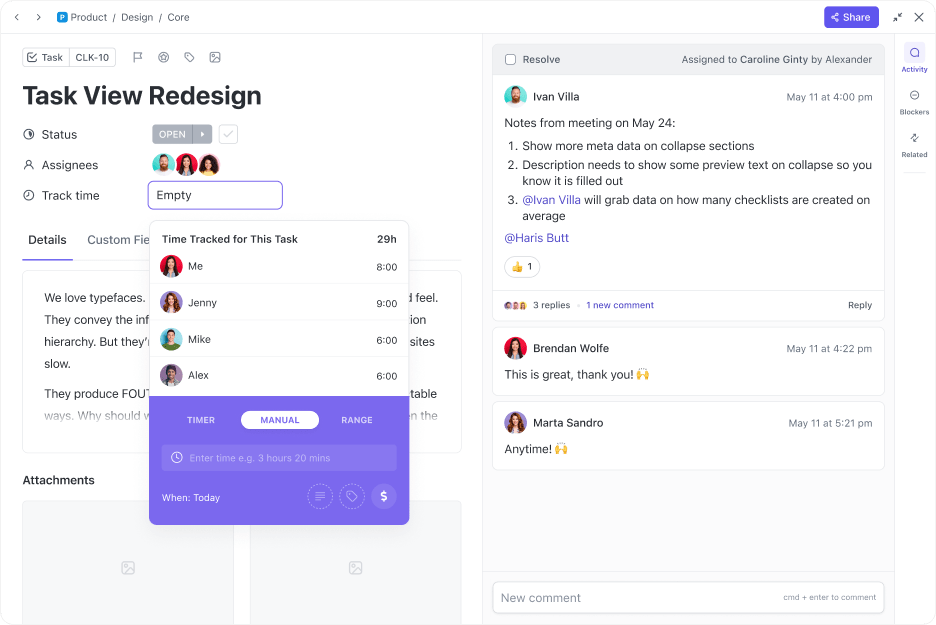
ClickUp comes with a native time-tracking feature. The Project Time Tracking tool on ClickUp allows you to put the 2-minute rule into action. Set quick two-minute estimates for tasks to ensure you stay focused and avoid getting bogged down or derailed. It also helps gauge your time estimation skills and the overall effectiveness of the two-minute rule for specific tasks. As you’ll discover, there will be times when certain big goals don’t fit the 2-minute mold, and this would be your litmus test.
Additionally, use the reminder and due dates feature to keep an eye on minor tasks. A good practice would be to have about four daily reminders—early morning, pre-lunch, post-lunch, and evening —to check your two-minute task list and register the quick wins that might otherwise slip through the cracks.
Automating workflows

Okay, an unspoken hack for two-minute tasks—automate all you can. Even if it takes just 2 minutes of your time, why would you waste it if it can be automated? For this reason, feel free to deploy the custom automation feature of ClickUp to take care of low-level and recurring tasks. Whether it is assigning tasks, sending quick confirmation emails, or marking a schedule in your calendar, ClickUp Automation takes these little things off your plate so that you can focus on the more challenging two-minute tasks.
This, and the fact that you can integrate ClickUp with virtually everything, makes it easy to build a detailed, centralized repository of two-minute tasks across disparate platforms. At the same time, you get the Universal Search feature that makes your entire tech stack searchable!
Templatizing success
Why waste time reinventing the wheel? ClickUp offers a rich library of ready-to-use templates that have been lifesavers in a pinch. You’ll be pleasantly surprised by how comprehensive and well-thought-out each template is.

Since we’re focusing on the 2-minute rule, ClickUp’s Getting Things Done Template is super apt for those looking to get started with the technique. This template embodies David Allen’s teachings and, well, makes it easy to get things done! From organizing tasks to prioritizing them, use this template to enjoy smoother workflows and efficient working.
While the above template is for advanced-level users, ClickUp also has beginner-friendly templates of the GTD framework.

Check out the Getting Things Done List Template on ClickUp. It converts your tasks into a simple list that you can chip away at for maximum productivity. Use the Board view to see tasks grouped by their status. It’s that simple.
Harnessing the power of AI
ClickUp Brain is a secret weapon for supercharging the two-minute rule workflow. It amplifies all the many ways ClickUp helps you follow the 2-minute rule, making the platform a productivity powerhouse.
Troubled by a two-minute task that’s popped up while you’re in the middle of deep work? Simply ask Brain to keep note of it (or even better—add it to your two-minute task list) without switching context. ClickUp Brain can even identify the task priority and any interdependency for you! Have to respond to an email? Get Brain to do it for you—the possibilities are endless.
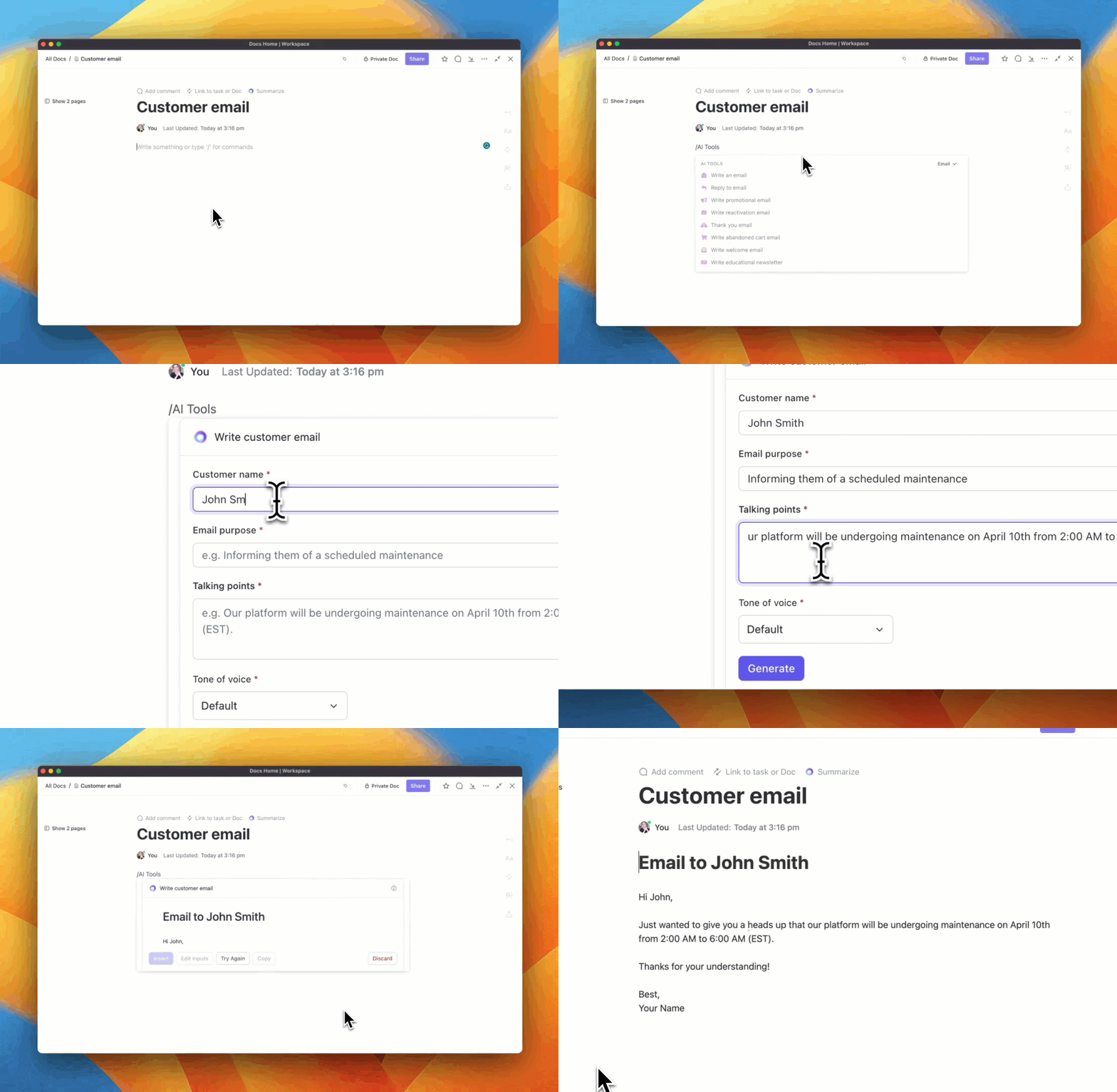
As an AI engine, Brain learns iteratively from your habits and working styles. This, paired with the built-in time tracking tool, makes time estimation easier. Ask Brain how long a specific task would typically take, and Brain will give you a realistic estimate.
Essentially, everything you do using ClickUp—you can do it better with Brain.
Summarize this article for me pleaseTwo Minutes Can Change Your Life!
In today’s world, two minutes may not seem like a lot. Hopefully, this article has changed your perspective.
Whether it is getting started on a tough assignment or working through your laundry list of to-dos, the two-minute rule can help in maximizing productivity. You win half the battle just by showing up and staying committed. Once there, there’s virtually nothing standing in the way of success. Just be mindful of the occasional pitfalls shared above, and you’ll be golden.
Also, use ClickUp—it’s free. Signing up takes less than two minutes, which is a good way to start practicing the two-minute rule! So, sign up and try ClickUp today!


Everything you need to stay organized and get work done.

Recent Articles
Marketing Agency Productivity: Where Your Margin Actually Goes 
Marketing Agency Productivity: Where Your Margin Actually Goes
8 Communication Strategies That Actually Fix Team Chaos 
8 Communication Strategies That Actually Fix Team Chaos
What Is Tacit Knowledge? Definition, Benefits and Examples
What Is Tacit Knowledge? Definition, Benefits and Examples
