
Sorry, there were no results found for “”
Sorry, there were no results found for “”
Sorry, there were no results found for “”
If you’ve used Coda, you already know its pitch: a dashboard, a database, and a doc all rolled into one. And honestly? It works…for a while.
As your business grows, teams scale, and needs grow more complex, Coda can struggle to meet your needs. That’s why we’ve put together this article about the best Coda alternatives.
We’ve tried several database management and productivity platforms, stress-testing everything from ClickUp to Obsidian to Airtable.
These are the top tools we keep bookmarked for specific task tracking or documentation use cases. Whether you’re writing team wikis, managing complex workflows, or just in need of an all-in-one workspace that feels snappy and human, you’ll find something here that fits.
Coda is a strong tool, but it’s not always the right tool for every team or workflow.
Here’s where it might fall short 👇
⚡ Template Archive: Free Coda Templates for Project Management with Alternatives
Our editorial team follows a transparent, research-backed, and vendor-neutral process, so you can trust that our recommendations are based on real product value.
Here’s a detailed rundown of how we review software at ClickUp.
Let’s look at some of the best alternatives to Coda:
| Tool | Best for | Standout features | Pricing* |
| ClickUp | AI-powered documentation and team collaboration for teams of all sizes | Docs with live editing, task linking, AI summaries, ClickUp Brain, Table view, AI Notetaker, Connected Search, ClickUp Chat | Free forever plan; Customizations for enterprises |
| Notion | Customizable, modular documentation for mid-sized to large teams | Synced blocks, embeds, calendars, Kanban, sharing with permissions, AI assistance | Free plan available; paid plans start from $12/user/month |
| Confluence | Knowledge management across large technical and product teams | Content macros, Jira integrations, nested pages, department-level doc organization | Free plan available; paid plans start from $5.16/user/month |
| Quip | Real-time document collaboration across mid-sized to large sales, CS, and ops teams | Spreadsheet-doc hybrids with built-in chat, task assignment with @mentions, Salesforce integration | No free plan; paid plans start at $10/user/month |
| Obsidian | Linked, local-first note-taking for individuals | Graph view of ideas, markdown notes saved locally, backlinks, non-linear editing | Free plan available; paid plans start at $5/month |
| Dropbox Paper | Note-taking within teams and individuals already using Dropbox | Real-time editing, presentation mode, task checklists, embeds from tools like Figma or YouTube | Free with Dropbox; Paid plans from $11.99/month (Dropbox) |
| Basecamp | Simplified team communication and project documentation for small teams | Message boards, Campfire chat, Hill Charts, central doc/files section | Free plan available; paid plans start from $15/user/month |
| Slite | Async documentation and lightweight internal wikis for small to mid-sized teams | Verified docs, doc insights, Ask AI, Canvas diagrams, usage tracking | Free plan available; paid plans start from $10/user/month |
| Nuclino | Cloud-based internal team wikis and fast knowledge sharing for teams of all sizes | Graph view of linked docs, real-time editing, nested collections, publish as website | Free plan available; paid plans start from $8/user/month |
| Microsoft OneNote | Multimedia note-taking across devices for large teams in the Microsoft ecosystem | Infinite canvas, sketching, OCR search, rich media capture, stylus support | Free with paid Microsoft 365 plans |
| Airtable | Connected database-style documentation workflows for mid-sized teams and agencies | Interface Designer, custom tables, linked records, Airtable Automations, real-time updates | Free plan available; paid plans start from $24/user/month |
| Evernote | Structured personal documentation and fast note retrieval for individuals | AI note summaries, web clipper, search inside images, calendar sync | Free plan available; paid plans start from $14.99/month |
| Trello | Visual documentation with flexible cards for freelancers and small teams | Custom card covers, emoji reactions, card separators, Butler automation, PowerUps | Free plan available; paid plans start from $6/user/month |
Here are the top alternatives that give Coda serious competition, each with its own take on smarter docs, flexible workflows, and collaborative power ⬇️
ClickUp is your everything-in-one solution for collaborative work. Powered by AI, the platform blends note-taking, documentation, task management, and real-time team collaboration (minus the endless context-switching).

One of its most interesting features is ClickUp Docs for documentation. You can create detailed and richly formatted documents, edit live with teammates, tag coworkers, drop in tasks mid-sentence, and even summarize a messy draft with AI.
You’ll love how seamlessly docs in ClickUp connect to everything else (true to the promise of an ‘all-in-one solution’ aka the everything app for work). You can link them to tasks, add custom widgets, and even update project statuses without leaving the page.
By the way, did you know that you can embed entire lists and tables in a doc in ClickUp?
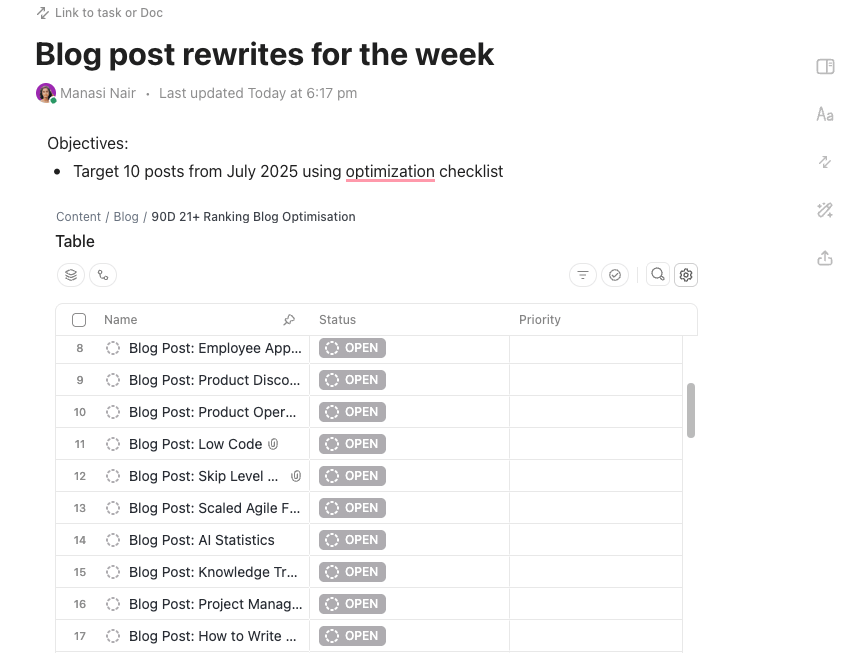
That same interconnected experience carries over to ClickUp Table View. It works like a mini database for task tracking, content calendars, client directories, and more.
Replace messy spreadsheets with neatly sorted and filtered tables with drag-and-drop columns, add all the context you need with Custom Fields, and keep all information in one place by linking tasks and documents together.
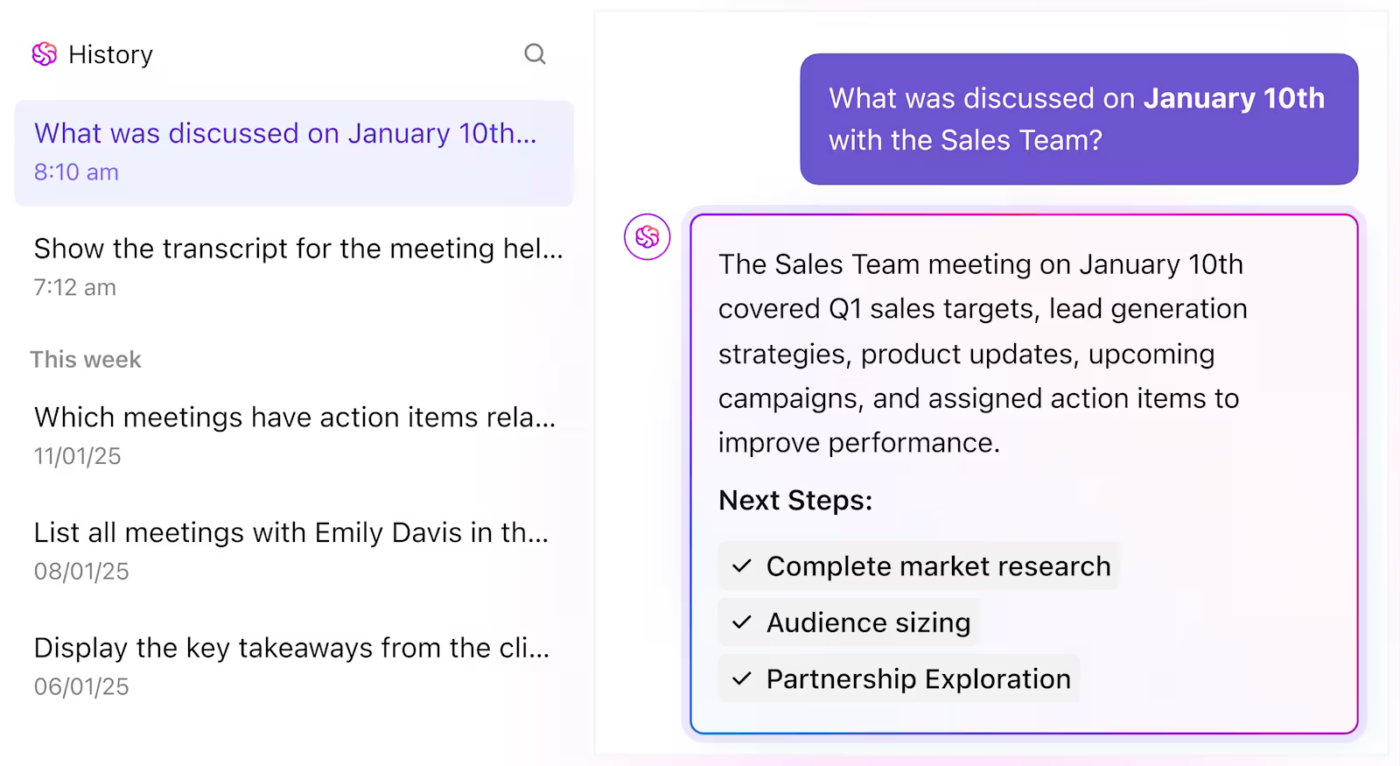
But where ClickUp truly excels is ClickUp Brain. The AI assistant integrated within ClickUp (including inside Docs), and the autonomous AI Agents it powers, can together shave hours off your workweek. Here’s how.
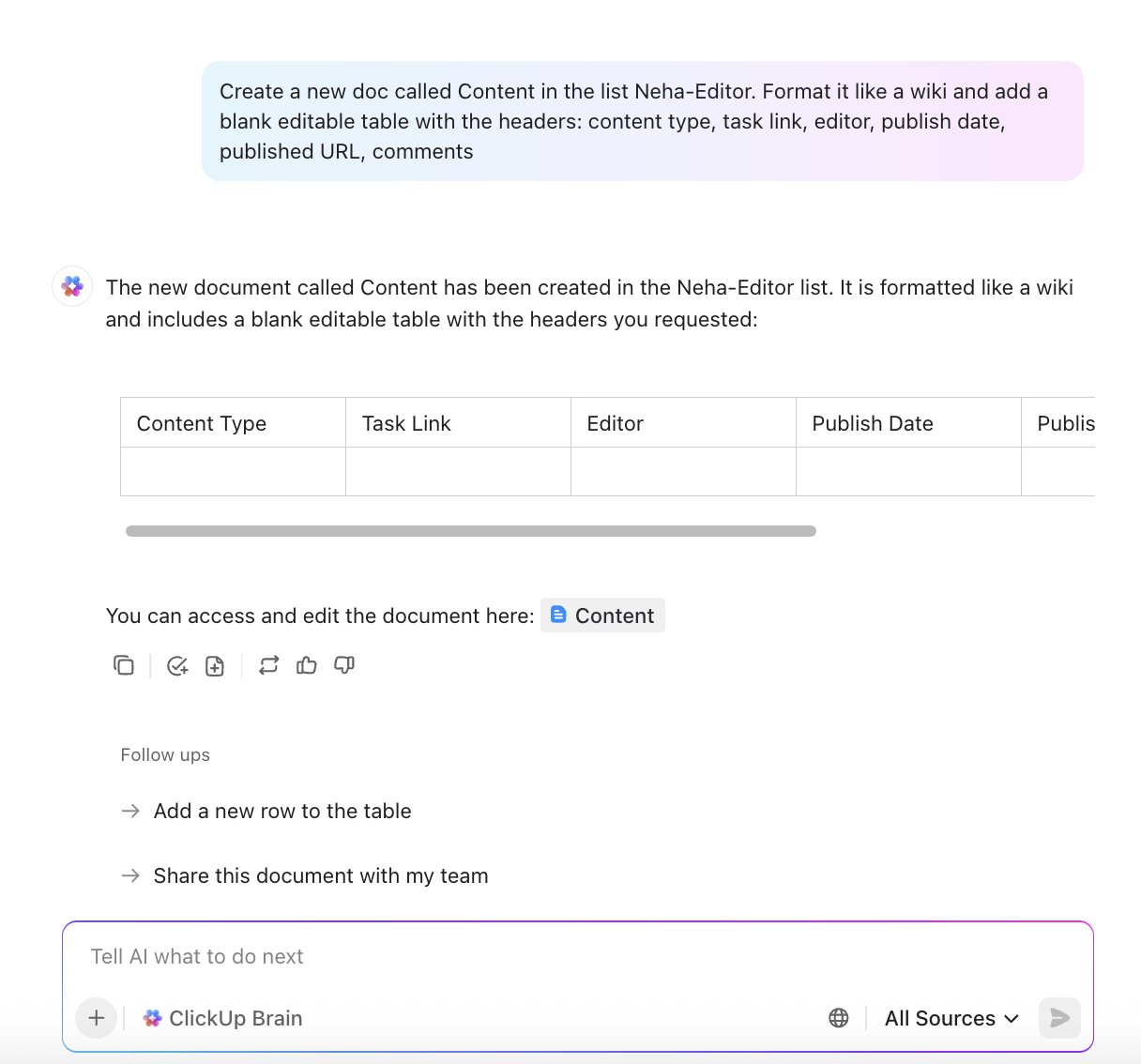
You can use ClickUp’s AI to quickly create and format documents, add editable tables within docs, include images and links, edit access permissions, and much more.
No more hours spent creating and updating wikis, SOP documents, and policy updates manually.
⚡️Bonus: Have you ever dreamt of a keyboard-free experience where you can create documents, notes, tables, and more with just voice commands?
We’re here to serve with ClickUp Talk to Text, part of ClickUp Brain MAX, a desktop AI companion that is the world’s most complete work AI solution. Users can also use the latest versions of external AI models like ChatGPT, Gemini, and Claude right from their connected ClickUp Workspace.
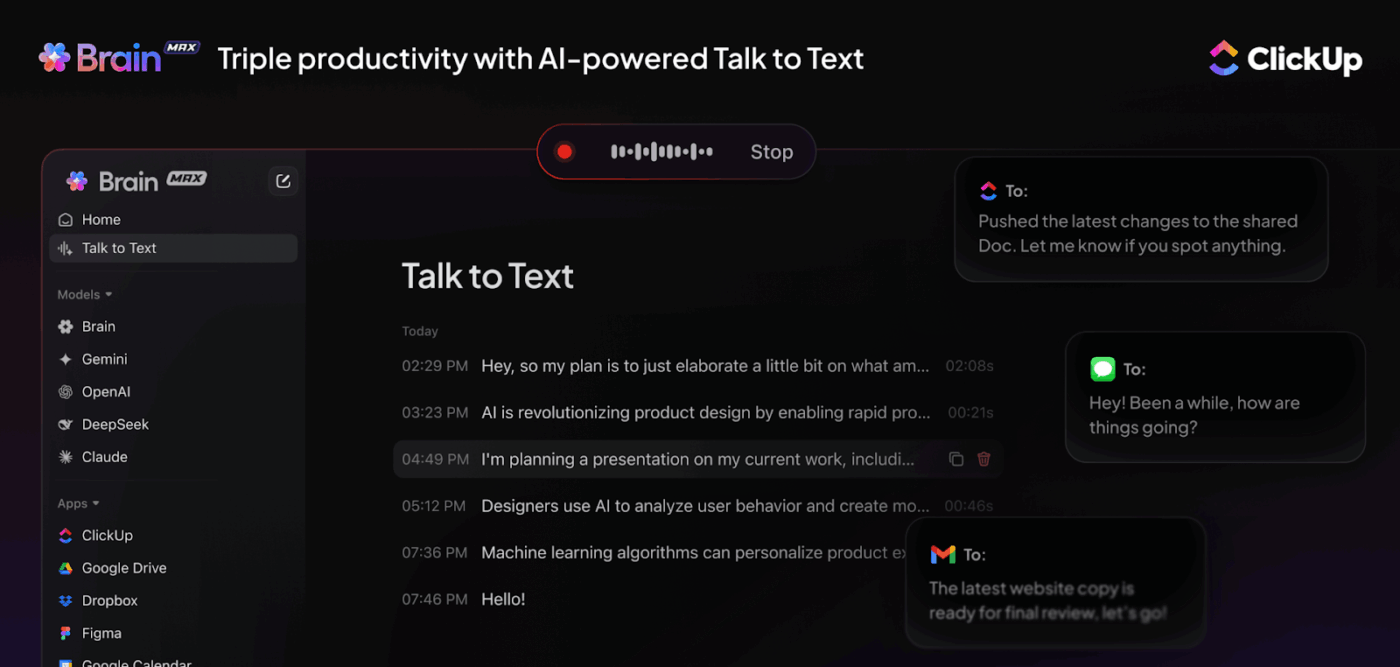
Got a lot of information across workspaces and connected apps? ClickUp Knowledge Management indexes everything from across your workspace—tasks, Docs, and even integrations like Slack or Google Drive.
Ask a single question, and ClickUp Brain surfaces answers that otherwise take ten tabs and three meetings to find.
📮 ClickUp Insight: Only 12% of our survey respondents use AI features embedded within productivity suites.
This low adoption suggests current implementations may lack the seamless, contextual integration that would compel users to transition from their preferred standalone conversational platforms.
For example, can the AI execute an automation workflow based on a plain-text prompt from the user? ClickUp Brain can! The AI is deeply integrated into every aspect of ClickUp, including but not limited to summarizing chat threads, drafting or polishing text, pulling up information from the workspace, generating images, and more!
Join the 40% of ClickUp customers who have replaced 3+ apps with our everything app for work!
A Capterra review says,
I was tasked with finding software that would give my department a place to store our work plans. We have multiple divisions within the department and needed something to be able to show our commissioner a snapshot of our projects for the year. ClickUp was amazing! It was visual, had so much detail that could be included, and had so much functionality and editing capacity that it could be used for a whole range of data. The system is user-friendly, and I had to do minimal training with the staff as it is very intuitive.
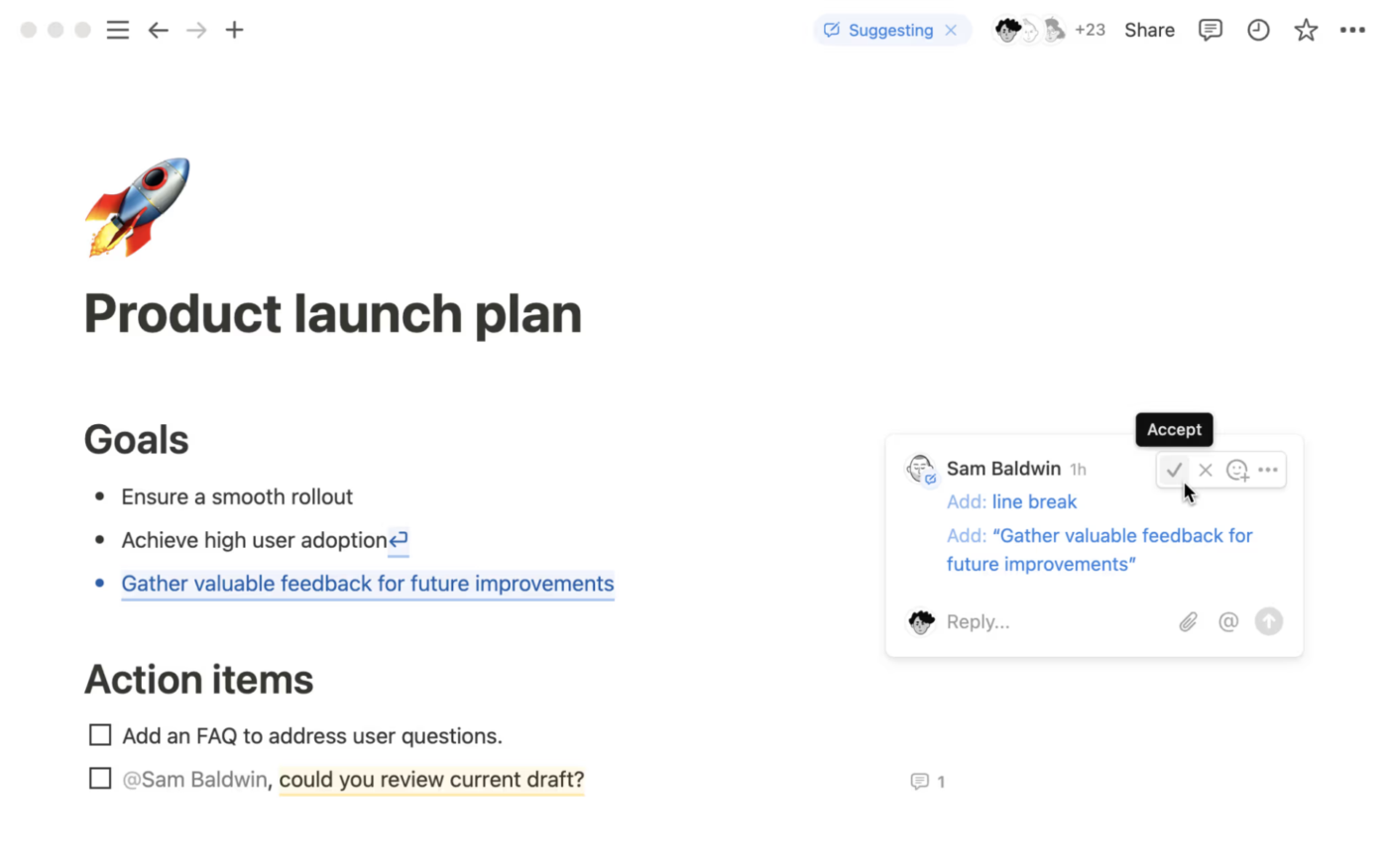
Notion is often described as the modular building block of the modern workspace. It’s used for a wide range of tasks—from documenting client onboarding SOPs to managing internal team wikis and project timelines through embedded databases.
One standout feature is Notion’s synced blocks. For teams managing tons of interlinked pages, such as company policies or marketing campaigns, the ability to sync content blocks across pages ensures everyone is working with the most up-to-date information. This significantly reduces version confusion, especially in asynchronous team environments.
Here’s a G2 review:
Notion makes it incredibly easy to organize information, collaborate with teammates, and build custom workflows without writing code. I love how flexible it is, I use it everyday for everything from product specs and meeting notes to project tracking and team dashboards.
👀 Did you know? The PDF, created in 1993 by Adobe, made documents virtually immutable, finally ending the chaos of ‘it looked fine on my screen!’
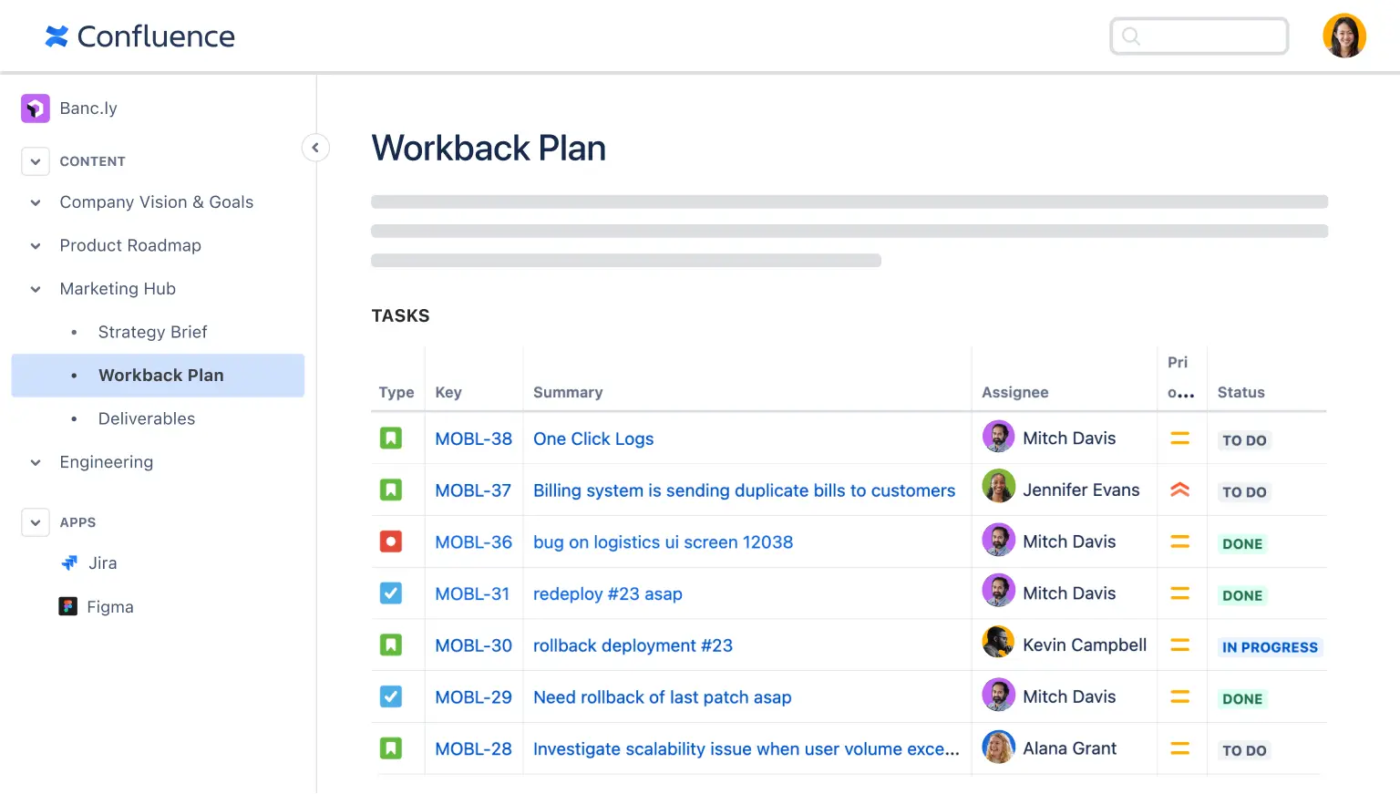
Confluence is widely used in fast-scaling product organizations where documentation is critical for cross-team clarity.
Its deep integration with the Atlassian ecosystem makes it a strong alternative to Coda. For teams already operating in Jira, especially engineering or IT, Confluence is a natural extension for planning, product specs, retrospectives, and internal knowledge sharing.
Unlike Coda’s flexible model, Confluence supports structured documentation tailored for technical teams. For example, product managers can draft PRDs that link directly to Jira epics, while engineering teams use the tool to create onboarding handbooks synced with team calendars.
A G2 review says,
Having a knowledge base for our team is a great way to make sure we’re all on the same page about our products, handbooks, and other important info. It’s designed to be user-friendly and easy to use in our day-to-day activities. Plus, it integrates seamlessly with tools we already love, like Loom, Drive, and Jira!
📚 Also Read: Best Confluence Alternatives & Competitors
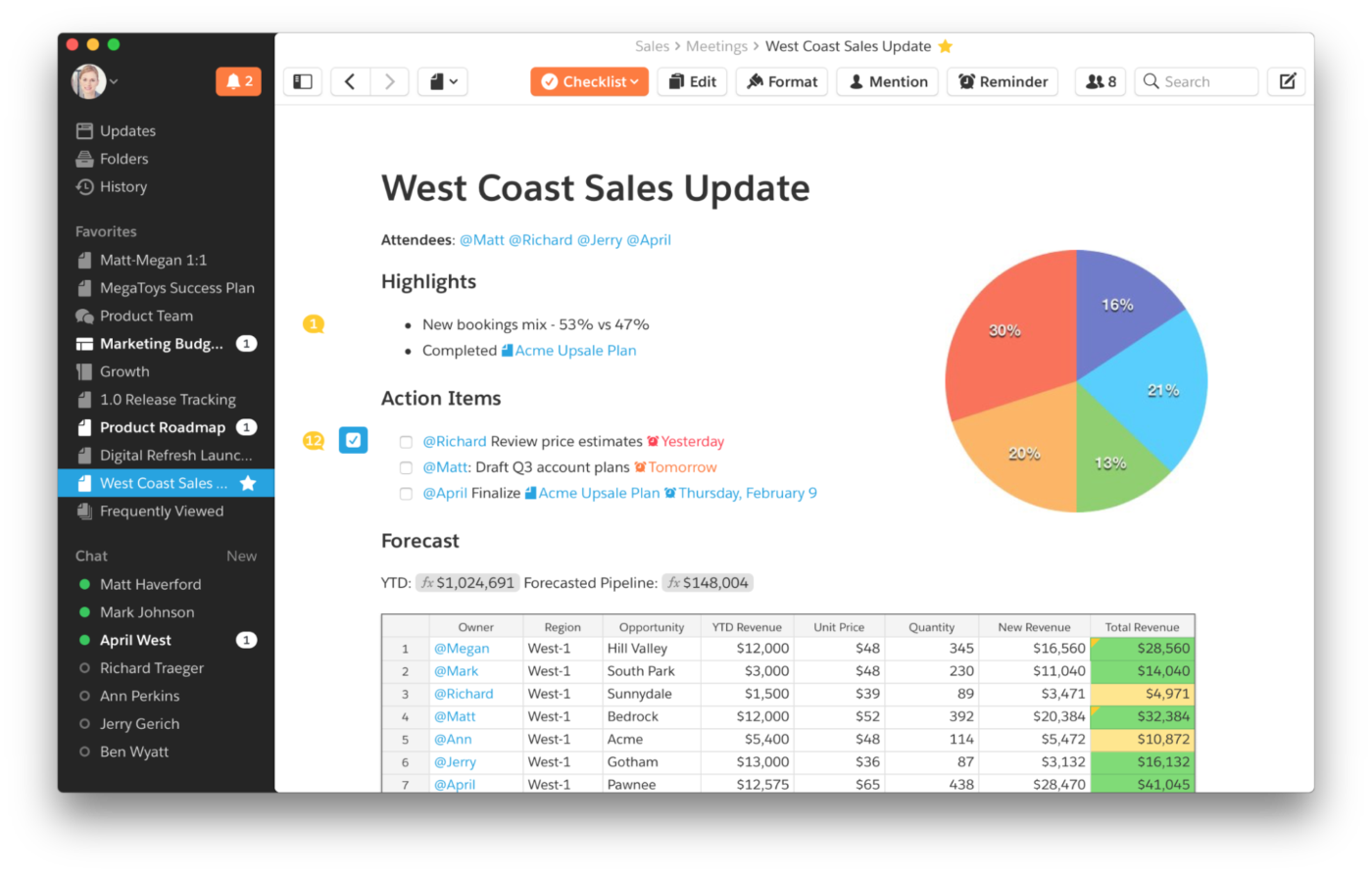
Quip is a collaborative productivity platform, owned by Salesforce, that combines documents, spreadsheets, and chat into a single, mobile-first interface.
At its core, Quip functions as a hybrid between documents and spreadsheets. It allows teams to embed tables, run formulas, assign tasks, and hold discussions. As one of the top alternatives to Coda for Salesforce-centric organizations, Quip helps streamline team alignment and minimizes the need to switch between multiple tools.
A standout feature is its native Salesforce integration. You can link live CRM fields, track account updates, or create collaborative playbooks that pull in real-time data.
Here’s a G2 review:
Quip streamlines document collaboration with real-time editing, chat integration, and a clean interface—perfect for teams seeking productivity and organization.
🧠 Fun Fact: The Antikythera Mechanism (from around 200 BC) had inscriptions explaining its purpose, making it possibly the first ‘computer documentation.’
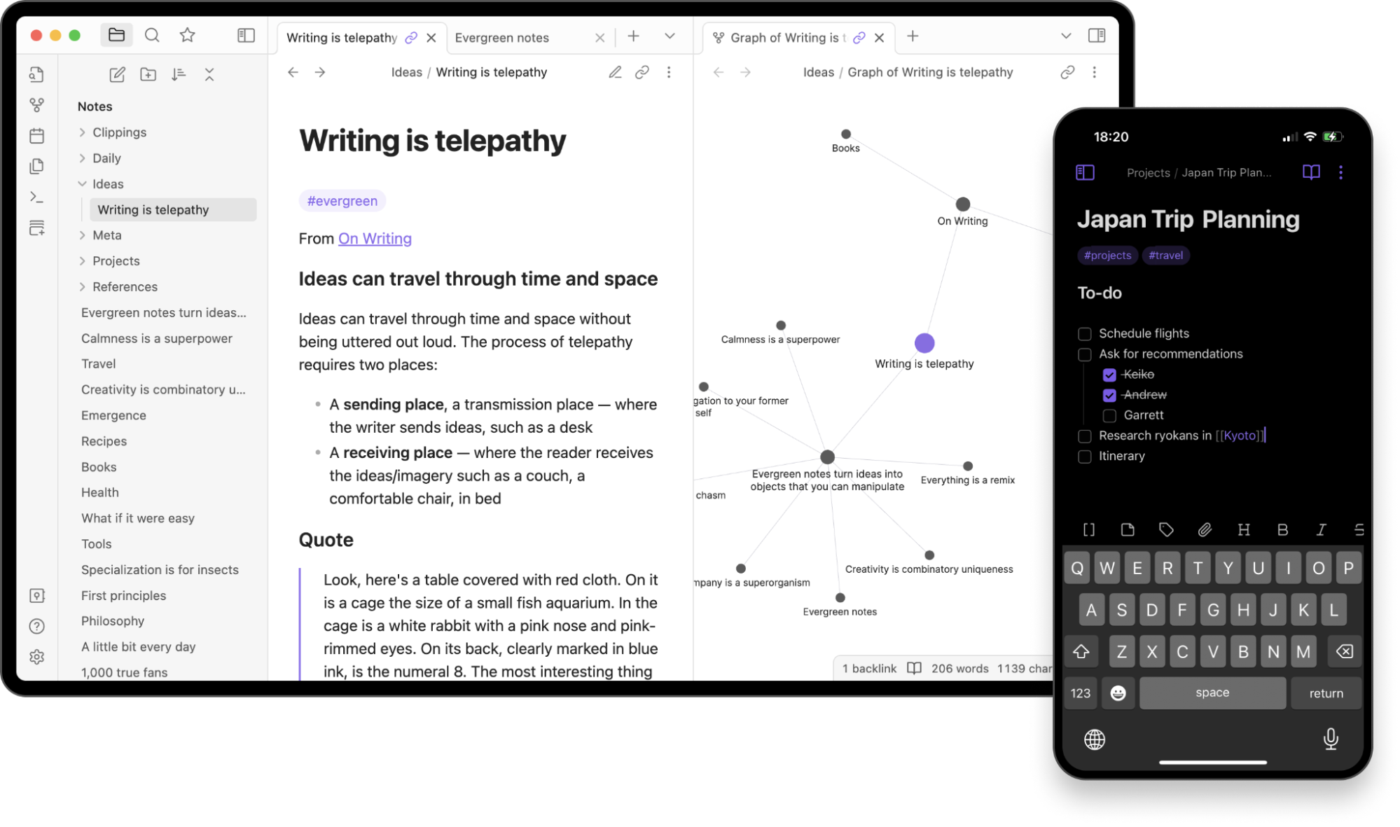
Obsidian is a knowledge base and note-taking application that can help you organize long-form research, connect ideas, and structure second-brain systems.
Since it transforms linear note-taking into a connected network of ideas through backlinks, internal links, and visual graph views, you start seeing your knowledge base as a living system.
It excels at tasks like research synthesis, world-building, and long-form writing, where connecting disparate ideas is crucial. It works as the thinking layer before projects are formalized or shipped.
This alternative to Coda stores everything locally, ensuring privacy and complete data ownership.
Look at this Capterra review:
Obsidian is a very flexible and user-centric product. It’s fast and increases my productivity while working with different documents. It’s simple to customize for my own use and has easy access to all commands and options.
⚡ Template Archive: Want to turn your Obsidian vault into a knowledge base? Check out these knowledge base templates for structure ideas you can mirror in your other tools.
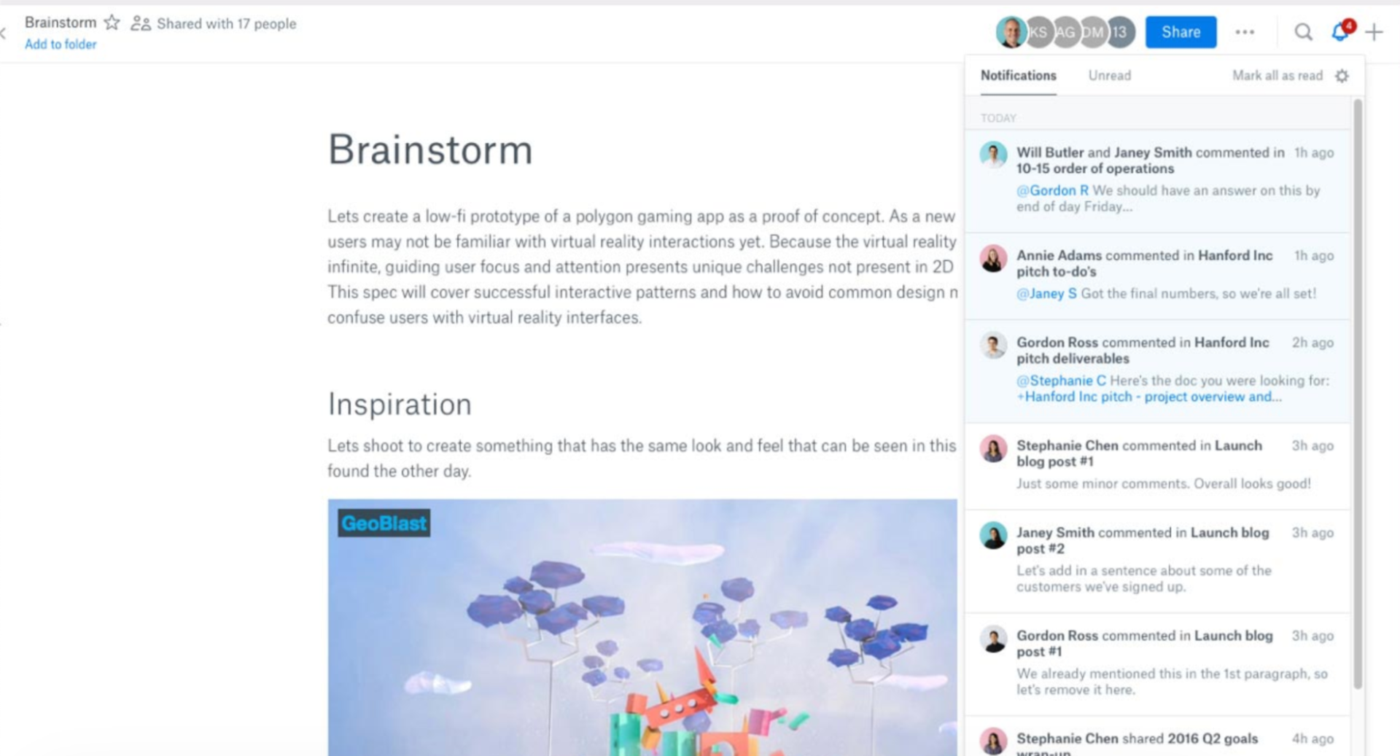
Dropbox Paper’s minimal interface makes it effective for fast documentation and creative brainstorming. It strips away the visual clutter and lets you focus entirely on content without a steep learning curve.
You can embed images, videos, Figma files, audio clips, and even live code snippets—no clunky plug-ins or complicated file sharing setups.
While it doesn’t offer the relational databases or flexible views of more advanced tools, Dropbox Paper is still one of the best Coda alternatives for teams prioritizing speed, simplicity, and seamless team collaboration.
📌 Note: Dropbox Paper is included within all Dropbox plans—there’s no separate pricing for Paper itself
Here’s a G2 review:
It’s a great tool for ad-hoc, informal, collaborative on-line documents, especially ones which change frequently.
🔔 Friendly Reminder: Not all tools play nice with the Google Workspace ecosystem. To keep your workflow seamless, look for options that support Gmail, Drive, Calendar, and Meet integrations.
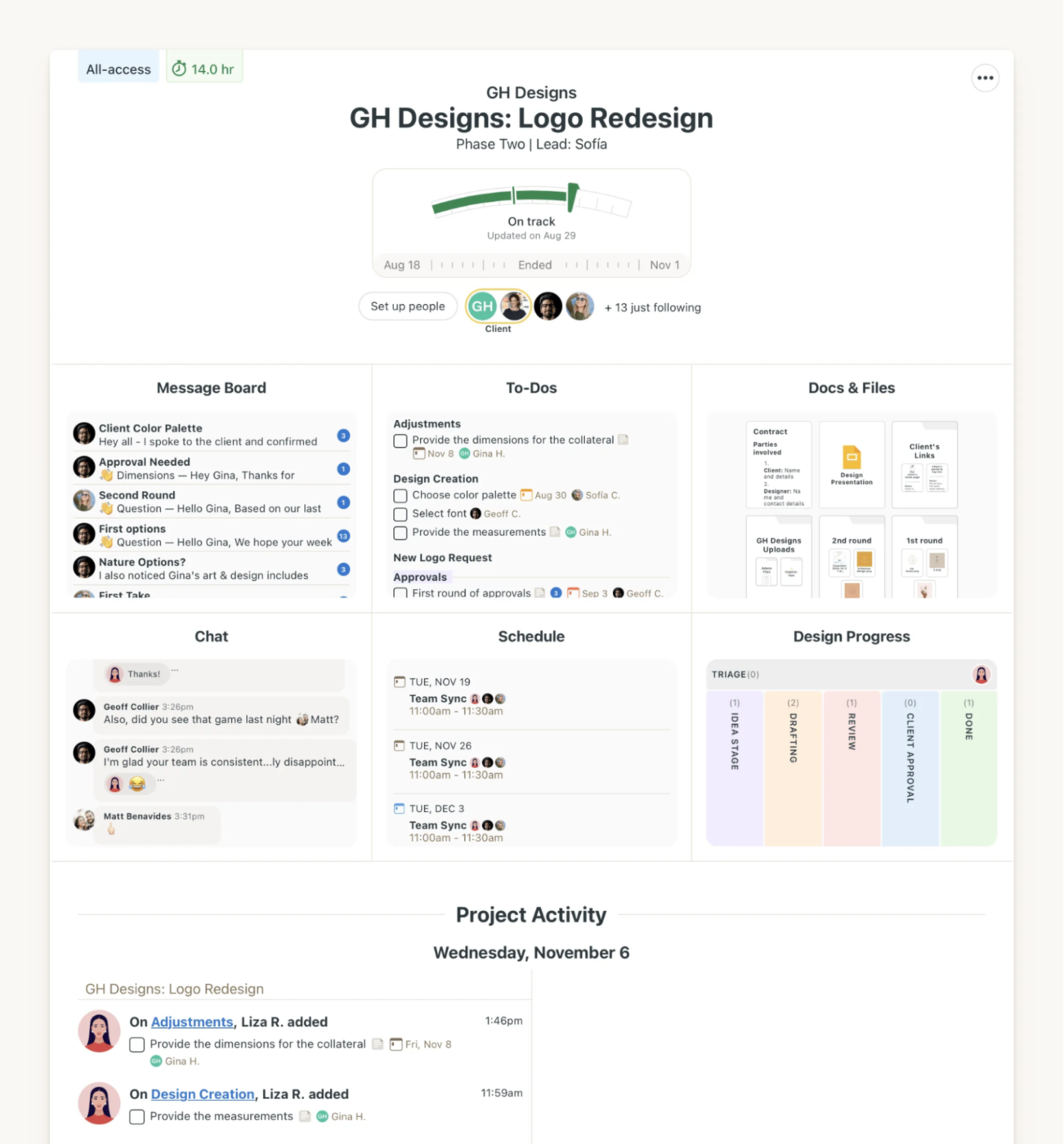
Basecamp is built around the idea that every project needs the same tools, like tasks, messages, files, to-do lists, and deadlines grouped in one place.
You don’t have to hunt through chat history to find the latest decision or wonder where the project brief is saved. Messages are threaded, task lists are visible to everyone, and you can upload docs or notes directly into the project space.
It also has a central repository for sharing documents, files, images, and other project-related resources. You can grant clients and external stakeholders limited, controlled access for feedback and approvals.
A Capterra review says,
It allows teams and departments to communicate easily and leverage important assets, such as creative, as a repository that can collectively be accessed, revised, and tracked. It also allows members to provide feedback and edits.
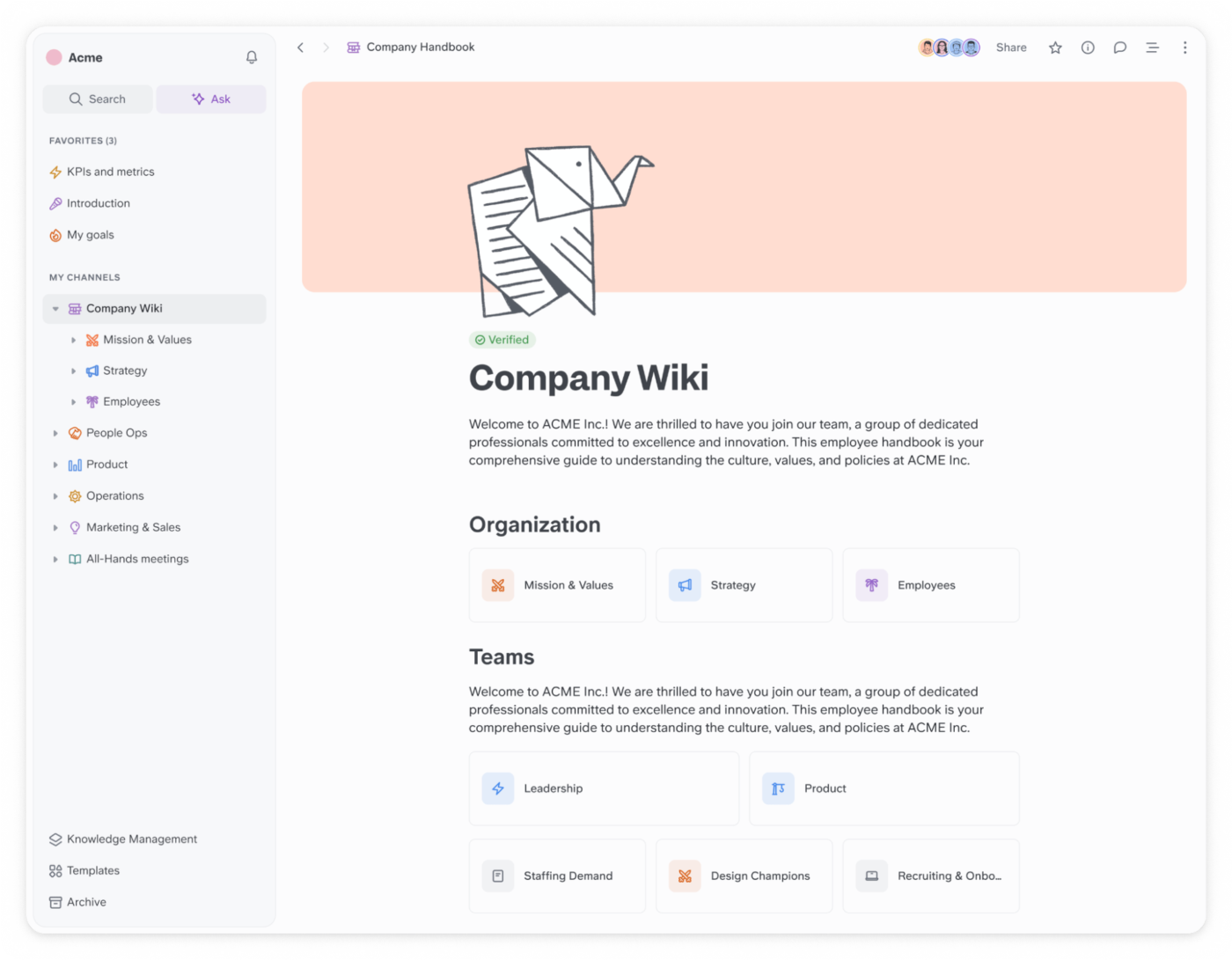
Slite is a knowledge management platform that combines collaborative documents with integrated discussion features.
Create verified documents, add videos, images, and rich formatting, and edit or update them along with your team. The built-in AI assistant can improve your writing, and summarize or translate your docs in seconds.
Unlike tools that lean into infinite flexibility, Slite prioritizes structure. Every note lives within a channel, and those channels are grouped by topic or team. You can ask for input on a doc, get responses via inline threads, and move forward without calling a meeting.
It also handles versioning and suggestions. When reviewing updates, you see exactly what changed and who proposed it. That’s useful when working on recurring docs like product specs, policy drafts, or internal playbooks.
A G2 reviewer says:
Writing and formatting content is incredibly easy, even as a new user. You’re never buried in features – instead, new tools and ways of working are easily discovered as you work in Slite.
💡 Pro Tip: Document your current workflows before migrating to any new platform. Create flowcharts showing how information moves through your team today. This ‘workflow blueprint’ helps you configure new tools from day one and identifies integration gaps that could derail adoption later.
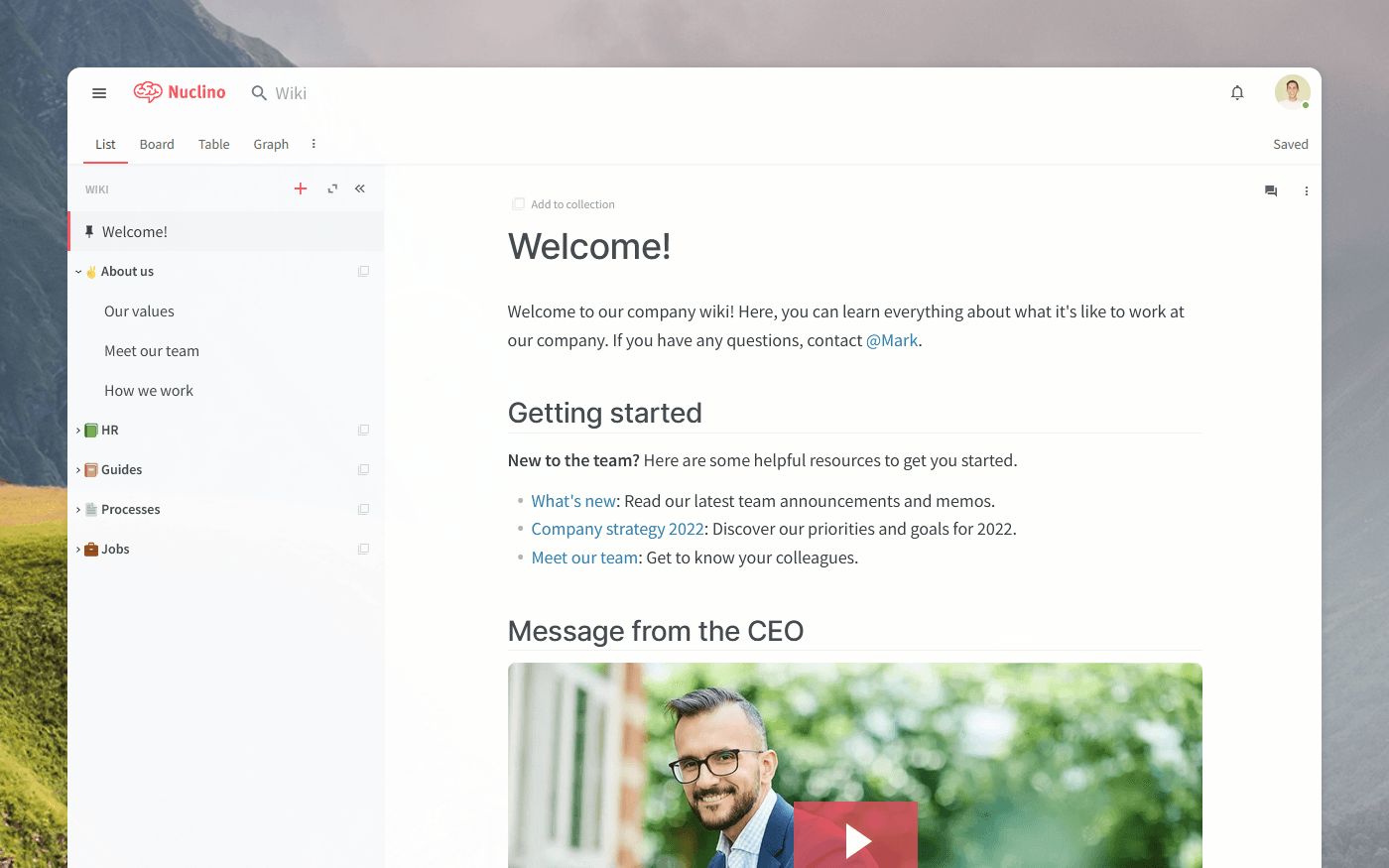
Nuclino is a cloud-based collaborative workspace and knowledge management tool that lets you create, edit, link, and organize documents in real time with a unified hub for knowledge, docs, project tracking, and brainstorming.
This tool has a drag-and-drop interface, so you can reorder items, nest collections inside one another, and switch between list, board, table, or graph views, depending on how you want to work.
Type ‘@’ to instantly connect one page to another and make your internal docs feel more like a website or internal wiki.
A Capterra review says,
I am looking to jumpstart several businesses and writing projects collaboratively and individually. Nuclino has provided a way for me to share and organize my information seamlessly and skillfully. Although I am just an average Joe, I feel more productive and professional while using Nuclino. I think it is a good platform for anyone striving to create an impact in the world..
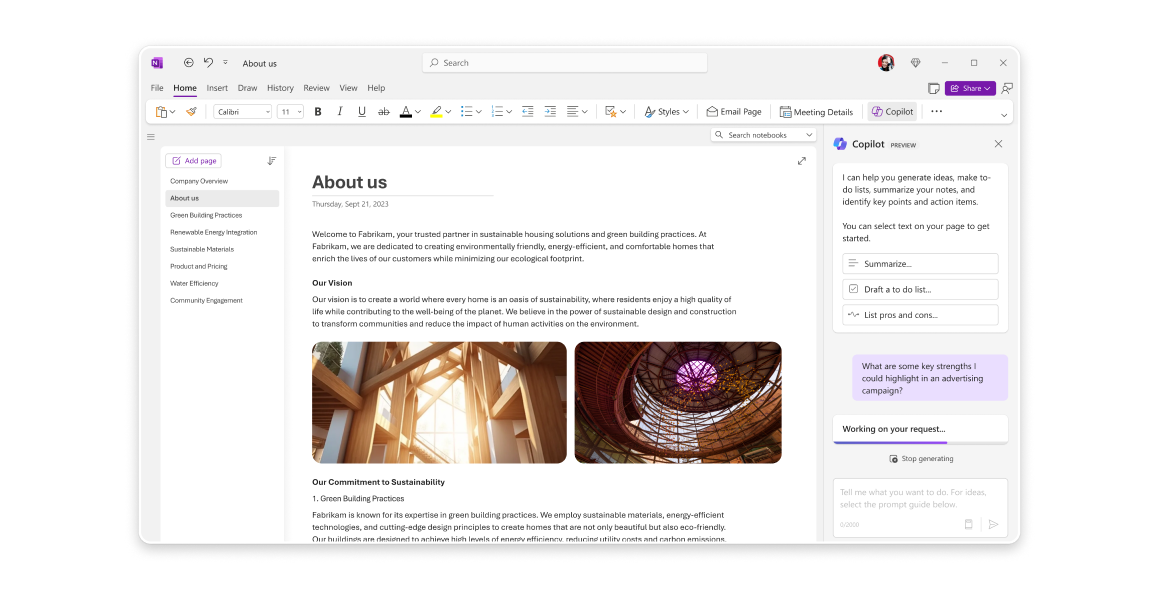
OneNote by Microsoft is designed for freeform note-taking that doesn’t assume structure upfront. You open a notebook, pick a section, and drop in whatever you need: text, voice memos, PDFs, whiteboard snapshots, or handwritten notes.
Each page behaves like an infinite canvas. Place content anywhere, annotate over screenshots, and even write equations or doodle. The Copilot AI assistant cuts down time and effort for generating ideas, creating lists, and organizing your information.
The syncing is seamless across platforms. Whether you’re using the desktop app on Windows, the web version via OneDrive, or the mobile apps on iOS or Android, your notes stay synced and accessible.
A G2 reviewer says:
OneNote is great for organising notes in a clear, flexible structure. I like how it mimics a physical notebook with tabs and sections, making it easy to manage different topics or projects.
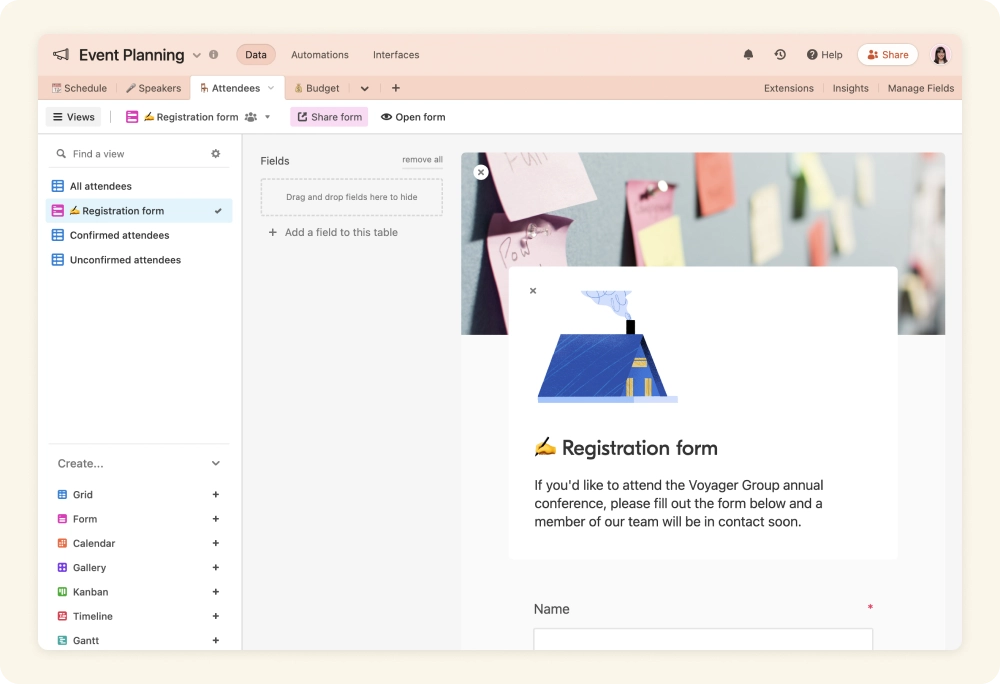
Airtable a powerful no-code tool for building custom applications, such as CRMs, content planners, project trackers, and more. It is useful for documentation and internal knowledge systems where real-time data sync, ownership, and field-level organization matter.
Each base can include multiple tables that support rich field types like text, dropdowns, linked records, attachments, collaborator tags, and more. You can connect related docs across tables, build filtered views, and turn records into knowledge entries.
Enhance functionality further with extensions or scripts if needed, and control access with sharing and permission settings.
A G2 review says,
I found Airtable’s interface to be very user-friendly. It has a powerful structure to take in and share data in various formats. I like the different interfaces you can build off of one table. I appreciate the ability to have people fill out forms that load data into the tables without having a license for each individual filling out a form. Super easy to change data types, labels, and most everything in Airtable, but I also appreciate the warnings it gives if you’re about to impact data in a different, linked base.
📚 Read More: Coda vs. Airtable Comparison: Which Tool is Better?
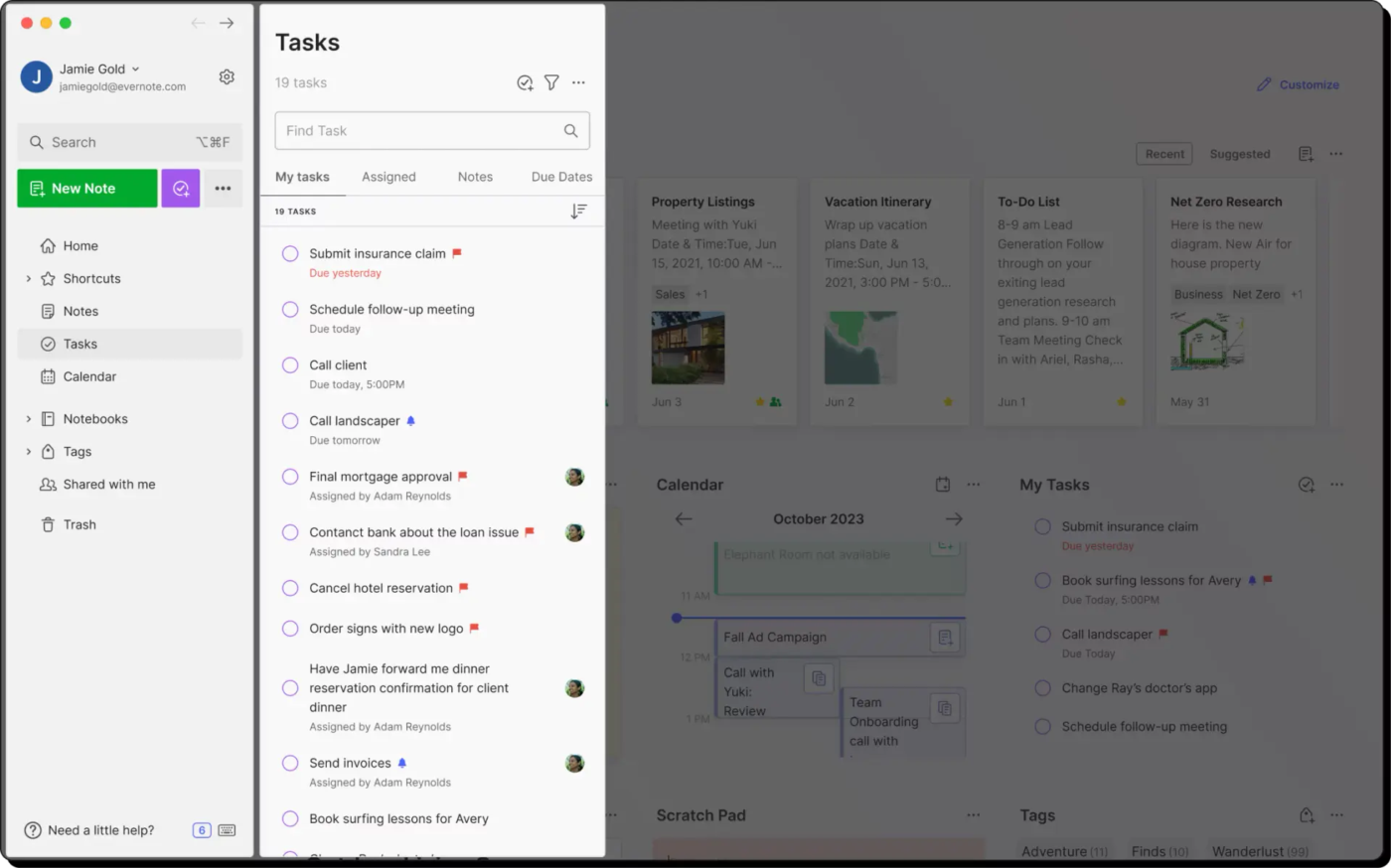
Evernote is a popular tool for structured, personal documentation. Users can clip web articles, scan handwritten notes, forward emails into notebooks, and then tag and organize everything for easy retrieval.
Each notebook serves as a container, with notes that can include checklists, attachments, embedded documents, and links to calendar events. It offers reliable syncing across desktop and mobile devices, and with built-in OCR support, even scanned receipts or handwritten notes become searchable.
The built-in AI can summarize, edit, and transcribe your notes and also quickly find the right information from them.
Here’s a G2 review:
Evernote is a handy app for taking notes. I like the notebook organization system and the use of tags. It makes it quick and easy to find your information.
⚡ Template Archive: Free Evernote Templates for Note-Taking
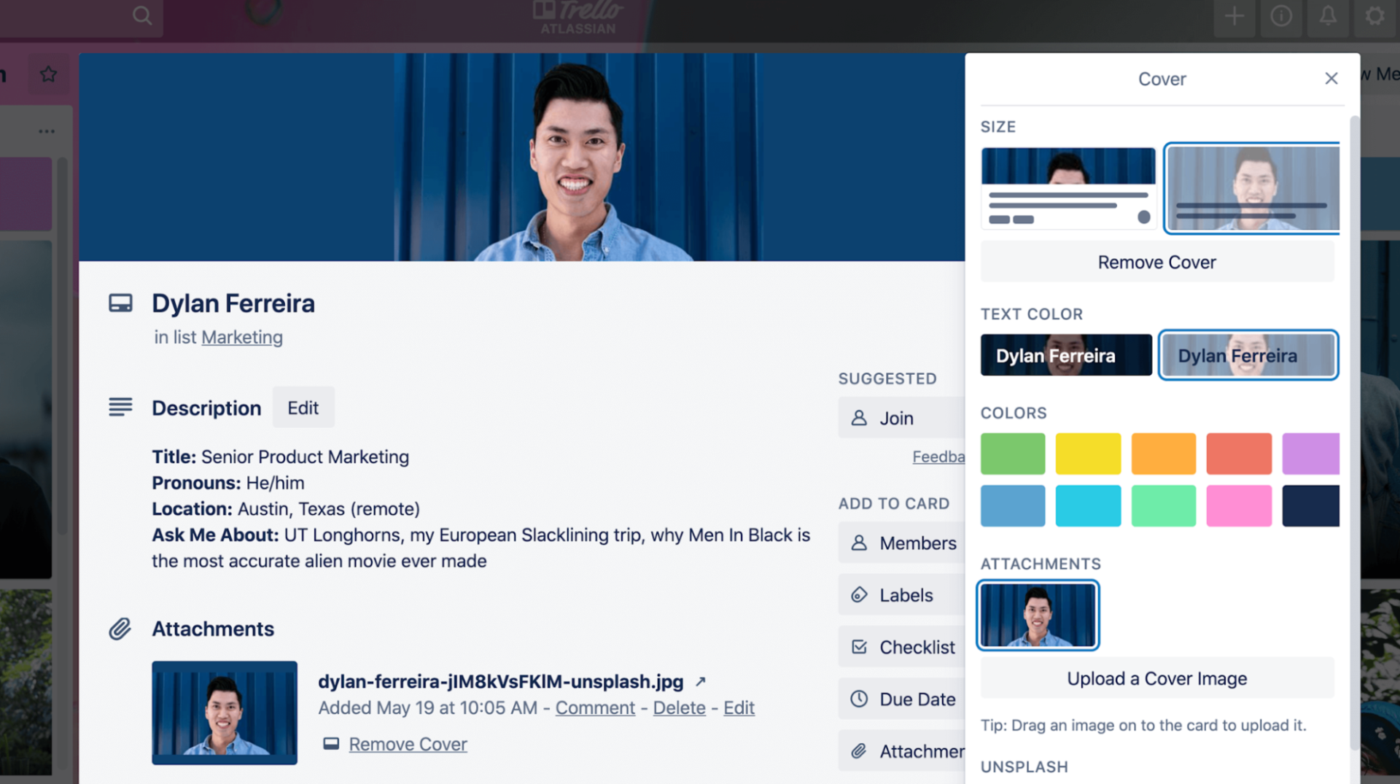
Atlassian’s Trello is often associated with Kanban-style project management. However, looking closer, it’s also a tool for documenting processes, capturing meeting notes, or creating team knowledge boards in a visual-first format.
Inside it, the custom card covers, emoji reactions, and confetti animations give documentation a more human touch.
You can also organize content more effectively using separators, labels, keyboard shortcuts, and set up ‘Done’ states that match your workflow. For teams that don’t need nested databases or structured tables, Trello gives just enough structure to manage shared knowledge.
A Capterra review says,
I’ve been using Trello for many years as a personal to-do list organizer and a project management tool with multiple contributors. I’ve stuck with it all this time despite the allure of alternatives because Trello is simple and very easy to use.
There’s no denying Coda is clever. It helps you move faster by storing documents, databases, and dashboards. But as your workflow becomes more demanding, you need a tool that doesn’t slow down under pressure or limit what your team can do together.
ClickUp is that step up.
It offers docs that connect to real-time project tracking, tables that pull live data, chat features that connect teams, and AI that actually scales with your work. The best part? ClickUp adapts. Whether you’re managing product docs, SOPs, or internal wikis, it shapes itself around your workflow.
If you’re ready for a productivity platform that keeps up with how you work, no matter how fast things move, ClickUp is worth a serious look.
👉 Try ClickUp today and bring your docs, tasks, and ideas together in one powerful workspace.

Manasi Nair
Max 26min read

Arya P Dinesh
Max 16min read
Manasi Nair
Max 24min read

© 2026 ClickUp