
What Is the Right Team Structure for Your Company? 8 Types to Pick from


Sorry, there were no results found for “”
Sorry, there were no results found for “”
Sorry, there were no results found for “”
Have you ever struggled with teams where tasks slip through the cracks and collaboration feels chaotic?
If yes, it could mean your team’s structure needs an overhaul.
Team structure is how roles and responsibilities are segmented within a team and assigned to individual members. A strong team structure paves the way for healthy communication, effective team collaboration, and high productivity.
There are several ways to organize your team, but you must pick one that fits your organizational goals, working style, team dynamics, and culture. Understanding the nitty-gritty of team structures, their advantages, and their types can help you make an informed decision.
Team structure is how tasks, roles, and responsibilities are assigned, controlled, and coordinated among team members to achieve common goals. Team structure defines the team size, decides the reporting hierarchy, and clarifies workflows. Well-designed team structures align team members’ skills and areas of expertise to tasks and objectives.
Common team structures include functional teams grouped by expertise (e.g., engineering, marketing, IT, etc.), cross-functional teams with diverse skills, and self-directed teams where members manage their work.
Team structure impacts coordination, accountability, problem-solving approaches, and overall team performance. Organizations may use different team structures across the company based on departmental needs. The optimal structure depends on team objectives, work complexity, and organizational strategy.
Here are seven reasons why a well-defined and effective team structure is essential:
Each team’s organizational structure features a different chain of command and offers unique ways to encourage teamwork. Here are some of the types of team structure:
This is the most common type of organizational structure. It looks like a pyramid, with the top level comprising the most senior leaders. Each level below represents a certain degree of subordination.
For example, at the top level is the CEO, followed by vice presidents, directors, managers, and finally, individual contributors.
Key benefits:
Limitations:
Ideal for: Large organizations with strong leadership
A functional structure organizes teams based on their job function. A company might have different departments like engineering, marketing, sales, and HR. Separate departments work on their own tasks in the functional organizational structure but contribute to the company’s overall goals.
Key benefits:
Limitations:
Ideal for: Organizations where each department handles a specific function, but cross-functional collaboration is still essential to operations
A flat team structure is a way of organizing a team that eliminates or minimizes management levels. Startups often use this organizational structure to encourage speed, innovation, and employee empowerment.
There is no rigid hierarchy here. Everyone collaborates directly, sharing the same decision-making power. It’s an organizational model where authority flows freely, and employees have a high degree of autonomy.
Key benefits:
Limitations:
Ideal for: Small to medium-sized organizations
A circular structure is a way of organizing teams that puts the CEO at the center, with multiple layers of management and staff around them.
The goal is to encourage open communication and equal information sharing across all levels instead of a hierarchical approach.
It’s a dynamic, collaborative space where everyone has a say and a stake in driving the team forward.
Key benefits:
Limitations:
Ideal for:
A matrix structure is a way of organizing teams that assigns two bosses to each employee. An employee may report to both their functional manager and a different project manager.
The matrix organizational structure is common in consulting companies, where people work on different projects with different teams.
Key benefits:
Limitations:
Ideal for:
A market-based team structure in a company creates several dedicated teams focused on specific customer segments or product lines.
Team members become experts in their assigned market, with a holistic understanding of customer needs and preferences.
Think of this organizational structure as a honeycomb, with each cell buzzing with activity tailored to a specific ‘flavor’ of the market.
Key benefits:
Limitations:
Ideal for:
In this structure, teams are organized according to specific business processes. For example, a manufacturing company’s process might include design, production, quality assurance, and delivery. Each team takes charge of a specific part of the process.
Each team plays a vital role in the decision-making process, ensuring smooth flow from start to finish. The process-based structure supports multiple business lines and encourages constant process improvement and innovation.
Key benefits:
Limitations:
Ideal for:
A network structure departs from the traditional hierarchical structure by grouping employees around specialized skills and expertise rather than fixed departments or functions.
This creates a flexible and adaptable work environment where teams are dynamically formed and disbanded based on specific project needs.
Think of it as a web where individuals from diverse locations and specializations collaborate and leverage their combined knowledge.
Key benefits:
Limitations:
Ideal for:
Building a successful team structure is an ongoing process. When a project starts, begin with a fixed team structure in mind and consider the stages of team development.
However, as external and internal conditions change, you should be prepared to adapt and calibrate your team structure.
Here’s a roadmap to guide you:
To create a successful team, clearly define everyone’s roles and responsibilities using a team charter. Each team member should know exactly what they’re supposed to do and what they’re accountable for.
For example, in a marketing team, you might have a content writer, a social media manager, a graphic designer, and a data analyst. Each person has a defined job function but with the common goal of generating new leads. Understanding these roles helps the team work more harmoniously.
Try out these team charter templates!

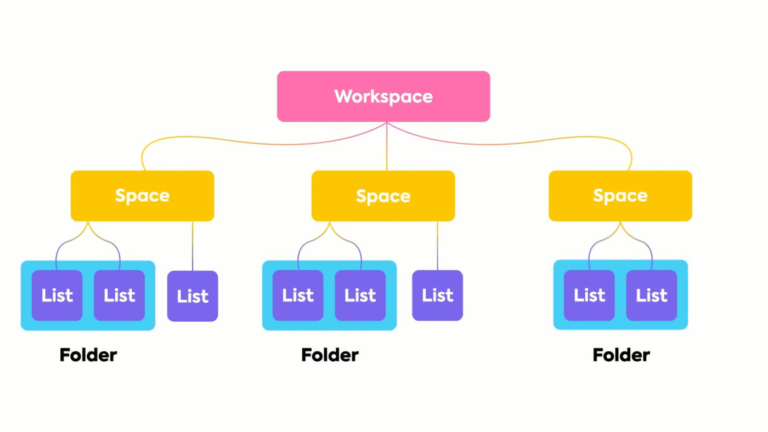
Here, ClickUp’s Project Hierarchy can be a helpful tool. It offers you a structured way to organize tasks and oversee team processes. It consists of several levels:
This structured approach allows for granular control over team organization and simplifies monitoring and managing team progress.
Open and effective communication is the glue that holds teams together. Team members should feel comfortable sharing their ideas, asking questions, and giving feedback.
For example, having weekly team meetings and regular check-ins can help everyone stay updated and be on the same page about shared goals and progress.
You can use ClickUp’s Chat view to communicate openly and quickly with your team from within ClickUp and share updates on their progress.

Encourage team members to work together and use their strengths and skills within the team structure.
For example, a software development team could have a front-end developer, a back-end developer, and a UX designer.
By collaborating, they can ensure the final application is easy to use and works well. Provide them with the necessary tools to ensure seamless collaboration.
Good leaders guide, inspire, and support their teams, setting clear expectations and holding them accountable. Here’s how:
For example, in a sales team, the leader sets sales targets, provides training, and motivates team members to reach their goals.
Give your team the tools and resources to do their tasks efficiently. It’s also essential to clearly outline the objectives, guidelines, and purpose for a team working on a project to ensure a smooth workflow.
For example, providing detailed project request forms will help your development team understand the requirements of any feature they are to build.
On the other hand, your customer service team might need a reliable CRM system, communication tools, and access to customer feedback and analytics to do their jobs well.
Pro tip: ClickUp’s CRM system is an excellent tool for bringing your marketing and sales efforts together. Manage leads, campaigns, deals, and communication in one place with customizable Kanban boards that make pipeline tracking and management smoother.
Communicate, share files, and assign tasks within deals, fostering teamwork across marketing and sales. You can also use custom automation sequences and gain data-driven insights with real-time performance metrics tailored to your goals.

Developing a positive, nurturing workspace culture enhances team performance. It makes everyone feel valued and part of a community working toward collective goals.
ClickUp’s project management tool helps create a positive team culture by streamlining workflows, facilitating collaboration, and assigning ownership. As an all-encompassing project management tool, it helps your team be more productive and goal-oriented.
You can effortlessly use ClickUp for managing tasks, tracking time, setting goals, sharing documents, and creating custom workflows. It’s easy to use, even for the less tech-savvy team members, and integrates well with other tools.

ClickUp is an excellent choice for any team, whether you have a functional, project-based, or matrix team structure.
Here’s how ClickUp can boost teamwork:
1. Connected workflows:


2. Integration of docs:

3. Real-time dashboards:

4. Custom views

You can also use several project overview templates and project management templates with pre-built workflows to manage your work more easily.
Finally, encourage your team members to keep learning and improving their skills. This can boost team performance and morale.
Invest in training, workshops, and professional development to show your team you care about their growth. Then, watch employee retention and loyalty soar.
No matter which team structure your organization or department picks, using team collaboration software like ClickUp can go a long way in bolstering team management and communication.
Whether your team is big or small, simple or complex, ClickUp adapts to your needs and boosts your productivity and efficiency with flexible features.
Try ClickUp’s unified workspace for free and experience its transformative power today.
A team-based structure is a management approach where work is organized around teams rather than individual roles or departments. Each team is responsible for specific tasks or objectives, and members work collaboratively to achieve them.
This approach fosters teamwork, problem-solving, and innovation, making it suitable for organizations with complex projects or those that are grappling with rapid change.
The ideal team structure depends on several factors, including the size, nature, and business goals of your organization. It also depends on the type of work you do, the skills and experience of your team members, and the workplace culture.
Building an ideal team structure can require you to consider factors such as the size of your organization, the complexity of the work, the skills and experience of your team members, and organizational culture. Each of these team structures has its unique strengths and challenges.

Sudarshan Somanathan
Max 17min read
Sudarshan Somanathan
Max 20min read
Sudarshan Somanathan
Max 12min read

© 2026 ClickUp




