Sorry, there were no results found for “”
Sorry, there were no results found for “”
Sorry, there were no results found for “”
An AI-generated lesson plan can give you objectives, activities, and an assessment in minutes. But there’s a catch: you still need to check whether the activities teach the intended skill, the readings suit your students, and the lesson fits the time available.
The time savings are promising. In a 2025 Gallup and Walton Family Foundation survey of 2,232 U.S. public school teachers, weekly AI users estimated saving an average of 5.9 hours per week across their work. That includes tasks such as preparing materials, grading, and administration, rather than lesson planning alone.
When choosing AI tools for lesson planning, consider what happens after the first draft. Can you use your assigned readings and revise an activity without rebuilding the plan? Those steps determine how much work remains before you can teach the lesson.
This guide compares eight tools on how they use your materials, support standards-based planning, and help you revise a draft. It also covers free-plan limits and school-account requirements, so you can narrow the options to those you can actually use.
TL;DR: AI tools for lesson planning can help you draft and adapt lessons, but their usefulness depends on how well they support revisions using your curriculum and materials. Choose based on the work you need to reduce: preparing readings, building classroom resources, or coordinating a shared unit. Check whether your account qualifies and whether the free allowance covers revisions as well as first drafts. Before teaching, verify that the activities and assessment address the intended skill and fit your students and class time.

That usually means you’re using the wrong type of AI for the job.
Take this 1-min quiz to see if your tools overlap, lack context, or if it’s time to hand off work to an agent.
| Tool | Best for | Standout feature | Starting price | G2 rating | Where it taps out |
| MagicSchool | Guided planning with standards and differentiation | Leveled versions of a core lesson | Free; Plus $12.99/month | Not enough reviews | Free plan’s 20 weekly generations cover both drafts and revisions |
| Brisk Teaching | Planning from existing Docs, Slides, and web content | Browser-based generation and revision | Free; paid school and district plans at custom pricing | Not enough reviews | No individual paid upgrade |
| Eduaide.ai | Building and reviewing resources from assigned materials | Evaluators for reading demands and prior knowledge | Free; Pro $49.99/year | Not enough reviews | Document chat and revisions from evaluator feedback require Pro |
| Khanmigo | Planning alongside Khan Academy practice | Lesson drafts and related assignment recommendations | Free teacher tools | Not enough reviews | Free teacher access excludes classroom AI tutoring for students |
| Gemini in Google Classroom | Planning within a school’s Google environment | Lesson outlines, quizzes, and text adaptation in Classroom | Included with Education Fundamentals, free for qualifying institutions | 4.4/5* | Requires a school-managed account and administrator access settings |
| ChatGPT for Teachers | Open-ended planning with saved teaching context | Teaching preferences, shared projects, and custom GPTs | Free for verified U.S. K-12 educators through June 2028 | 4.6/5* | Eligibility verification required; pricing may change after June 2028 |
| Canva for Education | Creating slides, worksheets, and visual activities | Magic Write drafting alongside classroom design tools | Free for eligible K-12 educators and institutions | 4.7/5* | Magic Write limits input to 1,500 words and output to around 2,000 |
| ClickUp | Shared unit planning and preparation | Brain² drafting, AI Skills for reviews, and Super Agents for prep tracking | Free Forever; paid plans available | 4.6/5 | Free AI access is a trial; creating and editing slide-deck Artifacts uses AI Credits |
Our editorial team follows a transparent, research-backed, and vendor-neutral process, so you can trust that our recommendations are based on real product value.
Here’s a detailed rundown of how we review software at ClickUp.
An AI-generated plan can name the right standard without giving students enough practice in the skill it requires. If the objective asks students to evaluate an argument, a lesson built around definitions and recall questions needs revision.
A 2025 study by University of Massachusetts Amherst researchers illustrates that gap. Researchers analyzed 310 lesson plans generated by ChatGPT, Gemini, and Copilot in August 2024 for Massachusetts’s eighth-grade civics standards. Of the 2,230 activities, 90% involved remembering, understanding, or applying information. Only 10% involved analysis, evaluation, or creation.
The study also found that more demanding activities often appeared outside the main lesson. In Gemini’s plans, 85% of extension or homework activities involved higher-order thinking, compared with 9% of in-class activities. That gives teachers a useful place to look during revision: an extension task may deserve class time and teacher support, depending on the objective and students’ readiness.
In the researcher’s own words:
we strongly encourage teachers not to adopt any AI-generated lesson plan exactly as it is written and, instead, consider how they can remix, revise, and reenergize these plans (and their prompts!)
For this roundup, the second pass means checking three things:
The practical takeaway is to check where students actually practice the intended skill. If that work appears only in an optional extension, consider whether it belongs in the main lesson and what support students will need. Our lesson plan templates can help you organize the revised sequence.
ClickUp’s overview of AI tools in education is a quick primer before you compare the teacher-facing options.
Start with your school’s requirements and a lesson you already teach. Use these questions to check whether a tool fits your planning process:
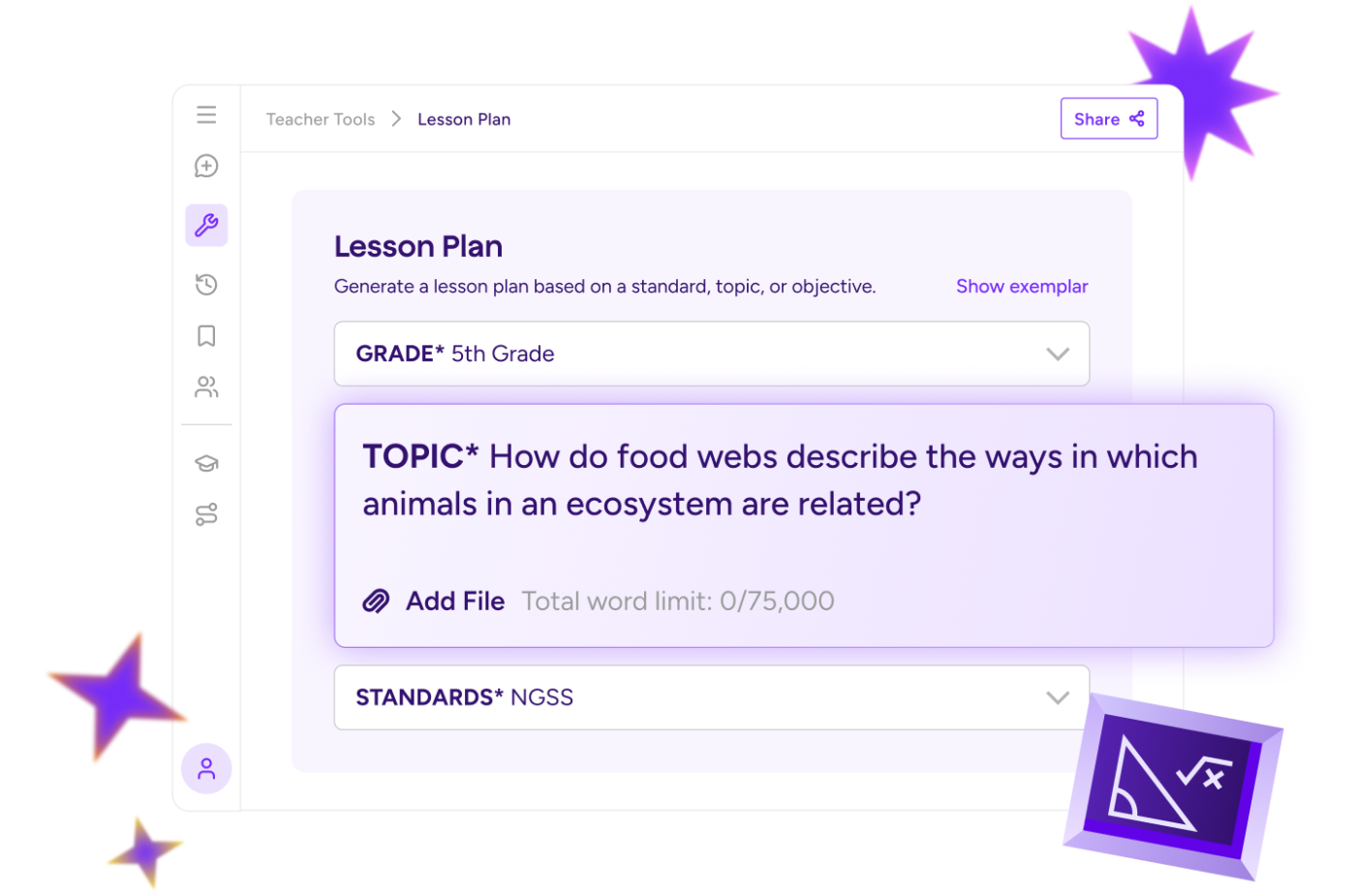
MagicSchool’s lesson plan generator turns a grade, subject, standard, and time limit into a structured plan. The plan includes objectives, activities, and an assessment. You can select or enter the standards you are teaching, and MagicSchool incorporates them into the objectives, activities, and assessment for you to review.
Once a core lesson exists, MagicSchool can produce versions for a different grade band or reading level while keeping the central objective fixed. For example, a sixth-grade science teacher with two inclusion sections could generate one photosynthesis lesson, then ask for a version with easier readings and sentence frames, keeping the same objective.
MagicSchool sits inside a platform of more than 80 teacher tools. They include quizzes, rubrics, and Raina, a chatbot for requests that don’t fit a template. That breadth helps if you want the lesson, exit ticket, and leveled reading in one place. The Plus plan adds unlimited generations, saved output history, and unlimited editing of AI output, with generation caps for extreme usage.
Where it taps out: On the free plan, refining a lesson uses the same generation allowance as creating one. Each tool output or Raina response counts, so adapting a lesson for several groups can use multiple generations. Frequent drafting and revision may require a paid plan.
A user review says:
Magic school is incredibly easy to use. All of the tools are listed right on the main page and you just have to click what you want it to do for you. If you want something custom or can’t find it, Raina is easy to talk to and will help. It’s also free which is great. It makes quality products in seconds.
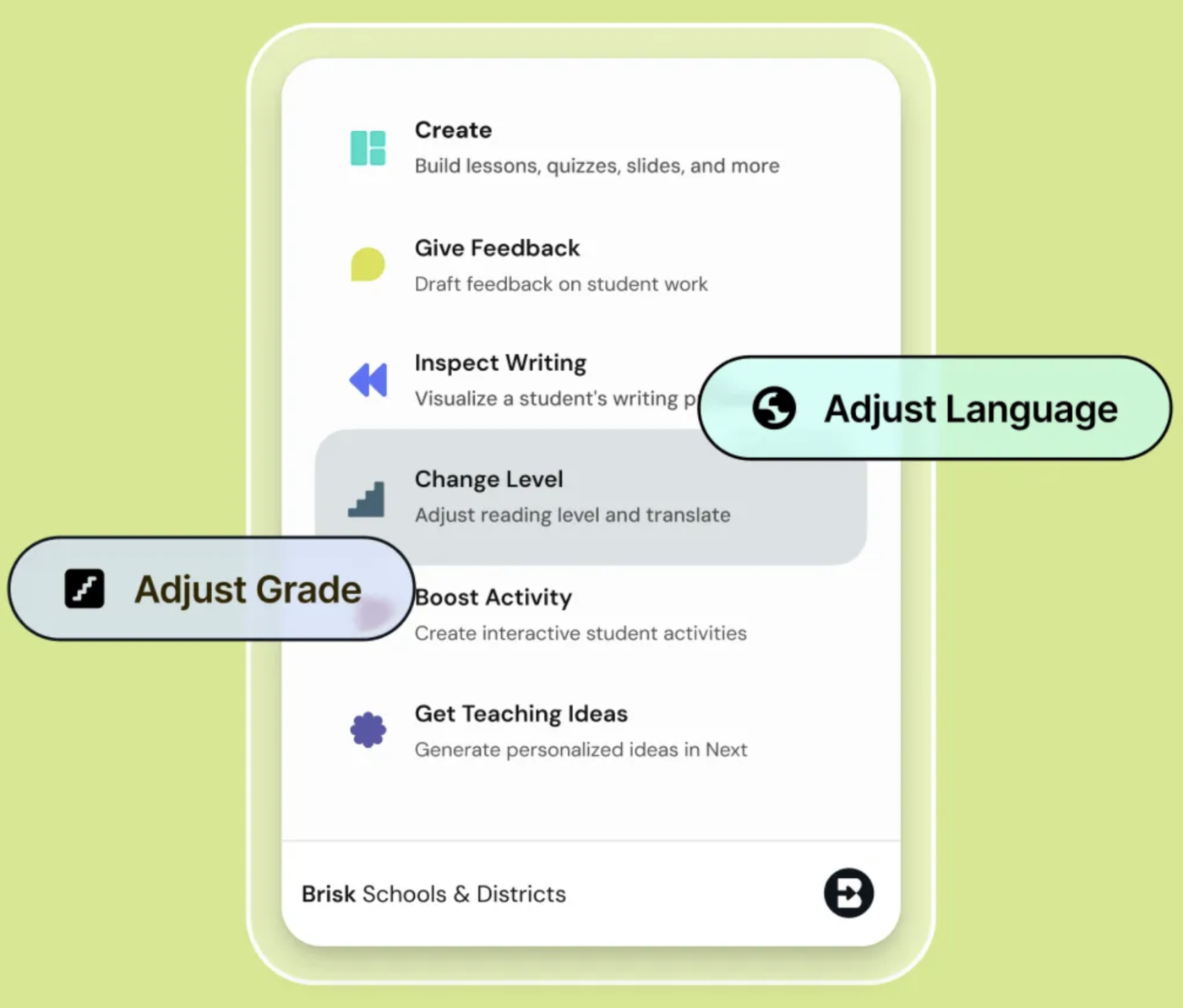
Brisk runs as a Chrome and Edge extension. Its lesson plan generator opens on top of the document, slide deck, video, or LMS page you already have open. You describe the topic, grade, and length, then answer a few clarifying questions. Brisk writes the plan into Google Docs or Word, where you edit it like any other file.
After the first draft, you can chat with Brisk to add an activity or change the pacing. There’s also the option to start from an existing lesson, or one of our lesson plan templates for Google Docs, instead of a blank prompt.
Lessons run from 20 to 120 minutes, and output works in more than 50 languages. Supported standards include Common Core, NGSS, state standards, and custom frameworks.
Teachers can use the Free plan independently. Premium adds district standards, rubrics, and classroom context. Intelligence adds adopted curriculum, pacing, and scope and sequence. Paid plans are designed for school-wide or district-wide adoption rather than individual teacher upgrades.
Where it taps out: The free plan runs on Brisk’s standard model with usage limits. Unlimited use and the faster model are reserved for school and district plans. A teacher whose district hasn’t bought Brisk can’t upgrade alone, because Brisk sells paid plans school-wide.
Best for: Google or Microsoft classrooms where lessons already live in shared docs and slide decks
Skip it if: You want to buy a paid tier yourself, or your school blocks browser extensions
A user review says:
One of the useful extensions I’ve found is Brisk Teaching. It has a button to inspect writing. If you’re concerned that a student used AI to create something, open the student’s submission online and click it. It replays the writing like Draftback does, but it’s easier to use. It’ll also show you the number and locations of large copy/paste sections.
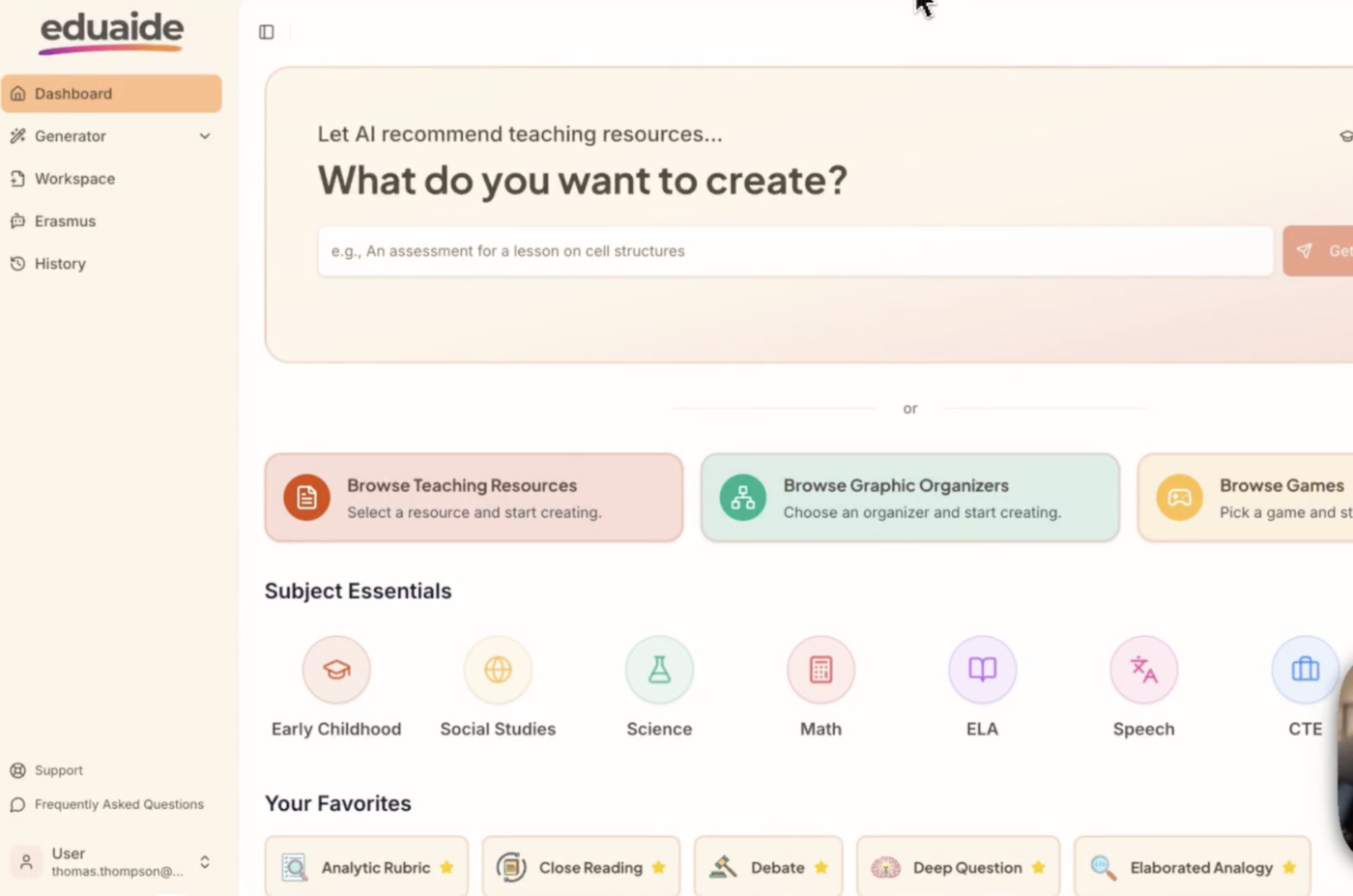
Eduaide builds lesson plans, worksheets, and games from a learning objective. It can also use your curriculum materials, including uploaded documents and websites, with YouTube transcript imports available on Pro. This lets you base a lesson on the text your students will read rather than supplying only a topic.
A fourth-grade teacher could upload a science reader chapter, generate a lesson, and use the evaluator’s feedback to identify passages that may need simpler wording or additional explanation. Eduaide also helps you review its output. Its evaluators examine grade level, text complexity, and the prior knowledge a resource assumes.
Standards come from more than 50 jurisdictions, and finished work exports to Google Docs, DOCX, Google Forms, or PDF. The free plan includes 24 credits a month for up to 8 resources, with limited input context for standards and uploads. Pro allows longer prompts, five standards, and three uploaded documents per resource. It also adds Erasmus Document Chat for revisions.
Where it taps out: Free includes evaluations, but turning that feedback into revised resources and using document chat require Pro. If you want to generate a lesson, assess it, and revise it within the same workflow, those revision features are part of the paid plan.
Best for: Teachers with a set curriculum who want plans built from their own texts and checked before use
Skip it if: You need dozens of resources a month and will not pay for Pro
A user review says:
To get ready, I’ve been leaning on Eduaide.Ai. It’s helped me get organized, generate fresh ideas, and add a little creativity to my lessons
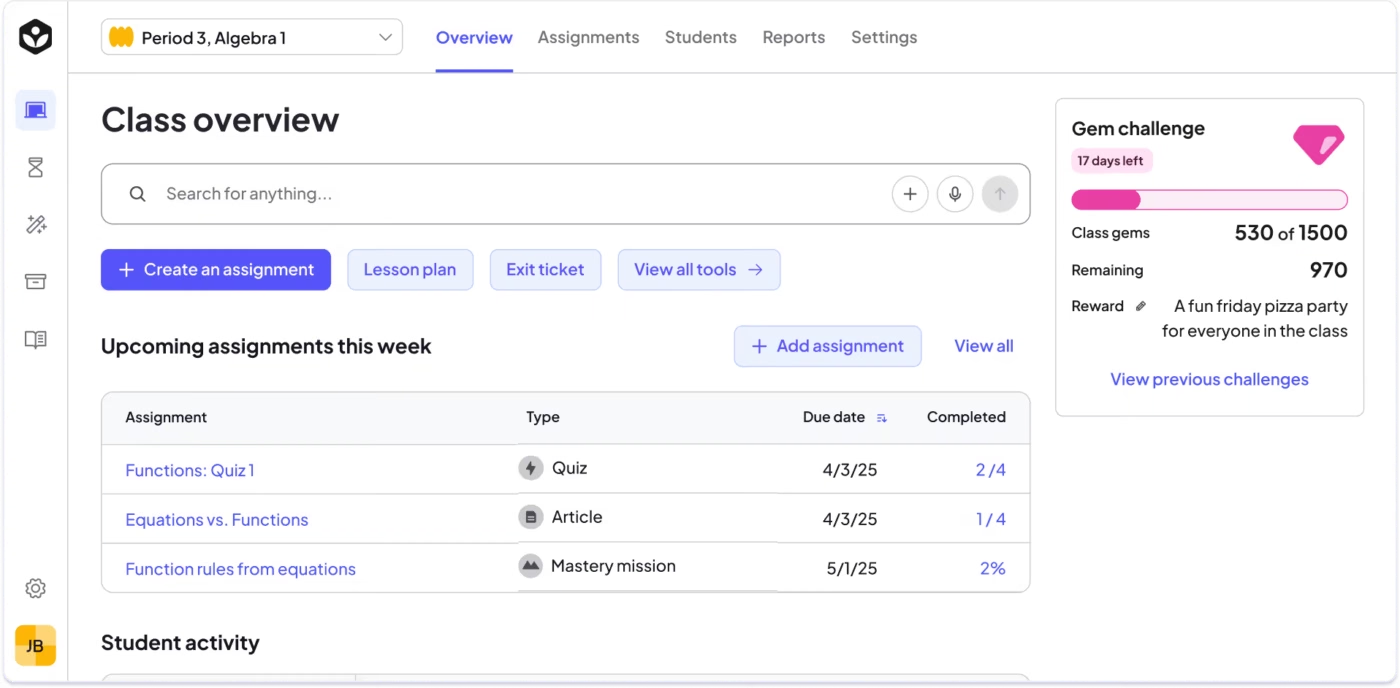
Khanmigo is Khan Academy’s AI assistant, and its teacher tools are free. Its lesson planner generates standards-aligned, differentiated drafts tied to Khan Academy’s content library. Separate tools help you create learning objectives, rubrics, and exit tickets.
That connection to the library is useful when you already assign Khan Academy practice. A seventh-grade math teacher could draft a lesson on proportional relationships, then use Recommend Assignments to find and assign related practice. Class Snapshot provides a summary of students’ recent work on Khan Academy, including assignment completion and course mastery progress, to help inform the next lesson.
Teachers do not need a learner or family subscription to use the free planning tools. Those subscriptions cover tutoring access, while school and district arrangements can provide classroom access for students, rostering, and single sign-on.
Where it taps out: Free teacher access does not let you give students access to Khanmigo’s AI tutoring. You can use the planning tools and assign Khan Academy content, but classroom access to Khanmigo for students requires a school or district implementation.
Best for: Math, reading, writing, and science teachers who already assign Khan Academy practice
Skip it if: Your subject sits outside Khan Academy’s core catalog
A user review says:
In chatGPT you can use a khan academy extension not sure if the same but I dont see benefit in using Khanmigo over ChatGPT.
Gemini in Classroom is Google’s set of AI tools inside Google Classroom. It is available with all Google Workspace for Education editions, including Education Fundamentals, the free edition for qualifying schools. Teachers can generate learning objectives, outline lesson plans, create quizzes, and adapt text from the Classroom interface.
The planning advantage is having those tools alongside the place you manage assignments. Google also supports teacher-assigned Gems and Gemini Notebooks grounded in class materials.
These are related but distinct workflows: generating a lesson outline does not mean it automatically uses every reading posted in your class. Supply the relevant context and materials, then check the result.
Access depends on your school’s account and administrator settings. Education Plus adds Gemini capabilities in apps such as Docs, Slides, and Forms, while Google AI Pro for Education provides expanded access to premium AI features.
Where it taps out: The lesson-outline tool is available on the web but is not currently listed among Classroom’s mobile features. Access also requires a school-managed Google Workspace for Education account and the relevant administrator settings, so a personal Gmail account does not provide the same Classroom tools.
Best for: Teachers in Google Workspace for Education districts who want AI where assignments already live
Skip it if: Your school runs on Microsoft 365, or you plan on a personal account
A user review says:
I use Gemini for making school projects or gathering information on any topic, and sometimes for finding reviews of books. It helps me as a friend when I am alone. I enjoy discussing topics with it, and when I’m bored and alone at home, I chat with it. The initial setup of Gemini was easy
Read More: Gemini vs. ChatGPT
ChatGPT for Teachers gives verified U.S. K–12 educators a dedicated workspace for planning lessons, adapting materials, and collaborating with colleagues. It includes unlimited messages, file uploads, web search, and connected apps. Content shared in this workspace is not used to train OpenAI’s models by default.
You can have it remember your grade level, curriculum, and preferred lesson format, then bring in readings or resources from Google Drive and Microsoft 365. When an activity needs revision, teachers can ask follow-up questions and refine it against the supplied materials.
For the second pass, give ChatGPT the lesson objective, relevant standard, and draft activity, then ask it to explain whether students actually practice the intended skill. You still need to check that explanation against the standard and your students’ needs.
Where it taps out: Access requires verification as an eligible U.S. K–12 educator or staff member, and free access is confirmed only through June 2028. OpenAI may adjust pricing after that, so schools that build it into their lesson-planning workflow could face an unbudgeted cost to continue using it.
Best for: U.S. K–12 teachers comfortable writing detailed prompts who want one assistant that knows their curriculum
Skip it if: You want guided forms with standards built in, or you teach outside U.S. K–12
A user review says:
Their SAML integration doesn’t work correctly with Google. We’ve had a lot of random trouble. Half of our staff got set up without problem, but half can’t join the workspace or can’t even sign in. OpenAI support is not helpful.
Read More: ChatGPT alternatives for writing
Canva’s lesson plan generator runs on Magic Write. It is free to eligible teachers, districts, and administrators on Canva for Education. One prompt produces a draft with objectives, assessments, and materials. It lands in the same platform where you design the slides and handouts.
The tool earns its spot at the delivery end of planning. Magic Activities can expand a lesson plan into a course you customize with your own templates, graphics, and activities. For the second pass, Magic Write can work from prompts or existing text in your design. You could ask it to simplify a worksheet’s instructions, then review the wording before sharing it with students.
Canva says its safety measures screen generated plans for harmful, biased, and inappropriate content. It also states FERPA and COPPA compliance and has signed the National Data Privacy Agreement.
Eligibility matters: Canva for Education is free for verified K–12 educators at eligible institutions. Private tutors and higher-education instructors need another plan.
Where it taps out: Magic Write has a 1,500-word input limit and an output limit of around 2,000 words. A long curriculum document or detailed unit plan may need to be split into smaller sections, and generated text can be cut off mid-sentence. Free Education access also requires eligibility verification, with credentials rechecked every three years.
Best for: Teachers who spend more time building slides and handouts than writing the plan itself
Skip it if: You need Magic Write to process a curriculum document longer than 1,500 words in one pass
A user review says:
As a math teacher and community organizer for teachers, Canva is very helpful for us in creating infographic formulas, presentation materials, and engaging student worksheets. Its best feature is the ability to share template links; I just share one link and other teachers in the community can immediately copy and edit it according to their class needs. Its integration with Google Classroom is also excellent because I can directly share design materials to the class without the hassle of downloading and re-uploading. The app is very lightweight, accessible via phone or laptop, and syncs instantly.
Pro Tip: Our roundup of Canva alternatives covers other design tools, and college faculty can compare AI tools for college students to see what their students use.
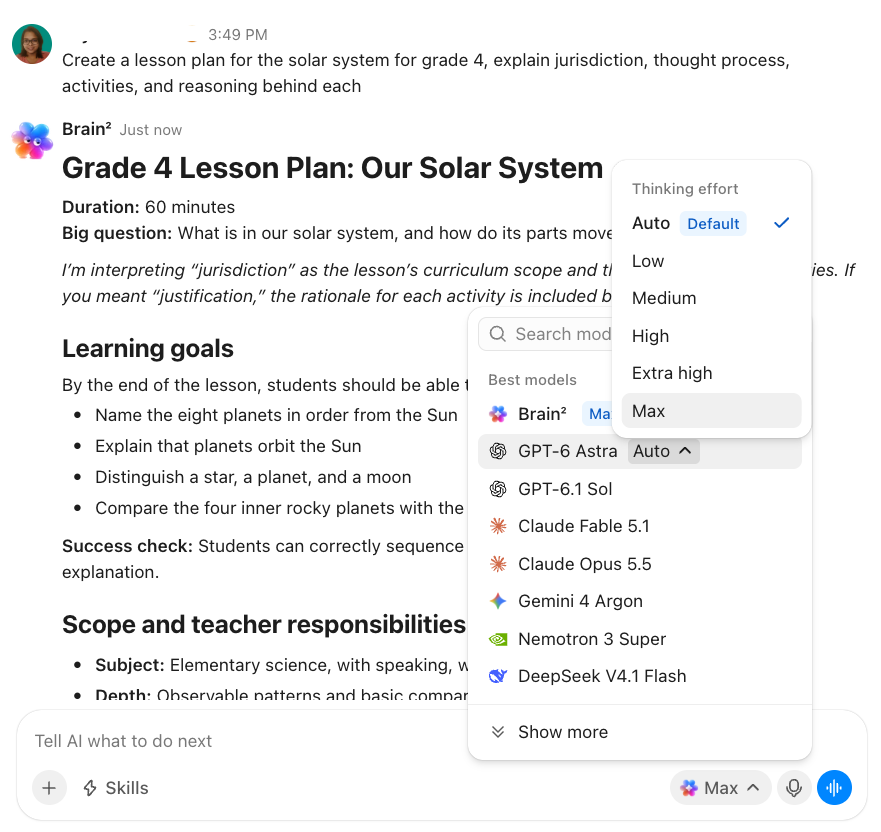
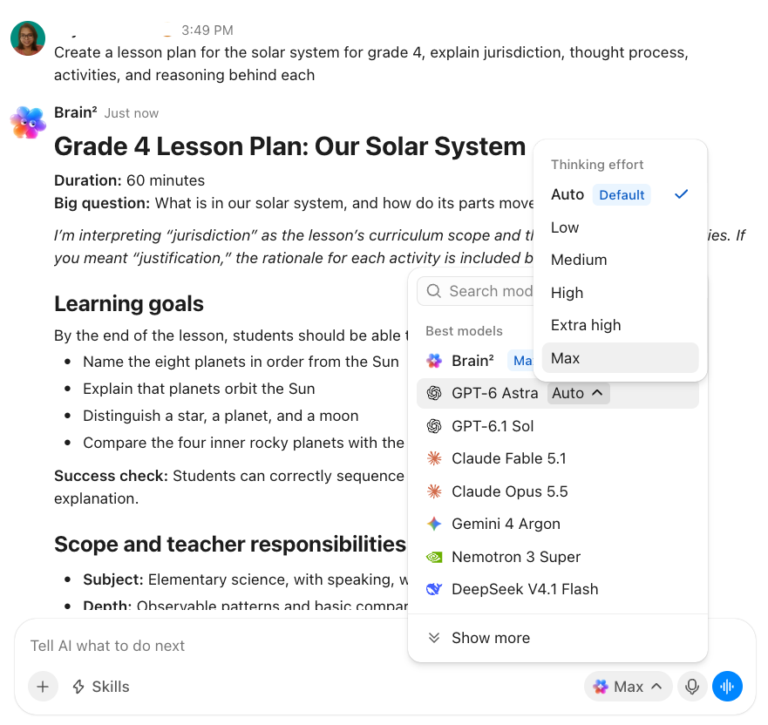
Planning a shared unit involves more than writing individual lessons. Teachers need to agree on objectives, prepare materials, review activities, and carry useful feedback into the next term. ClickUp brings that work together in Docs, tasks, and team conversations, with ClickUp Brain² to help turn those materials into lesson drafts and classroom resources.
Start with the curriculum outline, assigned readings, and previous lesson notes you want Brain² to use. It can work from accessible workspace content and uploaded files, so you can ask it to build on your department’s materials.
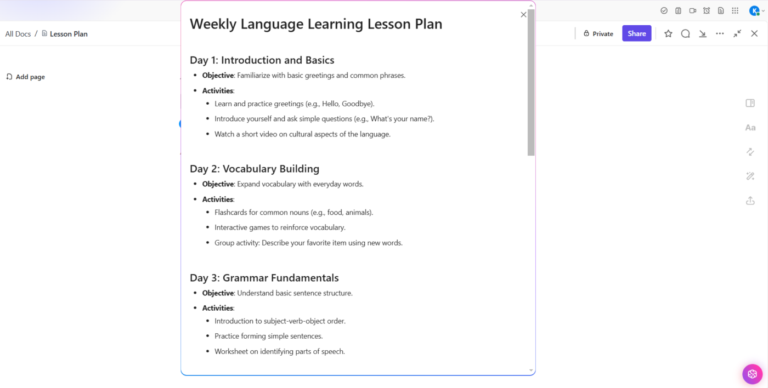
Teachers can review the scientific accuracy, reading demands, and assessment before using the lesson. Once the lesson is approved, Brain² can build artifacts, like a slide deck from the Doc, and create preparation tasks for the team, such as checking the answer key or assembling lab materials. Those tasks can have owners and due dates, keeping the remaining work visible alongside the lesson.
For setup guidance, see lesson planning in ClickUp. Our overview of ClickUp AI tools covers the wider feature set.
Where it taps out: Brain² needs access to the curriculum, readings, and feedback you want it to use. It cannot account for materials you haven’t supplied or connected, and teachers still need to check its proposed activities and assessments. Free Forever includes trial access to Brain; creating and editing slide-deck Artifacts also consumes AI Credits.
Best for: Departments and instructors planning full units or courses together and reusing them each term
Skip it if: You want a quick, standards-aligned plan for one class period
A user review says:
ClickUp has been really useful for managing the day-to-day operations of Mando School. We have lots of moving parts, including school partnerships, teacher recruitment, lesson planning, class schedules, marketing and general admin, so having everything organised in one place makes a big difference.
Pro Tip: The College Lesson Plan Template provides fields for objectives, lesson structure, detailed plans, and evaluation forms. For a full course, the Syllabus Planning Template organizes topics and preparation across the term. Save the finished task structure as a template, then remap its dates when the unit is taught again.
Start with where your lessons already live and the part of preparation you need help with:
Before committing, check whether the plan you qualify for covers your weekly workload, including revisions. School approval, usage limits, and access to paid features may narrow your choice.
A lesson plan records what you intend to teach. After class, you have information the first draft could never supply: which explanation students needed twice and what their answers revealed about their understanding. Those observations give the next revision a more useful starting point than the original prompt alone.
Keep a short teaching note with the plan. Be specific about what happened and what you would change. Over a term, these notes can help a department distinguish an isolated difficulty from a recurring gap. If several lessons reveal the same misunderstanding, it’s time to reconsider the sequence.
ClickUp gives those reflections a place alongside the lesson Docs and preparation tasks. Ask Brain² to compare the notes with the original plan and propose changes for your review. A colleague picking up the unit can then see both the revised materials and the reasoning behind them.
Include the grade, subject, learning objective, class length, assigned materials, and assessment requirements. Supply the relevant standard’s wording and describe support needs without identifying students. For example: “Draft a 45-minute seventh-grade civics lesson using these two sources. Students should compare the authors’ arguments and support a conclusion with evidence. Include discussion questions and an exit ticket.”
Compare the objective, main activity, and assessment with the official standard’s wording. A matching standard code alone does not establish alignment. If the standard requires students to evaluate evidence, the lesson should give them practice judging evidence, and the assessment should ask them to demonstrate that skill. Check the accuracy and suitability of any sources the AI suggests.
Only if your school has explicitly approved the tool and that use of student data. For routine planning, describe learning needs without names, identifiers, or individual records. For example, request vocabulary support and sentence starters without uploading a student’s learning plan. An education account’s privacy protections do not replace your school’s approval process.
A lesson plan sets out objectives, activities, timing, materials, and assessment. A lesson script adds suggested wording for explanations, questions, and transitions. You can ask an AI tool for either, but check which output it provides. Use a script as preparation rather than something to follow word for word, so you can respond to students’ questions and understanding.
Yes, if you save or print the plan and its materials beforehand and the activities work offline. Download readings, worksheets, slides, and answer keys rather than relying on links. Replace activities that require live websites or AI responses with offline alternatives. Before class, disconnect from the internet and check that the files open and any required media plays.

Manasi Nair
Max 22min read
Manasi Nair
Max 23min read
Manasi Nair
Max 29min read
© 2026 ClickUp