

Sorry, there were no results found for “”
Sorry, there were no results found for “”
Sorry, there were no results found for “”
We all rely on tools—whether sticky notes, spreadsheets, or simple apps—to stay organized. But those tools simply can’t keep up with complex workflows, tight deadlines, and team coordination. This is where project management software becomes indispensable, transforming how businesses plan, execute, and monitor projects at scale.
Among the top contenders is monday.com, celebrated for its flexibility in handling diverse workflows and managing projects. But even the best project management software has limitations.
If you’re a business leader or project manager considering using monday.com or its alternatives, this monday.com review will help you make a decision. Read about Monday’s strengths, drawbacks, and why you might consider more powerful project management tools like ClickUp.
Here’s a rundown of monday.com and its alternatives:
monday.com stands out among the many cloud-based free project management software available for its intuitive design and user-friendly interface. It’s organized into workspaces, teams, boards, and subitems. As you visualize tasks as rows in Monday’s table view, you can customize corresponding columns to track task data, including status updates, timelines, and tags.
The platform offers basic task management with 15 view types, including Gantt charts, Kanban boards, calendars, maps, and snapshots. These views allow teams to monitor progress from multiple perspectives with real-time updates. Tasks are color-coded for easy identification, making tracking progress at a glance simple.

The columns in each view are customizable. You can add details like budgets, timelines, or other relevant information. You can share Boards with non-monday.com users through a view-only guest access link. This keeps all stakeholders informed without needing separate accounts.
monday.com also includes an extensive tutorial library. It helps both beginners and experienced users maximize the platform’s features. The platform provides diverse data visualization tools, enabling users to customize workspaces for specific needs. Let’s take a look at monday.com’s features and see how to make them work for you.
🧠Fun Fact: Henry Gantt invented the widely used Gantt chart between 1910 and 1950. It was created to manage shipbuilding projects during World War I and has since become a staple in project management.
Also Read: How to Create a Gantt Chart in monday.com
monday.com provides a no-code solution, allowing users to automate tasks and processes effortlessly without requiring coding experience. Users can create custom automation workflows using when-then commands or select from various pre-built automation templates to meet their needs.

The Monday AI workflow assistant boosts productivity by performing various tasks, such as sending notifications, updating statuses, creating new items, and assigning team members, when the specified conditions are met.
monday.com’s dashboards allow you to view all projects in a single layout. With over 30 available widgets and apps, you can effectively monitor project progress, track budgets, and estimate team workloads.

You can select and organize groups from different boards into one dashboard, centralizing all the data in a single location and utilizing widgets to access all the necessary tools and information at a glance.
monday.com offers robust time-tracking features that allow you to view each task’s time intervals and progress by simply clicking into a specific time-tracking cell. You can edit all entries in the time tracking log, ensuring accurate records.

Additionally, the platform supports time blocking. Improve productivity by breaking your day into manageable time blocks, focus on one task at a time, and maintain a structured workflow throughout the day.
Organize tasks into groups and assign them to individual team members or entire teams easily. The People column lets you assign tasks to individuals, entire teams, or sub-teams. You can also add time estimates and priorities to tasks for better workload management in monday.com.

The Workload view allows project managers to monitor team member workloads in real time. The blue bubbles indicate workloads, and the red bubbles signal potential overload.
monday.com integrates with popular tools like Slack, Google Drive, Microsoft Teams, and Salesforce. It enables automation through apps like Zapier, features two-way syncing with tools like Google Calendar, and provides real-time updates via communication platforms.

With an open API, users can create custom integrations for more tailored workflows, ensuring seamless collaboration and increased efficiency across multiple platforms.
💡Pro Tip: Use the ClickUp Monday integration to check for new pulses on Monday and automatically create respective tasks in ClickUp.
👀 Did You Know? monday.com was founded in 2012 by Roy Mann, Eran Kampf, and Eran Zinman, initially under the name Dapulse. The company rebranded to monday.com in 2017.
monday.com is for businesses that need structure without sacrificing creativity. Whether you’re juggling deadlines, managing cross-team collaboration, or tracking resources, it offers a suite of work management tools to make work feel less chaotic.
I’ve used Monday at two different companies and love it. Sure, there are times when I struggle with wanting more, but I feel that would happen with any system. What I like most about Monday is that ‘anyone’ can set up ‘any’ workflow in it.
But what exactly makes it popular? Here are a few pros of using monday.com.
I like that monday.com is so community based. With the app marketplace, and exposed API access, there is a lot of custom work that can be done to your monday.com account. Very flexible.
Although it offers a wide range of features, monday.com reviews online explain where it falls short:
Used Monday at my previous org. Did not like it–really basic things were hard to do without tons of hacky work arounds.
Another frequent complaint is the platform’s limited flexibility in advanced reporting and automation.
My biggest hurdle has been reporting. Being able to generate reports for tracking at a micro-level is difficult. Not all reporting views allow for the level of drilling down that I have come to expect for things like time-tracking or grouping.
A Reddit user adds,
monday.com’s mobile app, while improved since its initial release, still lacks flexibility.
While Monday.com is a solid tool, many teams look for a more complete solution—like ClickUp for Project Management.
As the everything app for work, ClickUp brings task management, workflow automation, and docs, wikis, and team chat together in one place, while its built-in AI-powered tools work harder so you can work smarter.
With ClickUp’s Unlimited plan, teams get unlimited tasks, dashboards, and Custom Fields—making it a powerful yet cost-effective choice for Agile teams.
I can’t remember the precise details, but I spent quite a lot of time looking at them both and concluded that Monday was a lot of style over substance. Have been really impressed with ClickUp.
Let’s compare monday.com and ClickUp at a glance:
| Feature | ClickUp | monday.com |
| User interface | Flexible and highly customizable | Intuitive and visually appealing |
| Views and layouts | Multiple views, including lists, tables, Kanban boards, calendars, Gantt charts, whiteboards, mind maps, and more | 15+ views including Gantt, Kanban, and calendar |
| Automation | More advanced automation, multi-step workflows, and AI-powered automations | No-code automation, but advanced features are paywalled |
| Task management | Keep tasks and async work connected with built-in chat, audio, and video calls | Conversations and tasks exist separately, requiring external tools for real-time collaboration |
| AI features | Integrated AI assistant (ClickUp Brain) for $7/user/month on any paid plan; free trial available | AI for task automation and content generation; currently in beta for Pro and Enterprise users |
| Sprints | Built-in sprint management and reporting | No built-in sprint management |
| Collaboration | Docs with real-time editing, assigned comments for accountability, whiteboards for brainstorming, and connected chat | Commenting, @mentions, shared boards. No assigned comments for accountability |
| Integrations | 1,000+ native app integrations; integrates with more via Zapier | 200+ native app integrations; integrates with others via Zapier |
| Storage | The free plan has a 100MB cap | The free plan provides 500 MB of file storage space |
| Mobile app | Well-optimized for mobile | Some users report limited flexibility |
| Pricing | Generous free plan with all features Unlimited: $7/user Business: $12/user Enterprise: Custom ClickUp Brain is available on all paid plans for $7 per member/workspace | Limited free plan with basic features Basic: $12/seat, Standard: $14/seat, Pro: $24/seat, Enterprise: Custom |
| Best for | Teams looking for an all-in-one work management platform with advanced automation and AI | Teams that need a visually intuitive project management tool with good automation |
Let’s now take a closer look at ClickUp vs. monday.com.

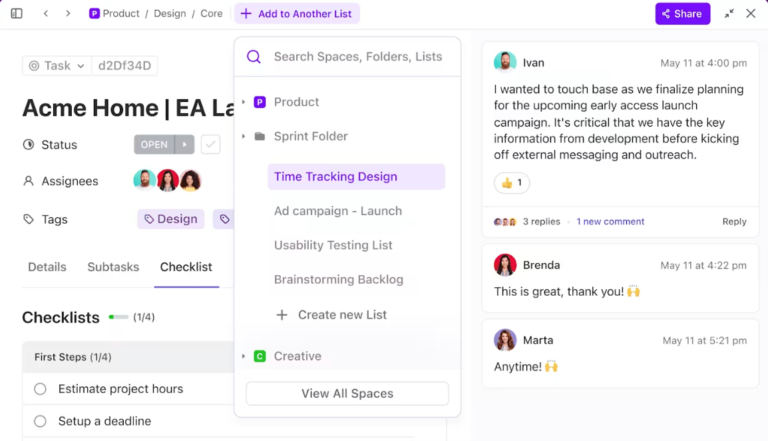
To start with, ClickUp offers advanced task management with features like subtasks, checklists, time tracking, and Gantt charts available across all plans, including the free plan. You can create tasks from various places, such as within your chat or on whiteboards, seamlessly integrating into your workflow.
monday.com provides intuitive task creation and assignment but requires higher-tier plans for features like Gantt charts and time tracking.
I can’t remember the precise details, but I spent quite a lot of time looking at them both and concluded that Monday was a lot of style over substance. Have been really impressed with ClickUp.
In ClickUp, you can easily organize tasks using customizable lists and boards, sorting them by priority or status. Complex tasks are broken down into subtasks and checklists for clarity. Set task priorities and dependencies to ensure everything gets done in the right order. Assigning tasks to multiple team members helps create shared ownership and accountability.
You can also communicate important information in tasks through comments and mentions. Plus, ClickUp offers great visibility with search, filters, an activity stream, and notifications to keep you on top of tasks and deadlines.
Compared to monday.com, ClickUp stands out as more than just a task management tool—it’s a comprehensive productivity platform. Its ability to create both private and collaborative tasks enhances its versatility.
ClickUp Goals offer a comprehensive approach to project management, helping teams set clear, actionable goals and track them precisely.

Set high-level objectives aligned with your vision using frameworks like OKRs, sprints, or scorecards. You can break goals into specific, measurable targets like tasks, numerical milestones, or true/false outcomes. ClickUp also offers real-time progress tracking with dynamic progress bars to monitor goal achievement visually.
While ClickUp offers a full-blown feature, Monday.com uses a simple widget for goals. It also offers detailed templates for setting all types of goals but is a much more basic alternative to ClickUp’s detailed tracking, OKR offering, and deep customization.
As a simple example, using the Goal widget in monday.com requires you to add a Numbers Column to your board and fill it with the key metrics. Tracking non-numeric values is a challenge, unlike in ClickUp, where you get four types of targets: Number, True/False, Currency, and Task.
ClickUp Docs let you create versatile documents and wikis with nested pages, templates, and styling options for various needs, from roadmaps to knowledge bases. Unlike monday.com’s Workdocs, which works quite like a collaborative note-taking app and doesn’t let you organize company knowledge in a wiki yet, ClickUp’s Docs can be used to create your centralized knowledge base or single source of truth.

While Monday.com provides a custom automation builder, it primarily focuses on straightforward automation scenarios. Users can create automations by selecting predefined triggers and actions, but the platform may not support the same level of complexity and customization as ClickUp.
Plus, automations in monday.com are paywalled in higher-tier plans, while ClickUp offers a custom automation builder available on every plan, including the free plan.

Bonus: ClickUp also lets you build automations in natural language using ClickUp Brain’s AI assistance!
Both ClickUp and monday.com offer AI features to summarize tasks and create action items, but ClickUp takes it further with ClickUp Brain. It provides instant, context-based answers from everything within and connected to ClickUp, analyzes data to predict issues, and offers real-time insights on your projects.
ClickUp’s powerful AI agents can help you forecast risk and adapt to changes, automatically create tasks from your chat threads, link them to projects, write standup reports for you, build automated workflows, and even generate content for multiple use cases—from PRDs to marketing campaigns.

Additionally, ClickUp’s Connected Search quickly finds what you need across connected apps, like Google Drive, GitHub, Salesforce, Figma, Dropbox, Confluence, Box, and more.
📮ClickUp Insight: Monday blues? Turns out Monday stands out as a weak link in weekly productivity (pun unintended), with 35% of workers identifying it as their least productive day. This slump can be attributed to the time and energy spent hunting for updates and weekly priorities on Monday mornings.
An everything app for work, like ClickUp, can help you here. For instance, ClickUp Brain, ClickUp’s built-in AI assistant, can ‘catch you up’ on all critical updates and priorities in seconds.
And, everything you need for work, including integrated apps, is searchable with ClickUp’s Connected Search. With ClickUp’s Knowledge Management, building a shared point of reference for your organization is easy! 💁
Another strength of ClickUp is its wide range of customizable project management templates covering everything from software development to digital marketing campaigns. These templates come with pre-defined tasks, statuses, and workflows, helping teams hit the ground running.
The ClickUp Project Management Template, for example, provides a structured framework for your workflow, guiding your team from project initiation to completion.
Key features include:
📮ClickUp Insight: Context-switching is silently eating away at your team’s productivity. Our research shows that 42% of disruptions at work come from juggling platforms, managing emails, and jumping between meetings. What if you could eliminate these costly interruptions?
ClickUp unites your workflows (and chat) under a single, streamlined platform. Launch and manage your tasks from across chat, docs, whiteboards, and more—while AI-powered features keep the context connected, searchable, and manageable!
Work today is broken. Our projects, knowledge, and communication are scattered across disconnected tools that slow us down. ClickUp fixes this by combining your projects, knowledge, and chat in one place—all powered by AI that helps you work faster and smarter.
As part of the ClickUp work management platform, ClickUp Chat lets you manage your team updates directly within tasks.
Unlike monday.com, which separates chat from task management, ClickUp Chat seamlessly merges conversations with work. It allows users to turn messages directly into tasks, assign them on the spot, and track progress (all within the same chat window).
Discussions remain actionable, as threads can be linked to specific tasks, ensuring that important decisions don’t get lost in endless context switching. With built-in voice and video calls, AI-powered task creation, and mobile chat, ClickUp eliminates context-switching, keeping teams focused and aligned.

ClickUp Inbox consolidates all project communications, ensuring that important messages and updates are easily accessible, promoting clarity and efficiency in team interactions. In comparison, Monday.com uses notifications to highlight updates, which can easily get buried among other alerts.

ClickUp offers over 1,000 integrations, while monday.com provides more than just 200, making ClickUp the ideal tool to fit into your ecosystem seamlessly.
ClickUp Integrations connects with popular platforms like Google Drive, Dropbox, Slack, Zoom, and Microsoft Teams. These integrations allow teams to centralize workflows, minimize context switching, and eliminate data silos.

Are you still uncertain about making the right choice for your team?
Here’s what one of our users, Winser Espinal, has to say about ClickUp after trying out other project management software:
In love with ClickUp, it’s kinda like Monday or Asana, but better. No kidding, I am no pro when it comes to keeping track with the million things I’m doing without an app, so seeing a noticeable change in my performance has got me in a good mood.
Also Read: ClickUp as #1 monday.com alternative
The effectiveness of any team largely depends on the project management platforms they utilize. While monday.com provides a sleek and user-friendly interface, ClickUp offers flexibility and integration that monday.com doesn’t quite match.
Unlike Monday.com, which may require other project management tools to fill feature gaps, it centralizes all project interactions into a single platform, eliminating the confusion that often comes with using multiple tools.
🧠Fun Fact: 40.9% of customers using ClickUp have eliminated 3 or more tools from their tech-stack since making the switch!
Whether you’re managing tasks, collaborating on documents, automating workflows, or communicating with your team, ClickUp has all the features you need to manage complex projects and keep your team productive.

Arya P Dinesh
Max 15min read

Manasi Nair
Max 15min read
Manasi Nair
Max 19min read

© 2026 ClickUp





