

Sorry, there were no results found for “”
Sorry, there were no results found for “”
Sorry, there were no results found for “”
I’ve used MindMeister since way back, and I still think it is a solid mind mapper. You get clean maps, real-time editing, and tight MeisterTask integration. But the longer I leaned on it, the more the limits showed. The free plan capped me at three maps and blocked exports. And the catch that finally sent me looking: a finished map just sat there, while the real work happened somewhere else. Yes, MeisterTask picks up some of that handoff, but it means running a second tool to do what one workspace should.
Here’s the pattern I keep seeing, in everyone I’ve watched switch: you leave MindMeister for another standalone mapper, feel better for a while, then leave that one about a year and a half later. Same reason every time. You’re not fixing the problem, you’re just changing which app the dead-end map lives in.
So I decided to test the alternatives that step in where MindMeister falls short.
I cross-checked every one against current pricing pages and reviews. Then I ranked them by the factors that determine a switch: collaboration, AI, price, and whether the map survives contact with a real project.
Before we get into the individual reviews, here is a short video walkthrough of how the leading mind mapping tools compare:
Here’s the quick scan before the full reviews, with each MindMeister alternative mapped by fit, standout strength, price, and trade-off.
| Tool | Best for | Standout feature | Starting price | Where it taps out |
|---|---|---|---|---|
| Miro | Live team workshops and whiteboarding | Infinite canvas with mind maps, sticky notes, voting, timers, and 250+ integrations | Free; paid from $8/member/mo | Whiteboard-first, so structured solo maps take more manual arranging |
| Xmind | Solo, structured, presentation-ready maps | Multiple map structures, mixed layouts, Pitch mode, and strong export options | Free; paid from $4.92/mo | Best for solo thinking; team collaboration needs higher plans |
| Coggle | Free, shareable diagrams | Unlimited public diagrams, real-time editing, QR sharing, and auto-arrange | Free; paid from $5/mo | Light on privacy, AI, task handoff, and advanced controls |
| ClickUp | Turning maps into tracked work | Mind Map nodes convert into live tasks with owners, due dates, statuses, Docs, and Dashboards | Free; paid from $7/user/mo | Heavier than needed for standalone diagrams |
| Mindomo | Browser-based MindMeister replacement | Mind maps, outlines, Gantt charts, classroom tools, offline editing, and 20 export formats | Free; paid from about $6.85/mo | Interface feels less modern; advanced exports need paid plans |
| MindManager | Microsoft-stack enterprises | Teams, SharePoint, Office ties, project views, admin controls, and enterprise deployment | 30-day trial; paid from $99/yr | No permanent free plan; too costly for simple personal mapping |
| MindNode | Apple-only individuals | Native Apple apps, iCloud sync, Outline View, Focus Mode, and Apple Intelligence on Plus | Free; Plus from $2.99/mo | Apple-only, with no Windows, Android, or full web app |
| Ayoa | Brainstorm-to-task work for neurodiverse teams | Organic maps, task boards, whiteboards, Gantt views, and neuro-inclusive AI settings | Free; paid from $13/user/mo | Busier than a pure mapper; lighter than a full PM platform |
Our editorial team follows a transparent, research-backed, and vendor-neutral process, so you can trust that our recommendations are based on real product value.
Here’s a detailed rundown of how we review software at ClickUp.
The best MindMeister alternative comes down to six factors: collaboration model, whether the map becomes tracked work, AI depth, free-tier limits, platform fit, and pricing model. Weigh those before features, because the right pick depends on how you work, not which tool has the longest spec sheet.
Most of the switching regret I see comes from choosing a tool based on features rather than fit. These six questions sort the field fast.
Get honest about those six, and the noise drops away fast. If you want a broader view beyond direct MindMeister rivals, our roundup of the best mind mapping software covers even more options. And if MindMeister already fits and you’re only price-shopping, skip all of this: the switching cost may outweigh the savings.
The right pick depends less on the map and more on what happens next. Below are the eight I’d actually recommend, each strongest for a specific kind of work.
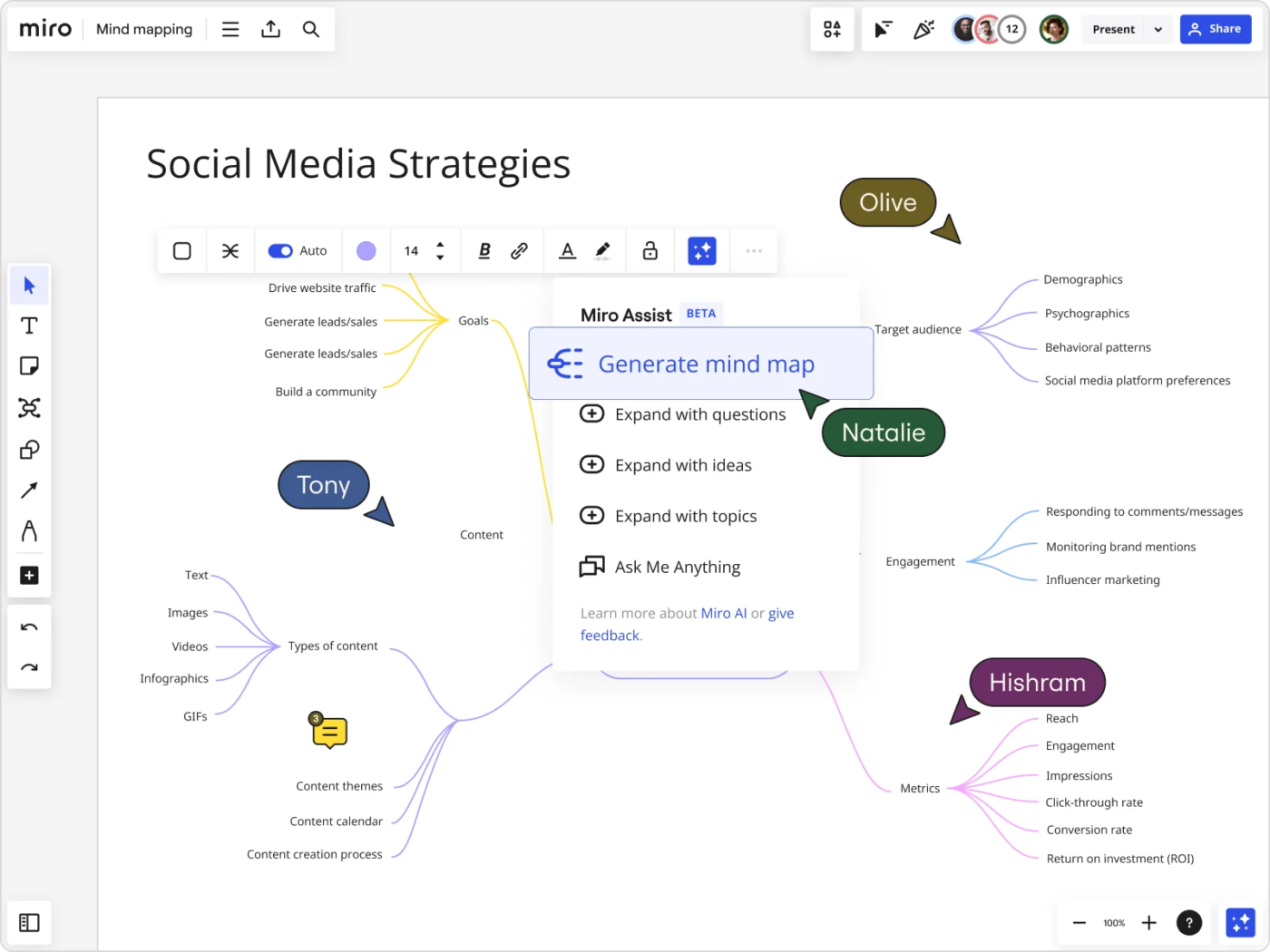
Miro is basically an infinite canvas, so when your quick map turns into a full team session, it already has the room. You can throw sticky notes, diagrams, tables, docs, and planning boards onto the same workspace, and it never feels cramped.
It is super useful for teams where the map is really the opening move in a sprint plan, discovery session, or messy group brainstorm. You get workshop controls like timers, voting, private mode for unbiased input, and a presentation mode that turns any board into a walkthrough.
MindMeister is excellent at classic mind mapping, but Miro is the one I reach for when the session needs structure.
Who it’s built for: Product, design, marketing, strategy, and operations teams that run live mapping sessions with several people editing at once.
AI capabilities: Miro AI helps generate diagrams, tables, summaries, sticky-note clusters, AI workflows, and agents. Free plans include limited AI credits, while paid plans increase the monthly allowance per seat or plan.
A G2 user writes:
Miro is my go-to place for brainstorming: the infinite canvas is a standout feature and is easy for anyone on my team to pick up quickly. I love how it syncs seamlessly with other tools like Jira, turning our ideas into real tasks without any extra manual work. The new AI features are a great addition, enabling us to convert rough thoughts into polished architecture diagrams in seconds.
Where it taps out: Miro is a whiteboard first and a mind mapper second. You can build a mind map in it, but I would not use it as my default tool for clean solo maps. It takes more manual arranging than Xmind or MindMeister when you want fast branching, tidy structure, and automatic layout.
Best for: Cross-functional teams that want mind mapping inside a wider workshop canvas.
Skip it if: You mostly build structured maps alone and want the tool to arrange branches for you.
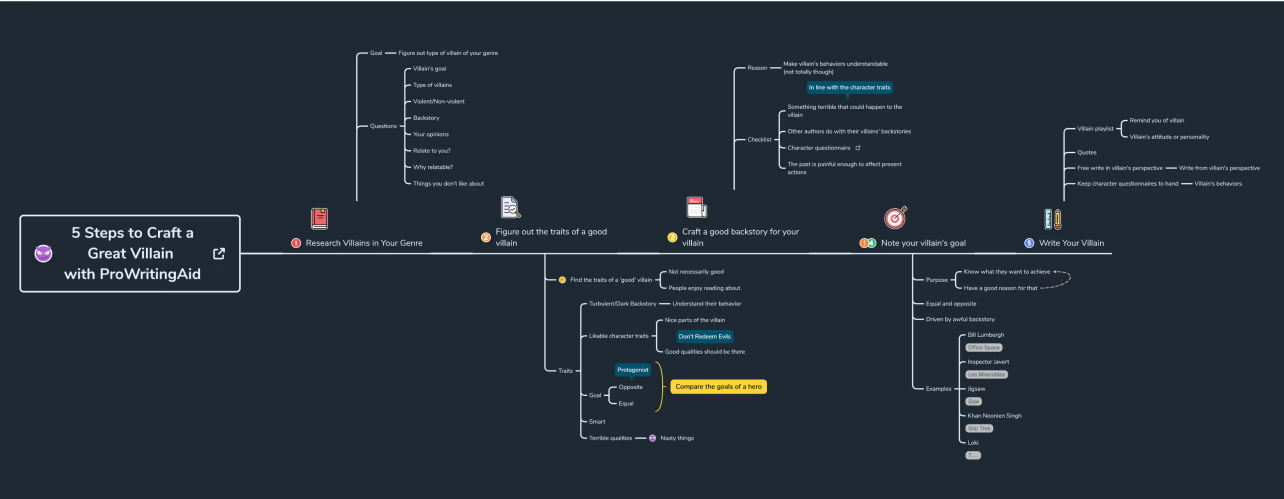
Xmind is my pick when the map itself needs to look sharp. It feels like a true mind-mapping app, not a whiteboard with mind maps bolted on. You get classic mind maps, fishbone diagrams, timelines, org charts, tree tables, and matrices, which give your thinking more shape than a plain branch-and-node layout.
What sells me is the structure switching. I can start a loose mind map, flip a branch into a fishbone to chase root causes, then drop the whole thing into Pitch mode and present without ever leaving the app. While MindMeister is lighter and more web-native, Xmind brings more structure, polish, and export control to the table.
Who it’s built for: Consultants, writers, researchers, QA leads, product managers, students, and solo planners who build maps first, then share or present them.
Note: Those are Xmind’s individual prices. Team and education plans run on a different structure. The Business plan for teams is billed per seat at $10.00/seat/month (yearly), while education pricing is lower, with Pro at $3.42/month, Premium at $5.75/month, and a Campus plan for institutions.
AI capabilities: Xmind AI helps turn text, files, links, and rough ideas into maps. It can also summarize material, expand topics, refine maps, reorganize ideas, and break projects into tasks. For individuals, Free and Pro include just 10 AI credits. So on those tiers, it works more like a trial. Premium includes 500 AI credits/month.
A Capterra user writes:
I have used Xmind for years. I used the free version but finally ended up paying the small yearly fee. I love it! The simplicity of creating mind maps and tracking all my thoughts for different projects is amazing. I can easily collapse any area I do not want to engage with at the moment so I do not see it.
Where it taps out: Xmind is at its best when the map belongs to one person first. Its structure and polish are built around focused, solo thinking, so live group workshops are simply a different job. Worth noting that the $4.92 Pro tier is an individual plan, so team collaboration requires the Premium or per-seat Business plan ($10/seat/month).
Best for: Solo thinkers who want structure, polish, and presentation-ready maps, and are happy to step up to Premium or Business when the work turns collaborative.
Skip it if: Your core use case is fast, live group workshopping, where a canvas-first tool will feel more natural from the start.
Also Read: Visual Project Management
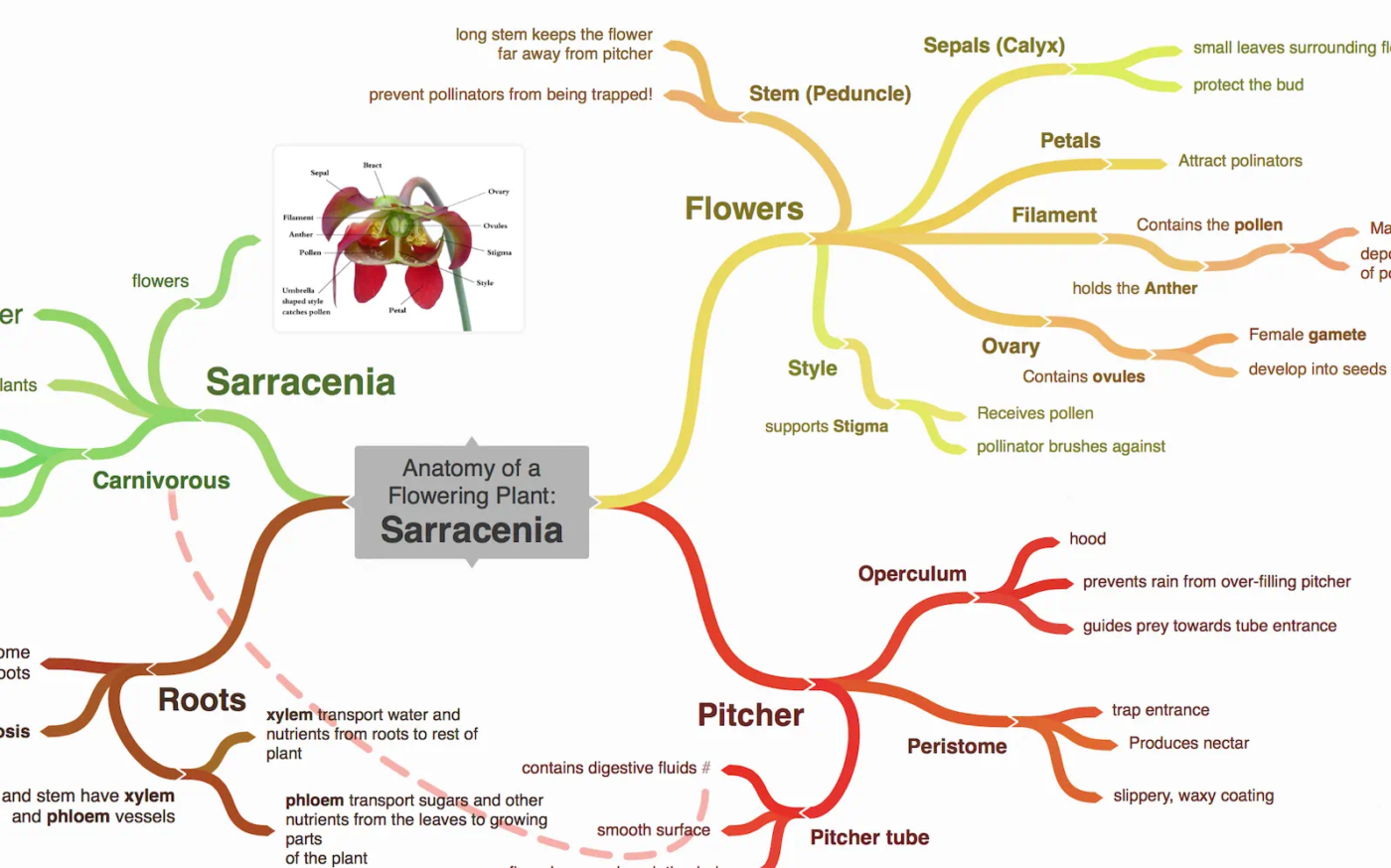
Coggle is free, browser-based, and dead simple. It’s what I open when I just need a quick map without any setup. It runs right in the browser with nothing to download and almost no learning curve. I get quick concept maps, class notes, light process diagrams, and public knowledge sharing without any fuss.
The canvas is unfussy, too. Type a node, hit tab, and a branch appears, with auto-arrange keeping the whole thing tidy as it grows. It handles loops and multiple start points, so you’re not forced into a rigid top-down tree.
MindMeister gives you a more structured workspace, but Coggle keeps things light and easy to share.
Who it’s built for: Students, educators, open-source contributors, and small teams that need fast, shareable diagrams and don’t mind keeping some work public.
AI capabilities: Coggle does not have a built-in AI assistant as of today. It is for people who want to map their own thoughts with a clean, low-friction tool. If AI-generated branches, summaries, or research-to-map workflows matter, look at Miro or ClickUp instead.
A G2 user says:
It’s very easy to create visual diagrams with a professional finish in Coggle, which is very convenient for planning my monthly activities. The interface is very functional, and I’ve been able to create complex mind maps since I started using it. Whether it’s changing colors, adding icons that help classify ideas, or reorganizing content, the versatility in customizing the maps is high.
Where it taps out: Coggle is intentionally light, so free maps are best for public or low-risk work. Advanced privacy, branding, and user controls require a paid plan. It also doesn’t offer the deeper structure, task handoff, or AI that you get in more modern tools.
Best for: Quick, shareable diagrams when budget matters and the content can be public.
Skip it if: Your maps need to stay private by default, or you want built-in AI and task handoff baked in.
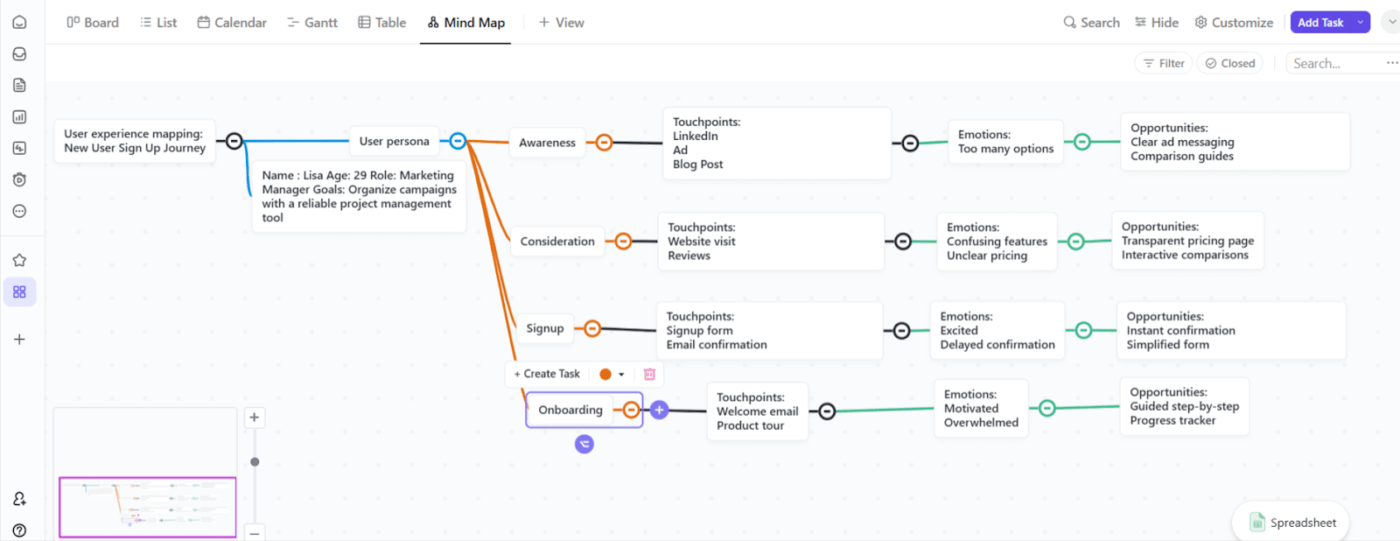
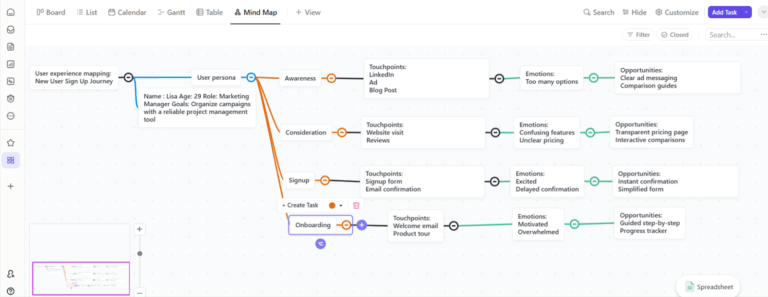
Some maps refuse to stay maps, and that is where I need ClickUp. ClickUp Mind Maps lets you turn nodes into real, trackable work inside the same workspace instead of copying everything into a separate tool.
What keeps me here is that the map never becomes a dead end. In Task mode, every node is a live ClickUp task, so dragging a branch actually reorganizes the work sitting behind it. When the plan is finally ready, those same nodes already carry owners, due dates, and statuses. The moment a map needs owners and due dates, I’m in ClickUp.
Who it’s built for: Product, marketing, operations, agency, and content teams that brainstorm visually, then need owners, due dates, statuses, docs, and dashboards tied to the plan.
AI capabilities: ClickUp Brain is useful when mapping is tied to real work, since it can summarize tasks and Docs, answer questions across your workspace, draft project content, and help turn loose ideas into next steps. For AI-agentic workflows, ClickUp also offers Super Agents.
A G2 user writes:
I find ClickUp incredibly useful for productivity, it provides both a bird’s eye view of projects and a detailed view for daily tasks. I love that ClickUp is built specifically for task management, making it excellent for team management and task tracking. The ClickUp whiteboard is great for mapping out visions and plans and I love that I can create tasks directly from it. The task views are straightforward, which I really appreciate. I also find the feature where I can command ClickUp Brain to create tasks in preferred views and formats very handy. Lastly, I love using templates in ClickUp for automating tasks.
Where it taps out: ClickUp is a full work platform, so it is more than a solo user needs for a quick diagram. New users can feel the setup curve at first, because tasks, docs, views, dashboards, and automation all live together in one place. It pays off when your planning and doing need to stay connected.
Best for: Teams that want brainstorming, task ownership, and execution in one workspace.
Skip it if: You only need a standalone diagram and never plan to turn map nodes into tasks.
People mix these up all the time. Reach for ClickUp Mind Maps when you want structured node-and-branch hierarchy that ties straight to tasks. Pick ClickUp Whiteboards when you want a free-form canvas for messier group brainstorming with sticky notes, shapes, and embeds.
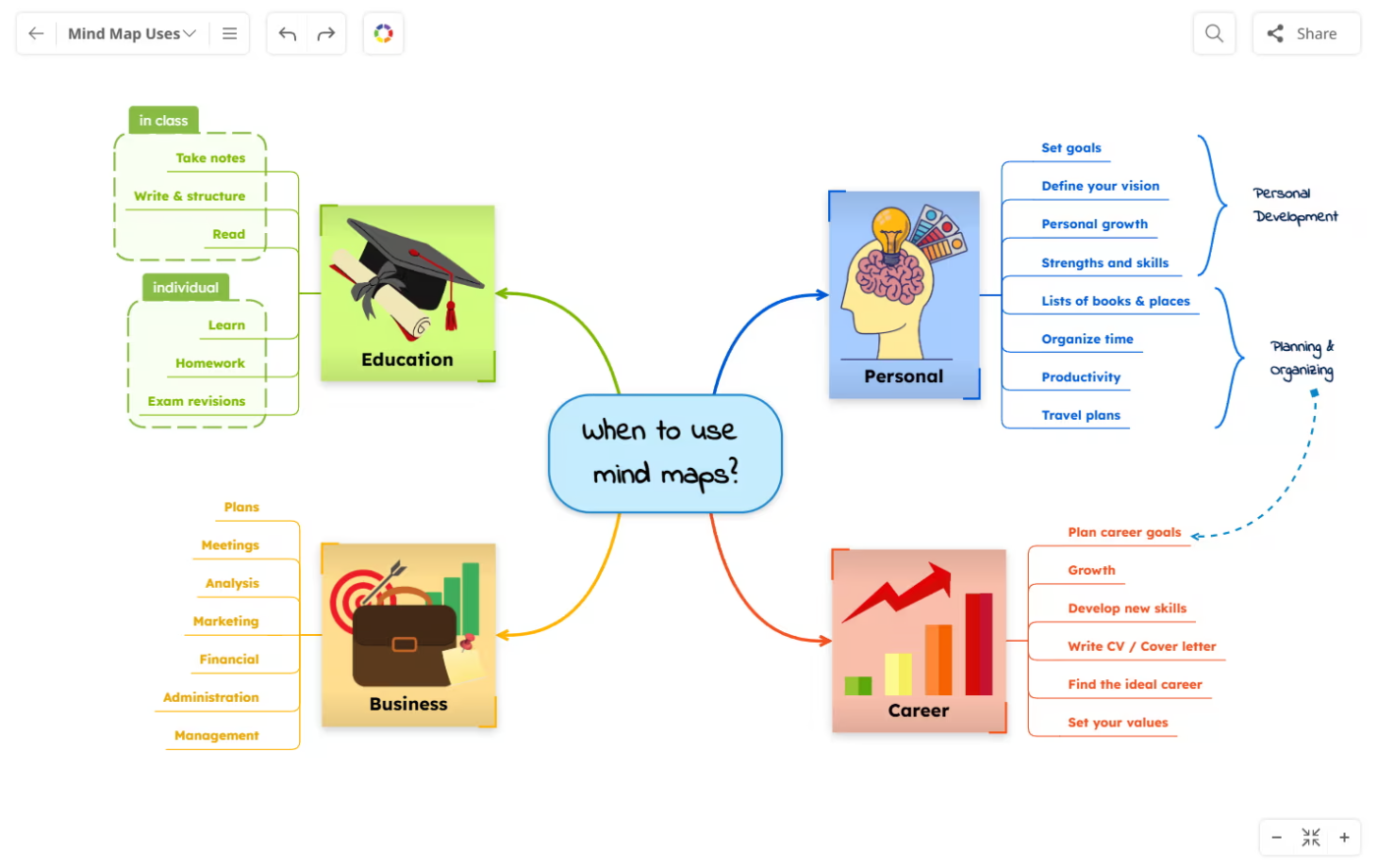
Mindomo is the closest one-to-one alternative to MindMeister if you still want a clean, browser-based mapper. It handles mind maps, concept maps, outlines, and Gantt charts, so the experience feels familiar. Map ideas, switch into an outline, add tasks, and keep it all in one visual workspace that works online or offline, on any device.
Where it pulls away is in education: teachers can run classes, assign and grade work, and leave feedback without leaving the tool. Plus, it plugs into Google Classroom and LTI platforms. If you’re not in education, it’s still a capable all-rounder, just less flashy than the newer tools.
Who it’s built for: Individuals, educators, students, and small teams who want a browser-based mind mapping tool with collaboration, classroom tools, and familiar map layouts. It fits well with study and lecture workflows, especially when paired with a mapping note-taking method.
Note: The migration story is a real strength here. But you only get so many in the free plan. You need the Professional plan to unlock all 20 export formats. Even so, I would budget for some cleanup after import if your old maps lean on custom styling or complex structures.
AI capabilities: Mindomo AI can generate complete diagrams from a prompt or pasted text, translate them into 50+ languages, expand topics, and build SWOT or pros-and-cons analyses. The Free plan includes 1 AI credit for testing. Premium includes 50 AI credits/month, and Professional includes 60 AI credits/month. One AI credit generates roughly 1,000 words, so this is useful for light map expansion, not heavy AI-first brainstorming.
A G2 user says:
Feature for feature, Mindomo offers more than any single competitor I’ve tried and the Professional tier in particular is great value for consultants because guest editing lets external collaborators use premium features on your maps without buying their own seats (up to 5/10/15 simultaneous guests depending on package). The platform also supports a wide range of foreign languages for the interface itself, which matters for our international team.
Where it taps out: Mindomo is familiar and capable, but it doesn’t feel as modern as Miro, ClickUp, or Xmind. A few advanced features sit behind paid plans, and complex imported maps may need a manual tidy-up.
Best for: Educators, students, and teams that want a browser-based MindMeister replacement with strong classroom features.
Skip it if: You want the most modern interface, the deepest AI, or a workshop canvas built for large live sessions.
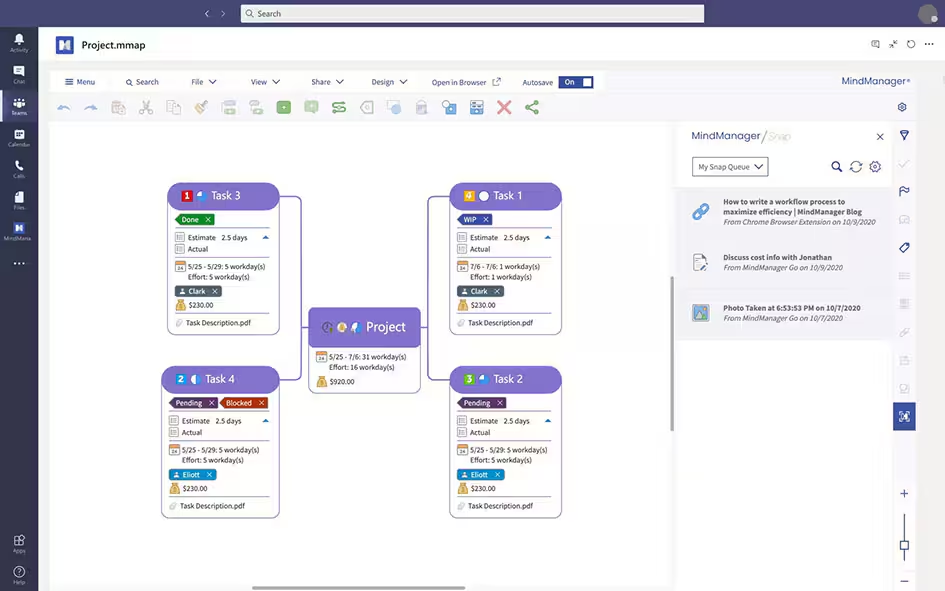
For teams that live within Microsoft 365, MindManager is the alternative I would recommend. It’s not the lightest mapper here. It’s not trying to be. It’s built for teams where a map must hold project plans, process flows, and business context in a single structured view, and where IT controls who sees what.
It earns its place in larger teams where mapping is tied to planning and governance, not just brainstorming. You get Microsoft Teams integration, real-time co-editing, SharePoint and Office ties, and project views with stronger admin controls on Enterprise.
MindMeister is easier to start with, but MindManager brings more corporate muscle.
Who it’s built for: Mid-market and enterprise teams in Microsoft-heavy environments, especially IT, operations, consulting, PMO, process, and regulated teams that need structured mapping with admin control.
There is no permanent free plan. You get a 30-day trial, then you move to a paid license. And most of the governance features that make MindManager strong for large companies are available in Enterprise plans: volume license discounts, premium support, large-scale deployment, the IT admin portal, SSO activation, read-only licenses, and optional training or consulting.
So if compliance and admin control are the reasons you are looking at MindManager, price the Enterprise plan early.
AI capabilities: MindManager doesn’t offer the same native, generate-the-whole-map AI assistant you get in Xmind, Miro, or Mindomo. Its own AI guidance leans on external tools like Microsoft Copilot, ChatGPT, Gemini, or Perplexity, then brings those results into a map. So the story here is “use AI beside the mapper,” not “generate the map inside it.” For a Microsoft-standardized team already running Copilot, that may fit fine, but it is worth knowing if in-app AI is a priority.
A G2 user mentions:
I use mind manager atleast once in a week mostly for building mind maps. It seems very user-friendly and conducive to ideation. I personally leverage the ability to toggle between map, org chart, flowchart, and other visualizations gives users options to think and present ideas differently.
Where it taps out: MindManager is powerful, but the price sits higher than most tools on this list, and newcomers can feel the learning curve. It is more than you need if you only want to sketch quick ideas or build a clean personal map.
Best for: Microsoft-standardized enterprises that need serious mapping, project planning, and Office ties under admin control.
Skip it if: You are an individual, a small team, or anyone after a low-cost MindMeister replacement.
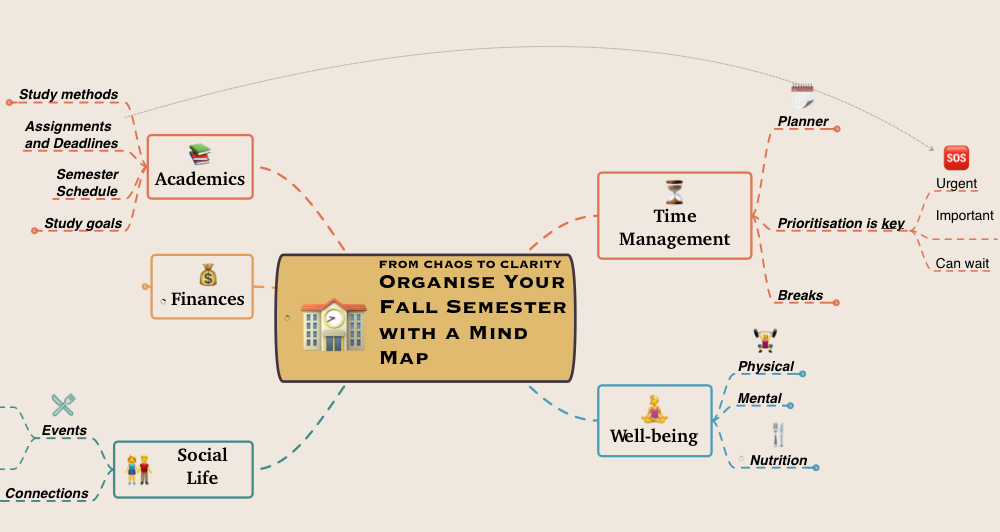
MindNode feels like a first-party Apple app, because it basically is one. It is fully native on Mac, iPhone, iPad, Apple Watch, and Apple Vision Pro. Meaning it moves, looks, and syncs the way the rest of your Apple tools already do. You get mind maps, outlines, visual tags, notes, and tasks in one workspace.
I like it because it barely asks anything of me. I dump a loose map, flip to Outline View the moment I need structure, turn branches into tasks, and iCloud keeps every device in step without a single thought.
Who it’s built for: Solo Mac, iPhone, and iPad users who want native design, iCloud sync, Apple Reminders support, and a focused mapping experience.
MindNode promises to always let you create, edit, and export maps, so you never lose access to your work if you cancel. But free is genuinely core-only: it is mind mapping, import/export, and private local storage, and that is it. Almost everything people associate with MindNode—Outline View, Focus Mode and visual tags, connections, notes and tasks, collaboration, Apple Watch, and Apple Intelligence—lives on Plus. So treat the free tier as a dependable place to build and keep maps, and Plus as the version that unlocks the actual toolkit.
AI capabilities: MindNode taps Apple Intelligence to help you brainstorm, generate text, summarize, and expand ideas. That is a real shift from its old manual-only pitch. The catch is that it relies on Apple Intelligence, requires Plus, and is only available if you pay and your device/region supports it.
A G2 reviewer mentions:
Dumping my thoughts and outlines is a breeze, and since it’s fully integrated via iCloud I can access and review my mental outlines on any of my personal devices to maintain continuity. MindNode’s visual presentation is minimalistic and I like that it doesn’t clutter the screen, offering visual templates that enhance the structuring of ideas.
Where it taps out: MindNode is Apple-only. There is no Windows app, no Android app, and no full web app, so it stops making sense the moment your team goes mixed-platform.
Best for: Solo Apple users who want a beautiful native mapper with iCloud sync and Apple workflow support.
Skip it if: You collaborate with people on Windows or Android, or you need a browser-based MindMeister replacement.
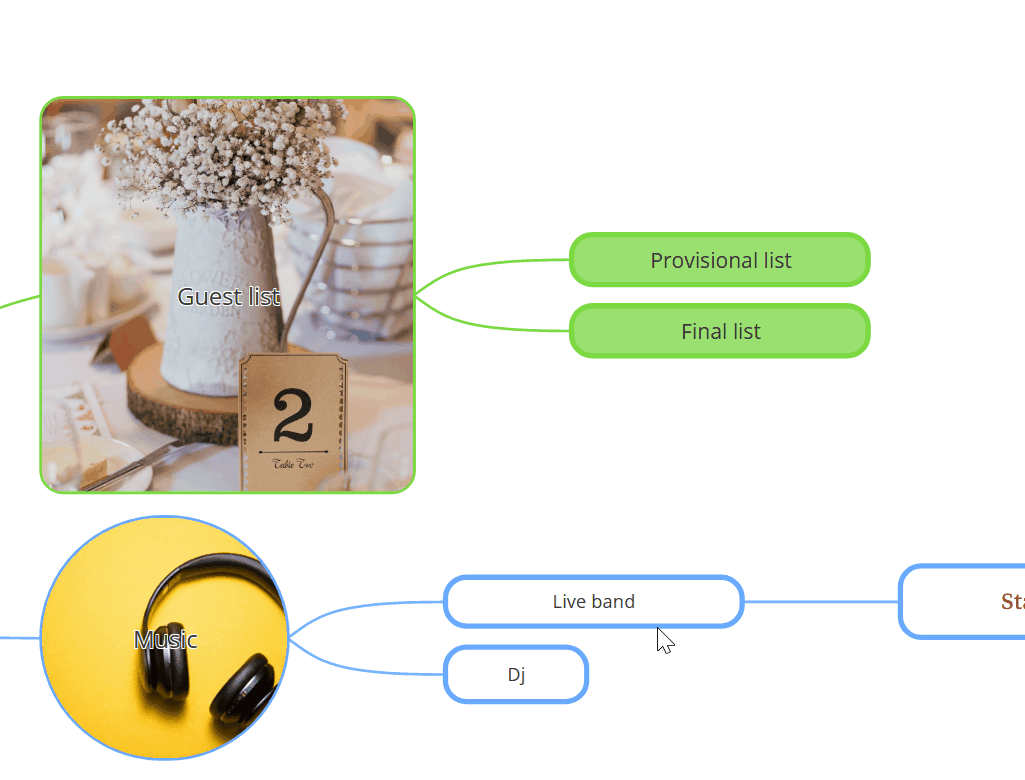
Ayoa is the pick when a map has to turn into action, but the team doesn’t want a heavy project management system bolted on. It pulls mind maps, task boards, whiteboards, outlines, workflows, and Gantt views into one visual workspace. So you start with loose ideas, shape them into a map, and drag the good ones into tasks, all in the same place.
It is designed to support different thinking styles, including ADHD, dyslexia, and autism. That matters if your team wants lower-pressure idea sharing and more flexible ways to get from thought to task.
Who it’s built for: Neurodiverse teams, educators, students, creative teams, and small groups that want mind mapping, whiteboarding, and light task management in one visual tool.
AI capabilities: Ayoa’s AI can generate mind maps, prompt ideas, expand branches, and support brainstorming. It also has Neuro-Settings that tune AI mind-map generation with clearer sentences, simpler language, special interests, and layouts built for neurodivergent users.
A G2 user writes:
The most powerful feature is the ability to turn a branch on a mind map directly into a task. Like brainstorming ideas in a colorful, organic mind map. Once we decide an idea is worth pursuing, we can convert that branch into a task with a due date, assignee, and checklist.
Where it taps out: Ayoa does two jobs, so it can feel busier than a focused mapper. Its task management is handy for light planning, but it does not go as deep as ClickUp for complex work. And if all you want is a clean mind map, the extra boards, workflows, and planning views may read as clutter.
Best for: Neurodiverse teams that want brainstorming, visual planning, and light task follow-through in one place.
Skip it if: You want either a minimal mind mapper or a full project management platform.
I wouldn’t use a mind map for every kind of thinking. If I’m in a lecture, interview, meeting, or research sprint, linear notes are usually faster. A map asks me to organize ideas while I’m still collecting them, and that can slow me down.
One Reddit user made the same point in a thread on mind maps versus traditional notes:
Contemplating about ditching linear notes for mind maps but not sure if it’s worth the effort. Traditional notes feel faster to write, but mind maps seem better for connecting concepts.
They still used linear notes first, then rebuilt the topic as a map later. Another commenter in the same thread said they used linear notes for lectures and mind maps for big-picture topics, because forcing one system full-time felt worse than mixing both.
Research backs the trade-off. In a 2002 study on the mind map study technique, 50 medical students were split between mind mapping and their usual study method. After one week, the mind map group scored about 10% higher on factual recall after adjusting for baseline performance. However, they also reported lower motivation. A technique can work on paper and still feel hard to keep using.
So I would not pick a MindMeister alternative just because it makes pretty maps. I would ask when the map enters the process. If it helps, use it for synthesis after capture. If it slows capture down, keep notes first and map later.
MindMeister alternatives range from free (Coggle, ClickUp, MindNode core) to enterprise licenses. Paid entry plans run $2.99–$13/user per month, with MindManager the outlier at $99/year. Some tools charge per seat, others charge a flat individual rate, and a few tuck the features you want a plan or two above the headline number. The table below lines up all eight at a glance, so you can spot the real cost before you commit.
| Tool | Free tier | Entry paid plan | Pricing model |
|---|---|---|---|
| Miro | 3 editable boards | Starter, $8/member/mo (billed annually) | Per member |
| Xmind | 10 maps | Pro, $4.92/mo (billed annually) | Individual; per seat for teams |
| Coggle | Unlimited public maps | Awesome, $5/mo | Flat/individual |
| ClickUp | Unlimited members and tasks | Unlimited, $7/user/mo (billed annually) | Per user (AI add-on) |
| Mindomo | 3 diagrams | Premium, ~$6.85/mo (billed annually) | Per user; education plans |
| MindManager | None (30-day trial) | Essentials, $99/yr | Annual license or one-time |
| MindNode | Core mapping, free forever | Plus, $2.99/mo or $24.99/yr | Individual |
| Ayoa | Up to 10 mind maps | Ultimate, $13/user/mo (billed annually) | Per user |
Pick a pure mind mapper (Xmind, MindNode, Mindomo) if the map is the deliverable, a whiteboard (Miro) if it’s a live team session, and a project management app (ClickUp, Ayoa) if the map has to become tracked work.
Not every MindMeister alternative is the same kind of tool. A pure mind mapping tool helps you shape ideas. A whiteboard helps a group think together in real time. A project management app turns the map into assigned work.
Here is how I split them:
| If you need… | Choose this type of tool | Good options |
|---|---|---|
| A polished map you can present, export, or study from | Mind mapping software | Xmind, MindNode, Mindomo |
| A shared canvas for live brainstorming or workshops | Online whiteboard | Miro |
| A visual plan with owners, deadlines, and status | Project management app with mind maps | ClickUp, Ayoa |
| A quick, free, shareable public diagram | Lightweight diagramming tool | Coggle |
| Local files and open-source control | Desktop open-source mapper | Freeplane, FreeMind |
| Enterprise mapping with Microsoft ties | Business mapping software | MindManager |
If the map is the final output, reach for a focused mapper like Xmind or MindNode. The layout is cleaner, exports are easier, and you skip setting up a whole workspace first.
If the map is part of a live team session, Miro fits. You get the map plus sticky notes, voting, timers, and room for the messy thinking around it.
If the map needs to translate into work, ClickUp or Ayoa earn their place. Standalone mappers stop at the diagram; these two keep going.
The mistake is picking a tool just because it has mind maps. Start with what happens after the map.
Sometimes, yes. But don’t assume the move will be clean.
Most mind mapping tools can import common file types, and the basic structure usually survives. Your branches come through; the hierarchy stays intact. Styling, icons, attachments, comments, task links, and custom layouts are another story: they can break or need cleanup.
That matters if you already have years of MindMeister maps and want to switch without rebuilding everything by hand.
Before moving everything, test one complicated map first. And no, not a neat two-level sample. Pick the ugly one with icons, links, notes, attachments, colors, and crossed branches. That map shows you what migration really looks like.
Here is what I check:
| Migration check | Why it matters |
|---|---|
| Export formats | Some formats need a paid MindMeister plan |
| Import support | Not every alternative accepts the same file types |
| Layout cleanup | Imported maps can lose spacing or structure |
| Styling loss | Colors, icons, themes, and branch shapes may not survive |
| Attachments and links | Files, comments, notes, and URLs need separate testing |
| Task connections | Map-to-task links usually do not move between tools |
| Collaboration history | Comments, versions, and activity trails often stay behind |
If migration matters, check Mindomo, Xmind, and MindManager first. They handle import and export better than the lighter tools. Coggle is built for quick new diagrams, not old-map migration. Miro works if you want to rebuild maps into a workshop canvas, but it is a poor pick for exact structure.
The eight tools above all map ideas well. If a standalone diagram is all you need, the focused mappers will be lighter and faster. But if you’re tired of rebuilding branches as task lists in a second tool, get started with ClickUp for free and skip that step entirely.
Yes. FreeMind and Freeplane are the two established open-source MindMeister alternatives. Both are Java-based desktop tools, fully free, and built for local mind mapping rather than polished browser collaboration. They are best if you want zero cost and control over your files. If you want free browser-based collaboration instead, Coggle’s free plan is the easier pick, while ClickUp adds mind maps and node-to-task conversion on free and paid plans.
Mindomo is the strongest education pick. It supports classes, assignments, grading, feedback, Google Classroom, and LTI integrations, which most general mind mappers do not cover. It also keeps the familiar browser-based feel of MindMeister, so teachers and students don’t have to relearn the whole workflow. The free plan covers 3 diagrams, while education pricing starts at €4/user/month for students and €5/user/month for teachers on an annual billing plan.
Yes. MindMeister and MeisterTask are both MeisterLabs products, and they still work together. You can turn mind map topics into MeisterTask items, assign them to teammates, and keep project work connected to the original map. That is MindMeister’s own answer to the map-to-task problem, though it still means using a second tool. Alternatives like ClickUp and Ayoa are stronger if you want maps and tasks inside one workspace.
Xmind, MindNode, and Mindomo are the best offline-friendly MindMeister alternatives. Xmind and MindNode are desktop-first tools that let you work with local files. Mindomo also supports offline editing and syncs changes once you reconnect. Browser-first tools like Coggle and workshop canvases like Miro are better when you have a live connection and need real-time collaboration.
MindMeister has a free plan capped at 3 mind maps. Its paid plans start at $3.50/user/month for Personal, $5.50/user/month for Pro, and $8.50/user/month for Business on an annual billing plan. The free plan is useful for light testing, but private maps and exports sit behind paid plans. That is usually where users start comparing MindMeister alternatives, especially if they need more maps, exports, or task handoff.
Miro is the strongest pick for live, multi-person mapping: it’s browser-first and built for many editors on one infinite canvas with voting, timers, and private mode. Mindomo and Coggle also offer solid real-time co-editing at a lower price. If the collaboration needs to end in assigned tasks rather than just a shared board, ClickUp fits better because map nodes convert directly into trackable work. Desktop-first tools like Xmind and MindNode lag here, since simultaneous editing isn’t their focus.
Yes. Several mind mapping tools can now generate a map from a prompt, notes, or pasted text. Xmind AI, Mindomo AI, and Miro AI are the more direct options for AI-generated mind maps. ClickUp can help brainstorm and expand ideas with AI, then organize that work into Mind Maps and tasks. The quality still depends heavily on the prompt, so test one real use case before choosing a tool for AI alone.
MindMeister is better for structured, outline-style solo maps; Miro is better when the map is part of a live team workshop. Miro’s infinite canvas holds sticky notes, voting, and timers for group sessions, but takes more manual arranging for a clean branch-and-node map. If you map alone and present, MindMeister or Xmind is tidier. If several people edit at once, Miro wins.

Arya P Dinesh
Max 15min read
Arya P Dinesh
Max 16min read

Praburam Srinivasan
Max 25min read

© 2026 ClickUp




