Sorry, there were no results found for “”
Sorry, there were no results found for “”
Sorry, there were no results found for “”
Every team builds rituals. The smart ones know when to break them.
A ritual reset is how you cut the noise, reclaim your time, and rebuild routines that actually serve the work, and not just fill the calendar.
This isn’t about productivity hacks. It’s about creating space to think, reset, and move with purpose again.
Rituals shape how your team works, but progress can be hindered when they stop evolving. Here’s how to run a ritual reset that clears the clutter and restores focus:
A well-timed ritual reset won’t just clean up your workflow; it’ll help your team work with purpose, not just momentum.
A ritual reset is a deliberate pause to step back, assess your current rituals, and reshape them with intention. It’s not about throwing out everything and starting fresh, rather, it’s about refining the rhythms that guide how your team works.
Over time, even the best rituals become outdated. What once boosted energy, focus, or alignment can slowly turn into background noise. That’s where a ritual reset steps in, to recalibrate without chaos.
It helps you:
Think of it like updating a shared document that’s been edited too many times before it becomes messy and hard to follow. You’re not rewriting the entire thing. You’re restoring clarity.
A ritual reset can apply to your team meetings, your Monday priorities, your end-of-week reflection, or even your project planning flow. The scale doesn’t matter, what matters is the impact.
It’s a form of systems maintenance. It helps your team stay aligned, your processes stay relevant, and your habits stay intentional. And when done regularly, it builds the kind of structure that actually gives you more freedom.
Rituals lose their value when they stop evolving. The signs aren’t always dramatic, more often, they show up in small moments your team has learned to ignore.
Instead of efficiency, you get motion without direction. Instead of clarity, you get noise disguised as structure. A ritual reset becomes necessary when your systems start dragging instead of driving momentum.
You’re busy but the outcomes aren’t obvious. Tasks are being completed, calendars are full, but it’s hard to point to what’s actually being achieved.
It’s not that people aren’t trying. It’s that the processes guiding them have lost relevance.
You’ll notice:
Even high-performing teams lose rhythm when rituals no longer reflect their reality. Instead of adapting to shifting priorities, they stay locked in outdated routines.
What this looks like:
Without intervention, this leads to burnout not because of too much work, but because the structure no longer supports the work being done.
👀 Did You Know? The term “burnout” was first coined in 1974 by psychologist Herbert Freudenberger. This was done after watching idealistic volunteers at a free clinic slowly lose their drive.
Burnout didn’t start in corporate boardrooms, it started with people who cared too much for too long, without enough recovery.
You’ll hear it in conversations: “This is just how we do things.”
That mindset signals the biggest gap, a lack of reflection and intentional change. The team keeps moving, but not necessarily in the right direction.
A ritual reset opens space to:
Ignoring these signals costs more than time. It leads to lost focus, misaligned momentum, and the slow decay of high performance.
The earlier you spot them, the less drastic your reset needs to be. Small, intelligent changes now can save hours every week and bring your team back into sync.
A ritual reset works best when it’s structured, intentional, actionable, and not abstract.
These four steps will help you break down what’s no longer serving your team, rebuild with purpose, and design rituals that actually drive progress.
By the time you notice symptoms like low engagement, poor focus, or dropped rituals, the system’s already out of sync.
This step is about getting underneath the surface. Not just spotting the friction, but understanding where your team’s current structure is misaligned with how they actually work.
Start with a clean audit. Don’t just list your existing rituals, rather classify them into these categories:
This helps you isolate what’s worth keeping and what’s quietly slowing your team down.
To go deeper, map your team’s energy across a typical week. Where do things flow easily? When does progress stall? This gives you insight into whether your rituals are reinforcing natural momentum or fighting against it.
📮ClickUp Insight: Over 60% of a team’s time is spent searching for context, information, and action items.
According to research by ClickUp, teams lose precious hours jumping between different tools. To prevent broken communication, integrate messaging into your workflows with a centralized platform that unites project management, collaboration, and communication.
Try ClickUp, the everything app for work.
You can also gather feedback by prompting your team with a few focused questions:
This isn’t about tearing things down. It’s about creating a shared understanding of what’s not working anymore, so the reset is built on clarity and not assumption.
📖 Also Read: What is Change Management?
This is where things shift from identifying the drag to designing your flow. Your team already has rituals. But if you’re rebuilding, don’t default to what looks good on a calendar.
Focus on what actually helps your team create, achieve, and stay in sync without overload.
Think of your routine as scaffolding. It should hold up deep work, clean handoffs, and space to reflect, not just block off hours.
Start with your anchors. These are the rituals that create momentum:
Don’t stop at the obvious. Great routines also protect focus:
📌 Example
One team replaced their standing Monday check-in with a shared doc where each person updated their to-do list and weekly focus before noon.
They followed it with a short sync call, only if needed. The meeting didn’t disappear; it just became lighter, sharper, and more useful.
Now zoom out. Does this routine reflect how your team actually works or how it used to? Where are you repeating rituals that have no clear intention? Where are people working against the clock instead of with it?
A solid routine isn’t rigid. It’s responsive. It adapts to energy patterns, project rhythms, and the pace your team can sustain. And most importantly, it leaves room to breathe.
📖 Also Read: How to Have a Productive Day?
A ritual reset only works if your new rhythms stick. But with the pace of day-to-day execution, even well-designed routines can slip without the right support system.
That’s where the right tools help by embedding structure into the flow of work. Here’s how to build accountability into your rituals without micromanaging your team.
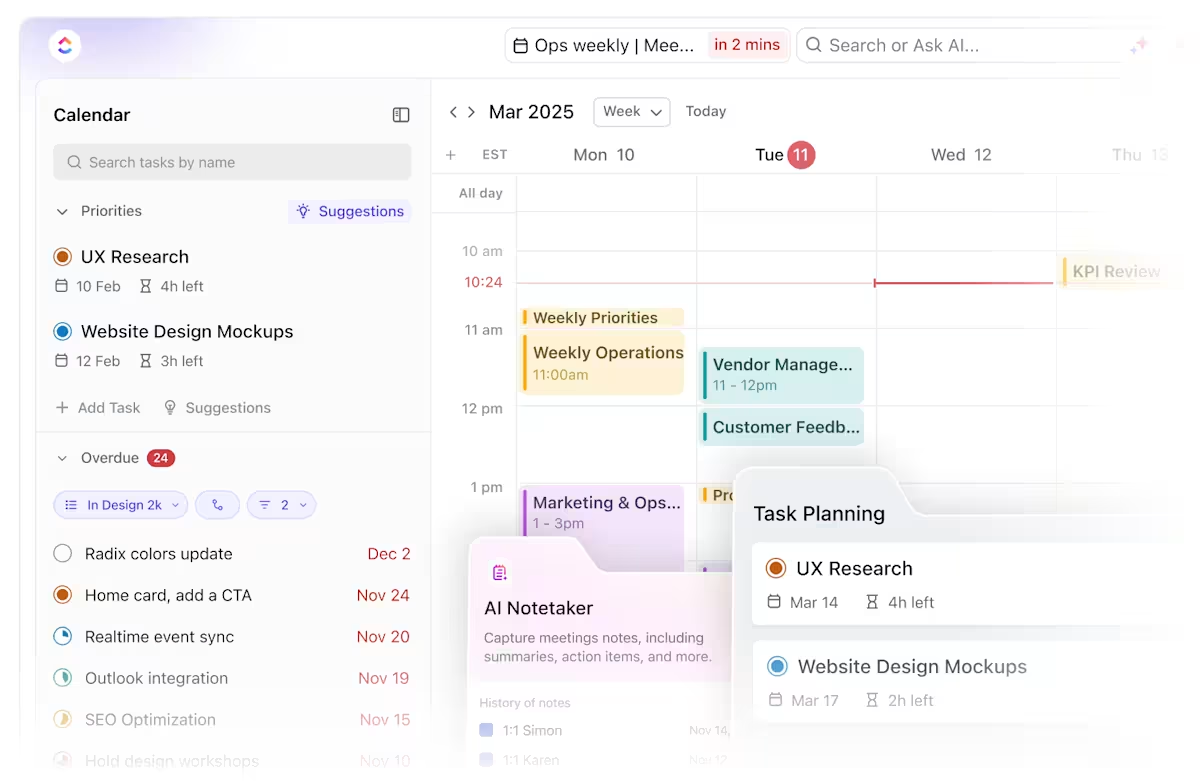
It’s hard to stick to a rhythm if no one knows what it looks like. Before the week even begins, your rituals should have a clear home on the calendar.
Use ClickUp Calendar to map everything, from your Monday priorities to shared no-meeting focus blocks.
Everyone sees the plan, and more importantly, respects the time that’s been protected for deep work, regrouping, or re-alignment.

Rituals are only as useful as the outcomes they support. The more visible the progress, the more likely your team is to stay consistent.
ClickUp Dashboards give you a real-time view of what’s moving and what’s not. Whether you’re tracking key tasks, active projects, or overall team engagement, Dashboards turn your routines into measurable systems—not just habits.
The most sustainable rituals are the ones that don’t need constant reminders to happen. ClickUp Automations let you build structure into the background.
Automatically assign recurring reviews, trigger updates after standups, or move tasks forward when the right condition is met. Less chasing, more flow.
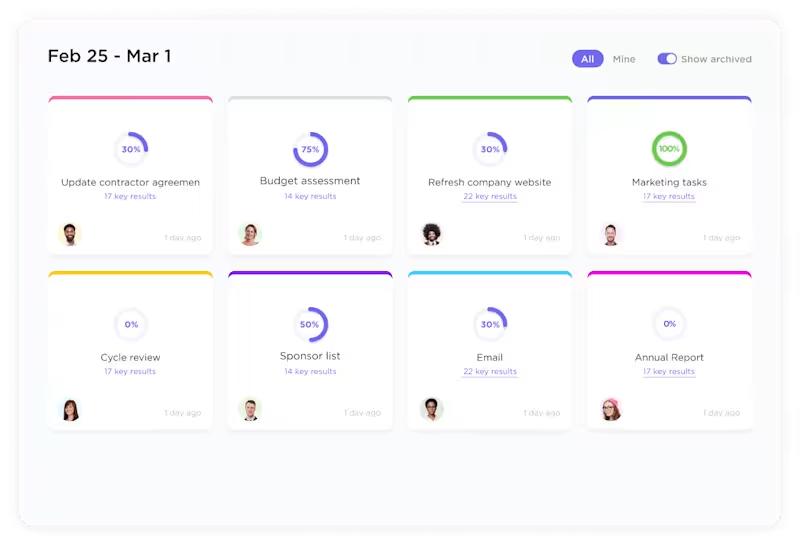
It’s easy for routines to turn into checklists if no one sees how they tie back to something meaningful.
With ClickUp Goals, you can connect your rituals to real outcomes, whether it’s project milestones, team OKRs, or weekly check-ins. Your team isn’t just going through the motions. They’re moving toward something that matters.
⚡ Template Archive: Free Goal-Setting & Tracker Templates for Excel & ClickUp
Even with the best structure, things fall through the cracks. That’s normal. What matters is whether your system catches them.
Use ClickUp Reminders to reinforce what matters most, whether it’s a quick moment to reflect on your week, prep for a reset, or follow up on a blocker.
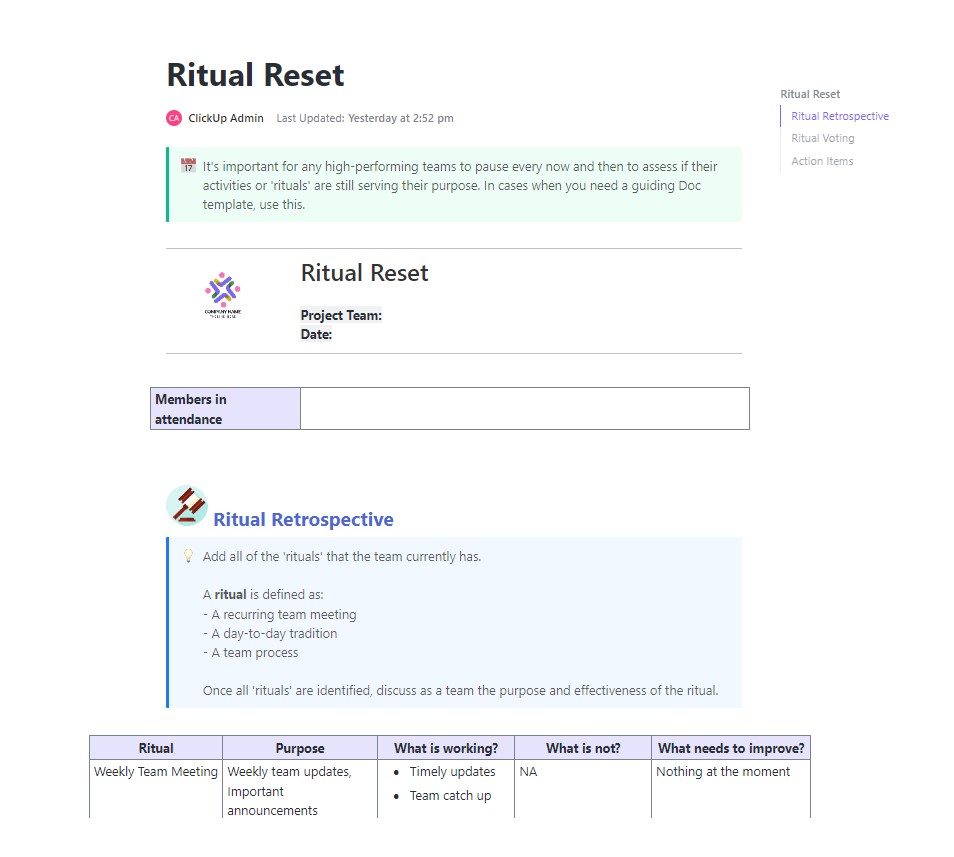
The ClickUp Ritual Reset Template gives you a jumpstart without the requirement of any whiteboard.
Here’s why it works:
You can also layer in the ClickUp Personal Habit Tracker Template to reinforce individual consistency alongside the team rhythm.
⚡ Template Archive: Free Habit Tracker Templates in Google Sheets, Excel, & ClickUp
Resetting is the easy part. Keeping the rhythm alive? That’s where it gets real.
Consistency doesn’t mean sticking to rigid routines. It means creating rituals that evolve with your team’s energy, priorities, and momentum. When your structure is too tight, it breaks. When it’s too loose, it disappears.
You want the sweet spot—a flexible structure that sticks.
If your rituals are sacred, they’re also reviewable. Make it normal to pause, ask “Is this still working?” and shift when needed. The reset shouldn’t be a last resort. It should be part of the system.
Not every ritual needs to be a standing meeting or a fixed checklist. Some are quiet, some are solo, and some are about not doing.
Here’s what breathing rituals look like:
These don’t break the flow. They restore it.
👀 Did You Know? In Japan, there’s a word for death by overwork called, “karōshi“. It’s a recognized occupational phenomenon and a stark reminder that burnout doesn’t always come from chaos. Sometimes, it comes from too much routine without pause.
Want to avoid burnout? Watch how your team feels, not just what they produce.
Use the reset to spot patterns:
If the answer is yes, it’s time to re-evaluate. Small shifts now prevent bigger breakdowns later.
The biggest trap? Thinking your reset is finished. Rituals aren’t static—they’re living systems. Let them grow with the team.
Protect what’s working. Drop what’s not. And always leave space for the unexpected. Because the real magic of a ritual reset isn’t in how you start. It’s in how you keep showing up without burning out.
📖 Also Read: How to Optimize Your Life with Habit Stacking
You’ve redesigned the rhythm. Now it’s time to operationalize it.
These practices aren’t about keeping rituals consistent. They’re about keeping them resilient. So they scale with your team, stay relevant under pressure, and evolve without losing their core purpose.
Every recurring ritual should have someone responsible for its health. That person doesn’t need to run it, they just need to care if it’s working. Ownership drives reflection, iteration, and longevity.
Examples:
This builds accountability into the culture.
If your team can’t tell when a ritual is effective, it won’t stick.
Define what success looks like:
Success signals create clarity and help you avoid rituals that just go through the motions.
Most teams review rituals by schedule, weekly, monthly, and quarterly.
Go deeper:
This keeps your system integrated, not fragmented.
A ritual might still be happening, but not how it was intended. Maybe it runs longer, or it’s rushed. Maybe half the group checks out.
Track where things have drifted from their original design. That’s where the gaps begin and where resets need to happen before things break down.
Want your reset to last? Bake it into how new hires learn to work with your team. Introduce core rituals during onboarding—not just what they are, but why they exist. It turns cultural memory into shared muscle.
A ritual reset gives you more than just cleaner workflows. It brings your team back to work that feels aligned with your goals, your life, and the way your team actually operates as a body, not just a list of tasks.
Use it as a regular moment to discuss what’s working and what’s not, before the friction builds. The more space you create for alignment, the easier it becomes to sustain momentum.
Try ClickUp today and turn your team’s rituals into a system that supports real progress.

Manasi Nair
Max 32min read

Sudarshan Somanathan
Max 20min read

Praburam Srinivasan
Max 14min read

© 2026 ClickUp