
Sorry, there were no results found for “”
Sorry, there were no results found for “”
Sorry, there were no results found for “”
Imagine a chaotic construction site with workers running haphazardly and building materials scattered everywhere.
The project is set to miss the deadline, which is just weeks away. And to make matters worse, every worker and project contributor is wearing blindfolds. Terrifying picture, isn’t it?
That’s what project management can feel like if the roles and responsibilities are unclear.
Now imagine the same construction site. But this time, the blindfolds are off, and everyone knows what they’re responsible for. Sounds harmonious, coordinated, and efficient—wouldn’t you say?
That’s the RACI matrix, also known as the RACI model or the RACI chart, in action.
RACI, the acronym for responsible, accountable, consulted, and informed, is a project management framework that defines roles, thereby:
It’s the perfect plan for transforming your team into a lean, mean, project-completing machine.
But here’s the kicker—how’s the ‘R’ for ‘responsible’ different from the ‘A’ for ‘accountable’?
A project manager may often get confused when implementing this framework because both words seem to mean the same.
However, in project management, there’s a huge difference between the two.
And that’s the intent of this piece—defining the individual roles of the ‘Responsible’ and ‘Accountable’ in the RACI matrix and exploring how you can use this matrix.
Let’s get this project on the road, shall we?
The RACI matrix is a project management tool that defines the roles, responsibilities, and involvement levels of every team member working on specific project tasks.
Also known as the Responsibility Assignment Matrix, RACI stands for the roles attributed to various stakeholders in a project :
To understand this, let’s consider the RACI matrix example of a new feature being built for a mobile app. Here’s how it works:
Over the years, the RACI matrix has been further customized to include more roles:
We’ve seen how the RACI project management framework can give your projects structure and clarity, ensuring you’re on track.
However, the similarity between ‘Responsible’ role and the ‘Accountable’ role can often lead to roadblocks in communication and project progress—leading to the RACI responsible vs. accountable topic.
As people don’t know their exact role in the project, they can step on other people’s toes or, even worse, not do their part as they might think someone else is doing it.
Let’s look at what ‘Responsible’ and ‘Accountable’ can mean in various scenarios.
The Responsible person or group is the one doing the work. They’re the individuals tasked with completing specific activities within a project. They possess the necessary skills and expertise to execute the assigned actions.
The Accountable person, on the other hand, is the one answering for the work. They hold the ultimate authority and ensure the ‘Responsible’ party delivers the expected results. The ‘Accountable’ person may not directly perform the tasks but oversees their completion and bears the consequences of success or failure. Usually, there is only one accountable person for every project.
Example:
Let’s look at this in a real-world scenario of freelance writers and in-house content leads.
Sometimes, like in the above example, one ‘accountable’ content lead may be in charge of multiple ‘responsible’ freelance writers.
Here are some common misunderstandings about the ‘Responsible’ and ‘Accountable’ roles:
It’s important to note that projects aren’t static. Scopes may shift, as will role definitions. So, there may be a case where an accountable person might have to get hands-on with the work, or the responsible person might have to refuse a suggestion made by the former.
Let’s explore how to create a robust RACI project that is clear, has defined roles, and is well-coordinated.
But first, here are some benefits that you can expect by using the RACI matrix:
Let’s get started planning the RACI matrix. To simplify things, we’ll showcase each step using the example of launching a software feature.
Start with a goal for your project. Be as specific and time-bound as possible. For example, you could launch a new real-time document collaboration feature for a document editing tool in the next sprint.
Once you’ve set your goal, the next step is elaborating on the scope and output. For example, you could allow users to co-edit documents, see real-time edits, and track changes.
We recommend using a project management tool at this stage. While the RACI model clearly defines roles and responsibilities, using a project management tool will give you an overview of your projects and let you track progress easily.
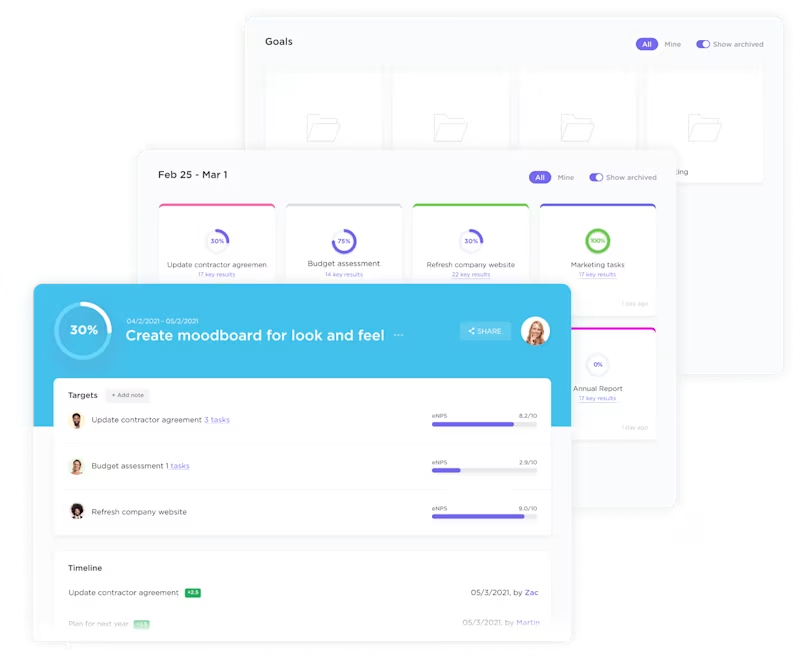
How about you try ClickUp? It can support you at every stage of your project journey. For example, you can use ClickUp Goals to define the goals of each project and set deadlines and milestones that ensure you stay on track to achieving them.
This feature also helps define each teammate’s goals so everyone knows what they’re supposed to accomplish. To do this, create separate folders for each project and organize goals there.
📮 ClickUp Insight: 63% of our survey respondents rank their personal goals by urgency and importance—but only 25% organize them by timeframe.
Meaning? You know what matters, but not necessarily when. ⏳
ClickUp Goals, enhanced by ClickUp Brain’s AI assistance, brings clarity here. It helps you break down large goals into time-bound, actionable steps. ClickUp Brain provides intelligent suggestions for timelines and keeps you on track with real-time progress updates and automatic status changes as you complete tasks.
💫 Real Results: Users report a 2x boost in productivity after switching to ClickUp
Once you’ve finalized what’s required, the next step is listing who’s involved in the process. In this case, it can be the:
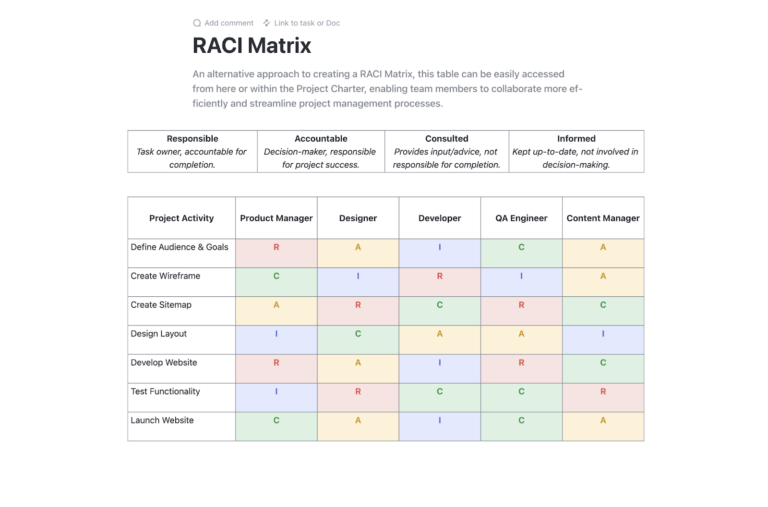
Here’s where you combine the roles and project outputs set above to formulate your RACI matrix. Here’s how this would look like for our case of launching a feature.
| Task | Responsible | Accountable | Consulted | Informed |
| Write user story | Product Manager | Software Developer | Marketers and sales reps | CEO |
| Develop feature | Product Manager | Product Manager | Product head/CEO | QA team/marketers |
| Design UI | UI/UX designer | Product Manager | Developer | – |
| Create campaigns | Product marketer | Marketing lead | Product manager | Sales team |
While this is a simple example, you can see the overlaps in some areas where the product manager is both responsible and accountable for creating user stories. At the same time, all project teams have different roles in each task.
For your actual project, you can get more detailed and break down each task into multiple subtasks. This could be who builds each element of the collaborative editing feature: comments, tagging, and more.
You can do this on an Excel sheet or use project management software to make things easier. The latter is a better choice as it can help you reduce repetitive work.
ClickUp lays the groundwork for you with ready-to-use templates like the ClickUp RACI Planning Template.
Using this template, you can:
Apart from this, you can also create a master document explaining the RACI matrix and the guidelines to follow so all team members are aware. You can also advise team leads to use the RACI matrix to break down their tasks into actionable items and assign responsibilities.
The template also gives you an idea of which stage of the project each department needs to be informed at.
In the previous step, we saw which team is responsible for a particular task. Now, it’s time to decide on the individual team members.
At this stage, you can also:
Another thing you can do here is analyze if you want to customize the RACI matrix into RACSI or something similar. For example, you could add a user researcher to ‘support’ the UI/UX designer in creating the UI or add a legal professional to sign off on the approval process.
After you’ve assigned roles and set deadlines, periodically revise the RACI document to ensure it’s updated.
Bonus tip: As the RACI framework has multiple steps and involves many roles (sometimes overlapping, too), you might benefit from using a tool to ensure you don’t miss anything. For example, you can use the ClickUp RACI Matrix Template to organize the complex project details.
This includes fields for you to:
This template ensures everyone knows their tasks, leading to fewer miscommunications.
Now that we’ve seen how to set up a RACI matrix, let’s explore some tips and tricks to help you make the most of it.
For the last point, you can collaborate with your team during the planning phase by setting up a meeting with all stakeholders.

If you’re going for a virtual meeting, a tool like ClickUp Whiteboards (which comes with built-in pens, shapes, sticky notes, and other drawing elements) can help you visualize your RACI matrix and team workloads.
The tool allows everyone to collaborate and brainstorm, helping you create a matrix that works best for your project. Various collaborative editing features will make the experience more interesting, inclusive, and visually appealing.
You can learn more about it here:
There are a few things to watch out for when using the RACI matrix to avoid confusion and wasted effort:
The RACI framework can be a valuable tool for software teams irrespective of the development approach, whether agile project management or Scrum. For example, Scrum focuses on ‘self-organized’ teams, so the roles might not be well-defined. You can remove this hurdle by adding the RACI matrix to your Scrum projects.
During sprint planning, your development team can use RACI to assign ownership to user stories or tasks within each user story.
This ensures everyone understands who’s responsible for completing the work and who’s accountable for the outcome.
Plus, it also fosters transparency between teammates and defines the boundaries between tasks.
Traditionally, Kanban boards—whether in ClickUp, Jira, or a different project management tool—don’t assign ownership to tasks. However, RACI can be used to create a more dynamic ownership flow.
Here’s how it can help you throughout a project’s life cycle:
This approach allows you to see the ownership shift on the Kanban board itself. The ‘Responsible’ person keeps the task moving forward, and the ‘Accountable’ person ensures it reaches completion.
For an extra dose of transparency, you can also display the initials or avatars of the ‘Responsible’ and ‘Accountable’ individuals directly on the Kanban card.
Integrating the RACI matrix into your project management approach—whether Scrum, agile, or Kanban—can level up personal accountability, team collaboration, project clarity, and, ultimately, project success.
It’s effortless to use as it can be adapted to different roles and projects, making it an easy framework to use across departments.
The job gets even easier if you’re using a workspace management tool like ClickUp. Not only can you create and track your RACI planning doc, but you can also brainstorm the plan from within the same platform.
So, why not sign up for ClickUp today? It’s free to get started, and you can see how ClickUp optimizes your RACI planning, saving project managers time and sparing all the stakeholders confusion.

Sudarshan Somanathan
Max 23min read
Sudarshan Somanathan
Max 22min read
Sudarshan Somanathan
Max 22min read

© 2026 ClickUp