

“60% of the content on the Internet is duplicate,” says Gary Illyes, Google Webmaster trends analyst.
So, how do you seek valuable tips for complex projects or find innovative business ideas when everyone is almost learning the same techniques or ideas?
Enter subject matter experts (SMEs)!
Let’s say you are launching a new marketing campaign for a bleeding-edge tech product. A tech product branding or marketing SME can help you find and define your value proposition.
And that’s just one example. Beyond hands-on mentoring and guidance, involving subject matter experts in projects can often lead you to unique, untapped opportunities.
However, it is essential to clearly outline and guide their role within a project so they can help you in the best possible way.
In this blog, we will discuss subject matter experts, their roles, and how they can contribute to success within a project.
Subject Matter Experts (SME)

 Summarize this article for me please
What is a Subject Matter Expert?
A subject matter expert (SME) is an individual with deep and specialized knowledge, skills, and expertise in a specific field.
They can help navigate the nuances of your field, providing invaluable insights for industry-specific research, process improvement, and project management.
Since they’ve spent years honing their knowledge in a specific area, they can provide unique insights into a niche industry problem that you may otherwise struggle with.
While the concept of a subject matter expert (SME) may seem new, the core idea has existed for centuries. Even in ancient Greece, everyone knew who to go to for the best advice on philosophy (think Socrates!). These were the original SMEs, even though we wouldn’t have called them that back then.
Fast-forward to the 20th century, the rise of complex fields like psychology and management created a need for people with formalized expertise to build cars or organize a group of people to work in factories (think Henry Ford). These experts played a vital role in shaping everything from education to business practices like the eight-hour workdays.

We also cannot discount the role of World Wars I and II, further highlighting the value of specialized knowledge of weather forecasting, geographical knowledge, and better-flying technologies.
The term “SME” itself is likely a mid-20th-century invention, but the concept of people possessing deep knowledge and using it to guide others has been around for a very long time.
An SME’s niche knowledge is typically acquired through:
Extensive experience
SMEs have tackled tough challenges in their respective industries for years, figured out the best industry tools and techniques, and gained skills to solve complex problems with unique approaches. They’re also likely to be innovators or experimental leaders in a specific subject. With their deep industry know-how, they can come up with creative solutions faster than generalists.
For example, a construction project manager with decades of experience in the field can be a unique SME for software team-building tools specifically for the construction industry.
Rigorous education
Along with experience, SMEs also have advanced degrees or specialized certifications that help them gain technical skills. For instance, in project roles, a Project Management Professional (PMP) certification indicates a strong foundation in project management methods, team management, and stakeholder communication
Here are a few examples of how SMEs contribute to different industries:
- Technology sector: SMEs design innovative solutions and troubleshoot complex issues. For example, cybersecurity SMEs anticipate hacker tactics and design cutting-edge defenses to safeguard critical systems
- Manufacturing: SMEs optimize production processes and ensure quality control based on organizational objectives. Robotics engineers, as SMEs, go beyond programming robots. They analyze production lines, identify bottlenecks, and optimize processes for maximum efficiency and quality
- Financial services: Financial SMEs navigate regulations and manage risk. Compliance officers, for instance, decipher complex rules, advise on risk mitigation strategies, and ensure smooth financial operations within legal boundaries
Summarize this article for me pleaseRole of a Subject Matter Expert
Subject matter experts are valuable resources in any industry, thanks to their deep knowledge and experience.
SME roles typically fall into three main categories:
1. Knowledge sharing and education
- Disseminating knowledge: SMEs serve as knowledge vaults in their organizations, sharing expert knowledge and insights with colleagues and steering committee members with the help of knowledge base templates. This can mean creating training materials, giving presentations, or conducting knowledge-sharing sessions
- Mentoring and coaching: SMEs guide and train less experienced members of the organization to build a pool of in-house experts over time. This creates a culture of continuous learning within the organization
- Staying updated with the latest trends: They keep abreast of the latest trends and developments in their industry, incorporate new learnings into their work, and share them with the organization as required
2. Problem-solving and decision-making
- Analyzing complex issues: SMEs excel at breaking down complex problems into smaller components, identifying root causes, and evaluating potential solutions. Their deep understanding allows them to assess risks and outcomes more accurately
- Strategic guidance: Subject matter experts are strategic thinkers. They provide valuable insights and recommendations for strategic and data-driven decision-making
- Quality assurance: Ensuring quality assurance within organizations by defining and maintaining high-quality standards, auditing existing processes, identifying potential bottlenecks, and recommending measures to optimize processes—all are done by SMEs
3. Collaboration and communication
- Bridging the gap: SMEs act as the liaison between technical teams (e.g., software development team) and non-technical teams (marketing team). They explain complex concepts in simple language to improve understanding and alignment for all stakeholders. This aids in clear communication between departments
- Collaboration with other experts: You will also see SMEs often teaming up with other experts from their field or with those from complementary disciplines. Such collaborations result in the development of innovative solutions for challenging problems. For example, If a team of biomedical engineers (SME in medical device design) collaborate to build a personalized healthcare app, they would need a healthcare SME to provide insights into health-related information. A data security SME will also be required to ensure secure collection, storage, and management of users’ personal data
- External communication: Sometimes, SMEs represent their organizations at industry events or conferences and share their expertise with a broad audience
By fulfilling these responsibilities, SMEs drive innovation, help in strategic decision-making, and ensure project success.
Examples of SME Scenarios
While SMEs exist in all fields, here are a few examples illustrating their roles in the different industries:
- Technical writer: An SME in technical writing focuses on specializing in a specific knowledge-based software or programming language, crafting clear and concise user manuals or API documentation for developers. Their deep understanding of the technology ensures the documentation is accurate, comprehensive, and tailored to the target audience
- Product manager: A product management SME for a content management system (CMS) develops possesses a thorough understanding of the platform’s features and functionalities. They leverage this knowledge to ensure that product-led content caters to the specific needs of its user base
- SEO specialist: Search Engine Optimization (SEO) is a vast field, and expertise can be tailored to different industries. For instance, an e-commerce SEO subject matter expert may have possessed a deep understanding of product page optimization, user intent, and competitor analysis within the online retail space. They use this knowledge to develop and implement strategies to boost the website’s visibility for relevant product searches

We have all seen the stunning visuals from the James Webb Telescope. However, we don’t know the story of the subject matter expertise that defines the space’s rich, vibrant colors.
Developed under the guidance of science visuals developer Alyssa Pagan and senior data imaging developer Joseph DePasquale at the Space Telescope Science Institute (STSI) in Baltimore, these images are stitched together like a jigsaw puzzle, using multiple outputs coming from the telescope. Here’s what Pagan says about their process:
“There are artistic principles to it, too, that you kind of have to follow [when] you’re just like, ‘This just doesn’t read.’ And the thing is, after they’ve done the objective part, [someone] might have a different conclusion. And like that’s part of the fun, I suppose, is that there are different ways to represent the data.”
So, how do they decide the most accurate way to represent the images? Researchers worldwide chime in to ensure that the images emphasize the scientific value of the observations. “It’s that back and forth of making sure that the science is informing the image and that it’s illustrating the discovery,” says Pagan.
Summarize this article for me pleaseSME vs. Consultant
SMEs responsibilities often overlap with that of a business consultant. However, these two roles are quite different. Here’s a breakdown of SMEs and Consultant roles and responsibilities:
- Role:
- SME: Sharing knowledge, solving problems in their specific domain, and being involved in ongoing operations
- Consultant: Analyzing overall problems, developing broad solutions, and implementing recommendations for process improvement
- Project involvement:
- SME: Involved throughout a project, offering ongoing guidance
- Consultant: Often brought in to provide recommendations for specific phases of a project
- Collaboration:
- SME: Often collaborates closely with internal teams, integrating their expertise into existing workflows
- Consultant: Might collaborate with internal teams during the project, but their primary focus is on delivering their recommendations and may have less hands-on, ongoing involvement
For instance, a manufacturing process engineer (SME) helps improve the efficiency of a specific plant where only a single product is manufactured. On the other hand, a manufacturing consultant assesses overall manufacturing practices and principles and suggests ideas for improvement.
Summarize this article for me pleaseThe Limitations of Subject Matter Expertise
While Subject Matter Experts (SMEs) offer invaluable knowledge and insights, it’s important to acknowledge that expertise can also have its flipside. Let’s look at some potential pitfalls and ways to mitigate them:
Drawbacks of expertise
- Limited perspective: While SMEs bring in-depth knowledge, they might struggle to see the bigger picture. They might have a tunnel vision, and their focus on their specific area of expertise could lead them to miss alternative approaches that someone with a broader understanding of marketing might identify. For example, a Meta Ads SME might be so focused on optimizing ad campaigns for clicks or conversions that they fail to consider organic opportunities and channels for brand awareness, resulting in low ROI for all marketing activities
- Overcomplicating processes: SMEs can be too focused on achieving perfection that may overcomplicate processes or involve highly complex tools, leading to increased costs for organizations and delays in achieving project goals
Mitigating these limitations
- Foster interdisciplinary collaboration: Encourage collaboration between SMEs and professionals from diverse backgrounds. By fostering interdisciplinary collaboration, SMEs learn various perspectives, helping them think of alternate solutions
- Open communication: Create a culture of continuous learning that is open to feedback for both SMEs and the wider team. It helps SMEs stay updated on developments outside their immediate field while also equipping the team with a baseline understanding of the SME’s area of expertise
In a nutshell, expertise is like a double-edged sword. While it sharpens your ability to excel in a particular field, it can also cut you off from new ideas and perspectives. So, keep an open mind, stay curious, and always be ready to learn and grow while working with SMEs.
Summarize this article for me pleaseCan AI replace SMEs?
With the evolution of AI, you might wonder if it will eventually replace Subject Matter Experts (SMEs) altogether. The answer is likely no, at least not in the near term. Here’s why:
- Human judgment and creativity: SMEs bring human judgment, intuition, and creativity to problem-solving. They can foresee the long-term impact of a particular decision. However, even though AI can analyze data and identify patterns, it may struggle with tasks requiring critical thinking
- Understanding context: SMEs understand the nuances of their field and can interpret situations within a broader context. AI may struggle to account for these complexities
- Evolving knowledge: Fields constantly evolve, and SMEs can stay updated through continuous learning. While AI can learn from data, it may require human intervention to incorporate new information, making them ineffective without human support
However, AI can be a powerful tool for SMEs. AI can:
- Automate repetitive tasks: AI-powered automation allows SMEs to devote their time and bandwidth to focus on strategic thinking and problem-solving
- Analyze large data sets: AI is efficient at processing huge volumes of data and extracting insights that inform decision-making for SMEs
- Support research and innovation: AI can assist SMEs in analyzing a large number of combinations and outcomes to develop comprehensive solutions
The future likely involves collaboration between SMEs and AI, with each leveraging their strengths to achieve optimal results.
Summarize this article for me pleaseHow to Make the Most of Subject Matter Experts at Work?
An SME’s deep knowledge and expertise can help you overcome complex challenges, significantly improve project outcomes, aid strategic decision-making, and improve overall team productivity.
Here’s how you can leverage their expertise effectively:
Identify and document expertise
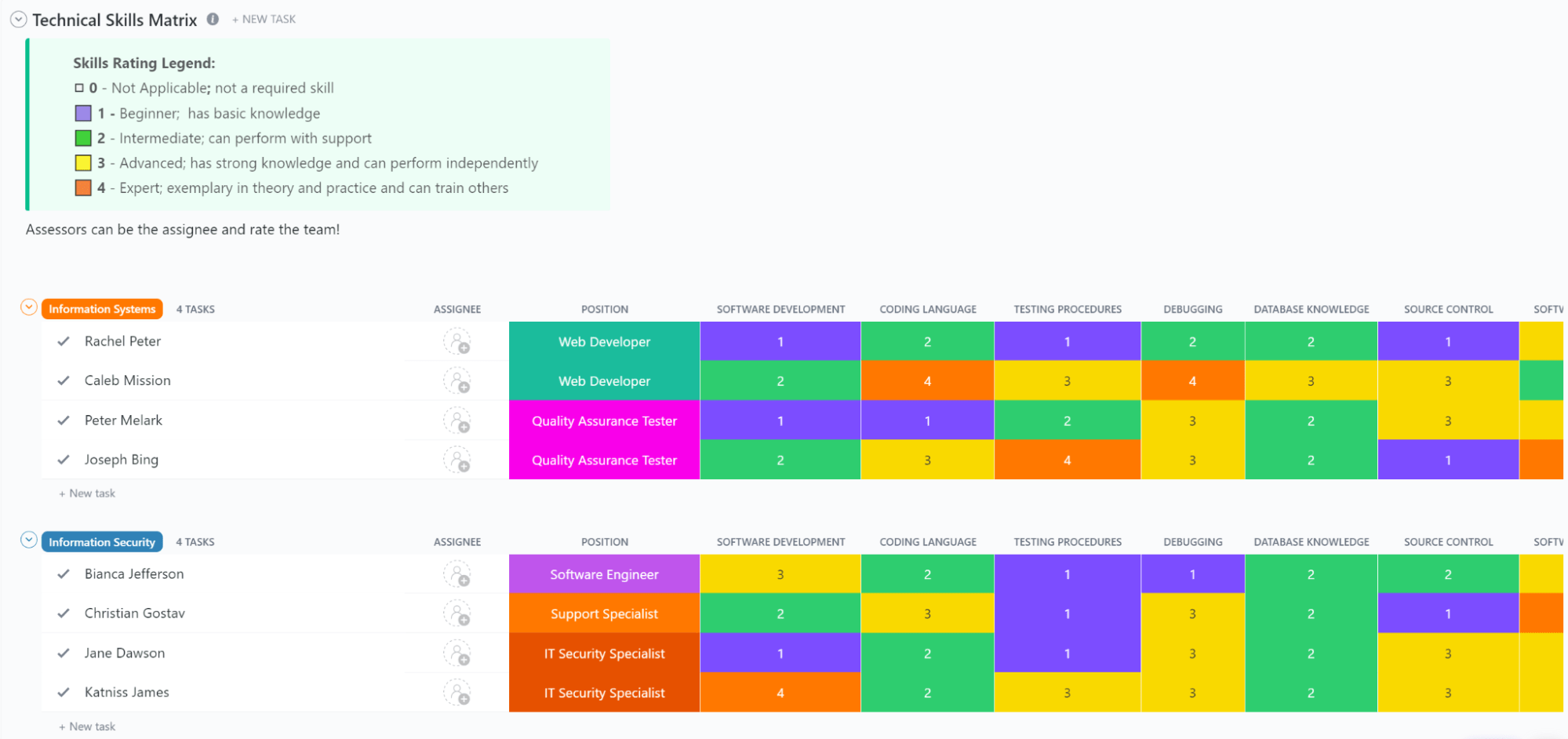
The first step is understanding the specific knowledge each SME possesses. Consider using a tool like the ClickUp Technical Skills Matrix Template to create a visual representation of your team’s skill sets.
This template helps you establish project goals and identify which skill of the SME aligns with the goals. It promotes skills management by helping you identify potential skill gaps within the organization and find areas of improvement.
Facilitate knowledge sharing
Encourage SMEs to share knowledge with the rest of the organization. This can be done through formal training sessions, mentorship programs, or even casual knowledge-sharing lunches.
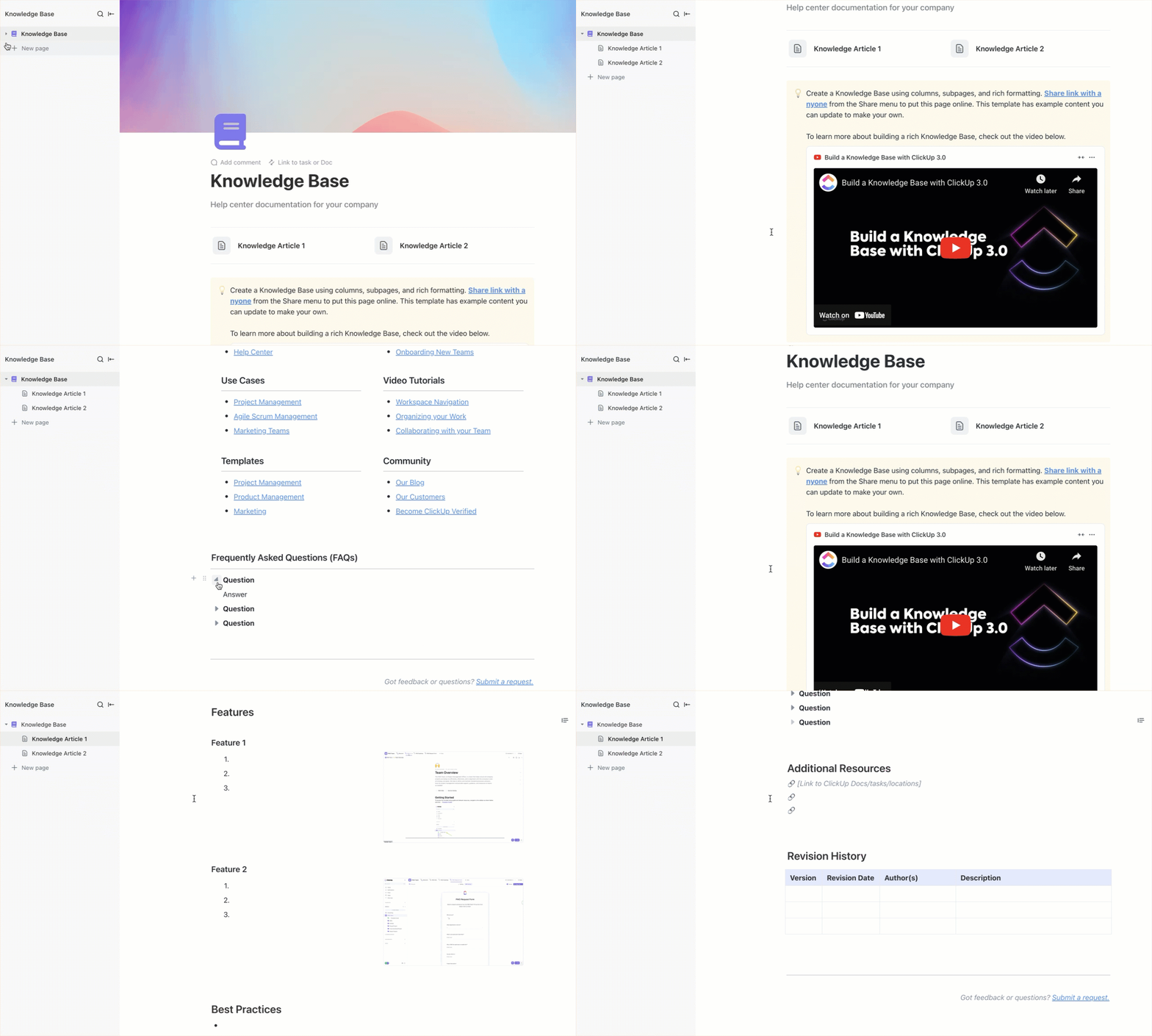
ClickUp Knowledge Base Template can be a valuable tool for SMEs to document their expertise and create a central repository of information accessible to the entire team. The template helps create a digital library of FAQs and actionable insights, making it easier for diverse teams to find valuable information.
Active communication and collaboration
Maintain open communication channels with your SMEs. Regularly solicit their input on projects and encourage them to ask questions. Collaborative tools like ClickUp can facilitate smooth communication and ensure everyone is on the same page.

Respect and recognize contributions
Acknowledge the value that SMEs bring to the team. Show appreciation for their contributions and expertise. This can be done through public recognition, providing them with opportunities for professional development, or simply by actively listening to their ideas.
Summarize this article for me pleaseBecoming a Subject-Matter Expert (SME)
Have you ever dreamed of being the go-to person in your field? Becoming a subject matter expert is a rewarding journey that allows you to make a real impact in your industry by applying your knowledge. Here’s how to get started:
Sharpen your skills
- Master the basics: Dive deep into the core concepts of your field. Read books, articles, and research papers to build a strong foundation on a particular topic. Don’t be afraid to challenge your understanding and ask questions
- Think like a pro: Develop your analytical skills using skills matrix templates to solve problems and make informed decisions. Practice breaking down complex topics into smaller, manageable parts. Identify patterns, research different perspectives, and consider potential risks and solutions for specific industries
- Talk it out: Learn to explain complex ideas clearly, both in writing and verbally. Tailor your communication style to your audience. Use simple language and analogies when necessary, and be prepared to elaborate on technical concepts for those with deeper knowledge
- Stay curious: Focus on agile learning. Attend workshops, listen to podcasts, and stay updated on the latest trends in your field to gain professional experience. Look for opportunities to expand your knowledge beyond your core area of expertise. This well-roundedness will allow you to make connections between different ideas and bring fresh perspectives to your work
Build your credibility
- Share your ideas: Write articles, give presentations, or even start a blog to showcase your knowledge on social platforms to present yourself as a domain expert
- Solve real problems: Take on projects in a particular area that let you test your skills. For example, if you are a marketing SME, you could consult a startup to develop a go-to-market strategy
- Connect with the best: Interacting with other experts in your field or collaborating on budding projects could be a good way for you to keep up-to-date with new innovations in your field and build a vast network of like-minded professionals. For example, a data science SME could participate in online forums to discuss new machine-learning techniques and collaborate on open-source projects with other data scientists
- Get certified: In some fields, certifications can add weight to your expertise. For instance, you can benefit from certification as a Professional in Human Resources (PHR) if you want to become an SME in the HR field
Stay on top of your game
- Find your niche: Instead of being a generalist, choose a specialization within your field to become an expert. If you are a marketing generalist, you could specialize in social media marketing for the healthcare industry to become an SME
- Find a mentor: Learn from someone who’s already an expert in your field. They can guide you and share their insights. For example, if you are a copywriter, seek out and learn from established copywriting leaders through their online courses, social media accounts, books, or even in-person industry events
- Never stop learning: Attend conferences, take online courses, and stay up-to-date on the latest developments. Consider pursuing advanced degrees like an MBA in marketing or specialized training like a boot camp with a data-driven marketing focus to deepen your knowledge
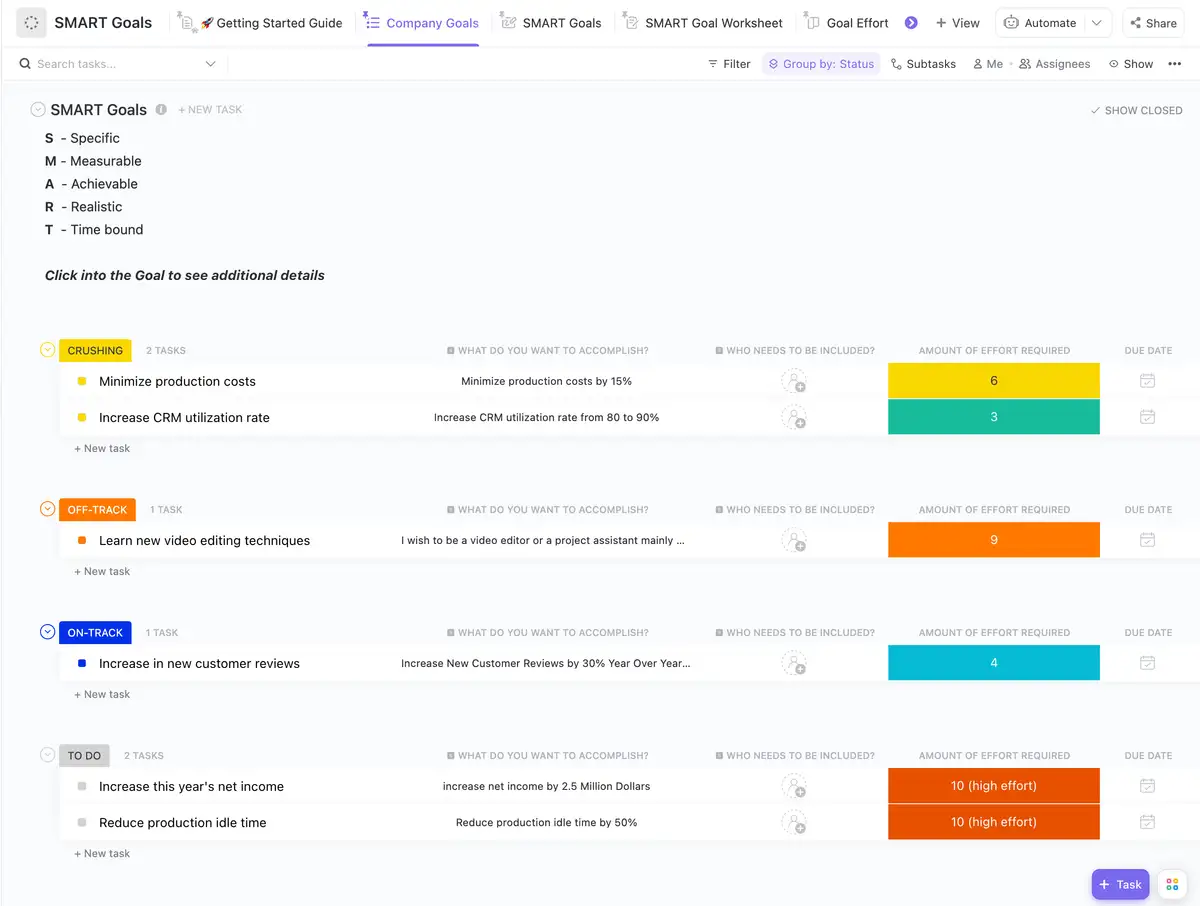
Pro tip: Use ClickUp’s Learning and Development Goal Template to define your learning goals. You can identify areas of improvement, create milestones, and break the goals into actionable steps to enjoy learning, and achieve your goals faster.
 Summarize this article for me please
Leverage the Power of Subject Matter Experts
The deep knowledge and experience that subject matter experts bring to the table can empower your team to achieve greater success. By following the tips outlined in this guide, you can create an environment that fosters collaboration, knowledge sharing, and continuous learning.
Remember, SMEs are not just information repositories; they are strategic partners who can propel your organization forward.
To get the most out of your SMEs, you must define effective collaboration procedures. Use project management tools like ClickUp to streamline knowledge sharing, feedback facilitation, and task allocation. ClickUp empowers your SMEs to share their expertise effectively, leading to a more efficient, innovative, and successful team.
Sign up for ClickUp today and see the difference SMEs can make!


Everything you need to stay organized and get work done.

Recent Articles
What Is a Tiger Team? Definition, Origin, and When to Use One 
What Is a Tiger Team? Definition, Origin, and When to Use One
Marketing Agency Productivity: Where Your Margin Actually Goes
Marketing Agency Productivity: Where Your Margin Actually Goes
8 Communication Strategies That Actually Fix Team Chaos 
8 Communication Strategies That Actually Fix Team Chaos
