

Sorry, there were no results found for “”
Sorry, there were no results found for “”
Sorry, there were no results found for “”
Knowledge workers spend about 28% of the workweek on email, roughly 11 hours, according to the McKinsey Global Institute. Somewhere in those hours sits an approval, a shifted deadline, or a client note that quietly determines whether your project ships on time.
That’s the case for email project management: running the work that arrives in your inbox so nothing important stays buried there. The trouble is that email organizes everything by arrival time, while projects run on owners, due dates, and dependencies.
Teams that get this right draw a clean line between the two. Email carries the conversation, a tracker carries the work, and each one handles the job it was designed for.
This guide walks through how to draw that line. You’ll get steps for moving requests out of the inbox, templates you can copy today, and a rundown of the tools and automations that keep work from slipping between the two.
Two-layer setups usually collapse for a single reason. A senior keeps replying in the thread, and everyone else follows them back into the inbox. No integration fixes that habit. But this rule does: If a message changes a date, an owner, or the scope, it belongs in the tracker before you hit send.
The other half of the judgment call is knowing when to skip all of this. For three people on a three-week project, email genuinely works, and adding a second system costs more time than it saves. The gap opens later, when a project outlives someone’s memory of it, or when the person who took the original request is no longer the person doing the work.
Email project management is what happens when a team runs a project out of the inbox: assigning tasks, sharing files, requesting approvals, and tracking progress in threads. Most small teams start here, and for good reason. Email is already open, everyone has an address, and nobody has to learn a new tool to join in.
Done well, it works. A clear subject line, a named owner in the first sentence, and a date in the body can carry a small project from kickoff to delivery.
Picture a designer who emails three logo options to the team. Everyone replies in the same thread, the founder picks option two, and the file goes to the client that afternoon. No extra tool needed.
The catch is that it has no built-in idea of an owner, due date, dependency, or status. You can add that structure with flags, folders, and shared habits, and plenty of teams do well with it. But as the project grows, you’re asking a messaging tool to do a job that project management software was built for.
Projects stall in the inbox because email lacks the structure needed to manage work. Tasks get buried in long threads, decisions get lost across replies, and once a message drops off the first page, the task is forgotten, even if it’s still open.
Pro Tip: Every Friday, forward yourself a one-line summary of open threads with the subject “Recap: [date].” Future you gets an instant status log without digging through the inbox.
Email is excellent for a specific set of jobs, like client reporting, and poor at everything a project tracker should own. The skill is knowing which is which.
| Keep it in email | Move it out of email |
|---|---|
| Announcements everyone needs to see once | Task assignments with owners and due dates |
| External and client communication | Project status and progress tracking |
| Approvals you want as a written record | Dependencies and handoffs between people |
| One-off notes that need no follow-up | Files that change and get versioned |
| An audit trail of a formal decision | Recurring updates and standing check-ins |
The left column is communication. The right column is coordination, the kind of visual task management a tracker handles well.
Running email as the intake channel and a tracker as the record gives teams a specific set of advantages that neither system delivers alone.
When a client emails a project lead at 5 PM on Friday, the request lives in one person’s inbox until Monday. Forward it to a List and it has an owner, a due date, and visibility to anyone who might pick it up. A design agency running ten concurrent client accounts gets this benefit immediately: coverage doesn’t collapse when someone takes a sick day or goes on leave.
Email buries decisions inside threads. A tracked task pins the decision to the thing it changed. Six months later, when a stakeholder asks why the launch date moved, the answer is attached to the task, not lost in a chain of 47 replies with the subject line “Re: Re: Quick question.”
CC’ing five people on a request creates the illusion of delegation. A task with one named owner makes it clear. Teams that move from “everyone saw the email” to “one person owns the task” consistently close the gap between work discussed and work completed.
An inbox can’t tell you how long your team takes to act on a client request. A tracker with timestamps can. Operations and account teams use this to spot patterns: a 48-hour average turnaround on approvals, for example, reveals a bottleneck you’d never notice by feel alone.
When someone leaves, their inbox leaves with them (or gets archived into a black hole). Work tracked in a shared system stays visible to whoever inherits the project. A consulting firm onboarding a new account manager can hand over a full task history instead of asking the client to re-explain six months of context.
The real failure mode is social, not technical
Most guides treat this as a tooling gap: install the right integration and email stops being a mess. But the pattern that kills two-layer setups has nothing to do with software.
Cal Newport names it in A World Without Email (2021): knowledge workers default to unstructured messaging because it’s the lowest-friction path available. And the person who sets the friction threshold is always the most senior person in the conversation. When a VP replies in the thread instead of updating the tracker, they’ve told everyone else that the thread is where decisions happen. The tool goes stale within a week.
Which makes enforcement a seniority problem, not a software problem. Whatever handoff rule you set, the most senior person in the thread has to be the first one visibly bound by it, because everyone else is reading their behavior, not the process doc. Watch where your leads put a date change and you’ll know which layer your team actually trusts.
This workflow works with almost any setup, from a standard Gmail account to a dedicated project management platform. The principle stays the same:
Decide what to do with each email the moment you open it: Do, Delete, Delegate, or Defer. Process each message once and don’t re-read your way into a decision.
The trap is treating “defer” as “leave it in the inbox,” which is how the inbox becomes a broken to-do list.
Pro Tip: When you delegate, forward the email and BCC yourself, then drag your own BCC copy into a “Waiting On” folder. You get a built-in follow-up trigger without setting a separate reminder.
Every email that requires meaningful work should become a task with, at a minimum:
The exact process depends on your tools:
Suppose a client emails, “Can we replace the header image before launch?” Convert that into a task such as: “Replace campaign header image before launch.”
Assign it to the designer, add the launch deadline, and attach the original thread. The team can now see who owns the request and whether it has been completed without searching the inbox.
Once the task is captured, archive the email. The message remains available as evidence and context, but the inbox no longer needs to track the work.
Reusable templates cut the time you spend writing routine project emails and make them easier to act on. A kickoff, a status update, and a closure email hit the same beats every time, so there’s no reason to draft them from scratch. Each one has a different job to do:
Standing updates are the fastest way to flood an inbox and the easiest thing to relocate. Instead of a weekly status email that spawns a dozen reply-all responses, post the update where the work already lives: a shared dashboard, status reporting tools, or a task comment thread.
People read it when they need it, and it stays attached to the thing it describes.
The same logic applies to feedback. Comment on the shared document instead of emailing a list of edits. The note sits next to the sentence it’s about, so nobody has to reconcile an email against a file. A marketing team reviewing a campaign brief can leave inline comments on the draft itself, rather than sending “see my notes below” and making the writer work across two windows.
Checking email constantly turns your day into a string of small, reactive blocks. The fix is processing email at planned intervals that suit your role. Someone fielding urgent customer requests will need tighter check-ins than a writer, analyst, or designer trying to protect a block of focus time.
A practical routine might look like this:
Researchers at UC Irvine have found it can take over 20 minutes to fully regain focus after an interruption, based on Gloria Mark’s field study on the cost of interrupted work. That doesn’t mean every single email costs you 20 minutes, but it’s a good reminder of why constant context switching drags down focused work.
Two additional habits can reduce avoidable interruptions:
Choose one system that holds the current state of the project. It might be a task list, a dashboard, a project board, or a work management platform.
That system should answer:
Make it the default answer whenever someone asks, “Where does this stand?” Email can still announce the change, as long as it points back to the record: “The revised launch timeline is now in the campaign dashboard. Please review the two milestones marked ‘Decision needed’ by Wednesday.”
Four templates cover most project communication: kickoff, status update, change request, and closure. Each has a fixed job and structure, so you fill in the brackets instead of drafting from scratch. Replace the bracketed text, link the project record, and save each one as a reusable snippet.
Use this before work begins to align the team on the goal, timeline, responsibilities, and source of truth.
A strong kickoff email should include:
Subject: [Project name] kickoff: Goals, timeline, and next steps
Hi team,
We’re kicking off [project name], with the goal of [one-sentence outcome] by [target date].
[Name] will lead the project. You can find the full plan, assigned tasks, owners, deadlines, and current status here: [Link to project workspace]
Please review your assigned work by [date] and flag any deadline, capacity, or dependency concerns in the project workspace.
Our kickoff meeting is scheduled for [date and time].
[Meeting link]
Thanks,
[Name]
Use this for stakeholders who need a clear summary without opening the full project workspace.
Keep the message focused on:
Subject: [Project name] status: [on track / at risk / off track] as of [date]
Hi [name or team],
Here’s the latest update on [project name].
Overall status: [On track / At risk / Off track]
Completed:
In progress:
Risks or blockers:
Action needed:
Please [specific action] by [date] so we can [reason or outcome].
You can view the full project status here:
[Link]
Thanks,
[Name]
Use this when a proposed change affects the project’s scope, timeline, resources, or budget.
Describe the change alongside its consequences. The recipient should be able to understand what is changing, what it’ll affect, and when a decision is required.
Subject: Change request: [project name] [scope/timeline/budget]
Hi [name],
I’m requesting the following change to [project name]:
Proposed change:
[Describe the change clearly]
Reason:
[Explain why the change is needed]
Impact on scope:
[New, removed, or revised deliverables]
Impact on timeline:
[Number of days or weeks, or revised completion date]
Impact on budget or resources:
[Amount, additional staffing, or no expected impact]
Options considered:
Please confirm your decision by [date]. A response after that date may affect [milestone, launch date, budget, or dependent work].
Supporting details are available here:
[Link]
Thanks,
[Name]
Use this when the work has been delivered and accepted. The email should confirm that the project is closed, record any remaining handoffs, and tell people where to find the final materials.
Include:
Subject: [Project name] complete: Deliverables, results, and handoff
Hi team,
[Project name] was completed on [date].
Final deliverables:
Results:
Remaining handoffs:
You can find the final assets, project documentation, and retrospective notes here:
[Link]
Thank you to [@names or teams] for your work on the project.
Best,
[Name]
Turn follow-ups into tracked work: A well-written email still fails if nobody remembers to send it. The ClickUp Follow Up Email Template helps you track pending follow-ups as tasks, assign owners, set reminders, and monitor each email’s status in one place. Use it for client check-ins, approval reminders, overdue responses, or any message that needs another action later.
Inbox-based tools (Gmelius, Hiver, Front) add assignments, status, and boards inside Gmail or Outlook. Standalone trackers (ClickUp, Asana, Trello, Microsoft Planner) pull the email out into a workspace with owners, dates, and dependencies. Pick based on where your team should spend the day.
A shared inbox gives one address, like support@ or projects@, to a whole team, along with the coordination layer that email is missing. You assign a conversation to a person the way you’d assign a task. You leave internal notes on a thread that the client never sees. Collision detection warns you when a teammate is already typing a reply, which solves the two-people-answered-the-same-client problem.
Hiver runs inside Gmail and has a free tier, with paid plans starting at $25 per user per month, billed annually. Front is a standalone app that pulls email, SMS, and chat into one workspace, starting at $25 per user per month. Both report on response time and volume per person, which a normal inbox can’t tell you.
Best for: Teams handling a single shared address where the core problem is knowing who’s replying to what and avoiding duplicate responses.
Skip it if: Your work already has individual owners and personal inboxes. Collision detection and conversation assignment solve a “too many cooks” problem, not a project tracking one.
These tools bolt task features onto the email service your team already uses. Nothing new to log into, which is the whole appeal.
Gmelius turns Gmail and shared inboxes into team workspaces. You can assign a conversation, set a deadline, turn an email into a task, and track it on a Kanban board, all without leaving Gmail. It fits best when each message is itself a piece of work: a client request, a support case, a sales inquiry. Plans start at $19 per user per month, billed annually, with no free tier.
Zoho Mail takes a similar route through its eWidget panel. The Zoho Projects extension lets you view projects, create and manage tasks, and link emails to existing work from inside the mailbox. Zoho Projects is free for up to five users and three projects, then $5 per user per month.
Best for: Teams that want lightweight task and Kanban features bolted directly onto Gmail or Zoho Mail, without asking anyone to log into a separate tool.
Skip it if: You need shared inbox features like conversation assignment or collision detection. These add-ons focus on turning individual messages into tasks, not managing one inbox across several people.
Planner pulls personal tasks, team plans, and premium project features into Microsoft 365. You manage plans in Planner and Teams, see your own work in Microsoft To Do, and connect eligible tasks to Outlook.
The advantage is continuity. A request lands in Outlook, becomes a task, shows up in someone’s assigned work view, and stays visible to the team in Planner. For companies already running docs, meetings, and calendars on Microsoft 365, that’s a lot of value with no new vendor.
The catch is that the email link here is looser than a true email-to-task add-on. Features also vary by plan and task type. Worth confirming your exact workflow is supported before you commit a team to it.
Best for: Companies standardized on Microsoft 365 that want project work wired into Outlook, Teams, and To Do.
Skip it if: You need quick external collaboration, a simpler setup, or a workflow that turns an email straight into a fully built task.
Standalone trackers move the work out of your inbox and into their own workspace. An email arrives, you forward it or hit an add-on button, and it becomes a task with an owner, a due date, and a status. The original email stays behind as a receipt you can archive.
Asana turns emails into tasks through its Gmail and Outlook add-ons. You can assign an owner, set a due date, and attach the message to existing work. A marketing lead reviewing a legal redline can push it straight onto the campaign task instead of forwarding it twice. The Personal plan is free, Starter runs $10.99 per user per month annually, and Advanced runs $24.99.
Trello keeps things lighter and board-shaped. Every board has an email-to-board address, so a forwarded message becomes a card with the subject as the title and the body as the description. A small studio can run its whole intake this way: forward, drag, done. The Free plan covers up to 10 collaborators per Workspace, and Standard is $5 per user per month annually.
The trade-off with any of them is a second place to maintain. Everyone has to genuinely agree that status, owners, and files belong in the project tool. Otherwise, the real updates drift back into email, and you end up running both.
Best for: Teams that want email to feed a project system rather than be the system.
Skip it if: Your team won’t keep a second workspace current, or you need shared inbox features like conversation assignment and collision detection.
A project folder alone won’t keep work organized. It stores messages, but it can’t tell you which ones need action, which are waiting on someone else, and which are done. A better setup sorts email by project and by next step. The features differ between Gmail and Outlook, but the structure stays the same.
| Folder or label | What belongs there |
|---|---|
| Action Required | Messages that need work or a reply from you |
| Waiting On | Requests you’ve delegated or sent for approval |
| Project Reference | Decisions, agreements, and useful context |
| Completed | Closed conversations waiting to be archived |
Gmail uses labels instead of folders. One email can carry several labels at once, which helps when a message belongs to a project and also needs action. A client approval request might carry both ‘Project: Website Redesign’ and ‘Waiting On.’
Create one main label for each active project. Nest workflow labels under it when you need them:
Skip the urge to label every small topic or sender. A long list of near-identical labels turns into a second inbox you have to manage.
Now, put filters to work on predictable mail. A filter can apply a label, archive, star, delete, or forward a message based on the sender, recipient, subject line, or keywords.
A few filters worth building:
Save stars for messages that need your attention. Gmail can also snooze a message until a date and time you pick, which helps when there’s nothing to act on yet. Give every snooze a reason to come back, like a follow-up after an approval deadline. Once the email becomes a task or the work is done, archive it.
Outlook uses folders to store messages and categories to group them. Start with one folder per active project, then add a short list of workflow folders:
A message lives in one folder, so reach for categories when it needs a second layer of context. An email can sit in the Website Redesign folder and still carry an ‘Approval Needed’ or ‘Client Decision’ tag. Outlook allows several categories on the same message.
Rules move incoming mail into folders based on the sender or other conditions. This works well for routine project updates, automated notifications, and any subject line with a consistent project code.
Flag the emails that need follow-up. A flag can include a due date and a reminder, and you can view all flagged messages together as a task list. Categories tell you what a message relates to, while flags tell you that something still has to happen.
Supported versions of Outlook also handle pinning and snoozing the same way Gmail does.
Folders and filters work better when project emails follow the same subject format.
Use:
[Project name] [Action]: Specific topic
For example:
Keep one topic per thread. When the conversation shifts from design approval to launch scheduling, start a new thread with a new subject.
Once you’ve processed a project email, it should leave the main inbox in one of three ways:
ClickUp sits in the standalone-tracker category above, with email-to-task addresses on every List and two-way email inside the task itself. Here’s what that looks like in practice for email-driven work.
Email in ClickUp connects Gmail, Outlook, Microsoft 365, or any IMAP account to your tasks. Inside a task, the comment field toggles between internal comments and outbound email. Client replies and team discussion live side by side with the assignee, status, due date, and files. No digging through the inbox to reconstruct context.
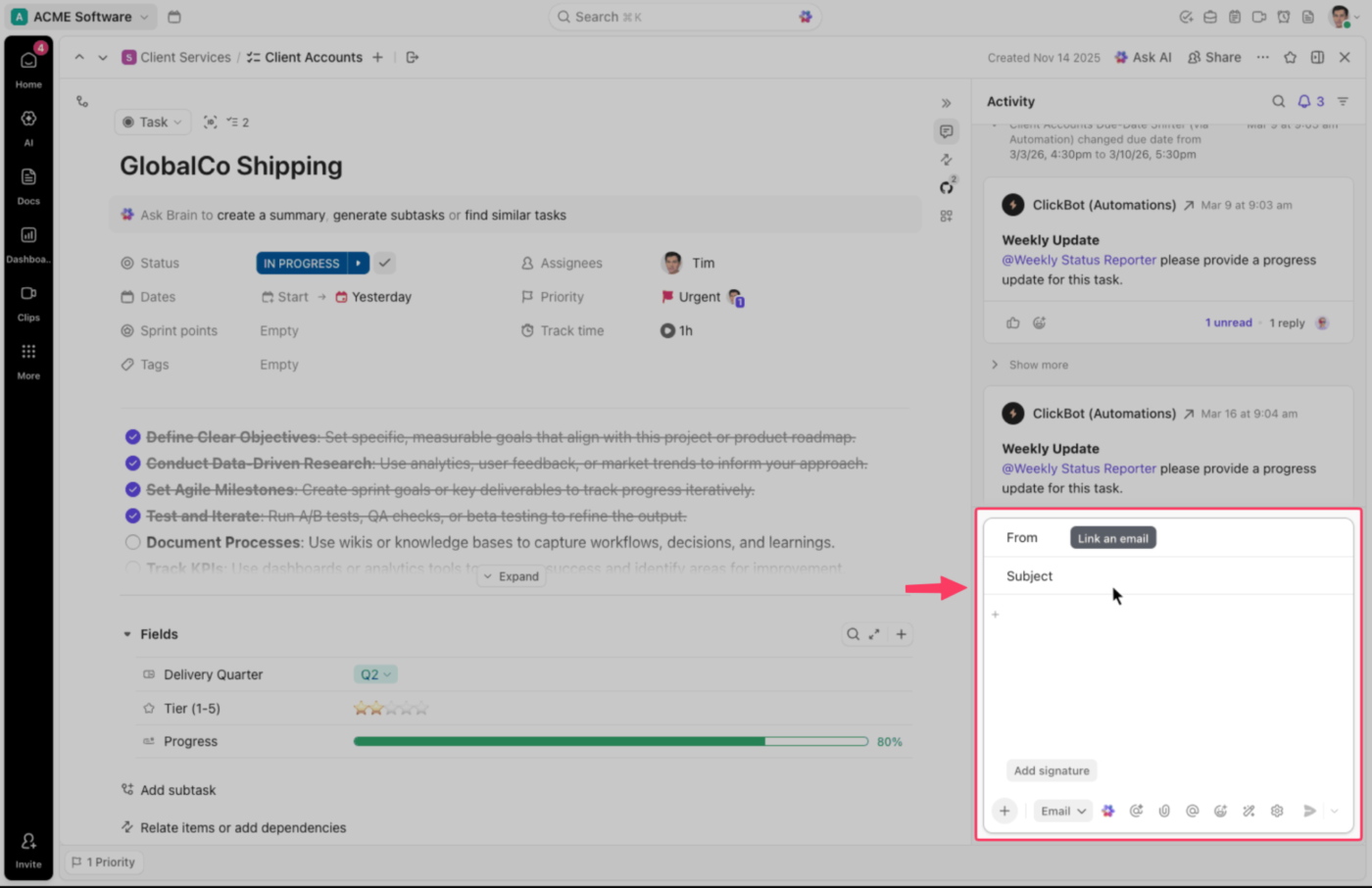
Every List and task in ClickUp has its own email address. Forward a client message to a List and it becomes a task: subject as title, body as description, attachments carried over. Send to an existing task’s address instead, and it lands as a comment for work already in flight.
That’s what makes email task management work in practice. The request no longer depends on whoever happened to receive it.
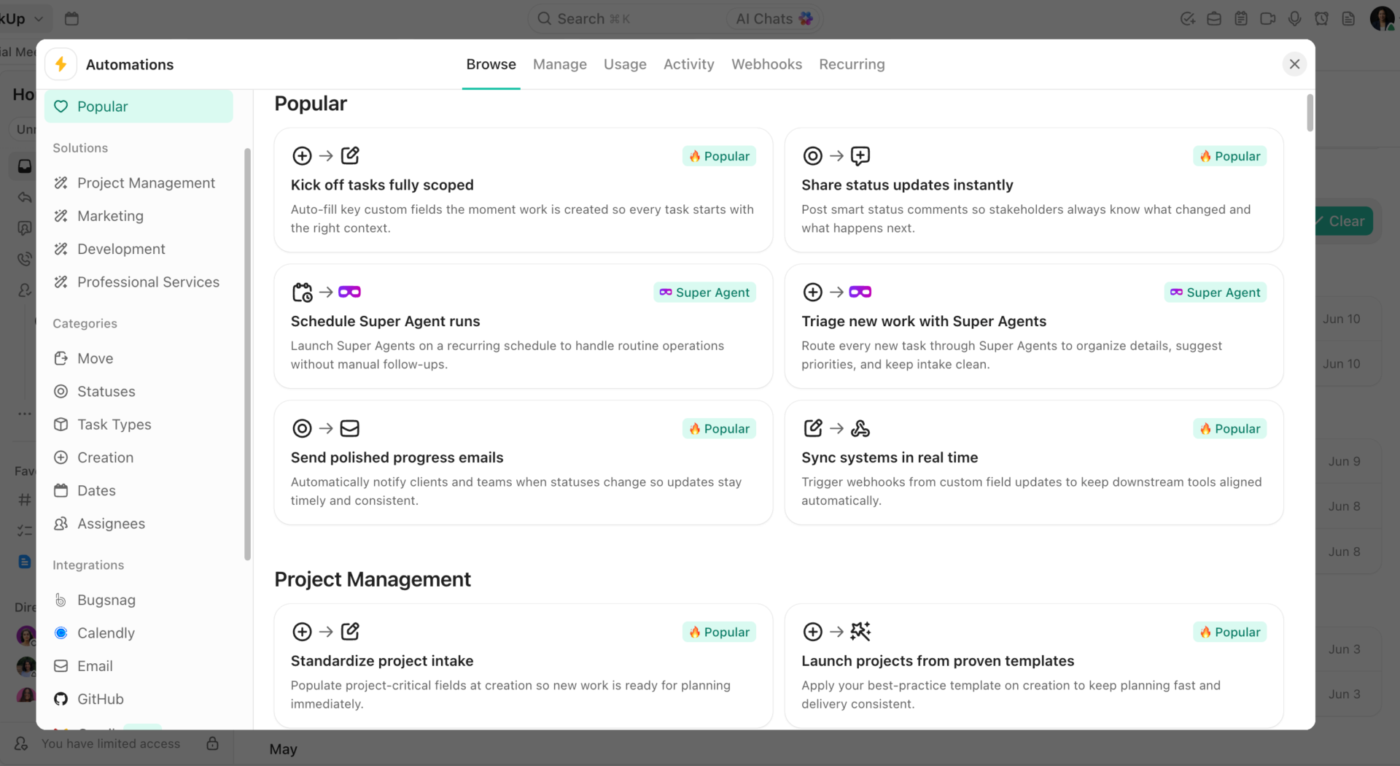
ClickUp Automations can fire templated emails when a status changes or a due date arrives, removing manual follow-up. A “task created” trigger can acknowledge a request the moment it lands. Dynamic fields such as the task name, description, assignee, status, due date, and selected Custom Fields make the email specific to the task.
We also use this at intake. A request comes in through a ClickUp Form and lands as a task in the right List with every field filled. A “task created” Automation then emails the requester an acknowledgment.
This ClickUp walkthrough shows how to build an automated workflow with triggers, conditions, and actions in under five minutes.
Keeping email inside the task preserves the full history, but long client threads can still take time to read. ClickUp Brain summarizes task activity and comment threads, pulls out the main points, and generates project updates from work. It even flags delays, and helps draft messages from the context already stored in the task.
Best for: Teams that receive project requests through email but want the actual work, client communication, files, owners, deadlines, Automations, and reporting in one Workspace.
Skip it if: Your team only needs a shared inbox or a lightweight way to assign emails, and does not need broader project planning, workload management, or cross-functional tracking.
Five email tools close the gaps a project tracker leaves. FollowUpThen tracks messages no one has answered. SaneBox filters out inbox noise. Mailparser extracts data from incoming requests. cloudHQ saves email threads as PDF records. Lastly, Email Meter measures response times across Gmail and Microsoft 365.
None of these replaces project management software. They fix the small email problems that stall work before it reaches the tracker.
| Tool | The email problem it solves | How it helps project work | Best for | Keep in mind |
|---|---|---|---|---|
| FollowUpThen | Important follow-ups depend on memory | Add an address such as 3days@followupthen.com to an email, and the conversation returns at the chosen time. Task reminders can also repeat until you mark the item complete | Client approvals, delegated work, unanswered requests, and promises you need to revisit | It reminds you about the conversation, but doesn’t track the underlying project status |
| SaneBox | Project messages compete with newsletters, alerts, and low-priority mail | Learns which messages matter, moves less important mail out of the main inbox, and provides tools for unanswered emails and scheduled reminders | People managing several projects from one busy inbox | Automated filtering needs some initial correction before it reliably matches your priorities |
| Mailparser | Teams manually copy details from structured emails and attachments | Extracts fields from email bodies and attached PDFs, spreadsheets, Word files, CSVs, and other documents, then sends the structured data to another system | Order requests, application forms, invoices, leads, bookings, and other messages that follow a consistent layout | It works best with recurring, structured emails rather than unpredictable client conversations |
| Save Emails to PDF by cloudHQ | Final approvals and decisions are difficult to preserve outside the inbox | Converts individual Gmail messages, full conversations, or groups of emails into PDF files that can sit beside briefs, contracts, and final deliverables | Formal approvals, client sign-offs, disputes, handovers, and projects that need a readable email record | A saved PDF is a fixed record. Later replies won’t appear unless you export the thread again |
| Email Meter | Managers can’t see whether slow email responses are delaying work | Measures email volume, first-response time, unanswered messages, and communication patterns across Gmail and Microsoft 365 | Client services, operations, and account teams with response-time targets | It measures communication activity, not whether the underlying project is on track |
Most email project failures come down to a handful of habits that quietly break down how information moves between people. The table below lays out each mistake alongside the fix, side by side, so you can spot the pattern you’re running into and swap it out directly.
| Mistake | Fix |
|---|---|
| Using the most recent email attachment as the version of record, which leads people to edit outdated copies without realizing it | Share a single drive link instead, so everyone opens and edits the same file rather than a copy from three replies ago |
| Writing vague subject lines like “Quick question” or “Update” that give no indication of which project or action is inside | Use a consistent tag like [ProjectName] or [Action Needed] so people can triage by scanning subject lines alone |
| Letting one thread drift across multiple topics, starting with budget and sliding into scheduling and design, without anyone noticing | Keep one topic per thread so each conversation stays searchable and referenceable on its own later |
| Treating silence on a proposal as agreement, when really people miss emails, deprioritize them, or mean to reply and forget | Confirm explicitly, even with a one-line “confirming we’re good to proceed,” instead of assuming no reply means approval |
| Letting an unanswered request sit for days with no follow-up plan | Set a default rule, like escalating to a manager or switching channels after 48 hours, so requests don’t die in an inbox |
| Looping in stakeholders only after a decision is finalized, which invites pushback that could’ve been caught earlier | Send a short heads-up mid-process instead, since one extra email costs far less than redoing finished work |
Email project management comes down to a clean division of labor: decide what belongs in email, then move the rest into a system built to track it. Email stays the front door for requests and updates, while the work itself lives somewhere the whole team can see at a glance.
The tool matters less than the crossing. Every request needs a clear trigger for when it becomes a tracked task and one person who owns that conversion. Get that part right and email stops being the place projects go to die.
If your projects keep vanishing into threads, that two-layer setup with a firm handoff rule is the fix. Get started with ClickUp for free and give the work a home outside your inbox.
Email project management runs the work through threads, so assignments, approvals, and updates all live inside messages. Project management software stores the same work as structured records with an owner, due date, status, and dependency on every item. The practical difference is retrieval: email answers “what was said,” a tracker answers “where does this stand.” Most teams end up running both, with email as the intake channel and the tracker as the record.
Outlook handles project communication, reminders, and lightweight task capture, but it has no native fields for dependencies, workload, or project-level status. Microsoft’s own guidance routes team projects to Planner and personal task lists to To Do, with Outlook as the front end.
Gmail has no project management module. Google Workspace supplies the adjacent pieces: Google Tasks for to-dos created from a message, labels and filters for triage, snooze for deferral, and Google Chat Spaces for shared task lists. For owners, due dates, statuses, and dependencies across a team, you need a Gmail add-on such as Gmelius or a tracker connected to the inbox.
No. A shared inbox (Hiver, Gmelius, Front) gives one mailbox multiple owners, with conversation assignment, internal notes, and collision detection so two people don’t reply to the same client. Email project management is broader: it covers how a request moves from a message into a tracked task with a deadline. A shared inbox solves ownership of messages. A tracker solves ownership of work.
Keep the client in email and mirror their messages into the tracker automatically. Most platforms assign every list or project its own email address, so forwarding a client request creates a task with the subject as the title and attachments carried over. ClickUp, Asana, and Trello also let you reply from inside the task, so the client experience stays email-only while your team keeps owners, dates, and status in one place.
Email works when the whole project fits in one person’s working memory: roughly three people, a few weeks, no handoffs between functions. It stops working the moment a project outlives someone’s memory of it, or when the person who received the original request is no longer the person doing the work. Email has no native field for owner, due date, status, or dependency, so that structure lives in someone’s head until it doesn’t.

Manasi Nair
Max 22min read
Manasi Nair
Max 15min read

Praburam Srinivasan
Max 16min read

© 2026 ClickUp




