




How to Build Clever Marketing Strategies That Boost Growth

Sorry, there were no results found for “”

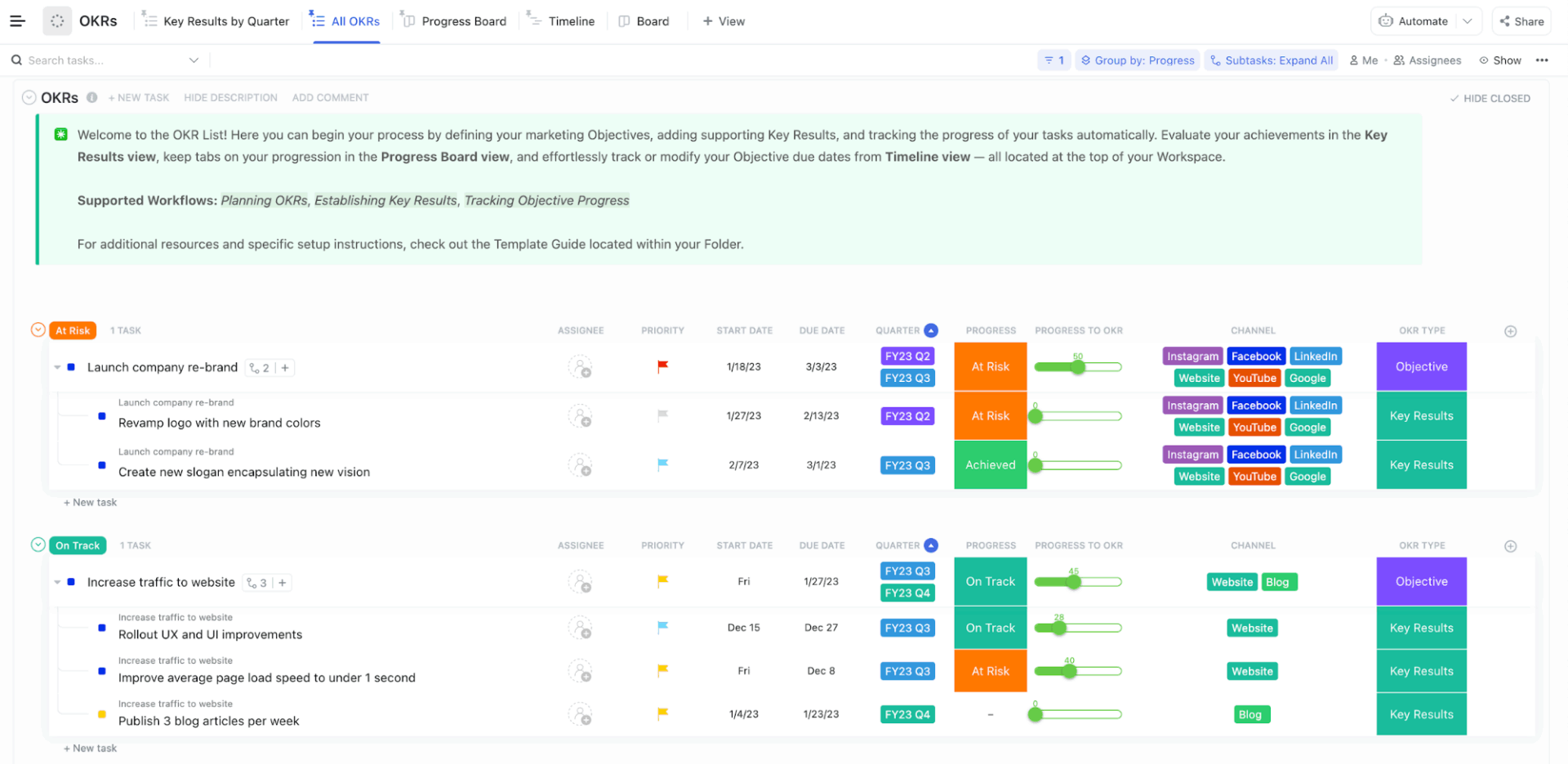
Success in marketing isn’t about talent or technology. It’s about talent and technology. Teams must keep pace with innovation while celebrating and empowering professionals who are bold, clever, creative, and dynamic, bringing exceptional work and energy to everything they do
Teams seeking genuine, sustainable growth need clever marketing strategies that help them land, scale, and perform across channels without slowing momentum.
This guide walks you through practical ways to shape a foundation of clear workflows using tactics, templates, and ClickUp! Let’s get started. 🎯
Clever marketing strategies employ creative and innovative tactics that engage audiences in unexpected ways. They blend strategy with originality to build brand awareness, foster emotional connections, and drive business growth beyond traditional advertising.
People expect marketing to feel less like advertising and more like help. Here’s what delivers:
🔍 Did You Know? A lot of people credit a 1907 magazine cover experiment as the first ‘A/B test,’ but the idea actually came later. The real foundations of A/B testing were developed in the 1920s by statistician Ronald Fisher, who created randomized controlled experiments to test things like fertilizer effectiveness on crops. His methods (randomization, control groups, and statistical significance) became the blueprint for the A/B tests marketers use today.
Clever marketing strategies separate growing brands from stagnant ones. Here’s why these matter:
📮 ClickUp Insight: 16% want to run a small business as part of their portfolio, but only 7% currently do.
Fear of having to do it all on your own is one of the many reasons that often holds people back.
If you’re a solo founder, ClickUp BrainGPT acts as your business partner. Ask it to prioritize sales leads, draft outreach emails, or track inventory—while your AI agents handle the busywork.
Every task, from marketing your services to order fulfillment, can be managed via AI-powered workflows—freeing you to focus on growing your business, not just running it.
Clever marketing strategies take shape when teams understand their audience, work from the same information, and move through an organized planning process.
Many teams struggle because work sprawl breaks their momentum.
A Converged AI Workspace like ClickUp for Marketing Teams solves this problem. Your research, planning, collaboration, timelines, and performance data stay connected in one place, so your team builds strategies without losing context or speed.
Follow these steps to shape clever marketing strategies. 📝
Before you write copy or book ads, you need to see how everything connects.
A visual campaign map shows which channels feed into each other, where content gaps exist, and how each tactic supports your primary goal.
Lay out your campaign structure so your team understands the relationships between audience segments, messaging angles, and distribution channels. This prevents disconnected tactics that compete for attention.
🚀 ClickUp Advantage: Grow your marketing strategy from clear insights with ClickUp Whiteboards. You can drop trends, screenshots, notes, competitive findings, and audience cues onto one visual canvas without worrying about structure yet.
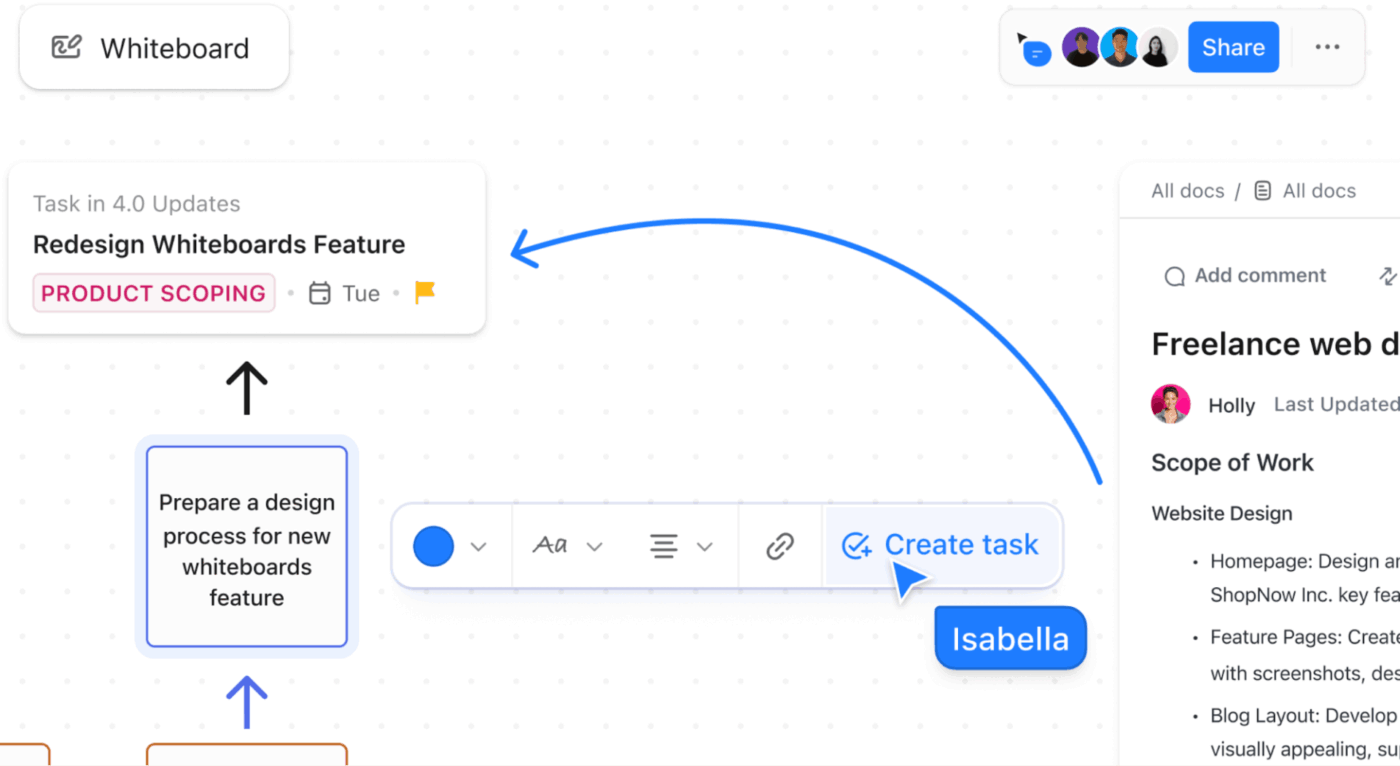
For example, a beverage startup prepares its content marketing strategy. The team opens a Whiteboard and adds:
The Whiteboard helps them see a pattern: ‘summer nostalgia’ consistently appears in every input. That theme shapes their messaging direction before they write a single line of copy.
Generic audience descriptions lead to generic campaigns. You need to document the exact personas you’re targeting, including their current challenges, the language they use to describe problems, and what motivates them to take action.
Build audience profiles after conducting market research:
The more specific your audience definition, the easier it becomes to craft messaging that resonates. Teams can reference these profiles when designing the next social media marketing campaign to ensure every asset speaks directly to real customer needs.
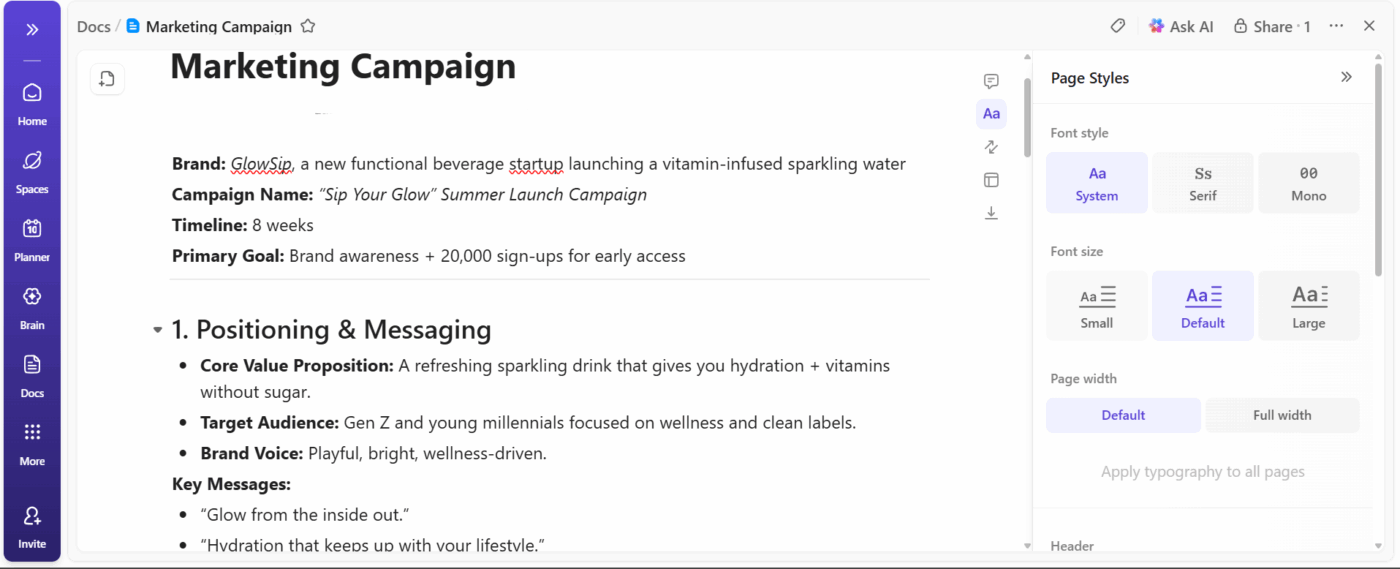
💡 Pro Tip: Outline positioning, goals, channels, competitive market trends, deliverables, and creative requirements in ClickUp Docs. Not only can team members work on them collaboratively, but they can also be linked within the relevant ClickUp Tasks. Context is added without breaking the planning flow.
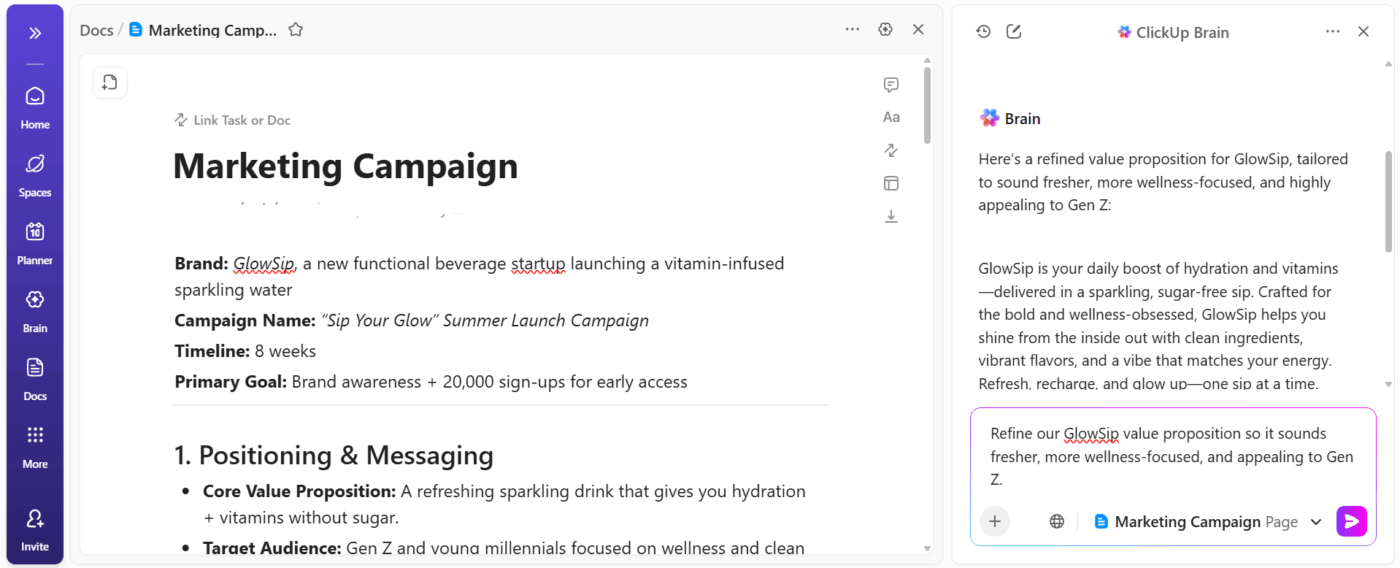
Plus, ClickUp Brain elevates this through fast rewrites, tone adjustments, and message variations. You shape messaging inside the same system that houses your research and execution.
So the marketing team for the beverage startup could create a doc containing:

You use the AI marketing tool to generate three tone options based on audience personas. After testing a small sample, your team chooses the tone that resonates strongest and updates the doc instantly.
📌 Example Prompts:
Your sales and marketing strategy needs a permanent home that team members can access anytime they need clarity on positioning, messaging, or tactical priorities. This document captures the decisions you’ve made, so teams execute consistently across every touchpoint.
Structure your strategy ClickUp Doc to include:
Update this document as your campaign evolves so it remains useful throughout the entire marketing funnel.
🧠 Fun Fact: The ‘mere-exposure effect’ proves that people develop a preference simply by seeing something repeatedly. This is the psychological backbone of retargeting ads and consistent content posting.
Most campaigns fail because content bottlenecks slow down execution. You need a clear workflow that shows who creates what, when assets move between teams, and where approvals happen.
Document each stage of your content pipeline:
This workflow prevents last-minute scrambles and ensures your team produces content at the pace your campaign demands.
🚀 ClickUp Advantage: Turn marketing ideas, tasks, and deadlines into a connected, structured workflow with the ClickUp Strategic Marketing Plan Template.
It includes:
Coming up with fresh angles for every campaign drains time and creative energy.
AI generates variations of marketing materials like social media ads, headlines, email subject lines, and content themes based on your brand voice and audience parameters.
Feed your AI marketing tool information like your potential customer profile, competitive positioning, and campaign objectives. Then, ask it to create first drafts you can refine with simple prompts. This accelerates the brainstorming phase, so you spend more time evaluating concepts for potential.
💡 Pro Tip: Take help from ClickUp BrainGPT. It brings all your work, knowledge, and AI needs into one place so you avoid AI Sprawl and move faster.
With BrainGPT, you can:
Checking analytics across multiple platforms wastes hours every week. A centralized marketing dashboard pulls metrics from all your active channels into one view so you can monitor campaign health without toggling between tabs.
Track these metrics:
Configure alerts for significant changes so your team can respond to performance declines before they become costly issues. Real-time visibility and smart marketing project management turn reactive troubleshooting into proactive optimization.
🚀 ClickUp Advantage: Visualize campaign production, creative volume, channel performance, and budget pacing in real time with ClickUp Dashboards.

For example, a home décor brand runs a fall promotion across Pinterest, Instagram, and email. Their dashboard includes:
Assign specific people to each campaign element so everyone knows their responsibilities and can move forward without waiting for direction.
Break down ownership across key areas:
Clear ownership prevents duplicated effort, helps teams execute faster, and ensures problems are addressed.
📖 Also Read: Free Content Strategy Templates for Marketing
Advanced AI analysis processes campaign data faster and more thoroughly than manual review. Use it to validate hypotheses, identify which tactics drive the highest-quality leads, and surface optimization opportunities buried in your metrics.
Ask specific questions like ‘Which audience segment converts at the lowest cost?’ or ‘What content format generates the most pipeline velocity?’ The AI reviews performance across channels and time periods to deliver insights you’d otherwise miss.
🚀 ClickUp Advantage: Highlight patterns that influence ROI with ClickUp Brain, so you adjust your strategy based on evidence.

Let’s say you’re comparing engagement across product demo videos, influencer clips, and short reels. ClickUp Brain spots a pattern showing that quick reels generate the highest add-to-cart rate for new customers, helping you shift budget immediately.
📌 Try this prompt: Analyze my video performance notes and weekly KPI updates. Identify which content type drives the highest conversion rate and recommend the top action to improve results next cycle.
A testing roadmap helps you prioritize experiments that have the highest potential impact on performance. Structure it around these elements:
Run one test at a time so you can isolate what drives results and document findings so future campaigns benefit from the insights you generate.
🧠 Fun Fact: The most successful early growth hack of all time was Hotmail’s sign-off link, ‘PS: I love you. Get your free email at Hotmail.’ It helped the company grow to 12M users in 18 months.
A shared calendar shows when emails are sent, ads launch, social posts are published, and events occur so you can coordinate timing across channels.
Color-code activities by channel or campaign phase to enable quick scanning. This prevents overlap that dilutes your messaging and helps you identify opportunities to reinforce key themes across multiple touchpoints.
🚀 ClickUp Advantage: Get a real-time view of meetings, production stages, campaign launches, and cross-team deadlines in the ClickUp Calendar View. Dragging a task to a new date automatically updates every connected view, so teams adjust quickly without losing clarity.

Say an influencer partner delays content delivery for three days. Your team drags the related task to a new date in Calendar View. Design, copy, social, and paid teams instantly see the updated timeline and adjust without confusion.
The gap between average and exceptional marketing comes down to execution. These seven clever marketing tactics deliver measurable results when implemented with precision and consistency. 👇
Create a landing page for an unreleased feature or product tier and position it as exclusive early access. Collect emails, and use the signup volume to decide whether to build it. This validates market demand and creates a revenue pipeline before you commit resources.
Structure your pre-launch sequence to maintain engagement:
Track which messaging in your landing page copy drives the highest signup rates. If ‘automated reporting’ generates more interest than ‘custom dashboards,’ you know which feature to emphasize at launch.
This approach builds an audience that converts at launch without traditional advertising spend.
🧠 Fun Fact: The Furrow was created as a farming education magazine. John Deere published it to help farmers learn new techniques, boost their crop yields, and run more profitable operations. The fun part is that it became so valuable that most readers never realized it was produced by a farm equipment company at all.
Record customer calls, support chats, and sales demos to identify the exact language prospects use when describing their problems. These phrases become your content titles because they match how people search for solutions.
Transform these insights into ranking content:
This strategy works because you create content around proven demand. Marketing operations teams should also assign someone to review call transcripts weekly and flag content opportunities for the production queue.
🧠 Fun Fact: While the first website went live in 1991, SEO didn’t actually begin then. The real practice, and even the term ‘SEO’, only emerged in the mid-1990s, when search engines like Yahoo!, AltaVista, and Lycos appeared, and the internet exploded with new websites.
Generic communities become noise. Focused groups around specific outcomes stay active because every member shares an identical goal. So, divide your audience by the job they hired your product to complete, then create dedicated spaces for each segment.
Build communities that generate business value:
These spaces produce organic advocacy. Members recommend your product to peers facing the same challenges because the community gave them solutions they could not find elsewhere.
You must also track which segments generate the most referrals and prioritize those communities for additional resources and featured content.
🔍 Did You Know? People trust brands more when they show a small vulnerability or flaw. This concept, called the Pratfall Effect, is why user-generated content often outperforms polished brand videos.
Structure co-marketing agreements where both parties commit to specific promotional activities on set dates. This creates accountability and makes ROI measurable from day one.
Set up partnerships that deliver predictable outcomes:
For B2B marketing teams, it’s best to focus on partners whose customers need your solution at a different stage of their journey. Suppose you sell project management tools, partner with time tracking software, or team communication platforms. Their customers already understand workflow optimization and convert faster than cold prospects.
Generic retargeting shows identical ads to everyone who visited your site. On the other hand, behavioral retargeting adjusts messaging based on which pages someone viewed, how long they stayed, and what actions they took. This precision reduces wasted spend on people who need different information.
Structure your retargeting around intent levels:
Someone who views your pricing page three times clearly evaluates whether your product fits their budget. Show them ads that address cost concerns directly, like implementation support or flexible payment terms.
🔍 Did You Know? The cognitive bias called ‘loss aversion‘ explains why scarcity-based CTAs (like ‘last few seats left’) are twice as effective as value-based ones.
Self-assessment tools generate leads and segment them simultaneously. Build a scorecard that evaluates where prospects rank on a relevant metric, delivers personalized feedback, and routes them to appropriate next steps based on their results.
Design assessments that drive a qualified pipeline:
Connect the assessment results to your CRM so Sales receives the prospect’s contact information, their exact answers, and tier placement. This eliminates discovery questions and lets sales reps personalize outreach based on specific gaps the assessment revealed.
🚀 ClickUp Advantage: Let ClickUp AI Agents power lead generation and qualification automatically. They act as AI teammates inside your workspace to capture assessment responses, score leads, segment prospects, and route high-potential contacts without manual work.

For example, say you publish a self-assessment form to prospects. When someone completes it, your Agent reads their answers and calculates a score based on your point values. It assigns them a tier (beginner/intermediate/advanced) and automatically triggers the next step: either a nurture sequence, a demo invitation, or routing to sales.
Personalized pages adjust headlines, social proof, and calls-to-action based on how someone arrived, what company they work for, or which content they previously engaged with. This relevance increases conversion rates without changing your core product messaging.
Implement personalization that scales with your traffic:
🔍 Did You Know? The classic marketing funnel was inspired by E. St. Elmo Lewis’s 1898 AIDA model, originally created for door-to-door salesmen.
Traffic spikes and email open rates mean nothing if they don’t translate into revenue. You need to track the specific actions that indicate someone is moving toward a purchase decision.
Define conversion events that matter for your business model:
Connect each metric to actual dollar values. A demo request might be worth $500 based on your close rate and average deal size. An activated trial user might be worth $2,000. When you assign values, you can calculate which campaigns generate profit and which lose money.
💡 Pro Tip: Surface revenue-driving patterns in your conversion data with AI Cards in ClickUp Dashboards.

They let you ask natural-language questions directly inside your dashboard and get instant analysis based on your tasks and linked data. You can pull insights from conversion events, revenue values, campaign tags, and performance timelines without exporting spreadsheets or running manual reports.
Companies that execute good marketing strategies share a common trait: they test relentlessly and scale what works.
SaaS businesses use product-led growth strategies that turn free users into paying customers:
Watch this video to build your own marketing playbook:
E-commerce brands that dominate their niches focus on customer lifetime value (CLV) over one-time purchases:
🧠 Fun Fact: Coupons were first introduced by Coca-Cola in 1887. They gave away free drink tickets and drove thousands of people into stores. It was one of the earliest growth-hacking tactics.
B2B companies winning in crowded markets use account-based strategies that concentrate resources on high-value prospects:
Here’s what Robyn Henke, Owner, Robyn Henke Consulting, had to say about using ClickUp:
Completely changed how I do business and gave me the foundation I was missing to GROW! As someone who gets overwhelmed easily, being an entrepreneur can feel like A LOT, but once I started harnessing the power of ClickUp, everything changed. The energy I bring into my business is different. I feel empowered by everything that’s possible and how easy I can make collaborating with freelancers and clients. It’s given me the motivation and excitement to spearhead projects of my own, and create workflows specific to MY business, not just client work. Needless to say, I’m obsessed!
Service businesses that scale profitably leverage referral systems and strategic partnerships:
🔍 Did You Know? The ‘paradox of choice‘ shows that offering too many options reduces conversions. Growth teams that simplify landing pages often see an instant lift in CTRs and signups.
Your strategy needs attention when performance patterns shift or your audience stops responding. Some signals call for a light refresh, while others show it is time to rebuild your approach entirely. ⚒️
| Situation | Refresh When | Replace When |
| Channel performance | A few channels show declining CTR or engagement, while others remain stable | Multiple channels show sustained drops in conversions or revenue contribution |
| Audience fit | Messaging feels slightly off, but core personas still match your buyers | Buyer behavior changes, or a new segment becomes more profitable than your current target |
| Competitive pressure | Competitors adjust campaigns or shift messaging, but the market stays steady | A competitor changes the category with new pricing, positioning, or product value |
| Internal changes | Your team needs process clarity or stronger alignment | You shift your product direction, enter a new market, or adopt tools that require a new approach |
| Goal alignment | You increase targets, but can scale current campaigns with optimizations | Your goals outgrow what your existing strategy can produce, even with improvements |
| Customer signals | Feedback shows minor gaps in relevance or clarity | Customers ask for different solutions, outcomes, or buying experiences than your strategy supports |
Great marketing comes from teams that test ideas, study real customer behavior, and course-correct before momentum slips. When you treat strategy as an ongoing practice, your campaigns stay relevant, decisions stay sharp, and growth stays consistent.
You move faster when your entire workflow lives in one place with ClickUp. Map ideas on Whiteboards, shape messaging in Docs, track work and performance in Dashboards, spot patterns through AI Cards, and refine direction with ClickUp Brain.
Sign up for ClickUp today! ✅
Clever marketing usually taps into psychology, community, or timing. Examples include: referral rewards, waitlist drops, user-generated content challenges, strong social proof campaigns, product-led giveaways, and hyper-personalized emails. They encourage sharing and make the customer feel involved rather than targeted.
A strategy stands out when it says something specific to the target audience. That means speaking directly to a real pain point, showing proof through stories and results, and making the brand identity feel human. Consistency across online platforms and a memorable message help people remember you even when they’re not actively buying.
The most reliable combination is local search visibility + referrals + email nurturing. Ranking on Google locally brings discovery, referrals build trust fast, and email keeps customers coming back without spending a fortune. When these three work together, small businesses get repeat revenue instead of random spikes.
AI helps by eliminating guesswork and busywork. It can analyze customer behavior, predict what content or offers will convert, automate follow-ups, recommend audience segments, and generate ideas based on trends.
A good rhythm is to evaluate every quarter for consistent business success while developing innovative products. Strategies should shift when customer expectations, competitors, product positioning, or economic conditions change. The goal is not to reinvent marketing constantly but to adjust before things stop working, not after.
© 2025 ClickUp