






Still downloading templates?
There’s an easier way. Try a free AI Agent in ClickUp that actually does the work for you—set up in minutes, save hours every week.
Sorry, there were no results found for “”
Sorry, there were no results found for “”
Sorry, there were no results found for “”
You walk into work every day, tackle your to-do list, and meet your deadlines. But at some point, you start wondering: am I actually moving forward?
Maybe you’ve been wanting to step into a leadership role, switch industries, or finally build the confidence to speak up in meetings. But without clear professional development goals, it’s easy to stay stuck in the routine.
The good news? You don’t need a complete career overhaul to grow. Small, strategic goals can help you gain new skills, expand your network, and create opportunities you didn’t even see coming.
Here are 25 career development goals to set for yourself, plus practical steps to achieve them. 🎯
Career development goals help professionals advance, acquire new skills, and create growth opportunities. Setting clear goals ensures progress remains intentional and aligned with long-term aspirations.
Career development goals are specific objectives professionals set to improve their skills, advance their careers, or explore new opportunities. These goals provide direction and help individuals grow in a structured and measurable way.
Setting clear career goals makes progress intentional. Instead of drifting through roles, professionals take charge of their growth, ensuring each step aligns with long-term aspirations. Some goals focus on acquiring new skills, while others aim at promotions, leadership positions, or industry shifts.
🧠 Fun Fact: Leonardo da Vinci wrote one of the first-ever résumés in 1482 when he applied for a military engineer job in Milan, listing his skills in designing weapons and fortifications.
Short-term and long-term career goals serve different purposes but work together to create a clear professional path. These are the key differences. 📝
| Aspect | Short-term career goals | Long-term career goals |
| Timeframe | Achievable within months to a few years | Takes several years or decades to accomplish |
| Focus | Skill-building, certifications, networking | Career advancement, leadership roles, industry shifts |
| Examples | Completing an online course, attending a conference, improving time management | Earning an advanced degree, becoming a senior executive, starting a business |
| Flexibility | Easier to adjust or modify | Requires long-term commitment but can evolve |
| Impact | Enhances daily performance and job satisfaction | Shapes overall career trajectory and life goals |
Winging it rarely leads to success. Setting career development goals can shape your future and keep you on track. Here’s why they matter and how they drive personal and professional development. 📈
Career development goals help you level up and stay on track. They give you a clear direction, so you’re not just going through the motions at work.
Here are some solid examples that actually push you forward. 💼
Leadership roles require strong decision-making, strategic thinking, and the ability to guide teams. Professionals aiming for leadership should take on more responsibilities, improve problem-solving skills, and seek mentorship.
Learning a new skill or earning a certification strengthens your expertise and keeps you competitive in a constantly evolving job market. Expanding your knowledge boosts confidence, improves problem-solving, and makes adapting to new challenges and opportunities easier.
A strong professional network creates opportunities, fosters collaborations, and provides career insights. Building meaningful relationships with industry peers increases exposure and opens doors to job referrals, partnerships, and mentorship.
🔍 Did You Know? Your career path might not exist yet. Some of the fastest-growing jobs today, like AI ethicist and VR designer, weren’t around a decade ago. The role you’ll have in five years might not even be a thing yet!
Clear communication builds trust and ensures ideas are understood. Leaders must articulate their vision effectively, resolve conflicts, and inspire teams. Strengthening verbal and written communication also improves workplace interactions and career progression.
🔍 Did You Know? Soft skills can take you further than technical skills. Companies value adaptability, communication, and problem-solving just as much (if not more) than hard skills because they’re harder to teach.
Industries shift due to technological advancements, consumer demands, and economic changes. Staying updated with industry knowledge helps professionals adapt, remain competitive, and position themselves as experts.
Technical skills make work easier, boost confidence, and keep things running smoothly. The more comfortable you are with the tools and systems in your field, the faster you can solve problems and take on bigger challenges.
Effective time management reduces stress and improves efficiency. High productivity ensures deadlines are met without burnout, leading to better work quality and professional growth.
Challenges arise in any role. Top performers are distinguished by their ability to assess situations, develop creative solutions, and implement effective strategies.
Understanding emotions improves collaboration and leadership effectiveness. High emotional intelligence enhances self-awareness, empathy, and conflict resolution.
Making a career change involving a new role or industry requires strategic planning. Understanding new industry trends, identifying transferable skills, and strengthening weaker areas help make the transition smoother.
🧠 Fun Fact: On average, people switch jobs every 2 years and 9 months. That means by the time you retire, you could have around 16 different roles on your resume!
Helping others navigate their careers builds leadership skills and industry credibility. Sharing knowledge strengthens understanding while fostering meaningful professional relationships.
Effective negotiation influences salary discussions, business deals, and project terms. Presenting proposals confidently and advocating for fair terms leads to better career outcomes.
A strong personal brand highlights expertise and attracts opportunities. Thought leadership and online presence position professionals as industry experts.
Changing environments require flexibility. Adaptable professionals embrace change, learn quickly, and navigate uncertainties with confidence.
Understanding salary negotiations, benefits, and investment strategies ensures long-term career stability. Professionals who manage finances well make informed career decisions.
🤝 Friendly Reminder: Your first job doesn’t define your future. Some of the most successful professionals started in unrelated fields. Jeff Bezos worked at McDonald’s, and Oprah was a news anchor before building her empire.
Working across teams improves adaptability and strengthens relationships in the workplace. Professionals who excel in cross-functional collaboration understand different roles, communicate effectively, and contribute to shared goals.
Managing a major initiative showcases leadership, strategic thinking, and problem-solving skills. Successfully leading a project boosts credibility and creates opportunities for career advancement.
Getting better at professional writing means learning how to communicate your ideas in a way that makes sense and resonates with others. Strong writing builds trust, grabs attention, and helps you stand out in any role.
Multilingual professionals gain a competitive edge in global industries. Speaking multiple languages improves communication, broadens job prospects, and fosters cultural awareness.
Handling workplace disagreements effectively improves relationships and teamwork. Professionals skilled in conflict resolution foster a positive work environment and prevent minor issues from escalating.
💡 Pro Tip: Participating in customer service training programs can significantly enhance your conflict resolution skills. These programs often teach active listening, empathy, and de-escalation strategies—all essential for navigating workplace disagreements.
Building a strong professional presence attracts opportunities and establishes credibility. Visibility in the industry positions professionals as experts and increases networking potential.
Understanding international markets, cultures, and business practices expands career opportunities. A global mindset enhances adaptability, improves collaboration across borders, and prepares professionals for roles in multinational companies.
The ability to negotiate effectively impacts salary discussions, business deals, and workplace dynamics. Professionals who master negotiation secure better opportunities, gain respect, and build strong professional relationships.
Unexpected challenges arise in every workplace. Being prepared to handle high-pressure situations, mitigate risks, and respond to crises effectively improves leadership capabilities and workplace stability.
Thinking like an entrepreneur helps professionals take initiative, drive innovation, and create opportunities within their current roles or future business ventures. Developing this mindset encourages problem-solving, adaptability, and long-term career growth.
🧠 Fun Fact: The word ‘career’ comes from the Latin carrus, meaning chariot. It symbolizes movement and progression.
Career growth starts with clarity.
You can’t hit a target if you don’t know where you’re aiming. Setting effective career development goals gives you the roadmap to make it happen, whether you’re gunning for a promotion, mastering a new skill, or expanding your professional network.
And with ClickUp, the everything app for work, keeping track of progress becomes a breeze. It helps you organize your goals, set deadlines, and collaborate effortlessly—all in one place.
So, let’s break down how to set goals with a goal-tracking app to keep you moving forward and ensure you’re not just busy but growing.
Before diving into goal-setting, take a moment to figure out what you want to achieve in your career. It’s easy to get caught up in day-to-day tasks, but understanding your long-term vision is key to setting meaningful goals.
Start by asking yourself: What’s the bigger picture? Are you aiming for a leadership role, wanting to switch industries, or looking to become an expert in your field?
Your aspirations might change over time, and that’s fine. The important part is to think about where you want to be in the next 3-5 years.
Once you’ve clearer sense of your career aspirations, you can set short—and long-term goals that align with that vision. This step helps you prioritize what matters most so you’re not wasting energy on things that don’t fit with your bigger plan.
The more focused you are on your aspirations, the easier it will be to create goals that motivate you.
When you’re setting career goals, it’s easy to feel like you’re spinning your wheels. It can be tough to figure out where to start.
That’s where the SMART framework comes in.
SMART stands for Specific, Measurable, Achievable, Relevant, and Time-bound. This structure helps you turn vague aspirations into clear, actionable goals that you can actually track. Let’s break down what each of these elements means:
For example, you could take something broad like ‘Improve my leadership skills’ and make it a SMART goal by saying, ‘I will lead a cross-functional team project within the next 4 months to improve my leadership skills.’ This version is specific, measurable (leading a project), achievable, relevant (if leadership is important for your career), and time-bound (within the next 4 months).
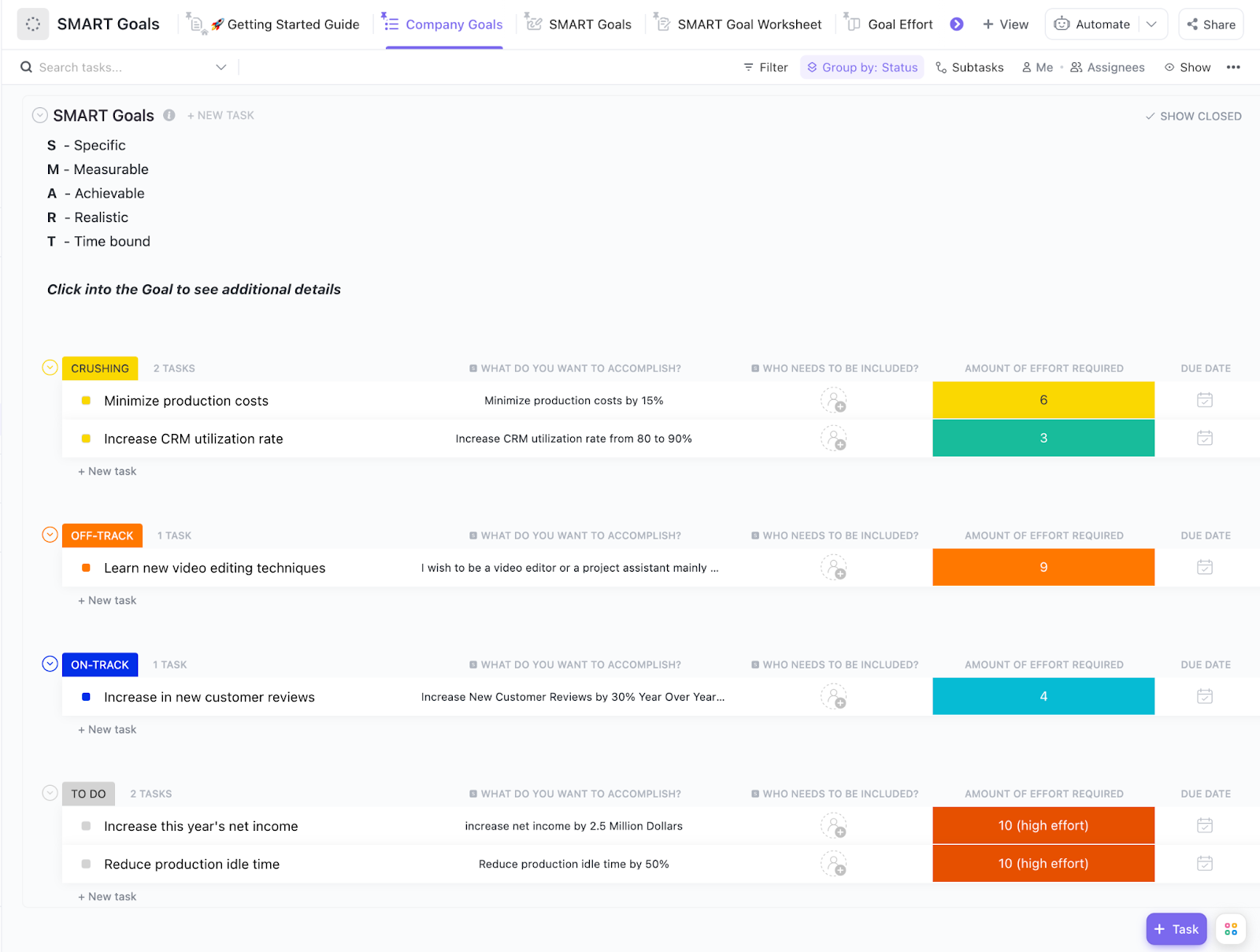
The ClickUp SMART Goals Template is a great tool to help you organize and track these goals.
The Goal Effort View makes this template especially useful. It helps you assess the effort required for each goal. It also includes a SMART Goal Worksheet View to brainstorm and organize ideas and a Company Goals View so you can track your team’s collective goals.
Once you’ve set your career development goals, the next step is to map out a clear, actionable plan to achieve them. Without a structured approach, it’s easy to lose focus or get sidetracked.
A career development plan serves as your roadmap, breaking down your big goals into manageable steps. Here’s how to create one that works for you:
Stay committed, but remain flexible as you navigate your journey.
🔍 Did You Know? The concept of a ‘career ladder’ is relatively new—before the Industrial Revolution, most people stayed in the same trade or family business for life.
Tracking your progress is crucial to achieving your career goals. Without visibility, it’s easy to lose focus or underestimate how far you’ve come.
ClickUp helps you stay organized and motivated as you work toward your objectives.
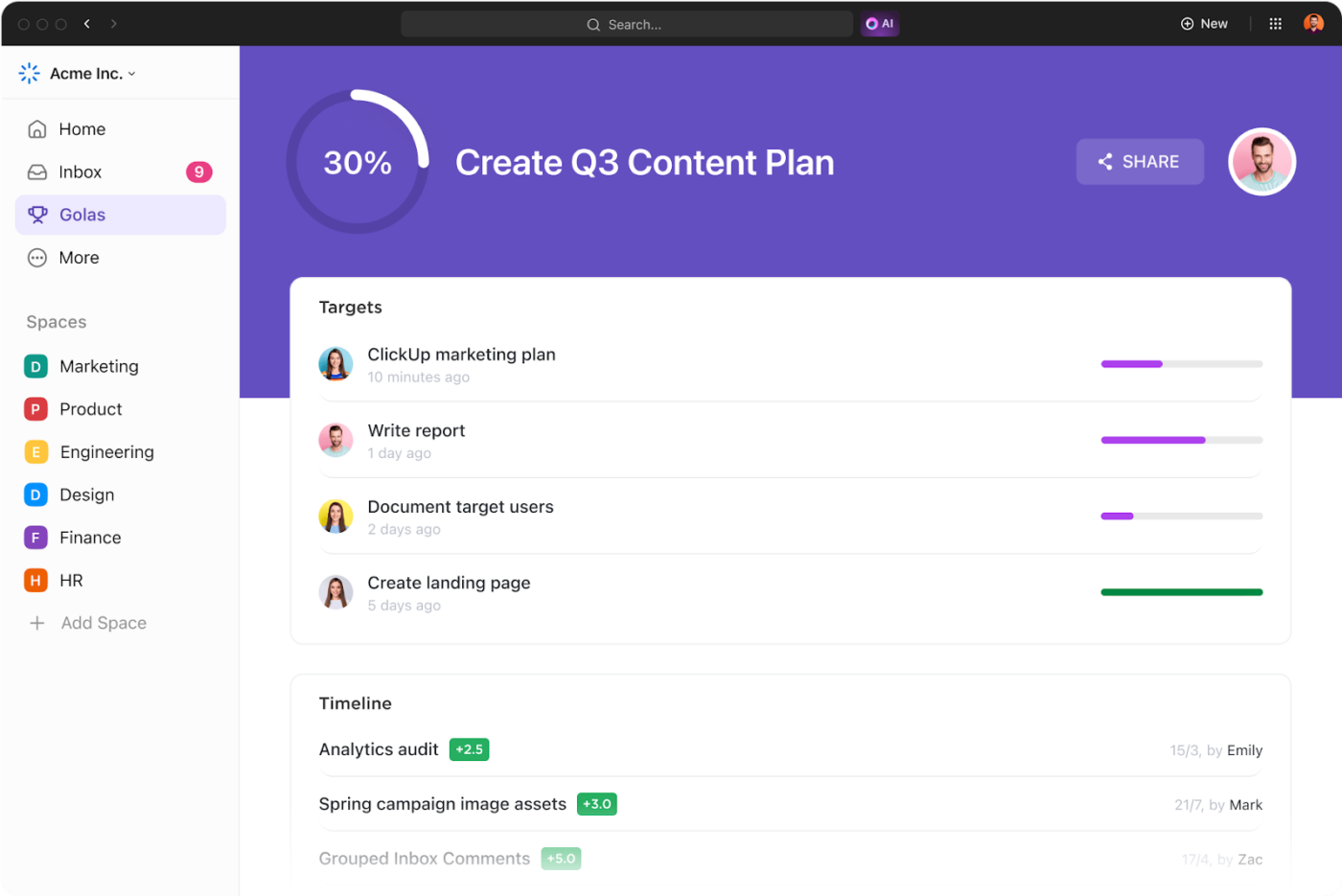
With ClickUp Goals, you can break down large objectives into smaller, manageable tasks. For instance, if your goal is to complete a professional certification, you can set tasks like enrolling in the course, completing modules, and finally, passing the exam.
You’ll get to see exactly where you stand at each step, which helps you stay focused and on track.
📮ClickUp Insight: 92% of workers use inconsistent methods to track action items, which results in missed decisions and delayed execution. Whether you’re sending follow-up notes or using spreadsheets, the process is often scattered and inefficient. ClickUp’s Task Management Solution ensures seamless conversion of conversations into tasks—so your team can act fast and stay aligned.
As you check off each task, you’ll move closer to achieving your larger career goals. Once you’ve broken your goals down, it’s time to get a bigger picture. This is where ClickUp Dashboards come in.
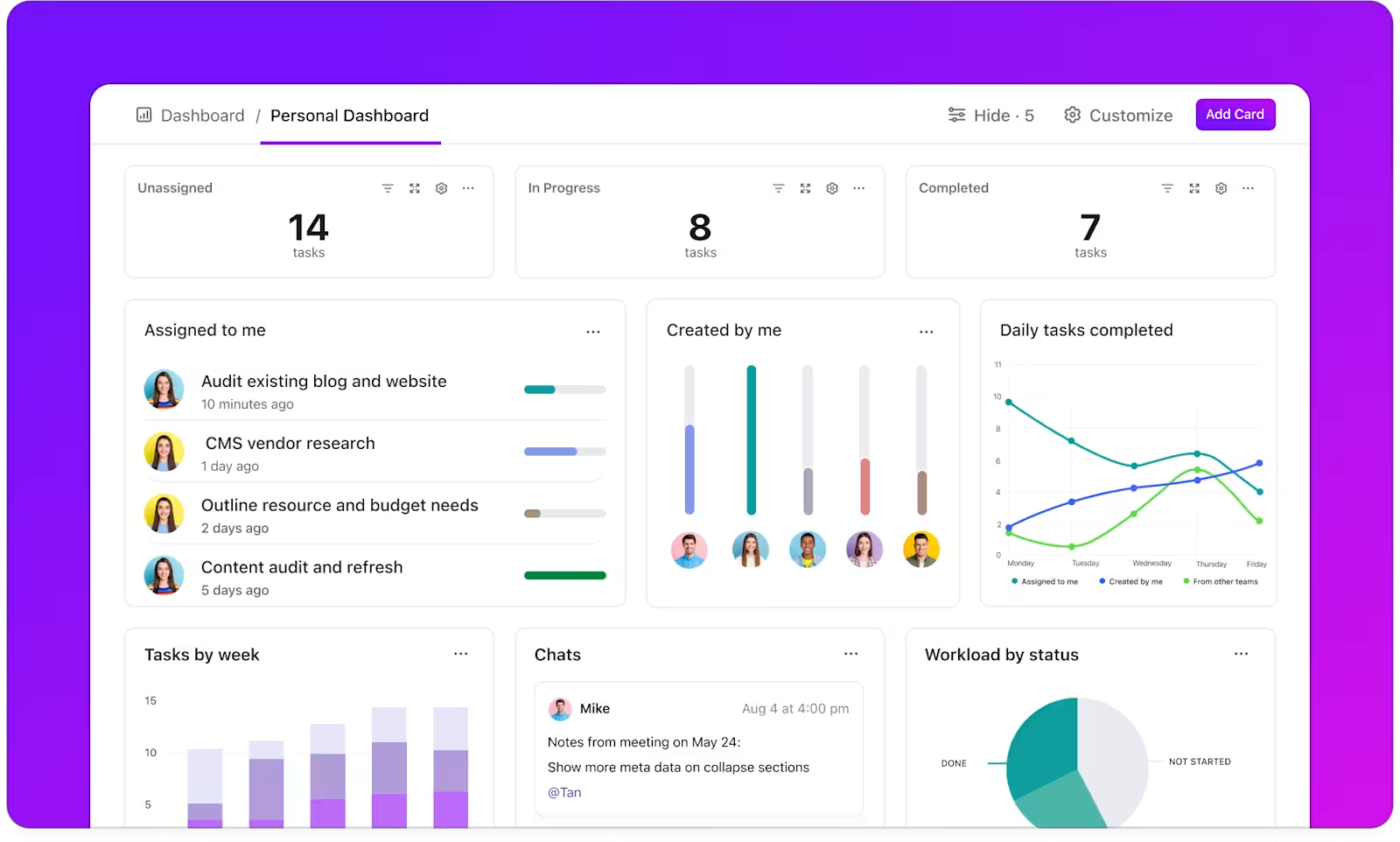
Dashboards are your career goal command center.
You can create a custom dashboard to keep track of all your objectives, see your progress, and know exactly what needs your attention.
Let’s say one of your goals is to develop leadership skills. You could set up a dashboard that tracks your progress across different related tasks—like enrolling in leadership courses, attending workshops, or taking on management responsibilities.
You’ll see everything in one place and have a quick overview of your progress, making it easier to stay motivated and adjust your plan.
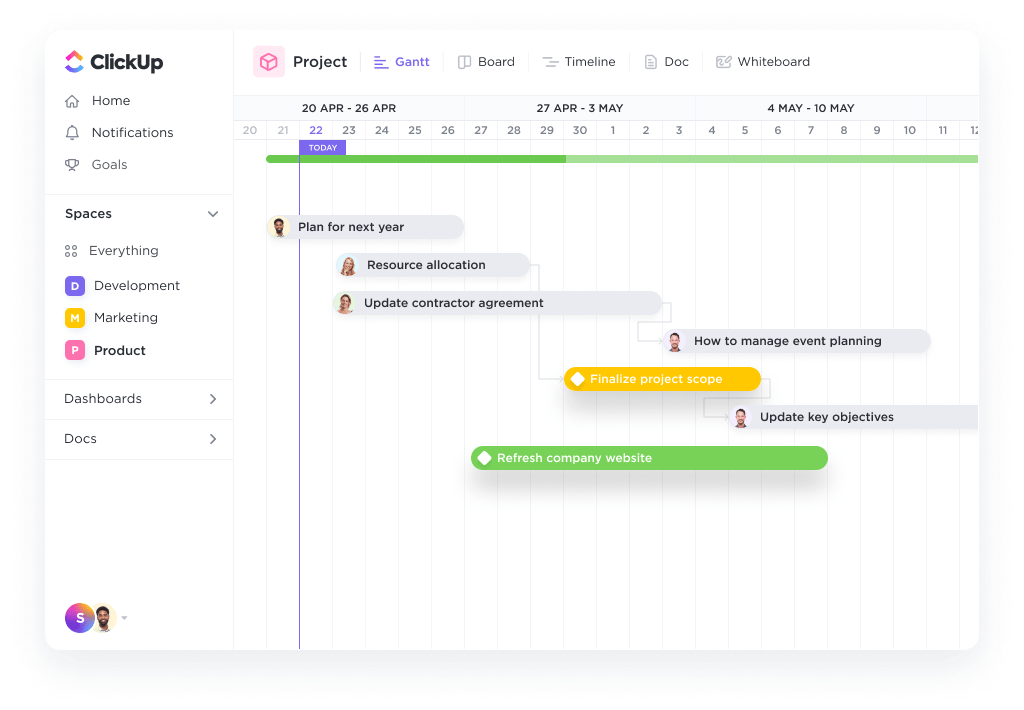
And if you want to get even more specific, you can use ClickUp Milestones to break your larger goals into smaller, more tangible checkpoints.
So, if you’re aiming for a promotion, set milestones like completing a leadership training program, taking on more responsibilities at work, or meeting specific performance targets.
💡 Pro Tip: If you’re feeling a bit lost when setting your career goals, goal-setting templates can save you a lot of time and confusion. They provide a clear structure and keep you focused so you can avoid the guesswork and stay organized as you work toward your next big milestone.
Growth doesn’t happen in a vacuum. Even if you’ve got all your professional work goals mapped out, sometimes you need a little guidance.
Seeking a mentor—someone who’s been through it, seen it all, and maybe even made a few mistakes along the way—can give you insight and advice you might never have considered. Mentors are often more than willing to share their knowledge because they’ve been where you are.
Beyond mentorship, continuous learning plays a huge role in your career journey. Industry trends change, new tools emerge, and there’s always something new to learn.
Consider taking an online course, attending webinars, or even reading the latest books on time management skills. The key is to stay curious and open-minded. You don’t need to master everything overnight, but small, consistent steps in learning can keep you ahead of the curve.
Career goals evolve as you do. What felt like the perfect goal six months ago might not be as relevant today, and that’s okay! The trick is to review where you stand and adjust your goals periodically.
Maybe you’ve gained more responsibility at work or discovered a new interest. This is a great time to re-evaluate your goals and make tweaks. Think about your progress and whether you’ve hit those milestones. If not, what’s stopping you? If you have, what’s next? Reviewing your goals regularly keeps your career path intentional and focused.
Set a reminder for yourself every few months to sit down and assess. Small changes now can lead to big wins down the road.
🧠 Fun Fact: Job hopping can actually help. While staying at a job for decades used to be the norm, strategic job changes can lead to faster salary growth and skill development.
Navigating a career comes with hurdles that can slow progress or create uncertainty. Identifying challenges early and taking strategic action helps maintain momentum and achieve professional goals.
Let’s explore some common career hurdles and how to navigate them. 🌱
Imposter syndrome is the nagging feeling that you’re not as competent or capable as others think you are despite evidence of your achievements. It can make you question your qualifications, undervalue your successes, and worry that you’ll be ‘found out’ as a fraud.
🛠 The fix: Recognize your accomplishments and remind yourself of the skills and qualifications that got you there. Talk to others who’ve experienced the same feelings and share strategies for overcoming them.
A role without room for advancement can feel restrictive. Stagnation leads to lower motivation, fewer learning opportunities, and missed career progression.
🛠 The fix: Don’t wait for opportunities to come to you. Volunteer for new projects or responsibilities that challenge your current skills. Upskilling with certifications or training can also open doors to personal and professional growth. If upward movement isn’t available, consider lateral moves within your company to broaden your experience and make yourself more versatile.
Stepping into new roles, industries, or responsibilities can feel overwhelming. Fear of failure or uncertainty often prevents professionals from seizing valuable opportunities.
🛠 The fix: Tackle big transitions in smaller, less scary steps. Think of it as leveling up in a game—you don’t go from beginner to expert in one shot. Build your confidence through continuous learning and connecting with others who’ve walked a similar path. Seeing their success stories can be the boost you need to take that first step.
When work takes over, life outside the office can feel like an afterthought. Long hours and heavy workloads can quickly lead to stress and burnout, leaving you with little energy for anything else.
🛠 The fix: Draw some clear lines between work and personal time. Think of your boundaries as non-negotiable commitments to yourself. Prioritize your tasks effectively, but don’t hesitate to speak up if your workload is unmanageable. Remember, a healthy work-life balance is essential for productivity and happiness.
🔍 Did You Know? The 40-hour workweek became standard in the U.S. in 1940, thanks to labor movements pushing for better work conditions. Before that, factory workers often worked 70+ hours a week.
Excuses don’t build careers—action does. People spend years talking about success but never take control of it. They drift through jobs, hoping things will work out, while the ones who plan, execute, and track progress move forward.
If you’re not setting clear goals and holding yourself accountable, you’re just running in place.
That’s where ClickUp separates the serious from the unsure. It offers an efficient system for getting things done. You can set real career targets, break them into actionable steps, and track your progress in one place.
Sign up for ClickUp today! ✅

© 2026 ClickUp

There’s an easier way. Try a free AI Agent in ClickUp that actually does the work for you—set up in minutes, save hours every week.