
Sorry, there were no results found for “”
Sorry, there were no results found for “”
Sorry, there were no results found for “”
It’s not uncommon to feel like your career is on autopilot. Even though you’re good at your job, it may often feel like that spark of challenge or growth is missing.
Step out of the comfort zone. Challenge yourself to grow in your career—vertically or laterally.
Vertical career growth is all about climbing the corporate ladder. It typically involves a title bump to a new position with more responsibility and authority.
On the other hand, lateral or horizontal career growth is more about expanding your skill set by moving sideways within an organization or even to a new company. You might not get an immediate promotion, but you’ll gain valuable experience.
Here’s the exciting part: these paths aren’t mutually exclusive! You can leverage vertical and horizontal career moves to create a well-rounded skill set. A lateral career move provides valuable experience and expertise, enhancing your readiness for vertical growth.
Vertical vs. lateral career growth: Which one should you choose? Let’s understand the what and why of each approach. By exploring their unique advantages, you can choose one that suits your career growth objectives and positions you for future success.
Vertical career growth is the traditional upward career trajectory within a specific field or industry. You progress through promotions to positions with greater responsibility, authority, and, typically, a pay increase.
Through vertical growth, you can move from entry-level, individual contributor positions to management roles, taking on new responsibilities and overseeing the work of others.
Pros
Cons
Here are some ways to maximize the vertical career path:
Now, let’s look at the pros and cons of a lateral career move and ways to maximize it.
Horizontal career growth focuses on expanding skills and experience by moving across different roles, departments, or industries without vertically climbing the hierarchical corporate ladder.
The key is to gain new experiences and broaden your knowledge base without necessarily aiming for a promotion (although that may happen soon!).
Pros
Cons
Here’s how you can maximize the lateral career path:
Whether transitioning laterally or horizontally, a successful career requires a clear purpose and flexibility to embrace new roles.
Purpose and adaptability are crucial to fuel your career journey. Purpose gives your career direction, while adaptability helps you to navigate the journey. These two factors can make all the difference in the type of career path you choose and how successful you’ll be.
How purpose influences career direction
You know that satisfying feeling when you’re doing something that just clicks? That’s the essence of purpose. It’s that intrinsic drive, that ‘why’ behind what you do.
With a well-defined purpose, you’re inclined to make decisions that align with your values and passions, leading you toward a path that ultimately brings long-term satisfaction.
Having a clear purpose will give you the confidence to make decisions, the motivation to keep pushing forward, and, consequently, a more meaningful and fulfilling career.
The role of adaptability in vertical and lateral career growth
The world of work is dynamic. New technologies emerge, industries evolve, and companies restructure. Adaptability is not just about rolling with the punches; it allows you to thrive in an ever-changing environment.
Vertical growth: As you climb the ladder, you’ll encounter new challenges and responsibilities. Being adaptable allows you to take on these challenges with confidence. Explore training opportunities to continuously learn, grow into new roles, and adjust to different work habits and management styles.
Lateral growth: When exploring different paths, each new role or industry brings its own challenges and opportunities. Adapting quickly and effectively can help you succeed in these diverse environments, helping you master new tools, integrate into a new team, and find creative solutions in unfamiliar territory.
In addition to these factors, your work environment can significantly impact your professional growth. Let’s see how.
Your organization’s work culture, the nature of your team, and your relationships with your peers, subordinates, and superiors can all significantly shape your ideal career growth path.
Understanding the importance of work environment in career growth
If you spend a significant chunk of your waking hours at work, it’s no surprise that your environment can profoundly affect your career trajectory. Whether surrounded by supportive colleagues, facing constant change, or thriving in a structured setting, these factors all come into play when considering your career options.
Determining the suitability of vertical or horizontal career growth based on your environment
When choosing between horizontal and vertical career growth, your environment can be a guiding light. By understanding its influence and assessing your goals and values, you can decide whether a horizontal career move or vertical career growth is the right path for you.
Vertical growth: If your company offers a clear path for promotions, focuses on talent management, and provides opportunities for leadership development and mentorship, then a vertical climb might be a perfect fit. It’s especially true if you crave increased responsibility and a leadership role.
Lateral growth: If your company encourages cross-departmental collaboration, learning new skills, and a self-paced workstyle, then a horizontal climb can benefit you. By creating a culture of openness to support internal job changes, your company can help you broaden your skill set and explore new areas within the organization.
If your company doesn’t offer these opportunities, then these red flags can help you identify the potential barriers to your career growth:
Now, let’s dive into the goal-setting process for vertical and lateral career growth.
After you’ve set your eyes on the future, the next important step is knowing where to start. Whether you’re aiming to climb the ranks or explore new horizons, setting clear goals will give you your roadmap to success.
Unpacking the goal-setting process for vertical and lateral career growth
Before diving into specifics, some self-reflection is key. Consider what motivates you. Understand whether you crave leadership positions and the responsibility that comes with them or if you are more interested in developing your skill set and tackling fresh challenges.
Vertical growth
Suppose you value leadership and increased responsibility. In that case, your goals might involve mastering specific management skills, taking on projects that demonstrate leadership potential, exceeding your project management goals, or pursuing certifications relevant to higher-level roles.
Consider using an effective goal-tracking app to make your journey seamless.
Lateral growth
Embarking on a horizontal leap involves developing and implementing a unique strategy to expand your skill set and venturing into new territories.
Here, goals might include acquiring new skills in adjacent fields within your industry or expanding your professional network by contacting colleagues in various departments or companies you’re interested in exploring.
You can also learn new software programs, take courses in complementary areas, or seek opportunities to collaborate with different departments.
Vertical growth: As you climb the ladder, you’ll encounter new challenges and responsibilities. Being adaptable allows you to take on these challenges with confidence. Explore training opportunities to continuously learn, grow into new roles, and adjust to different work habits and management styles.
Lateral growth: When exploring different paths, each new role or industry brings its own challenges and opportunities. Adapting quickly and effectively can help you succeed in these diverse environments, helping you master new tools, integrate into a new team, and find creative solutions in unfamiliar territory.
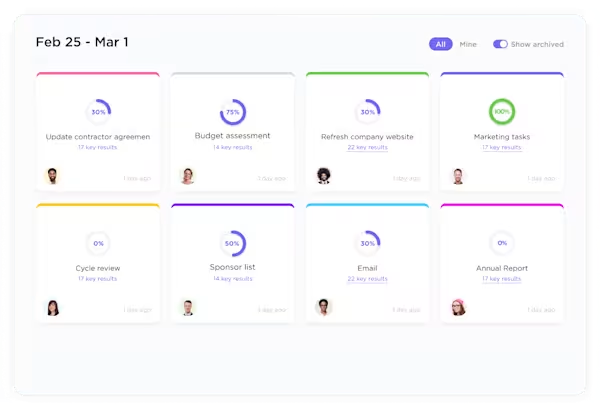
ClickUp Goals can be a powerful tool to map out and achieve your career growth aspirations.
First, unpack your goals. For vertical growth, set targets around acquiring skills needed for the higher position. Use ClickUp’s ‘Task Targets’ to link tasks such as taking online courses or mentorship programs to your goal.
Similarly, for lateral growth, identify desired skills and set measurable targets. You can use ‘Number Targets’ to track completed certifications or ‘True/False Targets’ to confirm attending relevant workshops.
ClickUp also promotes effective goal-setting through clear organization and progress tracking. Create ‘Folders’ to categorize your development goals, such as ‘Management Skills’ or ‘Data Analysis’.
Additionally, within each folder, set deadlines and milestones using ClickUp’s ‘Targets’ and ‘Progress Roll-up’ features. This allows you to visualize progress across various goals and stay motivated on your path to career advancement.
The ideal career path is a unique blend that aligns with your goals, skills, and aspirations.
Here are some key factors to consider:
Here are some recommendations for choosing between vertical and lateral career growth:

ClickUp’s Project Management platform can be a powerful tool to manage your career exploration and development. Here’s how:
📮 ClickUp Insight: Only 11% of our survey respondents share their goals with others for accountability. That’s a missed opportunity. Think about it: sharing your vision invites fresh perspectives, helping you unlock clearer goals and spot hidden issues you might have missed. 🎯
ClickUp makes it dead simple to tap into this superpower. Just @mention a mentor for their wisdom, loop in a friend for that accountability boost, or leave detailed notes for your future self.
💫 Real Results: Users say they can handle ~10% more work with ClickUp.
ClickUp features to enhance your journey
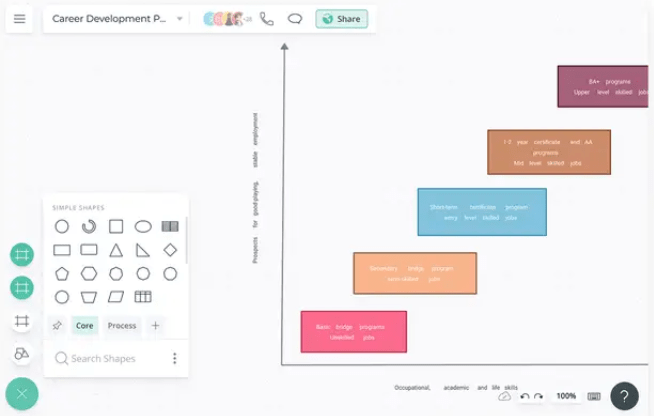
Finally, check out ClickUp’s Career Path Template! This handy tool helps you visualize your ideal career journey, identify key milestones, and track your progress toward achieving your dream career.
Create custom statuses for tasks, such as ‘Apply for position’ or ‘Attend informational interview’ for a lateral move. You can also use custom fields to categorize different career paths (vertical or lateral) and the essential skills for each. This lets you see the steps involved in achieving your desired move.
ClickUp lets you open different views of the same template. The ‘Start Here’ view outlines your current role and responsibilities. The ‘Whiteboard’ view helps you specifically measure progress toward your desired career move (vertical or lateral). This visual separation helps you brainstorm and plan the specific actions for your chosen path.
Overall, ClickUp’s Career Path Template provides a framework to:
You can adapt the template to fit your needs, whether planning for a promotion or switching to a different department.
Both vertical and lateral career moves offer advantages. However, there’s no one-size-fits-all approach. The best path for you depends on how you envision your journey.
A lateral career move may be the easiest and most effective option to transition into a different niche. If you’re satisfied with your current career path, focusing on vertical opportunities keeps you moving forward.
Whether you choose a vertical, lateral, or hybrid approach, the most important thing is to find a dream job to stay fulfilled and happy in your career. The key is staying true to your objectives, being open to new opportunities, and growing at every step.
While career planning is exciting, it can also feel overwhelming. Having a growth partner such as ClickUp can help you stay organized, seamlessly track your goals, manage your learning, and focus on achieving your ambitions can make all the difference.
Sign up for ClickUp today and embark on your dream career journey.
Lateral growth involves moving across different roles or industries, while vertical growth focuses on climbing the hierarchical ladder within a specific field or organization.
Vertical career development pertains to ascending hierarchically within a field, while horizontal development involves diversifying skills and experiences across different roles or industries.
An example of lateral growth could be a marketing professional transitioning to a role in business development within the same company.

Manasi Nair
Max 20min read

Praburam Srinivasan
Max 14min read
Manasi Nair
Max 32min read

© 2026 ClickUp