


Sorry, there were no results found for “”
Sorry, there were no results found for “”
Sorry, there were no results found for “”
Neural search is quickly replacing outdated, keyword-based systems that fail to keep up with the way modern teams work. As data scales and questions get more complex, teams need search that understands intent and not just words.
So what exactly is neural search, and why is it changing how enterprise teams find information?
Drowning in documents or struggling to surface the right info across tools? Here’s how neural search is changing the game for enterprise teams:
Try proper search tools to bring intelligent search into your workspace and work faster without the digging.
Neural search is an AI-driven approach to retrieving information that understands what you’re asking, even if you don’t phrase it perfectly. Instead of matching exact keywords, it interprets meaning and returns results based on context.
It uses artificial neural networks and vector search to process search queries the way humans process language:
This means you or your team no longer have to guess the “right” keyword to find a document. Neural search adapts to how you actually speak and think—making it far more effective in complex, unstructured environments.
Traditional keyword search works by looking for exact term matches. It’s fast but literal. Neural search, on the other hand, understands what the user is trying to say—even when the words don’t match exactly.
Here’s how the two compare:
| Feature | Keyword-based search | Neural search |
| Query matching | Exact keyword matching | Understands the intent and semantic meaning |
| Handling of synonyms | Limited, often requires manual configuration | Automatically recognizes synonyms and related terms |
| Language understanding | Literal and syntax-dependent | Context-aware and language-adaptive |
| Response to vague queries | Low accuracy unless keywords are clear | Delivers relevant results even with unclear phrasing |
| Search adaptability | Static rules, hard-coded relevance | Learns from user interactions and improves over time |
| Support for unstructured data | Limited and inconsistent | Optimized for unstructured data like docs, notes, messages |
| Technology base | String-matching algorithms | Deep learning and vector-based models |
| User experience | Often frustrating and incomplete | Intuitive, more aligned with how humans think and search |
If your team still relies on keyword-based search, you’ve likely run into limitations. Neural search solves those pain points by going beyond the literal.
Neural search doesn’t just guess better—it learns better. Behind the scenes are deep learning models trained on massive amounts of human language. These models detect patterns, relationships, and context in ways that keyword-based systems can’t replicate.
Here’s how they elevate search systems:
For enterprise teams working across thousands of documents, this means faster discovery, better alignment with user intent, and fewer dead ends.
Even if two users ask the same question in entirely different ways, a neural search engine trained in deep learning can still deliver relevant results.
📌 Key Fact: Unlike keyword search, neural search can find relevant results even when no original search terms appear in the document, thanks to vector-based similarity.
Neural search may feel like magic to users, but under the hood, it’s a well-engineered process powered by layers of AI models, vector embeddings, and index structures.
Here’s a simplified breakdown of how a neural search engine processes a query:
This entire process happens in milliseconds.
Several advanced technologies come together to make neural search possible:
Neural search systems also support hybrid models, combining traditional keyword search with semantic search. This is ideal when precision and recall are equally important.
Whether you’re searching across thousands of customer tickets, internal knowledge bases, or cloud documents, neural search dramatically improves the quality, speed, and relevance of the results.
📖 Also Read: Best AI Search Engines You Need to Try
When your team can’t find the right document, dashboard, or insight, work slows down. Neural search eliminates that bottleneck by making information instantly accessible, even across large, unstructured systems.
Here’s what that unlocks at scale:
It also improves cross-platform search experiences. With systems integrated via APIs or data connectors, neural search acts as a unified layer—returning relevant results from cloud drives, CRMs, knowledge bases, and more.
If your organization deals with high search volume or sprawling data sources, the upgrade is significant for:
Neural search optimizes information retrieval and improves how your entire organization works with information.
Neural search isn’t a niche feature—it’s reshaping how entire industries retrieve, manage, and apply information. When implemented across systems with large, unstructured datasets, it removes the friction that legacy search engines introduce.
Here’s how it works in real-world, enterprise-grade environments:
Product discovery is only as good as the system behind it. When search engines rely on keywords, customers often miss what they’re looking for—even when it’s in the catalog.
Neural search engines resolve this by:
This reduces time-to-product and increases conversions. It also scales globally—handling multilingual queries and adapting to changing inventory without manual rule updates.
For teams managing product catalogs across multiple markets or platforms, neural search eliminates the need for constant manual tuning.
In enterprise environments, critical documentation lives everywhere: project folders, tickets, internal wikis, PDFs, and archived inboxes. And most of it is unstructured.
With neural search:
For IT leaders, this means lower dependence on tribal knowledge and fewer internal support tickets asking “where do I find…?”
The result is a living, searchable organizational brain that evolves as your documentation grows.
Enterprise-grade virtual assistants often fail when faced with natural, conversational input. Neural search changes that by transforming how bots interpret and retrieve data.
Here’s how:
Instead of relying on fixed paths, neural-powered bots adapt in real time. For example, a user asking, “Can I update access after contract signing?” would be routed to the correct policy doc—even if that phrase doesn’t exist anywhere.
This makes self-service more effective and reduces pressure on support teams.
Search in healthcare isn’t optional, rather, it’s mission-critical. Doctors, researchers, and analysts rely on fast, accurate information retrieval across clinical notes, academic studies, and patient records.
Neural search supports this by:
This improves diagnostic accuracy, accelerates treatment planning, and saves hours in literature reviews. In research settings, it boosts discovery by enabling semantic exploration of prior work and datasets.
📖 Read More: How to Build and Optimize Your AI Knowledge Base
Shifting from keyword-based to neural search is a strategic shift in how your organization retrieves, connects, and activates information.
Whether you’re evaluating platforms, embedding AI into existing systems, or scaling enterprise-wide, it’s essential to understand the tools, integrations, and trade-offs involved.
Let’s break it down:
Several leading platforms now offer built-in support for neural search—each optimized for different enterprise needs:
These platforms offer building blocks like vector search, indexing, semantic matching, and hybrid query handling but they often require dedicated infra setup and ongoing ML ops support.
ClickUp redefines what neural search looks like in the workplace. Instead of functioning as a backend tool, it embeds intelligent search directly into workflows. Powered by AI, it connects across platforms and helps teams move faster with less friction.
Here’s how ClickUp makes this possible:
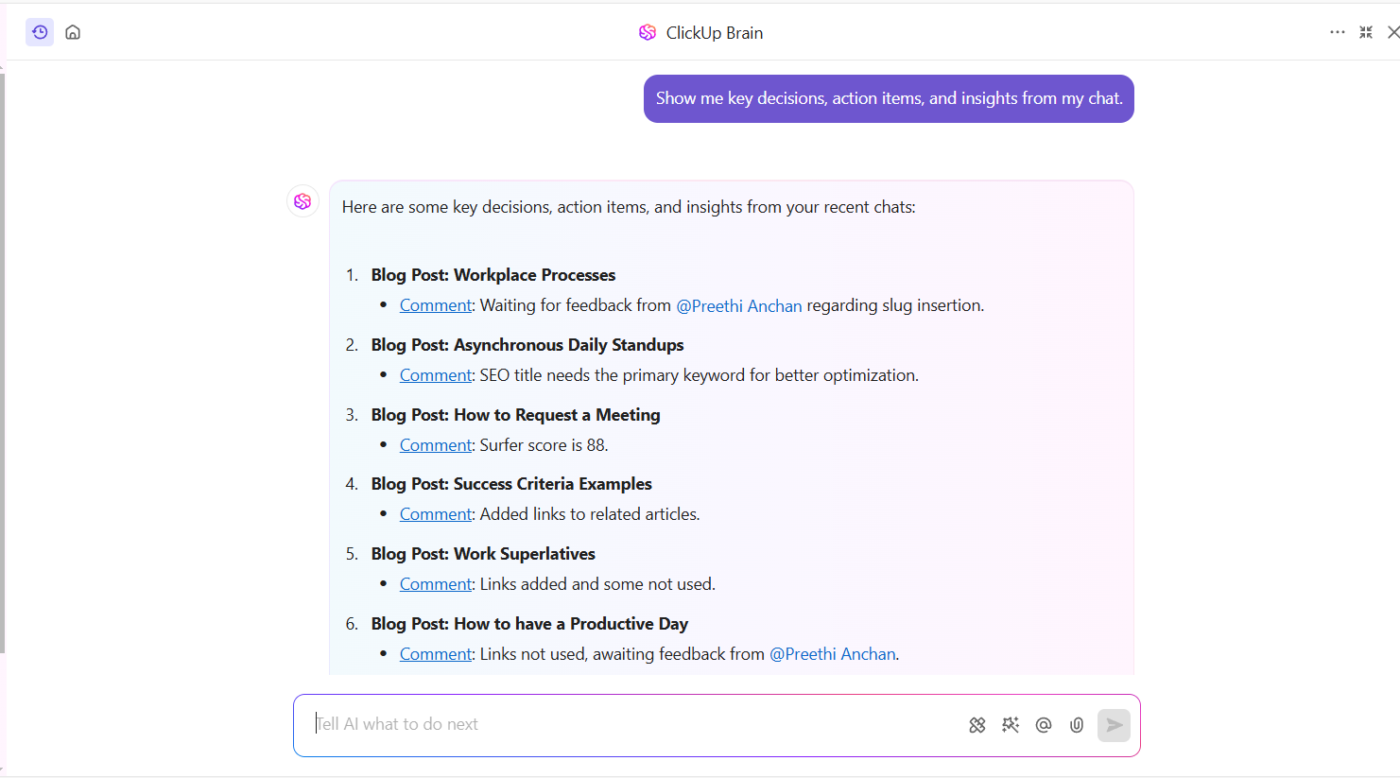
ClickUp Brain uses advanced neural search techniques to understand natural language input and return precise, context-aware results without relying on exact keywords.
Whether someone types “quarterly planning timeline” or “update onboarding docs,” ClickUp Brain interprets the intent and surfaces the most relevant content across tasks, docs, and conversations.
It learns continuously from user interactions, meaning results get smarter over time and adapt to how your team communicates.
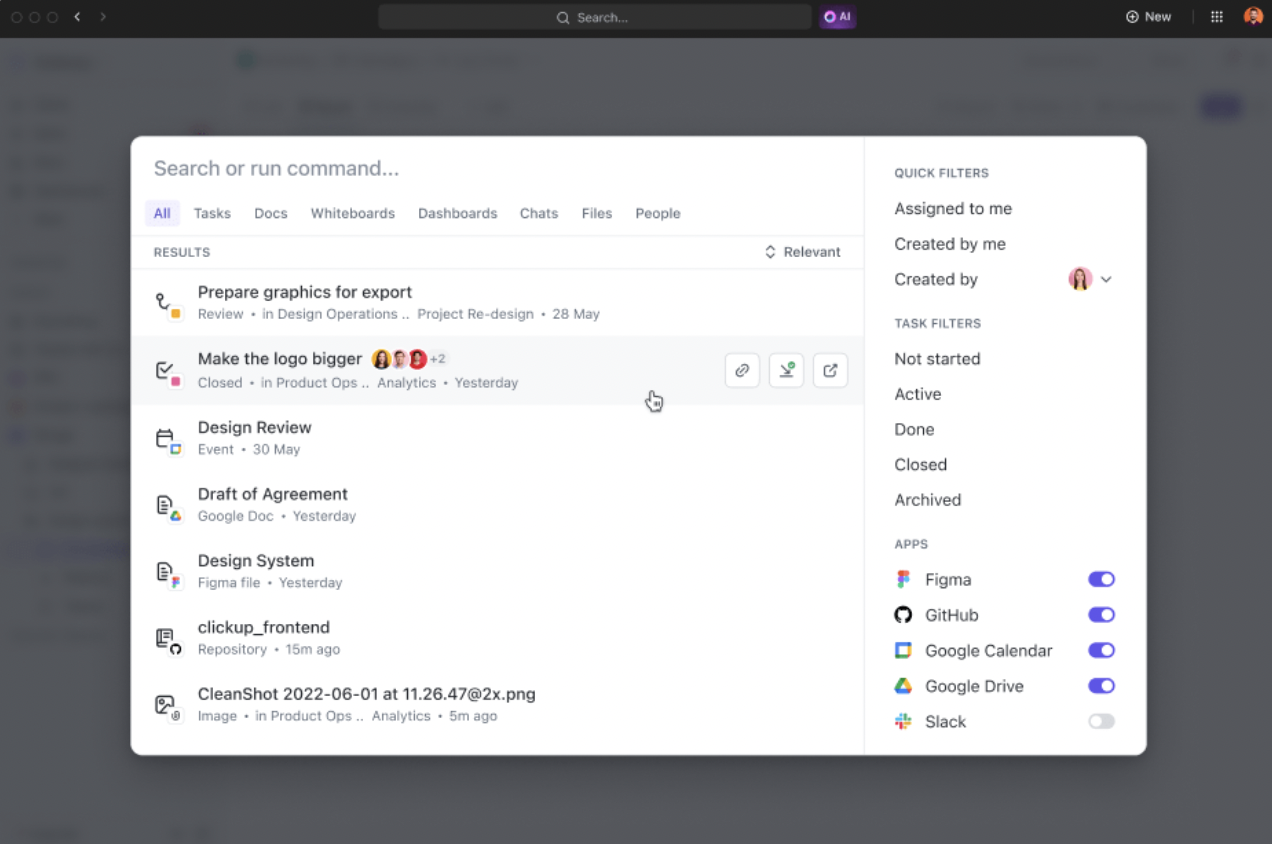
With ClickUp Connected Search, you can search across multiple platforms like Google Drive and Dropbox from a single, unified interface. Under the hood, neural search models analyze semantic meaning to deliver the right file, note, or ticket, even if the phrasing differs from what’s stored.
This makes Connected Search a true productivity multiplier:
It’s ClickUp’s innovative step in making neural search not just powerful—but accessible to every team.
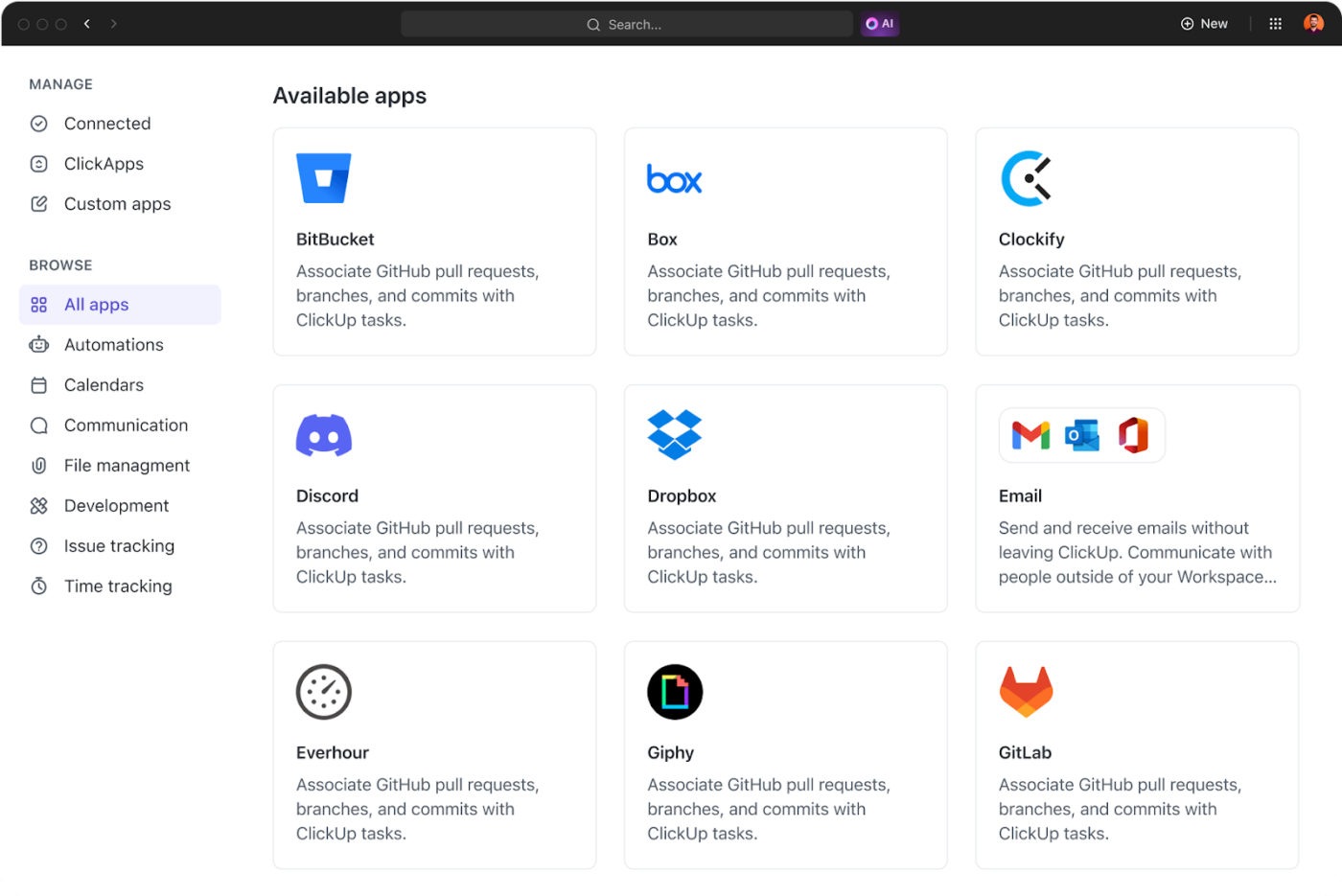
Enterprise environments are powered by dozens of platforms, and neural search only works when it has access to the full picture. ClickUp Integrations make this possible by syncing content from CRMs, project tools, cloud drives, and support systems directly into the ClickUp workspace.
This enables:
With neural search layered on top, teams can retrieve content from across the organization in milliseconds, no manual syncing required.
📮ClickUp Insight: 92% of knowledge workers risk losing important decisions scattered across chat, email, and spreadsheets. Without a unified system for capturing and tracking decisions, critical business insights get lost in the digital noise.
With ClickUp’s Task Management capabilities, you never have to worry about this. Create tasks from chat, task comments, docs, and emails with a single click!
Search should never be the end of the workflow. ClickUp Automations connect neural search results with immediate, intelligent action.
For example:
It’s how teams go from “I found it” to “It’s already handled”, without extra steps. ClickUp doesn’t just make information easier to find, it makes it easier to use, act on, and learn from.
📖 Read More: Top AI Workflow Automation Tools
You don’t need to overhaul your infrastructure to adopt neural search. Most teams layer it onto existing systems with minimal disruption. The key is knowing where to insert intelligence—and how to support it behind the scenes.
Here’s a practical path forward:
Neural search works best when it fits into your existing architecture and not when it tries to replace it.
Neural search unlocks smarter, faster access to information—but adoption isn’t just about plugging in a new model. It introduces new technical, operational, and organizational considerations that require thoughtful planning.
Here’s what enterprise teams need to weigh:
Neural models are only as good as the data behind them. If your data is inconsistent, fragmented, or locked behind permissions, semantic accuracy will suffer.
Without data alignment, even the best model will return noise.
Choosing the wrong model or over-engineering one can derail adoption.
This isn’t a one-time configuration; it’s a living system that needs tuning.
As usage grows, so do compute, storage, and latency demands.
Teams need to balance performance with cost when scaling across departments or geographies.
Neural search introduces a level of abstraction that not all users (or stakeholders) are ready for.
Setting the right expectations upfront is key, especially in high-stakes or regulated environments.
Neural search isn’t a drop-in fix. But for teams willing to invest in the foundation, the payoff is massive: smarter systems, faster discovery, and better alignment between people and the data they rely on.
Neural search is no longer an innovation layer; it’s becoming a core infrastructure for enterprise intelligence. What’s coming next isn’t about features; it’s about strategic leverage.
Here’s what enterprise IT leaders should be watching and building for:
The future isn’t about searching for better. It’s about building systems where searching becomes invisible because the right information is always within reach.
📚 Fun Read: How to Use AI for Daily Life Tasks?
Neural search transforms how teams work, make decisions, and collaborate. It facilitates vector search that understands relationships between data points. It goes far beyond traditional search methods, which are based on keyword matching.
As data grows and workflows get more complex, the ability to surface the right information in context becomes a serious competitive edge. The smartest teams won’t just search better. They’ll stop searching altogether.
ClickUp optimizes neural search by embedding AI-powered retrieval directly into workflows, allowing teams to quickly access relevant information across platforms without disruptions. Its seamless integration with enterprise tools further enhances productivity, ensuring that critical insights are easily transformed into actionable tasks.
Try ClickUp today and see what intelligent search can really do.

Sean Hardy
Max 26min read

Manasi Nair
Max 19min read
Manasi Nair
Max 19min read

© 2026 ClickUp




