


Since discovering ChatGPT, the interest in AI has soared.
From its near-human writing abilities to automating tasks and creating images from prompts, AI’s progress is astonishing.
In this regard, neural network software tools are advancing AI that can self-learn, inspired by the intricate design of the human brain. These AI tools are used for various tasks, including pattern recognition, data analysis, and prediction.
Drawing from extensive testing and insights from the ClickUp team’s research, we have curated a comprehensive list of the leading neural network software tools available in 2024.
Whether you’re new to AI or looking to enhance your neural network capabilities, these tools offer powerful solutions for improving efficiency and innovation.
11 Best Neural Network Software for 2024
- What Should You Look for in Neural Network Software?
- The 11 Best Neural Network Software to Use in 2024
- 1. ClickUp (Best as an all-in-one productivity tool)
- 2. Keras (Best for fast and advanced prototyping)
- 3. Caffe (Best for computer vision and image classification)
- 4. Chainer (Best for dynamic computational graphs)
- 5. Knet (Best for dynamic learning and pre-trained models)
- 6. Microsoft Cognitive Toolkit (Best tool for creating machine learning prediction models)
- 7. Synaptic.js (Best for building neural networks in-browser for web applications)
- 8. Torch (Best tool for researchers and developers in the academic and research community)
- 9. Nvidia DIGITS (Best Visual Playground for Deep Learning with GPUs)
- 10. Neural Designer (Best for GUI-based development)
- 11. Darknet by Joseph Redmon (Best for deep computation and image classification)

 Summarize this article for me please
What Should You Look for in Neural Network Software?
Choosing the right tools is essential when maximizing the full potential of neural network software.
Here’s what to consider when selecting the best software for your needs:
- Usability: Since not everyone is a tech expert or has taken AI courses, it’s best to choose software with an easy-to-use interface and clear documentation to guide you through every step
- Scalability: Even with thorough planning, we often grasp the complexity and workload of a project only as we advance. Therefore, consider neural network models that provide scalable plans and efficiently manage heavy workloads, possibly through GPU acceleration or cloud-based deployments
- Community support: Since most neural network software and machine learning tools are open-source, they benefit from robust communities and reliable support systems. Ensure your chosen neural network model offers user-friendly tutorials, walkthroughs, and forums to help address your specific questions effectively
- Productivity: Consider software that offers productivity-enhancing features such as automated model optimization, integrated development environments (IDEs), and tools for visualization and monitoring training processes. These features can significantly enhance AI in the workspace, helping you iterate faster and achieve better results
Summarize this article for me pleaseThe 11 Best Neural Network Software to Use in 2024
With the right neural network software, you can easily streamline tasks, uncover insights, and propel your AI initiatives to new heights.
Here’s our curated list of the best neural network software tools worth exploring in 2024:
1. ClickUp (Best as an all-in-one productivity tool)

In early 2024, ClickUp introduced ClickUp Brain, the world’s first neural network that integrates tasks, documents, wikis, people, and organizational knowledge with AI. Powered by machine learning algorithms, ClickUp Brain analyzes tasks, projects, and workflows, simplifying complex data management.

Use ClickUp Automations to streamline workflows and automate projects to save time on routine and administrative tasks.
With over 100+ automation templates available, tasks can be assigned, monitored, and progressed through pipelines using trigger-based actions. Moreover, the AI automation builder suggests automations tailored to your workflows, enhancing efficiency in automation workflows.
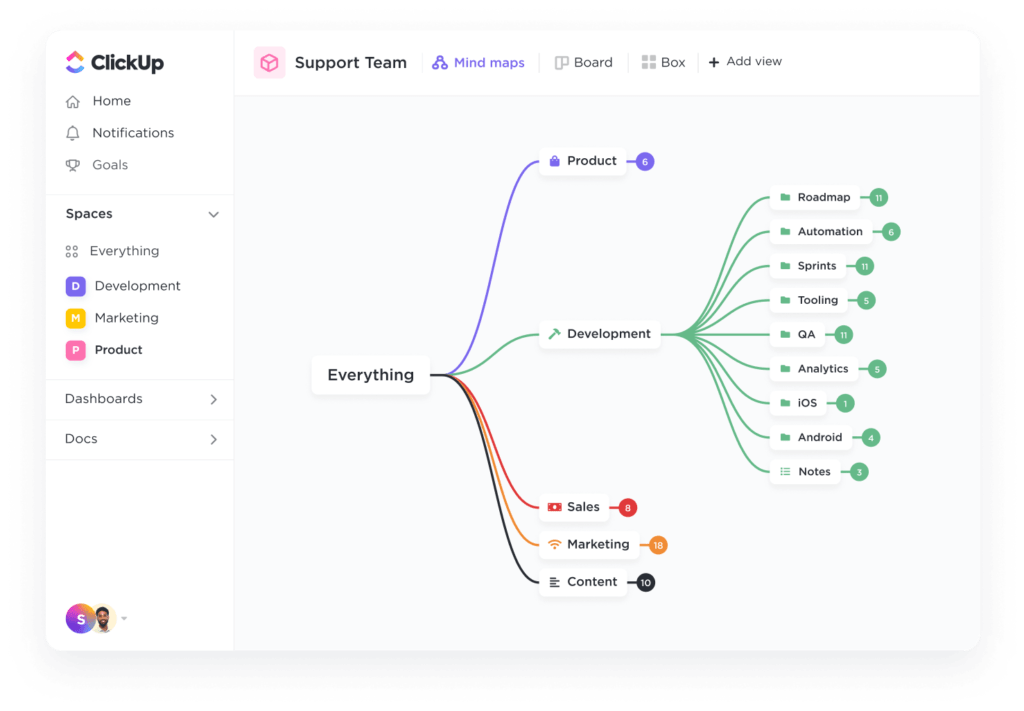
Building artificial neural networks isn’t something you do alone; it requires coordination across different team members and departments.
To make this easier, use ClickUp Mind Maps to brainstorm and share detailed plans. This tool lets you map out workflows, share plans, and clarify how tasks are connected and dependent on each other.
What is most beneficial about MindMaps is its intuitive interface for effortlessly adding, deleting, or editing visual structures. This visual organization helps understand project expectations and execute ideas effectively.

In addition to managing workflows and collaboration, quickly analyze and get a complete overview of all tasks using ClickUp Views.
With over 15 customizable views, visualize research findings, raw data, and other information in Gantt charts, tables, timelines, lists, and boards.
The tool also supports simulating learning experiences through supervised and unsupervised machine learning models. Direct the machine’s learning process in supervised learning, whereas in unsupervised learning, the machine learns independently from multiple data instances.
ClickUp best features
- Automate projects, tasks, and standups with accurate AI updates and status reports from your task, docs, and other reports
- Write with the power of AI using the AI writing assistant, that can help you summarize information, write prompt-based content, spell-check docs and tasks, and even suggest AI-based replies to messages with context and tone
- Use ClickUp Integrations to sync information and integrate ClickUp’s AI features with 1000+ tools for a unified workflow
- Use 100+ pre-built prompts and AI prompt templates to start training deep learning models faster
ClickUp limitations
- The mobile app offers fewer features than its desktop counterpart
- ClickUp Brain links tasks, documents, and data. Bringing all needed information for neural network training into the tool might add to your workload
ClickUp pricing
- Free Forever
- Unlimited: $7/month per user
- Business: $12/month per user
- Enterprise: Contact for pricing
- ClickUp Brain: Add to any paid plan for $7 per Workspace member per month
ClickUp ratings and reviews
- G2: 4.7/5 (2,000+ reviews)
- Capterra: 4.7/5 (2,000+ reviews)
2. Keras (Best for fast and advanced prototyping)

Keras would be an excellent choice if you’re seeking neural network software for rapid prototyping. It’s a high-level API designed for ease of use and quick experimentation.
Built on TensorFlow or Theano, Keras offers a simple interface that utilizes computational power without requiring intricate low-level coding. Plus, this dependence on popular frameworks ensures a vast and active community to help you with any assistance.
It offers a user-friendly, efficient interface for solving AI machine learning (ML) problems, particularly in modern deep learning. Keras guides you through every stage of the machine learning workflow, from data processing and hyperparameter tuning to deployment.
Keras best features
- Use the simple and intuitive user interface to build and train neural networks with minimal coding effort
- Maximize productivity using pre-built models for various tasks and training needs, significantly accelerating your development process
- Leverage the power of high-scale workflow and cognitive load engine to help free up developers and get optimal scalability
Keras limitations
- Error messages may originate from TensorFlow operations, requiring familiarity with both frameworks. This can be difficult for non-technical users
- It lacks advanced research-focused features such as dynamic charts or customizable visualizations, which can be challenging for researchers
Keras pricing
- Free and open-source
Keras ratings and reviews
- G2: 4.6/5 (60+ reviews)
- Capterra: 4.6/5 (30+ reviews)
3. Caffe (Best for computer vision and image classification)

Caffe is renowned for its speed, scalability, and efficient management of large datasets. Initially designed for image recognition, it now supports diverse neural network architectures and applications.
Caffe offers exceptional scalability and production-ready features. It is known for its optimized performance, particularly when leveraging GPU acceleration and distributed computing environments. This makes it a strong choice for handling massive datasets and complex neural network architectures that require significant computational power.
Caffe is a powerful neural network model worth considering if you’re involved in large-scale projects or aiming to deploy neural networks in real-world applications.
Caffe best features
- Gain the power of an optimized GPU accelerator and distributed computing, making it ideal for large-scale projects
- Use modular and expressive architecture for the customization of network structures and components, which are defined by configuration without any hard coding
- Accelerate your neural network training and experimentation as the tool can process over 60M images per day with a single GPU, making it among the fastest in the market
- Support from a large community to help you with resources and provide active support during troubleshooting
Caffe limitations
- Its steeper learning curve, requiring familiarity with programming languages like C++, might deter complete beginners, data scientists, and non-technical teams
- The tool is not optimized for mobile devices, which makes it challenging to deploy models on mobile devices or debug errors
Caffe pricing
- Free and open-source
Caffe ratings and reviews
- G2: 4/5 (16 reviews)
- Capterra: (Not enough reviews)
4. Chainer (Best for dynamic computational graphs)

Chainer is a versatile Python-based deep-learning framework that dynamically generates computational graphs. This allows for building and modifying neural network architectures during training, making it well-suited for research and experimentation.
This tool offers familiarity with the Python deep learning framework, which is well-known to most data scientists and analysts. It also provides a unique approach focusing on dynamic computational graphs, allowing for high flexibility during the neural network training process.
Chainer best features
- Modify neural network architectures during training with dynamic computational graphs, perfect for flexible control
- Streamline gradient calculations and optimizations using automatic differentiation for improved performance
- Access a rich library of functions and modules designed for easy building and manipulation of neural networks
Chainer limitations
- While it has a growing community, it is not as mature as some competitors. This means there may be slightly fewer readily available resources compared to more established frameworks
Chainer pricing
- Free and open-source
Chainer ratings and reviews
- G2: (Not enough reviews)
- Capterra: NA
5. Knet (Best for dynamic learning and pre-trained models)

Knet is a deep-learning framework implemented in Julia. It is known for its high-level interface and GPU-accelerated training capabilities. Knet is an excellent option for data analysts and scientists, as it allows them to leverage Julia’s programming simplicity for robust deep-learning projects.
This tool lets you experiment with different neural network architectures and ensures efficient training on high-power GPUs. This speeds up model development, making research and analysis more efficient and innovative.
Knet best features
- Leverage GPU Acceleration for faster training and processing, making it suitable for computationally intensive deep-learning tasks
- Simplify the process of calculating gradients using automatic differentiation, which is essential for training your neural network
- Use dynamic computational graphs for flexible training, letting you modify your neural network architecture on the go
- Make full use of extensive programming knowledge in Julia and use deep neural networks for efficient numerical computations and clear syntax
Knet limitations
- The tool’s reliance on Julia might be challenging for newcomers, as it requires familiarity with the language for practical use in deep learning tasks
Knet pricing
- Free and open-source
Knet ratings and reviews
- G2: 4.3/5 (12 reviews)
- Capterra: NA
6. Microsoft Cognitive Toolkit (Best tool for creating machine learning prediction models)

Microsoft Cognitive Toolkit, or CNTK, is an artificial neural network software developed by Microsoft Research. Although no longer actively developed, CNTK remains valuable to some users due to its unique features and historical significance in deep learning.
This tool’s scalability and performance support efficient training across multiple GPUs and servers, making it ideal for creating complex machine-learning prediction models.
Microsoft Cognitive Toolkit best features
- Leverage CNTK’s wise range of neural network architecture to effectively handle feed-forward neural networks (DNNs), convolutional neural networks (CNNs), and recurrent neural networks (RNNs)
- Get higher scalability for larger datasets, making it suitable for projects dealing with significant amounts of training data
- Speed up your process with GPU acceleration, offering faster training and improved processing efficiency
Microsoft Cognitive Toolkit limitations
- Due to its deprecation, the CNTK community is less active, making troubleshooting and finding resources more challenging
- CNTK is no longer under active development so users might encounter limited bug fixes and security updates compared to actively maintained frameworks
Microsoft Cognitive Toolkit pricing
- Free and open-source
Microsoft Cognitive Toolkit ratings and reviews
- G2: 4.2/5 (20+ reviews)
- Capterra: NA
7. Synaptic.js (Best for building neural networks in-browser for web applications)

Synaptic.js is a neural network library for Node.js, designed explicitly for developing machine learning models in the JavaScript environment.
This tool allows users to create interactive machine-learning applications that run directly in their web browsers. Its generalized algorithm is architecture-free, enabling you to build and train a wide range of neural network architectures, including first- and second-order structures.
It allows for deploying powerful machine-learning models without needing server-side processing.
Synaptic.js best features
- Use its easy API for beginners to focus on neural network basics without complex coding
- Build ML apps in web browsers without complex server setups, leveraging neural networks directly
- Get support from a strong community offering tutorials and support for web development with neural networks
Synaptic.js limitations
- It is optimized for web browsers, which limits its computational power compared to server-side or desktop-based frameworks
- It is not suitable for highly complex neural networks or massive datasets, as it is built for basic natural language processing
Synaptic.js pricing
- Free and open-source
Synaptic.js ratings and reviews
- G2: 4.5/5 (19 reviews)
- Capterra: NA
8. Torch (Best tool for researchers and developers in the academic and research community)

Torch is a powerful deep-learning framework written in Lua. It particularly resonates with those looking for an option focusing on research applications.
The tool supports various programming paradigms, such as procedural, object-oriented, functional, and data-driven programming, catering to diverse research needs. Overall, the tool provides extensive control over neural network architecture and training algorithms, which empowers researchers to innovate and explore complex deep learning models.
Torch best features
- Gain control over neural network architecture and training algorithms using the highly customizable Lua framework
- Leverage it for production deployment with multiple production use cases and additional libraries
- Tap into a large community for support and collaboration, enhancing knowledge sharing in deep-learning research
Torch limitations
- Torch primarily uses Lua, less widely known than popular languages like Python. This can be a hurdle for newcomers starting from scratch without prior Lua knowledge
Torch pricing
- Free and open-source
Torch ratings and reviews
- G2: 4.4/5 (15 reviews)
- Capterra: 4.2/5 (18 reviews)
9. Nvidia DIGITS (Best Visual Playground for Deep Learning with GPUs)

The NVIDIA Deep Learning GPU Training System (DIGITS) simplifies key deep learning tasks like data management, multi-GPU network design, real-time performance monitoring via visualizations, and model selection for deployment from the results browser.
DIGITS is highly interactive, which enables data scientists to prioritize network design and training over the complexities of programming and debugging.
Its capability to build and train neural networks without extensive coding will impress you. This makes it great for speeding up research and development in deep learning, welcoming newcomers, and helping experienced users refine complex models faster.
Nvidia DIGITS best features
- Create interactive visualizations with the interactive interface for monitoring training progress and network behavior
- Download pre-trained models such as GoogLeNet, AlexNet, UNET, and LeNet from the DIGITS Model Store
- Automate the scaling of training jobs across multiple GPUs
Nvidia DIGITS limitations
- It is optimized for NVIDIA GPUs, which may limit compatibility with other hardware configurations
- The visual interface simplifies development, but it might not offer the same level of customization as code-based frameworks for advanced users
Nvidia DIGITS pricing
- Free and open-source
Nvidia DIGITS ratings and reviews
- G2: 4.5/5 (23 reviews)
- Capterra: 4.4/5 (22 reviews)
10. Neural Designer (Best for GUI-based development)

Neural Designer is a user-friendly app with an interface tailored for building and training neural networks. It’s perfect for teams new to deep learning, as it offers an easy way to start without coding or building block diagrams.
With drag-and-drop features and ready-made components, the app makes learning and experimenting faster and simpler.
Neural Designer best features
- Simplify neural network creation using a drag-and-drop interface that requires no coding experience
- Accelerate workflows with its automated hyperparameter tuning feature, ideal for beginners tackling neural network optimization without extensive experience
Neural Designer limitations
- It is significantly more expensive compared to open-source alternatives with similar features
- It offers limited flexibility and customization compared to code-based frameworks
Neural Designer pricing
- Small annual subscription: $209 per month (billed annually)
- Small lifetime license: $520 per month (billed annually)
- Medium annual subscription: $10416 per month (billed annually)
- Medium lifetime subscription: $41 per month (billed annually)
- Large annual license: $624 per month (billed annually)
- Large lifetime subscription: $1562 per month (billed annually)
Neural Designer ratings and reviews
- G2: (Not enough reviews)
- Capterra: (Not Enough Reviews)
11. Darknet by Joseph Redmon (Best for deep computation and image classification)

Darknet is an open-source deep-learning framework written in C and CUDA created by Joseph Redmon. Its focus on speed and real-time applications is impressive. Due to its efficient architecture and command-line interface, it’s prevalent in computer vision tasks like object detection.
If you’re working on projects requiring real-time processing, such as object detection in video streams, Darknet is worth considering.
Darknet best features
- Use its powerful command-line interface that caters to experienced developers comfortable working in this environment
- Get high-speed performance optimized for real-time processing, making it suitable for resource-constrained environments
- Leverage the library of pre-trained models for deep-learning models, especially computer vision tasks
- Deploy neural networks in real-time scenarios using its powerful convolutional neural networks
Darknet limitations
- Darknet has a steeper learning curve than beginner-friendly frameworks because it relies on the command line and C code
Darknet pricing
- Free and open-source
Darknet ratings and reviews
- G2: (Not enough reviews)
- Capterra: NA
Summarize this article for me pleaseMaster the Art of Training Machine Learning Algorithms with ClickUp
The right neural network software can be a game-changer for advancing your AI projects and maximizing productivity. Selecting tools with robust features, user-friendly interfaces, and seamless integrations is essential for optimizing neural network training and achieving superior results.
ClickUp stands out among these tools. It offers hundreds of templates and a comprehensive suite of features, including ClickUp Brain, ClickUp Automations, and ClickUp Mind Maps, to efficiently manage complex AI projects. Its customizable views, integrations, and AI-driven capabilities ensure your team stays productive and innovative.
With ClickUp, you gain more than just a framework for training your ML models. You get a pre-defined neural model that understands prompts, connects data, tasks, and people, and simplifies your workflow. Sign up on ClickUp to revolutionize your AI project management today!


Everything you need to stay organized and get work done.

Recent Articles
7 Best Zoom Alternatives in 2026: Free Plans and Meeting Limits 
7 Best Zoom Alternatives in 2026: Free Plans and Meeting Limits
How to Create a Fillable Form in Microsoft Word (With Templates)
How to Create a Fillable Form in Microsoft Word (With Templates)
