


Sorry, there were no results found for “”
Sorry, there were no results found for “”
Sorry, there were no results found for “”
Tired of stock sitting idle for months while you chase items customers requested weeks ago? Inventory could easily be both a lifesaver and a headache, depending on how well you manage it.
The fix? A well-integrated ERP inventory management system that replenishes stock based on the latest production orders. The right solution relieves your team’s burden while driving stock optimization and inventory health.
No worries, we’ve got you. To save you time, effort, and maybe even inventory, here are the top 10 ERP inventory management software with key features, limitations, and user ratings.
Adopting the right solution is vital to avoid stockouts or excess pile-ups when handling multiple active components. Here are the top 10 ERP inventory management software solutions for you to adopt:
Enterprise resource planning (ERP) systems are modules that help your business manage production, logistics, sales, and finance information. They help you visualize what you need, why, and how to fund it.
Adopting an ERP inventory system helps use that data for better stock tracking and control. Plus, there are no manual records; everything is system-driven. Fundamentally, ERP systems aren’t an add-on; they’re essential power-ups.
Here are the key ways to integrate them into your inventory systems:
Still doubtful about how this is a level-up? Here’s how ERP-powered inventory solutions stand apart from traditional ones:
| Feature | ERP Inventory Management | Traditional Inventory Management |
|---|---|---|
| Data Accuracy | High, real-time updates | Prone to manual errors |
| Automation | Automates tracking & reordering | Manual processes, slower |
| Scalability | Easily handles multiple locations | Limited to specific locations |
| Integration | Connects with finance, sales, and suppliers | Standalone and focuses only on current stock levels Minimal integration |
| Visibility | End-to-end supply chain management insights | Fragmented, delayed |
🔎 Did You Know? The earliest known form of an inventory system was using clay tablets in ancient Mesopotamia—the records detailed the quantities of grains, animals, and other goods stored in warehouses!
The potential that ERP-powered solutions have has often made choosing the right solution even more crucial. Get it right and start strong by prioritizing these key aspects:
💡 Pro Tip: Upgrading an ERP system is one of the more expensive IT decisions, often costing around $500 million for enterprises. So, it’s best to list your must-have features before screening options.
With what you need ready, let’s move on to the best options in the market.

The first one is ClickUp, the everything app for work, which is especially suited for something as systematic and crucial as inventory management. It offers over 30 features to visualize and track your inventory.
Central to this capability is ClickUp’s Table View, an intelligent alternative to traditional stock tracking spreadsheets. This dynamic feature allows users to meticulously record product details, assign responsibilities, prioritize tasks, and monitor inventory status within a customizable interface.
Leveraging Custom Fields, businesses can incorporate specialized inventory metrics like stock age, expected monthly consumption, and reorder points, gaining deeper insights into their operations. Furthermore, Table View facilitates seamless task creation, enabling immediate follow-up on identified issues directly within the inventory space.
With its support for instant commenting, rich color coding, and multiple exporting options, ClickUp ensures systematic, traceable inventory optimization and efficient data sharing, transforming complex inventory management into a streamlined and collaborative process.
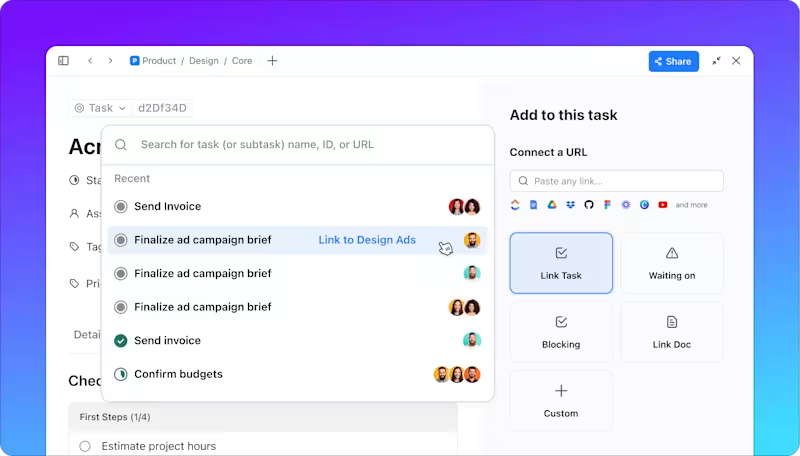
Businesses can also use ClickUp Integrations to connect their inventory management workspace with native and external HR solutions, finance management, and customer relationship management (CRM) systems.
There’s more! ClickUp Brain, ClickUp’s AI-powered assistant, makes the platform great for in-depth inventory data analysis as well as generating quick summaries and insights. Ask the AI assistant for instant updates on upcoming shortages, possible obsolescence, and changes in stocking policy documents.

ClickUp Brain can also help you create advanced automation for task assignments, purchase order creation, and routine report communication.
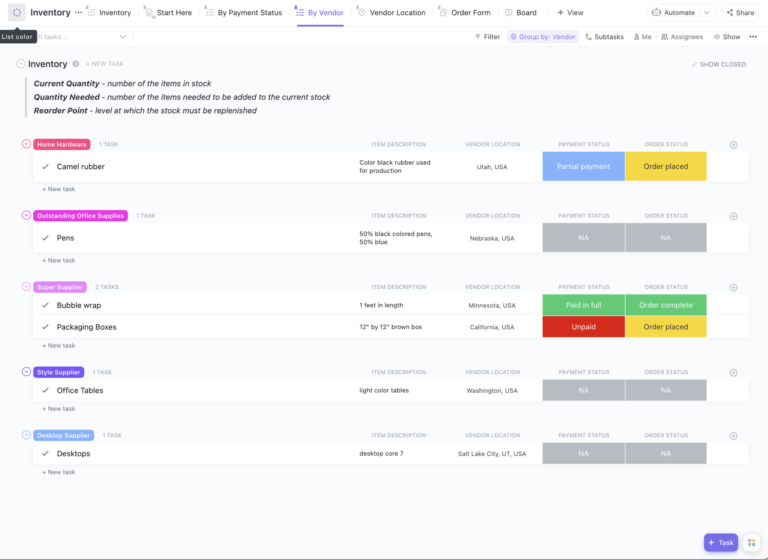
Need to save some of the setup time? ClickUp also features an extensive library of inventory templates to get your team started instantly. The ClickUp Inventory Management Template is the pre-designed solution you need for smooth order management.
It comes with:
The ClickUp Inventory Template is another simple option for tracking inventory, payments, and vendor locations. Its dedicated order form simplifies internal ordering and makes delivery logs more straightforward.
This online review accurately sums up what ClickUp does for inventory management:
Its versatility made it replace almost all tools we were using previously—company wiki, SCRUM boards, GTD boards for management, compliance documentations, marketing timelines, even company inventory tracking system—as it was just easier approaching it all in ClickUp.

The word ERP is synonymous with software giant SAP. One of its offerings is SAP Business One, an ERP inventory management solution tailored for small and medium-sized businesses. The software offers customizable pick-and-pack processes and automated data gathering, enhancing operational efficiency and decision-making.
Business One has integrated analytics for a crystal-clear view of stock levels. It also comes with automated alerts to prevent stockouts or overstocking. Plus, it seamlessly connects inventory management with production, finance, and sales, giving you a holistic picture.
What are real-life users saying about SAP Business One?
Excellent in end-to-end automation and critical in real-time reporting. Integrates with every SAP product, especially data from Concur transfers easily and smoothly.
➡️ Read More: Best Procurement Management Software & Tools

Looking for a more modern and easy-to-tweak solution? Odoo is a great place to start for efficient inventory management. This tool boasts extensive features, including detailed virtual putaway locations like cold storage or shelves. It also allows teams to add clear rules in lead times and freight mode selection for strong order management.
The system provides real-time tracking of inventory levels across multiple warehouses, supports advanced routing mechanisms, and integrates seamlessly with barcode scanners to streamline operations. Its user-friendly interface and customizable features allow companies to adapt the system to their specific needs, enhancing overall accuracy in inventory handling.
📮 ClickUp Insight: We recently discovered that about 33% of knowledge workers message 1 to 3 people daily to get the context they need. But what if you had all the information documented and readily available?
With ClickUp Brain’s AI Knowledge Manager by your side, context switching becomes a thing of the past. Ask the question from your workspace, and ClickUp Brain will pull up the information from your workspace and/or connected third-party apps!

Zoho Inventory is a cloud-based ERP inventory management system designed to help businesses efficiently manage their stock, orders, and sales across multiple channels. It offers comprehensive features, such as exhaustive multi-warehouse tracking of inventory levels, barcode scanning, and seamless invoicing.
Zoho Inventory even has serial and batch tracking to link production and warehouse effectively. The solution also simplifies operations with quick reporting options and automated communication workflows. These features enable businesses to optimize operations, reduce manual errors, and maintain optimal stock levels.
🧠 Fun Fact: ERP Inventory Management System is a 2.3 billion-dollar industry, and finding the correct software may be overwhelming.

Are your operations more production-oriented? Manufacturing teams often prefer solutions like Epicor ERP, a comprehensive enterprise resource planning solution designed to enhance inventory management for businesses across various industries. This powerful ERP system includes supply chain essentials like inventory forecasting, order management, and basic automation.
Its advanced inventory management module accurately tracks stock levels across multiple locations and warehouses. It supports various inventory methods, such as LIFO (last in, first out), FIFO (first in, first out), and average cost. Plus, it offers advanced reporting tools like the what-if analysis for in-depth and accurate insights.
What are real-life users saying about Epicor ERP?
The ease of being able to manage accounting and inventory in a one-stop shop. Has lots of powerful tools.

Oracle NetSuite stands out for its 100% cloud system approach with minimal upgrade costs. It offers customizable visualizations and charts, making its dashboards perfect for presentations. Its real-time visibility includes a 360° overview of user-selected KPIs, inventory count by location, and projected stock levels.
The system’s demand-based replenishment feature utilizes historical sales data and seasonal trends to dynamically manage reorder points, ensuring timely restocking and minimizing stockouts. Additionally, NetSuite’s multi-location fulfillment allows for predefined fulfillment rules, eliminating multiple shipments for a single order and avoiding excess shipping charges.
Microsoft Dynamics 365 is an ERP solution that packs all the familiarity and feel of popular Office products such as Excel and Outlook. The solution delivers real-time multi-location warehousing and a strong procurement process module.
It also integrates with the Microsoft toolset, including Power BI, Power Automate, Office 365, Teams, and more. Plus, Microsoft Dynamics 365 allows clients to use its advanced AI capabilities to build customized AI agents for routine tasks. The system’s integration with other business processes, such as sales and purchasing, streamlines operations and enhances decision-making.
What are real-life users saying about Microsoft Dynamics 365?
It has quite robust solutions for finance and supply chain and the dashboard tools can provide you real-time insights into inventory sales and demand forecasts. It is also easy to integrate with other MD tools such as 365 Sales and CS

Sage X3 is a comprehensive ERP solution designed to enhance inventory management for businesses in various industries. Tracking inventory levels in real time enables organizations to monitor stock across multiple sites and warehouses efficiently.
The system supports various inventory types, including manufactured, purchased, subcontracted, and non-stocked items, providing flexibility in managing diverse product lines. With user-definable product information and integration capabilities, Sage X3 ensures that all departments can access accurate and up-to-date inventory data, facilitating informed decision-making and streamlined operations.
➡️ Read More: Best Ecommerce Inventory Management Software

Do you prefer open-source flexibility in your inventory solutions? ERPNext delivers. Along with essentials like batch tracking and stock management, the software helps validate movement with quality inspections. Plus, transactions are seamless with preset warehouses and pricing method settings.
The system supports creating and maintaining product variants based on parameters, such as size, color, or material, allowing for detailed item management. It also comes with easy installation scripts for deploying your server and processes.
What are real-life users saying about ERPNext?
ERPNext Is easy to implement, support, and customize due to the fact that it uses only open source code, Python JS, etc.

SAP’s S/4HANA is for large organizations or those about to scale to that tune. Its next-gen ERP suite is designed for everything in real time with in-memory computing and AI-driven automation to optimize workflows. The system’s integration with other SAP modules, such as Sales, Distribution, and Production Planning, ensures seamless operations and data consistency throughout the supply chain.
S/4HANA also features embedded analytics and an intuitive Fiori interface to power through analytical decision-making. It also supports cloud, on-premise, and hybrid deployments, making it scalable for enterprises. In short, it’s a powerhouse for digital transformation.
📚 Also Read: Best Inventory Optimization Software to Use
📌 Special Mentions
ERP-integrated inventory management avoids blocking excess cash flow and removes the risk of sudden pile-ups. Plus, you have more scope to improve inventory accuracy, all without hampering production lines or customer sales.
The solutions in this guide are sure to suit your unique needs. However, it’s vital to prioritize productivity and analytics on top of inventory visibility.
ClickUp tops that with its versatile task management and automation, making it an ideal choice.
Is it time to keep green inventory as the norm? Sign up with ClickUp today!

Manasi Nair
Max 26min read
Manasi Nair
Max 20min read

Arya P Dinesh
Max 23min read

© 2026 ClickUp





