


Ever been stuck staring at a 30-page report at midnight, wondering why every line feels like it’s competing for ‘Most Wordy Sentence of the Year’?
Trust me, I’ve been there. That’s when I started exploring AI-powered summary generators.
My team at ClickUp and I’ve spent weeks testing these AI summary generators, throwing everything at them, from reports and blog posts to academic essays.
So here’s my honest, no-nonsense roundup of the 10 best AI summary generators that are worth your time.

 Summarize this article for me please
⏰ 60-Second Summary
Here’s my list of the 10 best AI summary generators available today.
- ClickUp (Best for AI-powered summarization and document management)
- Notta (Best meeting transcriber and online text summarizer)
- Hypotenuse AI (Best keyword-rich summary generator for marketing)
- Semrush AI Summarizer (Best free SEO-friendly AI summarizing tool)
- QuillBot (Best AI-powered paraphraser and writing tool for professionals)
- Anyword (Best AI-powered marketing copy generator)
- AI Summarizer (Best for concise text summarization)
- Jasper AI (Best summary generator for businesses)
- Any Summary (Best quick AI summary generator for any document)
- Wordtune (Best AI summaries generated for YouTube videos)
10 Best Summary Generators Powered by AI
- What Should You Look for in an AI Text Summarizer?
- The 10 Best AI Summary Generators Today
- 1. ClickUp (Best for AI-powered summarization and document management)
- 2. Notta (Best meeting transcriber and online text summarizer)
- 3. Hypotenuse AI (Best keyword-rich summary generator for marketing)
- 4. Semrush AI Summarizer (Best free SEO-friendly AI summarizing tool)
- 5. QuillBot (Best AI-powered paraphraser and writing tool for professionals)
- 6. Anyword (Best AI-powered marketing copy generator)
- 7. AI Summarizer (Best for concise text summarization)
- 8. Jasper AI (Best summary generator for businesses)
- 9. Any Summary (Best quick AI summary generator for any document)
- 10. Wordtune (Best AI summaries generated for YouTube videos)
Summarize this article for me pleaseWhat Should You Look for in an AI Text Summarizer?
The ideal summarizing tool should align with your workflow, handle complex content, and deliver accurate and insightful summaries.
Here are the key factors to consider:
- Accuracy and relevance: Ensure that the AI summary generator extracts key points without losing context or omitting critical details
- Customizability: Look for summarizing tool options to adjust summary length, tone, or focus based on your audience or purpose
- Ease of use: Prioritize a user-friendly interface and seamless integration with tools like Word or Slack
- Content versatility: Choose a summary generator that handles various formats to summarize articles, including PDFs, emails, and transcripts
- Speed and scalability: Ensure that the summary generator tool can quickly process large volumes of content, especially in fast-paced environments
- Data security: Opt for an AI summarize tool with strong privacy policies and encryption to protect sensitive information
- Cost vs. ROI: Assess whether the time saved justifies the cost, particularly for any enterprise-grade summarizing tool
💡 Pro Tip: Before committing to an AI summarizer, test its performance with diverse content types relevant to your needs. Many tools offer free trials. Use the opportunity to evaluate accuracy, speed, and customizability firsthand.
Summarize this article for me pleaseThe 10 Best AI Summary Generators Today
Now that you know what to look for in an AI text summarizer, let’s explore the 10 best options that meet these criteria:
1. ClickUp (Best for AI-powered summarization and document management)
For those who know ClickUp as primarily a project management and productivity tool, I’m here to tell you that ClickUp works fabulously as an AI summary tool.
Here’s how you can use ClickUp’s AI assistant ClickUp Brain, to generate perfect summaries.
ClickUp Brain
ClickUp Brain is an AI-powered writing tool and AI assistant designed to help teams and individuals process information, make decisions, and manage workflows more efficiently.
Based on natural language processing, it can easily analyze content, generate summaries, extract key insights, and even suggest actionable steps based on your tasks and documents.
For instance, I fed a long-winded 15-page status report into ClickUp’s AI Writer for Work, expecting vague results. Instead, I got a clear, actionable summary with suggestions for the next steps. It didn’t just save me time; it gave me the utmost clarity.
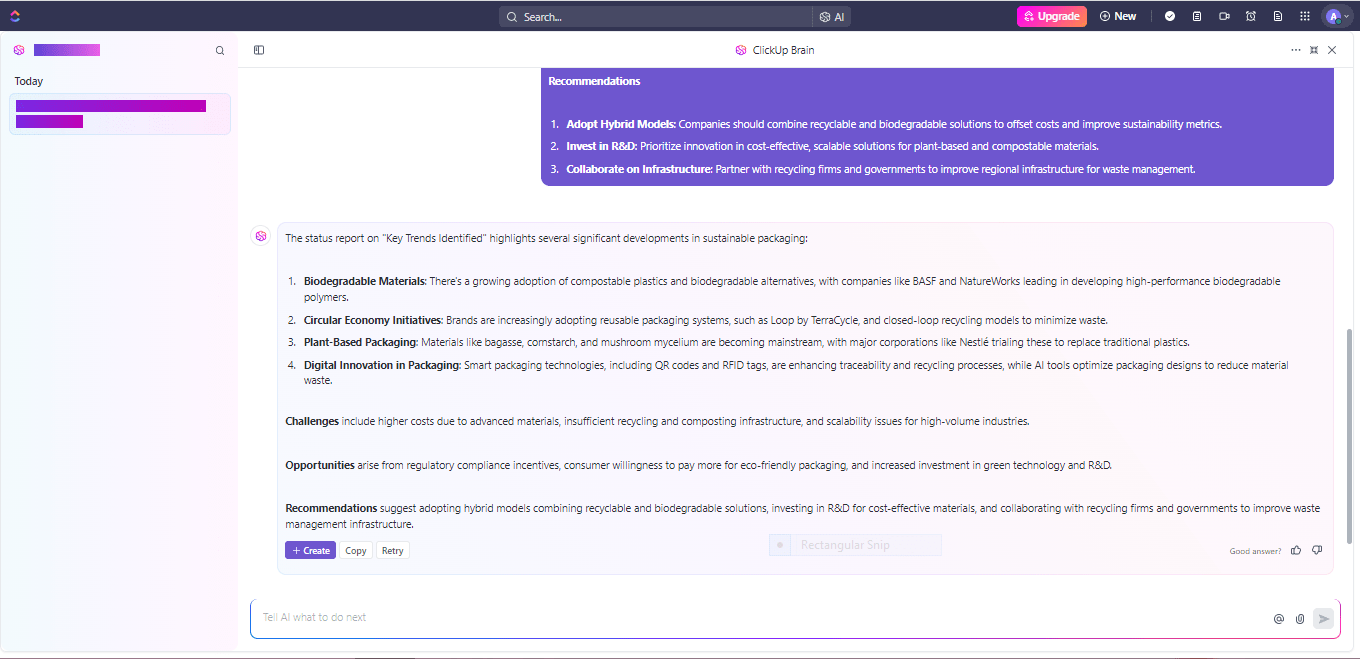
💡 Pro Tip: If you’re curious about using these AI features, see this helpful guide on generating summaries and updates.
ClickUp Docs
Previously, I worked with a team that was well-known for indulging in endless brainstorming sessions that led to fantastic but scattered notes. ClickUp Docs helped with this.
It’s a collaborative document tool within ClickUp designed for teams to draft, edit, and share content in real time. Drafting proposals, managing team wikis, and organizing meeting minutes became infinitely easier.

What’s unique here isn’t just that you can write collaboratively (lots of tools do that!); it’s that AI actively works within your documents. I threw 12 pages of team brainstorming notes at it, and what came back was a focused, actionable overview.
And unsurprisingly, I am not the only one who had this experience. Michael Holt, CEO of EdgeTech, says:

What sets ClickUp apart isn’t just the top ClickUp Brain features or ClickUp Docs’ ability to share and edit but how seamlessly it ties everything together. With Docs linked directly to tasks, nothing gets missed.
👀 Quick Hack: ClickUp can act as your multimedia hub! It lets you attach files like recordings, images, and even entire presentations to tasks. ClickUp isn’t just a summarization tool—it’s a complete ecosystem that makes every piece of information actionable.
ClickUp best features
- Summarize lengthy reports and meetings into concise, actionable insights with ClickUp Brain
- Tailor role-specific prompts and templates to generate summaries relevant to industries like marketing, sales, and project management
- Get actionable insights as bullet points from summaries, suggesting next steps to ensure clarity and direction
- Integrate lengthy essays as summaries directly into tasks, improving workflow and ensuring critical action items are not missed
ClickUp limitations
- Requires a paid plan to unlock some AI features
- Users new to the ClickUp ecosystem might face a learning curve due to the number of features on offer
ClickUp pricing
- Free Forever
- Unlimited: $7/month per user
- Business: $12/month per user
- Enterprise: Contact for pricing
- ClickUp Brain: Add to any paid plan for $7 per member per month
ClickUp ratings and reviews
- G2: 4.7/5 (9,000+ reviews)
- Capterra: 4.6/5 (4,000+ reviews)
2. Notta (Best meeting transcriber and online text summarizer)

Notta is an AI summary tool that does more than just summarization; it’s a full-fledged transcription and productivity assistant.
The live meeting transcription feature of this summary generator, powered by its AI bot, allows you to generate transcripts in real time simply by pasting a meeting invite link.
The AI Notes (formerly AI Summarizer) feature stands out for creating concise summaries directly from transcripts. Notta also supports over 100+ transcription languages and translation in multiple languages, which I found invaluable when collaborating on documents with international colleagues.
Notta best features
- Enable live transcription of meetings on platforms like Zoom and Google Meet, ensuring immediate access to key points
- Export files in multiple formats like DOCX, PDF, SRT, and MP3
- Get side-by-side original and translated text displays, aiding effective cross-language collaboration
- Extract highlights from dense transcripts, saving time on post-meeting documentation
Notta limitations
- Performance of the summarizing tool heavily depends on the clarity of the audio, struggling in noisy environments or with speakers who have strong accents
- Post-transcription refinements require exporting to external word processors, which interrupts workflow
Notta pricing
- Free
- Pro: $14.99/user per month
- Business: $27.99/user per month
- Enterprise: Custom pricing
Notta ratings and reviews
- G2: 4.6/5 (100+ reviews)
- Capterra: No ratings available
3. Hypotenuse AI (Best keyword-rich summary generator for marketing)

Hypotenuse AI can summarize dense content like white papers and long-form blog articles while integrating keywords. Its ability to customize summaries based on tone and style is impressive.
For instance, Hypotenuse does the job if you need a formal project summary for a client-facing report or a conversational version for internal brainstorming. This makes it particularly useful for marketers or content strategists who want to use AI for documentation.
Hypotenuse AI best features
- Get outputs tailored on the basis of professional, conversational, or creative contexts
- Generate well-structured summaries that bring together key themes rather than merely extracting sentences
- Excel in e-commerce and marketing with product descriptions or campaign-ready summaries that have embedded keywords
Hypotenuse AI limitations
- Struggles with academic or deeply technical documents, often failing to capture intricate details without manual guidance
- Restricted to English, which may alienate users working in multilingual environments
Hypotenuse AI pricing
- Individual: $29/50,000 words per month
- Teams: $59/120,000 words per month
- Enterprise: Custom pricing
Hypotenuse AI ratings and reviews
- G2: 4.7/5 (60+ reviews)
- Capterra: No ratings available
4. Semrush AI Summarizer (Best free SEO-friendly AI summarizing tool)

This AI summarizer is a natural fit if you’re already part of the Semrush ecosystem. Use it to condense SEO reports and keyword analytics into digestible presentation insights.
One of the strongest points of this summarizing tool is its integration with Semrush’s vast database. For example, when summarizing a site audit, the AI automatically contextualized the results, linking them to broader SEO trends. This depth of analysis is hard to find in standalone summarizers.
💡Pro Tip: Pair this summarizer with the Keyword Magic Tool to uncover related keywords and enhance the relevance of your summaries.
Semrush AI text summarizer best features
- Align content summaries with keyword optimization, ensuring improved visibility in search rankings
- Get actionable next steps, such as targeting underperforming keywords, directly within the summaries
- Create a unified workflow for SEO professionals by integrating AI text summarizer with other Semrush tools
Semrush AI text summarizer limitations
- Highly effective for SEO and marketing but unsuitable for creative, academic, or technical projects
- Functions best as part of the larger Semrush suite, making it impractical for users seeking standalone summarization solutions
Semrush AI text summarizer pricing
- Free
Semrush AI text summarizer ratings and reviews
- G2: No ratings available
- Capterra: No ratings available
5. QuillBot (Best AI-powered paraphraser and writing tool for professionals)

QuillBot is ideal for quick, concise summaries and paraphrasing tasks. The tool offers two summarization modes, Key Sentences and Paragraph Mode, which allow flexibility depending on the level of detail required.
What sets QuillBot apart is its affordability and multitasking capabilities. In addition to summarizing, it functions as a grammar checker, paragraph generator, and writing assistant, making it ideal for students, writers, and professionals who are juggling various tasks.
QuillBot best features
- Use the Highlight Sentences option to quickly identify the most impactful parts of lengthy documents
- Summarize text directly from web pages to speed up your research workflow
- Access paraphrasing and plagiarism detection to make your writing process more efficient
QuillBot limitations
- Free-tier users face restrictions on text length, which hinders its utility for processing longer materials
- Compared to advanced tools, the output lacks nuance and polish for professional or creative applications
QuillBot pricing
- Free
- Premium: $9.95/user per month
QuillBot ratings and reviews
- G2: 4.4/5 (30+ reviews)
- Capterra: 4.7/5 (100+ reviews)
6. Anyword (Best AI-powered marketing copy generator)

I tested Anyword with a product launch campaign where I needed summaries tailored for different demographics and platforms. Anyword generated a professional LinkedIn post summary, a punchy Twitter-friendly version, and a casual tone variation for Instagram.
One of Anyword’s most powerful features is its ability to personalize summaries. This makes the tool particularly helpful for businesses looking to maintain brand voice across multiple communication channels while adapting to the nuances of different audiences.
💡 Pro Tip: Explore the “Content Ideation” feature alongside summaries to generate fresh content angles for blogs or social media.
Anyword best features
- Create persona-based summaries tailored for executives, young professionals, or niche audiences with precision
- Leverage predictive metrics like click-through rates and engagement scores to make data-backed marketing decisions
- Optimize your content for various platforms with summaries perfect for tweets, ad headlines, or longer formats
Anyword limitations
- Requires a learning curve to interpret predictive metrics effectively, which can overwhelm first-time users
- The premium pricing structure positions it as an investment for professional marketers rather than individual or small-scale use
Anyword pricing
- Starter: $39 for solo marketers and freelancers
- Data-driven: $79 for small marketing teams
- Business: $349 for large marketing teams with 10+ users
- Enterprise: Custom pricing
Anyword ratings and reviews
- G2: 4.8/5 (1000+ reviews)
- Capterra: 4.8/5 (300+ reviews)
7. AI Summarizer (Best for concise text summarization)

AI Summarizer is a basic, no-frills tool that prioritizes simplicity and accessibility.
This AI document summarizer tool is good for users who need a quick and basic solution, such as students summarizing lecture notes or casual readers distilling online articles.
For professional settings, though, the absence of customization and refinement options makes it less competitive compared to tools like ClickUp.
💡 Pro Tip: Upload large technical reports and use the “Custom Focus” feature to summarize specific sections like executive summaries or appendices.
AI Summarizer best features
- Extract key insights from PDFs and web links to summarize research papers, reports, or news articles
- Specify a summary length or focus more on sections like introductions or conclusions
- Upload large files up to 50MB for detailed reports and comprehensive documents
AI Summarizer limitations
- Does not allow users to adjust summary length, tone, or focus, making outputs less versatile
- Lacks integrations or export capabilities, restricting usability within professional document workflow software
AI Summarizer pricing
- Free
- Weekly plan: $3.99
- Monthly plan: $6.99
AI Summarizer ratings and reviews
- G2: No ratings available
- Capterra: No ratings available
8. Jasper AI (Best summary generator for businesses)

Jasper AI is a tool that blends summarization with robust content generation. It’s effective for high-stakes projects like creating executive summaries from long market research reports or distilling brand guidelines into actionable takeaways for teams.
One feature that stood out to me was its content optimization capabilities. For example, it summarized a dense white paper, and Jasper condensed the content and suggested improvements to phrasing for better readability.
Another highlight is its versatility across content formats. Whether summarizing eBooks, newsletters, or even social media strategies, Jasper adapts its tone, structure, and focus.
Jasper AI best features
- Customize the tone, length, and style to tailor outputs for your audience’s specific needs
- Enhance your content by restructuring and polishing it for better clarity and impact
- Connect this tool with Grammarly, Google Docs, and CMS platforms for smoother workflows and version control
Jasper limitations
- Requires users to familiarize themselves with prompt crafting and advanced settings to achieve optimal results
- Its cost places it out of reach for users seeking basic or casual summarization capabilities
Jasper pricing
- Creator: $39/seat per month
- Pro: $59/seat per month
- Business: Custom pricing
Jasper ratings and reviews
- G2: 4.7/5 (1200+ reviews)
- Capterra: 4.8/5 (1800+ reviews)
9. Any Summary (Best quick AI summary generator for any document)

If you’re looking for a lightweight and straightforward tool for quick summarization tasks, Any Summary can help.
One of its strong suits is its speed. Even with moderately long content (e.g., 3,000-word articles), the tool processed and produced summaries within seconds.
💡Pro Tip: Test the browser compatibility feature to generate summaries directly from online articles or pasted URLs.
Any Summary best features
- Generates summaries without unnecessary steps or distractions
- Rely on this tool to handle medium-length text quickly, making it ideal for on-the-spot summarization tasks
- Capture primary ideas accurately, which makes it handy for personal use, like skimming through lengthy readings or preparing discussion points
Any Summary limitations
- Lacks advanced options like tone adjustment, integrations, or export features, reducing its appeal to professional users
- Designed for one-off summaries, with no scalability for larger projects or team use
Any Summary pricing
- Free
- Plus: $99.99 per year
Any Summary ratings and reviews
- G2: No ratings available
- Capterra: No ratings available
10. Wordtune (Best AI summaries generated for YouTube videos)

Wordtune is an intuitive writing assistant that helps refine content while condensing it. I found it particularly helpful when summarizing long YouTube videos, emails, project proposals, or blog drafts, as it not only created concise versions but also polished the language and improved clarity.
What makes Wordtune unique is its rephrasing options. Another feature is its real-time integration with platforms like Google Docs, which ensures a seamless writing experience. This makes Wordtune suitable for professionals, students, and writers aiming for polished outputs without sacrificing context.
Wordtune best features
- Adjust summaries to fit formal, casual, or concise communication styles to suit your audience
- Tweak and refine summaries directly in Google Docs, saving time on back-and-forth edits
- Improve your writing with rephrasing and clarity adjustments alongside summarization
Wordtune limitations
- Caps on word count and features in the free tier hinder its utility for users handling larger documents
- Many of its standout features, like advanced tone options, are locked behind a subscription, limiting value for casual users
Wordtune pricing
- Free
- Advanced: $6.99/month (billed annually)
- Unlimited: $9.99/month (billed annually)
- Business: Custom pricing
Wordtune ratings and reviews
- G2: 4.6/5 (170+ reviews)
- Capterra: 4.4/5 (70+ reviews)
Summarize this article for me pleaseClickUp: The Ultimate AI Summarization Tool
When I first started experimenting with AI tools for summarization, I had a checklist: it had to save me time, integrate with my workflow, and not leave me scrambling to connect the dots afterward.
Each tool on this list promised to deliver, but it wasn’t until I used ClickUp that I realized what I had been missing—a summarization tool that didn’t just process information but helped me do something with it.
Every insight becomes part of a larger plan, every task has a centralized hub, and every project moves forward without me needing to juggle multiple platforms.
For someone like me, who’s always balancing a dozen different priorities, ClickUp feels less like a tool and more like an extension of my work.
You, too, can sign up for ClickUp and experience AI summarization that drives similar results.


Everything you need to stay organized and get work done.

Recent Articles
7 Best Zoom Alternatives in 2026: Free Plans and Meeting Limits 
7 Best Zoom Alternatives in 2026: Free Plans and Meeting Limits
How to Create a Fillable Form in Microsoft Word (With Templates)
How to Create a Fillable Form in Microsoft Word (With Templates)
