






Still downloading templates?
There’s an easier way. Try a free AI Agent in ClickUp that actually does the work for you—set up in minutes, save hours every week.
Sorry, there were no results found for “”
Sorry, there were no results found for “”
Sorry, there were no results found for “”
You can have the most brilliant, soul-stirring ad concept in the world.
But if it takes you three weeks to produce and optimize it, you’ve already lost the window to create impact.
That’s why brands leverage artificial intelligence. To move fast, read signals early, and make creative decisions at scale.
But where do you begin?
How do you use AI to create ads without sacrificing human creativity?
There’s nothing more helpful than studying real-life AI advertising examples in action.
In this post, we break down successful campaigns from top brands, key lessons, and a step-by-step guide to launching your own AI-powered ad campaign.
Simply using AI technology to build an ad campaign doesn’t add a competitive advantage. Because almost every other brand is already doing it.
To cut through the noise, make sure your ad checks most of these points:
⚖️ AI marketing campaigns vs. AI advertising campaigns: It’s easy to confuse the two, but here is the breakdown:
In short: Every AI ad campaign is part of an AI marketing strategy, but not every AI marketing tactic involves advertising.
Now, let’s take a look at the top ten AI advertising examples from global brands and see how they use AI to communicate their selling points:
👀 Did You Know? Watches in ads are almost always set to 10:10. That’s because at 10:10, the hands frame the brand’s logo (usually centered at the top) and, more importantly, they look like a smiley face. 😀
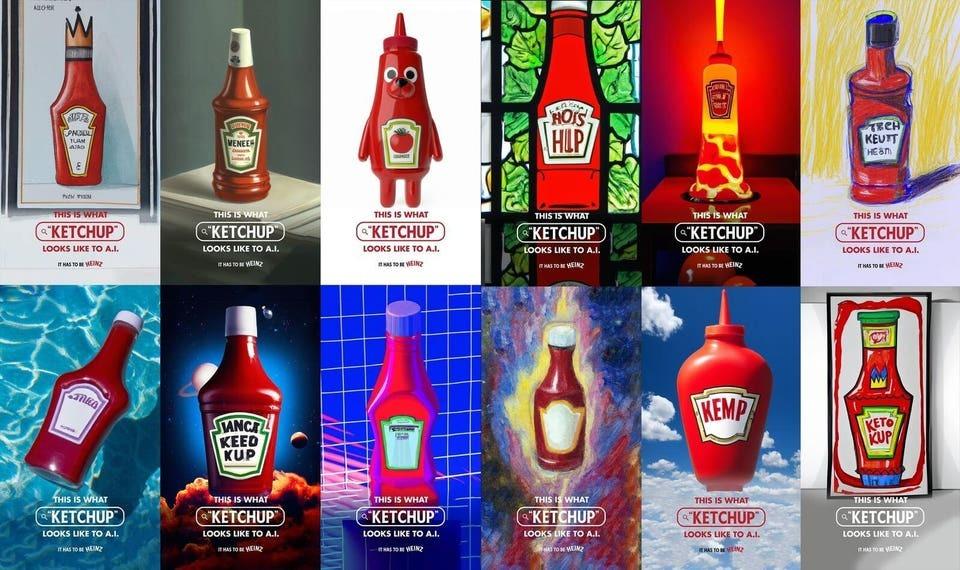
In 2022, Heinz hopped on the DALL-E hype train with a simple experiment: they asked AI to draw “ketchup.”
The result was a masterclass in brand equity. The AI consistently generated images featuring the iconic Heinz bottle shape, the tombstone label, and that specific shade of red.
Pushing it further, they fed AI increasingly bizarre prompts like “Ketchup in outer space,” “Renaissance ketchup,” and “Ketchup scuba diving.” No matter how surreal the request, the output was undeniably Heinz.
The campaign exploded when Heinz invited fans to submit their own prompts, transforming the initiative into a massive UGC engine.
✅ Key Takeaway: Use AI to validate a brand truth. This is a prime example of a brand using AI to prove a psychological point: Heinz is ketchup. Plus, because the prompts were generic, the outcome felt unbiased. The neutrality made the result far more powerful and convincing.
📚 Read More: Top AI Tools for Startups
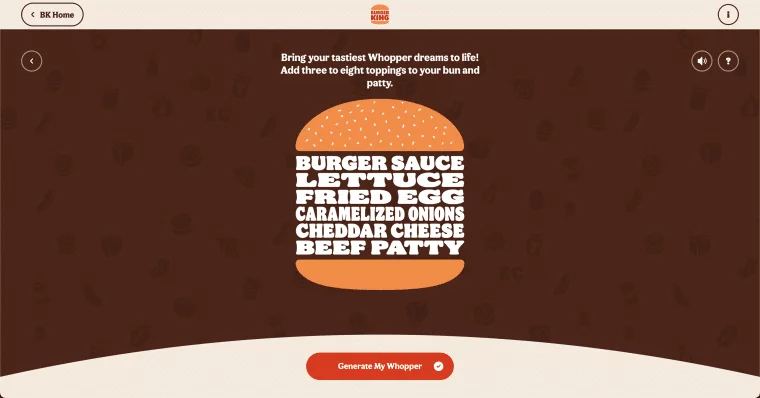
If there’s anyone who knows how to play the advertising game right, it’s BK.
And they did so once again in 2024 by launching an AI-powered microsite that invited customers to build their dream whoppers using simple text prompts.
Users submitted their wildest ingredient combos—think everything from candied jalapeños to peanut butter. An AI image generator instantly rendered a hyper-realistic, mouth-watering image of their custom whopper.
BK then let the public vote on which burger should be produced for a limited run, with a $1 million prize for the winner.
✅ Key Takeaway: Use AI advertising as a gateway for rapid product ideation and crowdsourcing. BK essentially turned a fun contest into the world’s largest market research study, letting its customers decide exactly what the next best-selling topping should be.
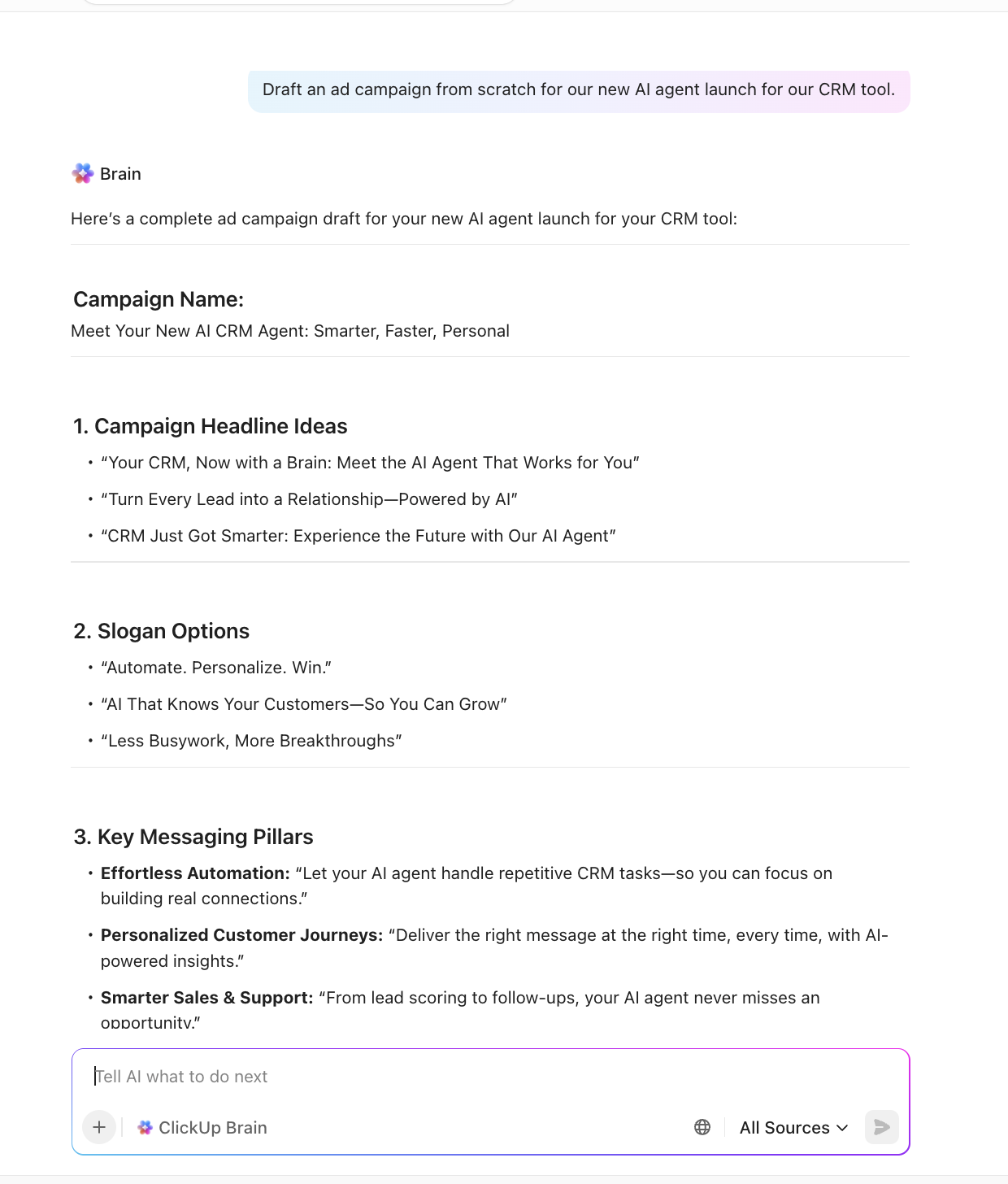
🚀 ClickUp Advantage: Losing hours to the blank-page syndrome? Use ClickUp Brain to produce content assets at scale—be it illustrations, images, ad copies, social media post captions, headlines, etc. For example, ask Brain to “Generate five variations of a 15-second video script for an eco-friendly laundry detergent launch targeting millennial homeowners” and watch it do the creative labor in seconds.
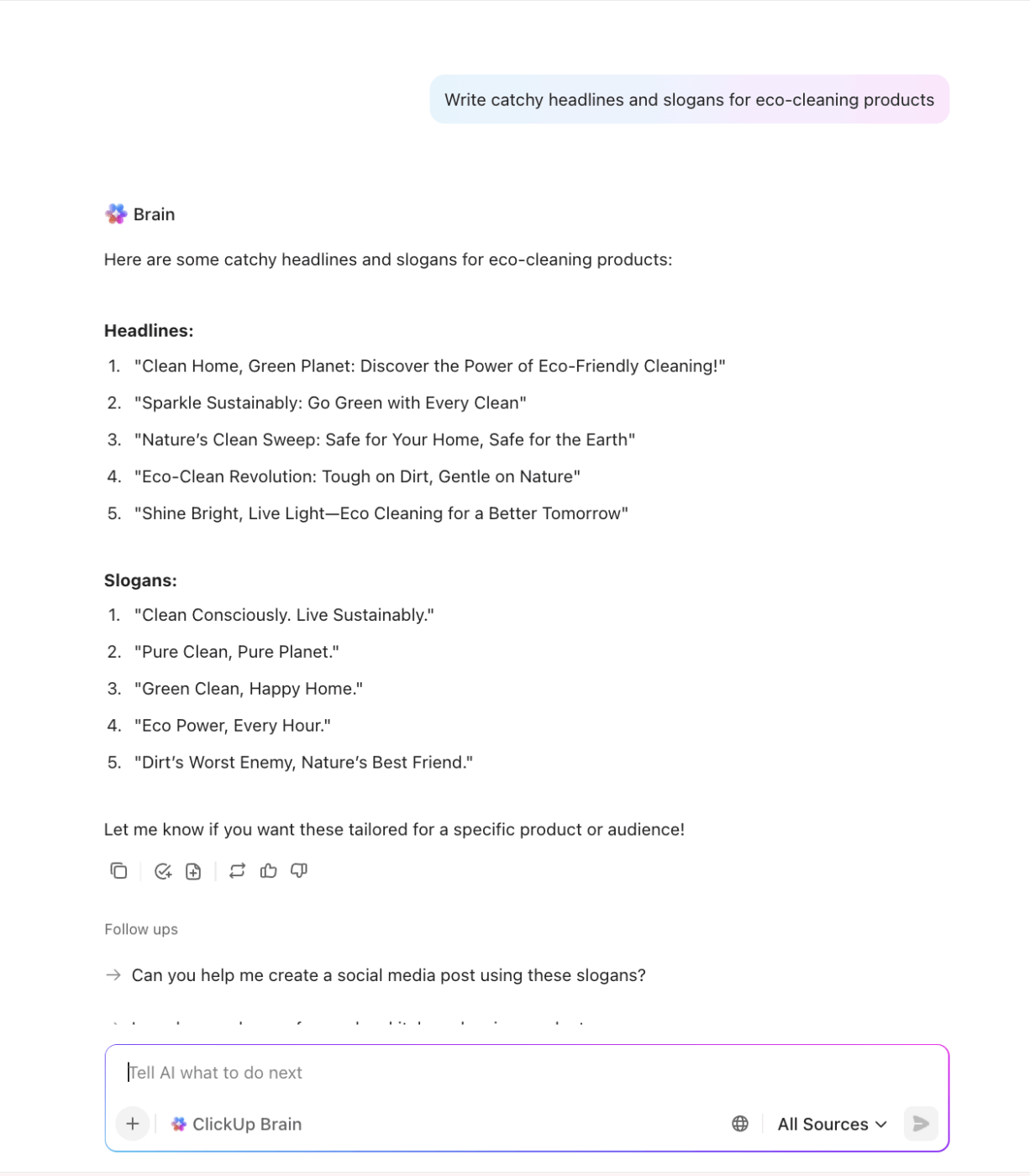
This doesn’t replace your designers, of course. Just gives them a head start and strong creative direction to work with!
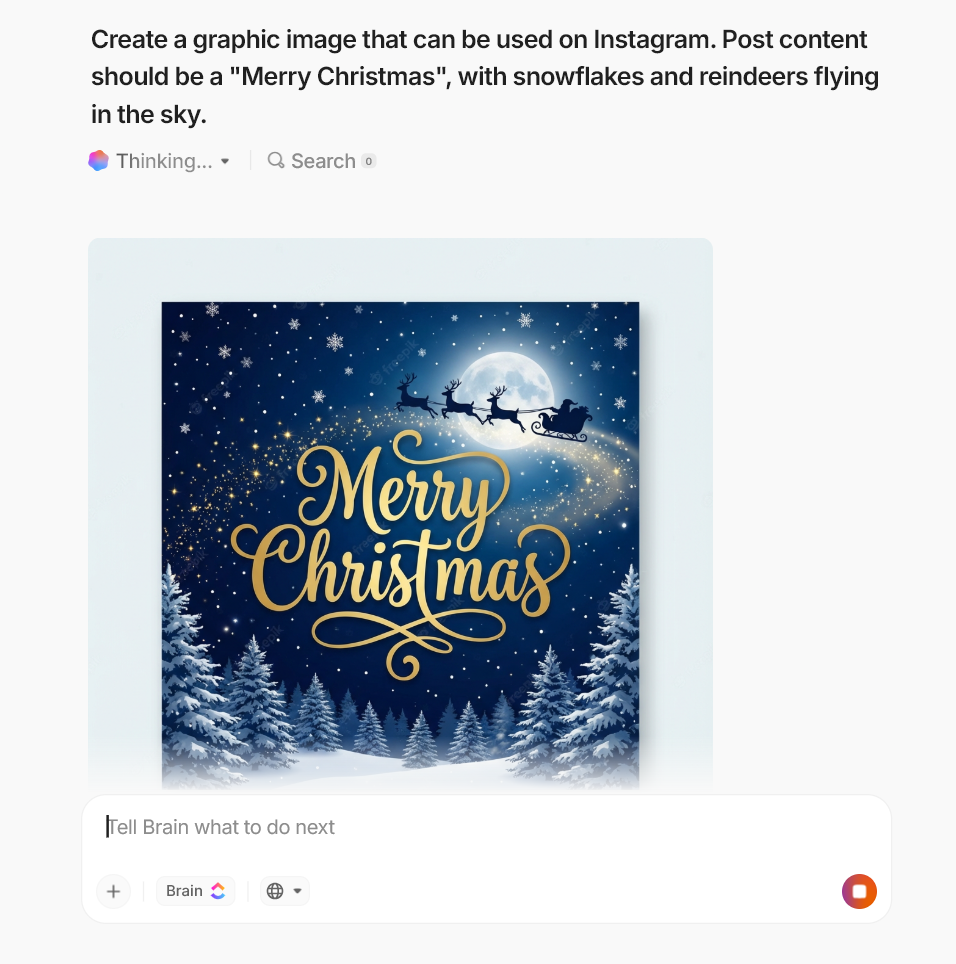
What’s more, you can even prompt ClickUp Brain to generate the image for you.
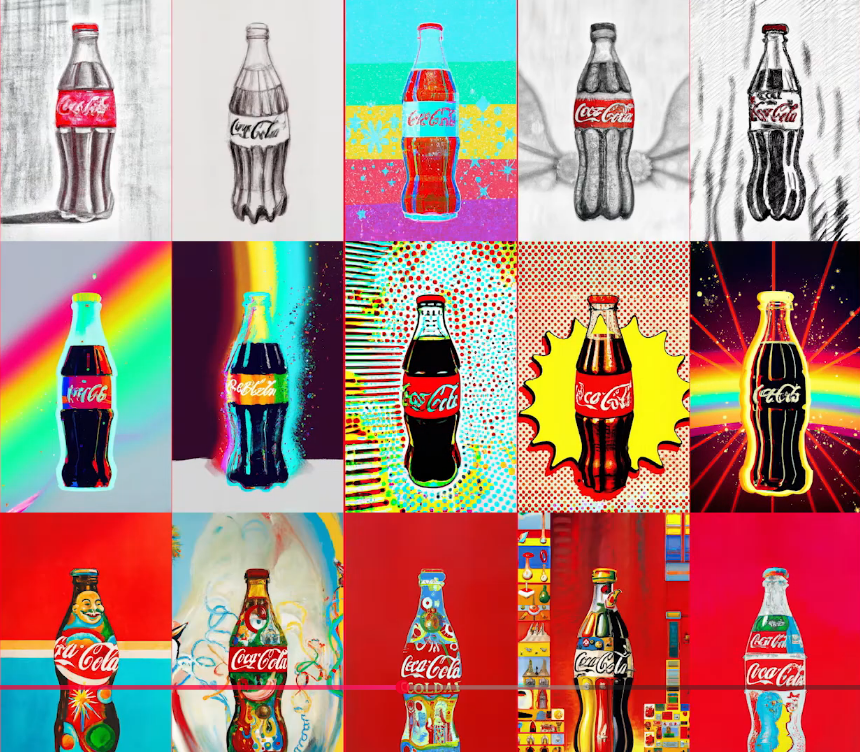
Coca-Cola opened its vault by giving fans access to its iconic brand assets like the logos, bottle shapes, archival imagery, etc., through a custom AI platform.
Leveraging DALL-E and GPT-4, users generated original, holiday-themed digital art. While AI enabled massive scale and creative variation, Coca-Cola acted as the curator, selecting the best pieces for high-profile placements.
By letting fans take the creative lead, Coke stayed at the heart of the holiday conversation without the massive overhead of traditional content production.
✅ Key Takeaway: Hop on the emerging AI trends to create ads that allow user participation and creative freedom. This leads to strong cultural impact, engagement, and widespread earned media, which are the real wins here.
🧠 Fun Fact: Santa Claus is red because of Coca-Cola. Originally, he was often depicted as a tall, thin man wearing green, blue, or brown. In 1931, Coca-Cola commissioned illustrator Haddon Sundblom to create a “wholesome” Santa for their holiday ads. He drew a plump, jolly man in a bright red suit (to match the Coke logo). That image was so powerful that it became the global, permanent standard for what Santa looks like today.
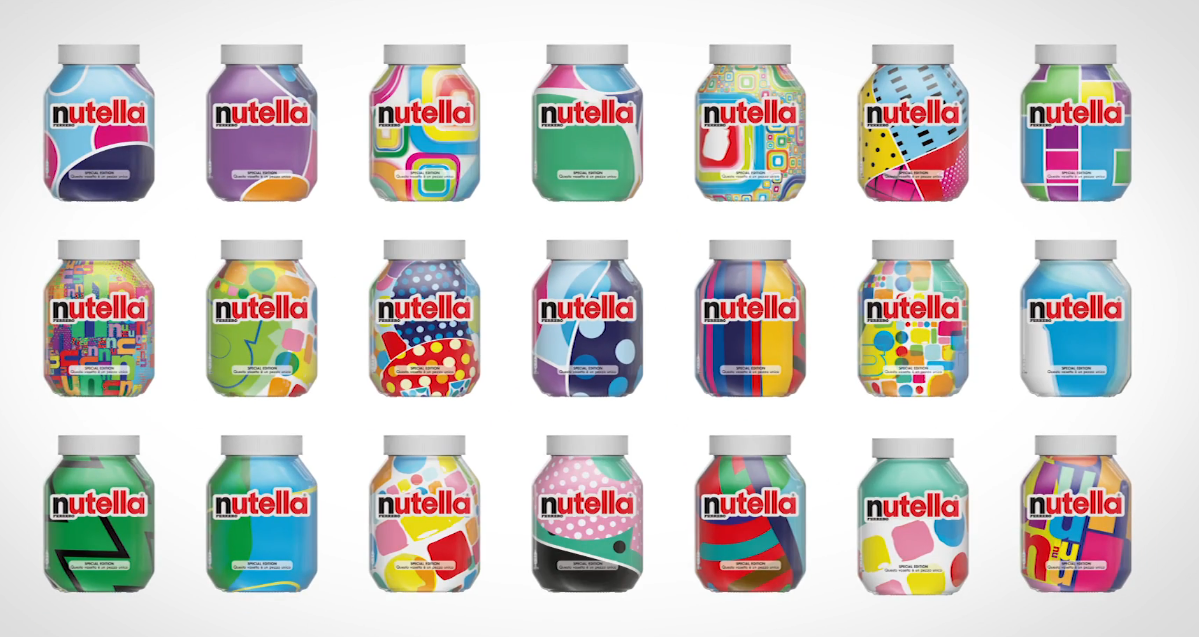
When personalization first became a buzzword, most brands kept it digital—emails, ads, and recommendations. Mass-produced physical products remained largely uniform.
Nutella saw an opportunity to disrupt the status quo.
They fed an AI engine a library of patterns and colors, which the system then used to generate seven million unique labels for their jars in Italy.
The result? No two jars on the supermarket shelf were identical.
The campaign sparked a social media frenzy as fans hunted for the most aesthetic designs. That’s how Nutella successfully turned a routine grocery item into a “1-of-1” collector’s piece, effectively making every customer the owner of a limited-edition artwork.
✅ Key Takeaway: AI-driven personalization is most effective when it is baked into the product experience. In this case, the jar itself became the billboard, the collectible, and the social-sharing trigger all at once.
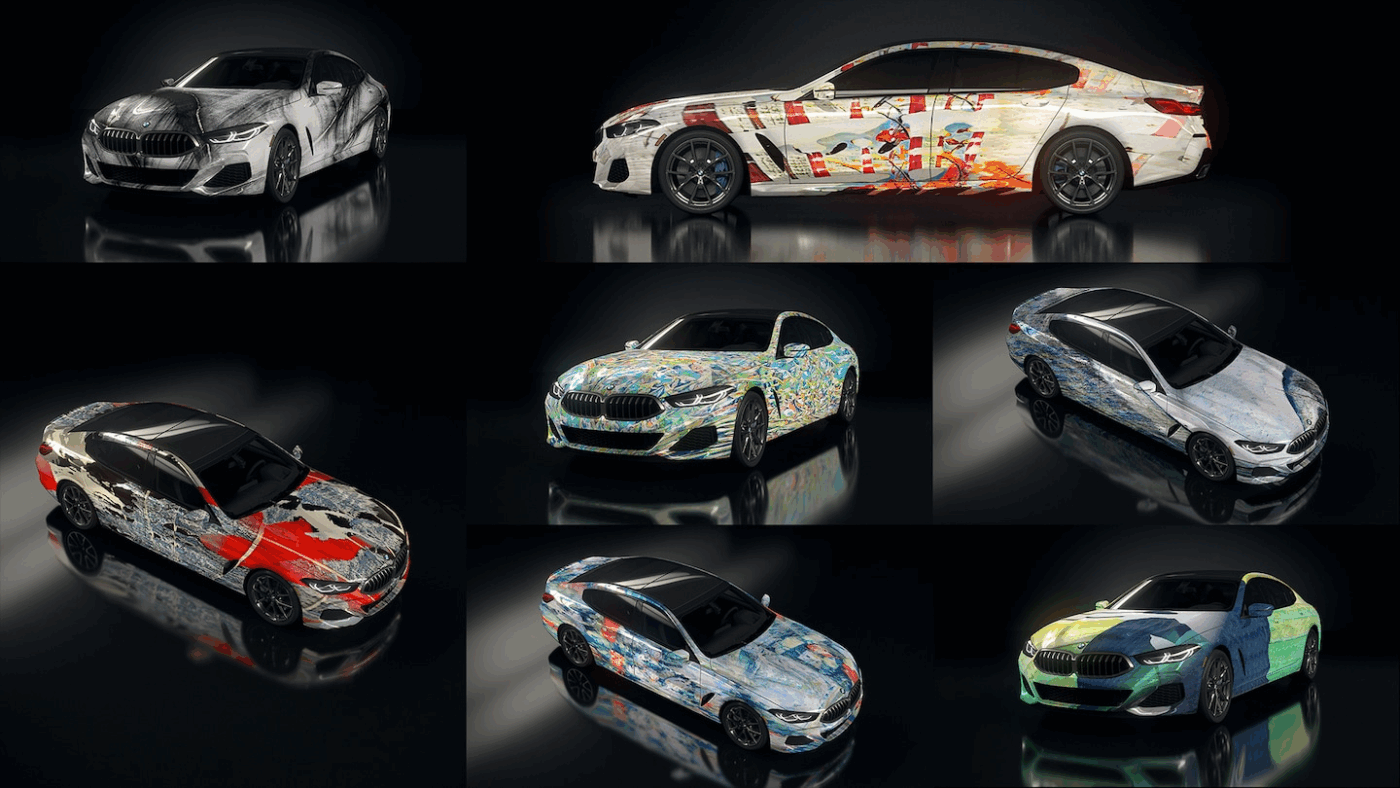
BMW took its legendary “Art Car” tradition into the digital age with The Electric AI Canvas.
They trained StyleGAN, an AI model, on a staggering 50,000 images spanning 900 years of art history, plus works from contemporary legends. The result was a dynamic, evolving masterpiece projected directly onto the car’s surface.
The installation became a massive social media magnet because it was impossible to capture the same photo twice—the art was always changing.
✅ Key Takeaway: Don’t just incorporate AI to introduce new narratives. Use it to enhance your brand’s existing heritage and brand identity. The above example shows how BMW amplified its long-standing association with innovation, craftsmanship, and art through generative AI.
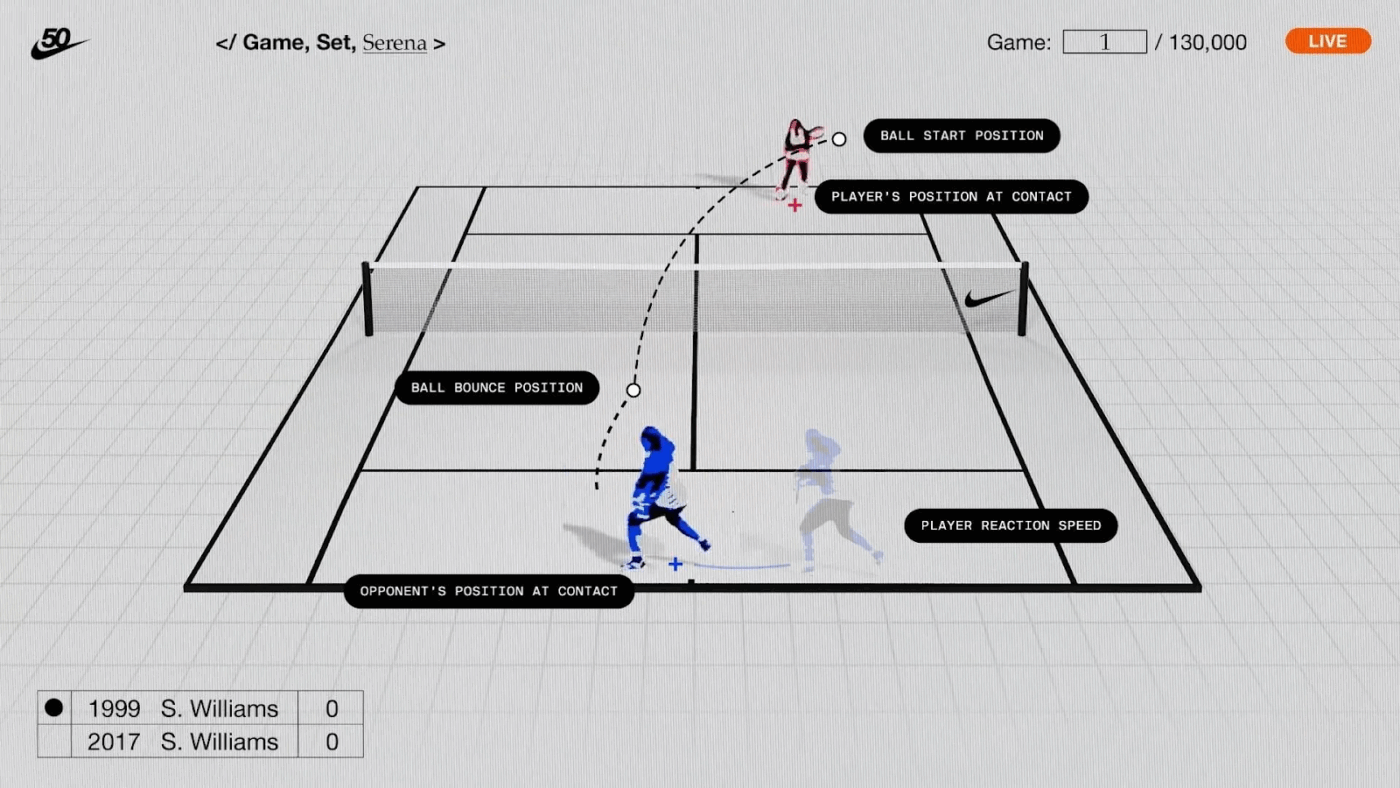
To celebrate its 50th anniversary and Serena Williams’ retirement, Nike did the unthinkable: they staged a match between 1999 Serena (the 17-year-old prodigy) and 2017 Serena (the 35-year-old champion).
Using machine learning, Nike analyzed 20 years of gameplay—modeling her footwork, shot selection, and even her psychological reactions under pressure. They simulated 130,000 matches between her two “selves” and broadcast the grand final as a live event.
This generated invaluable data-driven insights for tennis enthusiasts and Nike’s internal product development team alike.
✅ Key Takeaway: Who said ads have to be explicitly promotional? Combine machine learning with your creative genius to create ads that deliver meaningful insights and shape perception.
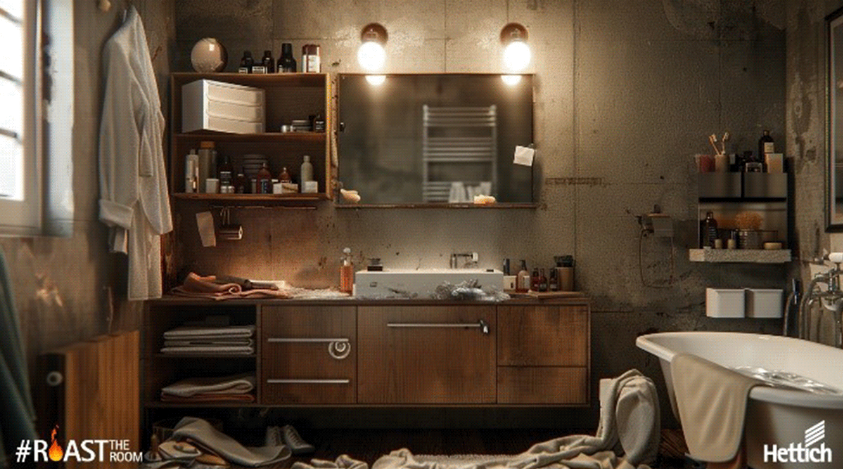
Hettich (the furniture hardware giant) leaned into the internet’s love for “roasting” with their #RoastTheRoom campaign.
They used AI to generate “disaster rooms”—living spaces that looked like post-apocalyptic nightmares of clutter and chaos. They posted these images on Instagram, daring followers to roast the designs.
Once the comments poured in, Hettich used generative AI to give the rooms a “glow-up,” showing a stunning, organized transformation powered by their hardware.
✅ Key Takeaway: AI doesn’t replace creativity. Top brands use it to execute concepts that would be too costly, complex, or physically impossible to shoot in the real world.
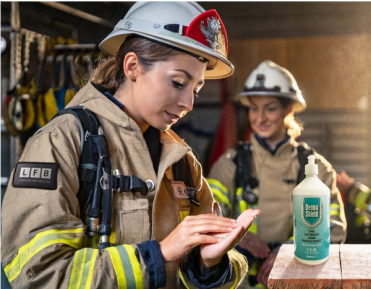
Unigloves faced a significant challenge: their hand protection product, Derma Shield, is used by everyone from gritty mechanics to lab scientists. But they lacked the budget for a massive global photo shoot.
Instead of settling for boring stock photos, they used AI to generate 250 hyper-realistic scenes showing industry professionals using Derma Shield in high-intensity environments.
From a firefighter prepping for duty to a tattoo artist cleaning their hands, the AI-generated imagery allowed Unigloves to communicate relevance across dozens of industries with perfect visual consistency.
✅ Key Takeaway: Use AI where your biggest friction lies. For Unigloves, it wasn’t creativity, but budget constraints and time-to-market. They leveraged AI accordingly to create images at a scale humanly impossible in such a short time.

H&M flipped the script on fashion photography by creating high-fidelity digital twins of their top models. Instead of booking a studio for weeks to shoot a new 500-piece collection, they used AI to clone the models once.
These twins could be used to showcase clothing across different poses, environments, and formats—without requiring repeated photoshoots. It turned a grueling, months-long production schedule into a few clicks on a screen.
✅ Key Takeaway: Use AI to decouple your creative output from physical limitations. By digitizing the talent, H&M turned a logistical nightmare into a scalable, high-speed content engine.
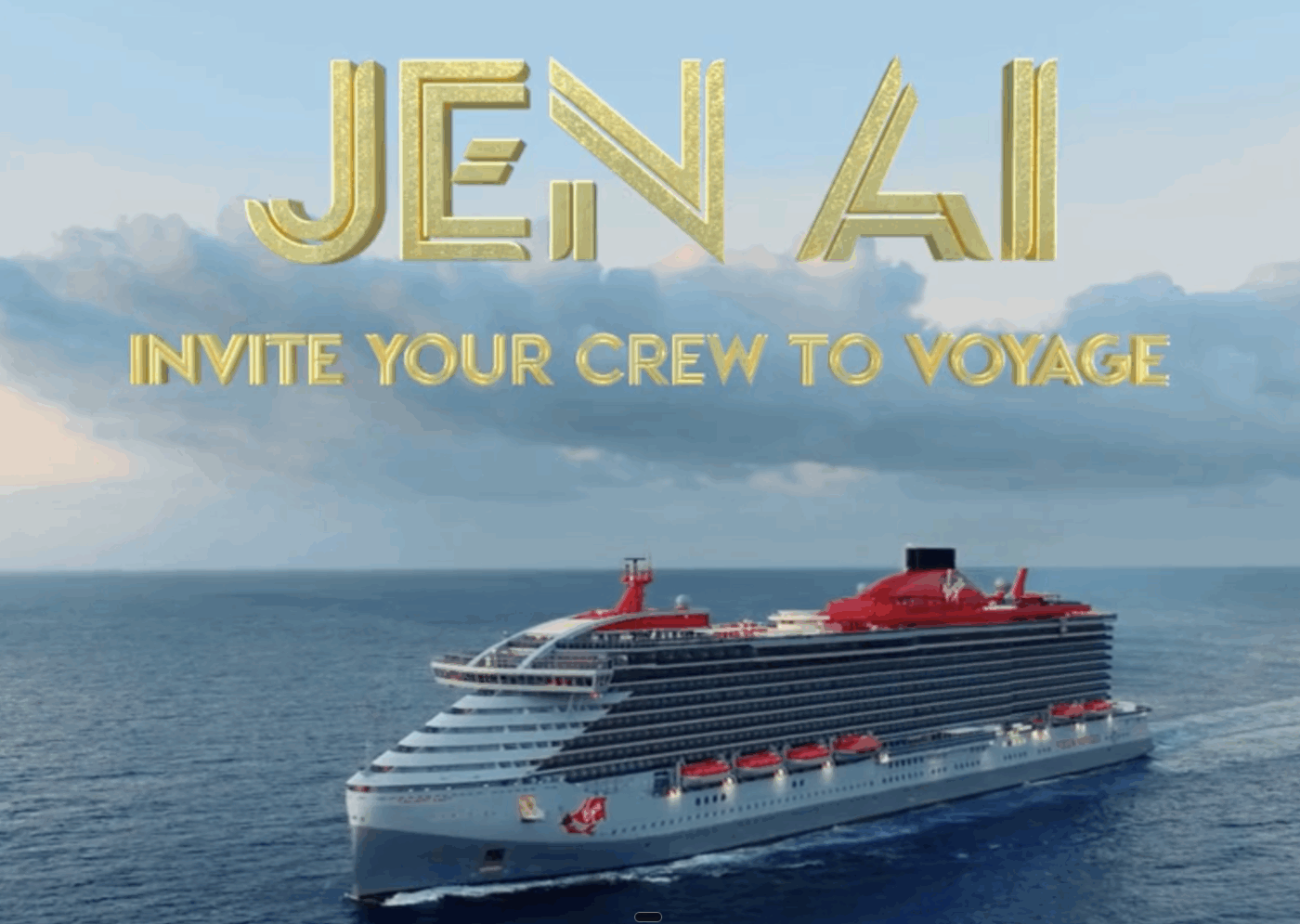
Here’s another great example: Virgin Voyages knew they couldn’t get Jennifer Lopez to sit down and record millions of individual videos. So, they cloned her likeness and voice to create Jen AI.
Through this tool, users could generate a hyper-personalized video invitation for a cruise. You could tell “Jen” your friend’s name and why they needed a vacation, and she would deliver a custom message directly to them.
✅ Key Takeaway: Celebrity-led campaigns no longer have to be limited by a spokesperson’s calendar. The Jen AI campaign demonstrates how AI cloning can transform a single brand ambassador into a scalable, interactive brand asset.
📚 Read More: AI Tools for Affiliate Marketing (Free & Paid)
Ten examples. Ten key takeaways.
But what does it all boil down to?
Here are the four most important lessons that every successful AI-powered campaign gives us:
If you only use AI to write ad copy faster or automate repetitive work, you’re missing the point.
Successful AI campaigns prioritize AI-driven insights. They use AI to analyze massive datasets, tracking engagement patterns, customer behavior, drop-offs, and creative fatigue to support data-driven decision-making.
These insights then dictate creative direction, channel selection, timing, and campaign structure.
Use AI right from the start, i.e., the creative process (ideation and conceptualization stages). Analyze trends, cultural signals, audience interests, and historical performance to uncover white-space opportunities your competitors might miss.
AI-powered digital marketing tools push creative boundaries, producing fresh angles and spin-off variants that resonate more deeply with the audience.
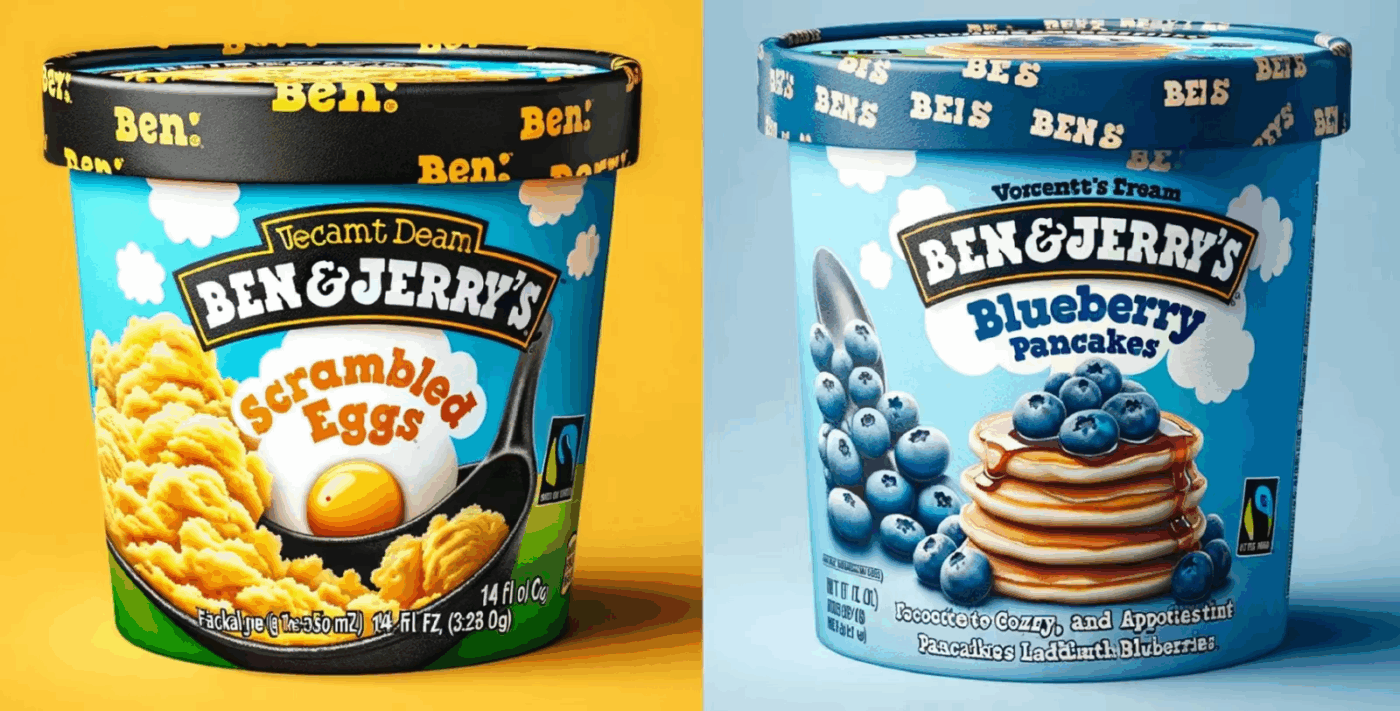
👀 Did You Know? Ben & Jerry’s used AI to analyze over two years of social media conversations and discovered a massive, untapped trend for “ice-cream for breakfast.” Their flavor experts then applied their creativity, taste judgment, and brand personality to turn those insights into real products.
Advertisers today design campaigns with variations from day one. AI generates multiple creative directions, formats, hooks, and messages that run simultaneously. It then analyzes how each variant performs across different demographics, placements, and micro-moments.
Instead of guessing which creative will resonate, advertisers can monitor real-time performance signals and optimize campaigns instantly.
👀 Did You Know? Meta’s AI Sandbox provides advertisers with generative and predictive tools designed specifically for this kind of optimization. Such AI innovations allow brands to automatically spin up dozens of versions of ad copy, backgrounds, and formats to see what truly converts in a live environment.
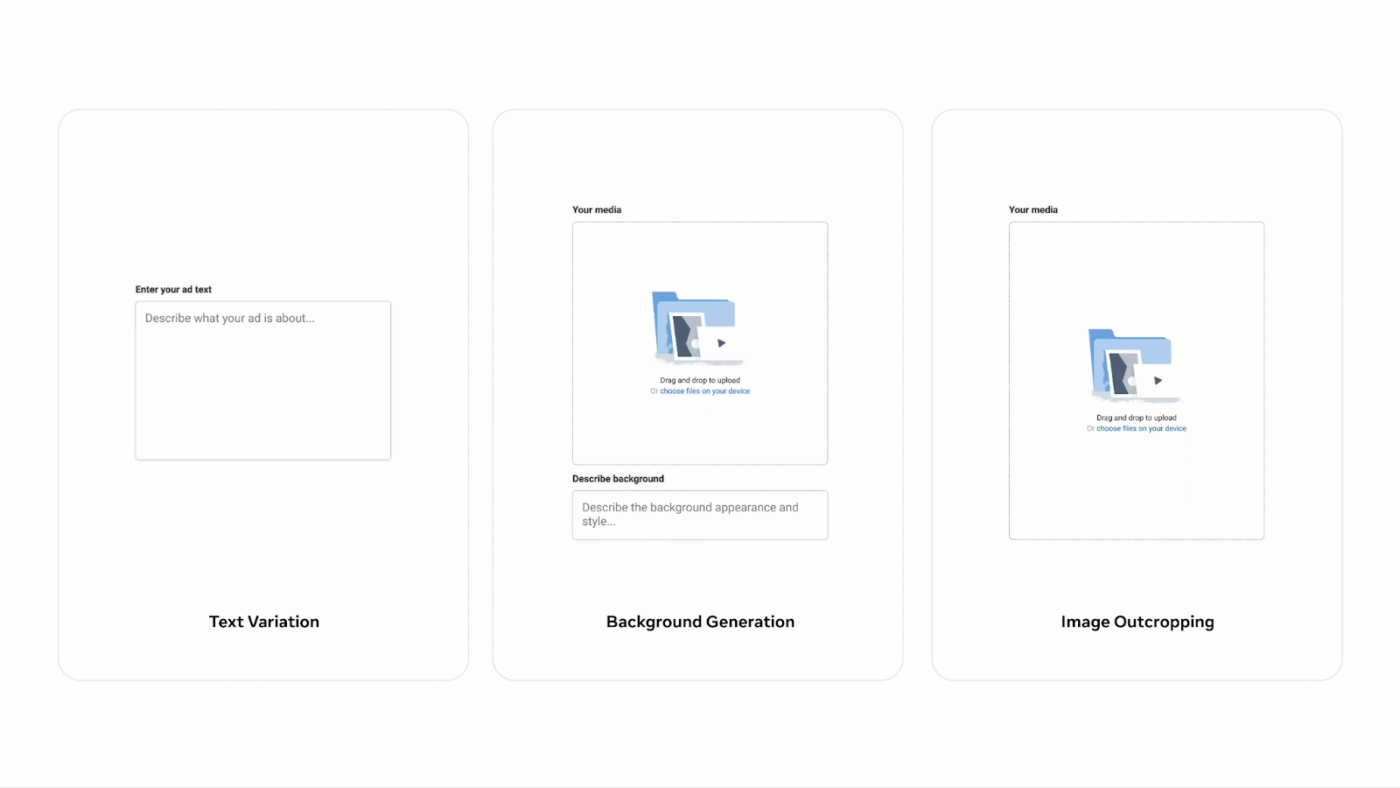
AI models learn from historical data.
The catch? This historical data often reflects societal bias around gender, race, age, body type, geography, or economic status. If left unchecked, AI can reinforce stereotypes even when that was never the brand’s intent.
Transparency also plays a critical role. Audiences respond better when brands are clear about how AI is used in their ads. Campaigns that hide AI involvement risk backlash when discovered later.
👀 Did You Know? Dove took a strong, explicit stance by announcing that it would never use AI to generate or alter women’s bodies in its advertising. The brand acknowledged that generative AI models are often trained on biased datasets that reinforce unrealistic beauty standards, and that using such outputs—even unintentionally—could undo decades of its “Real Beauty” positioning.
📚 Read More: Best AI Tools for eCommerce to Drive Sales
Inspired to build your AI advertising campaign?
Below, we show you how to do so.
⭐ Bonus: If you want to do it all in one place, without constant tool-switching and tab-hopping, ClickUp, a Converged AI Workspace, becomes your productivity hub.
You can plan and execute AI campaigns within ClickUp—eliminating the chaos of disconnected tools and the Work Sprawl that comes from it.
AI advertising campaigns drive results, provided you use AI intentionally.
Start by identifying the biggest friction points you usually face when planning or executing such campaigns.
Common areas where AI can move the needle:
Pick one or two high-impact areas to introduce AI and amp up your advertising strategy. This keeps the campaign focused, prevents AI Sprawl, and justifies your AI investment.
⭐ Bonus: Need a quick way out of the AI Sprawl? Watch this video 👇
📮 ClickUp Insight: 88% of our survey respondents use AI for their personal tasks, yet over 50% shy away from using it at work. The three main barriers? Lack of seamless integration, knowledge gaps, or security concerns.
But what if AI is built into your workspace and is already secure? ClickUp Brain, ClickUp’s built-in AI assistant, makes this a reality. It understands prompts in plain language, solving all three AI adoption concerns while connecting your chat, tasks, docs, and knowledge across the workspace. Find answers and insights with a single click!
Once you know where you’ll use AI, it’s time to prepare the concept for your creative campaign.
Gather your team to discuss the problem you want to solve, the story you want to tell, and what success for this ad campaign looks like.
Move away from static meetings and use ClickUp Whiteboards for visual marketing campaign planning. This is where your ad strategy takes shape in real time.
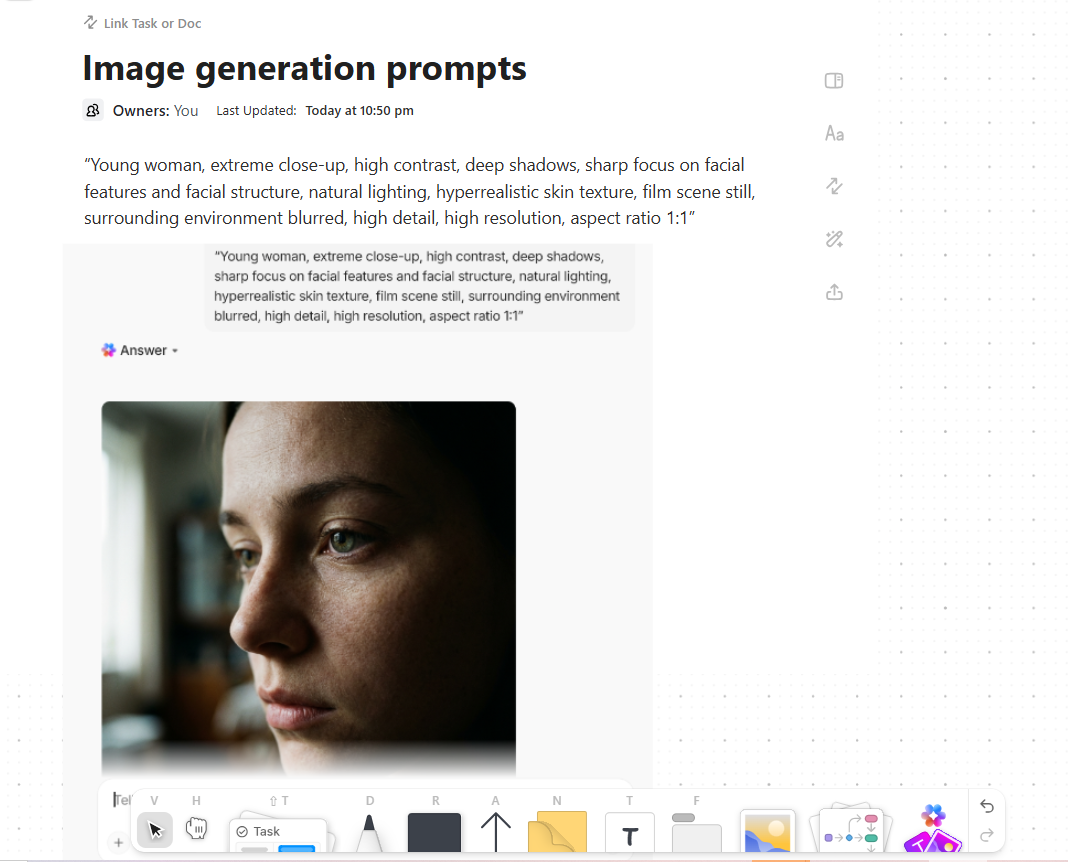
Here’s how they speed up and structure your brainstorming sessions:
When low on energy and ideas, directly ask ClickUp Brain to suggest market-relevant campaign themes and ad inspos to work on.
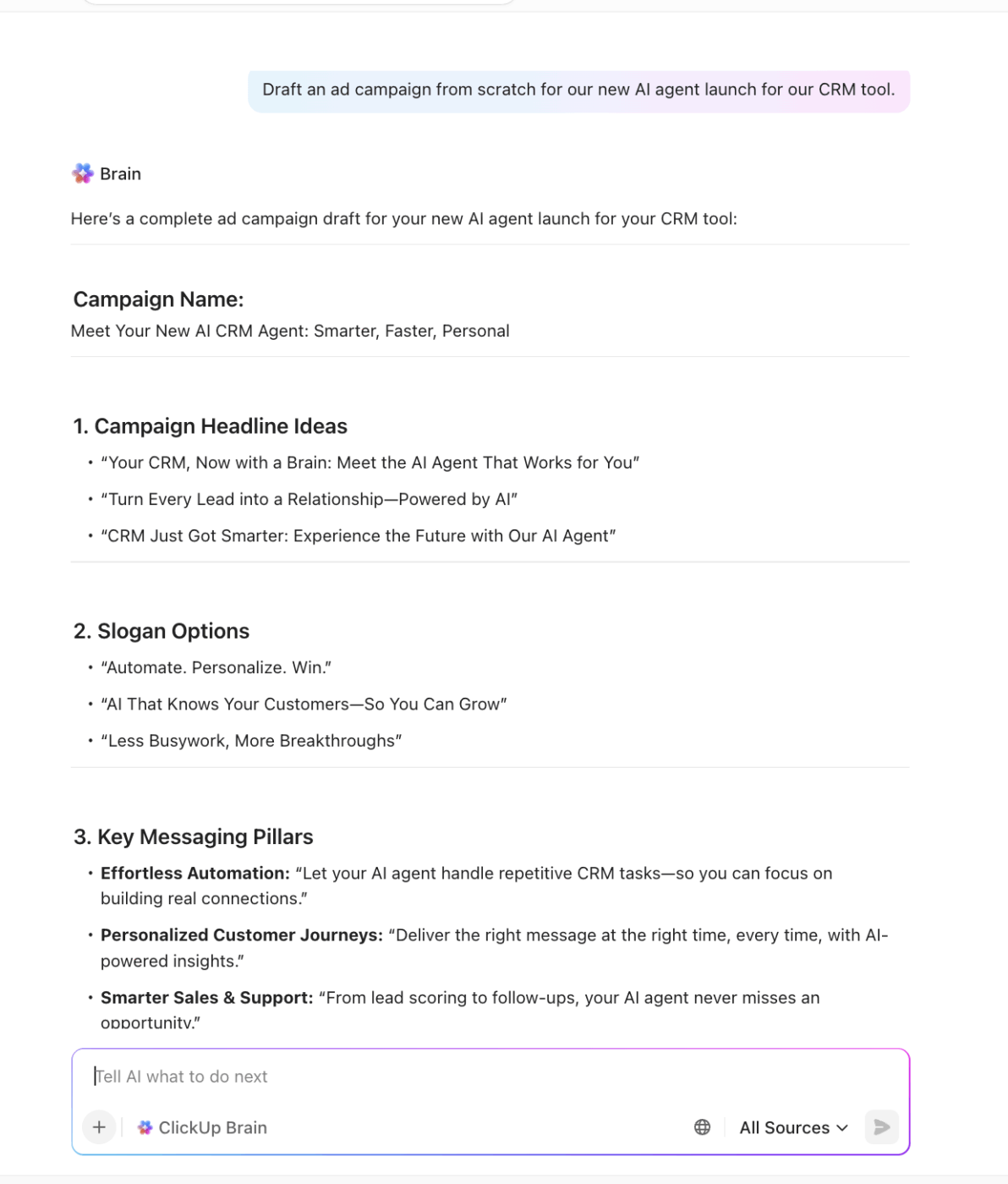
Some insanely easy ways to do so:
Once you’ve finalized a campaign idea, use ClickUp Docs to draft foundational elements. This includes creative briefs, brand guidelines, messaging frameworks, QA checklists, content marketing plans, and more.
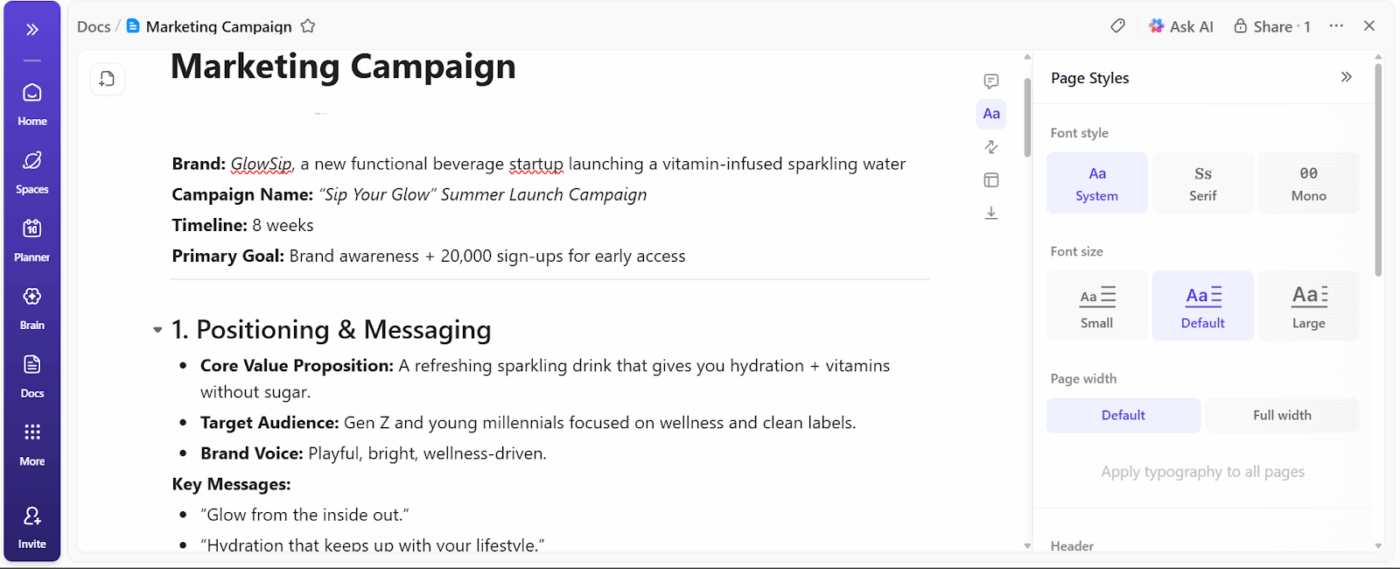
Here’s how:
🚀 ClickUp Advantage: Brainstorming usually eats up billable hours. But what if there was a way to ideate faster, without sacrificing quality?
ClickUp Brain MAX is the next-gen AI desktop companion for creative teams. It brings together powerful AI capabilities under one roof:
Here’s how Brain MAX makes your life easier 😎
📚 Read More: How to Create Your Social Media Strategy
Your campaign timeline depends on how you plan to use AI.
📌 Example: If you plan to train a custom AI model first to create an ad (like Nike’s Serena vs. Serena ad), your creation and planning phase expands. But if you’ll only use it whip up AI-generated visuals, the same phase shrinks.
The key to a successful launch is building in a buffer. Always leave room for unexpected pivots, feedback cycles, and repositioning.
ClickUp offers multiple ways to easily map and visualize realistic AI campaign timelines:
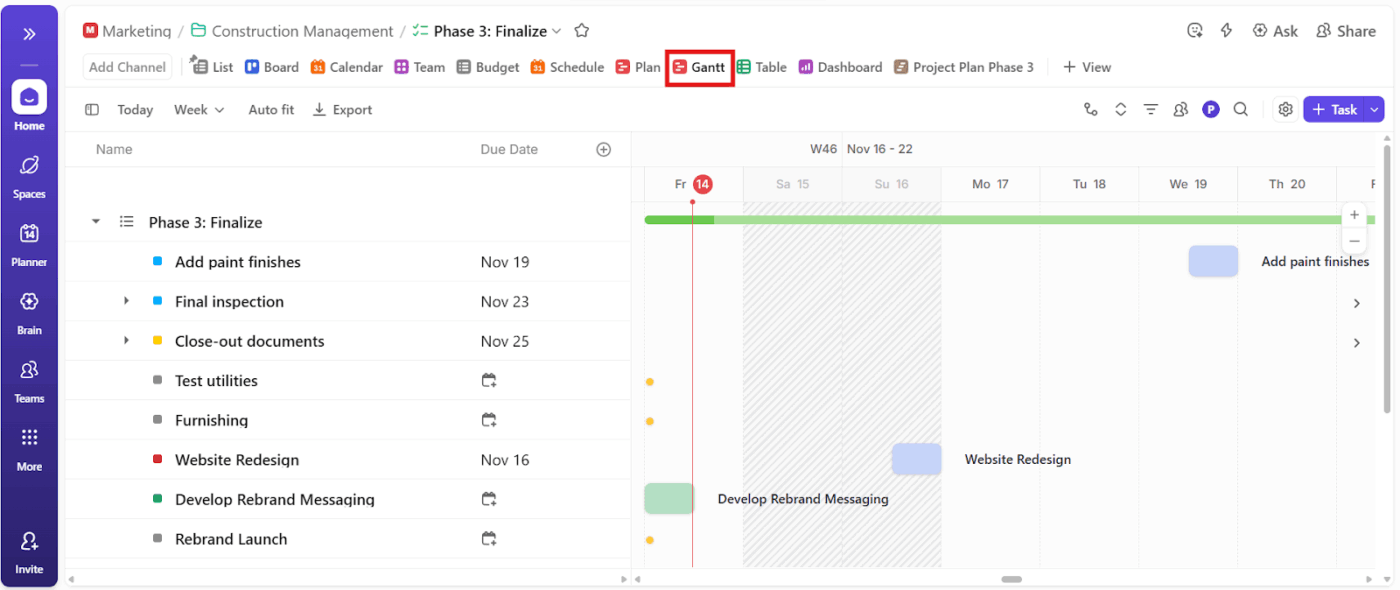
Use the ClickUp Gantt Chart View to display your entire campaign as a series of connected tasks with clear dependencies.
You can move tasks directly on this timeline to reorder them, color-code bars for easy identification, and expand them to see detailed information.
📌 Example: “Finalize campaign brief” flows into “Confirm budgets,” which flows into “Bill of materials.”
If one task slips, you can immediately see which downstream tasks are affected. Or how your timeline expands when tasks are added mid-campaign.
It’s perfect for managing AI ad campaigns that involve multiple teams (creative, media, strategy) and keeps everyone on the same page.
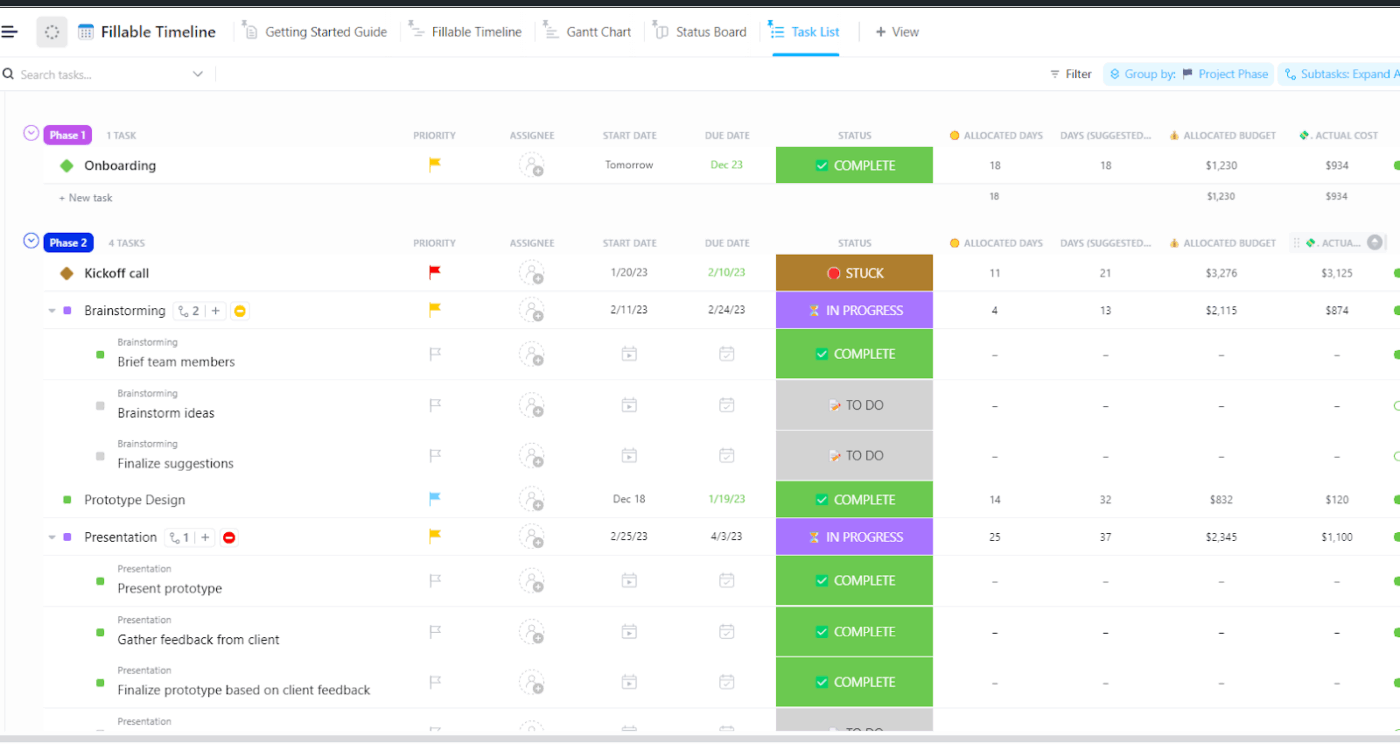
While a master view is great for leadership, individual team members do not need to see the whole thing. The ClickUp Timeline View lets you slice the schedule by status, assignee, priority, channel, etc.
For example, filter it by assignees so that each person sees their stream of work across the campaign. Or filter by status to see timelines for completed, in-progress, and waiting-for-review tasks.
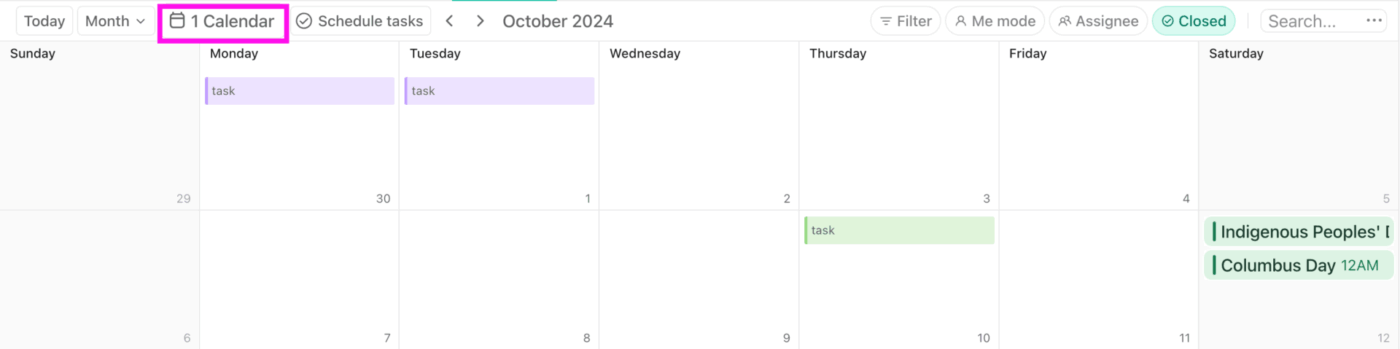
💡 Pro Tip: For immediate clarity, toggle to the ClickUp Calendar View. Seeing your deadlines laid out by the day, week, or month makes the workload feel manageable.
These calendars are fully interactive—if a content review needs to shift, just drag and drop the task from Friday to Monday, and your team is instantly notified.
Start with clear ownership. Communicate roles and responsibilities for everyone in your team to establish accountability.
ClickUp Tasks make this a breeze by letting you add multiple assignees (with distinct roles) to campaign tasks. For example, create a ClickUp Task titled “Write copy for social media post #1,” and add the content writer as the contributor and the editor as the reviewer.
Break these tasks down further into subtasks to keep execution organized. As your team completes these individual steps, the Rollup feature provides a real-time progress bar on the parent task
Once you’ve created the tasks, pair them with ClickUp Automations + Super Agents to automate campaign execution.
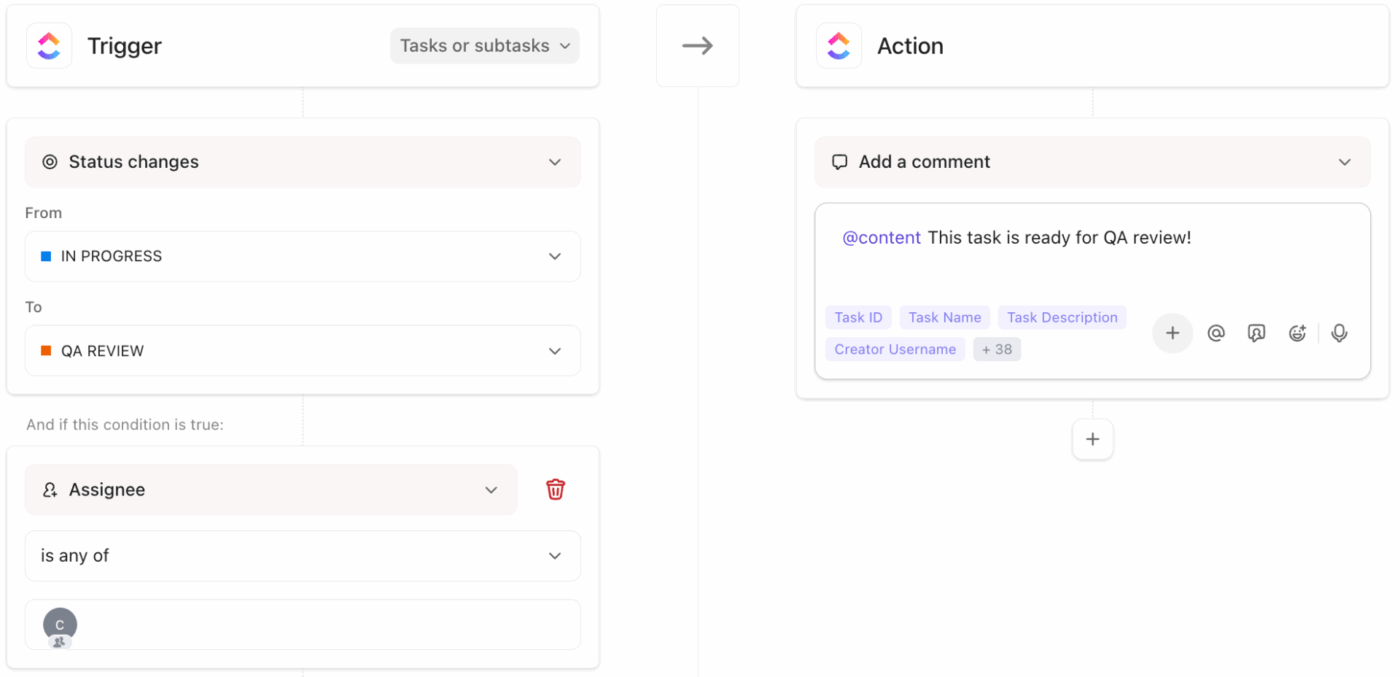
Set simple rule-based automations in ClickUp in two ways:
For multi-step, complex automations, deploy Super Agents into your marketing workflows. They work in the background to execute entire sequences automatically, without manual help.
📌 Example of a Super Agent at work: Deploy a custom AI agent to monitor your “Design Briefs” list. The agent automatically scans new briefs, creates the necessary sub-tasks, and assigns them to the team member with the most available bandwidth. Thanks to these AI teammates, your work keeps moving without you lifting a finger.
⭐ Bonus: To learn how to use AI agents for marketing content creation, watch this video 👇
📮 ClickUp Insight: 21% of people say more than 80% of their workday is spent on repetitive tasks. And another 20% say repetitive tasks consume at least 40% of their day.
That’s nearly half of the workweek (41%) devoted to tasks that don’t require much strategic thinking or creativity (like follow-up emails 👀).
ClickUp AI Agents help eliminate this grind. Think task creation, reminders, updates, meeting notes, drafting emails, and even creating end-to-end workflows! All of that (and more) can be automated in a jiffy with ClickUp, your everything app for work.
💫 Real Results: Lulu Press saves 1 hour per day, per employee using ClickUp Automations—leading to a 12% increase in work efficiency.
AI-powered dashboards transform campaign monitoring through real-time data analysis, AI suggestions, proactive alerts, trend prediction, and automated reporting.
Take ClickUp Dashboards, for example. They centralize performance metrics into a single, cohesive view.
You can create role-based views tailored to specific stakeholders (e.g., high-level insights for C-suite execs; granular, task-level data for project managers).
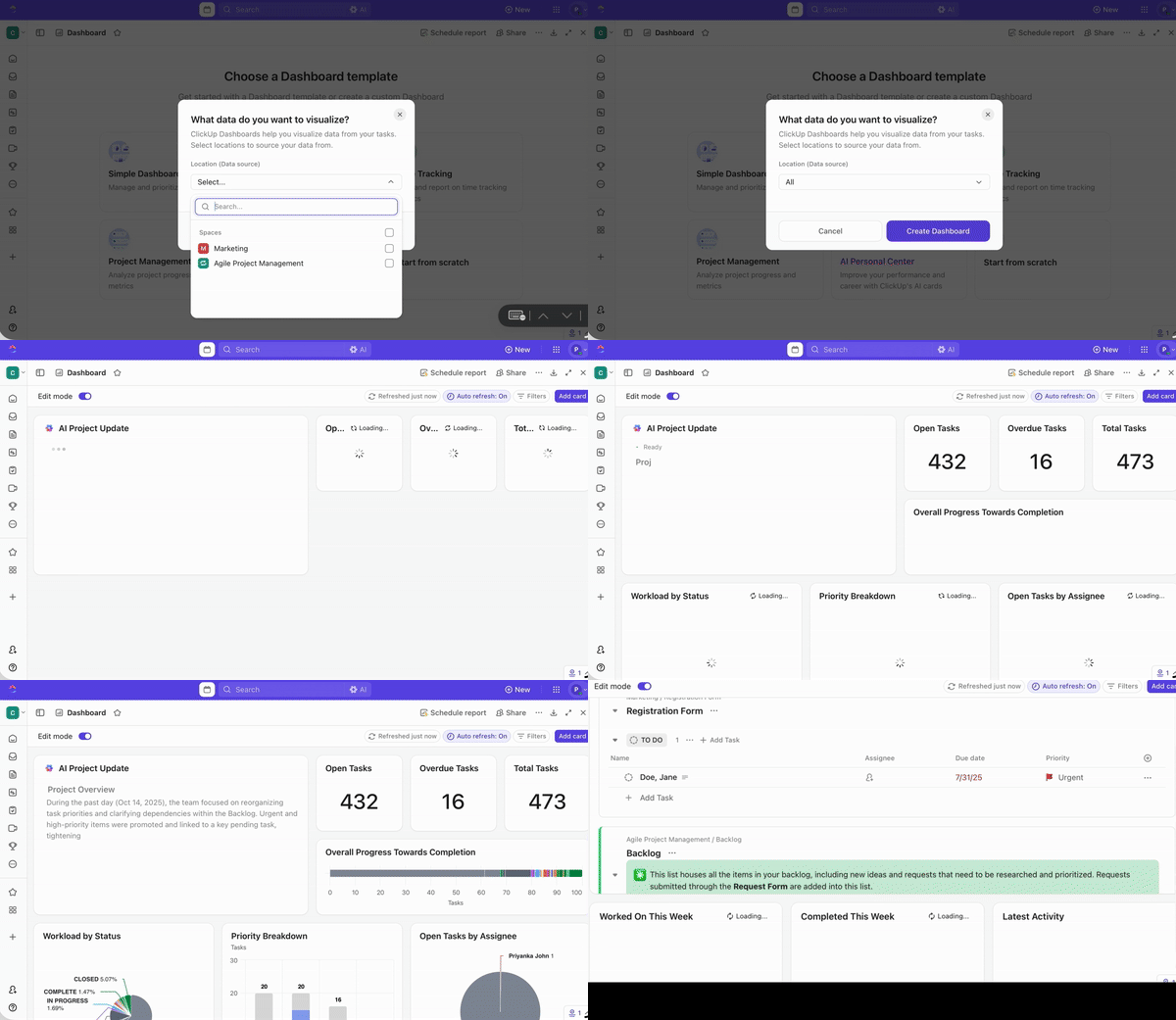
🚀 ClickUp Advantage: ClickUp takes reporting a step further with AI Cards, which offer intelligent summaries directly on your dashboard.
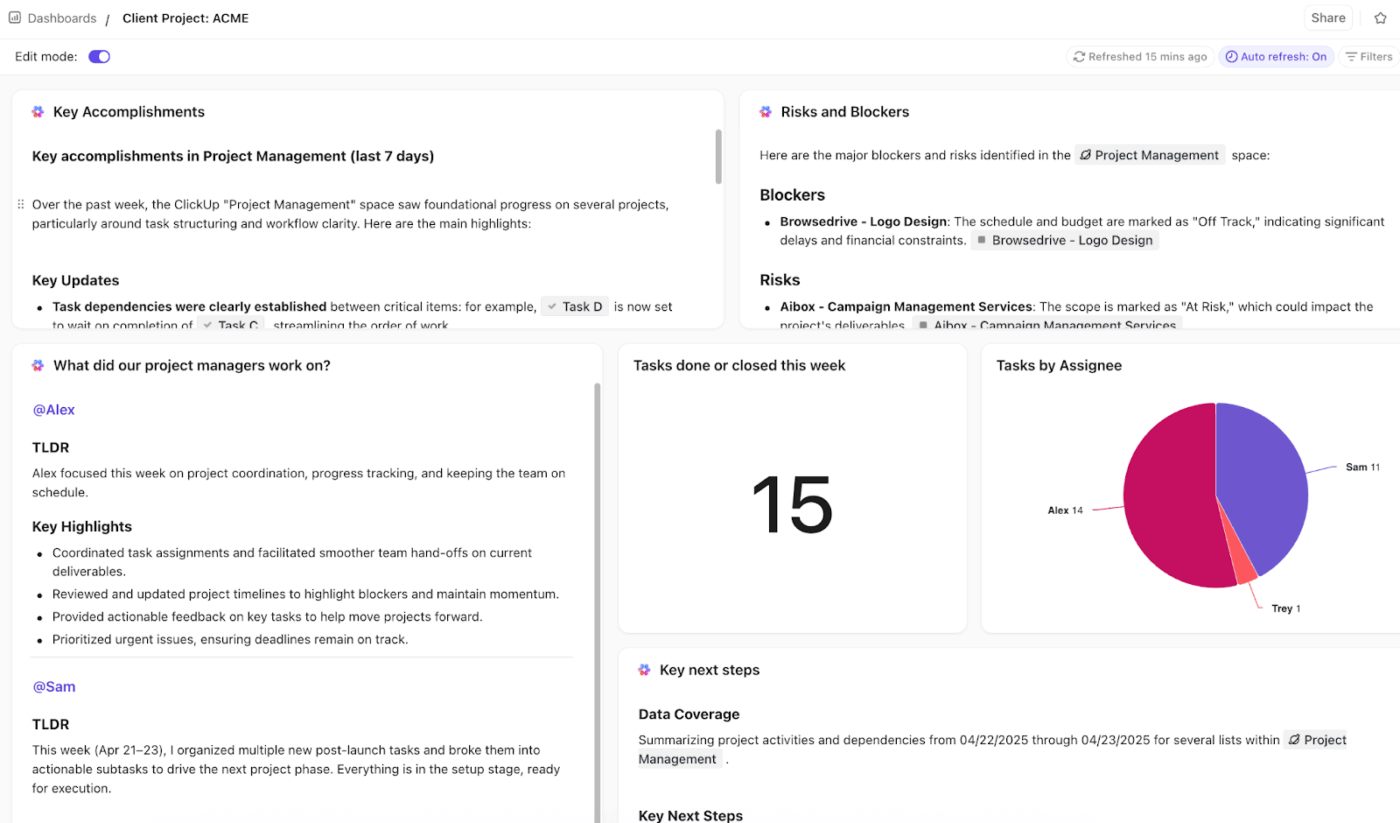
Some common AI cards you can use for ad campaigns:
Additionally, we also have some marketing dashboard examples for inspiration.
Below are five common challenges that creative teams face when planning their AI ad campaigns, along with easy fixes:
| Common challenge | Why it happens? | How to avoid it? |
| Over-reliance on AI and automation | AI tools promise speed and efficiency. Once your ad campaigns start performing well, you stop questioning the system. | Build regular check-ins where someone actively reviews AI decisions and performance in your ad campaigns. |
| Generic content creation | Vague prompts, bias in training data, and incomplete instructions reduce AI output quality. | Write prompts clearly, backed with complete context or necessary guidelines. Iterate until you get it right. |
| Balancing human creativity with AI | Mostly seen in advertising agencies where the pressure to create overpowers designers to max out on AI tech. They lose touch with human creativity and start trusting AI outputs blindly. | Define boundaries for AI usage in your creative ads. For example, use AI for insights and asset variations, but leave primary creative direction to humans. |
| AI tool sprawl | Teams adopt separate AI marketing tools for different tasks—content creation, project management, analytics, etc. Together, they create fragmented workflows. | Be intentional about your creative AI stack. Understand where you need AI and invest in tools that offer multiple AI capabilities under one roof. (Like ClickUp!) |
📚 Read More: Top AI Tools for Consulting Businesses
Before we wrap up, we have a little surprise. 🎁
We’ve curated a short (but super helpful) list of tools and templates that will add structure to your AI campaigns and help you plan better.
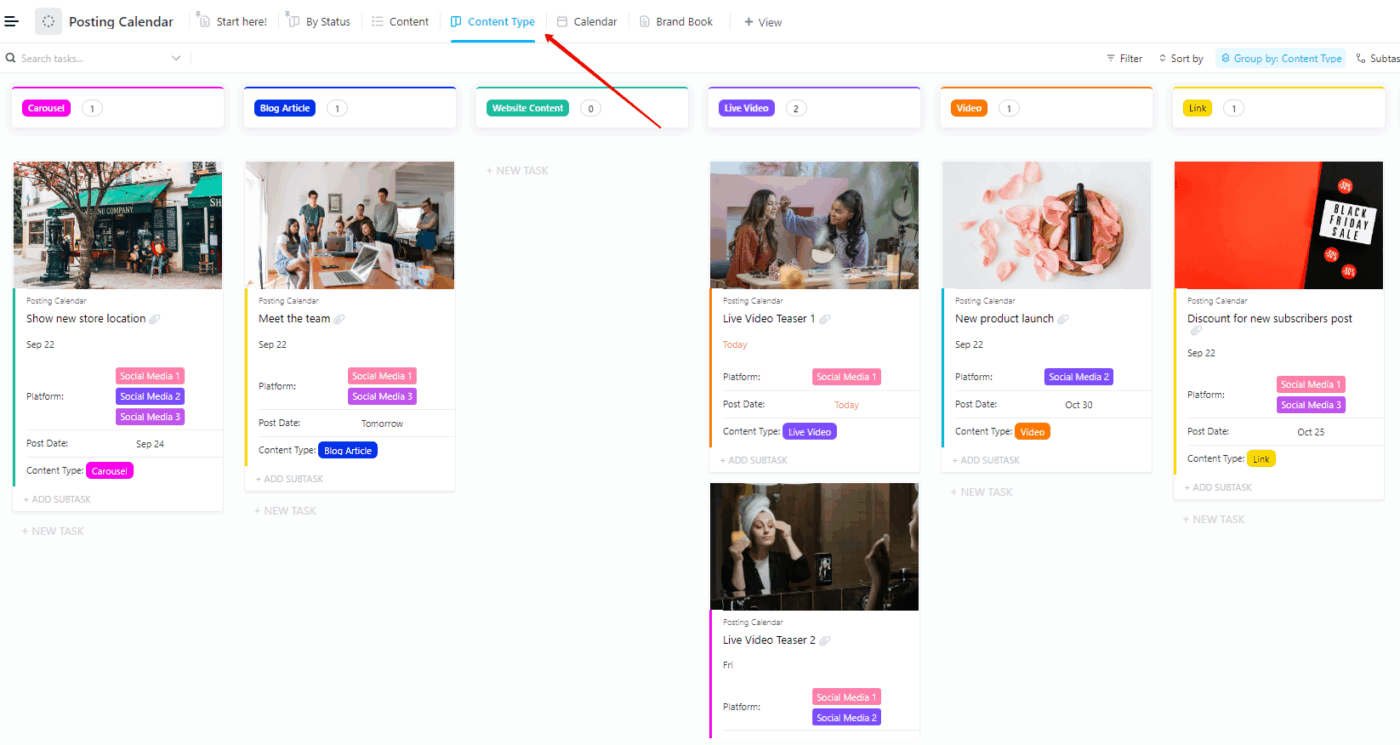
ClickUp’s PM Software for Marketing Teams is an all-in-one hub for AI ad campaigns. It serves as the single source of truth for your entire campaign lifecycle:
The platform consolidates all the tools needed to manage AI campaigns at any stage, for all professionals. Plus, you don’t even need AI expertise or technical knowledge to use ClickUp. It’s super intuitive!
💡Pro Tip: Here’s how our teams at ClickUp plan their marketing campaigns end-to-end. Hear it from Mike, one of our Strategic Solutions Engineers.👇🏼
📚 Read More: Your Guide to Project Management for Marketers
Jasper is used by copywriters looking to scale content without losing their brand’s soul. It’s a conversion-focused engine that generates ad copy, headlines, and landing pages tailored to your specific brand voice.
By feeding it your creative brief, Jasper can spit out dozens of A/B variants in seconds—perfect for high-velocity testing.
For brands spending heavily on paid media, Google Marketing Platform is the gold standard for unified ad buying and measurement. It integrates Search Ads 360 with Display & Video 360, providing a holistic view of the customer journey.
Use it to identify exactly where drop-offs occur and which AI-generated creative combinations are driving the highest ROI.
📚 Read More: Best AI Tools for Customer Service
🧠 Fun Fact: On July 1, 1941, the first legal TV commercial aired in the U.S. during a baseball game between the Brooklyn Dodgers and the Philadelphia Phillies. It was for Bulova Watches. It lasted 10 seconds and showed a watch over a map of the United States with the voiceover: “America runs on Bulova time.” The total cost for the airtime? Nine dollars.
Here’s our list of pre-built templates to take your campaign from idea to launch 10x faster:
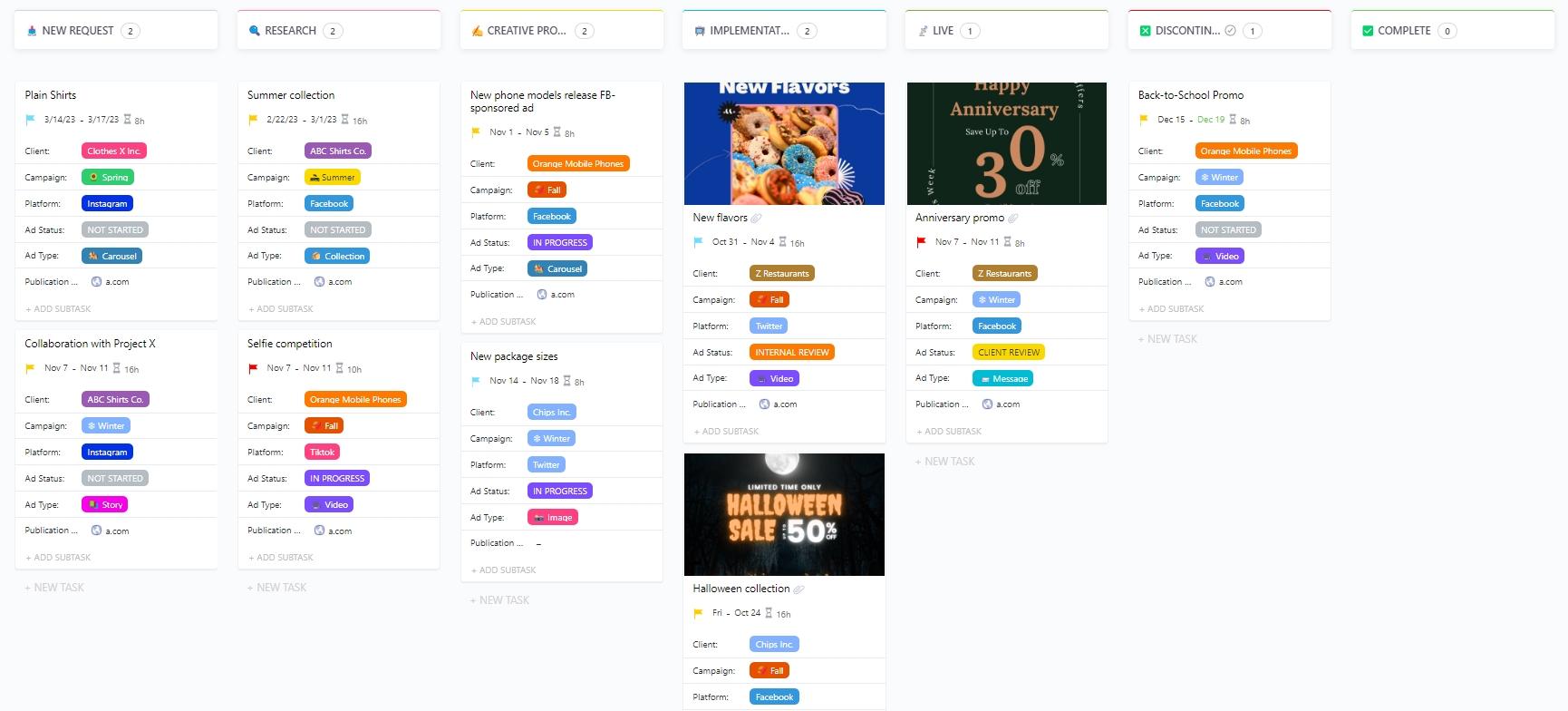
ClickUp’s Advertisement Template is your ready-made blueprint for running digital marketing ads smoothly. Drop it into your ClickUp Workspace, and it instantly creates a dedicated List with everything preconfigured for advertising workflows.
This template lets you:
Not sure where to start your ad campaign plan?
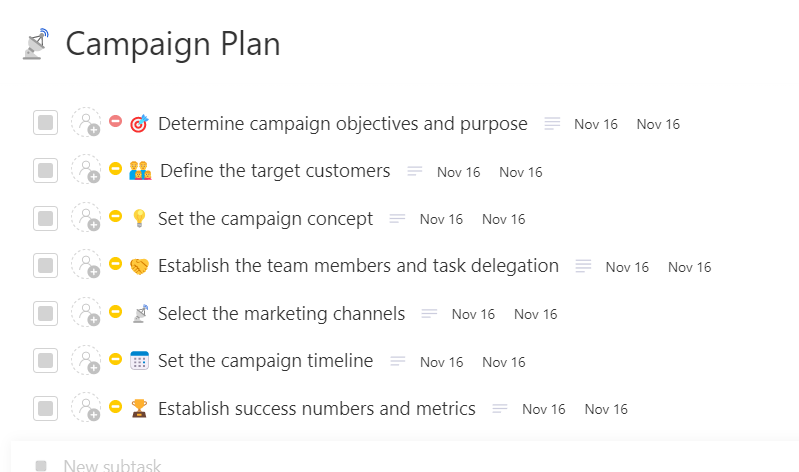
Use ClickUp’s Campaign Plan Template to get your AI advertising machine running in minutes. It helps you set goals for your next campaign, communicate objectives and assignments, track progress, and measure overall success.
The template lets you:
⚡ Template Archive: Cracking Advertising Templates for Maximizing Your Reach
If there’s one common key insight from every successful AI advertising campaign, it’s this:
AI doesn’t build campaigns. People do.
Sure, it speeds up work, reduces mental load, and supports your creative processes.
But at the end of the day, you are the one with the high-level judgment, the emotional intelligence, and the unique perspective required to make a brand truly resonate.
ClickUp is designed to restore this balance. It automates repetitive tasks and makes your workspace super productive so that you can ultimately focus on creating personalized campaigns that never miss the mark.
Ready to see it in action and drive business growth? Sign up for ClickUp today.
You need to master prompt engineering—the ability to give AI clear, specific instructions to get high-quality results. Having a strong editorial eye is equally important, as you’re no longer just a creator but someone who filters and refines AI output.
AI in advertising automates high-volume tasks, such as versioning ads for different platforms or segments (e.g., older vs. younger audiences; local vs international audience). It’s also used as a content generator to produce assets at scale and bypass slow brainstorming sessions.
Behind the scenes, AI brings in predictive analytics to understand past performance, consumer data, and market trends. Based on these, it tells you the next-best decision for optimal campaign performance.
The key challenges of using AI in advertising include over-reliance on AI and automation, generic or outdated content creation, balancing human creativity with AI-driven marketing efforts, and AI tool sprawl.

© 2026 ClickUp

There’s an easier way. Try a free AI Agent in ClickUp that actually does the work for you—set up in minutes, save hours every week.