






Still downloading templates?
There’s an easier way. Try a free AI Agent in ClickUp that actually does the work for you—set up in minutes, save hours every week.
Sorry, there were no results found for “”
Sorry, there were no results found for “”
Sorry, there were no results found for “”
In 1996, Robert Kaplan’s Balanced Scorecard warned that only 10% of strategic initiatives succeeded, which sounds bad.
But the data that came after is even more mind-boggling; it says the probability of your project’s success could be anywhere between 7% and 99%. The odds seem to have shifted significantly.
But the playbook and challenges remain pretty much the same: You build the strategy, align stakeholders, and launch the initiative. Then, progress slows, deadlines slip, updates lag, and teams scatter into disconnected workstreams.
This is where strategic ambition meets operational chaos.
Execution at scale, whether digital transformation, M&A, or market expansion, breaks down under complexity. Siloed tools, poor visibility, and slow decisions disconnect strategy from delivery.
AI is closing that gap. AI-driven strategic initiative execution gives leaders real-time visibility, faster planning, and smarter resource alignment—turning strategy into outcomes.
In this guide, we’ll break down how AI changes execution and how to tap into it with tools like ClickUp.
AI in strategic initiative execution stands for embedding AI algorithms, AI models, AI systems, and AI technologies deep into the strategy development process, so that every stage—from defining strategic goals and business objectives to choosing initiatives and mobilizing human resources—is guided by AI generated insights.
Isn’t that just “project management with AI”? Not really.
AI-driven strategic initiative execution marks a fundamental shift in how companies approach strategic delivery. In short, AI becomes a co‑pilot: providing computational power, foresight, and pattern recognition, while human judgment, creativity, and oversight ensure relevance, purpose, and ethical alignment.
| Traditional approach | AI-driven execution |
| Manual reporting and tracking | Real-time dashboards and automated reporting |
| Reactive risk management | Predictive analytics and early warning systems |
| Siloed decisions and tools | Integrated intelligence across systems and workstreams |
| Gut-feel prioritization | Scenario planning and data-backed decision-making |
Here’s what it looks like in practice: Instead of relying on bi-weekly status meetings and Excel trackers to detect issues, your AI assistant flags risk patterns, budget overruns, timeline bottlenecks, or goal misalignment, before they escalate.
Your executive team gets tailored summaries with real-time ROI forecasts. Frontline teams are automatically aligned to top-level OKRs, and cross-functional stakeholders stay connected through a shared, always-updated source of truth.
Think extreme visibility, faster pivots, and a tighter feedback loop between strategy and execution. That’s the promise of AI-driven strategic initiative execution.
When strategic initiatives fail, the cost isn’t just sunk investment. It’s lost time, market share, and morale.
According to McKinsey, 70% of transformation efforts fail, often due to execution gaps, not flawed strategy. That’s because execution, especially at scale, is deceptively hard.
It’s not one project, it’s dozens (or hundreds) of interrelated efforts, stakeholders, and dependencies, all operating across time zones, functions, and tech stacks.
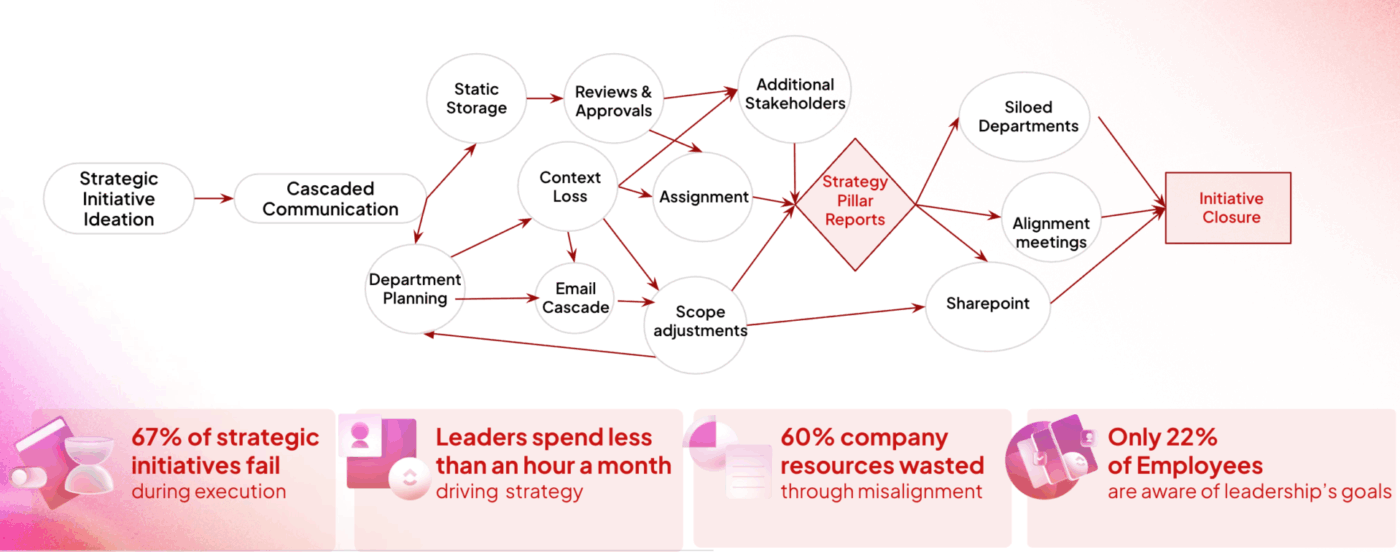
One of the most pervasive (and underdiagnosed) causes of initiative failure is work sprawl, the uncontrolled fragmentation of execution across tools, teams, and channels.
Let’s unpack its symptoms:
When updates live in silos—slide decks, Slack threads, Monday boards, Jira tickets—no one sees the full picture. Leaders struggle to track impact, and teams duplicate work without realizing it.
📮 ClickUp Insight: 83% of knowledge workers rely primarily on email and chat for team communication. However, nearly 60% of their workday is lost switching between these tools and searching for information.
Teams often sprint without a clear line of sight to the “why.” A ClickUp survey found that 92% of knowledge workers risk losing important decisions scattered across chat, email, and spreadsheets. And that’s how OKRs get buried, initiatives drift, and execution becomes disconnected from intended outcomes.
When decisions rely on outdated reports or static dashboards, leaders lose the agility to respond. By the time risks surface, it’s often too late to course-correct.
📮ClickUp Insight: In a ClickUp survey about decision debt, 32% of respondents said that their work gets delayed while waiting on decisions. While reasons for this range from a lack of visibility or no clear ownership, the result is always the same: a slow leak in productivity and effective execution.💧
Work sprawl, combined with unclear ownership and scattered communication, makes it hard to see who’s overloaded or underutilized. This causes teams to misallocate resources, leading to burnout in some areas and wasted capacity in others, while budgets spiral out of control.
This invisible chaos quietly drains your initiative’s momentum and inflates costs.
📮 ClickUp Insight: When it comes to visibility in project execution, 31% of managers prefer visual boards, while others rely on Gantt charts, dashboards, or resource views. Each view often means adding one more tool or integration to your tech stack, further adding to the work sprawl and complexity.
When integrated well into your workflows, AI becomes a strategic enabler by maintaining momentum.
Momentum, in this context, means sustaining a consistent, bi-directional flow of information between leadership and delivery teams.
It ensures strategy informs execution in real time, and execution continuously feeds back insights that sharpen strategy. AI keeps this loop intact, surfacing insights, highlighting risks, and enabling course correction before momentum is lost.
That looks like:
AI delivers value across the full lifecycle of strategic initiative management.
From early-stage planning and alignment to execution, AI enhances foresight and improves cross-functional coordination. Here are some of the most impactful AI use cases for strategic execution:
AI models can simulate various initiative paths using historical project data, internal performance metrics, and external market trends. This allows leaders to test assumptions before committing to a plan, such as estimating time-to-value for a product launch, projecting the ROI of an M&A integration, or modeling resource impact on delivery timelines.
But forecasts aren’t just limited to launch readiness; they extend into execution, allowing for dynamic adjustments based on live input and shifting priorities
📣 ClickUp Callout: Shipt, a leading American delivery service, transformed its strategic execution by moving from Wrike to ClickUp. Facing challenges with fragmented communication and limited visibility, Shipt’s Marketing Project Management Office consolidated over three communication channels into ClickUp, creating a single source of truth for all marketing operations.
This shift enabled faster cross-functional alignment, accelerated the execution of marketing programs, and improved collaboration across teams. With ClickUp’s centralized platform, Shipt streamlined workflows, enhanced real-time updates, and empowered teams to make quicker, data-driven decisions. As Leslie Jones, Senior Marketing Project Manager at Shipt, shared:
ClickUp allowed us to streamline our operations and efficiency, making it easier to collaborate and manage our projects effectively.
Stakeholder communication is one of the most resource-intensive parts of managing large-scale initiatives. AI eliminates the need to manually compile updates by generating timely, tailored reports for each stakeholder group.
Whether it’s a board-level summary, a cross-functional status update, or a department-specific KPI snapshot, AI can automatically extract and synthesize relevant data, ensuring consistency, clarity, and alignment without the usual reporting overhead.
In large organizations, goals often get diluted as they cascade down through business units. AI solves this by mapping organizational OKRs and KPIs across departments in real time, identifying overlaps, gaps, or misalignments before they cause confusion.
When team-level activities start to drift from strategic intent, or when duplicate efforts emerge, AI surfaces these inconsistencies and helps recalibrate priorities. The result is a tighter connection between enterprise vision and execution at the team level.
📖 Read More: Best Marketing AI Tools
AI doesn’t just show you where resources are allocated; it recommends where they should be. By analyzing team capacity, task dependencies, delivery velocity, and historical workload patterns, AI can propose more efficient use of talent and budget.
For example, it may suggest shifting a specialized resource to a higher-risk initiative, rebalancing team loads to prevent burnout, or reallocating budget mid-quarter based on performance variance.
Senior leaders need sharp visibility into what’s working, what’s off-track, and what decisions need to be made. AI tools can distill complex initiative data into intelligent, contextual summaries. These highlight key updates, surface unresolved risks, and project downstream impact, helping leaders stay informed, make timely decisions, and communicate confidently with other stakeholders.
💟 Bonus: Brain MAX is your AI-powered desktop companion that makes staying up to speed effortless. Need a quick update? Just ask, and Brain MAX instantly generates real-time summaries of meetings, chats, documents, or project updates—pulling in the most important details so you never miss a beat. Whether you’re catching up after a busy day or prepping for your next task, Brain MAX keeps you informed and focused in seconds.
In strategic initiatives, AI allows you to finally stop managing projects and start executing.
Here is a structured, AI-enhanced approach to initiative execution, designed for cross-functional teams, PMOs, and strategic leaders.
Start with clarity.
Before execution begins, ensure your initiative has a defined scope, business outcome, and measurable success criteria (OKRs, KPIs, or key results).
AI tools can assist in benchmarking these goals based on historical data, market dynamics, and performance trends.
Where AI adds value:
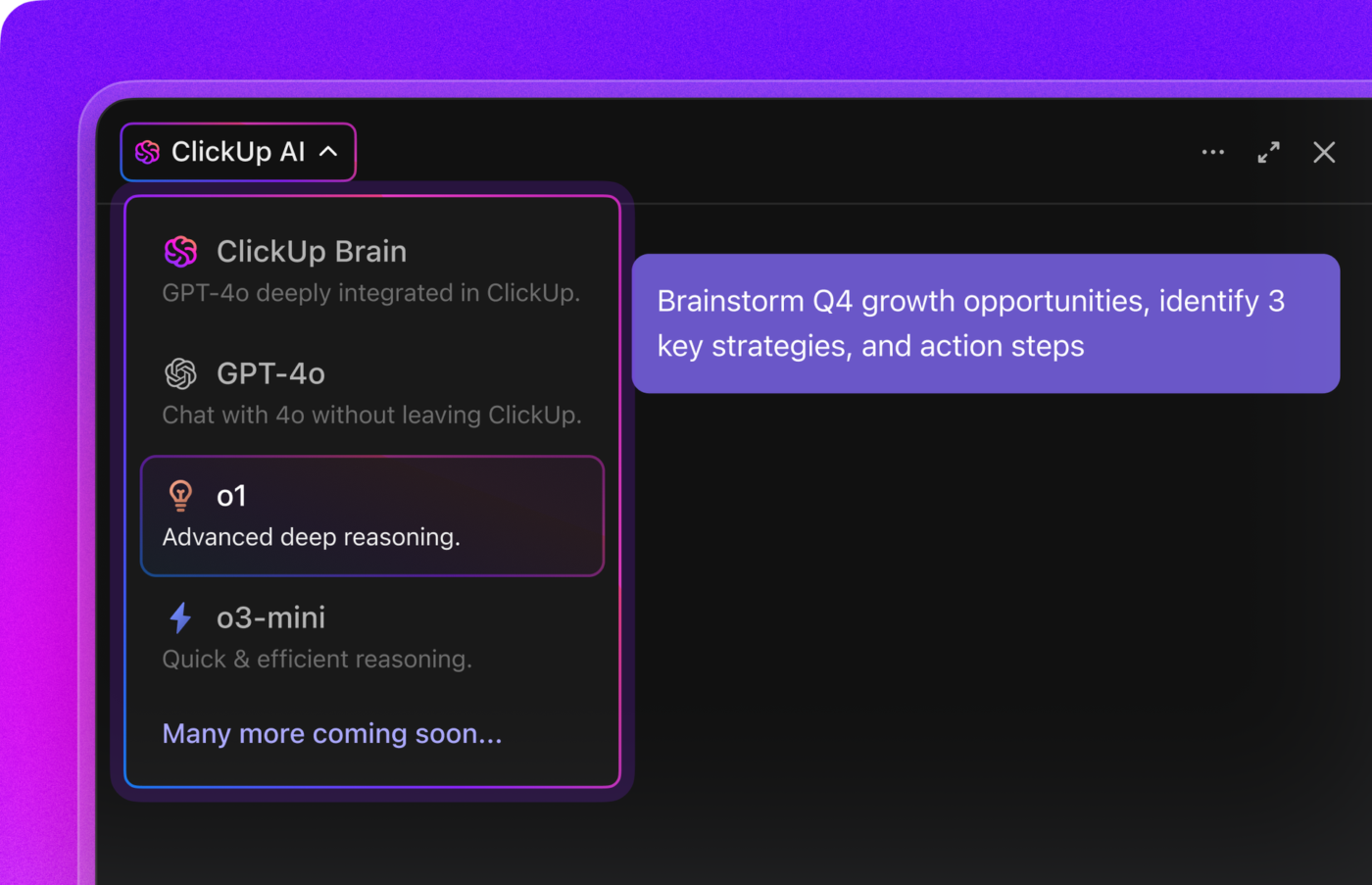
💫 The ClickUp advantage: As the everything app for work, ClickUp brings all the tools you need for goal-setting, tracking tasks, keeping your team in sync, and more. And AI connects it all. Let’s start with goals!
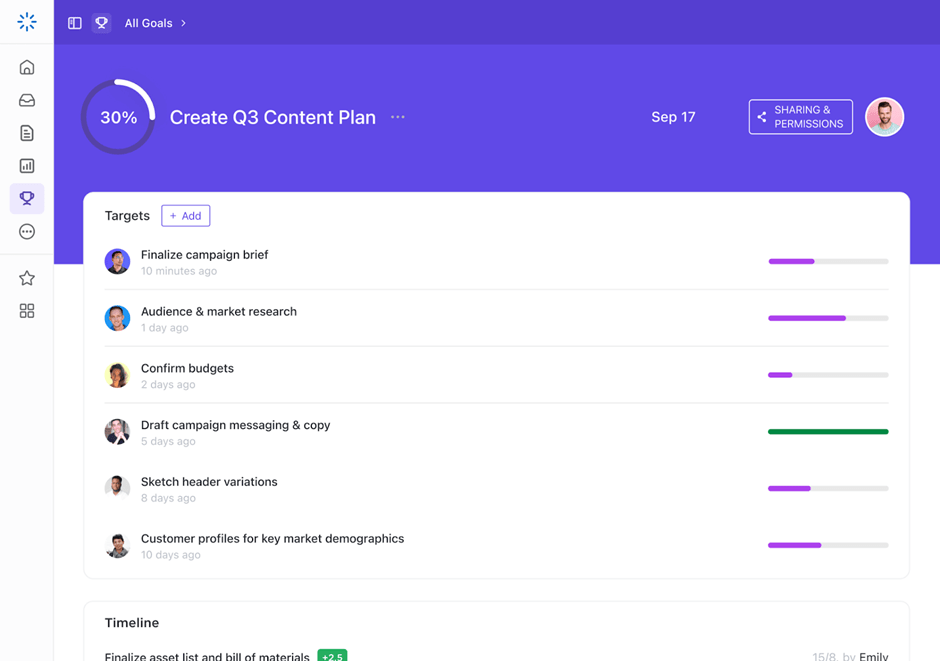
This is where many strategic plans lose momentum—big ideas stay too high-level.
Most strategic failures happen because big ideas don’t break down into manageable, measurable work. AI enables you to translate vision into workstreams, phases, epics, and tasks—complete with ownership, dependencies, and timelines.
Where AI adds value:
💫 The ClickUp advantage: With ClickUp Brain, teams can prompt the platform to break a strategic goal into tactical steps, set priorities, and assign them among teammates. These are intelligently grouped, prioritized, and linked to timelines.
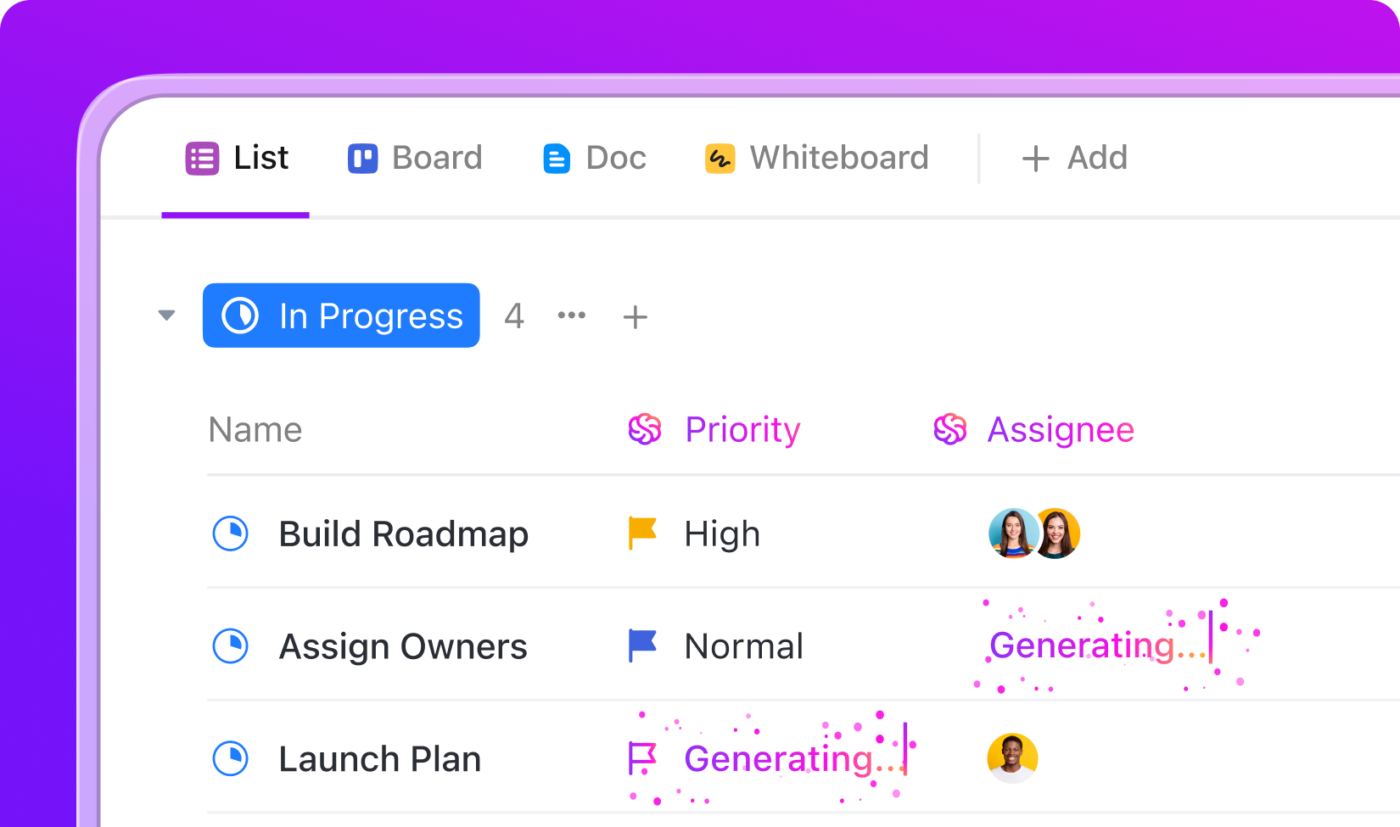
Strategic initiatives often demand cross-functional collaboration to the highest degree. That means teams like sales, marketing, product, IT, finance, and HR need to move as one.
But part of the execution can be incredibly complex and often derails the whole thing.
How AI helps:
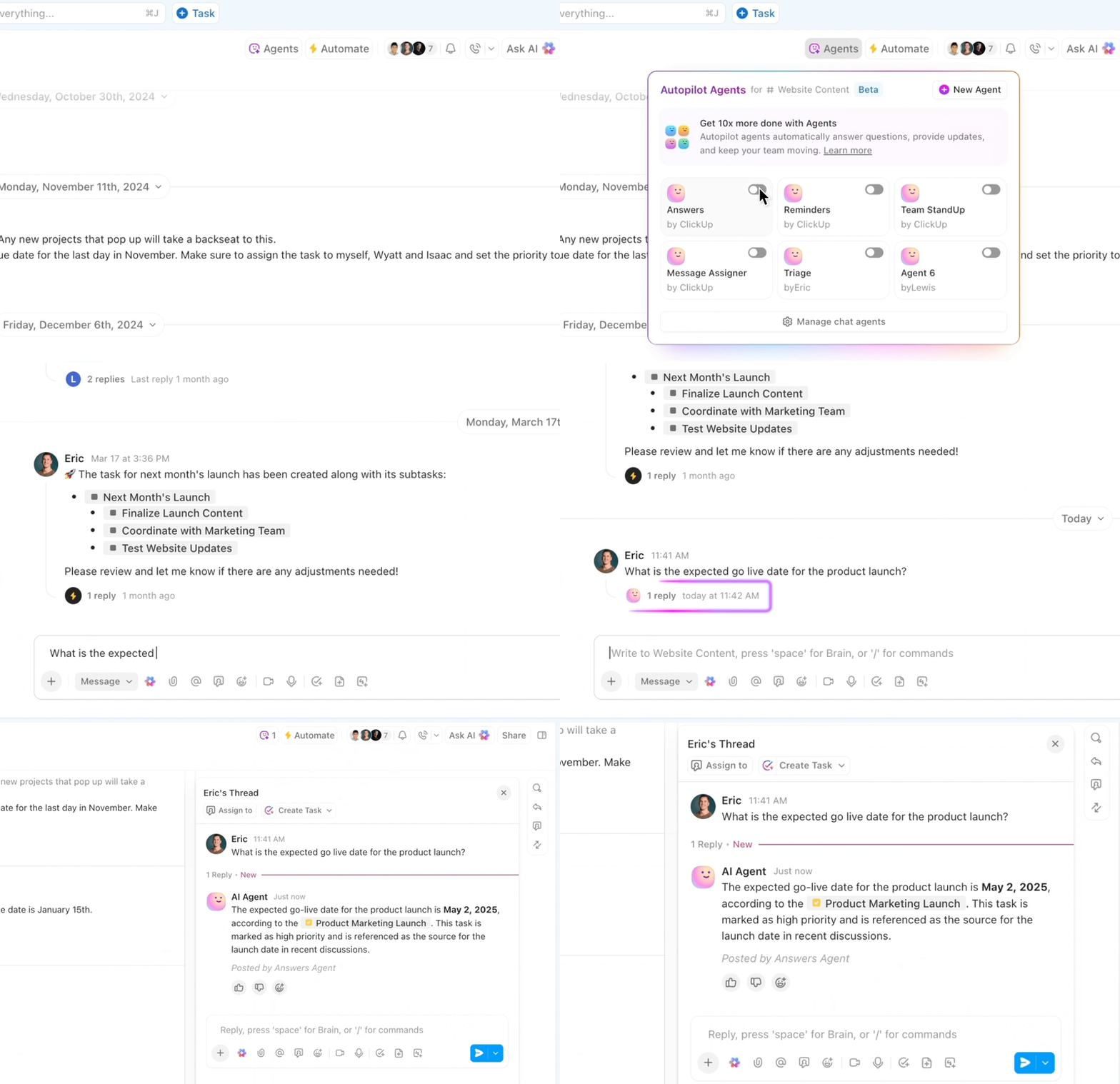
💫 The ClickUp advantage: Integrated Chat in ClickUp ensures that all your teams are communicating within the same platform, and AI Autopilot Agents in ClickUp can be configured to handle communication-related tasks autonomously:
📖 Read More: 60+ OKR Examples–How To Write Effective OKRs
Risk management is no longer about reacting to issues after they arise. AI can detect early signals of slippage before they appear in reports.
Where AI adds value:
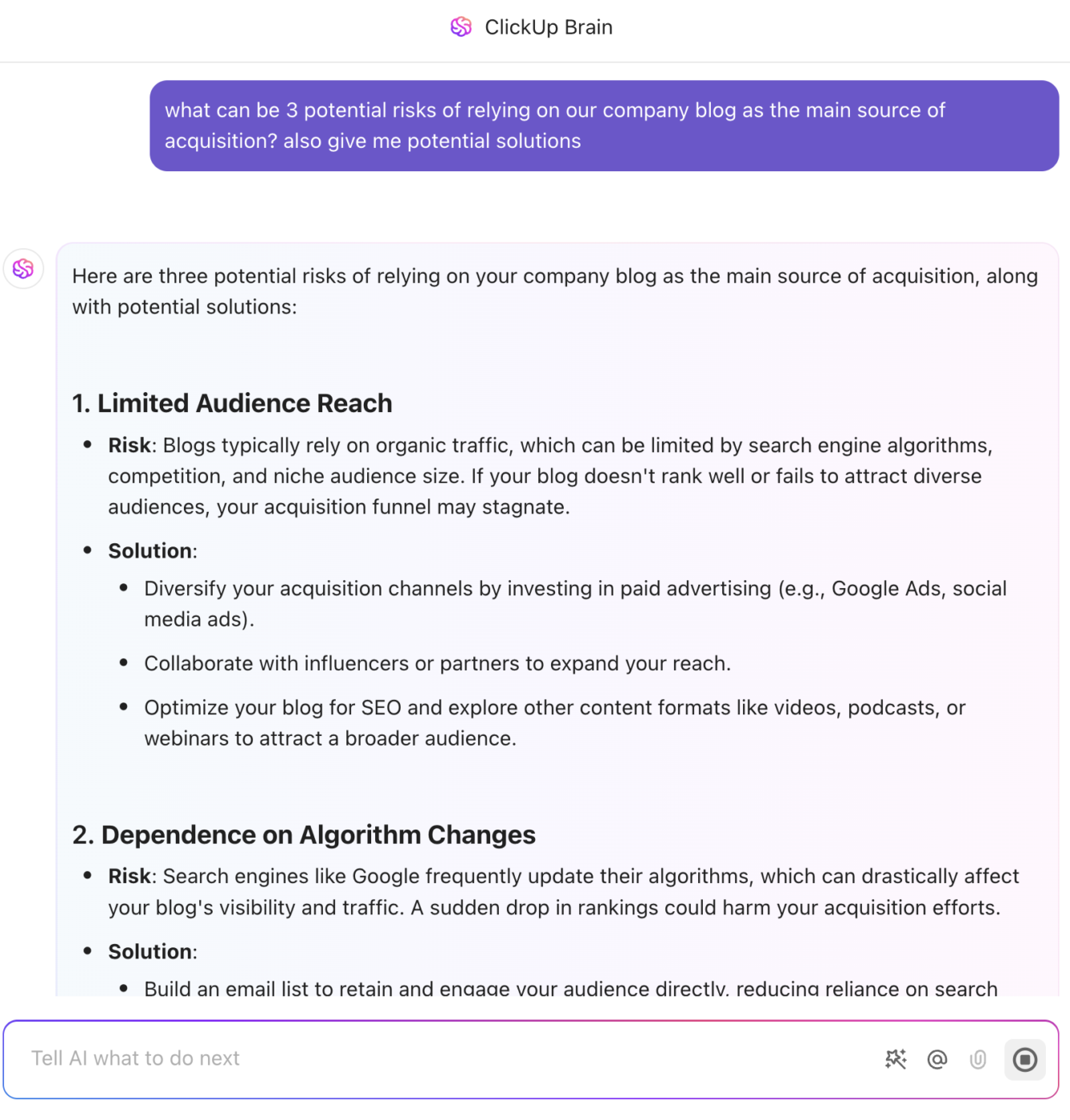
💫 The ClickUp advantage: ClickUp Brain can monitor all project activity and historical velocity to flag at-risk deliverables. Ask it to help you:
Leadership needs more than task checklists—they need business insight. AI transforms data into meaningful dashboards that reflect initiative health, pace, and outcomes.
Where AI adds value:
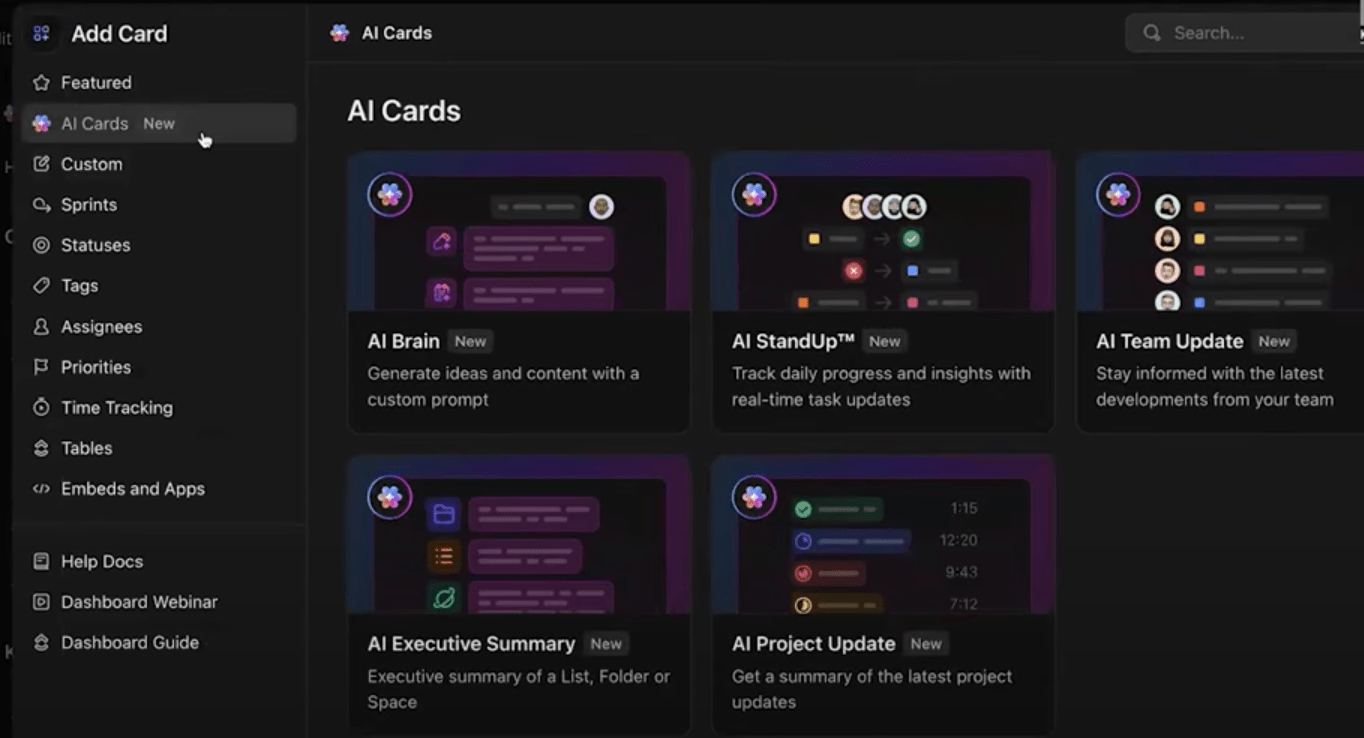
💫 The ClickUp advantage: Use AI Dashboards in ClickUp to help you visualize key metrics fast.
Execution isn’t the finish line. It’s the beginning of a feedback loop. AI empowers teams to learn from every initiative, improving agility and effectiveness over time.
Where AI adds value:
💫 The ClickUp advantage: ClickUp Brain generates automated retrospectives with performance analytics, qualitative insights, and stakeholder feedback. Simply provide the framework you want, and it will summarize what worked, what didn’t, and why—without needing manual analysis
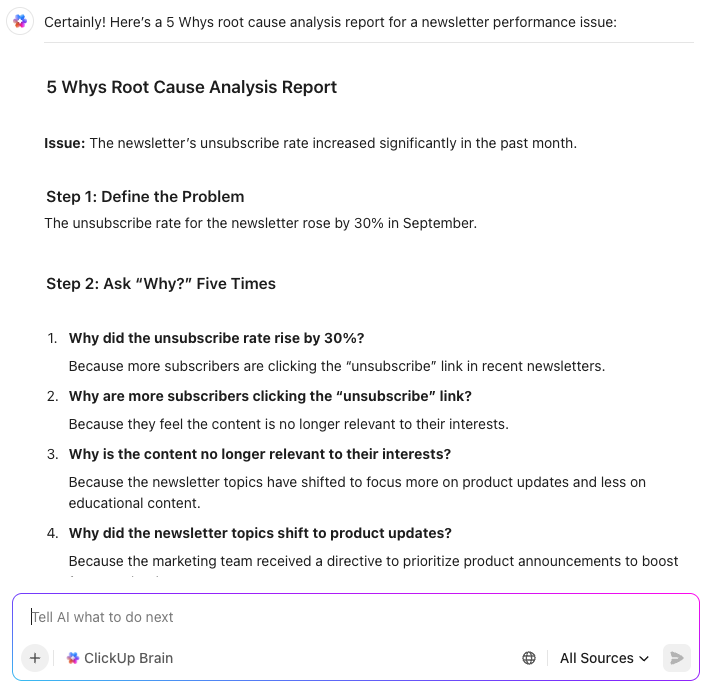
In strategic execution, completion is only one dimension of success.
What matters is the ability to understand impact while there’s still time to influence it.
That’s where AI changes the game: by helping teams interpret both current performance and future trajectory with clarity and precision.
Success often begins with early signals—pacing, engagement, cross-functional coordination, or emerging blockers. These are leading indicators, and they often tell you more about likely success than any retrospective metric can.
Lagging indicators, like cost reduction, revenue impact, or customer growth, confirm what actually happened. They matter deeply, but they come too late to change course.
The real advantage of AI lies in its ability to synthesize both types of data in real time. Instead of waiting for the end-of-quarter review, leaders gain access to intelligent updates like:
When both signal types surface early, teams aren’t just tracking; they’re adjusting.
Traditional dashboards often capture the what, but not the why or what’s next. AI-enhanced dashboards go further, pulling in live data across tasks, timelines, and conversations to produce strategic context.
Instead of passively reporting project completion percentages or overdue tasks, these systems synthesize data into dynamic updates that reflect the state of execution across key dimensions. Stakeholders can see not only where the work stands, but what emerging trends or risks require attention.
A cross-functional initiative, for instance, may show high completion rates overall, but AI might surface a specific dependency in IT that threatens to delay rollout, something a static timeline might not flag until it’s too late.
Here’s how AI-powered dashboards help, Kyle Coleman, our GVP of Marketing, stay on top of his priorities.👇🏼
The most effective teams don’t just learn from what happened. They learn from mistakes and prepare for what’s coming. AI brings predictive modeling into strategic execution by analyzing initiative performance alongside market signals, internal trends, and historical benchmarks.
This allows organizations to anticipate:
These insights enable faster, smarter strategic decisions, before results are locked in, and while there’s still time to optimize.
While many tools offer AI capabilities, only a few are purpose-built to support strategic execution at scale. We’ve rounded up the best tools here for you!
As the everything app for work, ClickUp stands out as one of the best AI-powered tools for organizations seeking to turn vision into results. At the heart of this transformation is ClickUp Brain, an intelligent AI layer that streamlines planning, tracking, and insights across every stage of an initiative.
With ClickUp’s AI-powered goal setting and alignment, teams can easily translate high-level strategies into actionable objectives. The platform helps break down complex vision statements via ClickUp Goals, assign responsibilities, and ensure that every contributor understands how their work connects to the organization’s broader mission.

As for leaders, one of the most valuable features is ClickUp’s ability to generate AI-powered executive summaries automatically. Instead of spending hours compiling updates, executives receive concise, AI-generated overviews that highlight key achievements, risks, and next steps. This empowers decision-makers to stay informed and respond quickly to changing priorities, without getting lost in the details.
Collaboration and work context are further enhanced through ClickUp’s integrated Chat, which allows team members to communicate instantly within the platform. Whether discussing project updates, sharing files, or brainstorming solutions, chat keeps conversations organized and accessible alongside tasks and goals. This seamless communication eliminates the need to switch between tools, ensuring that everyone stays connected and aligned throughout the execution process.

For tracking results, real-time Dashboards in ClickUp offer instant visibility into every aspect of an initiative. Teams and leaders can monitor progress, identify bottlenecks, and track key performance indicators at a glance. This transparency fosters accountability and enables proactive adjustments, ensuring that strategic goals remain within reach.
By combining advanced AI capabilities with strategic project management, ClickUp empowers organizations to move seamlessly from strategy to execution. The result is a frictionless experience where planning, collaboration, and reporting are unified—enabling teams to achieve ambitious goals faster and more efficiently than ever before.
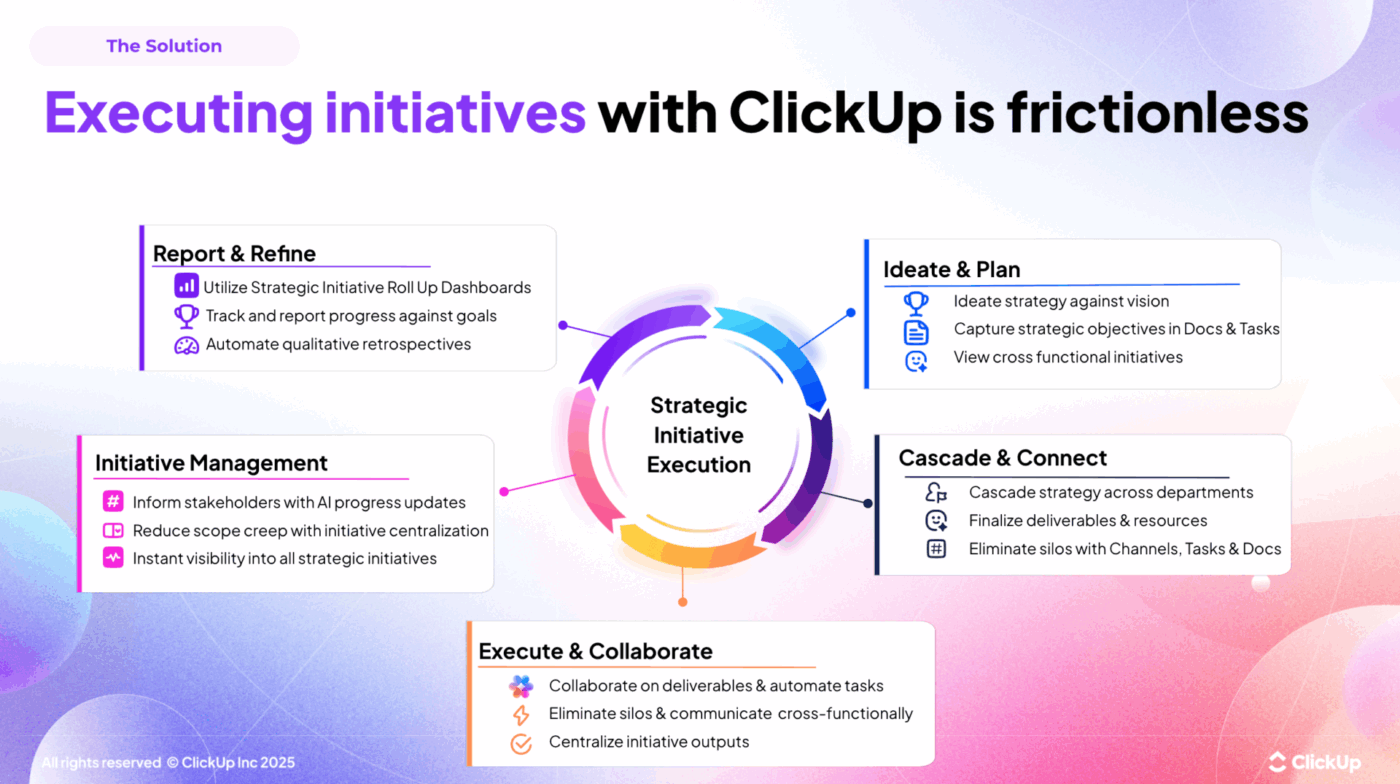
⚡️ Template Archive: ClickUp also simplifies the process of launching and managing strategic initiatives with its library of AI-enhanced templates. Whether building a strategy roadmap or tracking progress on multiple initiatives, these templates provide a proven structure that teams can adapt and reuse. This not only saves time but also ensures consistency and best practices across the organization.
Here’s a list of top strategic execution templates from ClickUp!
| Template Name | Description |
| Strategic Business Roadmap Template | Plan, track, and manage strategic business growth with a clear roadmap |
| Strategic Roadmap Template | Visualize your company’s future and align teams with strategic initiatives |
| Project Strategy Template | Organize and execute project strategies for better alignment and results |
| Growth Experiments Whiteboard Template | Ideate and execute growth initiatives and experiments visually |
| Company OKRs and Goals Template | Align your organization with objectives and key results for strategic execution |
| Strategic Roadmap List Template | Map out and visualize your company’s long-term strategy and initiatives |
Palantir Foundry is an advanced data integration and analytics platform designed for large-scale, high-security environments such as governments, defense, and complex global enterprises. It enables strategic execution by bringing together data, logic, models, and operations in a single governed platform.
Foundry’s unique ontology layer models both data and operational processes, allowing teams to simulate outcomes, perform advanced analytics, and then take action, all within one system. It tightly integrates with Palantir’s AI Platform (AIP), enabling users to embed AI agents and workflows directly into decision-making processes.
Workday Adaptive Planning is a cloud-based enterprise platform that uses AI and machine learning to enhance financial, workforce, and operational planning. Designed for CFOs and planning teams, it allows organizations to quickly adapt to changing business conditions through flexible budgeting, forecasting, and what-if scenario modeling.
Recent enhancements have introduced AI-driven features like Predictive Forecasting, which automatically generates data-driven insights and recommendations based on historical and external data. Adaptive Planning supports continuous planning cycles and close alignment between finance and HR, ensuring that workforce and financial strategies are connected. It empowers decision-makers to move beyond static planning toward more agile, responsive execution.
Tableau AI brings advanced analytics and machine learning into the hands of business users through its augmented and generative features. As part of the Tableau platform, it enhances traditional data visualization by enabling natural language querying, AI-generated insights, and intelligent recommendations.
Features like Tableau Pulse and Explain Data help surface real-time, personalized insights, making it easier for non-technical users to understand what’s happening in the business and why. Built on Salesforce’s Einstein Trust Layer, Tableau AI also incorporates strong data governance and transparency features. It’s ideal for organizations looking to democratize data, enhance strategic reporting, and empower teams to make informed decisions at speed.
Here are specific, documented use cases of organizations that used AI in executing strategy. And not just planning, but aligning their operations, priorities, capabilities etc.
Let’s have a look:
| Organization | Strategic goal / Focus area | AI in execution |
|---|---|---|
| DBS (Singapore) | To industrialize AI in banking, improving customer experience, operational excellence, and workforce capabilities. (DBS Bank) | DBS embedded AI across many parts of the bank since ~2014: ✅ Hyper‑personalised nudges for customers to improve investment & financial planning decisions ✅ Providing relationship managers with deeper insights about customers to engage better ✅ Tailored career / upskilling‑roadmaps for employees, to build long-term capability |
| Toyota | Speed up time‑to‑market for new vehicle development, reduce friction in R&D workflows, share internal knowledge, improve engineering productivity. (Microsoft) | Toyota built a system of AI agents (on Azure OpenAI Service) that store and share internal expertise. Engineers can query agents about workflows; multiple agents respond. Deployment started with their powertrain engineering teams (~800 engineers) since Jan 2024. |
| ABB | Improve industrial operations, maintenance, energy/emissions, bring AI into operations to make them smarter and more responsive. (Microsoft) | ABB developed Genix Copilot, a natural‑language tool on top of its IoT + AI platform (ABB Ability Genix). Users (non‑AI experts) can ask questions to get insights (about maintenance, operations, emissions etc). This lowers barriers to using the advanced analytics embedded in their products. |
| Johnson & Johnson (J&J) | To shift from many AI experiments to only those delivering high value; improve prioritization and governance of AI; ensure AI investments map to business impact. (Wall Street Journal) | J&J at one point had nearly 900 generative AI (and related) use‑case projects under a central governance board. They found that only ~10‑15% of those delivered ~80% of the value. In response, they pivoted: decentralized governance for some areas, focusing on high‑value domains (drug discovery, supply chain, internal support tools), reducing or killing low-yield initiatives. Also introducing “Rep Copilot” for sales reps to engage healthcare professionals. |
| Estée Lauder Companies (ELC) | To shorten time from trend detection to product launch; improve marketing & brand responsiveness; enhance internal efficiency in product development. (Vogue Business) | ELC + Microsoft created an AI innovation lab. Some projects: internal chatbot for marketing that can pull up authorized product claims; faster trend identification; tools to speed product research. The lab pulls together AI across its ~20+ beauty brands. |
Here’s a real-world example of how ClickUp is being used for strategic solutions:
I just stacked 5 ClickUp AI Agents together to remove all project management and administrative work I need to do to onboard a new customer.
All your sales team needs to do is move something to closed won in the CRM, and AI takes care of the rest.
👉 I’ve got a handoff agent that assigns the client lead based on their expertise and available capacity, plus pulls in relevant sales notes.
👉 I’ve got a team assignment agent that assigns the rest of the work based on the client lead (more helpful if you work in pods).
👉 I’ve got a kickoff agent that determines the onboarding kickoff date from the deal data and then uses that to remap due dates.
👉 I leverage Make to deploy a ClickUp folder template with documents, lists, and onboarding tasks, and create a shared drive and kickoff deck.
👉 I then have an onboarding agent that automatically assigns and remaps all onboarding tasks based on the previous agent outputs.
This work used to take over 2 hours.
But a few agents and automations can do it for you in 15 minutes or less.
AI can accelerate execution, surface unseen risks, and drive better decision-making, but it is not a silver bullet.
When misapplied, it introduces new types of failure modes: false confidence, automation without accountability, and friction in adoption. Here are the most common pitfalls that undermine AI-powered strategy execution—and how to mitigate them.
AI excels at identifying patterns, trends, and anomalies, but it operates without a business context. It doesn’t understand strategic nuance, cultural dynamics, or the unquantifiable dimensions of leadership judgment.
When teams lean too heavily on AI outputs without critical interpretation, they risk optimizing for what the system sees, not what the business actually needs.
❗️What to watch for:
✅ What works better:
Use AI as a source of insight, not authority. Create review points where humans interpret AI outputs in the context of business priorities, constraints, and strategic intent.
AI-driven forecasts are not guarantees—they are probability-weighted projections based on historical data and current signals. When treated as certainties, they can lead to overconfidence, premature commitments, or underestimation of risk.
❗️What to watch for:
✅ What works better:
Treat predictive analytics as directional intelligence. Use them to frame scenarios, test assumptions, and inform, but not dictate, your planning and investment decisions.
No matter how advanced the system, AI adoption fails when people don’t trust or understand it. If teams feel excluded from the process, unclear on how decisions are made, or overwhelmed by automation, resistance builds quickly.
❗️What to watch for:
✅ What works better:
Anchor AI implementation in transparency. Involve stakeholders early. Communicate not just what AI is doing, but why it matters—and how human oversight remains central.
📖 Read More: How ClickUp’s Marketing Team Uses ClickUp
As AI becomes more capable, organizations are moving beyond seeing it as a tool or automation engine to positioning it as a partner in strategy execution. This means embedding AI deeply in decision workflows, accountability, foresight, innovation, and pairing its strengths with human judgment, values, creativity, and oversight.
What follows are key dimensions of this shift, with what’s happening now, what it enables, and what challenges and design actions are required.
A major trend is the rise of agentic AI, software agents that can act with some autonomy, and how it’s forcing executives to rethink trust.
According to a Capgemini Research Institute report, agentic AI could unlock roughly US$ 450 billion in economic value by 2028 (through both cost savings and revenue gains), yet trust in fully autonomous agents has dropped sharply (from 43% to 27%) in just a year due to concerns around ethics, explainability, and privacy. Organizations are increasingly considering AI as a “co‑pilot” rather than a replacement—over 60% expect AI agents to form human‑agent teams in the next year.
Another evolving pattern is that organizations are demanding more visibility into how AI makes decisions and are embedding accountability structures. From the Capgemini study, only about 15% of business processes are semi‑autonomous to fully autonomous today, with most AI agents functioning in a supportive/copilot role.
Also, nearly 70% of organizations believe adopting AI agents will lead to restructuring roles, workflows, and team responsibilities, essentially redefining who is responsible for what.
Finally, there is movement away from reacting to changes toward using AI to anticipate trends, simulate strategy alternatives, and spark innovation. The research shows that in environments where human‑AI collaboration is effective, organizations expect to see substantial upticks in human engagement in higher‑value tasks (about 65%), creativity (≈ 53%), and employee satisfaction (≈ 49%)—all of which are ingredients for proactive innovation.
Moreover, strategists surveyed by Gartner believe that tools like AI and analytics will exhibit more “critical thinking skills” soon. On average, they estimate that 50% of strategic planning and execution activities could be partially or fully automated—signalling that proactive, AI‑assisted strategy execution is becoming more feasible.
AI is no longer an emerging idea in strategy; it’s a competitive advantage.
From scenario planning and resource optimization to real-time dashboards and executive summaries, AI-driven strategic initiative execution allows organizations to turn strategy into results—faster, smarter, and with fewer surprises.
Tools like ClickUp Brain enable this shift, giving teams everything they need to move from misalignment to momentum.
The next generation of strategy leaders won’t just make plans. They’ll execute flawlessly, continuously, and intelligently. Start your AI-led strategy journey with ClickUp today!
What does AI-driven strategic initiative execution mean?
It refers to using AI to plan, manage, and monitor large-scale programs—improving alignment, decision-making, and outcomes across teams.
How can AI improve strategy alignment across business units?
AI maps goals to tasks, detects misalignment, and provides real-time summaries for different stakeholder groups.
Can AI replace human judgment in strategic decision-making?
No. AI enhances decision-making by surfacing insights, but humans must apply context and leadership judgment.
What are the best AI tools for tracking strategic initiatives?
ClickUp Brain, Palantir Foundry, Tableau AI, and Workday Adaptive Planning are leading tools depending on your use case.
How do you measure the ROI of AI in strategy execution?
Track both leading indicators (speed, risk detection, alignment) and lagging indicators (revenue, time-to-market, cost savings).
What is the 30% rule for AI?
The 30% rule for AI suggests that if an AI solution can automate or improve at least 30% of a process or workflow, it’s worth considering for implementation. This threshold indicates a significant enough impact to justify the investment in AI, balancing efficiency gains with the resources required for adoption.
How can AI be used in strategic planning?
AI can enhance strategic planning by analyzing large volumes of data, identifying trends, forecasting outcomes, and generating actionable insights. It helps leaders make data-driven decisions, simulate scenarios, optimize resource allocation, and monitor progress toward strategic goals in real time.
What are the five stages of the AI project cycle?
The five stages of the AI project cycle are:
What are the 7 C’s of artificial intelligence?
The 7 C’s of artificial intelligence are guiding principles for effective AI adoption:

© 2026 ClickUp

There’s an easier way. Try a free AI Agent in ClickUp that actually does the work for you—set up in minutes, save hours every week.