


Your key clients have signed a long-term deal with your marketing agency, and your campaigns have won them prestigious awards. These are encouraging achievements, but you might wonder if you could have done better.
For example, do you know where your clients are coming from? How much does it cost to acquire them? What does your marketing spend vs ROI look like? And ultimately, are your marketing efforts driving accurate results?
To answer these questions, you need data. However, continuously collecting, storing, and analyzing data about every aspect of your organization can be overwhelming. Here’s where defining key performance indicators (KPIs) can help you.
KPIs are guideposts on your marketing map. Defining KPIs involves breaking down your organizational goals into smaller, more manageable goals defined by data-driven metrics. Tracking KPIs helps you see where you are exceeding, meeting, or falling short and course-correct to chart an efficient path to success.
In this post, we’ll explain KPIs for digital marketing agencies and marketing professionals and share 25 essential marketing KPIs, how to track them, and how to use this data to make strategic decisions.
Use these insights to serve your clients better, retain customers, and make your marketing team more efficient. This will drive better business growth results and increase revenue.
💡 Pro Tip: ROI is considered to be the most important marketing agency KPI, as it helps you calculate the revenue generated against the cost of your efforts. A free marketing ROI calculator can help you with this.
25 Marketing Agency KPIs To Track in 2024
- Benefits of Tracking Marketing Agency KPIs
- 25 KPIs for Marketing Agencies
- Customer KPIs
- 1. Customer lifetime value (CLV)
- 2. Customer acquisition cost (CAC)
- 3. Conversion rate
- 4. Churn rate
- 5. Upsell rate
- 6. Event attendance
- Financial KPIs
- 7. Monthly recurring revenue (MRR)
- 8. Net profit margin
- 9. Return on investment (ROI)
- Digital Marketing KPIs
- 10. Social media conversion rates
- 11. MQLs and SQLs
- 12. Click-through rate (CTR)
- 13. Cost per click (CPC)
- 14. Average position
- 15. Follower growth
- 16. Return on ad spends (ROAS)
- 17. Leads to opportunities
- Website and Traffic KPIs
- 18. Brand awareness metric
- 19. Web traffic sources
- 20. Bounce rate
- 21. Keyword ranking
- Project KPIs
- 22. Estimated vs actual project time and cost
- 23. Utilization rate
- 24. Bottom line profitability percentage
- 25. Employee satisfaction

 Summarize this article for me please
Benefits of Tracking Marketing Agency KPIs
Consider marketing agency KPIs, which are a set of metrics to assess your agency’s health. The key performance indicators are critical numbers you should analyze to determine whether your agency’s profitability is on the right track.
The benefits of tracking KPI metrics are:
- Overall gut-check before the campaign goes live: With marketing KPIs, the marketing and sales team is aware of their goals, has an action plan to achieve them, and tracks the campaign’s outcomes accordingly
- Post-campaign analysis: Use marketing KPIs to identify the goals you exceeded and the ones where you fell short, and use those findings to course correct when the campaign ends
- Measure return on investments: Measure the cost and results of strategies implemented to measure and enhance the ROI. When you know the actual project cost incurred vs the estimated cost, it becomes easier to predict the agency’s profitability
- Improve customer satisfaction: Customer-related KPIs such as customer churn indicate poor customer relationships. This is an indicator that the agency needs to focus on retaining existing customers and increasing customer lifetime value (CLV)
So, what are the critical KPIs that you should be tracking? Let’s take a look.
Summarize this article for me please25 KPIs for Marketing Agencies
Here are 25 top-performing marketing KPIs to help you monitor and manage your overall performance and optimize budgets.
Customer KPIs
1. Customer lifetime value (CLV)
Customer lifetime value indicates the total revenue you can expect from a single client throughout your business relationship. It compares the revenue with the predicted lifespan.
A high CLV indicates that your agency is good at finding and retaining new clients.
If CLV is low, initiate corrective measures, such as having dedicated project managers, improving cross-selling and upselling, and setting up an affiliate or referral program.
Customer Lifetime Value = Customer value X Average customer lifespan

Importance of customer lifetime value
- Reduces customer acquisition costs: Use customer lifetime value metrics to improve customer loyalty and word-of-mouth referrals to get more clients, which reduces marketing and sales expenses
- Offers insights into improving your services: Identify your customer pain points and areas of improvement to boost their loyalty and satisfaction using CLV metrics
2. Customer acquisition cost (CAC)
The CAC agency KPI is the total sales and marketing cost of acquiring a new customer over a specific period.
This is a crucial metric to determine the profitability of your digital marketing agency, as it compares the amount of money spent on gaining a new customer against the number of customers gained.
Compare the CAC against the LTV, especially when your customers have been around for a long time, to understand your future profitability better.
Customer Acquisition Cost (CAC) = Total cost of sales and marketing / Number of customers acquired
How to improve CAC?
- Invest in conversion rate optimization (CRO): Test your website copy and CTA to make sure it is clear to understand, optimize your website for mobile, and use A/B testing to maximize the output
- Streamline your sales cycle: A CRM or an end-to-end agency management software can help you capture more qualified leads, engage with them, and nurture them until they convert into customers
3. Conversion rate
Conversion indicates whether or not the customer converted or took the action you wanted them to. For example, conversions include requesting a demo, subscribing to the newsletter, and buying your first marketing service.
A high conversion rate indicates the effectiveness of your marketing strategy.
Conversion rate = (Number of conversions/ Total interactions) X 100
Importance of knowing the conversion rate
- Compare the performance of marketing channels: If you’re running a campaign with a set audience across channels, conversion rates can be used to set ROI expectations at scale and to optimize campaign performance
- Reveal the most impactful channels: Use conversion rate analysis to determine which channels are more effective in promoting your client’s product or service
4. Churn rate
The churn rate measures the number of customers who stopped giving you business over some time. A high churn rate indicates reduced client satisfaction. This KPI impacts net margin as you incur more costs and try to acquire and retain new customers.
Churn rate = (Lost customers/Total customers at the start of the period) X 100
Importance of tracking customer churn rate
- Understand the factors behind lost customers: Your churn rate should generally be steady. Watch for fluctuations. For example, after increasing the annual retainer fee, you may find some customers moving to other agencies or downsizing the engagement
5. Upsell rate
Upselling to an acquired customer is cost-effective and more straightforward than selling to a new customer. The upsell rate calculates the total number of customers who accept an offer to purchase a higher-priced item, upgrade, or add-on versus the total number of customers you pitch it to.
Upsell rate = (Number of successful upsells / Total number of upsell attempts) X 100
6. Event attendance
Marketing agencies run several campaigns to acquire new clients for their services. Evaluate the performance of each campaign based on footfall, interest shown, and, most importantly, the number of clients acquired.
Event attendance is a valuable KPI that will help you assess whether the event has accomplished its goal of increasing visibility and engagement.
Financial KPIs
7. Monthly recurring revenue (MRR)
Monthly Recurring Revenue (MMR) shows the revenue guaranteed monthly and includes recurring income from monthly contracts, subscriptions, discounts, and coupons. It excludes one-time fees.
Finance, sales, and marketing teams use MRR to assess the organization’s financial health and forecast future earnings based on active subscriptions.
MRR = Total number of paying customers X Average revenue per user (ARPU) per month
Importance of tracking MRR
- Tracking performance: MRR allows the sales team to view the size of accounts they manage and identify ways to modify the sales approach to close high MRR deals
- Sales forecast: Helps the marketing team plan for growth in the long and short term and gives leaders visibility into how the team is performing overall
- Budgeting: Business leaders use MRR to know how much revenue is coming each month that can be reinvested in the business
Use ClickUp Goals to set specific and measurable goals for your sales and marketing teams. If you’re using the objectives and key results (OKR) framework, ClickUp breaks down each objective into quantifiable key results to measure progress and success.

8. Net profit margin
Net profit margin is profit after deducting all expenses. A low net profit margin could mean increased outlays or reduced sales. It is calculated by subtracting the advertising and marketing spending and overhead costs from the revenue.
Stakeholders use this KPI to assess whether the company is generating enough sales profits and whether operating costs and overheads are under control. Net profit margin indicates the company’s overall financial health.
9. Return on investment (ROI)
Return on Investment indicates the cost-effectiveness of your marketing campaign and the return on money spent.
Example of ROI in marketing
An online gardening store uses PPC to spread awareness about its new line of lawnmowers, which cost $1000 each.
In the first campaign, they did not show the mower’s price and spent $1000 on PPC ads. Of all the visitors, three added the item to their cart, and one purchased it.
In the next campaign, they showed the price and spent $500. Of all the visitors, 12 added the item to their cart, and 7 purchased it.
Campaign 1: [((3 X 0.33 X $1000) – $1000 / $1000] = -$1
Campaign 2: [((12 X 0.583 X $1000) – $500) / $500] = 129.92%
Pro tip: The paid search KPI results indicate that price transparency can nudge more qualified leads to click on the ad and avoid clicks from people who cannot afford the item.
Digital Marketing KPIs
10. Social media conversion rates
Social media conversion rates help you understand the impact of your social media strategy on overall sales and marketing. It measures the percentage of your audience converting based on your social media efforts.
It indicates whether your team’s content, posts, engagement, and advertisements resonate with the buyer persona. If your social media conversion rates are not as expected, consider prioritizing user-generated content and creating more click-worthy posts. Employ social media tools to simplify management and measure performance.
Social media conversion rate = (Number of conversions from social media / Total number of visitors clicking on social media links) X 100
11. MQLs and SQLs
The Marketing Qualified Leads (MQLs) measure the number of leads that come from the team’s marketing efforts but have not been approved by sales. Once the sales team approves the leads, they become Sales Qualified Leads (SQLs).
The narrow gap between the two metrics indicates seamless coordination and alignment between the marketing and sales teams.

12. Click-through rate (CTR)
Click-through rate indicates the success of your digital ads, content, and online marketing campaigns. It refers to the percentage of users who clicked on a specific link compared to the total number of people who viewed it.
A high CTR shows that your ads effectively capture attention and encourage engagement. By tracking this metric, you can optimize your budget allocations and assess the efficacy of your advertising creatives.
CTR = (Total clicks / Total number of impressions) X100
Importance of click-through rate
- Indicates what’s wrong and what’s working: When trying to reach your target audience, CTR tells you what works and doesn’t. A low CTR indicates either you’re targeting the wrong audience or you need a more persuasive copy to convince them to click
13. Cost per click (CPC)
Cost per click is a digital marketing KPI that tells you the cost of one click in pay-per-click (PPC) advertising. Like CTR, it helps you understand campaign performance and easily control your ad budgets.
It provides a more realistic view of the cost incurred in marketing services and helps you optimize resource allocation.
Average cost per click = Total cost of clicks / Total number of clicks
14. Average position
Average position is a digital marketing growth metric that indicates your website’s or ad’s rank in a search result. It helps determine the visibility and effectiveness of your online ads or website. By monitoring the ranking, you can optimize the ads or website for visibility and performance.
Average position = Sum of ad positions / Number of ads displayed for the specific keyword
15. Follower growth
After starting a digital marketing agency, follower growth helps you evaluate the success of your social media campaigns. It involves calculating the number of followers you have across social media channels.
Follower growth = (Followers across a period/Total followers) X 100
16. Return on ad spends (ROAS)
Return on ad spends is a metric used to measure the success of your ad campaigns. It reflects the revenue earned for every dollar spent on an ad campaign.
ROAS = (Revenue attributed to ads/cost of ads) X 100
You can either measure the ROAS of your marketing strategy or look at the performance at the ad, campaign, or targeting level.
17. Leads to opportunities
Leads to opportunities is a metric that tracks conversions and indicates whether your ad campaigns attract the right leads. The lead to opportunities KPI measures the number of leads converted into opportunities.
Website and Traffic KPIs
18. Brand awareness metric
Brand awareness involves tracking metrics such as brand mentions, social media and relevance, web traffic, search engine visibility, customer surveys and reviews, influencer impact, and media impressions.
19. Web traffic sources
Your website receives traffic from multiple sources, and understanding how a visitor landed on your website is critical in formulating strategies that ensure a steady flow from various sources. Search, direct, and referral are three of the most common sources for your website visitors.
You can further break it down into traffic based on landing page and keyword rankings with Google Analytics.
20. Bounce rate
The bounce rate is a website metric that measures the number of people who leave your website after viewing a single page without interacting with it further.
Factors such as the website user experience and landing page attractiveness contribute to the bounce rate.
21. Keyword ranking
Keyword ranking metrics indicate the effectiveness of your search engine optimization (SEO) efforts. You can identify SEO opportunities and challenges impacting content strategy and optimization efforts by tracking keyword rankings.
Regularly monitor and track keyword ranking by using SEO tools to check the position of target keywords in search engine result pages (SERPs).
Project KPIs
22. Estimated vs actual project time and cost
This metric indicates the accuracy of your project time estimation capabilities. It compares the time you expected the project to be completed to the actual time taken. Accurate estimations indicate the team’s efficiency and effective workload management.
To do this, calculate the estimated project time and resource allocation. Once the task is executed, compare the estimate with the actual time taken and resources utilized.
23. Utilization rate
The utilization rate metric indicates the time an employee spends on project-related work. Calculated as a percentage, it showcases team members’ efficiency and productivity. It is a valuable indicator for identifying potential issues within the team and quoting the right price to the client.
Utilization rate = Total billable hours/total working hours X 100
24. Bottom line profitability percentage
The bottom line profitability percentage indicates the profitability of your agency during an accounting period. It helps you track how close you are to the goals you set at the beginning of the year.
Bottom line profitability percentage = Gross sales (Top line) – Total expenses
25. Employee satisfaction
The employee satisfaction KPI measures employees’ happiness and engagement quotient at a given time. Use this KPI to gauge employee satisfaction. The more engaged your employees are with the company, the less likely they are to leave and pursue other opportunities.
Surveys, interviews, and one-on-ones can help you track employee satisfaction, improve the workplace environment, and reduce turnover and related costs such as training costs.
Use ClickUp Brain to write survey interview questions, add them to ClickUp Forms, and send them to your employees. This is a structured way to collect and analyze information to find the employee satisfaction rate.
 Summarize this article for me please
How to Track Marketing Agency KPIs using ClickUp
You can track the marketing agency’s KPIs using spreadsheets or list them in a more structured format using ClickUp’s KPI Template.

Here’s why marketing agencies prefer using ClickUp’s KPI template to stay on top of their key performance indicators:
- Get clarity on your team’s progress towards the goal
- Ensure everyone is aligned on the goals and how they contribute to the bigger picture
- Track performance over visually appealing dashboards
- Custom views make it easy to analyze data and identify areas of improvement
- Improve KPI tracking with emails, notifications, tagging, and time-tracking
ClickUp for Marketing Teams allows teams to collaborate, plan, and organize their campaigns, workflows, and targets on a centralized dashboard. You can brainstorm for a campaign, execute and track marketing programs, measure and analyze KPIs on ClickUp.

ClickUp’s Creative Agency Project Management Software is a powerhouse for account managers and digital marketers, especially the executives working at creative agencies. Here’s how it helps bring the creative process in one place:
- ClickUp Chat: Fast-track conversations using ClickUp Chat, tag team members, share relevant documents, and get approvals faster

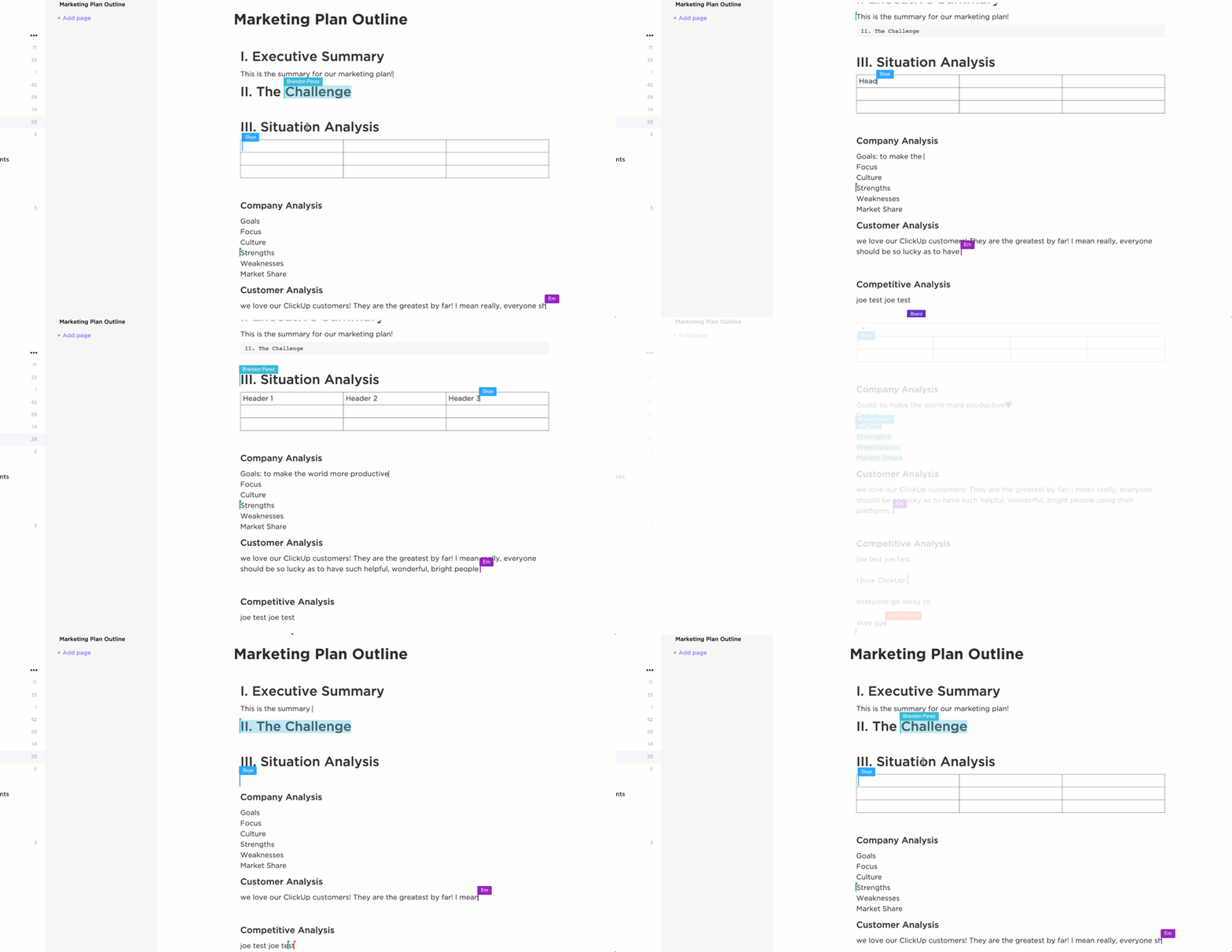
- ClickUp Docs: List down the project SOPs with ClickUp Docs, edit documents in real-time, and keep everyone updated with the shareable knowledge base
- ClickUp Whiteboards: Brainstorm campaign ideas over ClickUp Whiteboards, a creative canvas for marketing and creative teams. You can add sticky notes and define a project scope for your virtual and hybrid teams

If you’re looking for a more efficient way to track marketing agency KPIs, sign up on ClickUp for free and get started.

Everything you need to stay organized and get work done.
