
“The difference between successful people and really successful people is that really successful people say no to almost everything,” Warren Buffet once said.
The operative word here is ‘almost.’
To be successful, one needs to be able to focus on what matters and cut off nearly everything else. In other words, one needs to master rigorous and ruthless prioritization. Let’s see how.
How to Master Ruthless Prioritization for Peak Performance

 Summarize this article for me please
What Is Ruthless Prioritization?
Ruthless prioritization is choosing what to focus on, systematically and consistently, during a given period of time, such as the duration of a project, a month, a quarter, etc., and deferring everything else.
Ruthless prioritization helps in:
- Achieving limited yet ambitious SMART goals
- Eliminating distractions once a task/project/sprint has begun
- Managing your time and resources in the pursuit of specific goals
- Improving output quality and team efficiency
If you’re wondering, well, that just sounds like prioritization, what’s ruthless got to do with it? Here’s your answer.
| Regular prioritization | Ruthless prioritization |
|---|---|
| Scheduling highest priority tasks based on importance, urgency, and resource availability | Choosing the most critical tasks based on business value and impact |
| Includes should have and could have tasks as well | Only includes the must-have tasks |
| Designed to organize and plan projects | Aimed at eliminating distractions and enabling heightened focus |
| The goal is to get as much as possible completed | The goal is to do as few tasks as possible while accomplishing the chosen objective (or at least a significant part of it) |
| Offers leeway to include tasks contextually | Offers no space for sneaking in tasks after ruthless prioritization is done |
Summarize this article for me pleaseThe Process of Ruthless Prioritization
The Pareto principle or 80/20 rule states that 80% of outcomes come from 20% of efforts. So, focusing on the valuable 20% and optimizing work in those areas can produce greater results.
While not entirely similar, the Agile/Scrum/Lean project management also believes in eliminating wasteful processes to maximize output. In essence, across industries, one of the key factors for success is knowing how to prioritize your work.
Let’s look at how you can create a process of ruthless prioritization and leverage some key project management tools like ClickUp to do so.
1. Understand the context
Before you make any decisions around prioritization, understand the business context, goals, available resources, risks, etc. that factor into your tasks. Learn about the dependencies and complexities of the business. To prioritize effectively, you need to know the real cost and the opportunity cost of everything you eliminate.
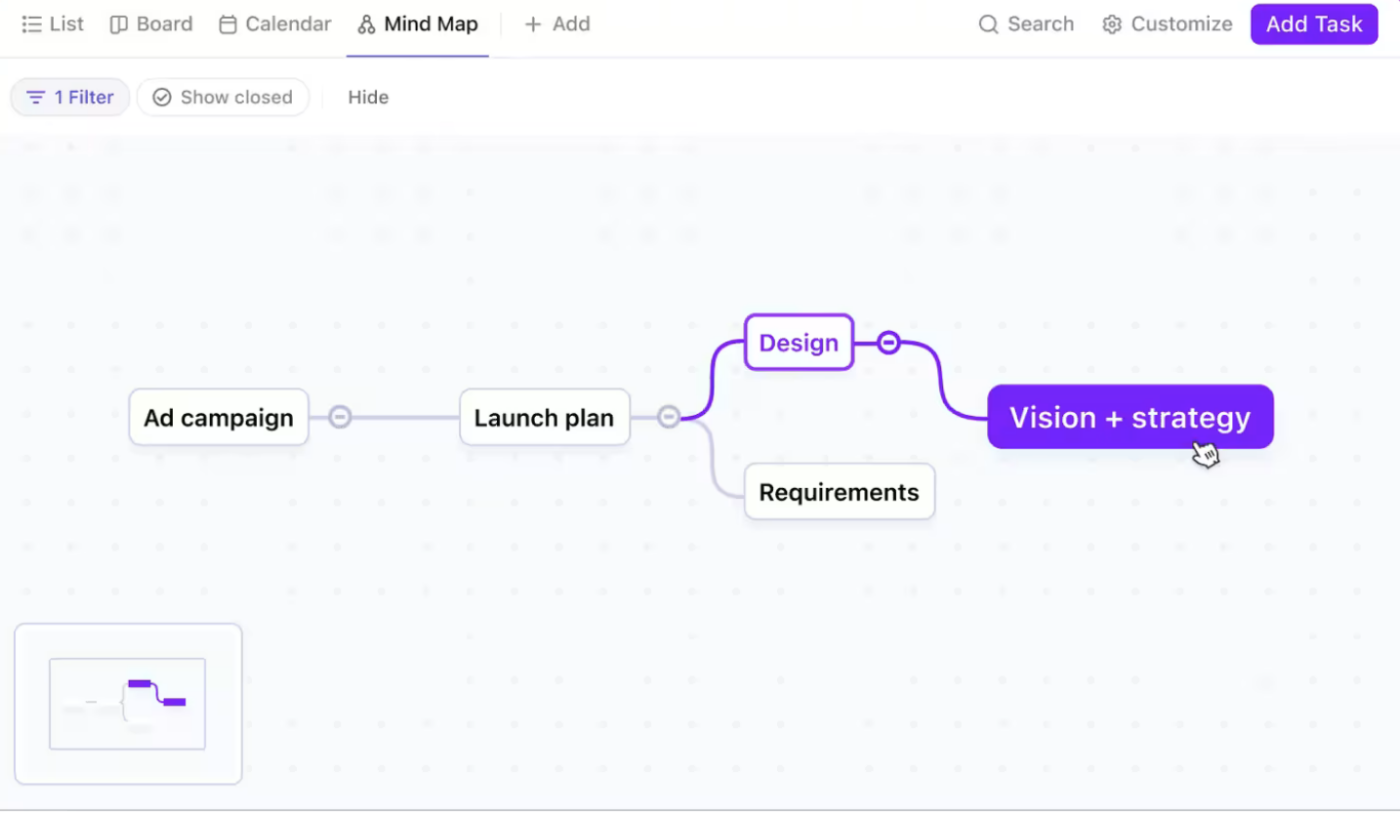
A mind map is a great way to bring all this information together. ClickUp’s Mind Maps allow you to break down ideas, draw connections, tame complexity, and create a single-pane view of everything you’re working on.
2. Identify priorities
Make a list of everything you’re choosing from.
In a software project, this might be features, tickets, or user stories to work on in that sprint. In a sales team, this might be all the leads in the pipeline, organized by various stages. Make sure not to miss anything at this stage, however irrelevant it might seem. Note down competing priorities as well, so you can manage them later.
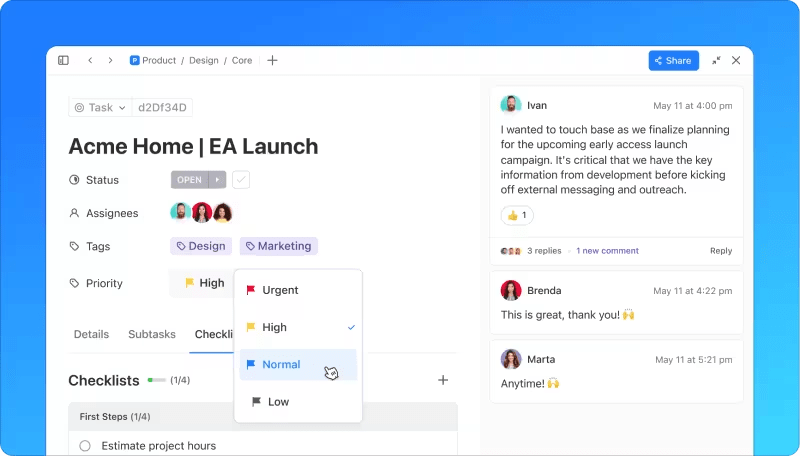
ClickUp Tasks helps achieve this effectively. To document the complete set of priorities under your purview, set them up as projects, tasks, and sub-tasks on ClickUp. Connect related tasks. Add more context with Custom Fields.
And then, use ClickUp Task Priorities to identify what you’re going to work on immediately.
3. Evaluate options
The only thing that matters in ruthless prioritization is the value each activity generates. Sometimes, this could mean the extent to which any activity pushes you toward your goals.
However, this is the tricky part. Measuring the value of each activity, especially in comparison to others, can be challenging. Create a scale and stick to it. For example, marketing teams use lead scoring, software teams use MoSCoW prioritization or the Kano model, and business leaders use the Eisenhower matrix. Choose a tool that works for you.
4. Make tough decisions
The road to ruthless prioritization is littered with tough decisions. It is tempting to work on less critical projects or too many tasks at once for emotional reasons, such as because it’s a project a coworker is deeply engaged in or has taken too much investment etc. However, for ruthless prioritization to be successful, you need to make tough decisions.
Eliminate anything that is not the most critical aspect of your project and that does not create extraordinary value. But to do this in a way that doesn’t jeopardize your professional relationships, watch for the next point.
5. Communicate effectively
As you see, ruthless prioritization is about making tough decisions. In one way or another, this is going to upset some people. The best way to avoid that is to communicate proactively and empathetically.
If you’re deprioritizing someone’s problem, sit them down and explain your reasoning. Show them that their efforts are appreciated, but your focus has been streamlined. Engage with them on objections and try to get them on board with your vision.
6. Measure and optimize
Irrespective of how confident you are about your prioritization, there is always something to improve. For each time period that you prioritize:
- Measure the outcomes of ruthless prioritization in terms of the value you projected
- Evaluate the value lost on tasks you deprioritized to validate that you made the right choice
Use ClickUp Dashboards to monitor your outcomes throughout the course of the project. Set up custom widgets for the metrics you identify as valuable, such as features developed, bugs quashed, revenue, profits, etc.

While this six-step process seems simple, it can be an uphill task.
How do you choose between developing data security features over integrating GenAI into your product? How do you resist the temptation of doing easy tasks over complex high-value tasks? How do you handle resistance from teams whose work might be deprioritized?
We’ve got some strategies to set you up on steady ground.
Summarize this article for me pleaseStrategies for Implementing Ruthless Prioritization
At each stage of ruthless prioritization, several challenges are likely to emerge. While you can’t preempt and pre-solve all of them, here are some best practices to put you in good stead.
Focus on value
The singular biggest reason to prioritize something ruthlessly is the value it creates for the business. This value could be:
- Additional revenue (when building a new feature/product)
- Eliminating risks (while prioritizing data security or compliance)
- Customer experience (while redesigning UI or training customer success teams)
- Efficiency (when implementing tools for project management or automation)
Depending on the project you’re working on, decide what the biggest value you are looking to achieve is. Tie it to the organization’s big goals. Then, assimilate that down to task prioritization.
For example, if you’re the head of marketing, you might prioritize bottom-of-the-funnel conversion activities to close more sales instead of building a wider audience base. This will have a direct impact on revenue in the short term, if that is the goal.
Be decisive
It’s relatively easy to sit in the comfort of your office and make a decision. However, in the face of objections and resistance from your team, you might be tempted to add back unnecessary tasks to your priority list. That’s a mistake. Once you set your priorities, be decisive until you achieve what you set out to.
To ensure your decisions stand:
- Get input from all stakeholders during the understanding context stage
- Inform them well in advance that you’re going to ruthlessly prioritize; this will prevent them from being surprised later
- Make your evaluations scientific, data-driven, and objective so you don’t question your decisions later
- Communicate proactively before the office gossip takes over
- Explain your rationale and invite feedback
Build agility
As we’ve said, ruthless prioritization is about making hard decisions. For instance, if you’re the operations manager prioritizing projects, you might choose to pause an experimental project when the economy slows down.
However, ruthless prioritization is not an excuse to be static. If the situation changes dramatically, you need to be able to adapt quickly. In the previous example, if your experimental project was with AI, the rapid rise of ChatGPT should be good reason to rethink your priorities strategically.
Leverage ruthless prioritization in various contexts
Ruthless prioritization is a great tool across areas. For instance, a writer might be ruthlessly prioritizing completing her novel, thereby canceling all new project meetings, social life, or other leisure activities. An athlete might prioritize rigorous training practice for a few months before the Olympics, eliminating desserts, endorsements, or leisure. A salesperson might use the pickle jar theory for time management.
In all these cases, the ability to steadfastly focus on just one thing can help immensely. Let’s see how you can apply that to your work life.
In project management
Good project management is about delivering the right things consistently. In that pursuit, project prioritization involves:
- Understanding project goals, milestones, and the progress on each of them
- Breaking the project down into tasks that roll up into goal accomplishment
- Identifying dependencies and possibilities of delay
- Building systems to prevent derailment
A robust project management tool like ClickUp can do wonders in this regard. ClickUp Goals can help you set your North Star, which can be tracked based on your progress on specific tasks. The Gantt chart view is great for visualizing dependencies and eliminating roadblocks toward effective priority management.

What’s more? ClickUp Automations can handle all the busy work, empowering you to focus on how to work faster on your priorities.
In agile software development
Prioritization is one of the fundamental tenets of agile software development. In fact, one of the principles of agile is the “art of maximizing the amount of work not done.” Teams use agile prioritization techniques to decide what to build for each sprint, which typically lasts two weeks.

A platform designed for agile software development project management will already have prioritization tools and templates. For instance, ClickUp’s Priority Matrix Template helps you organize tasks on a 2×2 grid, measuring importance and urgency.
In human resources
In talent acquisition, a folksy adage goes, “If it’s not a hell yes, it’s a hell no.” What this suggests is that if the hiring manager isn’t completely convinced of the suitability of a candidate, they shouldn’t be hired. In essence, ruthlessly eliminate profiles that don’t match.
Most HR leaders spend their time caught between prioritizing key roles to hire for, designing the compensation structure, strategizing diversity initiatives, and handling employee grievances. When the requests come, they are all pitched as urgent and important.
A good HR leader must be able to ruthlessly prioritize initiatives. Can you look at the compensation redesign next quarter? Then move it. Do you have a shortage of recruiters for roles in the pipeline? Cull the pipeline. Does the PR team want you to interview with Vogue? Say no and recommend someone else unless the employer branding outcomes are significant.
Prioritization itself, however ruthless, is an individual task. It is the work of an individual or a team to make decisions. Your biggest challenge is in implementing those priorities and staying on track. This is where a project management software like ClickUp can help immensely.
How a project management software like ClickUp facilitates ruthless prioritization
Across various scenarios, we’ve seen how the right tools and templates can help make the right prioritization decisions. Here’s a quick recap.
ClickUp Tasks: Breaking down complex projects into manageable tasks helps you see everything you need to think about before prioritizing
ClickUp Task Priorities: You’ve decided what’s a priority? Tag it as such on ClickUp so everyone knows what they need to focus on.
ClickUp Goals: The primary goal of ruthless prioritization is to achieve goals. Set task completion targets on ClickUp Goals and track your progress in real time. Facing a sea change? Adapt and be agile with all your project information at your fingertips with ClickUp.
Prioritization templates: Prioritization can be hard. While the decisions are yours to make, ClickUp simplifies the decision-making process with pre-designed templates based on popular frameworks like the Eisenhower matrix.
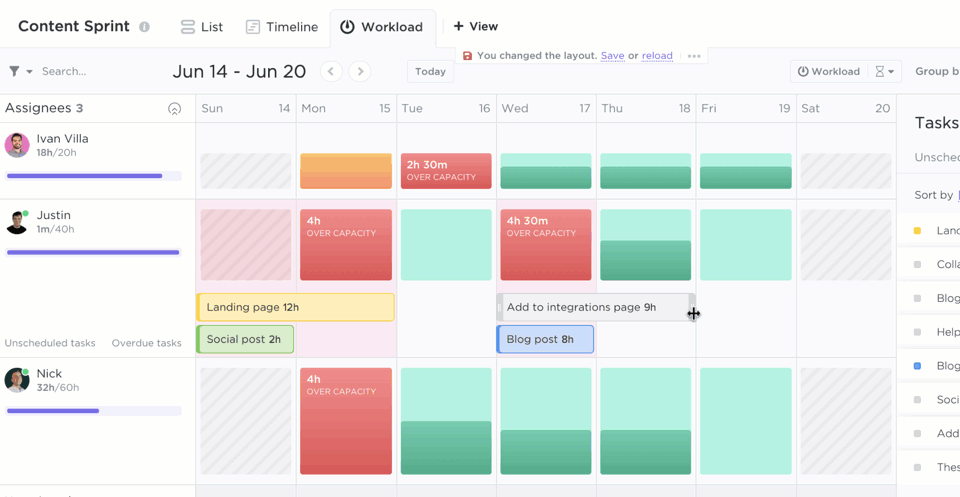
ClickUp Workload View: You might want to prioritize a number of things, but if you don’t have the resources to deliver them, there is no point. Use the ClickUp Workload view for a clear look into who is doing what, who is available, and who can be reallocated.
 Summarize this article for me please
Benefits and Challenges of Ruthless Prioritization
Clearly, ruthless prioritization is no easy task. Not only is it challenging to prioritize in the first place; it is equally difficult to implement those priorities and stay focused on them with a one-track mind. So, why do it?
Benefits of ruthless prioritization
- Focus: Ruthless prioritization empowers teams to work on one thing at a time, with no distractions and deep, undisturbed focus
- Clarity: By prioritizing, business leaders demonstrate clarity of thought and action to their teams, minimizing confusion and overwhelm
- Control: The standard practice is to prioritize 1-3 goals/activities at a time. This enables leaders to control operations and intervene if needed
- Avoiding ‘shiny object’ syndrome: It helps teams to eliminate distractions, especially from new technologies and products
- Greater chances of success: As ruthless prioritization focuses intensely on value or return on investment, the chances of value-based outcomes are higher
- Work-life balance: Teams that know their priorities can manage their time well and enjoy better work-life balance
That doesn’t mean the technique is without its challenges, though.
Challenges of ruthless prioritization
Definition of value: In project management, marketing, HR, etc. defining the concept of value can be a challenge. To avoid this, choose your rubric. Discuss with business leaders what the right metric is for each task’s value.
Short-sightedness: Sometimes, a project manager might ruthlessly prioritize tasks for the next two weeks, without an eye on what comes after, derailing long-term projects. Avoid this by prioritizing immediate work with long-term goals in mind.
Conflict-aversion: A leader who is scared of upsetting people with prioritization can inadvertently make the wrong decisions. Learn to be decisive. Consider engaging a coach to help you overcome managing conflicts and people pleasing.
Big failures, if any: If your prioritization process is faulty and you apply resources to projects that don’t produce value, your failures might be much bigger than if you had spread your bets.
Avoid big failures by making thoughtful decisions to prioritize. Choose the right definition of value. Validate it with peers and business leaders. Most of all, be agile. Track progress and be prepared to adapt if things don’t go as planned.
One other thing you can do is to use the power of ‘Not Now.’ Instead of completely eliminating less critical tasks, defer them to a later, defined time.
Summarize this article for me pleaseThe Power of ‘Not Now’ in Ruthless Prioritization
If you take Warren Buffet’s words literally, you’d be naturally worried about saying no to ideas from your team. An unequivocal ‘no’, especially in the context of it not being a priority, can thwart innovation and affect employee morale.
A much better and more open-minded response is to say, “Not now,” and follow it up with your rationale. When a developer brings an idea to add a new feature, you might say, “Not now, because that is not in the roadmap we have planned for this quarter. But let’s discuss this again in Q4.”
By acknowledging ideas and encouraging experimentation yet ruthlessly prioritizing based on value, you can create a more sustainable work environment. You can use the physical, creative, and emotional energy of your team members to build what matters.
In a way, by minimizing your projects, you can also minimize the assets you deploy, servers, data centers, compute, etc. and foster a more lean, efficient operation.
Summarize this article for me pleaseMaster Ruthless Prioritization with ClickUp
If you work on everything at once, you won’t complete anything, they say. Often, accomplishing audacious, ambitious goals demands that you pick a lane and apply a razor-sharp focus to never deviating from it.
This is especially true in the knowledge economy where energies are limited, talent is hard to come by, and problem-solving initiatives are constantly at risk of being derailed by important disruptions. Often, the only way to maximize the talent and energy we have is to practice ruthless prioritization.
List your ideas. Rank your tasks. Work toward what matters. Separate the wheat from the chaff.
Prioritize high-value work effortlessly with ClickUp. Try ClickUp for free today.


Everything you need to stay organized and get work done.

Recent Articles
Marketing Agency Productivity: Where Your Margin Actually Goes 
Marketing Agency Productivity: Where Your Margin Actually Goes
8 Communication Strategies That Actually Fix Team Chaos 
8 Communication Strategies That Actually Fix Team Chaos
What Is Tacit Knowledge? Definition, Benefits and Examples
What Is Tacit Knowledge? Definition, Benefits and Examples
