



Sorry, there were no results found for “”
Sorry, there were no results found for “”
Sorry, there were no results found for “”
RemNote is a note-taking tool known for its unique feature of making flashcards from notes. It helps you write notes and memorize them. It also shows flashcards correctly to ensure you retain the information longer.
While it’s great for students, there are RemNote alternatives that are better suited for various business purposes.
Whether you want more features or are casually exploring other options, check out our list of the top RemNote alternatives.
Compare their features, limitations, and pricing to make an informed choice.
Here are the factors you should consider when comparing RemNote alternatives:
📮ClickUp Insight: 21% of respondents want to leverage AI to excel professionally by applying it to meetings, emails, and projects. While most email apps and project management platforms have AI integrated as a feature, it may not be seamless enough to unify workflows across tools.
But we cracked the code at ClickUp! With ClickUp’s AI-powered meeting management features, you can easily create agenda items, capture notes from meetings, create and assign tasks from meeting notes, transcribe recordings, and more—with our AI notetaker and ClickUp Brain. Save up to 8 meeting hours per week, just like our clients at Stanley Security!
| Tool | Best Feature | Primary Use Case | Pricing |
|---|---|---|---|
| ClickUp | AI-powered meeting management, Seamless integration of tasks and notes, Customizable dashboards | Teams that need comprehensive note-taking, task management, and project tracking with AI support | Free forever; Customization available for enterprises |
| TiddlyWiki | Non-linear, customizable notes, Personal knowledge base creation, Portable and offline usage | Solo users or small teams building personal wikis or knowledge systems | Free |
| Notion | Flexible, multi-view organization, Collaboration and knowledge-sharing tools, Pre-built templates | Teams and individuals creating shared knowledge bases, tasks, and documents | Free; Paid plans start at $10/month |
| Coda | All-in-one document, task, and data management, Deep integration and automation capabilities | Mid-sized teams managing projects, documents, and workflows in a unified workspace | Free; Paid plans start at $12/month |
| Obsidian | Offline-first markdown-based note-taking, Connected note systems using graph view, Plugin-based | Writers, students, and developers building personal knowledge systems or following the Zettelkasten method | Free; Paid plans for Sync and Publish start at $10/month |
| Evernote | Multi-format note-taking (text, audio, images), Excellent search across content types | Individuals and teams organizing diverse content and capturing ideas, research, and documents | Free; Paid plans start at $14.99/month |
| Hypernotes | Visual graph-based note-taking, Built-in task management features, High security and encryption | Teams or individuals building interconnected notes and knowledge bases with task assignments | Free; Paid plans start at $8/month per user |
| Supernotes | Notecard-based note organization, Simple and visual UI, Easy real-time collaboration | Students, researchers, and creators building flashcard-style study materials or note organization systems | Free; Paid plans start at $10/month |
| Microsoft OneNote | Integrated with Microsoft Office, Flexible note-taking with stylus, text, and voice input | Individuals and teams working within the Microsoft ecosystem, students capturing lecture notes, professionals managing projects | Free with Microsoft 365 subscription |
| Workflowy | Infinite nesting of lists, Fast and minimal interface, Simple collaboration tools | Creatives, thinkers, and students organizing their ideas, to-do lists, and projects | Free; Paid plan starts at $4.99/month |
🧐 Did You Know? Traditional flashcard-based apps like RemNote are great for memorization—but they often lack a system for connecting those notes to real work, like task planning, collaborative research, or content creation.
Here are our top ten RemNote alternatives for you to choose from.
Staying on top of meeting details and action items can be challenging, especially when juggling multiple projects or remote teams. The ClickUp AI Notetaker is designed to eliminate manual note-taking, so you can focus on the conversation and let AI handle the rest.
ClickUp’s AI Notetaker automatically joins your meetings, records conversations, and generates accurate, structured notes in real time. With seamless integration into your workflow, it transcribes discussions, summarizes key points, and highlights action items—ensuring nothing gets missed.
After your meeting, you’ll receive a clear summary, action items, and key highlights, all saved directly in ClickUp. You can easily share these notes with your team, assign follow-up tasks, and keep everyone aligned—without any manual effort. The AI Notetaker works across platforms and is accessible from both browser and mobile apps, ensuring your notes are always at your fingertips
ClickUp also offers additional tools and features that rival RemNote’s note-taking capabilities. The ClickUp Notepad tool is simple yet effective. It has a user-friendly interface and easy navigation to make note-taking a breeze for users. Use it to quickly take notes on the go, format them how you like, and organize them for future reference.
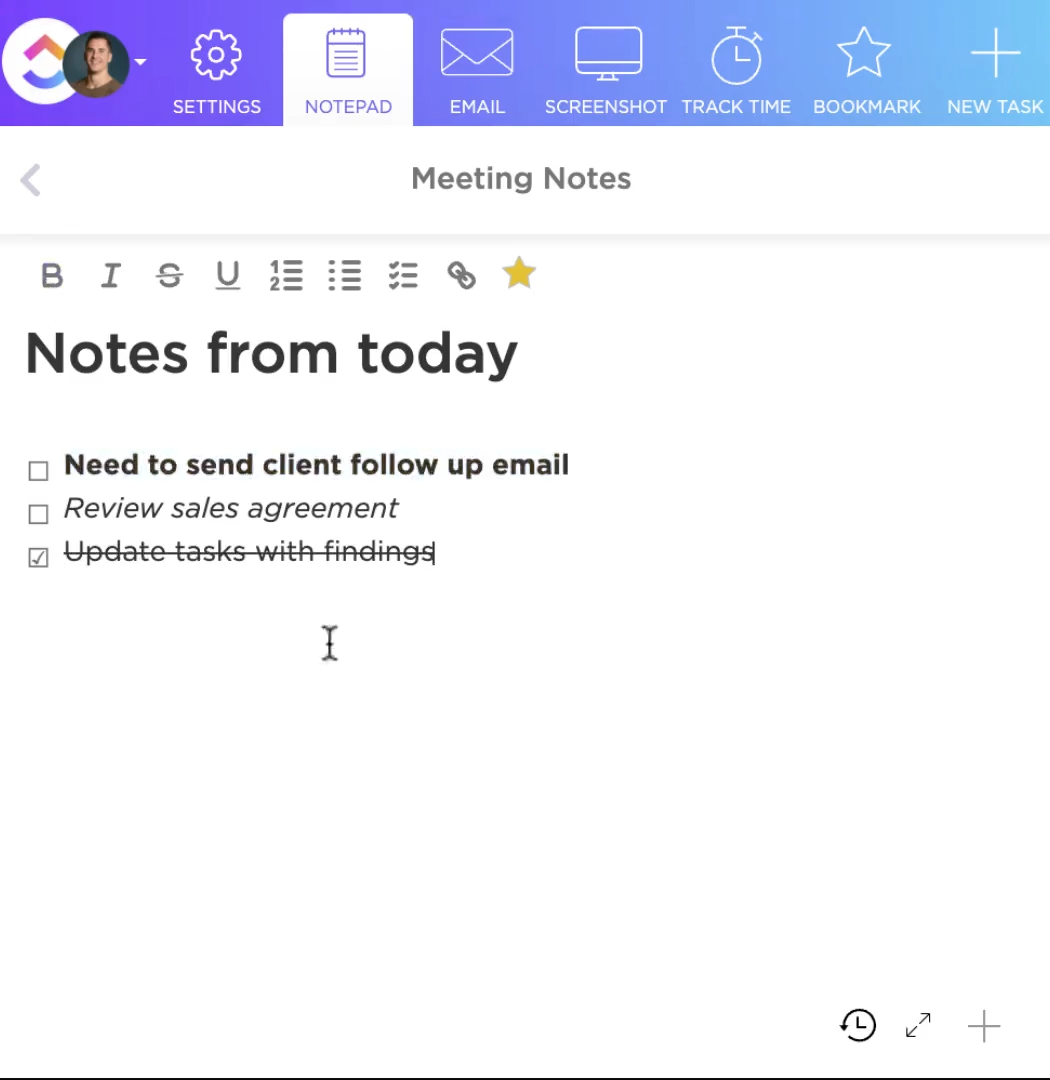
The best part is that it lets you convert your notes into tasks with a click. It also lets you access your notes from a browser and mobile apps. Want to check the changes you have made in the past? You can do that too!
Another way to take notes on ClickUp is by using ClickUp Docs. It’s a simple and collaborative document creation tool like Google Docs, with rich formatting and styling options.

Use it to jot down your notes or create checklists and share them with your team.
Need help creating notes or summarizing long text blocks? ClickUp Brain can help. This AI writing tool will generate automatic project summaries and send you timely project updates. ClickUp Brain will create automated meeting notes and summaries if you need consolidated meeting minutes.

Overall, ClickUp is the best note-taking app and a worthy RemNote alternative, providing an end-to-end note creation and organization solution to manage projects.
Team size: Individuals to enterprise teams
Who it’s best for:
ClickUp is so useful just as a to-list alone! Initially, I was sure that I would prefer written notes but it’s so nice having everything laid out however you prefer and being able to change due dates and attach files to tasks etc. It ensures that nothing is ever forgotten because it’s all in one place.
The whole system is very user friendly and works very well for sharing tasks with colleagues.
We use ClickUp every day in the marketing team and it’s super useful 🙂
A downside could be that there are a lot of features and it could be useful to be sent emails going through different features and how to use them, just so that everything gets utilised and not missed out on!
⏩ AI Capability: ClickUp Brain lets you generate and summarize notes, create meeting recaps, answer questions from your workspace content, and automate writing tasks. Use Autopilot Agents to streamline repetitive note formatting or tagging. AI tools also integrate across Docs, Notepad, and Chat for real-time assistance.
Absolutely. If you want a RemNote alternative that doesn’t just capture knowledge but also helps you use it—ClickUp is it. You can organize thoughts, assign action items, draft collaboratively, and bring AI into your daily note-taking. For students, creators, and remote teams alike, ClickUp is a huge step up from a standard note app.
💡 Pro Tip: Don’t just take notes—assign follow-up tasks directly from meeting summaries in ClickUp. You can even use AI to tag responsibilities, generate timelines, and set due dates without typing a thing.
TiddlyWiki is a unique, non-linear note-taking tool that allows you to organize complex information simply.
It is quite different from traditional note-taking apps. It lets you create ‘tiddlers,’ which are individual units of content you can link, tag, and organize in various ways.
Use it to create a Wikipedia-style notes page where content is connected through hyperlinks and tags.
It’s an open-source software solution which is free to use. Use an account online or download it to your Windows, Mac, or Linux device.
Team size: Solo users or very small teams
Who it’s best for:
Fantastic for personal website masters and Digital Garden Builders, very competent in managing fragmented pieces of short notes and quick reference information. Also good for practicing Personal Digital Zettelkasten (or Luhman Slip-box Note-taking method).
The learning curve is so steep you might want to drop it at the very beginning. But don’t be deceived! Once you get a hang of how tiddlers work and set up a system that matches your workflow, the payoff is crazy.
TiddlyWiki pricing
Yes—for power users who want total freedom, don’t need collaboration, and love building their own systems. TiddlyWiki isn’t plug-and-play, but if you’re tech-savvy and value longevity, privacy, and non-linear thinking, it can be your forever-note home. Otherwise, pick something more user-friendly out of the box.
💡 Pro Tip: Save time with slash commands in ClickUp Docs. Type /table, /summary, or /task to instantly structure your content while writing.
Notion is a productivity app that offers numerous features beyond simple note-taking. It provides a connected workspace to collaborate with team members and manage tasks.
Use it to create docs, to-do lists, or wikis or manage your tasks or projects. It offers multiple views to organize information, such as calendar, board, and timeline views.
Notion has a huge marketplace of templates, both free and paid. The app’s users also design and sell customizable templates for various use cases.
Overall, it’s an easy-to-use, intuitive note-taking app and one of the best RemNote alternatives.
Team size: Individuals to mid-sized teams
Who it’s best for:
I love notion in general, but now with integrated AI its next level compared to any note taking app. I think the fact that it is able to summarize my meeting and I can send minutes out right after with Action items is a game changer. I told my boss about it right away and he wants to get it as well. I just started using the AI meeting feature but have been using notion AI for a while to organize my notes and its mostly been great.
While I appreciate the vast capabilities, the flexibility can be a double-edged sword—new users can sometimes feel overwhelmed by the open-ended nature of the platform without guidance or templates. I would love for there to be an offline mode – enabling me to edit . Lastly, I’d love to see even deeper integrations with external tools like Google Drive, Slack, and QuickBooks without needing workarounds or third-party automation tools.
⏩ AI Capability: Notion AI adds powerful capabilities like summarizing content, generating outlines, writing drafts, rewriting paragraphs, and extracting action items from meeting notes. It works natively inside any page—so you can ask it to brainstorm ideas, format complex tables, or recap lengthy documents without context switching.
Absolutely—especially if you value aesthetic control and structured content. Notion isn’t just a note-taker; it’s a workspace builder. While it can feel overwhelming at first, the flexibility is unmatched once you get the hang of it. If you’re looking to go beyond simple text notes and build a second brain or collaborative hub, Notion is a top-tier choice.
🧐 Did You Know? You’re more likely to remember what you write down if you actually look at it again. That’s why searchable, organized notes > sticky notes on your desktop.
Coda is an all-in-one collaborative workspace combining project management features and note-taking apps.
It combines the features and functionality of documents, spreadsheets, and databases into an integrated platform. It offers rich text editing tools, options for inserting images and multimedia content, and collaboration options.
Team size: Mid-sized to large teams
Who it’s best for:
I’ve been using Coda for over a year now, and it’s been a revelation. As a developer, I’ve tried numerous tools for project management, note-taking, and collaboration, but Coda has become my go-to solution. Here’s why:
The Good is Flexible and Customizable, All-in-One Workspace, Collaboration and various tools integratgion, super fast loading.
Coda isn’t the smoothest notetaking tool. While Coda is fantastic in generating and maintaining content across tables or wiki-like pages, it’s missing some key note taking and automation features that some of its competitors have.
⏩ AI Capability: Coda AI is built directly into your docs. You can auto-generate content, summarize long notes, extract action items, translate text, and create tables based on context—all within a single canvas. It also integrates with Coda formulas to build smart automations and user-defined AI workflows.
Yes—if your notes often evolve into workflows, spreadsheets, or dashboards, Coda offers unmatched flexibility. It’s best for advanced users who want to build interactive systems, not just store thoughts. But for lightweight note-taking or minimalist writing, simpler tools may be a better fit.
💡 Pro Tip: Tag your notes like you’d tag your Instagram memes—be as specific as possible. Your future self will thank you when searching for that “brilliant idea from Tuesday.”
Obsidian is a writing and note-taking app that is an excellent alternative to RemNote. It’s perfect for capturing, organizing, and connecting related ideas.
Download the app to your desktop or mobile devices. It lets you access your notes online and offline.
Obsidian lets you easily capture, organize, and connect related ideas using links and graphs. It also allows you to turn your notes into Wikis, a knowledge database, or any other type of documentation.
Team size: Individuals or small teams
Who it’s best for:
Obsidian is free to use, and I sync it between all of my devices via iCloud. It’s a great way to store lots of information and to cross-link everything. Before, I used to add snippets to lots of note-taking apps and forget where I had put it.
It has a learning curve based on mark down language, but the plugins that you can add to it can make it more user friendly. It is not a million miles away from how Notion works.
Yes—if you’re building a long-term knowledge base or want full autonomy over your notes, Obsidian is one of the most powerful tools out there. Just be prepared to tinker. It’s not for those looking for quick collaboration or out-of-the-box simplicity, but it’s unmatched for deep, structured thinking.
Evernote is a popular note-taking app known for its ease of use and flexibility. It lets you capture notes across various devices and platforms using numerous formats.
Evernote allows you to use various note-taking strategies, capture notes in text, audio, web clippings, etc., and access them online or offline. The best part is that your notes will automatically sync across devices.
Evernote is also useful for creating to-do lists and organizing tasks and schedules.
Team size: Individuals to small teams
Who it’s best for:
I love how easy to use and versatile Evernote is. I can quickly add notes, photos or audio recordings and organise them using tags to ensure my workflow is efficient. When I need to recall something important, searching through my archive of material is also very helpful. In addition, the app’s integration with other apps keeps all my information synchronized across multiple devices. Because of all of these reasons, Evernote is a fantastic note-taking solution for me every day.
Evernote is a simple and convenient app for notes, but I was looking for a better solution to create a full-fledged external brain. To be able to store notes, information and manage projects.
⏩ AI Capability: Evernote introduced AI search and tagging features, helping users quickly surface relevant notes or auto-suggest organization options. While its AI isn’t as advanced as tools like Notion AI or ClickUp Brain, it does assist in making your note archive easier to manage and retrieve. For deeper use, third-party integrations can connect it to tools like Zapier, ChatGPT, or Readwise.
Yes—if you’re looking for a personal productivity system that captures anything, syncs everywhere, and just works. It’s especially strong for people juggling multiple content formats. However, for teams or users who need real-time collaboration, AI-powered workflows, or advanced project planning, a more modern tool like ClickUp may be a better fit.
💡 Pro Tip: Looking to build a true external brain? ClickUp Brain combines AI-powered search with connected docs, tasks, and wikis—so you can store ideas, surface info instantly, and manage projects without context switching. Whether you’re capturing fleeting thoughts or structuring long-term knowledge, ClickUp’s knowledge management system grows with your brainpower.
Hypernotes is one of the RemNote alternatives, and it is more than a note-taking app; it is a knowledge management software solution. Its graph-based model allows you to create a knowledge hub with interconnected nodes.
It lets you create and organize notes, wikis, scripts, articles, and more into an interconnected network.
Hypernotes also offers built-in task management features, which enable you to assign tasks and collaborate with your team members.
Team size: Individuals, research teams, or startups
Who it’s best for:
Hypernote is an excellent tool that helps mainly in note-taking along with many other features like bi-directional links, proper organizing, knowledge graphs and the best one is collaborating tools that help other teammates to work on the same note, comment, or assign a task which is really useful in an office environment. you can use the tool on web, laptop, and mobile and everything is well synchronized. it helps in keeping track of notes with interconnected information which makes it very useful.
It may take time for new users to fully grasp all the potential and features.
Yes—for visual thinkers, researchers, and teams building a long-term knowledge base. It’s best when your work benefits from deep linking, visual connections, and structured outlines. But if you need seamless integrations, rich templates, or native AI, tools like Notion, Obsidian, or ClickUp may provide more flexibility.
💡 Pro Tip: Organizing lecture notes or research? Tag Docs with folders, filters, and custom properties—then create a dashboard to track your learning journey like a pro.
Supernotes is a note-taking tool that offers a unique way to create notes—notecards. It lets you save notes in interactive cards instead of boring files and documents.
It offers rich content editing options and lets you add various forms of content, such as tables, images, emojis, and even mathematical equations.
The best part is that it allows you to add links to other cards, just as in any note-taking app. It can also organize notes visually in a hierarchical graph view (both 2D and 3D).
What’s more, sharing notecards with others is easy. They don’t need to be a user of Supernotes to read it, but they do need to be one to edit notes and leave comments.
Team size: Individuals or small teams
Who it’s best for:
Having been using supernotes for sometime, its a great tool to dump your organisational mom(minutes of meeting), notes, ideas during brain stroming sessions which can be used later for reference. You can create task lists. The app is easy to use and does not take much time to setup.
I wish it integrated better with other tools like MS Office. Also, better AI would be helpful
Yes—if you love thinking in short bursts, building second brains, or need a minimalist knowledge capture system. It’s fantastic for structured brainstorming, academic note-taking, and fast reference building. But if you prefer traditional document-style notes, team co-editing, or full AI automation, consider more robust tools like Notion, Obsidian, or ClickUp.
💡 Pro Tip: Too many notes to keep up with? Let AI do the cleanup. Use ClickUp Brain to summarize, sort, and make sense of your scribbles.
OpenNote is a cloud-based note-taking and organization tool that is part of Microsoft’s suite of tools. That’s why it’s perfect for those using MS Office, as it integrates seamlessly with other Microsoft apps.
It lets you take notes using a stylus to write or draw on a screen like you would with pen and paper. Of course, typing notes is also an option.
Team size: Individuals to large teams
Who it’s best for:
OneNote is great for organising notes in a clear, flexible structure. I like how it mimics a physical notebook with tabs and sections, making it easy to manage different topics or projects. It’s also really handy that it syncs across devices, so I can access my notes on my phone, tablet, or computer anytime. The ability to draw, highlight, and insert images or files is a big plus too.
It can feel a bit clunky at times, especially with syncing issues between devices or when working offline. The search function doesn’t always return accurate results, and formatting can be inconsistent if you copy and paste from other sources. Also, if you’re not already familiar with the layout, the interface can be a little overwhelming at first.
⏩ AI Capability: OneNote doesn’t currently have built-in generative AI, but when used with Microsoft Copilot (available via Microsoft 365), you can summarize notes, auto-organize content, and create follow-up action items. Copilot also works across Teams, Word, and Outlook—giving OneNote AI-powered context if you’re in the ecosystem.
Absolutely—if you’re already in the Microsoft universe or prefer a reliable, familiar structure for your notes. It’s a great pick for hybrid workers, students, and anyone looking for a dependable digital notebook. But if you’re after visual note-mapping, AI-first workflows, or deep customization, tools like Obsidian or ClickUp may be better suited.
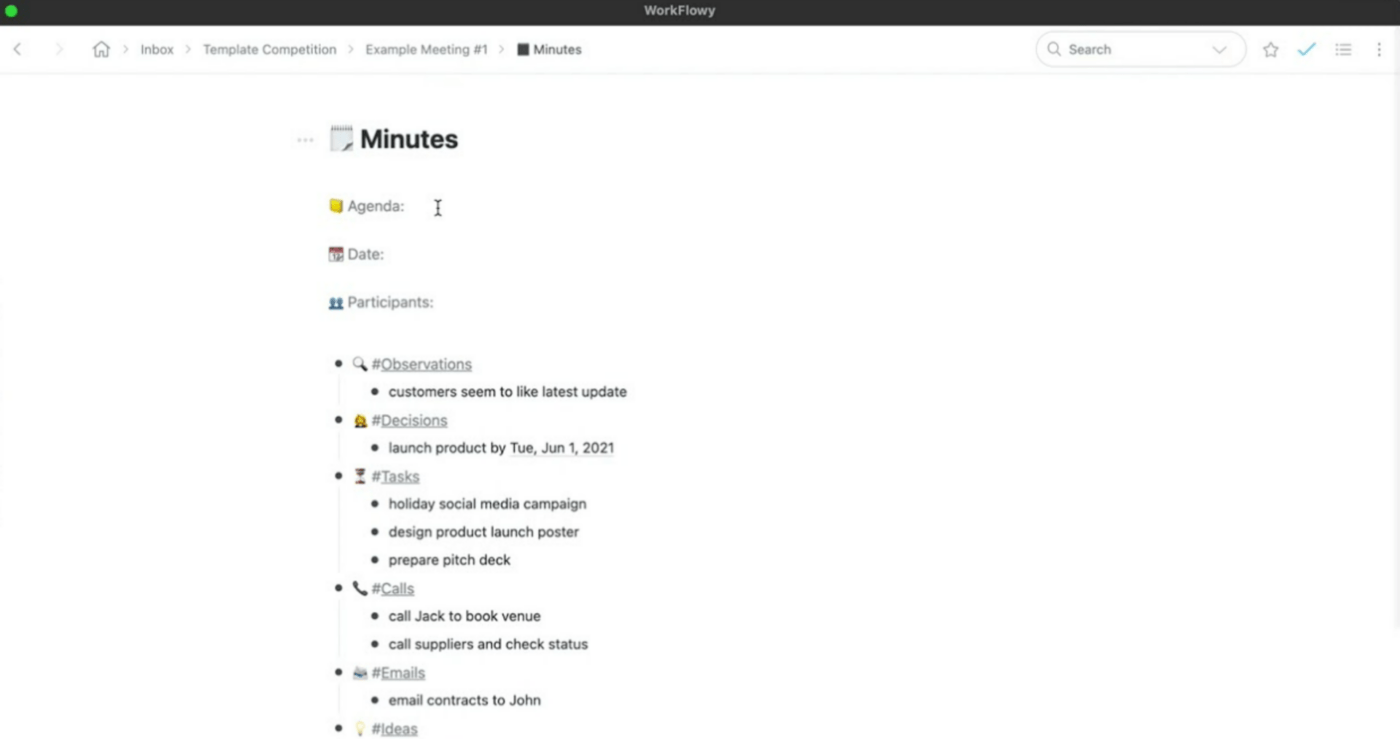
Workflowy is a simple note-taking and list-making app with an intuitive user interface and minimal design. Use it to create a multi-level bulleted list, jot down important notes, or organize your ideas.
It lets you drag and drop, insert images and files to your workspace and organize them any way you like.
One of its most notable features is the infinite-nesting lists that allow you to add as many points and sub-points as you want.
Team size: Solo users or small creative teams
Who it’s best for:
I love that workflowy is simple yet powerful. I can easily organize (and reorganize) my todos, and the powerful search capability makes it possible for me to have a history of my work.
Also, the easy sharing model makes collaboration a breeze.
I’ve kept my personal todo list in workflowy for more than a decade, and we’ve also tracked company-wide, department-level sprint goals for more than 300(!) two-week sprints.
I would prefer to have more options for formatting, such as larger headings or other styling options to differentiate notes. You also only have one file that all notes are taken in, which may not be preferable for some people.
Yes—for creatives, thinkers, and minimalist note-takers who want raw speed and mental clarity. Workflowy shines when you need to think in outlines or structure ideas without distractions. But if you need more collaboration, formatting, or automation, tools like Notion or ClickUp will offer a more complete experience.
There you have it, our list of top ten alternatives to RemNote. Compare their features, pros, and cons to choose one that best meets your requirements.
If you’re looking for the best RemNote alternative that offers much more than simple note-taking and organization, consider ClickUp. It’s an all-in-one project management, note organization, and team collaboration tool.
Moreover, ClickUp Brain supercharges your note-taking by creating automatic summaries and meeting minutes.
Sign up for ClickUp and explore its myriad features.

Manasi Nair
Max 32min read
Manasi Nair
Max 14min read

Arya P Dinesh
Max 21min read

© 2026 ClickUp




