

Sorry, there were no results found for “”
Sorry, there were no results found for “”
Sorry, there were no results found for “”
Every groundbreaking product starts as an idea that makes you think, ‘This could be revolutionary.’
But no matter how brilliant, an idea alone won’t move the needle. It needs a clear plan, a compelling case, and the right support to come to life. That’s where a well-crafted product proposal comes in.
A product proposal is a bridge between your idea and execution. It’s your chance to showcase how your product solves real problems, connects with your target market, and stands out in a crowded space.
In this guide, we’ll walk you through the steps to create a proposal that grabs attention, inspires confidence, and wins approval.
Ready to transform your idea into the next big thing? Let’s move the needle.
A product proposal is a document or presentation designed to pitch a product idea to stakeholders, such as investors, partners, or decision-makers.
Its purpose is to outline the key details of the product, including its concept, target market, technical details, benefits, market demand, and potential value.
Essentially, your product proposal should contain all the elements that make it pass through the approval window. It should answer vivid questions like:
1. What is the problem you are solving?
2. What is your solution, and how unique is it?
3. Who is your target market?
4. What is your go-to marketing strategy?
5. What is your competitive advantage?
6. What are your financial projections?
7. What are the risks and challenges?
8. What are your team and resources?
Plus, a winning product proposal can excite your potential clients while serving as a clear roadmap to guide your product development in the right direction.
When done right, it gets everyone as passionate about your idea as you are.
➡️ Read More: How to Write a Project Proposal (Examples & Templates)
Learn how to write anything, including a product proposal, with AI. 👇🏼
To create a winning product proposal, understand the different types and how each serves a unique purpose in bringing ideas to life.
Here are the many types you’ll come across⬇️
These proposals are perfect for pitching ideas within your team or organization, securing buy-in from executives or stakeholders, and fostering collaboration.
📌 Example: A proposal to implement a company-wide project management tool to streamline internal processes.
Designed to showcase clients, investors, or partners, these proposals focus on clearly and impactfully pitching your product or partnership ideas to an external audience.
📌 Example: A startup presenting a new AI-powered customer support platform to potential investors for funding.
These proposals, centered on fresh ideas, highlight an entirely new product, showcasing its features, benefits, and why it’s a perfect market fit.
📌Example: Proposing a new eco-friendly gadget to meet rising consumer demands for sustainability.
These proposals refine existing products, suggesting updates or new features to enhance their appeal and functionality.
📌 Example: A proposal to upgrade an existing fitness tracker with sleep monitoring and heart rate variability analysis.
These explore collaboration opportunities with other companies or partners to develop or improve a product and expand its market reach.
📌Example: A proposal for two tech firms to co-develop a smart home integration platform.
These proposals take an existing product to new markets or reach different customer demographics.
📌 Example: Proposing a regional expansion of a software service to international markets.
A proof of concept proposal validates whether an idea can work in the real world by using early prototypes or testing results.
📌 Example: A proposal showing successful trial results of a solar-powered charging station for urban areas.
These proposals focus on tangible products, outlining their features, production methods, and market potential.
📌 Example: A proposal for a new line of ergonomic office chairs designed to reduce back strain.
Every standout product proposal includes a few must-have elements. Here’s a list of essentials to secure the green light from stakeholders👇
In just two to three sentences, summarize your idea to stakeholders.
This is the product discovery phase compressed into a powerful introduction.
Explain the ‘why’ behind your idea. Keep it easy-to-follow—no technical jargon. Share the objectives, the USP, and how your product meets market demand. Use market data and research to back your claims.
Show that you’ve done your homework. Dive into competitive analysis to evaluate your product’s position within the industry. Discuss 👇
Stakeholders will appreciate seeing a sales forecast and knowing you’ve thought about how to keep them invested.
Make the problem crystal clear—what’s the issue, and why does it need solving now? Create a sense of urgency by highlighting market demand and showing why this moment is perfect for action.
Further, provide an in-depth walkthrough of the solution and how it caters to a group of target audience.
💡Pro Tip: Use the ‘Jobs To Be Done’ framework. Instead of focusing on what competitors offer, analyze what tasks/problems your customers are trying to solve. This reveals opportunities others miss because they’re too product-focused.
Here’s where you showcase what makes your product unique. Focus on features that excite your audience, improve the user experience, and solve real-world problems. Instead of diving into technical specs, frame your features as per practical benefits and usability.
It’s time to bring your product brief to life. Whether through pre-recorded demos, tutorials, or interactive prototypes, show stakeholders exactly how it works. If your product is still in development, mockups, concept videos, or storyboards can help visualize its potential.
♟️Master Move: Use the ‘Narrative-Feature-Benefit’ (NFB) framework for demos: Start with a relatable user story, smoothly transition into showing the relevant feature, then highlight the concrete benefit with a metric or outcome.
For example, ‘Meet Sarah, who used to spend 3 hours on payroll (narrative) → Watch how our one-click sync feature works (feature) → Now Sarah completes payroll in 15 minutes and saves $400 monthly (benefit).’
Provide a clear estimate of costs, revenue streams, and growth potential. Use charts and graphs to make your financial projections easy to digest and credible.
Your pricing strategy can make or break your proposal. Align your pricing with your product’s USP and market expectations. Explain the rationale behind your pricing in detail, showing how it impacts revenue and market positioning.
Lay out what it will take to bring your product to life. Detail the skills, personnel, and tools, along with a realistic timeline of the end-to-end product development process.
Be specific about what stakeholders can expect. Cover key deliverables, performance metrics, potential risks, projected revenue growth, and how everything will be managed. Further, include assumptions and plans for addressing uncertainties to set clear expectations.
Paint a picture of the product’s long-term potential. Highlight scalability, market expansion opportunities, and additional features that could be developed. Show stakeholders how your product is built for sustained success and growth.
No one likes reading heavy text documents with corporate jargon. You need to present your product proposal in a presentable and interactive way.
Here are a few tips to nail the presentation:
A winning proposal tells a compelling story backed by thorough research and all the essential elements.
Jumping in, here’s a step-by-step guide to help you bind together a powerful product launch strategy:
Before drafting your product proposal, research the market and understand your audience. Ask yourself: Who are you targeting? What problems does your product solve? How does it differentiate?
Here’s a quick checklist to guide your market research🔽
✅ Background: Identify why your product is essential and the problem it solves
✅ Data sources: Use surveys, competitor analysis, and market trends to gather insights
✅ Findings: Pinpoint trends, pain points, and opportunities that highlight your product’s key features and impact
✅ References: Support your points with reliable data to build credibility
Dig deep into the product features, key elements, and success metrics to ensure your proposal has a strong base.
And when it comes to creating an end-to-end product workflow, you need ClickUp.
For instance, use ClickUp Brain, ClickUp’s built-in AI assistant, to gather insights, organize data, and connect ideas—all in one place.

Here’s how it can make your research phase seamless:
📮ClickUp Insight: A typical knowledge worker has to connect with 6 people on average to get work done.
This means reaching out to 6 core connections on a daily basis to gather essential context, align on priorities, and move projects forward.
The struggle is real—constant follow-ups, version confusion, and visibility black holes erode team productivity. A centralized platform like ClickUp, with Connected Search and AI Knowledge Manager, tackles this by making context instantly available at your fingertips.
Once your research is ready, shape it into a detailed document with the key sections you plan to include in your proposal. This will vary largely based on the audience you’re pitching to.
Here’s an outline you can come back to:
It’s now easier than ever to create a product development proposal using ClickUp Docs.

Here’s how you can use ClickUp Docs to create product proposals that align with your team’s goals and workflows:

Bonus: Formatting and Styling Tools within ClickUp Docs
Dividers: Insert dividers (/divider) to separate sections for better readability
Headers and Subheaders: Use headings (/h1, /h2, /h3) to structure your document
Bullets and Numbered Lists: Clearly organize ideas or steps
Tables: Add tables (/table) for cost breakdowns, timelines, or feature comparisons
Callouts: Use callouts (/callout) to highlight key points or action items
By this phase, start breaking the outline into product stages—design, prototyping, testing, and refining.
Use ClickUp’s Product Management Solution to streamline the process. With it, assign specific milestones to each phase so your team knows exactly what needs to happen and when.
It empowers teams by centralizing their entire workflow within a single platform. Instead of juggling tasks across various tools, they can plan features, assign tasks, track progress, and collaborate seamlessly within ClickUp.
For example, designers can upload concept art directly to tasks, and developers can provide feedback instantly, fostering real-time collaboration. By automating repetitive tasks and providing valuable insights through data-driven reporting, ClickUp’s Product Management Solution enables product teams to work more efficiently, make informed decisions, and ultimately deliver high-quality products faster.
And to end the back-and-forth between feedback and discussions on email and other tools, use ClickUp Chat. That’s right, you can chat right from your workspace.

This is what we mean:
A winning product proposal isn’t just about presenting facts—it’s about telling a story that draws stakeholders in.
Here’s how to do it:
Start by painting a vivid picture of the challenge your audience is facing. Make it relatable and urgent—something they experience in their day-to-day work.
❌ Instead of, ‘Data management can be overwhelming’
✅ Use, ‘What if you could finally ditch the chaos of spreadsheets and manual updates? No more wasted hours or endless tabs to juggle.’
When you make it personal, stakeholders are more likely to connect with the problem and stay curious about your solution.
To take this further, define the problem together with your team using ClickUp Whiteboards and:
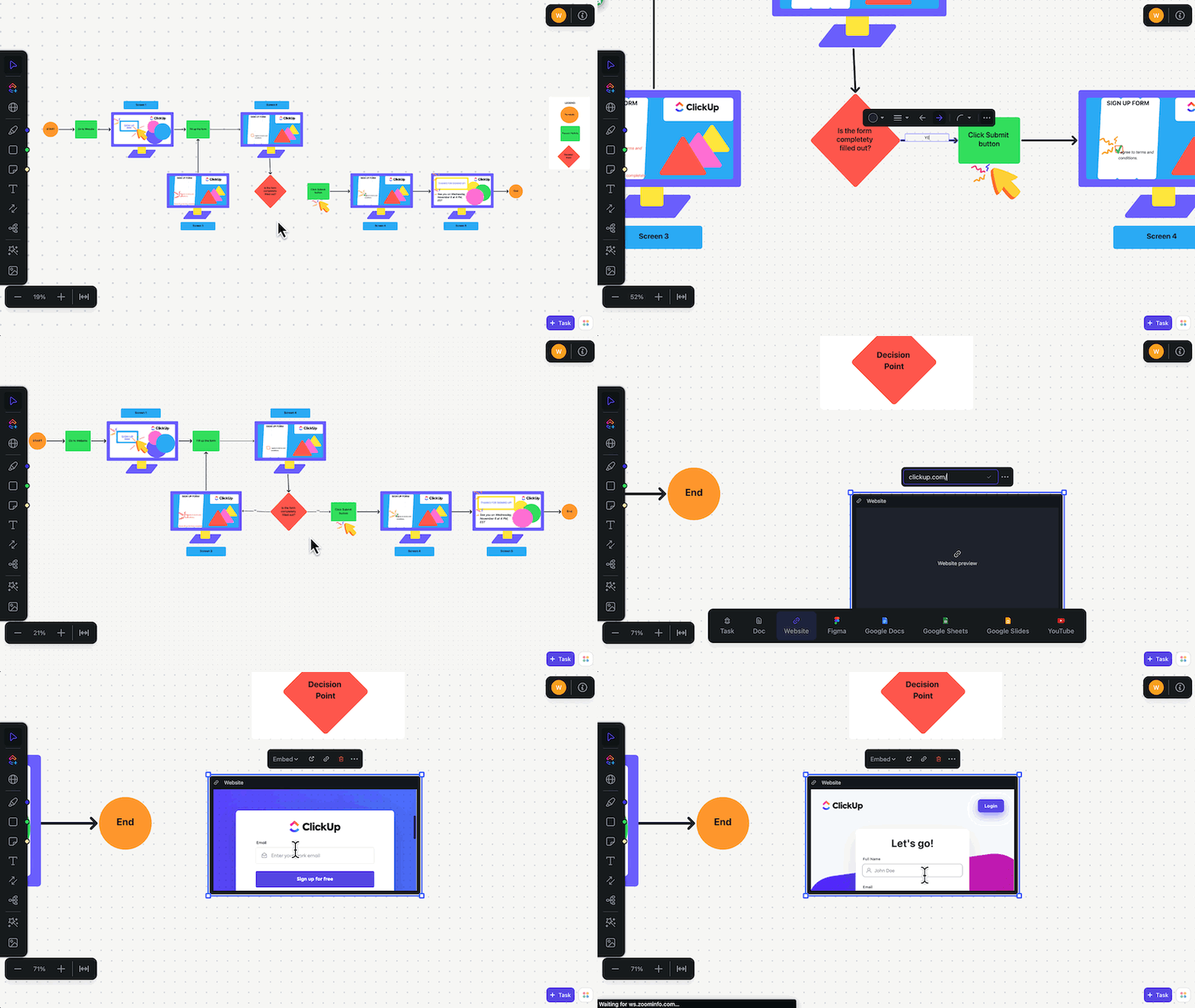
Now it’s time to introduce your product as the answer they’ve been waiting for. Focus on the experience it creates for the user rather than just listing features.
❌ Instead of, ‘Our product has a multi-functional dashboard.’
✅ Use, ‘Imagine having a sleek, all-in-one dashboard that automatically organizes and updates your data across platforms. No hassle, just results.’
Now, show exactly how your product transforms the way you work, solves a pain point, or achieves results. Use real-time data to validate your claims.
❌ Instead of, ‘Be more productive with our product.’
✅ Use, ‘With this tool, you’ll save hours every week, cut costs by 30%, and finally have time to focus on scaling your business instead of sweating the small stuff.’
Plus, discuss the pricing, financial forecasts, and ROI to demonstrate to stakeholders how your product can assist them in reaching their long-term objectives. To do that, use Whiteboards and:

⌛Time-Saver: Streamline your process with the ClickUp Product Proposal Template. It provides a ready-made structure with all the essential sections, helping you present your ideas clearly and focus on preparing a proposal that wins approval.
End with a CTA. Make the next steps clear and ask for a decision.
📌 ‘To move forward, we would need approval to begin the MVP phase by the end of this month. Can we get confirmation by next Friday?’
Winning stakeholder approval can be tricky, but it’s a crucial part of any product proposal. Their buy-in depends on how well you address their concerns and align your vision with theirs.
Here are some quick tips to help you secure that much-needed approval:
Building a product proposal is more about collaboration and precision than a big idea.
That’s where ClickUp steps in, the go-to solution for ‘all-things-work.’
Picture this: you brainstorm on ClickUp’s Whiteboards, visually mapping your ideas with your team. Then, transition seamlessly to ClickUp Docs to draft a polished proposal. Need a touch of finesse? ClickUp’s AI is right there to refine your writing and make your pitch shine.
Excited to take your proposal from concept to completion? Sign up to ClickUp for free today!

Praburam Srinivasan
Max 16min read
Praburam Srinivasan
Max 12min read

Garima Behal
Max 12min read

© 2026 ClickUp





