


Sorry, there were no results found for “”
Sorry, there were no results found for “”
Sorry, there were no results found for “”
Thinking is the hardest work there is, which is probably the reason so few engage in it.
Making decisions can be challenging, especially when faced with multiple options and variables. It’s tempting to rush through choices, but jumping ahead without careful thought can lead to regret.
Whether managing a project or choosing the next step in your career, critical thinking is the key to complex decisions. Slow down, analyze the facts, weigh your options, and question any assumptions.
In this blog post, we’ll explore practical strategies on how to improve your critical thinking skills and make more informed, effective decisions.🎯
We’ll also recommend some excellent books on the topic, summarized for your convenience by the team here at ClickUp! 🤓
Critical thinking enhances decision-making by improving problem-solving, analysis, and logical reasoning. Here’s how to develop and apply it effectively:
ClickUp helps sharpen critical thinking with:
Critical thinking is the ability to scrutinize information, question it, and make well-informed decisions based on facts. It involves breaking things down to understand them better, determining what is genuine, and combining different ideas to see the big picture.
Strong critical thinking skills help analyze situations, solve problems, and make sound judgments in any field.
It involves:
Critical thinking leads to better business, financial, and interpersonal outcomes while reducing the chances of negative results. It allows you to navigate challenges clearly and make decisions based on evidence rather than assumptions.
In real-world scenarios, critical thinking looks like:
🔍 Did You Know? The intellectual roots of critical thinking trace back to Socrates’s teaching practice and vision 2,500 years ago. He discovered that people can’t rationally justify their confident claims to knowledge when asked probing questions.
Critical thinking is a vital skill that goes beyond just analyzing information. As highlighted in Critical Thinking in Psychology by Sternberg and Halpern, it helps prevent manipulation and enables decisions based on logic, not influence.
Here’s how critical thinking helps:
🔍 Did You Know? According to common conjecture, John Dewey introduced the term ‘critical thinking’ in his book How We Think in 1910 as an educational goal he identified with a scientific attitude.
Critical thinkers stand out when solving problems, making decisions, or simply navigating everyday challenges. These individuals possess certain traits that help them think more effectively, from being open-minded to paying attention to detail.
Here are some typical characteristics of a critical thinker:
⚙️ Bonus: Read the ‘Six Thinking Hats’ book summary to navigate enhanced decision-making based on expected outcomes.
Improving your critical thinking skills doesn’t happen overnight, but the right approach can become a powerful tool for making better decisions.
Here are seven practical steps you can take to sharpen your thinking. 💁
Before proposing solutions, take a step back and define the problem. Apply the first-principles thinking method to break your problem statement into smaller parts and ask questions to uncover the root cause.
Consider asking yourself:
Relying only on surface-level knowledge—textbook definitions, high-level reports, or quick online searches—can lead to missteps in academic and professional settings.
Go beyond quick online searches or textbook definitions and seek more comprehensive, reliable sources, such as peer-reviewed journals, case studies, expert opinions, and real-world examples.
Here are some tips to keep in mind:
💡 Quick Tip: Stimulate critical thinking by creating hypothetical scenarios related to your work or studies. Analyze potential action and outcomes for better risk assessment.
For instance, you’re launching a new product. Hypothetical scenario: What if your leading supplier suddenly increases prices by 20%? Analyze options like negotiating contracts, sourcing alternative suppliers, or adjusting pricing strategies. Assess potential impacts on profits, customer retention, and timelines.
Once you have the information, separating valuable insights from noise is essential.
Developing strong metacognition skills lets you stay mindful of how you process information, helping you assess your sources’ credibility, relevance, and potential biases.
Here are some questions to ask yourself:
Ask thought-provoking questions and challenge assumptions by asking open-ended questions like ‘Why is this the case?’ and ‘How do we know this to be true?’
💡 Pro Tip: To check whether the source is credible, look for the author’s qualifications, expertise, and affiliation. You must also consider the publication, citations, references, publication date, biases in tone and language, domain and URL, and editorial standards like peer review.
Sticking to familiar viewpoints is easy, but stepping into others’ shoes can open up new possibilities. Challenge your assumptions and look at the situation from different angles.
You might want to:
This helps avoid tunnel vision and leads to more well-rounded decisions.
💡 Pro Tip: Challenge your cognitive comfort zone and regularly expose yourself to unfamiliar ideas, industries, or disciplines. Attend webinars, read books/articles outside your expertise, network with professionals in different industries, or take online courses in unfamiliar subjects. This broadens your perspective and sharpens critical thinking.
Enhancing critical thinking requires structured frameworks and mental models to organize thoughts, analyze data, and track progress.
ClickUp, the everything app for work, offers a suite of tools for task management, document collaboration, and brainstorming for a systematic approach to problem-solving.
Here’s how you can use ClickUp. 👀
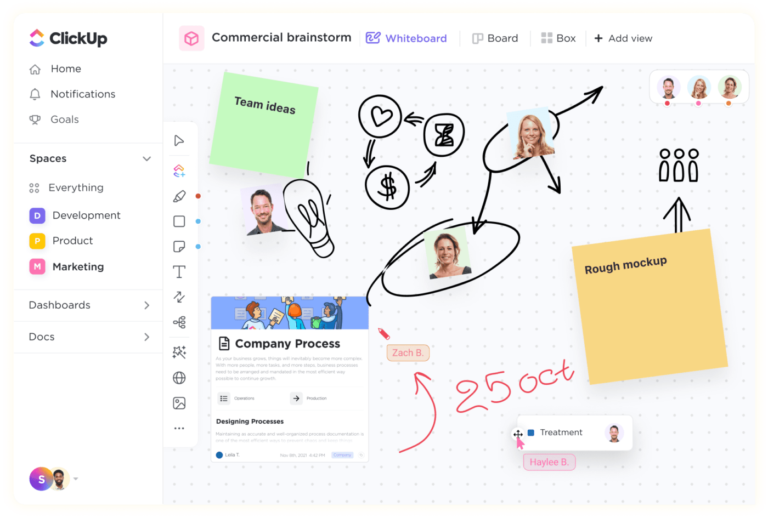
ClickUp Whiteboards are perfect for brainstorming and visualizing ideas collaboratively. They help structure thoughts, encourage creative exploration, and ensure your ideas lead to meaningful actions.

You can embed ClickUp Docs and ClickUp Tasks directly into your board, so brainstorming and execution stay in sync. With AI-powered visualization, text-based ideas transform into visuals, helping you see patterns and analyze information from different angles.
ClickUp Mind Maps are designed to break down complex ideas, organize workflows, and gain a clear perspective on intricate projects. This is especially helpful when you’re working on a project or research paper and need to track the flow of information and develop a clear strategy.

Students can use mind maps to brainstorm essay topics or study plans, while professionals can apply them to team projects or strategic planning. Ever struggled to make sense of complex ideas? Hierarchical visualization lets you create cascading views that map out connections, set priorities, and identify dependencies at a glance.
In addition to these visual tools, ClickUp Docs make taking and organizing notes easy. It helps you to stay on top of details and keep everything in one place for easy reference.
You can capture important insights, create outlines, and even draft reports, all while organizing your thoughts logically.
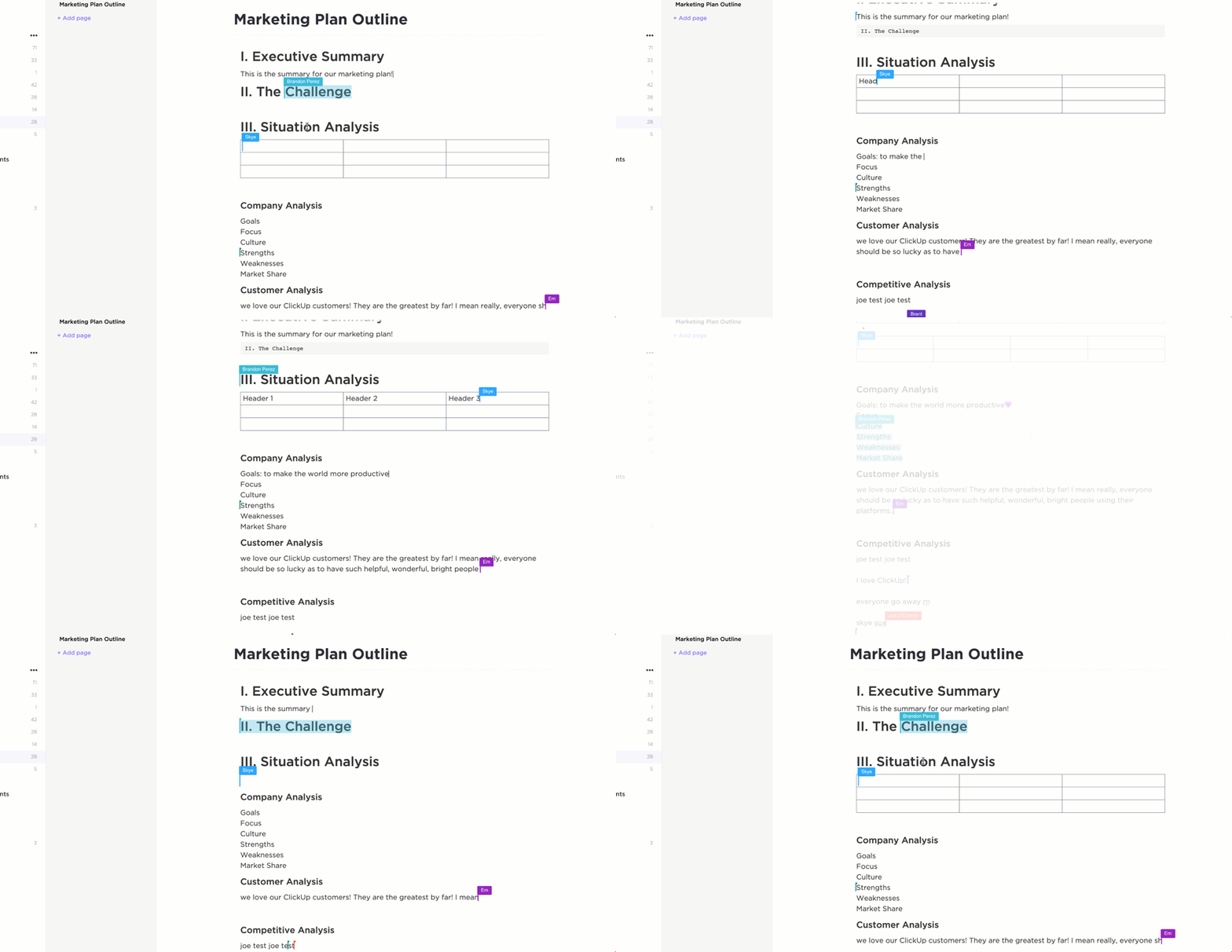
ClickUp Docs also offers rich text formatting to create tables, bullet points, and dividers. It’s perfect for breaking down complex ideas into clear, manageable parts and making your text engaging.
Making well-informed decisions requires structured approaches that help you evaluate options thoroughly.
For instance, the Socratic Method encourages critical thinking by asking thought-provoking questions that challenge assumptions and uncover deeper insights. It helps you break down complex problems and explore multiple angles to enhance your problem-solving skills.
On the other hand, a SWOT analysis offers a structured way to assess strengths, weaknesses, opportunities, and threats. It helps you develop strategies and anticipate challenges, whether you’re preparing for exams or tackling business decisions.
To further streamline your decision-making, ClickUp provides ready-to-use templates, like the ClickUp Decision Tree Template, which allows you to map out options, evaluate potential outcomes, and pinpoint key decision points.
Building on this clarity and structure, the ClickUp Decision-Making Framework Document Template offers a consistent process for making well-informed decisions. It ensures all stakeholders and educators are included, fostering collaboration and transparency.
💡 Pro Tip: Add a ‘gut check’ section at the end when using a decision-making template. Trusting your instincts can reveal insights that data alone might miss.

Moreover, ClickUp Tasks is ideal for staying organized while analyzing and processing information. Features like task prioritization, dependencies, and reminders allow you to keep track of deadlines and ensure a systematic approach to your work.
Finally, use ClickUp Timeline View to track progress and timelines to reflect and learn from your work. It visually represents your tasks and deadlines, helping you see how long it takes to complete various project stages.

For students, it can help manage research or project timelines, while professionals can use it to keep track of key milestones in their projects.
Rather than assuming you have all the answers, actively engage, listen, and ask insightful questions. This approach reveals overlooked perspectives and strengthens your critical thinking in any scenario.
Ask open-ended questions to understand the topic at hand better. Additionally, clarify vague or unclear points to avoid misunderstandings in class or at work.
💡 Pro Tip: Use the ‘five whys’ technique when faced with a problem by asking ‘why’ five times to uncover the root cause. This method helps you move beyond surface-level issues and discover underlying factors.
Once you decide, take the time to reflect on its effectiveness. What worked? What could be improved? Reflection helps refine your decision-making process for future challenges.
You must also record these insights to use them for future decisions. This way, each experience becomes a stepping stone for better decision-making.
💡 Pro Tip: Keep a journal where you analyze decisions, track your reasoning, and note patterns in your thinking. Over time, this practice helps identify areas for improvement.
Critical thinking often takes a backseat due to several obstacles that hinder growth, whether in academia or the workplace. Here are some of the common challenges you might face:
💡 Pro Tip: Be mindful of the ladder of inference when making decisions. It’s easy to jump from observation to action without fully analyzing your assumptions and beliefs.
Critical thinking is essential across various industries, enabling individuals to analyze situations, make informed decisions, and solve problems effectively.
Here are five critical thinking examples in the real world:
Improving critical thinking involves organizing your ideas and diving deep into the details.
Whether you’re an entrepreneur planning a product launch or a student writing a thesis, having the right tools makes all the difference. Knowing how to apply critical thinking skills means evaluating and synthesizing information effectively. Remember, continuous learning is key.
With ClickUp, the everything app for work, improving critical thinking becomes more effortless in everyday life. Use ClickUp Mind Maps to break down complex ideas, Whiteboards for collaborative brainstorming, and task management tools to keep everything in order.
These features help you stay organized, focus on what matters, and approach problems for the best solution with a sharper mindset.
Sign up to ClickUp for free today! ✅

© 2026 ClickUp





