






Still downloading templates?
There’s an easier way. Try a free AI Agent in ClickUp that actually does the work for you—set up in minutes, save hours every week.
Sorry, there were no results found for “”
Sorry, there were no results found for “”
Sorry, there were no results found for “”

A product manager recently posted on LinkedIn about a feature launch that completely flopped. She explained what went wrong, what she learned, and how she’d approach it differently. The post got 10,000 views and three job offers.
Her colleague shipped a wildly successful feature the same month and posted nothing. Zero recruiters reached out. 😶🌫️
This isn’t about who’s better at product; it’s about who shows their thinking. If people can’t see how you reason, they can’t remember you. And that’s why LinkedIn matters more than PMs like to admit.
This guide breaks down how to authentically grow your LinkedIn brand as a product manager. Plus, we’ll look at how ClickUp helps you track and showcase your PM work. 🗂️
As a PM, your network is your net worth. LinkedIn serves as the primary platform where recruiters find you, where you build thought leadership, and where you stay plugged into the latest in your field.
Here’s why it matters:
🧠 Fun Fact: LinkedIn’s redesign project in 2012 (codenamed ‘Project Katy’) was inspired by pop‐star Katy Perry: the idea was to move away from a 1990s-style web interface to something more modern and streamlined.
Think of a LinkedIn profile as your always-on product portfolio that works while you sleep. Here’s how to build a foundation that attracts the right opportunities.
Optimization starts with understanding how recruiters and hiring managers find candidates on the platform.
Recruiters search for titles, skills, and areas of impact.
If your profile says ‘worked on features’ but their searches are for ‘Product Strategy’ or ‘Roadmap Management,’ you won’t appear.
Place relevant keywords (LinkedIn SEO, essentially) in three critical spots: your headline (‘Senior PM | Product Strategy & B2B SaaS’), your About section’s first paragraph, and within role descriptions. Test this yourself by searching ‘Product Manager [your city]’ and notice which profiles rank highest.
🔍 Did You Know? In a study of LinkedIn profiles, using a combination of just a location + a few rare skills made a profile uniquely identifiable with about 75% probability in a sample of ~970 million users.
Saying you shipped a feature means nothing without evidence.
Proof converts.
Examples:
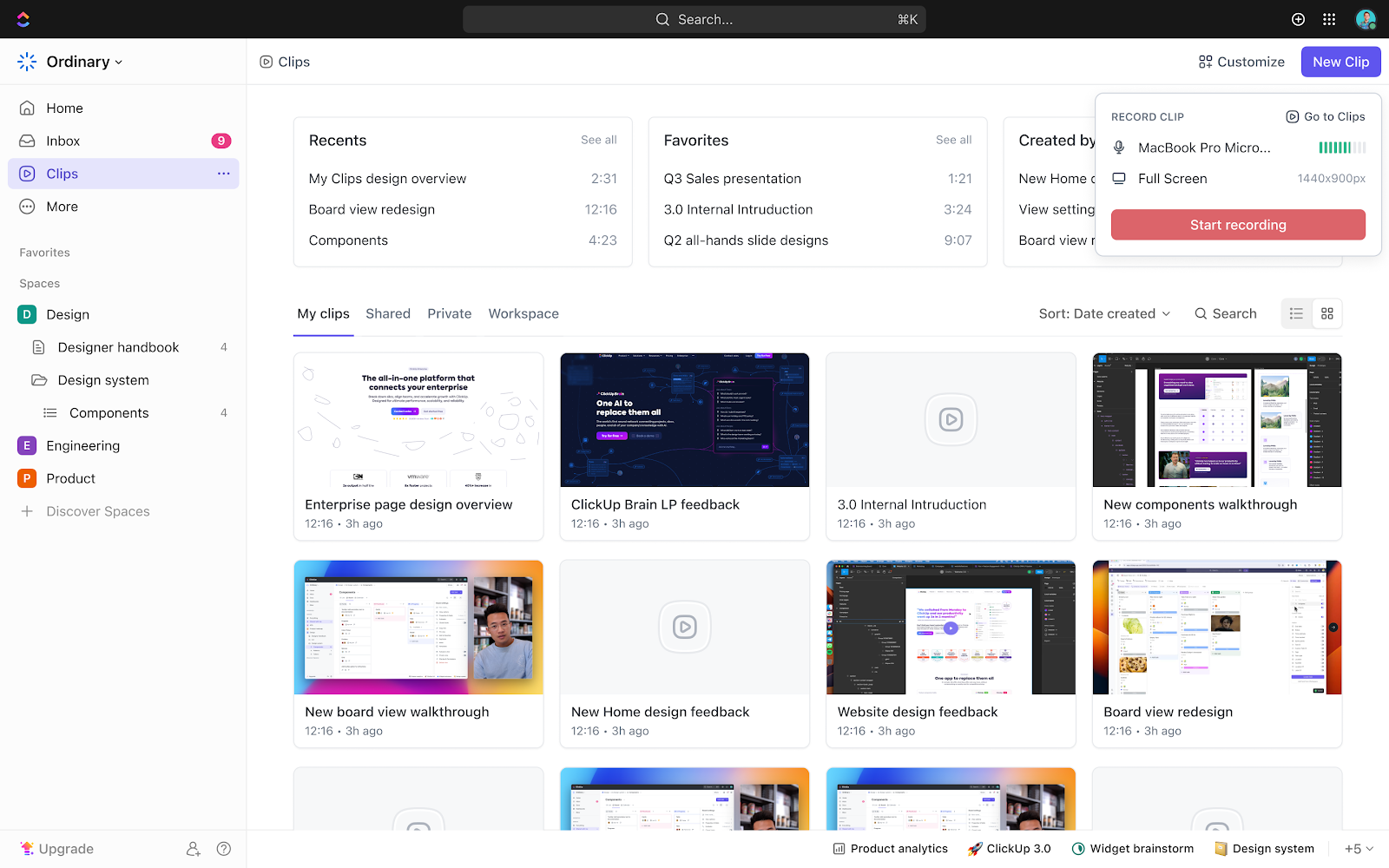
💡 Pro Tip: Use ClickUp Clips for clean walkthroughs.
Focus on context—what changed, why it mattered, and the impact once it shipped. That’s how you turn “I built X” into a story of decisions, trade-offs, and results.
Every bullet in your experience should contain at least one number: percentage change, dollar amount, timeframe, or volume.
Replace ‘improved user engagement’ with ‘Increased Daily Active Users (DAU) from 12K → 31K in 4 months after redesigning onboarding based on 40 user interviews.’
The specificity proves you measure impact, understand causation, and communicate results clearly.
📖 Also Read: How to Automate Content Creation With AI
Most PMs list responsibilities (‘managed roadmap,’ ‘worked with engineers’), but the best profiles reveal how you diagnose problems and create value.
A little truth for every PM: If you’ve ever hesitated to write your experience because you’re scared it’ll come off generic or “not senior enough,” don’t worry; every PM feels that. What matters is clarity of thinking, not perfection. Specific stories always land better than polished claims.
Open each role with the situation you inherited so recruiters understand the difficulty level.
‘Inherited product with 60% churn, no differentiation from 4 competitors, and engineering team shipping features nobody wanted’ tells a hiring manager you can handle chaos and ambiguity. The challenge framing proves you understand business problems, not simply execute tasks.
Explain your process in 2-3 crisp sentences, focusing on what you stopped doing.
‘Ran Jobs-to-be-Done interviews with 25 churned customers, discovered they bought for use case A but we optimized for use case B, killed three in-progress features to rebuild core workflow’ demonstrates structured thinking.
Trade-offs reveal judgment; anyone can say yes to everything, but strategic PMs know what to kill.
📖 Also Read: How to Use Trendspotting (With Examples)
Close with business metrics that matter to executives.
‘Reduced churn from 60% to 18% over 2 quarters, expanded average contract value by $14K through upsells, improved team velocity by removing 40% of backlog noise’ connects your PM work directly to revenue and efficiency.
If you shipped something that failed, own it and explain what you learned. Honesty builds more credibility than a perfect track record.
📮 ClickUp Insight: 19% of people surveyed don’t know what a portfolio career is, and 18% are held back by not knowing where to start. The desire is there, but the roadmap is missing.
With ClickUp Brain, you never have to wonder what to do next. Just ask, “How do I launch a product?” Brain can instantly search the web, analyze the latest strategies with multiple LLMs, and deliver a step-by-step plan tailored to your goals.
Whether you need a market analysis, a checklist for your first client, or advice on building multiple income streams, every answer is immediate, actionable, and backed by real data. Your roadmap is always just one question away.
Write one deep article monthly on a specific problem you solved, not generic advice everyone already knows.
Pick one decision like ‘How I prioritized 47 feature requests with three engineering resources’ and walk through your exact process:
Long-form articles with real examples, real tension, and industry news get shared because they’re immediately useful to other PMs facing similar problems right now.
We spoke to Jacob Goldschein, CEO of Orca, a LinkedIn ghostwriting agency for founders and operators, about how PMs can use storytelling authentically.
He told us:
Every product story starts with what inspired you to become a product manager in the first place: what inspired you to love product, to want to create something with your own hands, your own ideas, your own thoughts. […] As a product manager, your whole life is basically a story of creation, ideation, which is very unique.
💡 Pro Tip: Use ‘aha’ moments from user feedback as content gold. Next time a customer says something that changes how you see the product, write a quick post breaking down that shift in thinking. It makes you sound curious, not preachy.
Growing your LinkedIn presence as a product manager works the same way your product works: clarity, iteration, and feedback loops. You already think in systems.
ClickUp’s Marketing Solution lets you treat your personal brand the same way, as a living system that improves as you learn more about your audience, your voice, and your own product thinking.
Start here. 🏁
Your best content usually comes from real product problems: trade-off discussions, customer tensions, prioritization conflicts, alignment gaps.
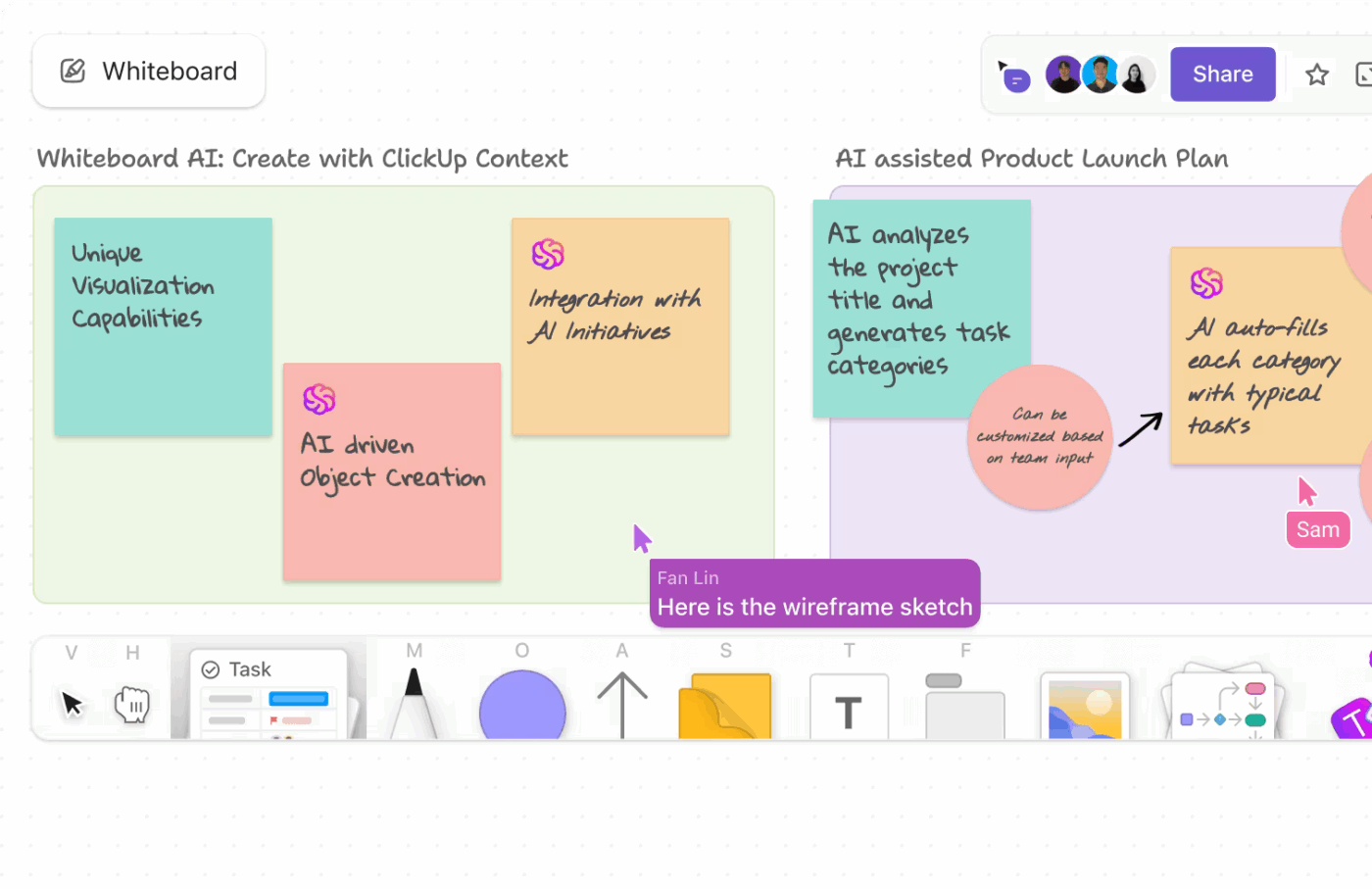
ClickUp Whiteboards helps you break these moments into clear narrative angles.
You can map stories you want to share:
For example, create a board titled ‘Leadership Signals in Conflict’ in the brand management software. You can add sticky notes for what happened, what you considered, the decision you made, and why it mattered.
This gives you structured clarity before you draft.
Your thoughts evolve through specs, meeting notes, research summaries, roadmap commentary, and decision logs.
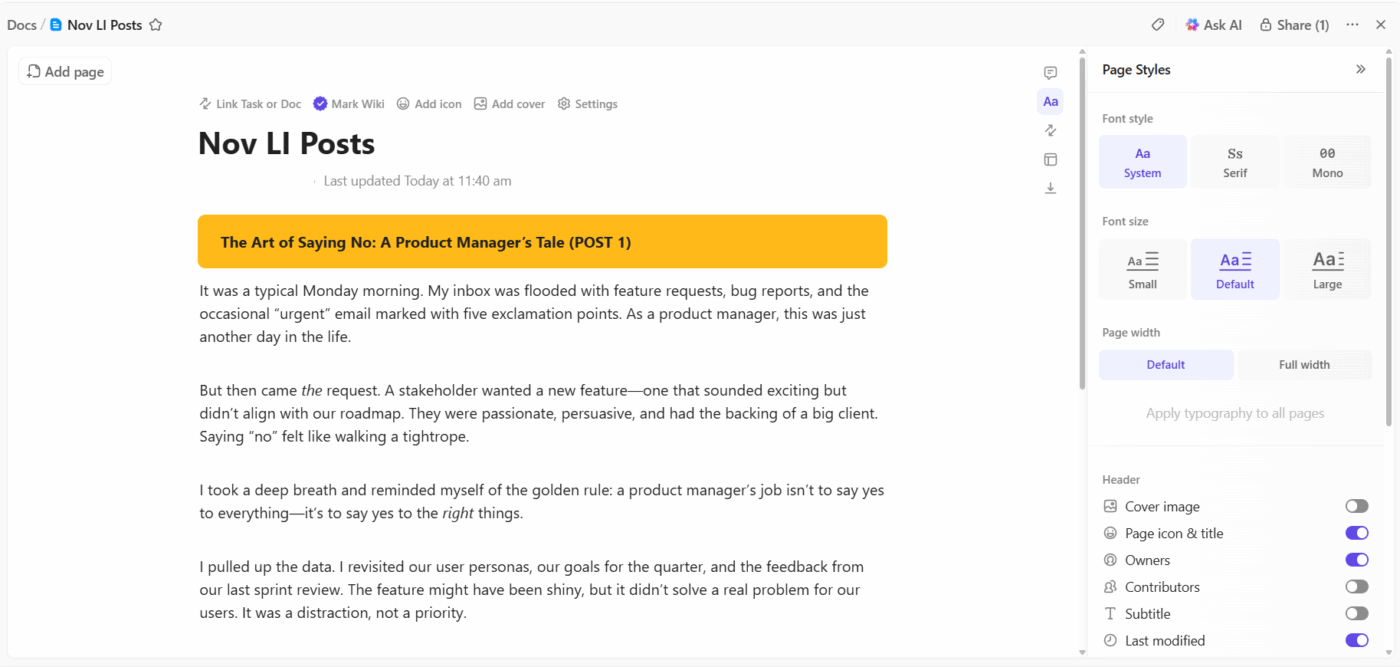
ClickUp Docs lets you convert that thinking into shareable narratives without needing to switch tools. For example, draft a post about feature prioritization:
This system turns your work experience into a consistent storytelling asset.
What’s more, you can also use Docs to centralize post drafts, caption ideas, and engagement templates.
🚀 ClickUp Advantage: You can bring expert eyes into your thinking process with ClickUp Assign Comments.
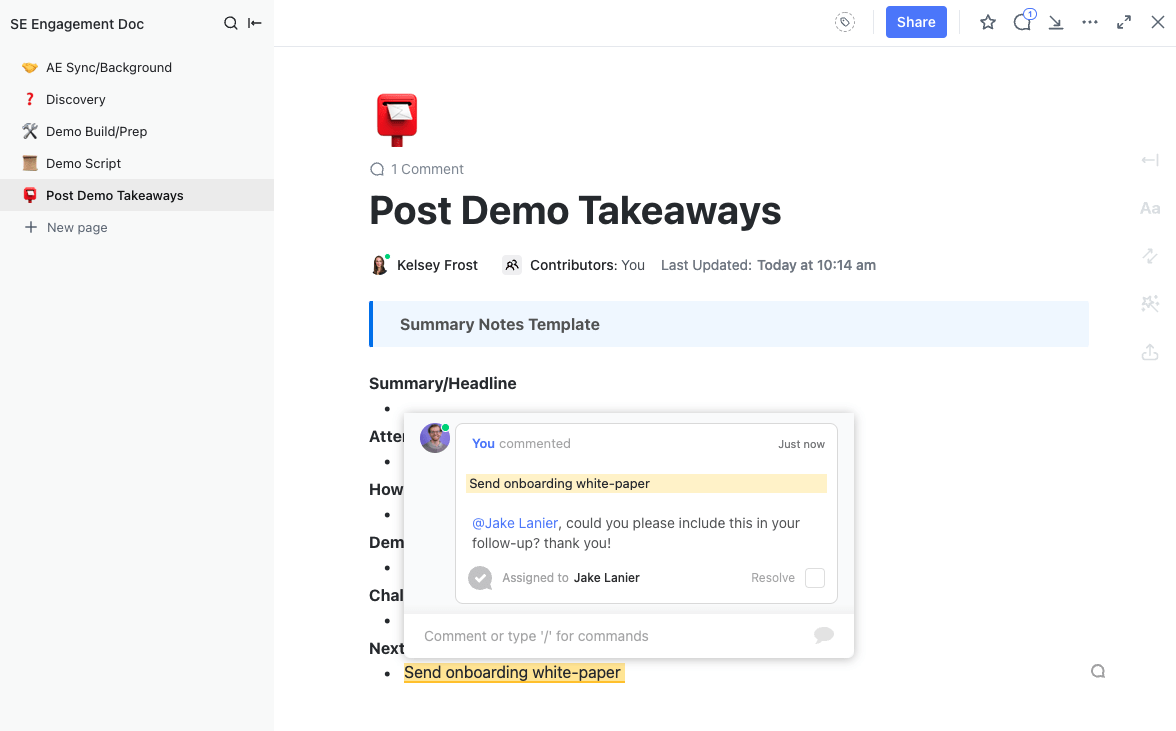
Suppose you want a senior PM to check your reasoning around why engineering resisted your proposed scope reduction. Highlight that specific paragraph in Docs and assign it the comment. Add a note: ‘Please check reasoning, tone, and clarity.’
They respond directly to where the improvement is needed. You tighten, resolve, and move forward.
As a product manager, your schedule is packed with sprint reviews, grooming sessions, stakeholder syncs, and constant context switching. Without a system, the ‘post today’ intention slips.
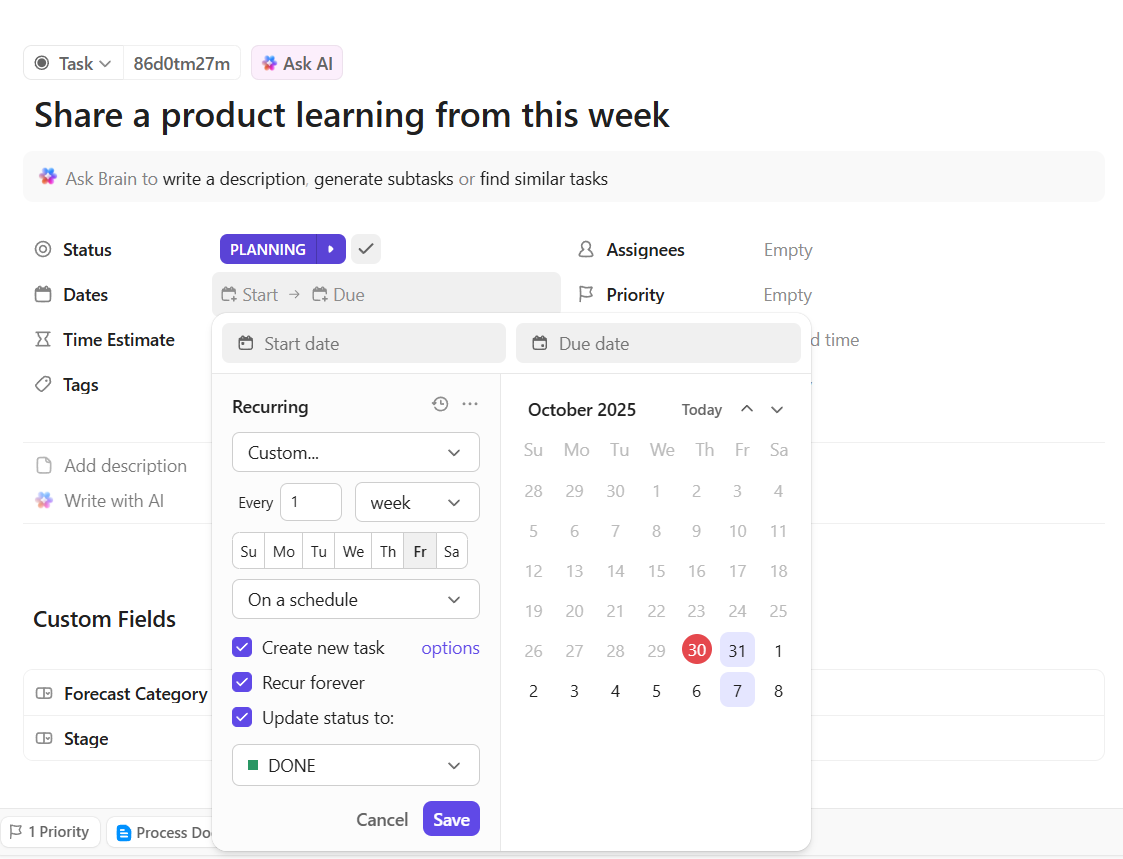
Use ClickUp Recurring Tasks to turn your content into a repeatable operating rhythm.
Set up recurring task templates built around your content pillars. For example:
Each task can include prompts, reference links, and your ‘story angle’ tiered by audience sophistication (beginner, practitioner, leadership-facing). When the task reappears in your LinkedIn content calendar, you’re essentially building a system that feeds itself.
🚀 ClickUp Advantage: Talk to Text in ClickUp keeps your strongest ideas alive long enough to shape them. Suppose you’re moving between a roadmap sync and a stakeholder review, and a great LinkedIn angle hits you, something sharp from a real product trade-off you handled last week.
You say it out loud in ClickUp BrainGPT, the AI desktop companion, and it’s ready to become a task in your workspace. The idea stays captured, ready for polishing later.
Learn more here:
Your job involves distilling ambiguity, interpreting data, framing decisions, and articulating trade-offs. This is the thinking that signals strong product judgment, and it’s exactly what builds credibility on LinkedIn. The challenge is surfacing it in a sharp, compelling, reader-friendly format.
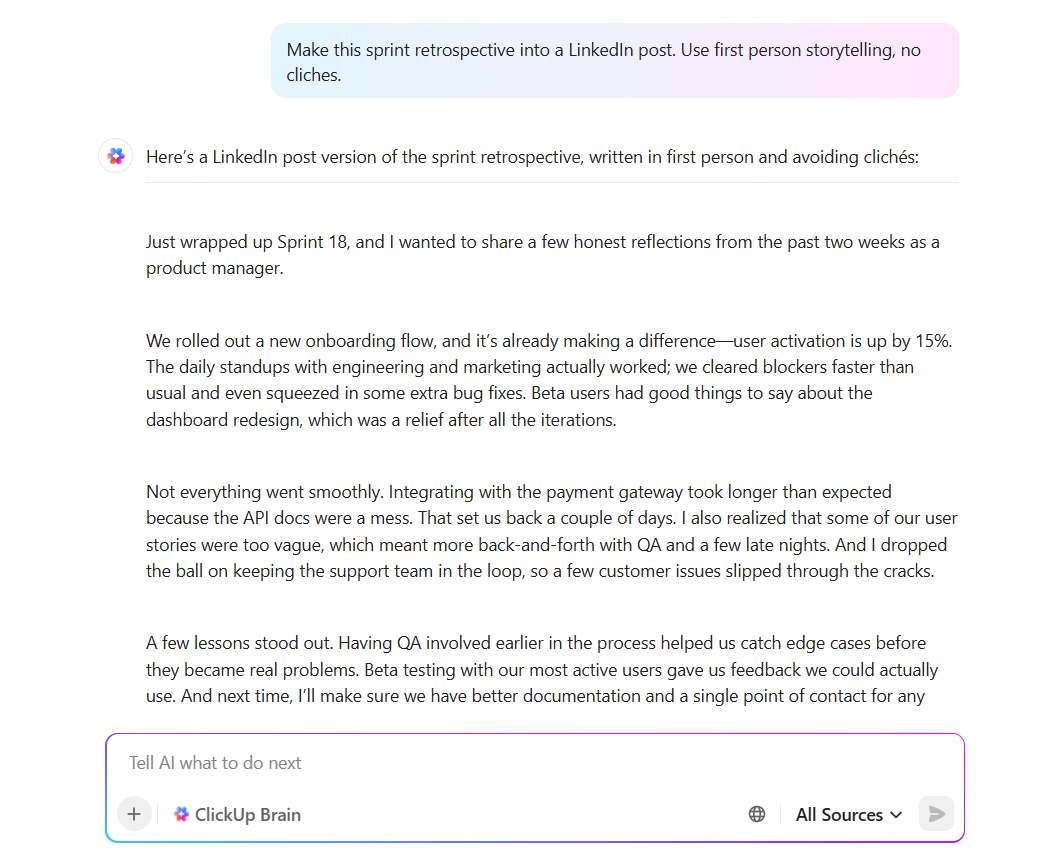
ClickUp Brain, the integrated social media AI assistant, helps you translate your working notes into insight-rich posts that show your depth.
Pull from:
Then, guide ClickUp Brain to surface your reasoning clearly rather than summarizing the event.
✅ Try this prompt: Summarize this customer feedback thread into a post explaining how to frame feature prioritization across competing stakeholder needs. Write in second person, direct, thoughtful, no clichés.
A ClickUp user shares how we helped them eliminate work sprawl:
ClickUp Brain saves me a ton of back and forth honestly. I know there are AI tools with a pretty efficient free tier, but the constant switching between tabs takes a toll. And honestly, when I’m in my deep work zone, this is the last thing I want to do.
I primarily use the AI for writing stuff since I’m in the content industry. It also edits what I’ve written (ah-mazing!). Another thing that really helps me is Docs. I love the formatting options, especially those banners. So cute!
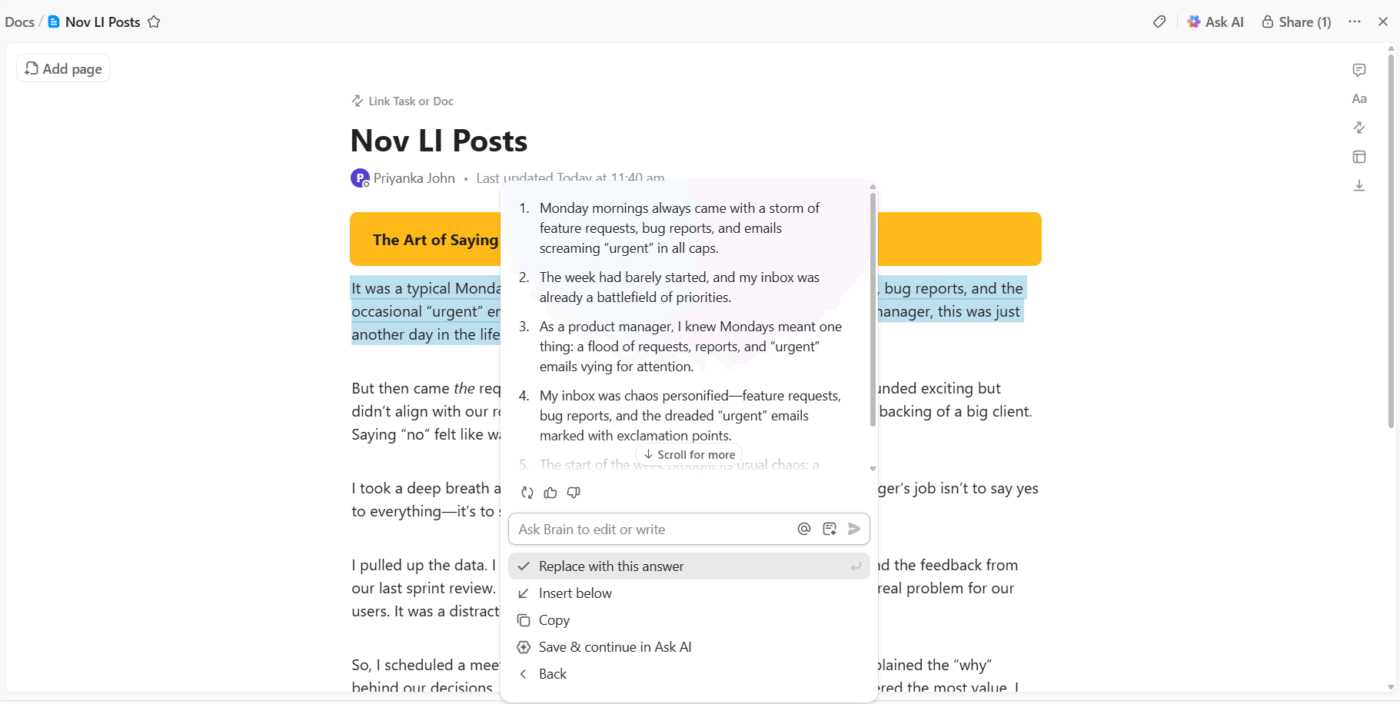
ClickUp Brain helps you experiment with tone shifts, hook variations, and example framing. Say your opening feels too academic.
Mention @Brain and ask for three versions:
Choose the style that aligns with your LinkedIn voice and refine it inside the same ClickUp Doc.
🧠 Fun Fact: While product managers are sometimes called ‘mini-CEOs’ of their products, some commentary suggests they’re quite rare in proportion: there can be more VPs than PMs in some companies, and PMs are statistically ‘unicorns’ because their role spans business, design, engineering, and data.
Your schedule already holds sprint reviews, team syncs, backlog refinement sessions, roadmap discussions, and 1:1s. Consistency on LinkedIn becomes easier when your posting schedule sits inside the rhythm of that reality.
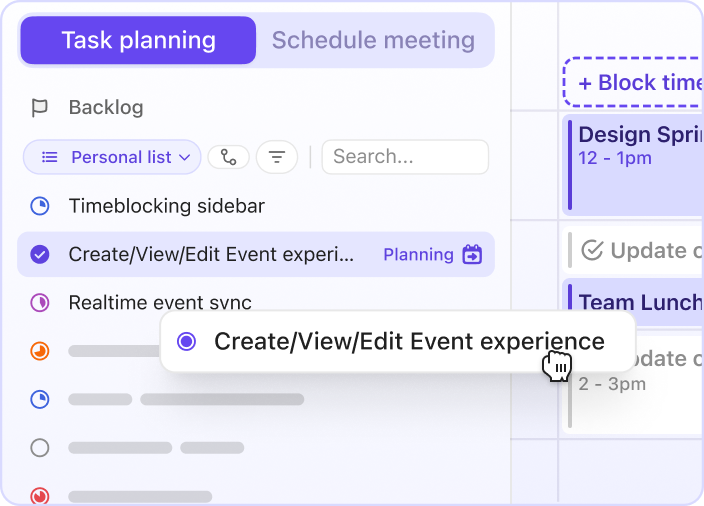
ClickUp Calendar brings your tasks, calls, and priorities into one visual flow.
Here, ClickUp Brain looks at your priority tasks, meeting load, and typical focus windows, to auto-block drafting time so you write when your energy supports good thinking, not when the deadline pressures you.
Suppose sprint planning always gives you clarity on Tuesdays. ClickUp Brain schedules Tuesday late-morning as your drafting window. Suppose Fridays run lighter post-standups. It marks Friday afternoon for publishing. Your content rhythm now tracks your product rhythm.
⚡️ Template Archive: The ClickUp Social Media Content Calendar Template ties this entire workflow together so every post moves through the same loop. The social media calendar template already includes spaces for idea storage, drafting status labels, scheduled posts, and engagement tracking. You simply plug your pillars into it and start producing.
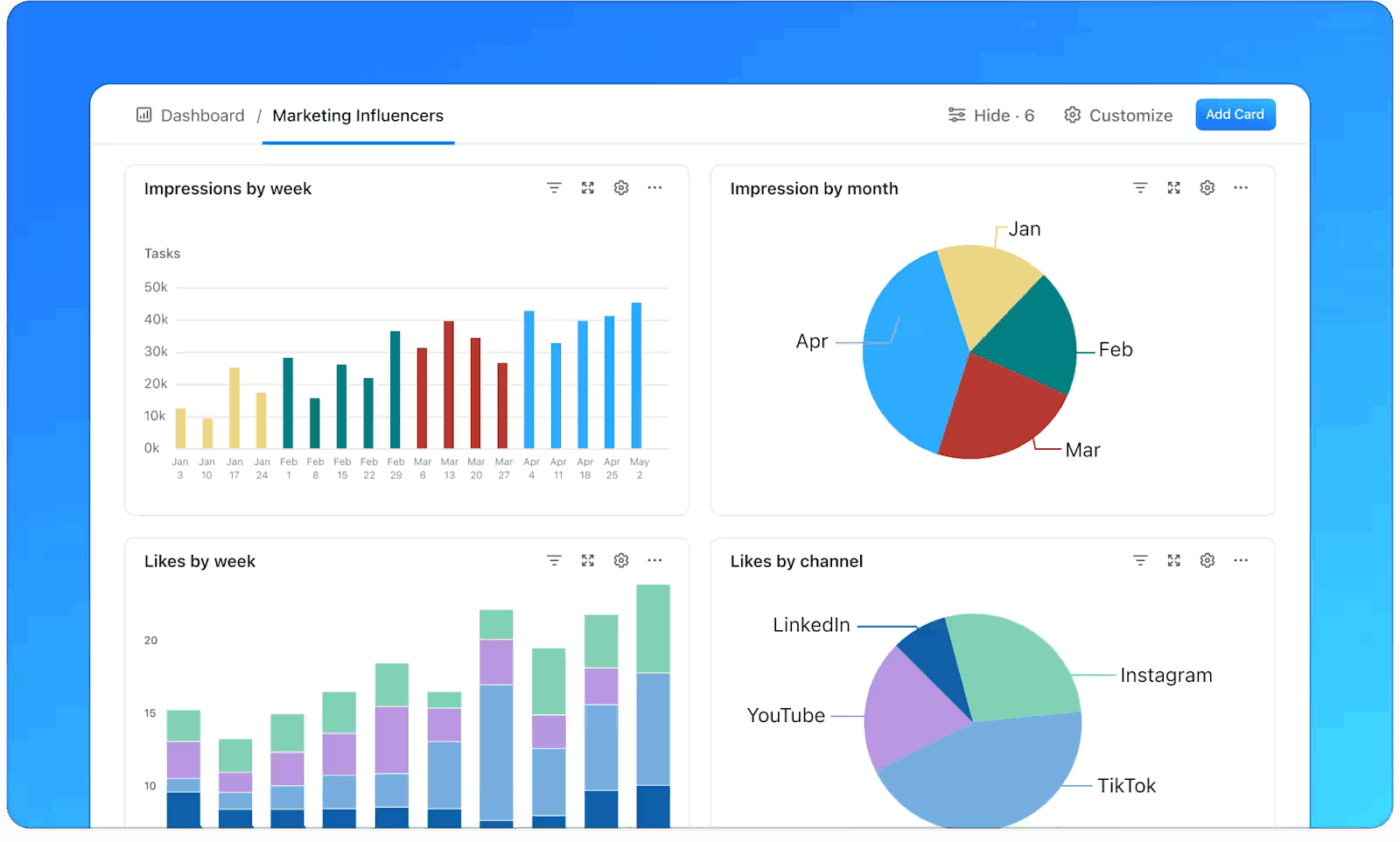
ClickUp Dashboards show which topics deepen trust and which ones fall flat. Suppose you track:
This tells you your audience values practical reasoning and concrete decision stories. So you double down on that.
🚀 ClickUp Advantage: Strong LinkedIn posts often rely on visual clarity. ClickUp Proofing helps you refine carousels, UI breakdowns, and product storytelling posts without chasing feedback across chats.
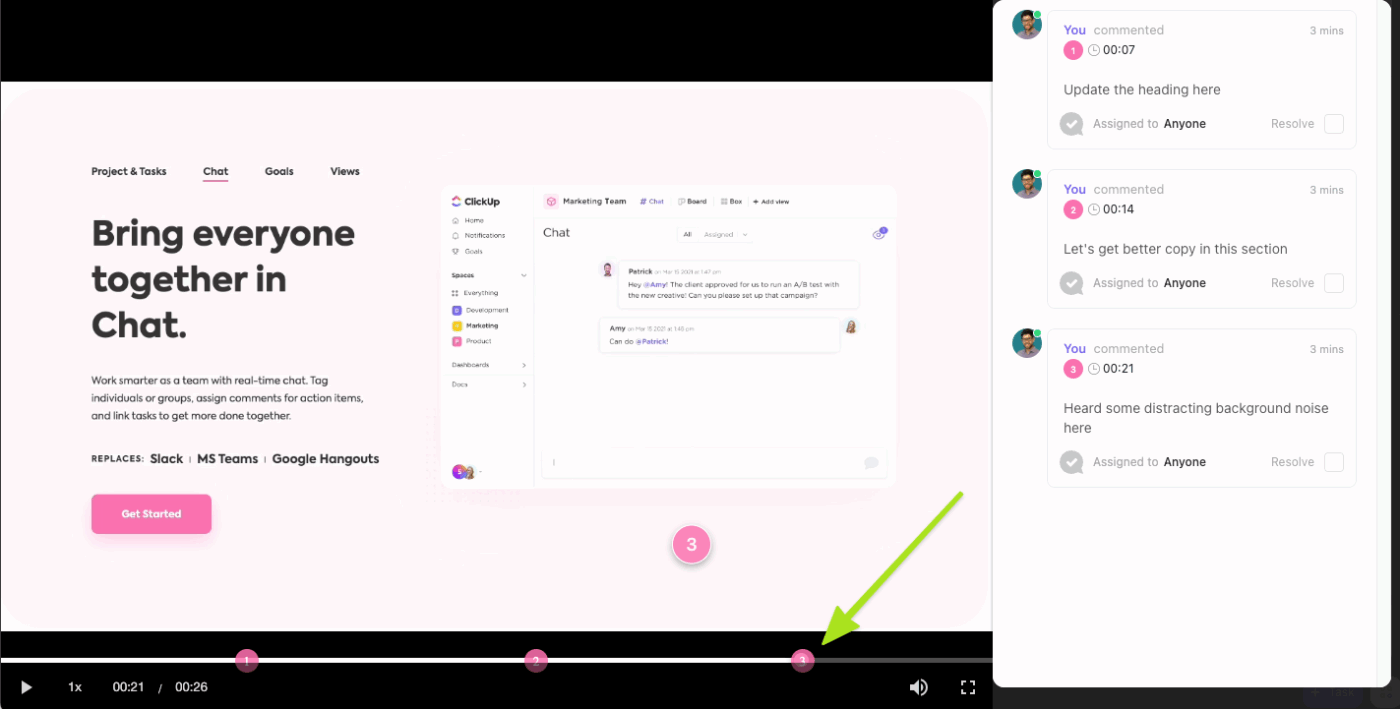
Upload your draft images, carousels, or short video clips directly into your task. Your reviewers can click anywhere on the visual and leave pinpoint comments tied to exact frames or sections.
📖 Also Read: Creative Brand Management Strategies (With Examples)
A strong profile means nothing if nobody sees it.
Your professional network determines your reach, and engagement determines your visibility. Here’s how to build connections that actually lead to opportunities.
Following the right people puts valuable content in your feed and gets you noticed when you engage thoughtfully.
💡 Pro Tip: Engage with their content strategically. Comment when you have something substantive to add, like a similar experience, a counterpoint with reasoning, or a follow-up question that deepens the discussion.
‘Great post!’ adds zero value, but ‘We tried this prioritization approach at [Company] and found it broke down when stakeholders had conflicting success metrics. Curious how you handle that tension starts conversations that get you noticed.
Communities give you access to peers solving similar problems and create opportunities for collaboration.
Attend events with a goal beyond collecting contacts. Ask speakers about specific challenges you’re facing, introduce yourself to 3-5 people with a genuine interest in their work, and follow up within 48 hours, referencing your conversation.
🔍 Did You Know? Executives who post on LinkedIn currently see their content get up to 4x more impressions than typical LinkedIn users, making leadership presence a big amplifier.
Co-creating content fosters relationships more quickly than passive networking, and it positions both contributors as thought leaders. Here’s what you can try:
Collaboration creates mutual visibility and builds reciprocity. When you help someone else get exposure, they remember and return the favor.
When we asked Jacob about balancing professional thought leadership with personal voice, he said it depends on the context:
If we’re working within something really technical, the personal insight should be kept to maybe 5% of the posts. If you’re in an industry like SaaS, where there are so many people building something likely similar to what you’re building, personality is how you really stand out.
🧠 Fun Fact: The concept of personal branding was formally introduced as far back as 1997 when Tom Peters published the article The Brand Called You in Fast Company, telling readers: “We are CEOs of our own companies: Me Inc…our most important job is to be head marketer for the brand called You.”
Building a LinkedIn personal brand without tracking performance is like shipping features without analytics (a PM joke, we couldn’t resist). LinkedIn provides clear metrics that show what’s working and what needs adjustment. 📊
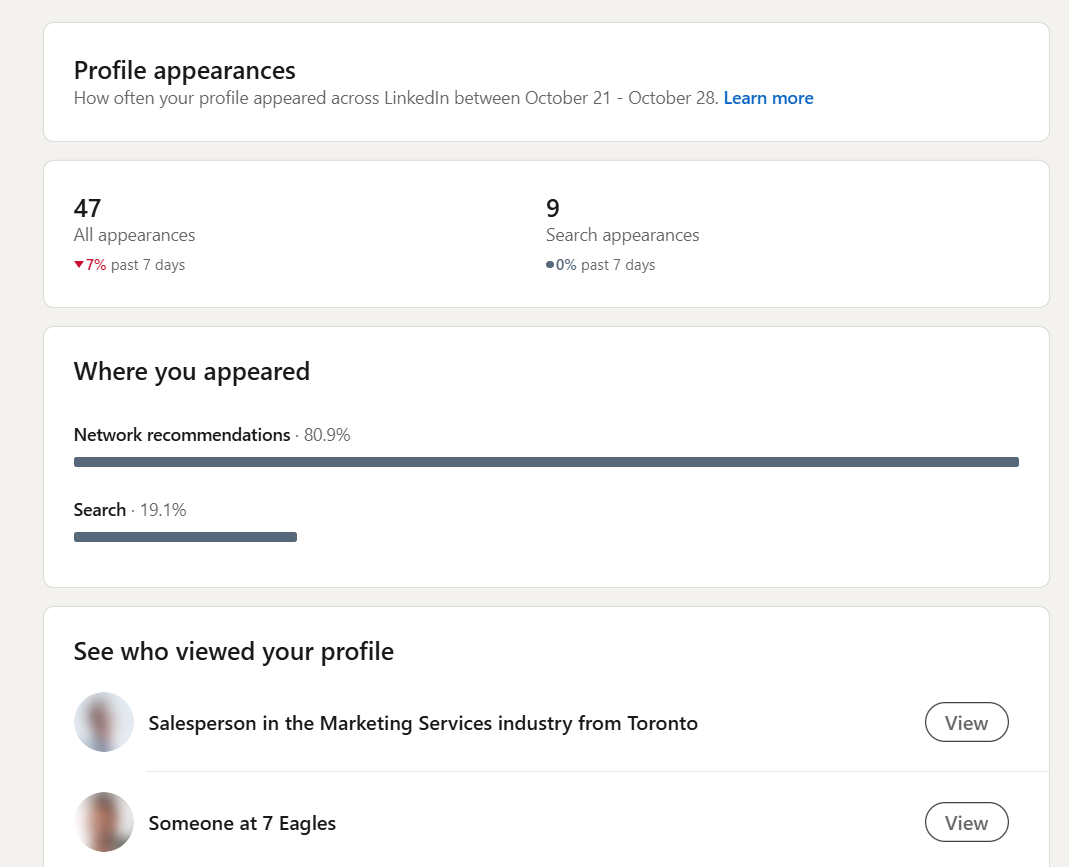
Weekly profile views measure your discoverability and content effectiveness.
A spike after posting content or engaging in discussions tells you those activities drive traffic. Aim for steady growth: 50 views per week as a baseline, 200+ if you’re actively posting.
The ‘How people found you’ breakdown reveals whether search keywords or your content are driving visits.
📖 Also Read: How to Reach Out to Recruiters on LinkedIn
The quality of inbound requests matters more than the quantity. If recruiters, hiring managers, or senior PMs are reaching out unprompted, your positioning is working.
Selective acceptance based on relevance to your goals beats arbitrary growth.
💡 Pro Tip: Turn product jargon into explainers. A simple post unpacking something like ‘What we really mean by user empathy in product decisions’ helps non-PMs understand your world and builds niche authority.
Impressions show reach, but engagement rate (likes + comments + shares divided by impressions) reveals resonance.
A post with 5,000 impressions and 2% engagement outperforms one with 10,000 impressions and 0.5% engagement.
Different topics drive different levels of meaningful interaction:
💡 Pro Tip: Review your top five performing posts monthly to identify patterns in topic, format, and tone, then double down on what your audience finds valuable.
Strong profiles follow clear patterns: strategic positioning, tangible proof of impact, and consistent engagement. Here are PMs whose profiles demonstrate what works.
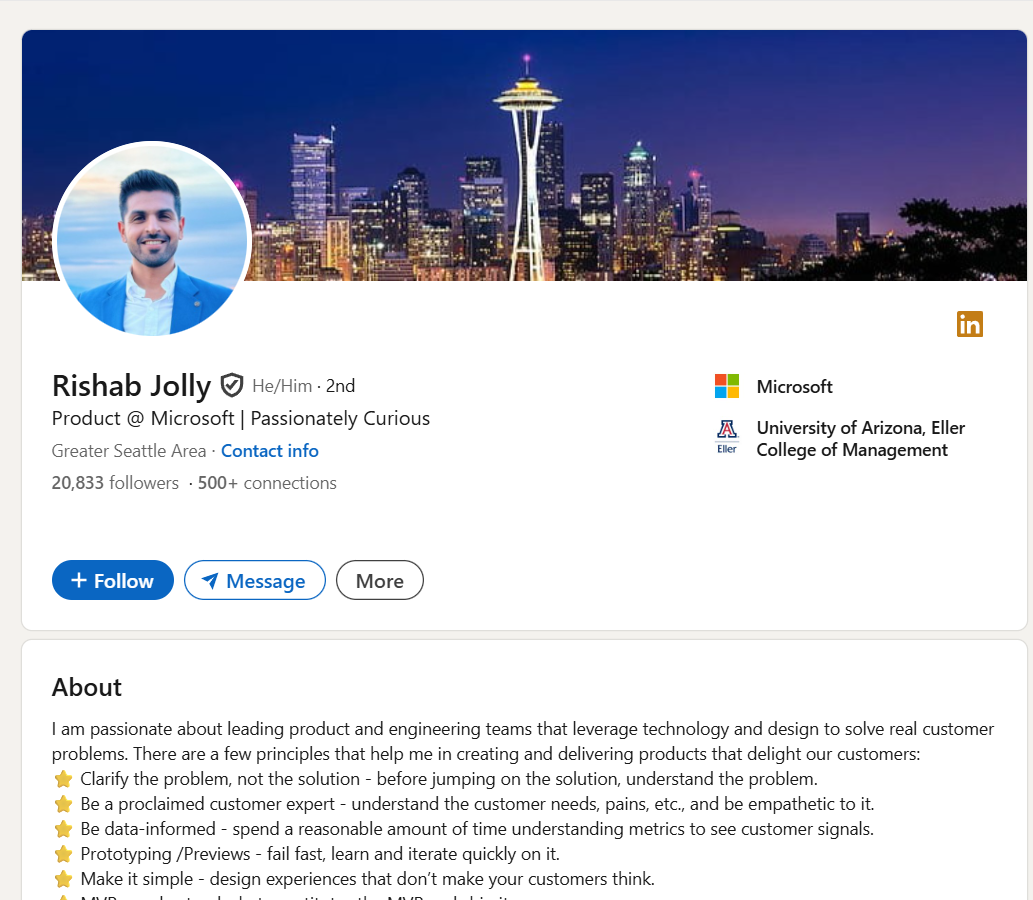
Rishab Jolly is a Senior Product Manager at Microsoft who drives strategy and execution for Azure Application Insights. His profile demonstrates how technical PMs can build thought leadership without executive job titles.
What makes his brand work is consistency paired with specificity. He shares insights on storytelling and stakeholder influence with his 20K+ LinkedIn community, posting frameworks and lessons from building developer tools at scale. He also hosts the Curious Soul podcast, where he interviews tech leaders from Microsoft, Meta, and beyond, then repurposes key insights into LinkedIn content.
The lesson: pick a niche (such as cloud product management or stakeholder storytelling) and own it through consistent content creation.
📣 SME Speaks: On hesitating to market yourself, Jacob was direct:
It’s inevitable. We are in a place in a time period where founder-led marketing is the key to success, especially in B2B. You can be scared to market yourselves, and most people are in the beginning, and that makes total sense. But it’s more so about understanding that it is inevitable if you want to continue to grow.
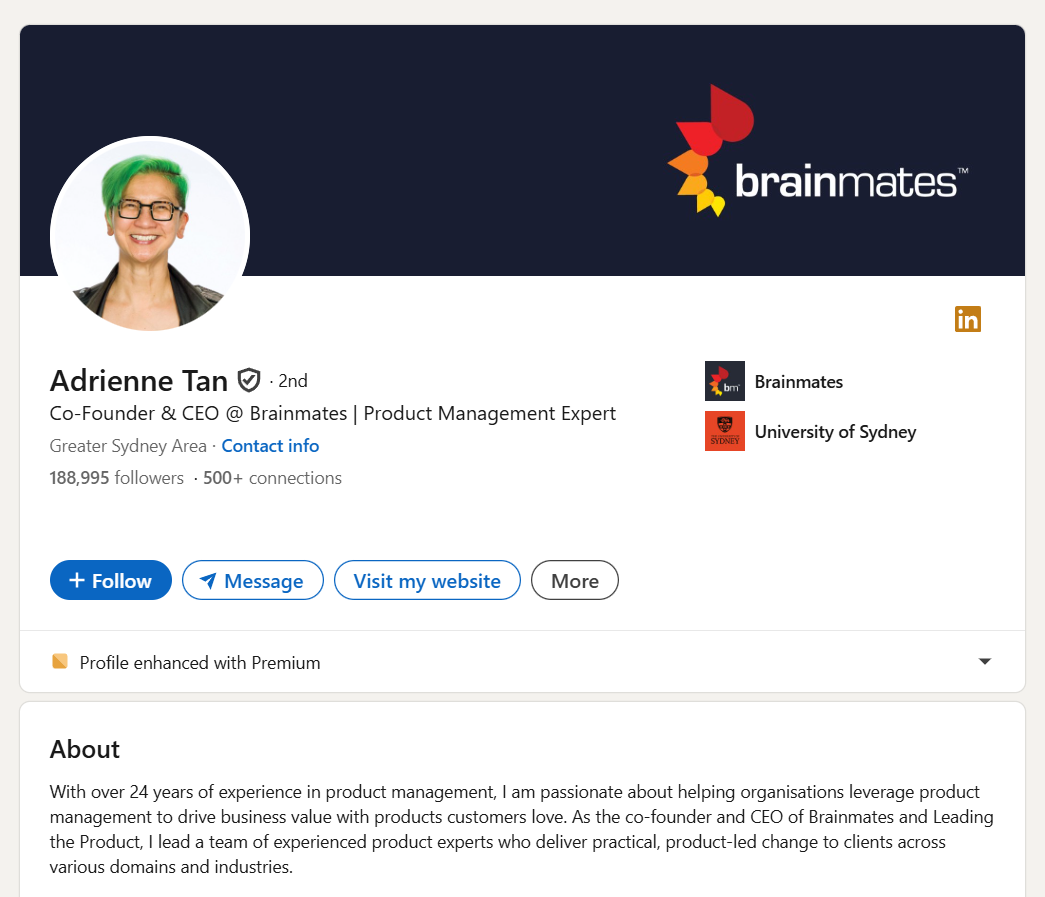
Adrienne Tan is the Co-founder and CEO of Brainmates, one of Australia’s most recognized product management consultancies. With over two decades of experience, she has shaped how organizations across various industries approach product strategy, customer value, and business growth.
Her experience highlights measurable contributions: launching Australia’s first national product management conference, mentoring emerging product leaders, and advising companies on customer-centric frameworks. Each role connects directly to outcomes like improved product-market fit, stronger go-to-market alignment, and increased business agility.
💡 Pro Tip: Start documenting your product experiments like story arcs. Write a short post series that walks through a hypothesis, a surprise result, and what you’d change next time. It gives your followers a front-row seat to your growth mindset.
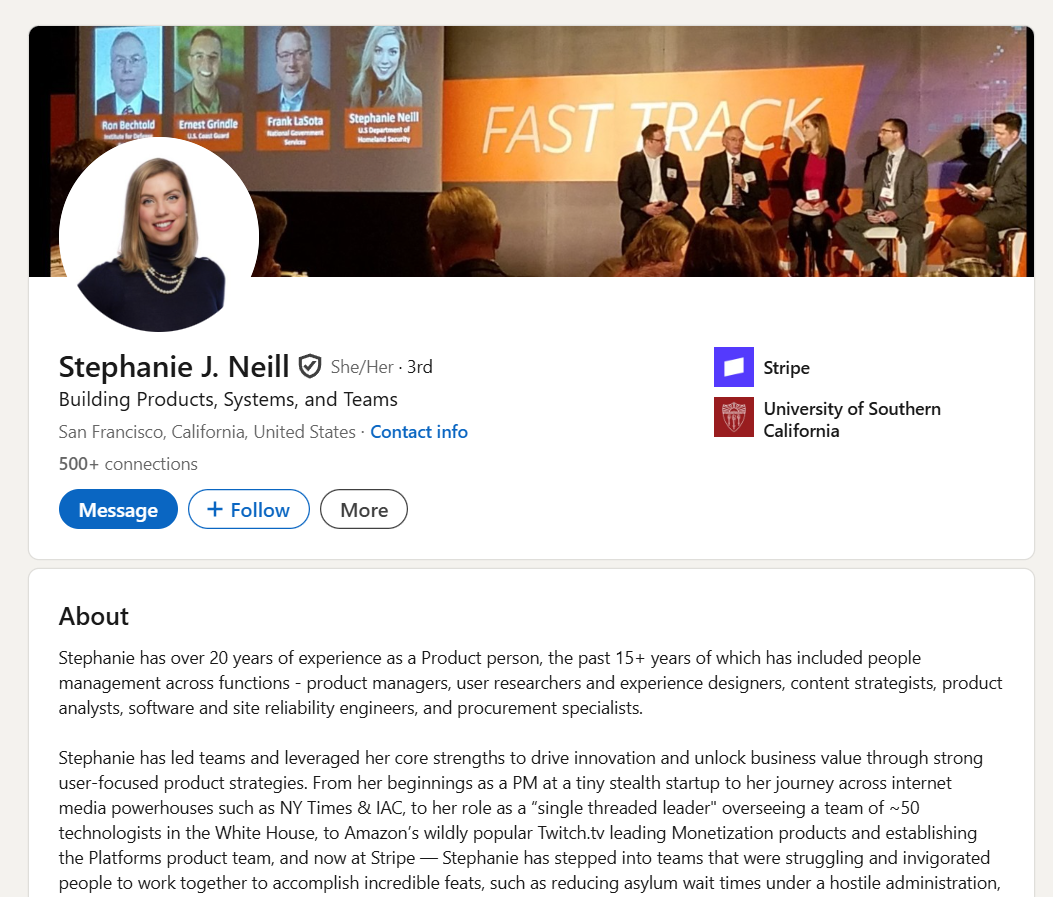
Stephanie Neill is Head of Product at Stripe with nearly 20 years of experience leading teams at The New York Times, IAC, and Twitch. Her profile demonstrates how to showcase leadership without abstract claims. She has built and scaled product communities across the US and leads teams focused on integrating machine learning to optimize operations and enhance customer experiences.
Her experience bullets connect her work to business outcomes: team size, revenue impact, and technical complexity. The profile balances strategic vision with hands-on execution, showing she can both set direction and deliver results. The lesson: quantify your leadership impact through team growth, revenue contribution, and technical scope.
💡 Pro Tip: Comment strategically before posting. Engage with founders, designers, or other PMs on their posts for a week before sharing your own. LinkedIn’s algorithm will naturally cross-pollinate your visibility to their networks.
Here’s a breakdown of mistakes to avoid when trying to grow your LinkedIn brand as a product manager:
🔍 Did You Know? A study in Frontiers in Psychology found that individuals who actively manage their personal brand have significantly higher odds of career advancement and recognition than those who don’t.
Every strong product tells a story of intent, trade-offs, and lessons earned in motion, and so does every strong product manager. LinkedIn rewards clarity of thinking more than polish, and credibility grows when you show how you reason, not how you perform.
ClickUp turns that reasoning into rhythm.
For example, while ClickUp Brain captures ideas the moment insight strikes, Docs shape them into sharp narratives, and Recurring Tasks ensure your momentum continues even on busy weeks. What begins as thoughtful documentation becomes visible proof of product judgment, the exact quality recruiters and peers look for.
Visibility, after all, is another product to manage. With ClickUp as your workspace, your ideas scale with the same precision you bring to every launch.
Sign up for ClickUp today! ✅
Posting two to three times a week works well. It keeps your profile active while giving you enough time to think through your ideas, reflect on your work, and share something meaningful rather than rushing to post every day.
Share what you’re learning from real product work.
For example, talk about how you approached a feature decision, what trade-offs shaped the final outcome, what you learned from a failed experiment, or how user feedback influenced direction. People respond to thought process and honesty more than theory.
Creator Mode helps if you want to grow your audience and be discovered through specific topics. A regular profile is completely fine if your goal is to build credibility and attract opportunities quietly. The choice depends on whether visibility or simplicity matters more to you.
Focus on your own experiences rather than repeating common PM frameworks. When you speak from your day-to-day work, your perspective becomes naturally unique.
Focus on your own experiences rather than repeating common PM frameworks. When you speak from your day-to-day work, your perspective becomes naturally unique.
ClickUp helps you stay consistent by keeping everything in one place. You can plan your weekly posting schedule, draft content in ClickUp Docs, store reference examples, and track ideas you want to develop as ClickUp Tasks.

© 2026 ClickUp

There’s an easier way. Try a free AI Agent in ClickUp that actually does the work for you—set up in minutes, save hours every week.