

Google Drive is a cloud storage solution created by Google that stores all documents created using your Gmail account or shared with another user. Moreover, Google Drive automatically syncs these documents, ensuring you can resume your work from where you left off without updating the file from scratch each time.
Google Drive is the backbone of any Google Workspace, providing free storage, accessibility, and visibility that your team requires. Google Drive interface makes creating and dropping files easy and quick.
Are you a Google Drive user looking to take your productivity to the next level? We’ve compiled a list of handy Google Drive hacks to enhance your experience and help you get the most out of it.
So get ready to optimize your usage and streamline your workflow with these convenient tips.
15 Google Drive Hacks to Get Organized in 2024
- Essential Google Drive Features
- Google Drive in Business: A Focus on Collaboration and File Sharing
- 15 Google Drive Hacks to Become an Expert User
- 1. Understanding Google Drive’s Quick Share feature
- 2. Availing of the benefits of notifications in Google Drive
- 3. Using the search function effectively
- 4. Exploring Google Drive extensions and add-ons
- 5. Installing Drive, Docs, Sheets, and other apps on your desktop and mobile
- 6. Avoiding Gmail attachment restrictions with Drive
- 7. Dragging and dropping external files
- 8. Bookmarking the important Google Drive files
- 9. Accessing pre-designed templates
- 10. Making your PDFs editable
- 11. Scanning documents without a scanner
- 12. Organizing your Drive for the larger team
- 13. Saving an informative article or video directly in Drive
- 14. Learning the Google Drive shortcuts
- 15. Turning on two-factor authentication (2FA)
- Google Drive Limitations
- Meet ClickUp: The Best Google Drive Alternative

 Summarize this article for me please
Essential Google Drive Features
Are you ready to unlock the full potential of this cloud-based platform?
Understanding Google Docs, Google Sheets, and Google Slides
The three components of Google Drive are Docs, Sheets, and Slides.
Google Docs
Docs are real-time, collaborative documents allowing you to write, edit, and share your content with anyone, regardless of device type or location.
As you create a new Google Doc, experience the following features:
- Real-time collaboration: Docs simplify real-time collaboration with cross-functional teams, enabling easy sharing, group editing, and adding action items, comments, suggestions, and version history checks. Mention specific team members by tagging them (@Name) so they can take the conversation forward within Docs without switching applications
- Built-in intelligence to write faster: Docs’ innovative composing feature provides automated writing recommendations to speed up the writing process. Additionally, features like voice typing, grammar suggestions, etc., make your final draft error-free
- Offline productivity: Docs allow you to write, edit, and access the Google Drive file stream without an internet connection, a helpful feature when you are on a flight or in a poor network area. Many Google Docs alternatives don’t offer this feature
- Integration with other Google apps and add-ons: A Google Doc invariably integrates with other Google applications like Google Sheets, Google Meet, Gmail, and Slides
Access third-party applications like productivity tools and contract management apps within Docs to work faster.
Google Sheets
Google Sheets, also called database software, are spreadsheets that help teams make data-driven business decisions by analyzing large volumes of datasets in real-time.
With Google Sheets, you avail of the following features:
- Access and analyze data with real-time collaboration: Similar to Docs, Google Sheets allows you to share data access with your team members, enable real-time editing to insert inputs, and assign action items related to analysis. With built-in intelligence, Google provides formula recommendations, simplifying data analysis for the team members
- Build custom solutions: Use the AppSheets extension to create custom applications like survey tools, Kanban boards, project trackers, audit checklists, and similar solutions. There are multiple no-code app templates to pick and customize as per your needs

- Extract critical data without security threats: Extract and download large volumes of datasets like social media reports, HubSpot monthly website visitor lists, and lists of potential leads without any security threats. Analyze data using tools like BigQuery within sheets and build personalized dashboards without worrying about security threats
Google Slides
Slides help you create impactful, story-led presentations in real-time with any device.
The key features of Slides are as follows:
- Compelling presentations with lesser effort: Slides’ built-in presentation templates, color palettes, and font options help you build real-time, collaborative, and compelling presentations faster
- Extra presentation features: Slides with added features like captions, speaker notes, and speaker view boost the speaker’s confidence during presentations
Additionally, Slides offers regular Google Drive features like real-time collaboration, editing, and sharing with team members.
The functionality of Trash (computing) in Google Drive
The Trash in Google Drive is the folder where your deleted Google Drive file streams are moved. One or multiple files in Trash are recovered within 30 days, and after 30 days, they are automatically deleted.
Trash in Google Drive has two main functionalities:
- Deleting a file: To delete a file from the trash, right-click on it and click ‘Remove.’ Only file owners can send files to the trash. If you are not a file owner, you must make a copy of the file (create duplicate files of the original ones) and then move it to the trash
- Recovering a file: Recovering a file from the trash is equally easy. Within 30 days of removing a file to trash, if you want to recover the same file, go to trash, right-click on the file, and click on ‘Restore.’ Alternatively, click on ‘Delete forever’ to remove it permanently if you don’t want to wait for 30 days
Maintaining the right amount of storage becomes easier with Trash. By allowing only owners to delete a file, Drive also ensures that your data is safe and cannot be removed without your consent.
How does the ‘undo’ feature work in Google Drive
The ‘Undo’ feature in Google Drive is helpful for Google workspaces as it allows you to move, rename, upload folders, update permissions, trash, and restore files within Google Drive and its subfolders.
Summarize this article for me pleaseGoogle Drive in Business: A Focus on Collaboration and File Sharing
With enhanced security features, advanced search capabilities, and real-time collaboration tools, Google Drive offers a robust solution for companies of any size.
How real-time editing enhances collaboration in Google Drive
Google Drives presents the following advanced editing features:
- Collaborate in real-time with multiple team members while editing a document, sheet, or slide
- Receive immediate notifications if a team member adds a comment, suggestion, or other action items through emails
- To understand the specifics of editing, check the version history of your doc, sheet, or slide
- Reply to your team members’ comments instead of switching between applications. Edit your comments/replies and mark them resolved when addressed to avoid confusion
With real-time editing features, your team is informed about the granular changes, resulting in less confusion/fewer conflicts among team members. Drive allows you to review the version history minute by minute and restore previous versions when needed.
Google helps each collaborator to contribute, ensuring all team members are on the same page and each detail is documented in the same place to build a single source of truth for your content and data.
Understanding the sharing permissions in Google Drive
Google Drive is a file-sharing software that allows team members to access a document or spreadsheet based on the owner’s preferences.
If you own a file, you have four types of sharing permissions:
View access
Provide view or read-only access to a particular user by adding their email address. You can also change the access to ‘anyone can view,’ where anyone with the shareable link to the file can view it.
When sharing an internal document with a customer or a third-party service provider, providing view access ensures the privacy of the file without restricting the underlying information.
Edit access
By providing edit access, you enable a user to make changes in the file directly. However, the user cannot move the file to the trash or a folder.
Collaborate with multiple team members within Google Drive. For common resources, provide team members with edit access to make necessary changes without seeking access each time.
Comment access
When you grant someone comment-only access, they can view your document, add comments, and provide suggestions. However, they can’t modify the document’s content or share the file with others.
Transfer of ownership
By transferring ownership to a user, you authorize them to view, edit, and make changes to files, keep files organized, move them to folders or the trash, and decide on the folder structure.
Suppose an employee quits your organization. As part of their knowledge transfer session, ensure they hand over ownership access to their Google Drive file stream in Google Drive.
That way, if you deactivate the employee’s ID in the future, you will still have access to all the files they worked on.
The importance of Google Drive in teamwork and for your business
Businesses use Google Workspace and Drive as productivity suite software to build inclusive cross-functional teams when everyone works remotely.
Some of the most significant benefits of Google Drive for enterprises are:
Scale your organization without burning out your team
Google Drive is a compilation of most solutions you will need to scale your organization and manage your team: Docs for documentation, Sheets for database management, Slides for creating innovative decks, Meet for collaborating with team members and stakeholders, and Chat for communicating with internal teams.
Google allows you to personalize your workspace with multiple extensions and add-on apps. Templatize your documents to reduce repetitive tasks, build custom workflows on Sheets, and create pre-defined presentation templates to minimize the time spent creating presentations.
Reduce cost of operations
Google’s free plan is practical enough for one person or small teams.
Alternatively, if you opt for the Google One paid plans, the Basic plan starts at $1.99/month and offers up to 100GB of storage space. The enterprise plan is $9.99/month for up to 2TB of storage space and access to all Google Drive apps.
Access from anywhere and everywhere
Mobility matters when managing remote teams. For example, employees can create a presentation from their mobile devices if they are outside.
You can access any document, sheet, or slide from anywhere worldwide as long as it has been shared with you. Whether you need to write a proposal on the go or join a meeting, the location or type of device you’re using isn’t a problem with Google Drive.
Summarize this article for me please15 Google Drive Hacks to Become an Expert User
Google Drive has immense potential to build and maintain a productive team. Use the following Google Drive hacks to make the most of your workspace:
1. Understanding Google Drive’s Quick Share feature
With Google Drive’s Quick Share feature, sharing a file or folder with a team member is a breeze. You can share your content with nearby devices with just a few clicks. This feature is available for Android 6+ devices, Chromebooks, and selected Windows devices.
Locate the file, tap ‘Share,’ followed by ‘Quick Share.’ Your screen will now feature the nearby device names. Pick the preferred one and send the file or folder. The best part is that this feature works offline, too.
Did you know that Google Drive allows you to change settings and decide who can share files with you? You can also share a file with someone only for ten minutes.
2. Availing of the benefits of notifications in Google Drive
While Email is the default notification mode for Google Drive, it lets you pick your desired web, mobile, and email notification modes.
Google Drive notifies you whenever the following things occur:
- A new file/folder is shared with you
- You are mentioned in an action item/comment
- A new user requests access to a file or folder you own
Set your device preferences to receive notifications. Go to the ‘Settings page,’ click on ‘Notifications,’ and check or uncheck the device (Computer, Android, iPhone, and iPad) based on your preferences.
Google Drive’s smart browser notifications are a game-changer for remote teams working asynchronously. They alleviate the need for frequent meetings and easily keep the entire team updated on work progress.
3. Using the search function effectively
Google Drive’s smart search bar lets you search a file by its name, content, type, size, date, and with whom it is shared. This advanced search feature allows you to add and fill out filters like owner, words, name, location, date modifications, and approvals. It ensures you find a file faster than manually opening each file.

4. Exploring Google Drive extensions and add-ons
Apart from its built-in features, Google Drive integrates multiple extensions and add-ons to provide a seamless experience to business users. For example, the ClickUp-Google Drive integration simplifies the lives of project managers in the following ways:
- Attach Google Drive file streams like Docs, Sheets, and Slides directly to ClickUp tasks, sub-tasks, and comments for the entire team’s visibility and collaboration
- Browse your personal Drive files and shared Drive files within ClickUp without leaving the platform or switching between both applications
- Create documents and sheets within ClickUp, and they will automatically be saved in your Google Drive and attached to your task

Access more Google tools from the Google Marketplace to organize your workplace.
5. Installing Drive, Docs, Sheets, and other apps on your desktop and mobile
One of the Google Drive hacks is to install Docs, Sheets, Slides, and similar applications on your laptop, iPad, and phone. Google Drive syncs across all devices. You may create a file from your computer, edit it on your mobile, and open it from another device, and the content will be updated automatically.
Though Google Drive backs up all your files and pictures, the storage limit is 15GB per account. Upon exceeding the storage limit, you’ll have to purchase more storage or permanently delete some old files to accommodate new ones.
6. Avoiding Gmail attachment restrictions with Drive
If you attach a doc or media file (like images or Adobe Creative files) above 25MB in size to your email, Gmail restricts you from sending it. Google Drive is a blessing and allows you to send files up to 10GB.

To make this possible, upload documents or Microsoft Office files to Google Drive first and send the shareable link from your email. Alternatively, click the Drive icon in the bottom bar of your email draft, pick the file you want to share, and click ‘Insert’ to attach the file to your email.
7. Dragging and dropping external files
There are two ways to upload files into Google Drive. Select ‘New,’ click ‘File Upload,’ choose your file from your device, and upload it in Google Drive.
The drag-and-drop feature is a faster way to upload a file. Simply drag a file from the Windows Explorer or MacOS Finder to Google Drive.
8. Bookmarking the important Google Drive files
Do you have to scroll through Google Drive whenever you want to find a new file? Instead, you can bookmark the file at the top of your screen.
A Google Drive hack is to add file types to the bookmark bar. Go to chrome://bookmarks and add file types for Docs, Sheets, Slides, and other file types.
9. Accessing pre-designed templates
Google has pre-designed templates for Docs, Sheets, Slides, Google Forms, and other components. These templates are your lifesavers whenever you are in a hurry or simply not in the mood to create a file from scratch. Pick any template from Google’s massive library, customize it if needed, and start using it.
To access the template library, pick a file type like Sheets and click on the arrow on the right-hand side to find two options: “Blank spreadsheet” and “From a template.” Click on the second option to find your desired templates.

Here’s the template library for Sheets, where you will find different template types, such as to-do lists, work, and project management.

For Docs, you have options such as resumes, proposals, and sales documents.
10. Making your PDFs editable
If you don’t have the original document and need to edit the PDF, upload it to Google and select the option ‘Open with Google Docs.’ Your PDF will be converted into a new document and automatically stored. Access it by clicking the Google Drive icon. Edit the document file and save it as a PDF.
11. Scanning documents without a scanner
Do you want to scan documents directly (like a physical bill or receipt) and store them on Docs? Here is a great Google Drive hack for doing so.
Open Google Drive from your Android phone. Click on “+” to find the Scan symbol and select it. Your phone’s camera will capture the image of the paper and crop it to remove the edges. Google Drive then converts it into a black-and-white PDF within your Drive.
12. Organizing your Drive for the larger team
If you use Google Workspace organization-wide, one of the best Google Drive hacks is to set up your Google Shared Drive (previously known as Team Drive). The purpose of Shared Drive is that the documents and files stored within it are for the team. You don’t have to share access every time; anyone from your team can access these files anytime.
The best part is that even though someone leaves the job, the documents they created will stay unaffected in this type of Drive.
The steps to create a Team Drive are as follows:
- Go to Google Drive
- Click ‘Shared drives’ on the left
- Now click ‘New’
- Enter a name for the shared/team drive
- Click ‘Create’
Now, add all members who can access this Drive for easy accessibility.
13. Saving an informative article or video directly in Drive
Suppose you find an informative article, report, or video while browsing the internet. How do you save it? With this extension by Google, you can save and upload the file to your drive for future reference.
14. Learning the Google Drive shortcuts
Here are a few keyboard shortcuts to speed up your Google Drive operations:
| Shortcut | Purpose |
| Enter or o | Open a file |
| x | Select only one file |
| Shift + t | Create a new doc |
| Shift + s | Create a new sheet |
| Ctrl + z for Windows Command + Z for MacOS | Undo the last action |
| Ctrl + Shift + C for Windows Command + Shift + C for MacOS | Check the word count of a document |
| Shift + 3 | Delete a selected item |
| . (dot) | Share a selected file |
| t | Open settings menu |
| n | Rename a file |
15. Turning on two-factor authentication (2FA)
Turning on 2FA always means that whenever a team member signs in to the drive from a different device, they must provide their ID and password and a code that Google sends to their registered mobile number. This verification code, alongside other details, ensures authentic access.
Enabling this will add an extra layer of security to your Google Drive, preventing unauthorized access.
Summarize this article for me pleaseGoogle Drive Limitations
While Google Drive is one of the most trusted tools for individual and large teams, some limitations associated with Google services often make users search for an alternative option.
Drive file and folder limits
Each Google Drive power user creates up to 500 million items through their account. If your average file size is up to 400 KB and you have a Standard 2TB storage space plan, you will hit the 500 million items limit before running out of space and will need to upgrade storage.
Storage limitations
The storage limit for individual users with the free plan is 15 GB. If you opt for the Basic G-Suite subscription, the storage limit will be 30GB, which is considerably less for a medium-sized organization.
The Enterprise Starter plan offers 1TB of storage to end users, starting at $6/month. The monthly charge will increase if you want to use more storage.
For small and medium enterprises looking for ample storage options, Google Drive’s storage limitations and relative pricing plans might not be the best choices.
Drive upload and copy limits
Your file upload limit from a single account will be up to 750 GB within 24 hours. Though this limit refreshes after 24 hours, it is still not enough for many businesses that require bulk uploads of media files like Google Photos.
If you are looking for a Google Drive alternative, we have a recommendation for you.
Summarize this article for me pleaseMeet ClickUp: The Best Google Drive Alternative
You might have heard of ClickUp as a project management solution, but its features go beyond that. Let us learn how to use ClickUp as a Google Drive alternative.
ClickUp as a database tool to replace Sheets
ClickUp’s built-in diagram tool and visual features, which include designing, building, and managing no-code databases, make it a top choice for large project databases.
Use Mindmaps to jot down ideas within your database. Expand these ideas with ClickUp Whiteboards to connect the concepts with sticky notes, connectors, images, and other database objects.

Switch to Table View to convert the entire idea into a database structure.

The Table View has 15+ custom fields and formulas to save time and speed up the database design process. ClickUp Dashboards help you display insights from this database for data-driven decision-making.

ClickUp Hierarchy to streamline your projects
Use ClickUp’s Hierarchy feature to store and organize your files, docs, sheets, and forms. This will ensure your entire team is on the same page, everyone has access to all files, and there is less confusion.
Based on your preferences, organize your files within folders and opt for a desired folder structure—list, table, and board view.
Improve your and your team’s visibility with the ‘Everything View.’ Categorize tasks with sub-tasks to gain more control over your projects and give your teams the flexibility they deserve.

ClickUp Docs to replace Docs
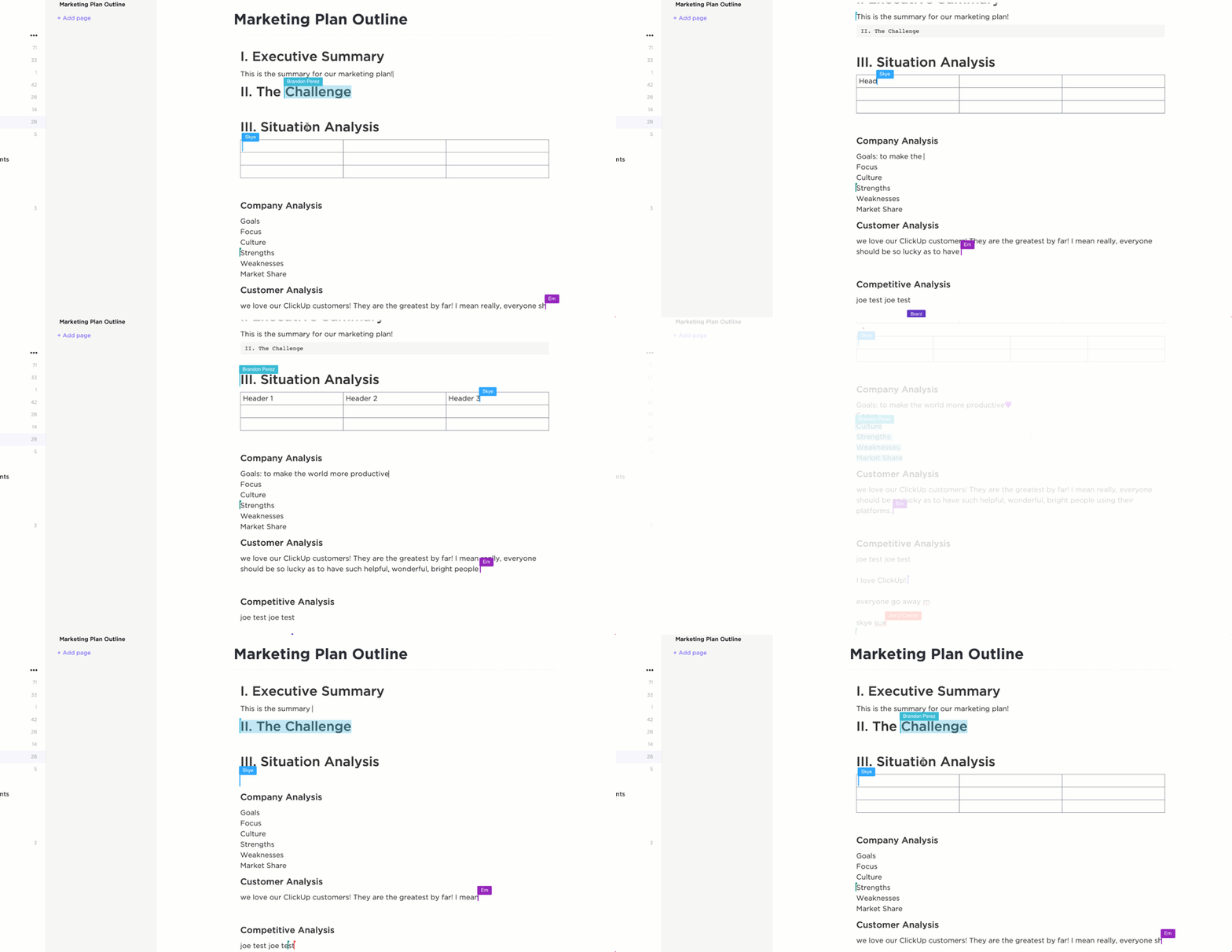
Use ClickUp Docs to create drafts, add tables, and convert them into knowledge bases for future use. Make the most of real-time collaboration by tagging team members, posting comments, and converting normal texts into trackable texts to monitor progress.
Connect your Docs to other workflows to improve accessibility and ensure productivity.
 Summarize this article for me please
Boost Your Team’s Productivity With Google Drive Hacks
Learning advanced Google Drive hacks is necessary if your team uses Google Workspace for day-to-day communication, file and document management, database management, and other workplace operations. This way, you can work closely with remote teams and keep track of all organizational tasks.
Use the above shared Google Drive hacks to complete your day-to-day tasks faster.
Boost your productivity with Google Drive keyboard shortcuts, offline access, and other hacks, such as editable PDFs, an intelligent search engine function, and an extensive template library.
If you are looking for another productivity tool that is a great Google Drive alternative, try ClickUp. Sign up for free.
Frequently Asked Questions (FAQs)
How to use Google Drive most effectively?
To use Google Drive or a Drive folder most effectively, learn the Google Drive keyboard shortcuts to avoid multiple steps. Access offline documents and entire folders to keep up with productivity.
How do I use Google Drive smartly?
Use features like offline access, advanced search, template library, Team Drive for storing files, and Quick Share features to create new folders and organize the same folders. You can also use other Google tools, like PDF Editor, to optimize your workspace.
What are the three benefits of Google Drive?
The three benefits of Google Drive are as follows:
- It is one source of truth for remote teams to collaborate on more than one file in real time
- It is affordable, and all changes you make in the files are automatically saved
- It allows you to edit files or Microsoft documents without internet access


Everything you need to stay organized and get work done.

Recent Articles
Marketing Agency Productivity: Where Your Margin Actually Goes 
Marketing Agency Productivity: Where Your Margin Actually Goes
8 Communication Strategies That Actually Fix Team Chaos 
8 Communication Strategies That Actually Fix Team Chaos
What Is Tacit Knowledge? Definition, Benefits and Examples
What Is Tacit Knowledge? Definition, Benefits and Examples
