

Individuals and organizations alike struggle with clearly defining what they want to achieve and systematically driving toward it.
In the 1970s, when Intel faced this challenge, Andrew Grove, ex-CEO of the company, designed the Objectives and Key Results (OKR) framework. Since then, Google, Microsoft, Uber, and several other multinational organizations have adopted OKRs to drive their efforts.
In this blog post, we focus on how you can adopt OKRs for your engineering teams. Let’s get started.
10 Engineering OKRs for Software Teams | ClickUp
- What are Engineering OKRs?
- Challenges in Implementing Engineering OKRs
- Implementing OKR in Engineering Teams
- 10 Engineering OKRs for Software Teams
- 1. Improve customer satisfaction with new releases
- 2. Optimize application performance
- 3. Improve software quality
- 4. Improve deployment efficiency
- 5. Improve app security posture
- 6. Streamline development workflows
- 7. Increase team productivity
- 8. Optimize resource allocation
- 9. Scale the engineering team
- 10. Strengthen collaboration across departments
- OKR Templates for Engineering Teams
- Common FAQs

 Summarize this article for me please
What are Engineering OKRs?
Engineering OKRs are objectives and key results you can set for your organization, software development teams, or individual employees.
Objective: A significant, relevant, and clearly defined objective that is qualitative and inspirational.
Key results: Measurable outcomes that track the achievement of that objective. Typically, there are 3-5 key results to each objective.
In practice, this is what it would look like for a product team.
- Objective: Improve system reliability
- Key result 1: Reduce system downtime from 5% to 1%
- Key result 2: Increase unit test coverage from 70% to 90%
- Key result 3: Implement automated performance monitoring tools
If you’re wondering where the word goal is in this definition, here’s a clarifying article on goals vs. objectives.
Importance of OKRs in the engineering team
Unlike activities like sales, which directly impact an organization’s revenue and profits, engineering is at a distance. This makes it somewhat confusing for the engineering team to know what they must do and achieve.
Yet, the first lesson in the how to manage engineers chapter would be OKRs. The objectives and key results framework gives a clear roadmap for engineering efforts, helping them focus on what’s important. Here’s how.
Focus: OKRs prioritize work by clearly defining what is most important, enabling teams to focus their resources and efforts on achieving high-priority business objectives.
Alignment: OKRs begin at the very top. The organizational objectives are broken down for teams and then individuals. This ensures that everyone’s efforts are aligned with the organization’s objectives.
Bridging qualitative and quantitative aspects: Engineering OKRs focus on breaking down qualitative objectives into measurable key results, covering the entire gamut of the organization’s purpose.
Objectivity: The measurable nature of OKRs enables teams to track progress objectively. Team members can find common ground in the key results, supporting each other to achieve objectives.
Purpose: OKRs give team members a mission and a purpose to rally towards. This needn’t be as grand as saving the world. It can be as simple as ‘delivering software excellence’ or ‘creating user-centric products,’ which gives team members an emotional connection to their work. Especially among millennials and Gen Z, who look at a company’s values closely, the OKRs are a great way to walk the talk.
Summarize this article for me pleaseChallenges in Implementing Engineering OKRs
Despite its many benefits, OKRs are not easy to implement. Implementing OKRs throughout an organization comes with its own challenges that we discuss below.
Too many objectives
Too much of anything isn’t good. Achieving too many objectives within a single OKR cycle can dilute focus and resources, leading to burnout and reduced effectiveness.
You might ambitiously set objectives to refactor the entire codebase, introduce microservices architecture, and achieve 100% test coverage, all within the same quarter.
This over-commitment is unrealistic and spreads the team too thin, risking failure to achieve any objectives satisfactorily.
Misalignment with individual goals
Engineering teams comprise individuals with diverse skills, career aspirations, and personal motivations. Often, they struggle to align their OKRs with the broader company objectives.
When OKRs are imposed top-down without involving the team in the goal-setting process, it can lead to disengagement and a lack of personal investment in achieving the OKRs.
Unrealistic OKRs
Within software engineering, every decision is a trade-off. For instance, if you set short deadlines, you might need additional team members or spend on automation tools.
If you are unwilling to make that trade-off (demanding short deadlines from the existing team without tools), you’ll likely burn them out and earn their resentment.
So, setting an overly aggressive objective or key result will not only fail but also hinder the joy of achieving it.
Vague OKRs
The critical part of key results is to be specific and measurable. When an OKR is vague, it is open to interpretation, causing further confusion.
For instance, the objective is to “improve customer experience,” the key result is to “increase NPS score,” which is incomplete and not measurable. This is a vague OKR.
Temptation to measure output instead of outcomes
Key results are not tasks to be completed {output} but outcomes to be achieved. So, your engineering OKRs can’t be lines of code or a number of bugs, even though they’re easy to measure.
Without actively considering this difference, companies set the wrong OKRs, which eventually don’t support their organizational goals.
Not tracking progress
OKRs are typically set for the year. So, the biggest risk organizations face is the problem of set and forget!
As a result, teams don’t track their key results, don’t make adjustments/improvements, and eventually fall behind.
For instance, without a clear view of OKRs in a goal tracking app, team members might prioritize immediate or urgent tasks over critical strategic ones, derailing all efforts.
Rigidity
Businesses evolve. What was a priority in one quarter may become less critical or even irrelevant in the next.
Projects today are dynamic, with new insights, customer feedback, or technical challenges emerging regularly. By not adjusting OKRs, engineering teams risk working towards objectives that no longer contribute meaningfully to the company’s success.
A team that rigidly sticks to an initial set of OKRs without considering the evolving business landscape might deliver dated work that’s no longer useful.
Thankfully, since its birth, several organizations have faced these challenges with OKRs and devised workarounds. Next, we see how you can overcome these challenges and implement OKRs successfully in your organization.
Summarize this article for me pleaseImplementing OKR in Engineering Teams
To successfully implement OKR for all the engineering teams, you need two things: Strategic processes and robust engineering project management software. ClickUp is designed to be precisely that. It is among the best OKR software available today, enabling comprehensive project management.
Here’s how you can successfully implement OKRs for your engineering teams.
Understand organizational OKRs
The purpose of OKRs is to align the entire organization towards common goals. To do this, engineering teams need to understand how their work fits in the context of the company vision.
Then, adapt the organizational OKRs to the engineering team. For instance, if the company aims to deliver a stellar customer experience, the engineering team can adapt it to deliver a stellar user experience on digital products.
Include the team
A set of objectives and targets set by the managers handed down to the teams would be uninspirational for them. So, include the teams in setting OKRs.
Get the team’s insights: Ask them about their current measures of success. Look at past performance with them to set the measurable components. ClickUp Dashboard gives you all the key metrics you’d like to see.
Make OKRs relevant in time: Map the business cycle and pin the OKR to the part of the cycle most relevant to it. For instance, if your brand achieves peak sales only in November-December, your platform reliability metrics are most relevant during that time.
Identify blockers early: Understand what challenges they face regularly and find ways to overcome them. You can use the time taken to report on ClickUp to identify tasks that take the longest time and discuss reasons with the team.
Be realistic: Get your team’s input on technical feasibility, resource availability, and potential challenges. You might want 100% of a key result, but that’s unrealistic. Experts suggest that 70% of key result achievement can be just enough.
Most importantly, when you include the team in the OKR development process, they are likelier to feel a sense of ownership and commitment toward them.
Find the balance
To be realistic, your objectives and key results must be ambitious and aspirational while aligned with team capabilities and resources. This is necessary to prevent teams from becoming demoralized by impossible tasks or complacent with too-easy targets.
ClickUp goals enables you to set goals and break them down into key results. This can be connected to smaller, manageable tasks.

For instance, if your objective is to enhance deployment efficiency, you can set that as a goal on ClickUp. Then, your key results, such as automating 90% of the deployment pipeline, zero downtime deployments, and daily deployment frequency, can be set up as targets. ClickUp targets can be numerical, monetary, or true/false.
Monitor progress
Organizations typically use yearly OKR cycles. If that’s the case with you, setting goals initially and then looking at your performance at the end of the year defeats the purpose.
Therefore, monitor progress regularly—each sprint would be a good frequency. Monthly is acceptable too. Then, identify areas that need attention, develop a culture of accountability, and continuously improve. Goal-tracking apps are designed for exactly this.

Iterate and improve
During the quarter, if you realize your targets are too easy or too ambitious, you can adjust them to reflect the right balance.
Actively collect feedback from all stakeholders about each OKR cycle and refine the process, objectives, and key results. Bring the practices of continuous improvement to goal setting as well.
With that foundation set, let’s see some goals for software engineers that you can adopt for your teams.
Summarize this article for me please10 Engineering OKRs for Software Teams
Engineering teams work on an extraordinary range of tasks, from writing code to managing app performance. You can set objectives and key results for each of these. Here are ten engineering OKR examples.
1. Improve customer satisfaction with new releases
This is a great organizational objective that can be adapted to engineering. While the rest of the company works on its key result areas, you can focus on new product releases to achieve this objective.
The engineering team’s key results could be:
- Achieve a Net Promoter Score {NPS} of 80 for every new feature release
- Reduce feature request response time to less than 24 hours (even if it’s a no)
- Build five major customer feature requests
2. Optimize application performance
Agile teams consistently seek improvement. Application performance is a classic continuous improvement metric. Use key results, such as:
- Reduce average page load time by 30%
- Increase application uptime to 99.9%
- Reduce data migration time by 25%
3. Improve software quality
Preventing tech debt and delivering better customer experience depends on software quality. The simplest way to implement best practices and ensure consistency is to use checklists. ClickUp tasks allows you to add checklists to every task/sub-task, making your job easier.
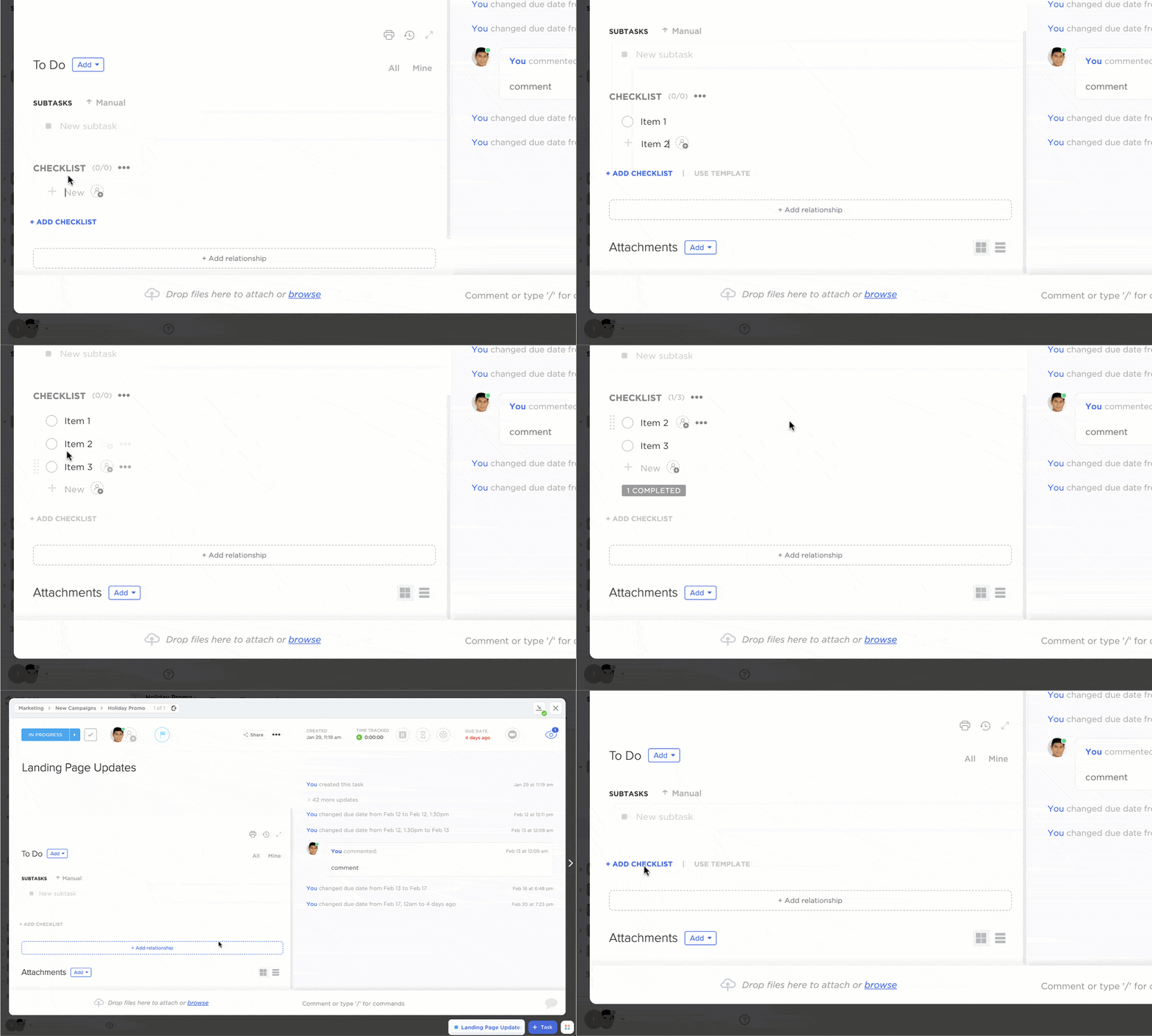
Set up your acceptance criteria and work towards key metrics, such as:
- Achieve a 95% pass rate on all automated tests
- Decrease critical bugs by 40% in the next quarter
- Implement a peer code review process with 100% compliance
4. Improve deployment efficiency
Deployment efficiency is a metric that’s critical to agile processes. Look at your deployment efficiency for the last year and set your key results. That could be:
- Automate 90% of the deployment pipeline
- Achieve zero-downtime deployments
- Reduce deployment frequency to daily releases
5. Improve app security posture
Every year, this would naturally be an objective for engineering teams. Improve your performance with key results, such as:
- Remediate all critical security vulnerabilities within 48 hours of detection
- Implement two-factor authentication for all internal systems
- Conduct quarterly security training sessions for all engineers
6. Streamline development workflows
From here, we’re moving towards team efficiency and productivity metrics. Seamless development workflows are fundamental to the flow of information and team efficiency.
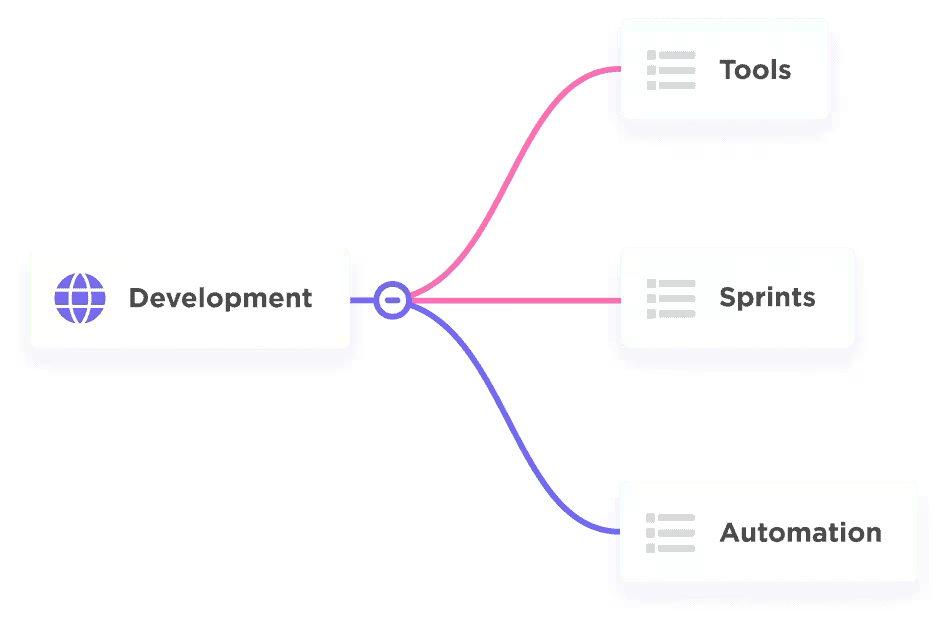
Engineering teams use ClickUp Mind Maps to visualize their workflows so that they can optimize performance. Examples of key results for streamlining development workflows are:
- Reduce the average pull request merge time from 2 days to 4 hours
- Implement automated build and test pipelines for 100% of projects
- Achieve a 30% reduction in the cycle time from ideation to deployment
7. Increase team productivity
Different teams define productivity differently. Choose your definitions carefully and set targets accordingly. Create OKRs, such as:
- Decrease the time taken from code commit to deployment to production by 50%
- Increase sprint completion rate to 90%
- Reduce the number of unplanned work hours to 4 per week (ClickUp time tracking and tagging can help monitor this at a granular level)
8. Optimize resource allocation
This goal is more for the project manager than for the engineers themselves. However, good resource allocation is fundamental to managing costs and performance.
ClickUp’s workload view ensures your people resources are allocated optimally. As we’ve covered productivity and efficiency, let’s discuss non-people resources.
- Reduce cloud infrastructure costs by 20% without impacting performance by optimizing utilization
- Reduce wastage by reducing unutilized licenses and subscriptions by 80%
- Implement dynamic scaling with minimal redundancy
9. Scale the engineering team
In a growing organization, scaling the software development team effectively is a big objective, not just for talent acquisition but for engineering leaders, too. Good OKR software for startups allows you to set key result areas, such as:
- Hire and onboard five new software engineers with specialized skills
- Achieve a retention rate of 95% for the engineering team
- Implement a mentorship program with 100% participation from senior engineers
10. Strengthen collaboration across departments
What’s a scrum team without collaboration. Strengthen collaboration within the engineering team as well as with business stakeholders with key results, such as:
- Eliminate defects due to communication gaps by 70%
- Conduct three interdepartmental knowledge-sharing sessions
Check out a few other examples of OKRs.
Summarize this article for me pleaseOKR Templates for Engineering Teams
Hopefully, the above examples inspired you. The templates below will give you the tools to put them into action.
ClickUp’s company OKRs template
Begin with ClickUp’s company OKRs template to set up and manage organizational goals. It includes eight views, 30 custom statuses, and an OKR submission board to organize your goals and make them easily accessible to the team.

OKR folder template
The ClickUp OKR folder template ups the ante. It is a comprehensive planning tool designed to help individuals and teams set and achieve their goals. It includes a planning cadence, OKR lists, five custom views, and seven custom statuses to effectively break down goals and monitor progress.

Looking for something specific? Here are seven free OKR templates in Excel, Google Sheets, and ClickUp. You can also find more engineering templates for other process optimizations.
Summarize this article for me pleaseSet and Manage Your Engineering OKRs With ClickUp
If you’re confused between mission, goals, objectives, targets, metrics, etc., the OKR framework is a handy tool. It gives you the structure and guardrails you need to work towards business success.
As a comprehensive project management tool, ClickUp incorporates the importance of OKRs throughout the product. It helps project managers set, track, monitor, review, revise, and achieve goals all in one place. Moreover, ClickUp’s templates accelerate your journey to adopting OKRs.
Improve your engineering outcomes with ClickUp. Try ClickUp for free today!
Summarize this article for me pleaseCommon FAQs
1. How do you write an engineering OKR?
OKR is made up of two parts: Objective and key results. The objective is a qualitative statement, and the key results are measurable outcomes. Here’s how you write OKRs for engineering teams.
Start with a clear, inspirational, and challenging objective for the engineering team aligned with company goals. For example—improve system reliability.
Identify key results that will aid in achieving this objective. It should be measurable, specific, time-bound, and achievable. For example,
- Reduce system downtime by 50% within Q2
- Achieve a customer satisfaction score of 90% regarding system reliability by the end of Q3
- Implement automated testing for 80% of the codebase by Q4
2. What is a technical OKR?
Technical OKR is the objectives and key results for the technical team. A technical OKR aims to focus efforts on high-impact technical improvements, innovation, or efficiencies that contribute to the organization’s overall success.


Everything you need to stay organized and get work done.

Recent Articles
AI Workload Management: A Practical Guide for Teams in 2026 
AI Workload Management: A Practical Guide for Teams in 2026
How Product Managers and Engineers Work Together: Tips to Make the Chemistry Happen 
How Product Managers and Engineers Work Together: Tips to Make the Chemistry Happen
How to Write Internal Release Notes That Teams Actually Use 
How to Write Internal Release Notes That Teams Actually Use
