
Sorry, there were no results found for “”
Sorry, there were no results found for “”
Sorry, there were no results found for “”
In project management, the difference between lead and lag hinges on how efficiently you can navigate tight schedules and unforeseen challenges. It’s not merely about ticking off tasks on a list but ensuring project execution meets the highest efficiency and quality standards.
The twin project management strategies of fast-tracking and crashing can help. These aren’t just buzzwords but crucial techniques that, when used wisely, can significantly shorten project durations and timelines.
When weighing crashing vs. fast tracking, project managers must consider the original schedule, critical paths, and additional project costs to determine which schedule compression technique best aligns with the project’s goals and constraints.
However, employing these strategies requires a delicate balance between speed and quality, resources, and risk management.
This blog post explores the essence of fast-tracking and crashing, providing a clear understanding of when and how to implement these techniques for maximum impact.
Whether you’re a seasoned project management professional or someone looking to refine your skills, mastering these strategies could be your gateway to delivering projects with unparalleled efficiency and precision.
Fast-tracking is an efficient method of cutting through delays to bring projects to the finish line quickly. This technique skillfully sidesteps the conventional, one-task-at-a-time approach by running tasks in parallel that would typically be done in sequence.
The agility of fast-tracking lies not just in speeding up the project timeline but in its ability to efficiently manage multiple tasks simultaneously, ensuring that the project stays on the same page towards completion.
There are some clear benefits of fast-tracking projects:
One of the prime benefits of fast-tracking is the significant reduction in lead time, propelling projects from inception to completion at an accelerated pace.
Fast-tracking ensures teams can deliver results swiftly without sacrificing quality by optimizing resource utilization and cutting through project bottlenecks.
There are also some limitations to employing fast-tracking in project management, too:
Fast-tracking a project is akin to picking the right tool for the right job. It’s particularly effective when deadlines are pressing or when an unexpected delay has thrown a wrench in the works.
It’s also a strategy to consider when project tasks possess inherent flexibility, allowing for simultaneous progression without jeopardizing critical milestones.
Now that we understand what fast-tracking is and when to use it, let’s explore some practical examples of fast-tracking:
Embarking on the fast-tracking path is a strategic decision that requires balancing the allure of speed against the potential quality challenges and team fatigue.
It is a testament to a project manager’s prowess in steering projects to swift, successful completion.
Crashing is a project management technique used to shorten the overall duration of a project schedule by allocating additional resources to critical path activities.
Unlike its counterpart, fast-tracking, crashing increases project costs but, in return, promises to recover lost time or to meet an immovable deadline.
There is one clear benefit of using project crashing:
Likewise, there’s one significant limitation of project crashing:
Crashing is not a one-size-fits-all solution but a strategic choice deployed when the project timeline is jeopardized. It’s most applicable when meeting a deadline is non-negotiable and the budget allows for added expenses.
Crashing is a powerful tool in the project manager’s arsenal, reserved for moments when the project’s success hinges on its timely completion.
Here are some practical examples of crashing in project management:
Crashing—because of its focus on injecting additional resources to compress the project timeline—requires a meticulous cost-benefit analysis. It’s a bold strategy that prioritizes time over expense—an alternative path to completion in the race against the clock.
However, the increased investment risk must always justify the benefit of completing the project sooner.
When comparing these two techniques, consider the original schedule and how deviations through either method can impact the project’s critical paths.
Both strategies require a detailed understanding of the project’s duration and scope to ensure that the increase in speed does not come at an undue cost.
| Fast-tracking involves performing tasks simultaneously that were initially planned to be done in sequence. |
This approach capitalizes on parallel task execution to save time but does not typically require additional resources, so it doesn’t significantly increase the project budget. However, it may elevate the risk of rework due to overlapping tasks and reduced focus on individual task quality.
| Crashing, on the other hand, keeps the project tasks in their sequential order but reduces the time allocated to them by adding more resources or extending work hours. |
This technique directly increases project costs but is less likely to compromise the quality of work, provided the additional resources are as effective as the original team.
| Both strategies aim to shorten the project schedule. They are often applied when a project is behind schedule or when there is a strategic advantage to completing it earlier than originally planned. |
They require thorough planning, risk assessment, and monitoring so that the project outcome isn’t jeopardized.
Fast-tracking is typically preferred when:
Crashing is most suitable when:
Deciding between fast-tracking and crashing involves strategically evaluating the project’s constraints, priorities, and flexibility. Project managers must weigh the potential benefits against the risks and costs, choosing the best approach with the project goals and current circumstances.
Whether opting for the simultaneous paths of fast-tracking or the resource-intensive route of crashing, the objective remains clear: to counter project challenges and deliver the project within set timelines.
📮 ClickUp Insight: 46% of knowledge workers rely on a mix of chat, notes, project management tools, and team documentation just to keep track of their work. For them, work is scattered across disconnected platforms, making it harder to stay organized. As the everything app for work, ClickUp unifies it all. With features like ClickUp Email Project Management, ClickUp Notes, ClickUp Chat, and ClickUp Brain, all your work is centralized in one place, searchable, and seamlessly connected. Say goodbye to tool overload—welcome effortless productivity.
Adopting fast-tracking or crashing to compress a project schedule demands a strategic approach. Following a series of practical steps, project managers can apply either technique effectively without compromising quality or scope.
The first step involves a comprehensive assessment of the project’s current status and future requirements. This includes identifying critical path activities, understanding project deadlines, and recognizing the scope for schedule compression.
It’s essential to differentiate between tasks that can be fast-tracked and those that require crashing based on their dependencies and the availability of additional resources. This stage sets the foundation for informed decision-making on which technique to employ.
Once project needs are identified, the next step is to adjust the project schedule accordingly. For fast-tracking, this means reorganizing tasks to run in parallel where feasible, ensuring overlapping activities don’t compromise critical dependencies.
In the case of a project crashing, it involves shortening the duration of critical path tasks by allocating extra resources, whether additional manpower, extended work hours, or employing expedited processes.
This stage is critical for visualizing the new critical path to project completion and setting realistic timelines.
Continuous monitoring of the project’s progress becomes vital with the adjusted schedule. This includes tracking the performance of fast-tracked and crashed tasks, ensuring they progress as planned without causing unforeseen issues.
As a project manager, regular check-ins with the project team and stakeholders are essential to identify any deviations from the schedule early on. If certain strategies don’t yield the expected results, project managers must be ready to make necessary adjustments, whether reallocating resources or revising task overlaps.
After the project’s completion, reflect on the effectiveness of the fast-tracking and crashing techniques. This involves evaluating what worked well and what didn’t, documenting lessons learned, and considering how similar challenges can be addressed more effectively in future projects.
Iteration is key to refining project management practices and enhancing the team’s ability to meet deadlines through schedule compression techniques.
Project managers can navigate the complexities of fast-tracking and crashing by methodically identifying project needs, adjusting the schedule, monitoring performance, and reflecting on the process.
These steps ensure that projects meet their deadlines and do so with an eye toward continuous improvement and strategic efficiency.
Project management software can transform the approach to implementing fast-tracking and crashing techniques.
And we have just the perfect tool for this—ClickUp!
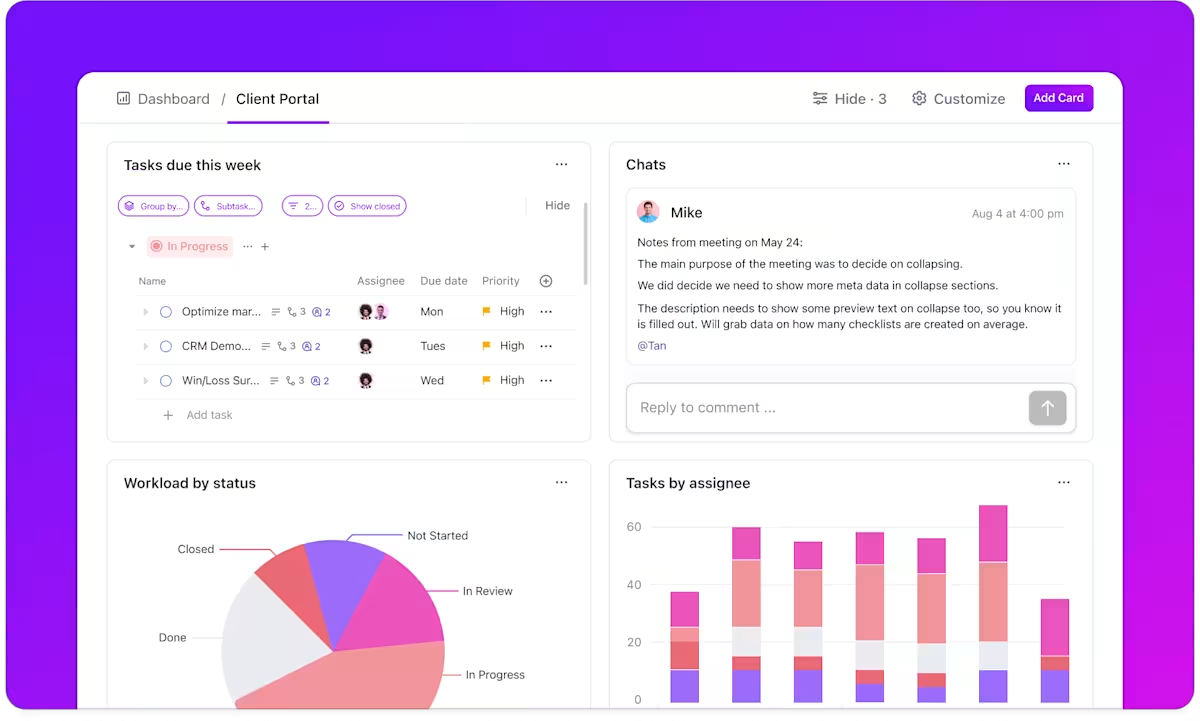
ClickUp can facilitate fast-tracking project management by providing tools to visualize critical paths, manage multiple tasks, and keep the entire project team on the same page.
ClickUp has several features that you can use for project fast-tracking and crashing:
By integrating the ClickUp Project Management tool into the process, project managers gain a powerful ally in compressing project schedules. The platform’s many features make navigating the complexities of fast-tracking and crashing easier. Here’s how:
This enables teams to allocate resources to meet their project deadlines with greater efficiency and precision, ensuring the successful delivery of projects.

Project managers can monitor the time spent on tasks versus the planned time with ClickUp’s Project Time-Tracking. This makes it easier to identify tasks that can be fast-tracked or areas where crashing might be necessary.
This real-time visibility is key to making informed decisions about where to allocate additional resources or how to overlap tasks without causing delays.
The ClickUp Priority Matrix Template enables teams to assign priorities to tasks, ensuring that efforts are focused on what’s most critical. Doing this is especially important when deciding which tasks to fast-track and which ones might benefit from the additional resources crashing provides.

ClickUp’s Gantt Chart view visually represents project schedules, including task dependencies. This feature is instrumental in planning and executing fast-tracking and crashing strategies.
It can help project managers identify which tasks can be overlapped and how adding more resources to specific tasks will affect the overall project timeline.

ClickUp’s Dates & Times feature lets you adjust schedules and deadlines easily. It allows project managers to quickly reshuffle tasks, extend work hours, and add extra resources, all within a unified platform.
This feature provides a flexible framework that supports the dynamic nature of fast-tracking and crashing.
While fast-tracking and crashing are powerful techniques for accelerating project timelines, they come with challenges, such as compromised work quality, team burnout, and escalating costs.
However, with strategic planning and careful management, you can mitigate these risks to ensure the successful delivery of projects.
By implementing these project management strategies, project managers can effectively navigate the challenges associated with fast-tracking and crashing. They can ensure that projects are completed on time and maintain high-quality standards, protect team well-being, and manage costs effectively.
These considerations are crucial to realize the full potential of schedule compression while safeguarding the project’s success and the team’s performance.
Fast-tracking and crashing stand out as invaluable strategies in the arsenal of project management, offering a path to navigate tight deadlines and unexpected delays. While distinct in their approach, these techniques share the goal of accelerating project delivery.
Fast-tracking leverages the parallel execution of tasks to shave time off the project schedule, while crashing focuses on adding resources to compress the timeline even further.
Their judicious application, rooted in fundamental project management principles, can transform project delivery, ensuring success even under the most pressing timelines.
As we navigate the complexities of managing projects, the support of a robust project management tool becomes indispensable. ClickUp offers a comprehensive suite of features to facilitate the successful application of fast-tracking and crashing techniques.
Whether you’re looking to fast-track your way to success or strategically crash through barriers and meet your deadlines, ClickUp can support you every step of the way.
Start optimizing your project delivery with ClickUp. Sign up today!
Crashing and fast-tracking are project management techniques used to accelerate project timelines. Crashing involves adding additional resources to tasks to complete projects faster, while fast-tracking involves initiating those tasks concurrently that were initially planned to be done in sequence.
An example of fast-tracking is in software development, where different modules’ coding and testing phases are conducted simultaneously rather than completing the entire coding phase before beginning the testing.
Yes, fast-tracking can increase the risk of project issues, such as lower-quality work or an increased need for revisions. Concurrent task execution may normally require more focused attention than sequential task execution.

Sudarshan Somanathan
Max 22min read

Praburam Srinivasan
Max 23min read
Praburam Srinivasan
Max 21min read

© 2026 ClickUp