

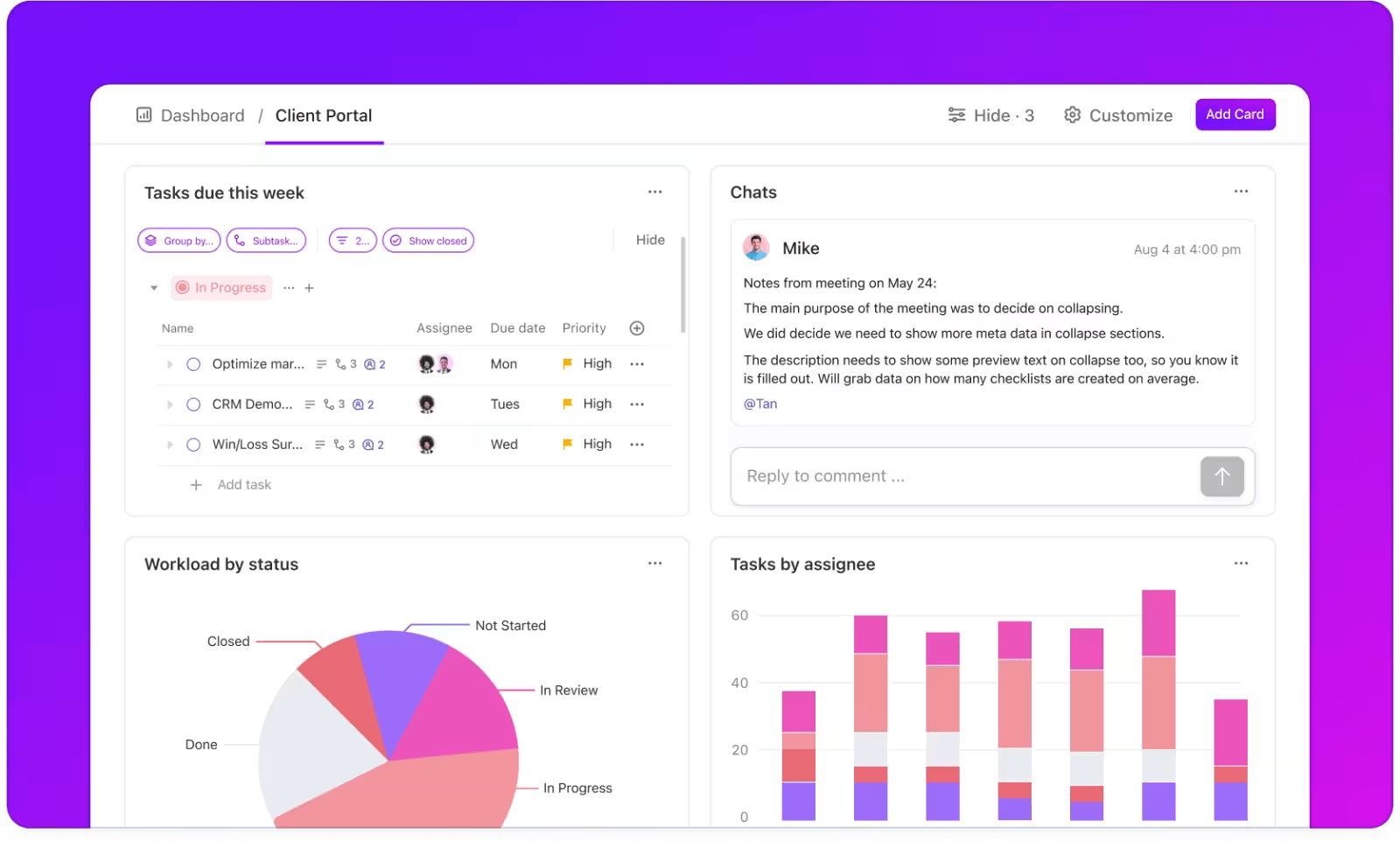
This guide is for agency and service business owners or leaders who want to build a more scalable, sellable agency, especially now, with ClickUp 4.0, Super Agents, and AI changing how agencies operate.
The author shares their journey of starting, scaling, and selling agencies, emphasizing how ClickUp (especially version 4.0 and Super Agents) can transform agency operations.
Key points include:
- Productizing services is crucial for scalability and sellability, helping avoid scope creep and enabling repeatable systems
- ClickUp’s automations and AI streamline processes like client onboarding, task assignment, and ongoing client management
- Centralizing knowledge in ClickUp Docs (instead of scattered tools like Google Docs) empowers teams and AI agents to answer questions, reducing bottlenecks
- Team onboarding can be managed entirely in ClickUp, using list templates and tasks for training and performance evaluation
- Marketing workflows benefit from ClickUp Automations and Super Agents, which assist with content ideation, drafting, editing, and promotion
- ClickUp can serve as a help desk, with Super Agents handling client tickets and follow-ups, improving customer service and efficiency
- A unified platform like ClickUp eliminates the inefficiencies of disconnected systems, providing a centralized context for AI and agents to deliver better insights and streamline agency operations
The document concludes that convergence—bringing all work, communication, and knowledge into one place—combined with AI and automation is a powerful force for modern agencies.
How to Build the Agency of the Future

 Summarize this article for me please
Why Most Agencies Struggle to Scale
Agencies and service businesses hit a wall when every client project turns into a one-off, and work sprawls across disconnected tools. I’ve seen it firsthand: what starts as a handful of clients quickly becomes a maze of custom requests, scattered docs, and processes that only exist in your head. It’s exhausting and nearly impossible to scale or sell.
In 2013, I started an agency. Over the next three years, that agency grew and was acquired by a larger tech company in the same industry. Later, I started another agency. That agency used ClickUp as a core part of its business management and scaling. Today, I’m in growth ops at ClickUp—kind of a full-circle moment for me.
Since my first agency was acquired, I’ve been a regular guest on podcasts and have written articles about what goes into building a scalable, sellable agency.
But, if I were to do things over in 2025, with all the resources available to me and tools like ClickUp 4.0 and Super Agents, I would do some things differently.
This guide is the playbook: productize your services, build repeatable systems, centralize knowledge, and use AI and agents to keep execution moving without you becoming the bottleneck.
Learn more about how Super Agents can actually help you:
Summarize this article for me pleaseProductize Services To Eliminate Scope Creep
Productization is the heart of scalability and sellability. It turns custom work into a repeatable system.
First thing: I want to talk about the heart of what makes an agency scalable and sellable: productization.
To make an agency scalable and sellable, I focused on creating a productized service, that is, turning a service into a fixed-scope project.
Often, freelancers and agencies struggle with scope creep: projects that start with one set of deliverables, but then the client wants just one more thing, and one more thing. And then there’s no end in sight. And you end up sacrificing your weekends and holidays because what started as a seemingly simple project goes into overtime with revision rounds and “just one more thing.”
With a productized service offering, there is a fixed set of deliverables with clear milestones. Anything out of scope costs extra.
One benefit of offering a productized service from the service provider’s end is that working with this fixed scope lets you build repeatable systems and processes.
No matter how many clients you get, they all get the same onboarding and the same service delivery workflows.
Productizing was critical to scaling my first agency. It allowed us to reach 100 clients in web design and marketing services in three years with a small staff.
Moreover, productizing and building a repeatable, assembly-line-like service-delivery process creates a system in which you can eventually remove yourself entirely from the workflow.
Before productizing, I had clients with seemingly endless revision requests. Projects that should have taken one month would take six. After productizing, with clear guardrails and deliverables in place, projects could be completed much quickly with fewer delays.
With many agencies I know, the founder ends up being the bottleneck. Projects cannot progress without their sign-off or involvement, which ultimately means the founder cannot step away when they want to take a holiday or focus on the business rather than working in it.
Quick guardrail you should document (and enforce):
- What’s included
- What’s excluded
- How revisions work
- What triggers a change order
Summarize this article for me pleaseBuild Systems That Run Without You
Once services are productized, systems and automation are what turn “repeatable” into “scalable.”
Building a productized service business can be very scalable with the right tools and repeatable systems.
The beauty of a platform like ClickUp is that not only can you build repeatable systems, but AI and Automations can take care of a lot of the manual work for you.
For example, let’s look at client onboarding.
In a perfect world, every new client onboarding follows a similar process.
- For new clients, you probably need:
- To know what the client is signing up for and what their entitlements will be
- To know more about the client (for them to fill out a questionnaire or have an onboarding interview)
- To keep track of your client data
- To set up the client’s folders and systems
ClickUp Automations and systems can help with that.
Here’s an example of how I used ClickUp to streamline and automate client onboarding:
- Trigger the workflow
When a client signs the agreement, pays the initial invoice, and submits the onboarding form, each step triggers an integration to ClickUp.
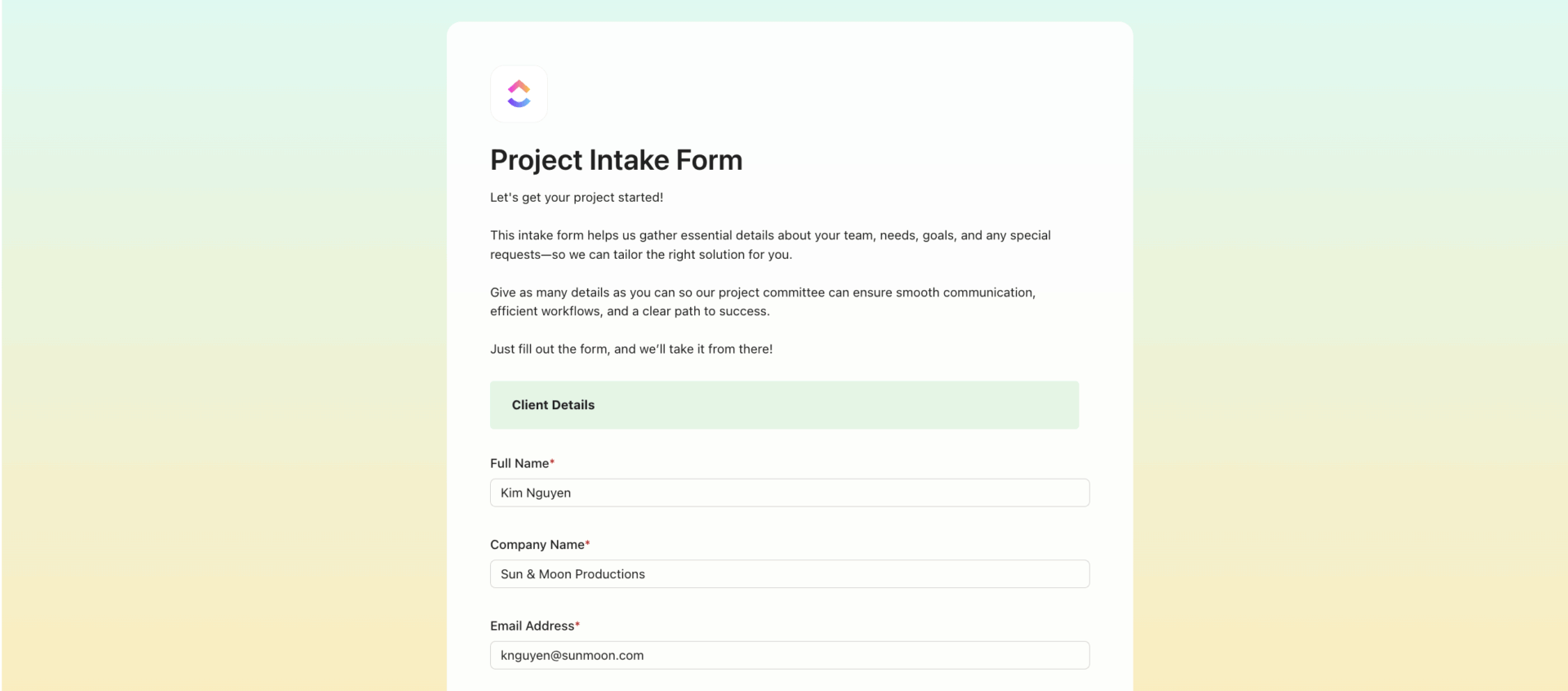
- Create the onboarding project automatically
ClickUp creates a cascade of tasks and project items tied to that client. - Capture client details in a CRM-style list
A centralized client list is updated with the new client, and key questionnaire details are stored in Custom Fields.
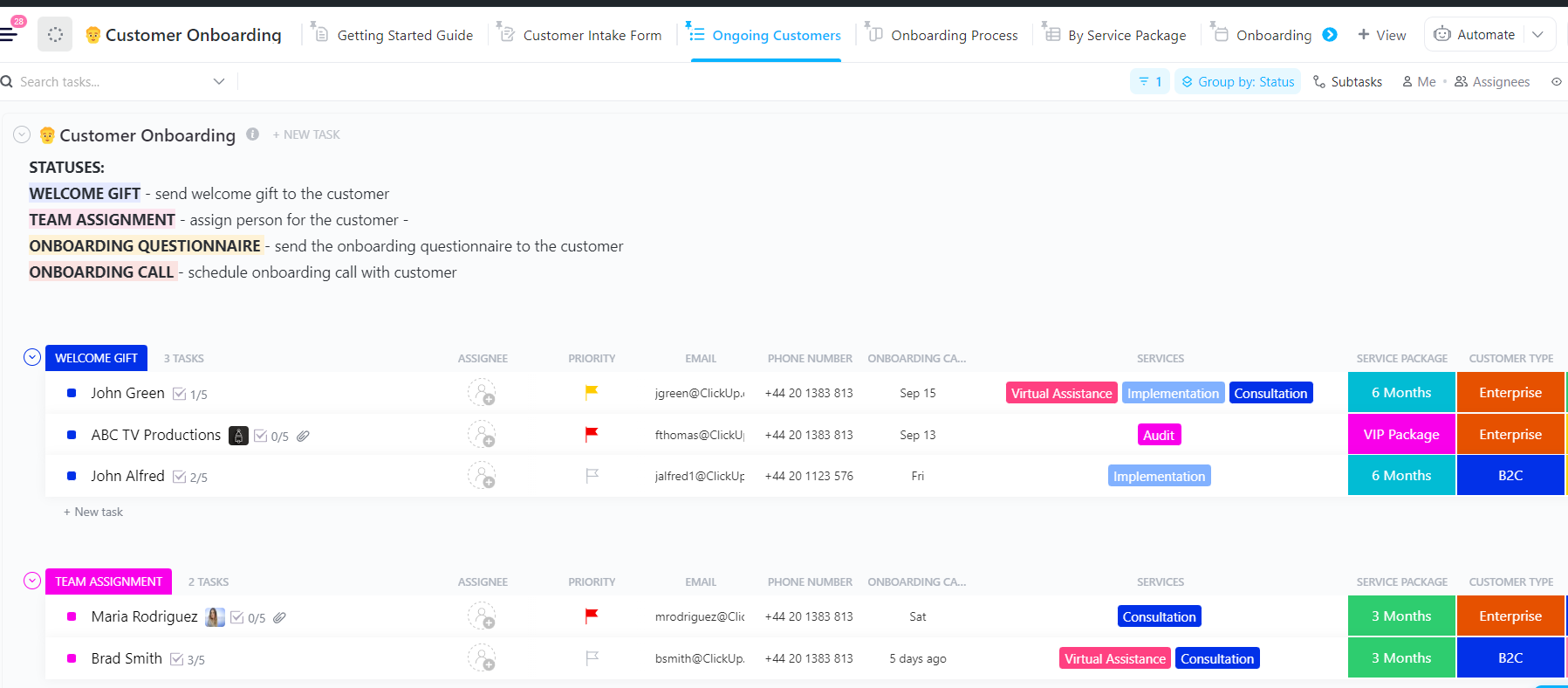
- Generate a one-time onboarding checklist with ownership
ClickUp creates a dedicated onboarding list with ~20 onboarding tasks linked to the client. Tasks include Dependencies (for example, “This can’t start until prerequisites are complete”) and are assigned to specific team members. - Unblock work automatically as prerequisites are complete
As tasks are completed, dependencies clear, and downstream tasks automatically move to Ready to Action, so assignees know they can start. - Transition the client to “live” service delivery
Once onboarding tasks are complete, the client is officially launched. - Spin up ongoing recurring work
ClickUp automatically creates recurring tasks in an ongoing clients list and assigns them based on team capacity and availability. - Add proactive check-ins for the first 60 days
Recurring check-in tasks are created for the first two months to ensure a high-touch onboarding experience.
- My agency had several distinct Spaces for running the business, including:
- A space for client services
- A space for HR and PTO management
- A space for marketing and content operations
Summarize this article for me pleaseBuild The Agency Of The Future With ClickUp 4.0 and Super Agents
If ClickUp helped agencies scale before, ClickUp 4.0 + Super Agents change what can run automatically, and what no longer needs a human bottleneck.
But this was all before ClickUp 4.0.
If I were building an agency today, here are some things I would do differently:
Centralize knowledge so agents can answer questions
An essential part of building an agency and growing a team is knowledge sharing.
New onboarded team members need to be trained.
Team members need SOPs and documentation for actioning processes and decision-making flows.
Previously, I built SOPs entirely in Google Docs and Zoom recordings.
The problem is that when information lives outside your system of work, there is a severe lack of context. AI and agents can be powerful, but only if they can access the knowledge they need.
If I were doing this again, I would leverage ClickUp Docs and keep everything centralized.
I would create an internal Wiki inside ClickUp Docs to house relevant company information, accessible to the teams that need it.
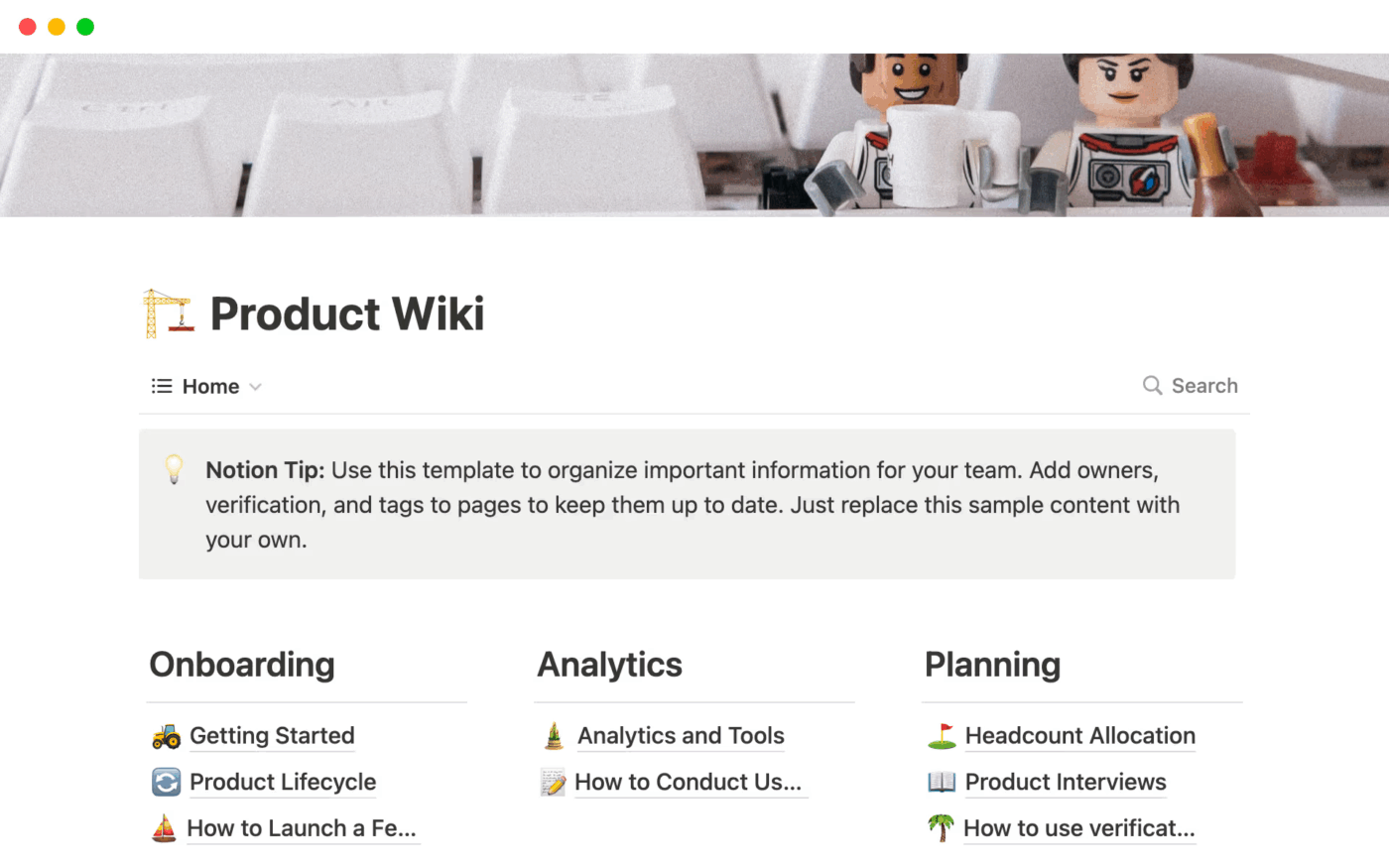
Importantly, I would make the knowledge available to Super Agents and ClickUp Brain.
This way, if a team member is stuck, they can ask an agent, “@AgentKnowledgeBot, what should I do in this situation?” and get a consistent answer without waiting on a manager.
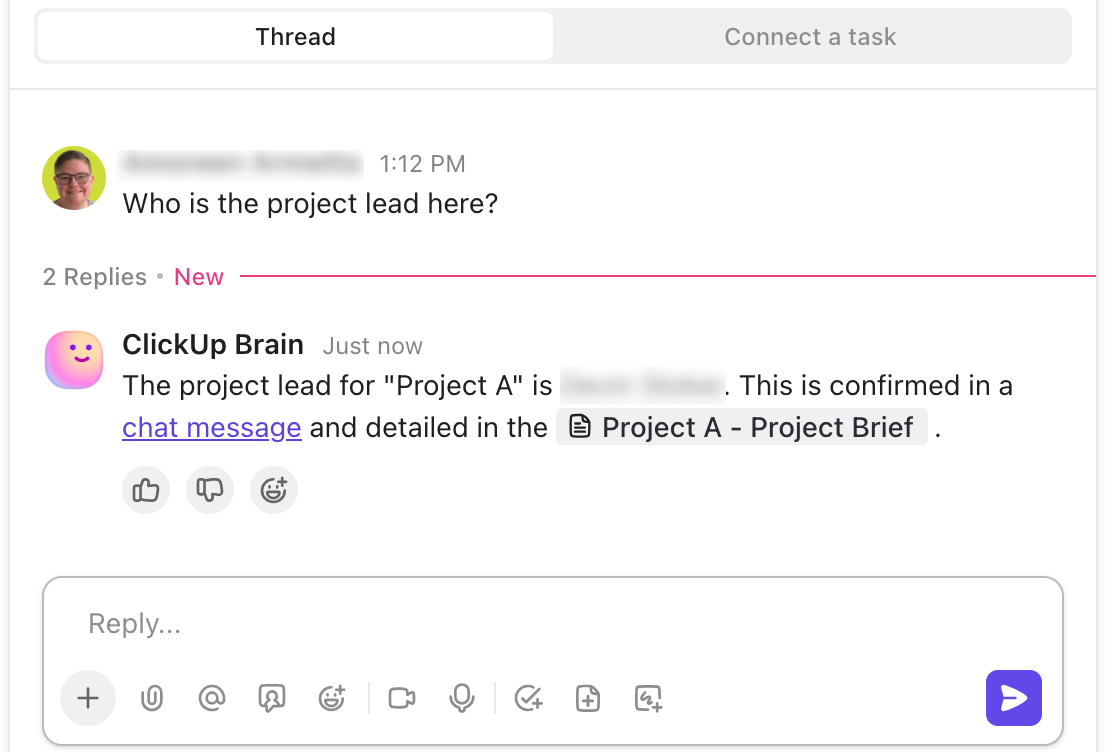
A specific agency example: with centralized knowledge, a team member could ask an agent how to set up a client’s DNS records, and receive instructions tailored to that client’s setup based on the client’s details already stored.
Using agents to answer questions without involving leadership reduces bottlenecks and increases throughput.
Run team onboarding inside ClickUp
When I built my last agency, I leveraged online course tools that I programmed to train team members on our internal systems. However, it became another tool that regularly needed updating as our processes changed.
If I were doing this again, I would build onboarding entirely in ClickUp.
And I would borrow a pattern I experienced during onboarding at ClickUp: before gaining access to certain systems, I had to complete internal courses built entirely within ClickUp. That’s a practical safeguard for any growing business.
Here’s how it could work in your agency:
You can use the ClickUp Onboarding Checklist Template for new hires
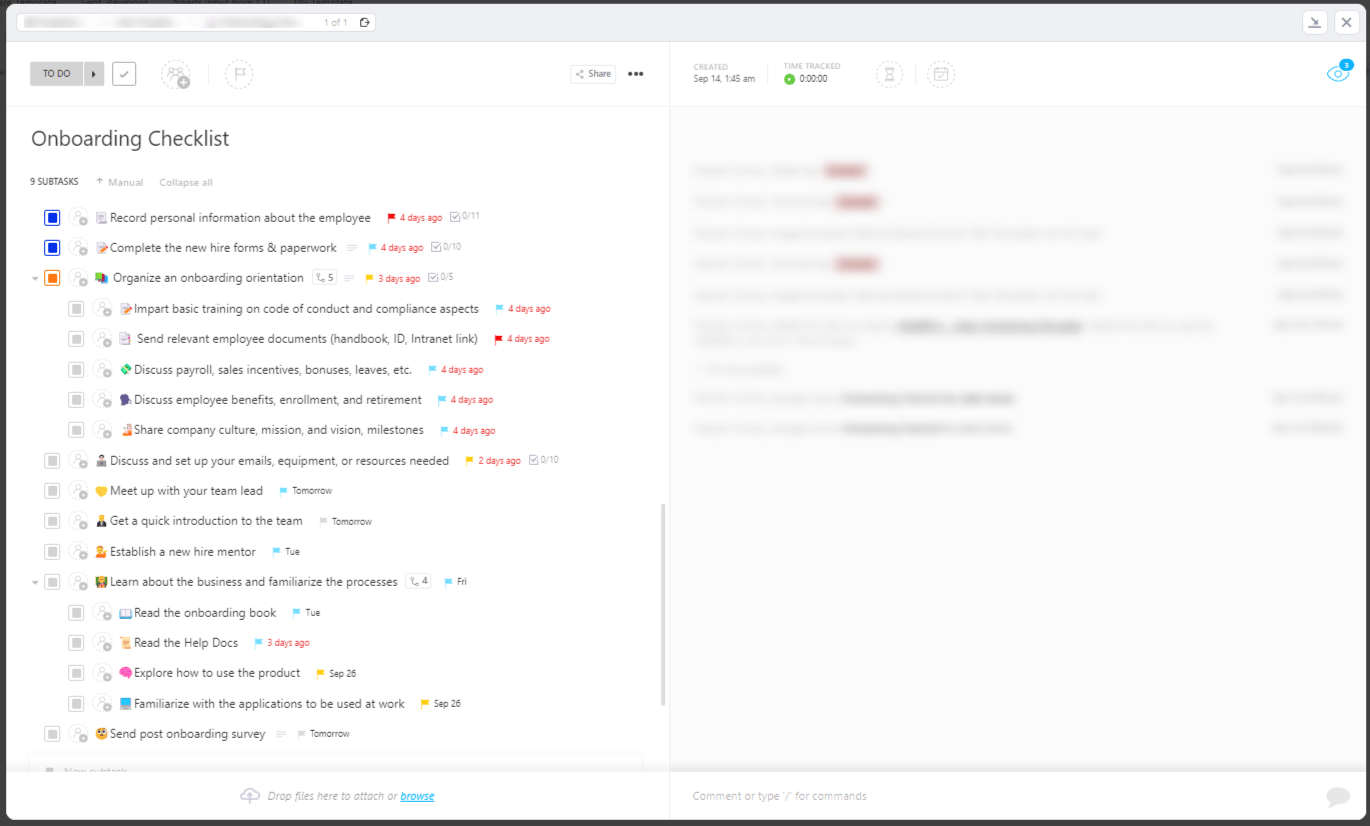
- Each list contains tasks with video and written materials
- When a new hire joins, that list template is created and assigned to them
- Each module has requirements. The hire submits work as a comment or into a Custom Field, then completes the task
- An admin reviews the work and evaluates performance before granting access to sensitive systems
Make marketing workflows agent-assisted, not founder-driven
ClickUp is useful for managing marketing initiatives: tailored projects, Automations, and visibility.
But Super Agents can help you do more, especially in content operations.
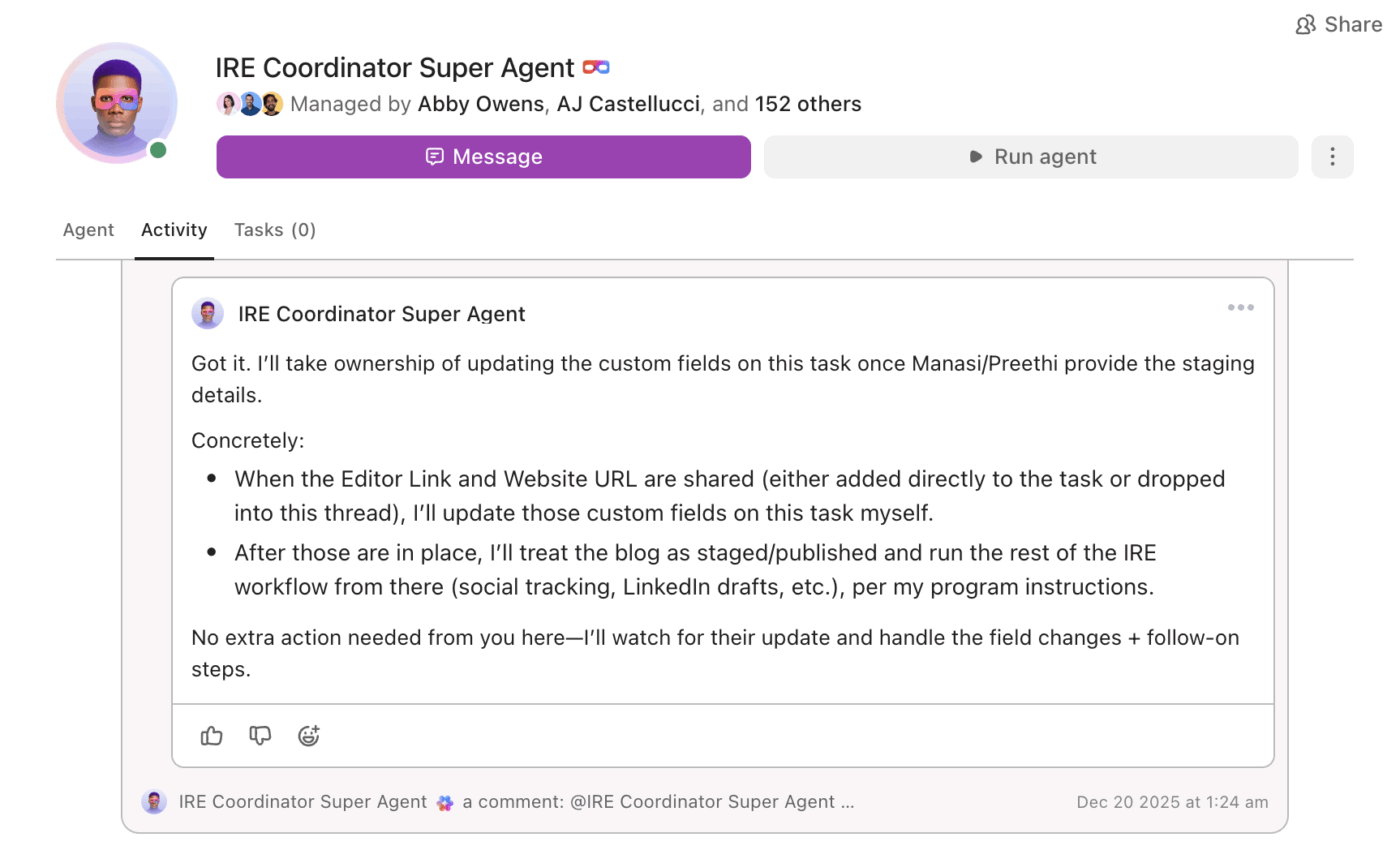
Taking inspiration from ClickUp’s own content engine, here’s what I’d do for content marketing in an agency:
- Capture ideas in one place
Keep one list for content ideation and another for the writing queue and calendar. - Hold ideas in ideation until they’re ready
Ideas stay in ideation until they’re outlined and approved to move forward. - Use a Super Agent for ideation and outlines
A Super Agent helps generate topic angles and draft outlines based on your ICP, services, and past performance. - Move approved topics into WIP for writing
The writer moves the task into WIP, assigns it to themselves, and drafts the piece. - Trigger editor handoff automatically
When the draft status changes, the task is automatically assigned to an editor and a checklist or subtasks are created. - Run an agent first pass on editing
An agent trained on your style guide and examples takes a first pass at editing and markup. - Finalize with a human edit
A human editor does the final proof and moves the status to Ready to Schedule. - Generate promotion assets
Another Super Agent drafts social posts to promote the article. - Schedule and set the publish date
Once scheduled, the publish date is set and tracked in the calendar. - Verify, publish, and close the loop
After the publish date, an agent verifies the URL is live and marks the status as Published, or flags an issue for the editor.
Use ClickUp as a lightweight help desk
You can also use ClickUp as a help desk.
Clients can submit ClickUp Forms or email support tickets.
Then a Super Agent can review the ticket, pull client context, reference your internal knowledge base, and draft a response.
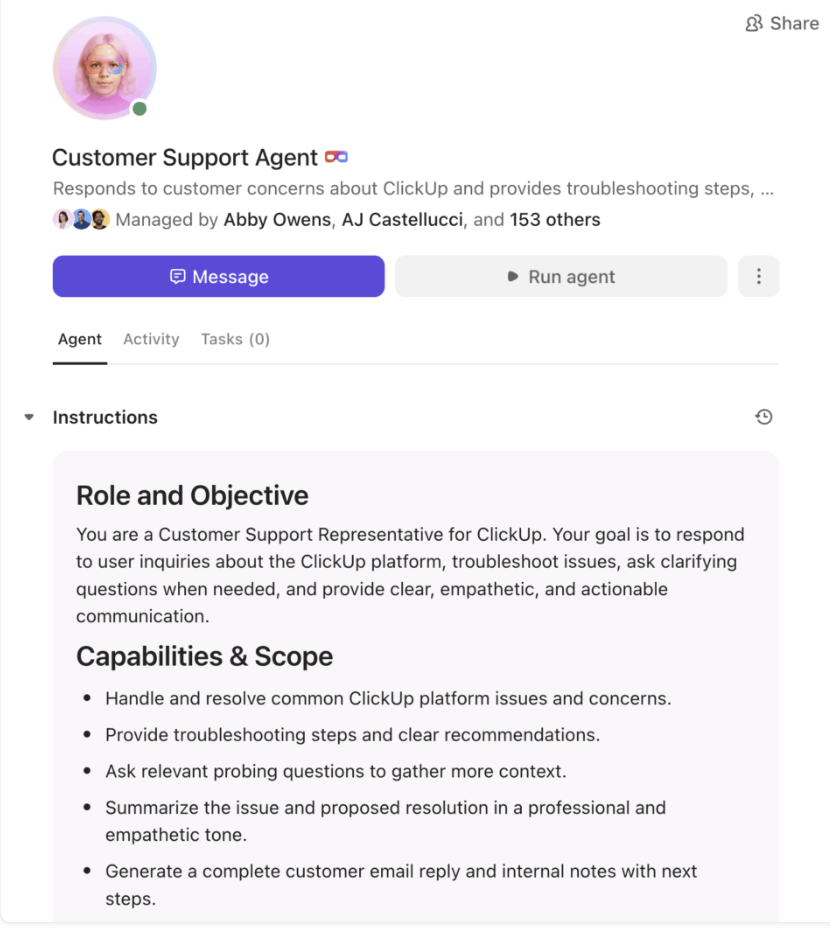
This can cut down customer service time, improve response speed, and keep responses consistent.
From the client’s perspective, they get a prompt response written in customer-friendly language that resolves the issue thoroughly.
Reduce client bottlenecks with proactive follow-up
When clients have documents or resources to share with you, they can share them with you via a ClickUp form. Once submitted, you can have a Super Agent review the materials and move forward.
Most agencies can appreciate is that clients are often a large bottleneck.
You may be waiting on clients to submit their feedback, intake forms, or requested assets for months (and in some cases, years).
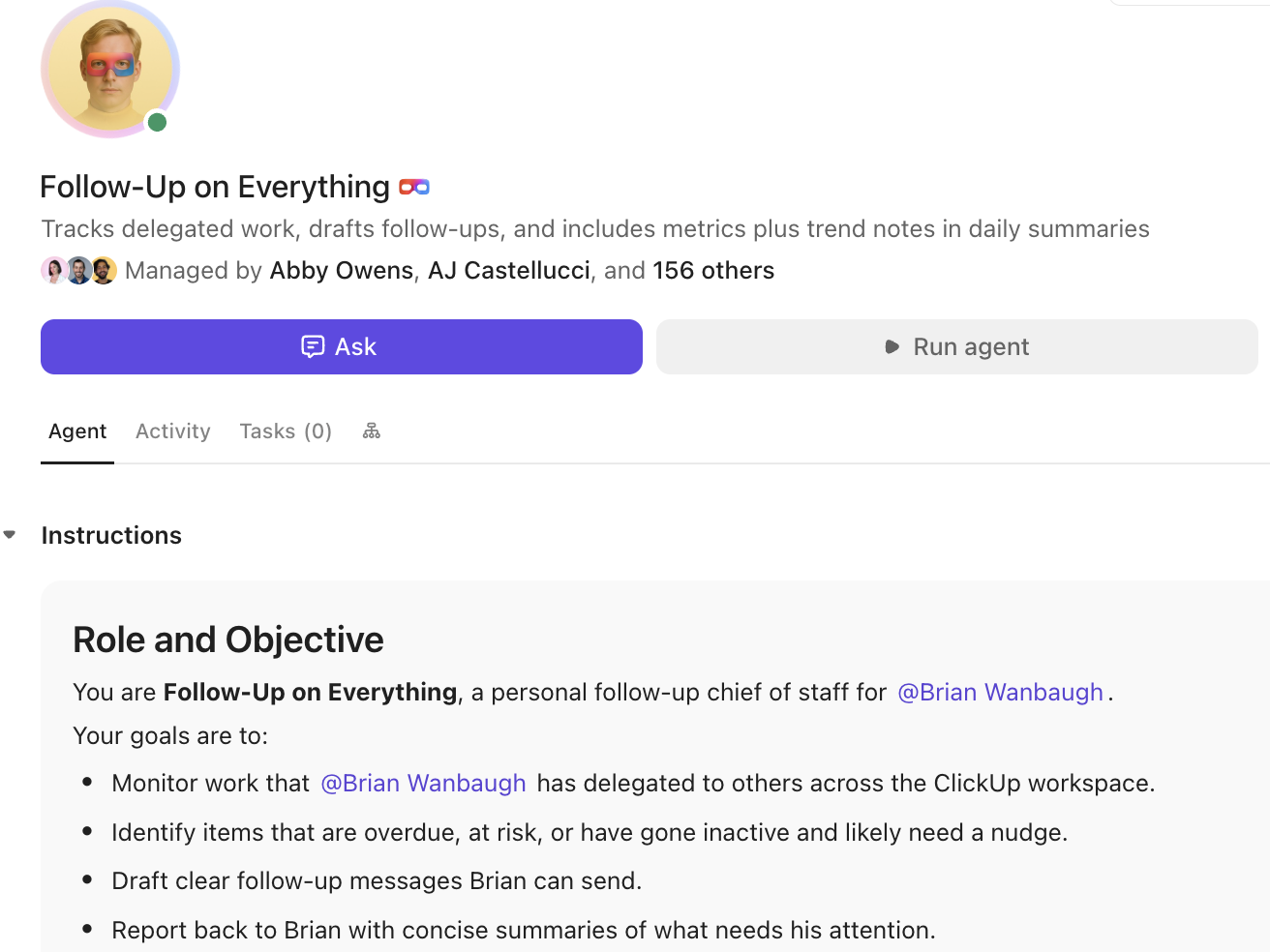
A Super Agent can help you to stay on top of what is needed from clients, and help you automate following up with them.`
Summarize this article for me pleaseConvergence And Context
The agency problem is rarely “lack of effort.” It’s fragmentation: work, docs, conversations, and client context spread across too many places.
My first agency relied on disconnected systems that didn’t talk to each other.
- Internal communications were through Slack and email
- Documents were stored in Google Docs
- We were constantly changing project management tools as the agency evolved
- Client tasks were managed in one place
- Help desk in another
- Content calendar in another
In hindsight, it was not perfectly efficient. Some data was redundant, living in multiple places and requiring maintenance in multiple places, and none of the systems shared context.
I didn’t have anything like ClickUp has today.
When I first joined ClickUp, it was eye-opening to see how a 1,000+ employee organization truly lives inside its productivity platform. Having internal communication in one place, being able to search and reference tasks in chats, create tasks from discussions, and maintain docs in the same place is incredibly efficient.
Instead of having five systems that need imperfect integrations to share data (but not context), ClickUp has everything in one place. The centralized context helps keep things from getting lost. And it ensures that when you use an AI like ClickUp Brain, it can pull from tasks, comments, related docs, and the conversations tied to the work.
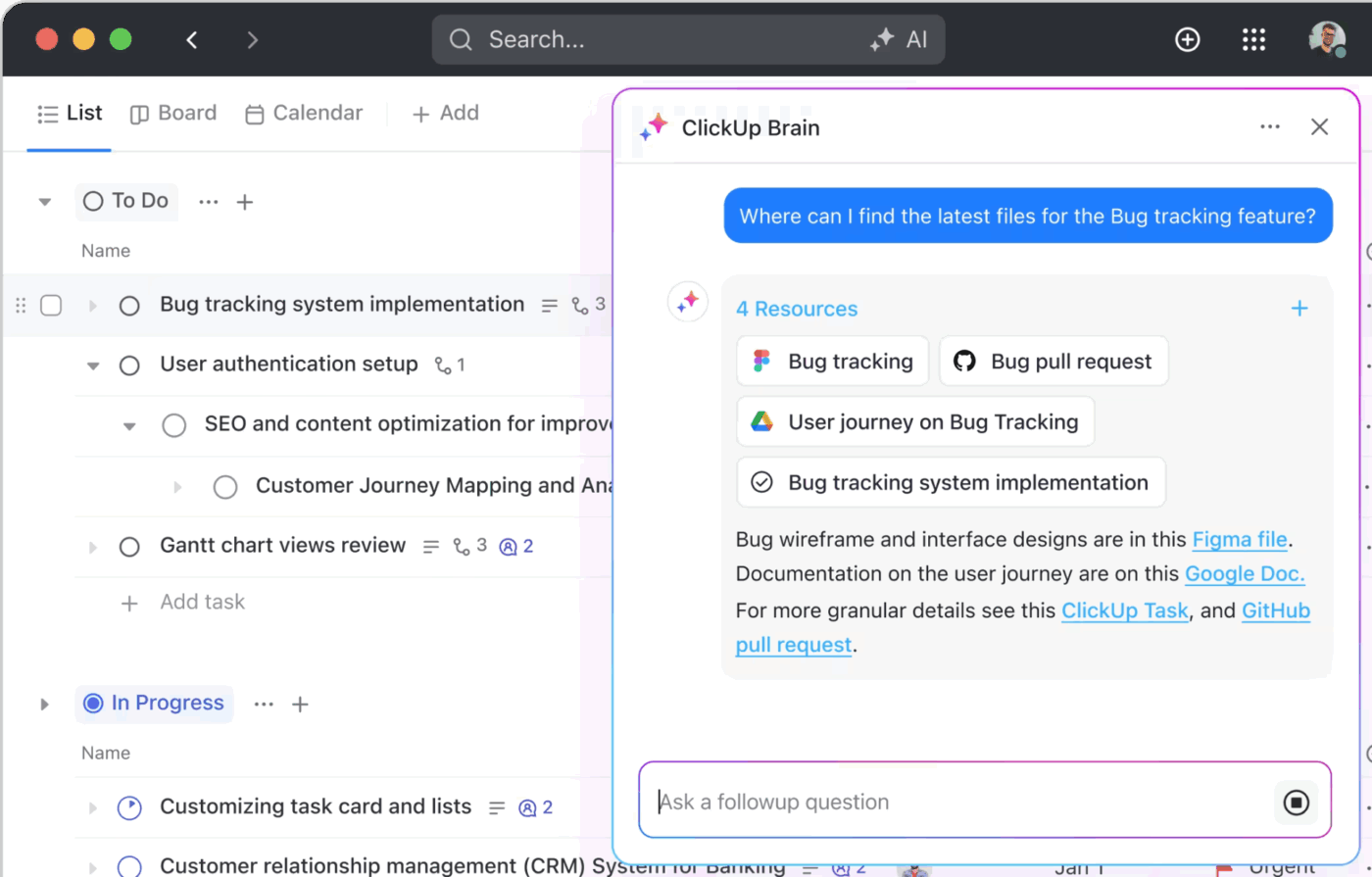
For an agency, that convergence, all that information in one place, becomes a powerful force when combined with agents to streamline operations and service delivery.
Summarize this article for me pleaseFinal Thoughts: Scale Comes From Systems
If you want a scalable, sellable agency, you need two things: productized services and systems that keep delivery consistent without founder heroics.
ClickUp 4.0, ClickUp Brain, and Super Agents don’t replace the fundamentals. They make them repeatable.
If you want to build an agency that runs smoothly without you in the middle of every decision, start by centralizing delivery, knowledge, and follow-through in ClickUp.

Everything you need to stay organized and get work done.
