


Every organization wants to drive transparency at work—but not all achieve it.
Workplace transparency is the practice of openly sharing information, goals, and responsibilities throughout an organization across all levels. It involves ensuring everyone understands their larger role in impacting the business (and strategy), improving employee engagement and productivity, and, by extension, making a manager’s life easier.
A culture of transparent communication encourages employees to share feedback, ask for help, and collaborate more effectively. This leads to increased engagement, clarity, and agility within the organization.
Use this guide as a primer to embrace transparency in the workplace and learn about the benefits that follow.
How to Build Transparency at Work: A 7-Step Guide
- Benefits of Transparency in the Workplace
- How to Build a Transparent Company Culture?
- Step 1: Define what transparency means for you
- Step 2: Model transparency in your behavior
- Step 3: Don’t over-communicate
- Step 4: Think accountability and build ownership
- Step 5: Encourage employees to speak up
- Step 6: Document decisions, processes, and policies
- Step 7: Enhance visibility with goal management software
- 4 Powerful Examples of Workplace Transparency
- 5 Additional Tips to Improve Workplace Transparency
- Tip #1: Reinforce trust by updating team members on changes
- Tip #2: Provide honest and constructive feedback
- Tip #3: Drive training and team peer sessions
- Tip #4: Drive open and standardized performance reviews with clearly defined criteria, goals, KPIs, etc.
- Tip #5: Include 1-on-1 performance discussions with managers for full transparency
- Lead with Honesty, Succeed with ClickUp
- Frequently Asked Questions (FAQ)

 Summarize this article for me please
Benefits of Transparency in the Workplace
Employees trust an organization more if it is open about its decisions, strategy, and efforts. Managers who clearly discuss organizational goals will get higher employee buy-in for achieving the brand vision. As everyone works towards the same goal, team collaboration and job satisfaction see an uptick.
Transparency creates a trusting and collaborative company culture
For employees, the most significant advantage of a transparent workplace is communicative managers who take the time and effort to provide guidance about the company’s vision to the team and discuss the employees’ professional goals.
In a transparent organization, managers openly share information about company strategy, goals, challenges, and overall business outcomes with their teams. With guidance and clarity on organizational goals, there is an atmosphere of trust and collaboration in the workplace.
Transparency improves employee satisfaction and productivity
Organizations that understand the pulse of their workforce benefit from enhanced employee engagement, job satisfaction, and productivity. The real question is: Can transparency in the workplace improve employee productivity? The short answer is yes.
For instance, improved transparency in projects helps employees get a granular understanding of how their work is contributing to the project’s success:
- Are they completing milestones as outlined?
- Is the project being completed on time and within budget?
- Are the project goals being tracked to their individual performance?
Getting buy-in becomes easy as employees see the tangible outcome of their hard work.
Managers showing transparency in leadership enable employees to experience a sense of belonging from being included in the decision-making process.
No matter how you slice it—employees and managers both stand to gain from a transparent workplace culture.
Summarize this article for me pleaseHow to Build a Transparent Company Culture?
Listing transparency as a core value is not enough; building transparency in the workplace requires a mindset and systemic change. Here’s a step-by-step guide on creating a transparent culture you can make your own:
Step 1: Define what transparency means for you
Employees often have difficulty trusting leadership if decisions are made behind closed doors and the team is not involved in day-to-day affairs.
The first task is to define what transparency translates to in your company. Does it mean:
- Offering greater clarity and visibility on company goals?
- Helping the team understand each other’s work process and their sense of shared purpose?
- Driving better accountability and ownership across levels?
If employees understand the meaning of transparency, they’ll embrace it more openly and quickly.
Step 2: Model transparency in your behavior
Organizations must move beyond simply stating a commitment to transparency to truly fostering trust and engagement. Demonstrating this value in everyday practices is critical. Establish a positive loop by showing employees how the organization promotes transparency at every step of the employee experience.
Here’s how leaders can model transparency within the organization:
- Share updates, wins, and challenges regularly with employees via company-wide emails, town hall meetings, and informal check-ins
- Gather input actively from employees on decisions that affect them
- Acknowledge when something goes wrong, take responsibility, and discuss how to prevent similar issues in the future
- Explain the rationale behind decisions, including why certain choices were made and how they align with the organization’s goals
- Be available and approachable to employees for questions, concerns, or just to chat!
- Be consistent in their actions and decisions, so employees know what to expect and can trust their leaders naturally
- Outline goals, expectations, and performance metrics clearly to keep employees in the know
- Hold themselves and others accountable for their actions, and ensure consequences are fair and consistent
Demonstrating these behaviors consistently will enable leaders to create a culture of transparency where employees feel valued, informed, and engaged.
Step 3: Don’t over-communicate
While oversharing is better than under-sharing, you still want to find the right balance in transparent communication. Here’s how to avoid over-communicating:
- Create and send a targeted communication plan encompassing strategic updates at a higher level via an all-hands meeting or well-designed newsletters.

To make things simpler, use the ClickUp Communication Plan Template to plan your business messaging strategy, improve internal and external communications, organize communication goals and timelines, and communicate consistently with cross-functional teams:
- Revisit your organizational chart and create best practices for disseminating information, such as leadership input, policy updates, customer feedback, teamwide changes, etc.
- Chart out a blueprint for what data to roll out, when to send it, which channels to use, and how to communicate
- Accommodate for employee’s feedback within the plan
Step 4: Think accountability and build ownership
Every task, project, initiative, or sub-task must be mapped to an owner. Establishing accountability is a stepping stone to creating a culture of open and honest communication.
Going granular ensures greater visibility into who is doing what at every level. To prepare better, look at other organizations known for their transparent practices and replicate the model as needed.
You must also conduct check-ins and daily standups to review progress and reiterate objectives, helping the team morale stay high.
ClickUp allows you to ensure transparency at scale by adding relevant stakeholders as watchers to tasks or projects.

Step 5: Encourage employees to speak up
A transparent work culture allows employees to ask questions or share feedback without fearing ridicule or judgment. As a manager, you must create opportunities for this.
To make the feedback more well-rounded and gather an on-the-ground perspective, use ClickUp’s Employee Survey Software Template to get a sense of employee sentiment.

Set up suggestion boxes, roll out anonymous feedback forms, and conduct regular one-on-one feedback sessions. This survey will help managers to understand how the team feels about their work. The insights gathered can be used to improve the organization’s employee engagement efforts:
To inculcate a culture of transparency among employees, use these steps as a starting point:
- Demonstrate you value feedback by acting on it and setting a positive example for others to follow
- Recognize and appreciate employees who speak up, even if their feedback leads to difficult conversations
- Ensure employees feel their opinions matter
Step 6: Document decisions, processes, and policies
Solid documentation is at the center of accountable workplaces. Every vital discussion and decision is promptly chronicled to help the team move with clarity.
That said, there are a few points to keep in mind:
- Document the rationale behind key decisions (factors considered, alternatives evaluated, and the ultimate reason for the chosen path) to help employees understand the context
- Document workflows, procedures, and best practices to ensure consistency via step-by-step instructions, relevant templates, one-click downloadable forms, etc.
- Outline and update organizational policies, including HR policies, code of conduct, and guidelines relating to data protection, diversity, and inclusion
- Create a centralized document management system to help employees access information easily. For any document-related tasks, ClickUp Docs is your ideal solution to manage all in one place

Step 7: Enhance visibility with goal management software
Understanding every employee’s role and responsibilities within the company structure builds alignment and trust. But with multiple departments and hundreds of goals, tracking every goal for every team member can be an uphill task. Enter ClickUp Goals—a tool that maps roles, targets, deadlines, and reporting structures to create transparent workplaces.
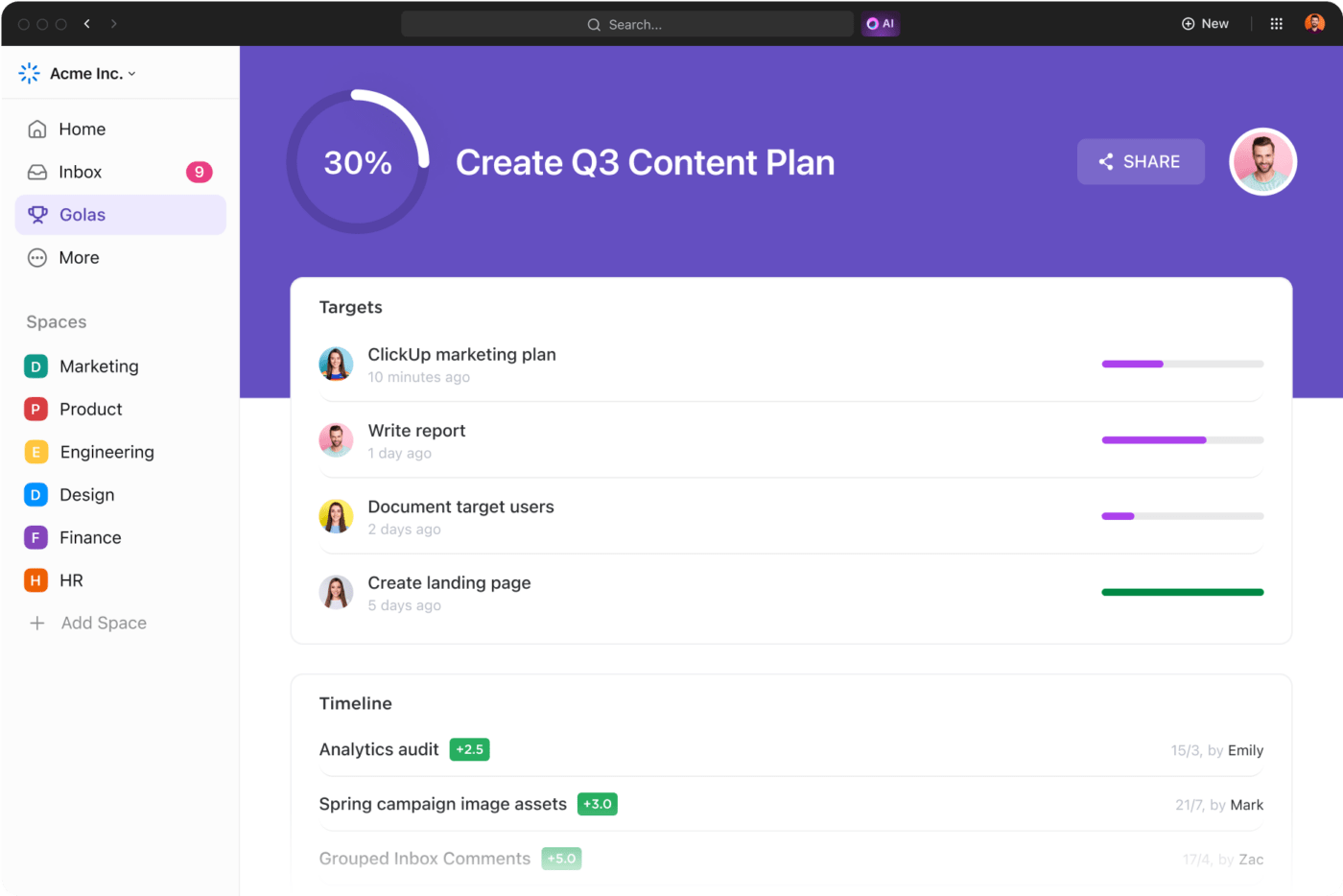
The 7 steps to transparency, recapped:
- Define what it means for your company
- Let leaders showcase transparency with their behavior
- Don’t overcommunicate
- Think accountability, build ownership
- Encourage employees to speak up
- Document everything
- Use goal management software to enhance visibility and trust
Summarize this article for me please4 Powerful Examples of Workplace Transparency
It’s common to wonder what an intangible concept like transparency looks like in the workplace. Below are four examples that throw light on a more transparent workplace culture:
Example 1: When your project is streamlined
You’re setting the team up for failure if there’s any second-guessing about who is responsible for specific tasks, goals, outcomes, etc.
Insufficient communication can lead to information gaps; the ClickUp Project Management solution helps fix this.
ClickUp offers multiple features to drive project transparency, team collaboration, and information visibility. Within this task management platform, managers can view the activity of team members, track tasks, add viewers to tasks, and more:
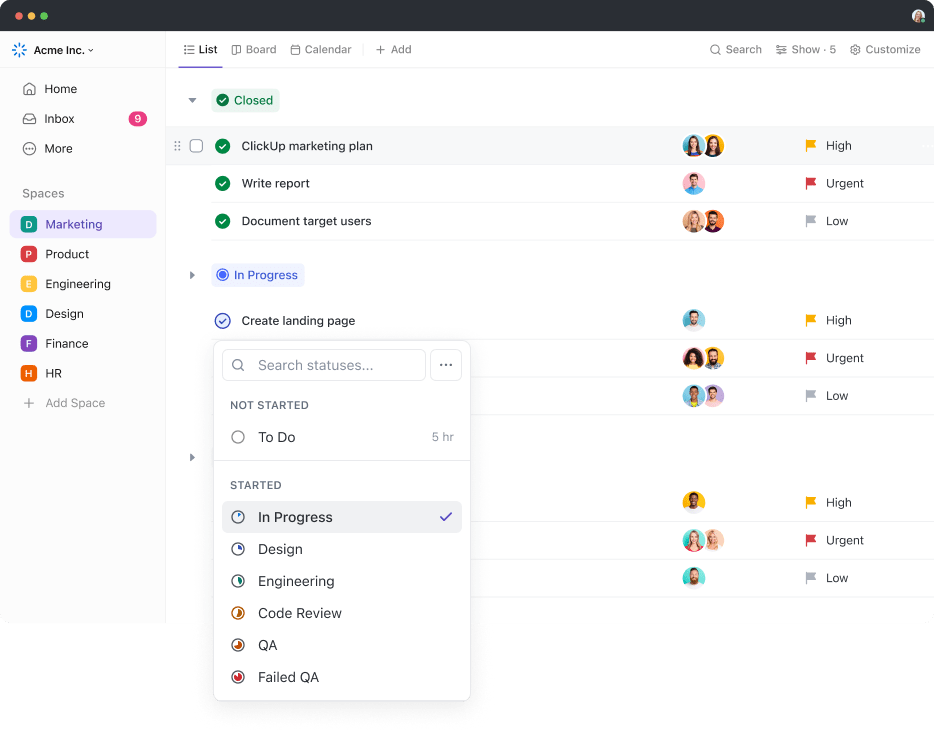
Tip: You can add sub-tasks to bigger tasks and assign owners for each, creating an inter-connected workflow and improved transparency
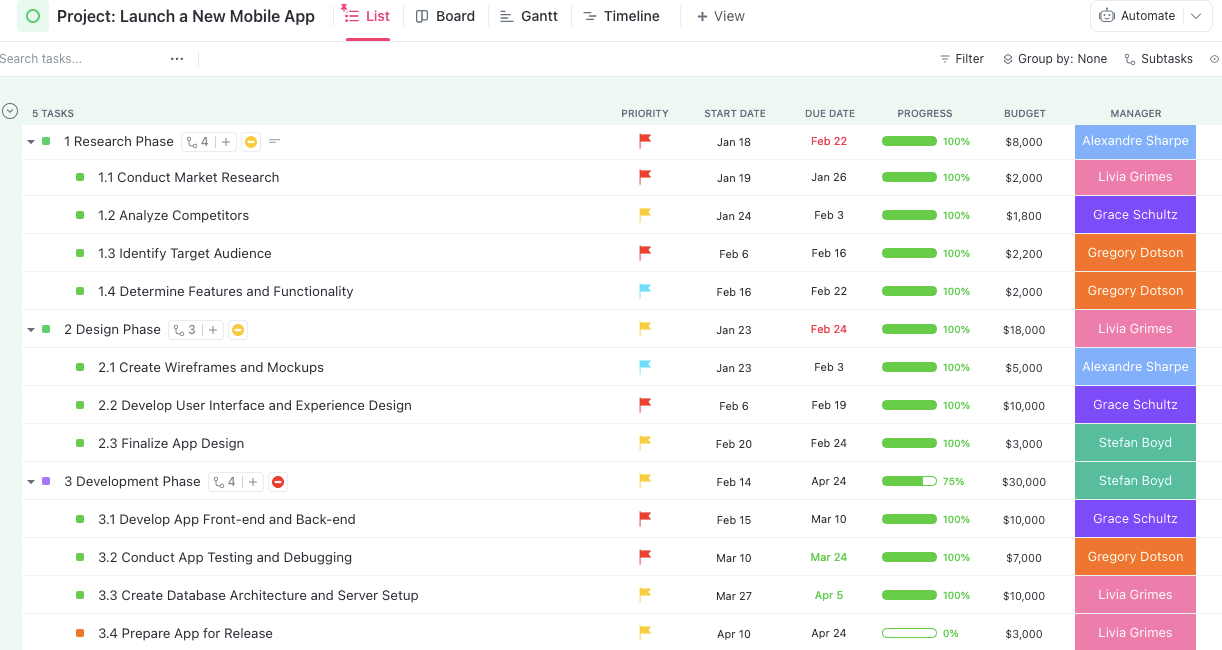
Accountability increases as each task gets mapped by priority, start and end date, progress, owner, etc.
ClickUp is a centralized solution for managing multiple project resources, identifying roadblocks, and streamlining workflows, all with a few clicks.
Example 2: When your company policy and goals are clear
A clear indicator of a transparent work culture is when everyone understands company policy, vision, and goals.
Managers play a proactive role in ensuring that everyone is well-informed about:
- The strategic alignment of goals with the brand’s vision (to ensure every individual understands how their work contributes to the organization’s success)
- Current projects within the team (to ensure employees get regular updates on progress and are on the same page at all times)
- The prioritization of initiatives by leadership (to ensure resources are allocated optimally and everyone understands the rationale behind the decisions being made)
Tip: Use shareable, trackable ClickUp Goals to create accountability and keep everybody in the loop
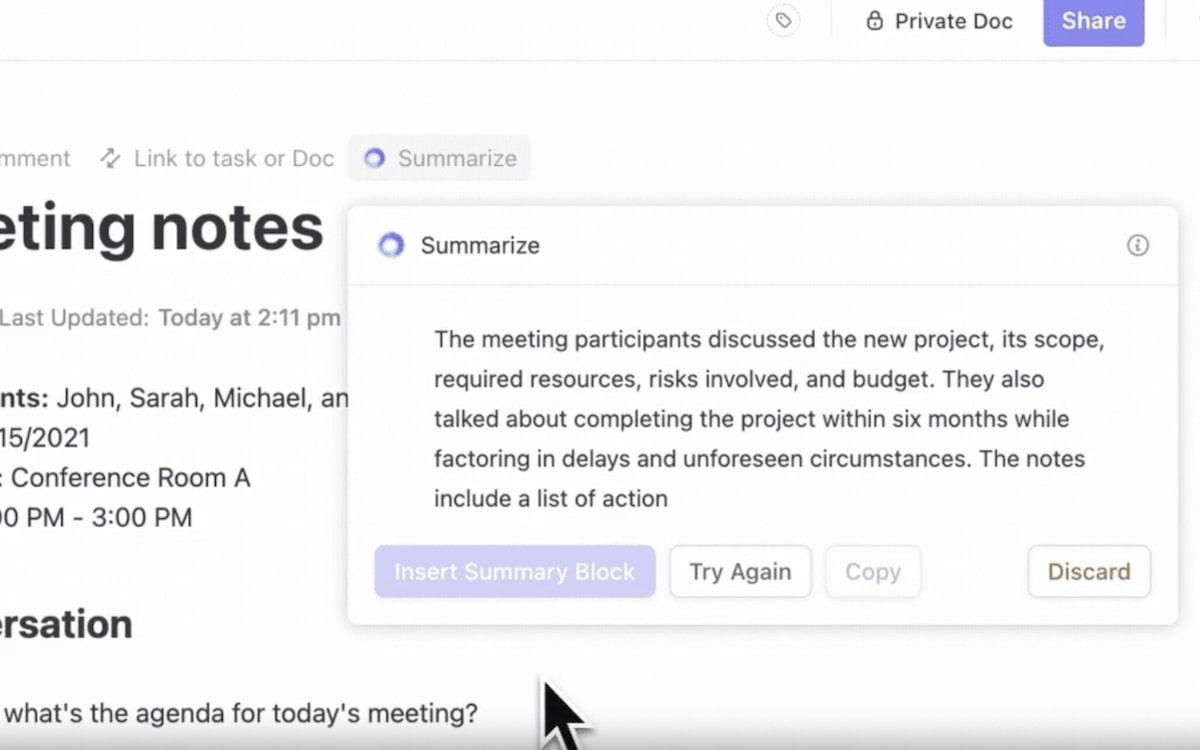
Given the many elements to keep track of, an AI-powered tool like ClickUp Brain can help managers get ahead of their tasks. The tool offers three features to connect the tasks, people, and documents in one place:
- AI Knowledge Manager: This feature helps get instant, accurate, and contextual answers for work within and connected to ClickUp. Imagine a team member has a question about an ongoing marketing campaign in ClickUp. Instead of wasting time searching through emails and chat messages, they can simply ask ClickUp Brain, which will instantly provide relevant information. This feature ensures everyone has access to the same information and reduces the risk of misunderstandings
- AI Project Manager: This feature automates project summaries and offers accurate AI-generated updates and status reports for tasks, docs, and people. Let’s say a project manager wants to provide a quick status update on a project. With ClickUp Brain, they can generate a comprehensive project summary that includes updates on tasks, milestones, goals, and team members’ progress.
- AI Writer for Work: This leverages an AI writing assistant to create tables, messages, templates, and transcripts on the fly. Suppose your team needs to create a new template for a recurring report. Instead of starting from scratch, they can use ClickUp Brain’s AI Writer for Work to generate a template based on previous reports quickly. This will save time, ensure consistency in the format and content of the report, and get everyone up to speed instantly
Example 3: When managers create open lines of honest communication
Approachable managers are the first sign of a transparent workplace. They actively engage in discussions about:
- Areas where the team or organization may be facing challenges and making mistakes
- Strategies for improvement and growth with the team at every level
- Ways to address concerns and feedback from team members
- Opportunities for professional development within the organization
Maintaining open communication enables managers to demonstrate their commitment to promoting transparency.

To make communication a core component of their work style, managers can use free HR templates such as ClickUp’s Corrective Action Plan template to identify areas of improvement within team performance, define communication-related challenges the team faces, list possible solutions for two-way interactions, and drive honest performance reviews.
Collectively, these efforts create a supportive environment where employees feel valued, heard, and empowered to contribute their time, ideas, and feedback.
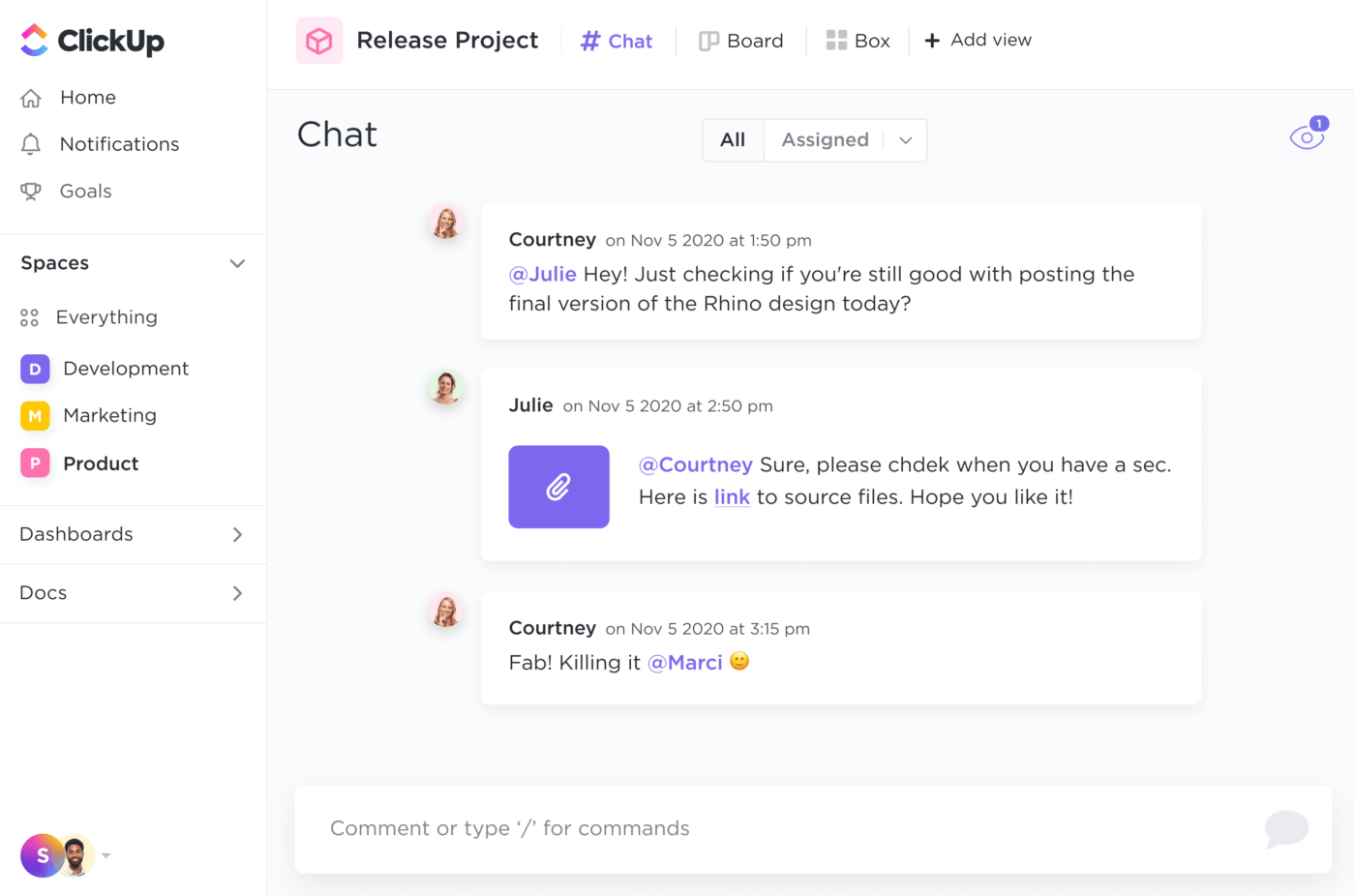
But where do managers begin? How can you stay connected and communicate with your entire team as the workload progresses? The solution is ClickUp Chat—an instant way of reaching out to colleagues and getting the conversation going:
Example 4: When the information you need is easily accessible
Lack of vital information feeds into project delays, misunderstandings, and team inefficiencies.
When the information you need is easily accessible, these issues are minimized, and tasks get completed more swiftly and accurately.
One way to store and collect helpful information is to use database software. Another way to organize and disseminate information within and between team members is by using features like ClickUp Docs and ClickUp Hierarchy.
ClickUp Docs is excellent for creating shareable documents that enable workplace transparency. Teams can co-edit in real time, use comments to tag people, assign tasks, create tables, track ideas, and more:

If you want to look at the big picture and organize your work with a scalable infrastructure, ClickUp Hierarchy is worth considering. Want to get a birds-eye view of your entire Workspace and everything in it? Check. Wish to organize separate departments and teams under Folders with unique permissions? Check. This feature delivers on all accounts.
The hierarchy is fundamental to ClickUp’s organizational structure, and it can be customized to fit your workflow.
Here’s what ClickUp Hierarchy would look like for a team or department: Start by creating your own Space. Within the team Space, organize all the projects in a Folder and represent each project as a List. Add respective tasks for each project within the respective project list:
 Summarize this article for me please
5 Additional Tips to Improve Workplace Transparency
There’s more to increasing workplace transparency than meets the eye. This layered concept involves keeping employees in the know, discussing successes and failures (without oversharing), and enabling employees with ongoing learning.
Add these to your transparency checklist and build a positive work culture:
Tip #1: Reinforce trust by updating team members on changes
Solidifying employee trust starts with honest information sharing (but not oversharing). Employees who encounter sudden surprises, uncertainty, and indecisive behavior will not be able to trust the organization.
To bolster your reputation as a strong leader:
- Set clear expectations about what’s expected from team members
- Update your team on changes in real time, be it organizational goals or stakeholder expectations
- Communicate with authenticity and encourage transparency
- Share information openly, even if the news is not all positive
Tip #2: Provide honest and constructive feedback
Employees perceive transparent communication as essential for fostering alignment, trust, and a positive work culture.
When communication is transparent, employees understand the reasoning behind decisions, feel valued, and stay engaged. This also applies to any feedback from managers and leaders.
However, achieving transparency can be challenging, especially in environments where information is closely guarded. These tips can help:
- Welcome feedback without judgment
- Create opportunities for employees to ask questions
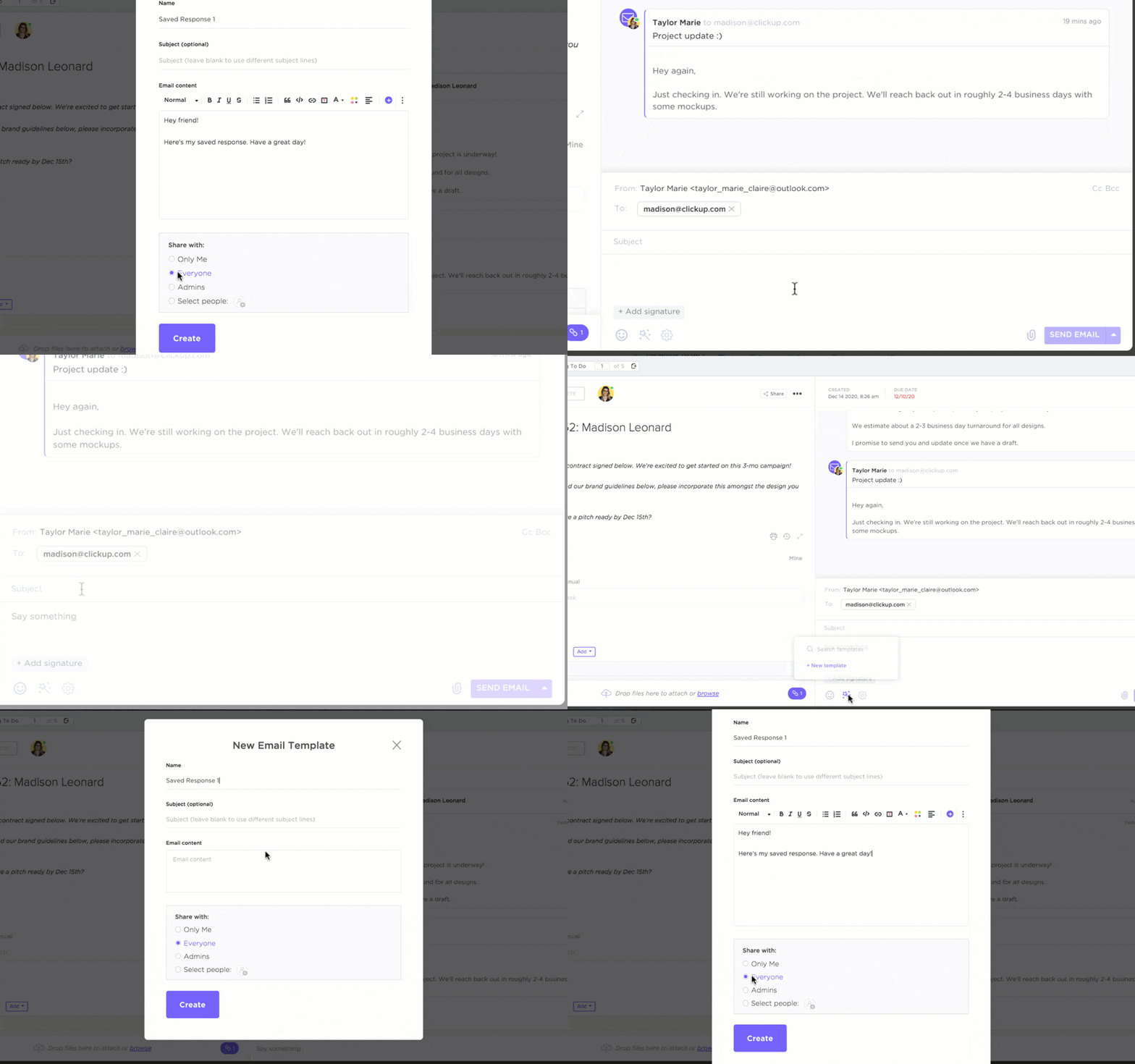
- Use a mix of communication channels, such as knowledge base software, team meetings, ClickUp Email, and collaboration tools to meet employees where they are
Tip #3: Drive training and team peer sessions
Want to drive transparency at work? Improve your employee engagement efforts by getting your team trained for relevant skills and expertise.
Training helps employees understand their roles and responsibilities better. When employees know what is expected of them, they are more likely to communicate openly about their progress, pain points, and needs, fostering transparency.
But before you set up a training program, have conversations around:
- Where your employees are in terms of knowledge and skills
- Where do they wish to be in the next year
- What they need to do to accomplish their goals
You can use database templates such as ClickUp’s Employee Record Template to maintain employee records, track interactions, and so on.
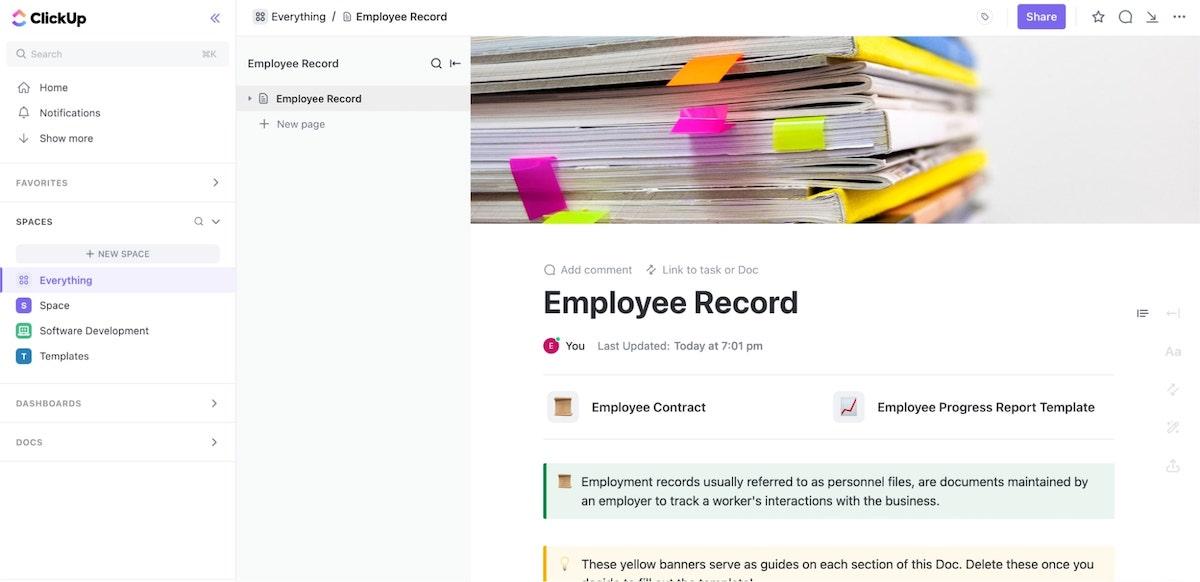
Capture employee data related to performance reviews, benefits offered, vacation days, and more. Having all of the employee data in one place ensures you have a 360-degree view of each employee’s experience with the organization at one click:
You can’t set up a full-fledged training program without first assessing your employees’ learning needs. In this scenario, a 360-degree feedback software comes in handy. It helps get continuous input from peers, supervisors, etc., creating a fair and transparent workplace.
- Use performance review software to offer constructive feedback and develop training sessions with the feedback as the foundation
- Facilitate peer-to-peer learning sessions where employees can share knowledge and best practices
- Leverage interactive training (read: workshops, simulations, group activities, etc.) to improve employee interest
- Offer access to online courses, webinars, and workshops to encourage employees to learn at their pace
Tip #4: Drive open and standardized performance reviews with clearly defined criteria, goals, KPIs, etc.
For transparent performance evaluations, your team must understand how their performance is being evaluated. Use these tips to help the team get on board with your evaluation process:
- Set S.M.A.R.T (specific, measurable, achievable, relevant, and time-bound) goals for each employee in discussion with them; engaging employees in goal-setting enhances their sense of ownership, commitment, and clarity
- Communicate clearly about the criteria and KPIs on which you’re assessing the individual’s performance–is it tailored to each role, and does it align with the organization’s strategy?
- Ensure you schedule frequent feedback sessions as opposed to relying on annual reviews to facilitate ongoing performance and expectation dialogues
- Maintain consistency by using a standardized evaluation form
- Provide a dedicated feedback channel for employees to contribute their thoughts on the evaluation process, promotions, and so on; encourage employees to make the feedback as descriptive as possible with detailed examples
Tip #5: Include 1-on-1 performance discussions with managers for full transparency
Without 1-on-1 meetings, the manager-employee relationship can take a hit. However, when used strategically, these meetings can double up as a powerful coaching tool. View these meetings as meaningful as they benefit the team members and the manager to understand how each part can improve performance.

As a manager, make your 1-on-1 performance discussions count with these tips:
- Talk about the employee’s mental and emotional well-being in addition to ironing out issues in the workload
- Help the employee talk openly about difficult issues by providing a real-life example of what you did when you were in the employee’s place
- Come prepared for the meeting with a complete overview of the employee’s highs and lows of the week from beforehand and create reports for corrective action
- Review the performance report together to ensure you’re on the same page as the employee in terms of professional goals, employee priorities, etc.
- Ask employees relevant questions such as:
- How would you describe your work-life balance at the moment?
- Do you feel adequately equipped to handle your assigned tasks?
- How stimulated do you feel by your current workload?
- What growth opportunities do you see for yourself within the company?
- What can I do better to support you in your professional and personal goals?
Summarize this article for me pleaseLead with Honesty, Succeed with ClickUp
Transparency in the workplace should be an integral part of your organization’s fabric. Leaders who prioritize practices, routines, and decisions to improve transparency will benefit from a highly motivated and productive workforce.
A tool like ClickUp helps managers offer one-click access to information, engage in meaningful conversations with employees, monitor goals and business performance, and drive the organization forward with employees seeing eye to eye. Try it, and see for yourself—Sign up now!
Summarize this article for me pleaseFrequently Asked Questions (FAQ)
1. What does transparency at work mean?
Let’s understand the meaning of transparency at work. A transparent workplace fosters open, honest conversations between employees and management. It aims to address matters such as business performance, goals, and objectives in a two-way dialogue.
2. How can you show your transparency in your workplace?
Common examples of transparency in the workplace include:
- Making transparency a part of company policy to make everyone accountable
- Dealing with challenging situations head-on to defuse tension
- Conducting “Ask me anything” sessions for an honest two-way communication
- Offering information to employees at their fingertips
- Clarifying the why behind decisions being taken
- Involving the team in decision-making via polls, surveys, weekly check-ins, etc.
3. Why is transparency so important?
Improving workplace transparency helps encourage employees to understand the value of their work and give their best. With increased motivation, employees get better at their work. Managers reward them for their hard work, leading to an enhanced employee experience.

Everything you need to stay organized and get work done.
